Is seed the new Series A? Investor Panel moderated by Indigo Partners | SaaStr Software Community
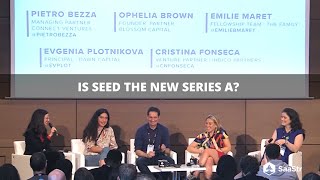
European VCs discuss how seed rounds now function like Series A, with median sizes of $2-3M and founders hitting metrics like $1M ARR before raising. They debate round sizing, product-market fit signals, and when founders should target US investors.
Chapters
So first of all, thank you so much for joining. The panel that we are in is called, is seed the new Series A? And this is a question that I've been asking informally yesterday and today. And the answer is yes, of course. People have been telling me, how come is that a question? We've seen funding rounds going up in size. But actually, Christopher from Point Nine, he did an analysis last year of the, the seed stage funding during the past 10 years, and one of his biggest surprises was that $2 to $3 million seed rounds were an exception and not the rule, and most rounds were below $1 million. So I guess there's a lot we will have to, to discuss here today. But before, I would like to remind you that We are open for questions. We might take questions, I might pick some questions from the audience. If not, there will be room at the end. So use Slido for that. Go to slido.com and the hashtag is #SasterEuropa. I think that's the correct one, but tell me if that's not right. So I'm Cristina Fonseca, Venture Partner at Indico Capital Partners. I co-founded Talkdesk before. That's why I'm here. We are based, we are a €50 million fund based in Lisbon, and we invest mainly in seed stage. Super happy to be moderating the panel. So I will ask you to quickly introduce yourselves, name, role, and also the stage in which you are investing.
Hello everyone, my name is Emily and I work at The Family. So for those of you who don't know The Family, what we're doing is recreating a European infrastructure from scratch, um, to help ambitious founders create very successful companies. I work in fellowship, which just means selecting companies, supporting them, helping them raise. Uh, our portfolio today is valued north of $3 billion. We have 250 active portfolio companies today. Most of them are still in France, trying to change that. Uh, some of them you might know: Algolia, PayFit, Side Comet, and I'm really excited about this discussion.
Salut! Hello everyone, Pietro Bezza, General Partner, Connect Ventures. Our mission is to back the best product founders in Europe. And yes, it's Filia.
Hi everyone, I'm the founder of Blossom Capital. We started the fund last year actually. We're a team of former investors and operators from the likes of Facebook, Deliveroo, and the Swedish payments company Klarna. We focus on Series A, and we only make a small number of investments, probably 4 or 5 a year, precisely because we like to work very closely with the companies that we invest into to really help you scale out of Europe.
Hi, my name is Evgenia. I work at Dawn Capital. We are a purely B2B fund focused on software and fintech. I guess I'm sort of the, the latest stage stage on that panel. So we do do Series A, but we also do Series B. So we invest anywhere between $5 to $15 million. We've got half a billion under management. We had some fantastic successes like iZettle, Calibra, and Mimecast in our portfolio. And so we're looking, we're looking to back more, more founders. We've got 2 deals, 2 companies here in France, but we invest across Europe. So if you're a software founder in that stage, come talk to us. Thank you.
So let's start with the early stage. Emily, do you agree that the bar is higher for seed investors right now, given that the amount of capital available increased significantly? Um, so yes, how do you differentiate?
Uh, okay. Um, so yes, I, I do agree the bar is definitely higher, but I don't think that it has to be. Um, So the way that I see it, there's been a great success, which has been education. Education has impacted both the supply of— we're talking about like B2B SaaS entrepreneurs and the supply of investors. So on the entrepreneurial side, what we see at The Family, so we take around 100 companies per year, maybe 50 of them are B2B SaaS. What we've seen is like the playbook to start a B2B SaaS company has become quite obvious. It's become cheaper. It's become quicker to build your first product, test your market, and people really have role models around them and understand how to get that started. And on the other side, you have investors. So there was this funny tweet the other day about— someone was saying if you don't have like a bunch of 50-year-old founders running B2B SaaS companies, then there's something you have wrong because the B2B SaaS playbook has been around for 20 years. So on the investor side, funds have matured, investors learned from the companies that have been successful and have understood how to invest in these companies. And so the way I see it, the bar is higher because on the— like, because of education, there's been a metrics war. So what we see when our companies are pitching to investors is that, like, you know what metrics investors will open the email, you know when they'll answer. And the thing is, because everything has become more or less standardized and we understand the way it works, and Anyone that's slightly top of class, so has better metrics in a shorter amount of time, will have all the VCs herding towards them. So I think that VCs are essentially making it harder on themselves and perhaps omitting some opportunities with less obvious models that are less well understood. And I can think of, you know, PayFit, which was reinventing payroll, super tough market, difficult playbook. Companies like this are, you know, the new companies to fund in seed. So to answer your question about how do you stand out, I think it's really important to think about the cost of conviction. Um, today it doesn't cost that much to make a conviction on something that's obvious, and I think that's why there's also discussions about the different ways that B2B SaaS companies will be funded, perhaps a mix of, of of equity and debt because it's becoming so understood. But the cost of conviction on a model that's not obvious yet, um, that's where funds like, you know, Connect and stuff have been really able to stand out. It's taking a bet that will take longer to prove just because it's new. And I mean, it's the wave of the way that things have always worked. Once something becomes the norm, then there's always one or two people that will push and bring the model to the next level. So I think That's the way to differentiate, except that the cost of conviction might be higher today.
So Pietro, what should the seed capital fund nowadays— when is a company that she invested based on conviction be ready for you? And when is a company ready for a Series A round? Is there an old playbook and a new playbook? How do you see that?
OK, it's quite a question. So yeah, let me start from the bottom, from the playbook, right? So historically, what I've been observing is being a seed investor in the last 8 years in Europe, in a simplistic way, is the following, right? The seed money has to fund the product engine, Series A money has to fund the growth engine, and the Series B money and see the expansion and the scale up, right? So let me focus in on the seed, which is what we do. We are seed-only investor. So at seed, we see that as a journey, right? So it starts from the founders having a great insight, found a unique problem and a great solution to tackle this problem. That's where we start. So at Connect, we invest through the all seed spectrum. 50% of our SaaS investment out of 30, 16 has been pre-product. Okay, so it starts from like really the founders, the problem and the solution, maybe a prototype. And then we deploy the capital to build, to build the initial team, to build the product, to build the go-to-market, the initial go-to-market, to build the first customers and to build the MRR, the starting, right? And this journey used to end at the legendary mythical product market fit, right? We can discuss at length what product market fit, a great product market fit means, but let me give you like two heuristics that you use at Connect. So one is qualitative is, let's say, when the customers love the product and the metrics for measure this love is phenomenal engagement, great retention, land and expand dynamics into the customers, growth led by expansion MRR more than the new business MRR, and ideally negative churn, right? So that is a, you know that the company is, it's built something that the company values. And in terms of more like quantifiable product market fit rule of thumbs, I think it's 1 million ARR still is valuable. At that point is, I'm looking on the left side of the funding stack, is Series A ready? But I have to say that we are observing that the bar for Series A is getting higher and higher. And the good things, the good news, the bad news. The good news is that the bar is higher, but also the round and the size, the ticket of Series A is larger. Which is great because you can raise more money, you can really deploy and grow and hyper, hyper growth and start really scaling up the company. The bad news is that of course, there's investors to sign a check ranging from $5 to $50 million. They want to, the valuation of course is connected, so the valuation gets higher. And to justify this kind of valuation, they want the company go further in the seed journey, right? So there are more pieces of the company building that you need to prove, like namely, like the grow repeatable machine as well, at least an initial of that. And that means more money to be in, to pre-Series A, to be funded from the seed investors, right? And so we as founders and seed investors must be super aware of this and take action, right? So the actions are define and design the funding strategy seed extremely well. Um, um, secondly, and of course when I say well and right, it means like bigger than the past. You can't unfund the company, it's a massive mistake. And second is understand that probably after a seed there could be another seed. And so, uh, sizing the valuation and this and, and, and the round is, is a strategic decision. Um, and third is, uh, Syndicate well with funds that you know they can might bridge if there is a last mile to do before the Series A. So the whole playbook, the new playbook probably is, there is no longer a playbook, there's not like a super monolithic seed A, B, it's more the ability for the founders to navigate through the early stage funding stack.
So for me, I'd actually have to say that I've never believed in a playbook. And I actually gave a talk here last year why $100K MRR isn't kind of the right metric to think about for raising your Series A. And if I look at where we've invested in companies, you know, we've done a Series A where there's no revenue, and we've done a Series A where there's mid-single-digit recurring revenue. And so really what we are trying to understand is some kind of form of product-market fit, but that can be seen in a number of different ways. Um, and I think we put the impetus on us to make sure that we get to know the founders as early on as possible, because one of the most critical things that we want to understand is execution ability and kind of ambition and, uh, ability to drive the company forward. And so we might see something within 2 months and we might see it within 18 months. Um, but we really like to understand kind of the journey that the company is on.
Evgenia, same thing with you. Like, do you still, uh, is there, is, I assume there's no framework in terms of KPIs and is more conviction. And another question I'm curious about is, do you feel you need to work with the founders a little bit earlier also to be able to, to get in the rounds?
Yes, I do. Um, well, I, I'm kind of with, with Ophelia on, on the point that I mean, traction's great, don't get me wrong. Like if people are paying you dollars for your product, that means something's working, right? If they're not buying your product, then probably something isn't, right? So, in a certain way, you know, it's great to have metrics and yes, SaaS, I mean, we're at SaaS, like everyone's seen the SaaS napkin from Point Nine, everyone probably knows all the metrics that Jason talks about now. That being said, parking that aside, I think the things that we look for are, product and execution. In terms of product, I don't mean technology. It's important to have good defensible technology and have a moat. What's important for us is your ability to define a category and become a centerpiece of a value chain and attract people to you rather than the other way around. There's a lot of companies in our portfolio that have been very successful, like Calibra, who became sort of a data insights category. And they started with cataloging and then they added lineage and This is how they outpaced Alation and Informatica and became the leader in the Gartner quadrant, right? And they defined what data insights is. Now that's success, right? And then once you've defined what constitutes your core capabilities and you created the category around you, what's the next important step is executing on it and the go-to-market. And that cannot be an afterthought, right? So you want to think about the top of the funnel. You want to think about lead generation. You want to start thinking about customer success. And that's not just support, that's also retention and upsell. You want people to be thoughtful. By no means, at Series A and B, you haven't figured out, otherwise my job would be real easy. But I think it's more around a consciousness of what you know or what you may not know, and then hiring around it to become successful.
I also think that some founders kind of get stuck in, we need to prove certain things before we go and raise our A. To give an example, I was talking to one founder before, his B2B SaaS company, and he's like, well, I want to hire, you know, VP sales to prove that, you know, what our cost of acquisition is, you know, our payback, et cetera, et cetera. I'm kind of like, even if you make, you know, 1 or 2 sales in the next couple of months with your VP sales, that it's gonna take you 3 months to go and hire, like, that's not proven. You can't go and raise an A off that. And I think a good investor can also say, well, it's known that you can probably hire a good salesperson. It's known that you can probably sell those first couple of contracts. So why do I need to wait that 5 months for you to demonstrate that to me when we could just start working together today and actually create some value along the way? And that's kind of how we think about it before we come in and invest.
You also want to comment on the most voted question from the, from the audience. Do you think between B2B and, and B2C, Is it harder to raise for B2C companies?
I personally, I don't think so. I mean, you've got so many really well-funded businesses in Europe that are B2C. I mean, let's look at latest delivery round with Amazon investing tons of dollars there. I think historically there have been a lot of really well-funded B2C companies in Europe. I think B2B and software is becoming more in vogue. These days in Europe. And I was like, darn, this is what we used to do. Everyone wants to do software. Um, so, so I, I think no. I mean, there are successful businesses on, on both sides, right?
So I think yes, actually.
Let's debate.
Just to disagree. No, I think distribution is getting much, much harder. Um, I think the cost of distribution and cost of acquisition on the consumer side, and I think, you know, a couple of years ago, or, you know, before, people were willing to take the risk from the acquisition cost. And I think that is becoming harder at the early stage because people no longer, and you know, we live in this deep fear of whenever the recession might come, if it might come, what happens if you've just been paying for growth along the way? So I guess—
I'm not sure it's just for consumer. I think from my perspective, because the cost of creating a startup is so much lower today than it used to be. So $5 million in the '90s to $500K early 2000s, now it's like $50K and some Amazon credits and you're kind of done. So for me, sort of, um, there is a multitude of people that Pietro probably has to face today, right? And then that top of the funnel is a lot larger. But I—
what—
once those winners emerge, I don't think whether they're B2B or B2C doesn't really matter for sure.
Like, what you're in, like, you're not— but I think the kind of the appetite to fund a lot of early-stage consumer ideas with kind of the monopolies we are facing in certain categories, I I feel that's hard. But you, yeah, I get that.
My point of view is that it's much easier if you are B2C because that's so rare. Sorry, this is like, we are in a B2B territory here, so I'm not making popular myself. Like if we back a consumer proposition and it's working, it's working, like it's killing. Like you guys just calling email because it's so rare, right? Because actually there's not more 100 billion company consumer, right? B2B. So when some VC downstream sees something in our portfolio that is a consumer and is like phenomenal traction, there's much more demand because it's just a rare beast.
No, but that kind of supports my point, right? If it's working, people will jump on it. But if it's not working, which is like the majority of consumer companies, that's true for all of us.
We agree. How hard is fundraising for a company that isn't working? We all agree it's fucking hard. And they shouldn't. They shouldn't even fundraise.
Yeah, and I think the, the fact that you say they're much rare, like, we see them super early stage. I think we have half our portfolio is B2C companies. One of the big problems is the bias of how people want to get into B2C, and a lot of the categories that they seem to want to go into are the ones that are just so hard to fund. Like, the number of, you know, sports, sports fans, social networks, or like partying apps. I mean, the ideas, the imagination, the creativity around what a B2C company is, um, is still like really bad. And I think that's partly because we aren't very good at building brands yet. We don't know how to do it. We don't have that many great examples. Um, so that part of the ecosystem hasn't matured as much. And I think that it creates a very strange bias of people as consumers imagine what they would want And so they're much less attuned to what an industry needs. When you try to solve your own personal problem, it's a very different thing than trying to understand what a market generally needs. And that creates a very strange deal flow bias. Like the average quality of a B2B apply at super early stage compared to B2C is like incomparable.
So B2B or B2C, one of the things we all know is that The, the conversion from seed to Series A is very low, is around 20%. Um, Emily, I guess that was one of the reasons why you created the program to help your founders get to the, the, the, the next stage. Can you tell us a little bit more about it and which type of help and what do you work with, with founders that will make a difference?
Um, so we're trying to— we created a program to try to get nice companies in front of both of you guys. Um, we, we see in fact, that the conversion is around like 15-20% graduation rate from seed to Series A in Europe. Um, we started the program in London because I think things are worse in London. There's just even more overfunding for early-stage companies. Uh, and the program we created is called the Family AAA, um, and we created it because, um, there's a lot of education now around how to raise a seed but raising a Series A, and I know like you guys have published great content around it, but there aren't that many entrepreneurs that can help entrepreneurs who are willing to do so yet. So there's kind of a gap. And I think by the time that companies get to you guys, often they could be great, they're just not in very good shape. Like they don't look very sexy. So what we do is that we take our time with founders, 6 to 8 months before they want to raise a Series A. Because that's how long it takes to prepare, in our opinion. We start the program and the idea is that every week we address one of the points which we know will be a huge pain for them. I would say the biggest one, and maybe we can talk about this later again, is just storytelling. Like, in Europe, this is such a pain. Nobody knows how to tell a good story. And it's not even about being a showman. It's not about, you know, getting on stage and say some saying something that will excite people. It's also telling a story to yourself. And it's not about making things look nice. It's about building your company in a way that aligns with a coherent story. And so whenever we speak to Americans, I always like step back and put a filter on. I'm like, okay, great storytelling alert. Like this is not reality. In Europe, we have the advantage of being very direct and more honest, and we should take that. And that's what we teach companies to do in AAA, is take that honesty and put it into a form that fits with VC's expectations. And also on top of that, it just takes many more months because you need to reach the right metrics, and metrics are so much more detailed. Like, founders don't expect that so much more detailed in Series A. You need to— like, all the metrics you were talking about, you need to break them down You need to focus on the right ones and anticipating that 8 months ahead of time. We'll send you the deals, you'll let us know what you think. But I think we really are able to transform within that amount of time companies from entrepreneurs, from, you know, company builders to like really leaders that know how to explain what they're doing to virtually anyone. And honestly, this goes back to 360 communication. It's like, okay, you need to tell the story to your investors, but if you can nail that story all these recruitments, all the whatever press you're doing, it's gonna get much better as well. So that's what we do. We have 8 companies, they're gonna graduate soon. So if there are any Series A investors in the room, happy to shoot you some stuff. But yeah, so we'll see what it gives, and I'm very excited about it.
Thank you.
So another interesting statistic that I have is from the Journey to Series A in Europe report. And one of the conclusions was that companies that raise $2 to $3 million in total pre-Series A convert better than the ones that raise less, but raising more than $3 million won't change the conversion. Is this something that you've seen in your portfolio, Pietro?
And so the question is about graduation and what is the right funding.
How much should a company raise?
Yeah, yeah.
So it's kind of related to the top question, actually.
Okay, so I think your point, your conclusion on this stuff is reflected in our portfolio somehow. There's not such a strict correlation because the old playbook, we got company like Marvel, Typhon, they were able, just some two where we work together, where they were able to raise a good Series A raising less than $2 million. Okay. But actually, TrueLayer, for example, or Soldo, they raised their Series A raising more than $4 million. So the trend is that the graduation is better if, of course, the company has more capital to invest before Series A. But my point here, I think, is what is important to discuss is that I think the point of what this rise Sizing not too much is absolutely directionally right. So the way we spend a lot of time on the funding strategy with the founders we want to back. So once we build conviction about the founders and the company, we spend a lot of time designing the right amount and what the right round looks like. So I was at Starbucks here because there's not like some any hipster coffee around. So, and I went there, it was so like, there was the short, the 20, and the grande, like it's the size of the coffee. And so the cappuccino, and this is the same for seed, right? So you don't have to go short because otherwise you underfund the company, which has been the classic problem of early stage startups in Europe, like historically, systematically underfunded. Which means compromise on quality. Should I hire 2 backend developers or a product design? You have to hire both. You can't compromise on that. But if you go too much, right? So because sounds get bigger, valuation get bigger, more time sheets. So it triggers higher valuation, which trigger higher size. If it compounds, then you end up raising too much and you go off stage, which our mantra is like founders, you have to play your stage, right? When you raise it around and you're in the seed stage, you don't have to invest money in doing things that belong to a different stage, right? Like hiring a super senior VP sales when you are pre-product market fit, for example. And so because raising too much trigger problems that are less obvious than the unfunding. So if you are overfunded, you've lost focus, right? You start doing things that doesn't matter. You lose discipline on burn or vice versa, which is even worse. You have this infinite runway and you just lose speed of habit. You just like, no, you don't have any pressure. Yes, we saw like a plot of time, like, oh, we have 36 months of runway and they take it easy, which is not innovation. Innovation technology, you just like the time you're ready, you've been like past forward 3 times. And so what is the conclusion at this point is, yeah, so it's important, it's important to get the right funding for us and it's very good. That is big and bigger for all the European ecosystem. Finally, I think there is an entire early-stage funding stack that enable companies to, to like get off in their journey and build a super good strong foundation for growth.
So successful companies raise closer to 2 to 3 million rather than 1.
Is that the—
Yes, absolutely. So our stats is like since 2012, The median size of the round has almost tripled and the valuation as well. And it's a good thing. And most of the time we, NetVentures, drive this size because we didn't want to underfund the company. And so after talking with the founders, you should raise more. So we go out, we help the founders, we lead them the round, but we help the founders to raise more capital to really, really be sure that the milestone that These guys want to see, I'll nail it.
I mean, seed extension is also kind of the new thing, right, that has been on the rise in the past few years, which I think proves your point, Pietro.
So moving to the later stage again, what are the mistakes you see in Series A fundraising? And I think we can also take that question. I know founders are very focused on valuations. So all you want to know is how high can I go in terms of valuation, which I don't think is the right question. But can you comment a little bit on, on the valuation range that is expected right now, or any other metric that you think is more relevant than valuation, which I believe—
yeah, I mean, we don't start with valuation. Where we started, we really tried to figure out the runway that you need for the next 18 24 months before you raise your Series B. When you're raising your Series B, you know, you have meaningful revenue. It's normally when people start thinking about multiples of revenue to drive your valuation. There are public comps that, you know, it's all kind of known. And so we kind of work back from that. If you're thinking about raising your Series B, should typically be like, you know, rule of thumb, 2.5 or 3 times step up to your A. So if you're shooting for that on a multiple of revenue, you can basically kind of work back to where you need to be from your A. And so we sit down and say, okay, how much do you need to put into sales and marketing? How much do you need for the team, etc., etc.? And that will form kind of the basis for the round size. And valuations are typically worked out as a function of how much dilution of the founders want to take and how much ownership do the VC fund want. And then it's a toss-up in between, and you know, you'll end up somewhere between probably 15 to 25%, um, and that's kind of how you figure out your valuation. So to Pietro's point, Series A round sizes have been going up, which is a good thing. I'd say the average Series A in Europe is probably around $8 to $10 million. And so if your VC wants 15 to 25%, that's your valuation.
As long as then another term sheet that competes come in and scramble things up. Happens to us as well.
See, just even if, um, I mean, this is Same thing as affiliate, but just valuation per se is a bit of an ego metric. And I might sound horrible for saying that, but if you're just chasing the valuation to feel like, oh, you know, nailed it, I'm at $100 million or $200 million or whatever that is, it doesn't mean anything unless you've actually exited the business and you created real cash for yourself, for the employees, and eventually for the investors. But frankly, you're also probably penalizing the people they're going to hire, particularly if you move to the US where The valuation of your stock options is a science and is based on the valuation of your business. And so, you know, if you are chasing that really high number, you are disadvantaging everyone else that you're going to bring into the business.
That's a very good point. So regarding moving to the US, which it's kind of the way to go, we believe, at what stage should a US VC come on board? And you incentivize the founders to go and try to raise in the US or combine around with a US investor.
Maybe I'll start on that one. So we actually, in our software portfolio, most of our businesses have raised with American funds. And that's great because once you move, and we can address maybe that question about whether you need to move or not, but part of your business will move. I don't think as a founder you necessarily have to go to the US. In fact, you probably don't have to go to the Valley. It's good to have American VCs to help you with that. Now, what one thing I would be careful about is that there are a lot of fantastic US funds that we work with and they're phenomenal. A lot of them are very large, right? A lot of them will be, you know, $1 billion, $2 billion, $3 billion, $6 billion funds. And as a founder, people are great at placing themselves on the competition slide and kind of like up and to the right. Haven't seen one that's Where it is opposite, you kind of have to think about your VCs in the same way, right? Because if it's a $10 million check for your Series A or a $20 million check for your Series B, and your VC is a $2 billion, $6 billion fund, the percentage that you represent, uh, is, is not going to be enough and to the right. And you want people to talk about you at a Monday meeting. You want to be significant and you want to be top quartile of resource for capital. and, and people, right? And so, I think having a US fund is fantastic. It's just at the right kind of stage in time. Uh, in terms of sort of where does it have to be, uh, well, we've got, we've got both scenarios. We've got Calibra where Felix is in New York. We've got Dataiku where Florian stayed in Paris. I, I think it doesn't matter. Uh, I think sales presence in the US for software business will become a necessity. Um, we've got some fantastic engineering talent, uh, here in Europe. Which tends to be not only cheaper but also twice as loyal. So it makes an absolute sense to keep that base here and perhaps have part of your team in the US. And some people like Front actually are doing the opposite move now, bringing back their CTO and engineering teams back to Paris.
So we actually started Boston because all of us as partners have spent a significant amount of time in California. I personally I've only spent kind of half my time there the last 10 years, and it's very clear that kind of the talent and the ambition in Europe is as good as, if not better than, sometimes what is going on in California. Same time, California is getting very competitive. It's incredibly hard to hire people, very expensive. And so what we saw when companies were coming to raise their A, you know, you still want to go to Sand Hill Road and try and raise from Sequoia and Kleiner, etc. And the reality is those funds, A, don't see themselves as best positioned to be doing your A in Europe where they're not close you, and B, also won't be getting on a plane for, you know, a $5-10 million investment, and they're 8 hours behind as well, right? So we felt that there was a gap in the market where you can get a West Coast style VC or former operators, and we can support you in those early stages for really helping you figure out a go-to-market in the US where you are then better positioned for your Series B from a US growth fund. Um, and we're fortunate enough to have many of those best funds. Many of the partners have personally invested into Blossom just to symbolize those relationships that we have with them through co-investments or board seats, etc., when we know that they will come in in a meaningful way with a, you know, $20-30 million investment at Series B, which is the right time to think about bringing a fund like them on.
So, uh, what are the recurring challenges that you see your portfolio companies, uh, going through when fundraising? And I guess like this is this is the last question, so I'll ask 1 minute each and also give a little bit of advice to the founders that came and are looking to close the next round.
Um, so for seed stage, I would say it's, um, where you meet VCs, uh, in the sense if an entrepreneur is on this end of the spectrum, the VC is on this end of the spectrum, it's where do you have to meet them. So figuring out what is the amount of information that you're able to disclose what is the way that you should be speaking to them. And I think, you know, when we spend 3 hours preparing entrepreneurs to go meet with VCs, these are always 3 hours well spent, even for people who think it's natural. Because although, you know, investors and seed stage investors are very good at evaluating entrepreneurs, it's like the feedback that we get from them is that it's very hard to speak to them on a level playing field and speak to them in the same language. So I think a big part of the challenge is just translation, um, what the entrepreneur thinks, what they want to achieve, and putting that in words that suit the investor. That's one of the big things. And I saw a question, uh, yeah, up here, um, do we always need to show you the deck? Um, like, it's just these kind of things, these kind of you know, questions and what's forbidden, what's expected. I think that the, the absence of transparency sometimes about what investors want to see, um, if they told that to entrepreneurs, it would be super valuable because entrepreneurs, you know, want to be cooperative. It's just that you need to understand where you meet investors. So storytelling and understanding how to speak the same language, uh, in seed are part of the biggest challenge that that we see.
Quickly, the challenges are if you are very unique proposition, great IP, creating your category, the challenge is show me the traction, the commercial traction. Vice versa, if you like amazing traction, strong revenues, growth, they tell me like, how do you stand out in the crowded market? Right? So you need both. You need to have like traction and just stand out, have an unfair advantage.
Yeah, I think, um, fundraising— and I can say this actually being a founder who fundraised— um, it's nuanced. Um, and I think actually, uh, the best founders succeed with their investors helping them behind because we speak like a weird language between us. Like, we kind of, you know, look at things the same way, we analyze things in the same way. And these poor founders come into the room and, like, to Emily's point, like, literally don't have a clue. And nor should you, right? You're building a business and that's what you should be doing. And so I think the one thing that we really help our founders is with fundraising, because, you know, we think about this is what the deck should look like, this is the importance you should place on these things, don't say that, etc. And hopefully you can get through the process rather easily.
And do you think founders— like, I feel founders sometimes at the earlier stage, they really have a problem in asking for help to like perfect the story or help with the deck. I think the deck question is a good one. But actually, circulating your deck is actually a great way to have feedback. So when you go and meet the partner, I mean, it should be pitch perfect.
And I mean, the deck question is very related to the top question uploaded on Fundify, which is one of our portfolio companies. The deck is a really good way, an opportunity for you to present the company succinctly and show off the kind of design and the thought behind the product and how you're positioning it and what you stand for, etc. And VCs have very limited attention span, like very limited, no longer than like 3 sentences in an email, please. Um, and so a deck is just kind of saves you a lot of like preamble before the meeting. And also you will then know when you go to the meeting whether that investor is at all interested, whether they've spent time on your deck, whether they've bothered to kind of spend any time thinking about the market, the opportunity. Because this is one piece of advice I always give as well, don't forget you you're the customer. It's not the VC who's the customer, you are. You're going to be taking up, you know, giving up part of your company to let them in on the journey. So you should also be doing the work in advance as well.
Yeah, no, I couldn't agree more. I mean, your deck is your business card, frankly. And so unless you've spent time on it and shared it with people, I mean, it just doesn't work. And the sort of the little bit of that question was about, oh, should I wait for a partner meeting? Don't be that person. VCs are constructed of people of different levels, but we all work as a team and every single person is important and every opinion is valued. And if your title on the card is an analyst or an associate, it doesn't matter. They are the gateway to then go and pitch your business to the rest of the team. So everyone is equally important the same way that every single developer in your business is important and not just your CTO. And then in terms of like where people, the challenges that they face, so I think for us it's focus and us being able to help the founders and hold their hand through the journey of fundraising very similarly to what Ophelia mentioned. It's very exciting where a lot of our businesses all of a sudden get a lot of inbound and you kind of can get a little bit carried away. And so I think it's about maintaining a sane head and kind of taking a step back and saying, okay, who is the right partner for me for the next stage? Both in terms of the fund, but also the person, because they're going to be on your board and you can't kick us out. It's very hard. So that's also a very important decision. And so we are there to help. In fact, as VCs, we work for you and kind of not the other way around.
Great.
So thank you so much. We are out of time. There's people dropping the mics already. So I'll ask for a round of applause to our amazing panelists.
More from Jason

Why Your Next Hire Should Report to an AI, Tragedy Apps, and Too Many AI SDRs? | The Agents #004

Our Agents Drove Our Salesforce Bill Up 80%, Marketo Hates Agents, and We Stealth-Churned Off Notion




Managing 20+ AI Agents: Lazy Agents, Our $500K AI Bill, Stealth Churn & the Death of 60% Solutions




