Keeping Culture First while Structuring a Scaling Team | Hired CTO + Senior Dir, Customer Success
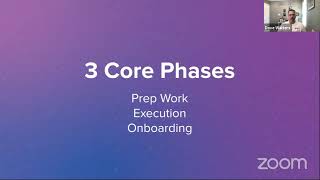
Krista Diaz and Dave Walters from Hired explain how they scaled from 10 people to 16 global offices while keeping culture intact. They built a Values Committee to assess every hire against five core values, moved from informal interviews to structured ones, and use three phases: Prep, Execution, and Onboarding. Remote work required new tactics like random coffee chats to maintain cohesion.
Questions this video answers
Hired created a Values Committee composed of certified interviewers from across the organization. The committee developed standardized values‑based interview questions that every candidate—technical, sales, or administrative—answers. This consistent process allows fair, equitable evaluation of values alignment.
Remote work removed face‑to‑face collaboration, making intentional relationship‑building essential. Hired introduced random coffee‑chats, virtual fun events, and other informal interactions to help employees get to know each other beyond daily tasks, thereby preserving cultural bonds.
Chapters
to our speakers. Awesome. Thank you so much. And hello, everyone. Thank you so much for being here. My name is Krista Diaz, and we are here today to talk about keeping culture first while structuring a scaling team. I know this is a challenge that many businesses go through. I'm sure many of you in the room are facing today. And myself and my colleague Dave both have personal experience with this very challenging stage of growth. We're excited to be here. Thank you so much for having us. And we'll share just a bit about our perspectives. To kick things off, we will do brief introductions. As I said, my name's Krista Diaz, and I lead customer success here at Hired. If you're not familiar with Hired, we are a marketplace for hiring top technical talent. So my group sees to it that our clients, companies much like yourselves, are using the platform, hiring efficiently, effectively, just having tons of success. I have been with Hired for just over 8 years. And when I joined, I was actually employee number 10. So much of my personal experience with high growth and scale has actually been here at Hired. I'm excited to share those experiences with you. I hope it'll resonate given where you're at in your various stages of growth. And with that, I'll kick it over to Dave.
Awesome. Thank you, Krista. So my name is Dave Walters. I'm the CTO here at Hired. I have not been here as long as Krista, nowhere near. I am a 3-time CTO though, with, with 20 years of technology experience across various industries. I joined Vetri almost 2 years ago prior to the acquisition and merger with Hired. And so I had the opportunity to work with Krista on bringing these 2 great companies together. In my career, I've been tasked multiple times with scaling teams anywhere from 2x to 10x. And so I'm going to try to share some of those experiences with you all today. So jumping into it, today we're going to talk a bit about what it takes to make and keep culture first while you're scaling and structuring a team. Many of you, like Kristin and myself, are either going through or have gone through the struggles of scaling a team and some of the challenges that come with that. One of the key challenges is how you can affect— how that growth can affect your culture. We're going to talk a bit about how to approach that change, what to watch out for, how you can be more successful at it. One quick note I do want to make: Q&A is going to be open throughout the event, so we encourage you to ask any questions you have, and we'll get to as many as we can at the end of the session. So, Krista, to kick us off, you and I have chatted quite a bit about the core need to establish and maintain culture as we've been growing our teams over the past year.
Yeah.
And I know you have some pretty meaningful experience with establishing establishing that value-driven culture. Love to hear you share more of that perspective to our audience today.
I would love to. And like I said, much of my experience with growth, high growth with the objective of maintaining culture has actually been here at Hired. So when I joined back in 2013, we were a tiny SF-based company. We were 10 people. Like I said, we all sat in one room. And growth was a very kind of simple process at that time. It was very, it was not a lot of growth at that time. However, in around 2015, 2016, we went through a very high growth period where we expanded significantly, not only in headcount, but also across multiple locations. And by the end of that sprint, we had office locations in 16 different cities across 4 countries. So, you know, very meaningful growth. And in the early stages of that growth, we talked a lot about the challenges that we anticipated we would face. Like you said, there is many. And we, you know, not only of course, like by growing in headcount, but by growing in such a distributed way, I think that presented a whole nother slew of challenges. And it was just a very different hiring and growth experience that we were going to go through than what we had experienced in the past. So we started just to like talk more critically around like, okay, like how are we going to go through this and maintain Hired's culture? Our strategy at the time, I think it's a generous term for what we had, but we were big fans of this interview called the beer test or the beer interview. Perhaps some of you in the room are familiar with this. It's effectively a very highly technical interview where you ask yourself, could I have a beer with this person? And the intent is that this is how you maintain company culture. You're adding a member to the team who will be collaborative or, you know, work well with the rest of the group. And, you know, this was our strategy, but we realized, well, one, I mean, it's a problematic interview to begin with. It's definitely not the right approach, but two, it certainly wasn't going to work for this next phase of very high and intense growth that we were going to go through. So like I said, we started to have more critical conversations around What is company culture? What's Hired's culture? What is the value of it? And what do we mean when we say that we want to maintain it? And through those conversations, we ultimately realized was what we really wanted to maintain were our values. We wanted to build teams of people who were different, but who aligned on values. And we believe that by focusing on that common thread of values alignment versus cultural alignment, or I guess in Hired's case, beer drinking alignment, that would be key to maintaining what mattered most to us. And, you know, through that, in the end, it really enabled us to grow our team in a way that was much more thoughtful, more equitable. It yielded more diverse teams. It was consistent. Like I said, we were in all these different office locations, but we had a consistent process. And it ultimately allowed us to build a team that aligned with what mattered most to Hired. So I wanted to share that distinction because I really do believe it has been key to maintaining culture at Hired. It was back then and it still is today. And the good news for us, at least, was that once we were able to kind of sit down and align on our values, there were really tactical ways that we could incorporate them into our business. And I mean, every aspect of our business. Of course, our growth, like I mentioned, but also our decision-making, our performance management, our people evaluation, and our product development. It really has truly become at the core of all the decisions that we've made. So I actually thought, Dave, if you'll go to the next slide, I wanted to share what those values were just to kind of put this in perspective. And in the interest of time, I won't spend too much time, but I will read them. We raise the bar. We think big and hustle. We are a people-first organization. We believe that transparency builds trust. We know that there is strength through inclusion. And we are one team working toward one dream. They still get me fired up 8 years later.
Awesome. I love it. Yeah.
So anyway, I wanted to share that. I think it's just like I said, it has been so pivotal for us as a business and maintaining that culture through so many challenges and hard yards and wins. And I hope that that resonated. Dave, I, although I've been talking quite a bit, I'd love to hear more from you. And I know you have a lot more experience with like the various, like phases of, of scale. And I, and I'm sure everybody else in the room would love to hear a little bit more around how you've approached those stages.
Absolutely. And first, let me say with this pandemic, I'm still waiting to have a chance to have a beer test interview with you. Hopefully one day it allows to be in the same room together.
I think you'll pass.
Yeah, I hope so. Too late anyway. Um, all right. So I like to think about scaling a team in terms of, um, let me advance the slide here, in terms of 3 core phases. You have your prep work, you have your execution, and you have your onboarding phase. Um, in your prep work phase, first and foremost, I advise everybody understand why you are growing, you know, what it is that is, is driving that growth so that you can focus on the right outcomes. Is this temporary growth so that you can do some refactoring or re-architecting of your systems or build some new product that's going to then transition to other parts of the organization? Or, or is this a sustained growth that you expect to have over the the years to come. Each of those are going to cause you to take different paths in your growth. Then you gotta define your new team structure. Have an idea, not just of what your, your structure is gonna look like in your next phase of growth, but in your next few stages of growth. I think that's, that makes it very easy for you to transition right from that one phase of growth to the next. Think about what gaps you're hiring for. What gaps do you have now versus what gaps are you going to— are going to be created with this next phase of growth? Are you hiring for today's needs or for tomorrow's needs? I would definitely advise as much as possible to hire for tomorrow's needs because we all know hiring takes a long time, right? It takes a lot of energy and then ramp and onboarding new employees takes a long time. So if you're hiring for today, By the time you have that person fully onboarded, it's going to be tomorrow. So don't get caught a little bit behind. And then set clear ownership for your new teams and structure. Having clear goals, KPIs, mission statements for each of those groups, so everybody knows what it is they're responsible for, what their objectives are, and all of their peer teams also know that and understand that. You're going to want to ensure you have a strong foundation as an engineering org or whatever organization you're growing and scaling. On the engineering side, do you have strong coding guidelines, automation in place, testing, strong process around PRs, etc.? Lack of any of that strong and clear process is definitely going to be exacerbated as you grow out your organization, right? Like I always say, if you're a team of 5 engineers that are just doing everything in a small startup, organization, everybody knows everything, right? Everybody's involved in every decision. You don't have to worry too much about process. As you grow out, right, that is not the case. You don't have that luxury. You got to make sure you have that strong foundation or you're going to struggle with that growth. And then lastly, tying back to, to what you just discussed, Krista, be clear on your culture needs and values. Are you anchoring to your existing culture during that growth, or are using growth as a way to shift your culture and change your organization? Particularly as a new leader for the organization, this is important to identify early on as you come in, right? Make sure that you know what you're trying to achieve here, so you know the, the types of people you're bringing into the organization. Next, the execution phase, building an efficient hiring pipeline. You know, working on recruiting, interviewing, coding tests, onboarding and training, right? All of these things have to be in place and working efficiently for you to grow, particularly at scale. Managing its transition for your existing team. There's going to be a lot of change as you go through this transition process, roles, scope, new managers getting introduced to the organization. You have to manage that through across your team. You have to train and invest in your existing team. Make sure you're focused on retention, remembering that, that hiring and retention are two sides of the same coin, right? If you're bringing a lot of good people in, but you're losing a lot of good people at the same pace, right? You're really just stuck on a treadmill and you're not going anywhere. Demonstrate your values and test for them throughout your hiring process. Really, the values and culture are part of all of these phases. You have to live them. Continuously throughout your organization. Make sure you're demonstrating them in the interview process to new candidates and you're testing for them through the hiring process, as you talked about earlier, Krista. And enforce them within the team as the org grows. You're going to want to look out for risks and manage some risks, moving too fast. Some key things to look out for, creating silos on existing teams and individuals, diminishing impact through lack of efficiencies, losing the ability to move quickly and be agile, which by and large will happen if you don't have those processes that are, that are clear and efficient and in place, and disengaging existing team members. All of those things will, will be harmful and will hurt you. And lastly, Communicate, right? I say communicate, communicate, communicate, right? You can't do it enough. Growth is a challenge. It's going to tug on the anxieties of some of your existing team. It's going to create confusion with, with some of your team members. You got to do whatever it takes to ensure communication is not breaking down across teams and between leadership and teams as all this change is happening. Make sure you have effective scrum of scrums, engineering leads meetings, all hands, small group meetings, one-on-ones, CTO office hours, smoke signals, whatever it takes to make sure that you're getting effective communication across the org. And then last phase, onboarding. Being prepared to properly and efficiently onboard those new team members, investing in your training programs, documentation, setting up Slack channels so that new team members have a a place to go to to get the answers that they need for, you know, you know, every, every new employee has new questions that come up. Have a clear list of systems they'll need access to so you can proactively set them up ahead of time versus have them have to ask for that access every time they hit a roadblock. Assign them peer buddies to help them in their first days and weeks, right? All things you can do to be more efficient in your onboarding. Then continue to improve upon your communication, right? That, that never ends. You have to monitor if there are any gaps in your communication due to that growth of the org, right? Are certain parts of the organization not clear on what the objectives are and who's responsible for what? And if so, how do you solve for that? How do you solve for that communication gap? And then last, continue to live those values every day in all you do, right? That is going to strengthen it within the organization and ensure that everybody is living those same set of values. All right.
Awesome.
Krista, I'm going to kick it back off to you.
Yeah, and thank you so much, Dave. Such wonderful insight. And your last comment on living values is just something that resonates with me so deeply and has been just at the core of my strategy of demonstrating values and holding my colleagues to the same standard. So quickly on the next slide, just want to summarize There are 3 main points that we hope that you'll take away from this, and then we'll get into the Q&A. First, define your values and culture. Take the time to really think through what matters most to your organization. This is time very well spent. Understand the 3 core phases of growth and incorporate those values into those various phases. And then finally, as Dave said, live your values. Demonstrate your personal commitment hold your colleagues to the same standard, and incorporate them deeply into every aspect of your business. This has just been so key to our success at Hired. And with that, we have just a few minutes left, but I wanted to open it up for questions. I did see one that I thought would be great to spend some time on. Do you use any kind of values assessment, like a personality test but for values, to see what candidates really care about versus what they say they care about to get the job? Great question. And I wanted to share what we did at Hiree because it actually is— it was a very effective strategy. So once we had aligned on our values, which we shared, we built a values committee. And this was a collection of team members across the entire organization who were certified in this values interview. And what we did was we created standardized questions that we would ask every single candidate, no matter what what role they were interviewing for, if it was a technical role or a sales role or administrative role, every candidate went through this interview process. And it was again administered by somebody on this committee. And the great thing about it was that it just provided this very consistent interview process where we were, were able to kind of very fairly and equitably evaluate, is this candidate aligned with our values? That was a great strategy for us and just has worked very well. And again, finding culture adds and values alignment. Dave, there's another question here that you might have some thoughts on. How has the COVID-19 pandemic impacted growth and culture and the structure evolution at Hired?
Yeah, great, great question. Well, I'd say the biggest and clearest impact, right, is You don't have the face— same face-to-face, you know, collaboration that you typically have within organizations, or at least organizations that are all within the same office. So, you know, it's tough. I know it's been tough for a lot of companies, right, last year and this year as they went through those transitions. Makes it even more important to set up time for teams to to collaborate, get to know each other outside of the day-to-day work initiatives that they're working on. You know, we do things like coffee chats where people are paired randomly one-on-one with various people across the organization, you know, just in a very casual get-to-know-each-other type of scenario. And, you know, within the engineering org, we have various different what we call fun events where we try to get everybody in there to participate, let their guard down a little bit, show a little bit of who they are, right, outside of just work and help build some of those bonds. Many ways to do it, right? I'd say definitely every organization needs to explore and find those ways that are going to be helpful and make sure that they're building, building those relationships within their organization.
All right, great. So we are actually right here on time. Thank you so much to Krista and Dave for a great session. And we have a lot of other great content rolling through the rest of the day. So we will see everyone around.
More from Jason

Why Your Next Hire Should Report to an AI, Tragedy Apps, and Too Many AI SDRs? | The Agents #004

Our Agents Drove Our Salesforce Bill Up 80%, Marketo Hates Agents, and We Stealth-Churned Off Notion




Managing 20+ AI Agents: Lazy Agents, Our $500K AI Bill, Stealth Churn & the Death of 60% Solutions




