Key Lessons from a $5B SaaS Category Leader, Doug Pepper, Shasta Ventures Managing Director
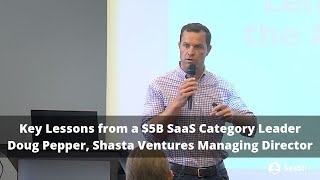
Doug Pepper, a Shasta Ventures managing director, traces Marketo's path from 2006 founding through its IPO and eventual acquisition by Adobe for $5 billion. He covers the company's early fundraising rejections, product rebuilds, sales leadership changes, and how it survived a crowded competitive field by focusing relentlessly on product while pioneering high-velocity selling and content marketing.
Chapters
All right. Good morning, everybody. How are you? I really appreciate you coming here since Jason M. Lemkin is speaking downstairs. Are you sure you don't want to be there? I'm amazed there's this many people in the room. I appreciate it. I'm really excited to give this talk about a great company and some really great lessons learned from the journey I'll just do a quick introduction. My name is Doug Pepper. I've been in venture capital for about 20 years. I made my first SaaS investment about 18 years ago and have really been focused on this space for a long time. I work at a firm called Shasta Ventures. We are based in Silicon Valley, both down on Sand Hill Road as well as up in the city of San Francisco. We make early-stage Series A investments in both consumer and enterprise companies. My own focus has always been enterprise SaaS, and my real focus in life is finding product-oriented founders that have built really amazing breakthrough products in big categories. And I've always believed in kind of two key areas for the enterprise that I think they'll never stop investing in. One is the customer journey, And the other is the employee experience. To me, companies will always be trying to innovate around how do they serve their customers better and their employees better in order to build their businesses and drive more revenue. So that's generally what I focus on. And the topic here really is as much about key lessons as it is really the reality of the entrepreneurial journey in a SaaS company. I think there's a misconception out there that successful SaaS companies are really nice, smooth rides up into the right. I think we all think of companies like Facebook and Uber and others and imagine that it must have been easy once they launched. Of course, now we all know the reality is different, that all of these companies are a set of challenges that need to be overcome and key decisions that determine whether you are a failure a good company or a great company. And I'm gonna talk about one investment that I was a part of for many years called Marketo. Who's heard of Marketo? Most everybody. And the kind of challenges we saw along the way and what were those key decisions that led us ultimately to be a great company. And by the way, when I say us, I really mean them because I was just an investor, but I had a front row seat. This is the dream. I think this is the misconception that many people have, that a successful company is a smooth up and to the right journey from the beginning. Those of us and those of you who are involved in these companies, even the successful ones, look an awful lot more like this. Challenges, mistakes, problems, surprises. Every step of the way, and it's the reaction to those problems, it's the decisions associated with those problems that determine whether you're going up and to the right or, or flatter down, quite frankly. So this was the Marketo journey, just a bit of history. The company was founded all the way back in 2006, amazingly. I was lucky enough to invest when it was 3 founders and a PowerPoint deck. They had an idea. Fast forward 2013, the company went public. 3 years after that, it was acquired by Vista for $1.8 billion and then was acquired by Adobe for $4.75 billion in 2018. One might think, "Well, gosh, what a great journey. Must have been easy. Must have been smooth." The reality was very, very different. It was scary at times and lots of challenges that the team really successfully navigated. And so I'll talk about some of those challenges and what were the key actions that were taken that led them to really build something very, very special. And I can't go through all of them. There are way too many to talk about, so I picked out just a few that I think are representative and can be learned from. The first is just— literally funding the company in 2006. This challenge they had actually long before they met me. Thank God for me that they had challenge fundraising because that gave me the opportunity to invest. But back in 2006, there was— they were fighting conventional wisdom. And the conventional wisdom at that time was that you could not make money selling software to marketers. Salesforce was already successful. They were selling seat-based, and the feeling was that CMOs and marketing didn't have enough seats. There just aren't enough marketers in a company to generate enough revenue selling seats. And even back in 2006, SaaS was not what it is today. Most firms weren't focused on it, and so they spent months and months going up and down Sand Hill Road, got mostly nos, in fact all nos, until I was lucky enough to meet them. And one of the founders shared with me later that he was 2 weeks away from taking a different job before we decided to fund it because the fundraising was so challenging. And so how did they get over that? How did they navigate through that? The first was that they never gave up. They believed in their vision and they took a bunch of nos and just kept at it. But they did some other things as well. The first was that they had picked an amazing category. To me, the single most important characteristic of market or category that you pick is something that we call "Why Now?" which I'm sure you've heard of, which is the meeting of two things at once, which is a dramatically increased need for a solution to a problem. Married with, right at that moment, the actual potential through technology to solve that problem. There's lots of great markets out there, but the ones that are truly explosive are the ones that literally couldn't have existed 2 or 3 years ago because the need wasn't there and the solution wasn't possible. The Marketo team talked to 75 CMOs before they decided to start the company, and they recognized those characteristics. In the case of Marketo, being a marketing automation company, the need by 2006 was there. In 2000, when the early marketing automation companies tried to exist, there wasn't the need. But by '06, marketers were using digital advertising, email marketing, Google AdWords. There was something to actually automate. And on the ability to solve the problem side, you finally had SaaS. Because CMOs didn't have access to capital expense budgets, they could now pay for software on a monthly basis with a simple UI that non-technical users could use. The Marketo team picked the right category and they convinced me of that. Then they really were the dream team. They had actually started a company called Epiphany years before that was kind of a failed predecessor marketing company. From that came a real product-first approach and a unique insight by them on what to build, and they had worked together. And those are the types of teams that we love. A unique perspective, ability to build a product, and risk mitigation through knowing that the founders can work well together. So that's how they got me to fund it and got through the fundraising challenge. Ultimately, we invested at a $3 million pre-money valuation. You could do that back in 2006. Off they went to go build a company and ran into their next challenge very, very soon, which was this concept of MVP, which of course we all know about— minimally viable product. I think in many cases that's what founders are encouraged to build and iterate from there. Quite simply, that did not work for Marketo. Marketo team started with what we call— we didn't call it MVP, we called it a version.5 product as a way to get into the market quickly, get some initial customers, and it was very far from the ultimate vision of what they wanted to build. It was really just a Google AdWords plus simple landing page product, and we got initial uptake, but ultimately we abandoned that product entirely. So we launched with that, Got about 100 customers. I don't think we got quite a million ARR. It was a little less than a million ARR. And we had real issues with the Google API. It was a challenge. And then we went to go fundraise. And once again, could not generate interest in funding this product. And Phil Fernandez, the CEO of Marketo, stepped back and really thought, "Am I gonna be able to deliver on my vision of a full marketing automation product?" with this product, I can't fundraise around it, and made the incredibly tough decision, I can't imagine as a founder doing this, fully abandoning that product. 100 customers, completely shut it down, all the revenue, shut it down, and started over to build what they had always planned to build, was the full lead nurturing marketing automation product. And so we funded it in 2006. That full product didn't come out until 2008. So here we are 2 years later. We've had to do an inside round now, a bridge round, to get to this new product. The good news being that product was a true breakthrough product in the market and ultimately led to all the success that we had. And it was the case of a founder making a very, very tough decision, uh, not to pivot because they had always had that vision, but to kind of abandon an initial product and rebuild. So that was, that was a big challenge, but one that was clearly the right decision. The other challenge, another big challenge, was team change. You know, I think we all like to believe that we hire well and that the team members we have on board will be able to grow with the company, and Marchetto very, very early on had to make a very significant team change. In our first VP of Sales. And kind of probably doesn't sound like a big deal, but one of the big knocks on the Marketo team early on was that they were too product-oriented, too engineering-oriented, and some VCs felt that they didn't have the DNA to build a great go-to-market team. And so firing the first VP of Sales was in some ways more than just giving up revenue and delaying revenue, it was admitting in some ways this defeat on the early go-to-market efforts and giving some people ammunition that maybe they were right to pass. But thank goodness that they made that decision and that we made that decision, and we brought on somebody named Bill Binch, who's actually now head of sales at a company called Pendo, But he took Marketo from zero to $250 million ARR, which is incredibly rare to have one VP of sales go that far in the journey. And every company needs one or two true game-changing hires, and this was one of those. So the takeaway is simple. When you've got a team member, especially early days, that isn't a fit, isn't a cultural fit, isn't that game changer, even though you're gonna take a step back, do it and bring on the right people to continue to grow the company. The next challenge here, left at the altar, you'll understand what I'm talking about here in a second, but this is really about competition. And I would say the single biggest challenge for Marketo all the way through was the tremendous competition that they faced. And any good software category is going to be competitive. In fact, as an investor, when I look at a category and it isn't competitive, something scares me. Because what I've always seen is that when you have that "why now" market that I mentioned, usually multiple smart founders recognize that market opportunity at the same time, and we see always waves of startups at the same time going after the same idea, not because they're copying each other, but because they're smart and recognizing the opportunity. When we don't see that, we're actually scared sometimes. But the Marketo marketing automation market was to the extreme. There were a dozen super well-funded, really good software companies trying to be the market leader in marketing automation. And that lengthened sales cycles and it reduced pricing, it reduced margins, it caused every company in the space to have to raise more money than you'd like. And a lot of our SaaS efficiency metrics were worse because of those competitive dynamics. But for Marketo, left at the altar, it was even worse, because every one of our competitors was acquired by major platform companies. So you may have heard of some of these competitors that we had. Pardot was acquired by ExactTarget, which was then acquired by Salesforce. Eloqua, which is what was really our key competitor, went public before us, and then was acquired by Oracle. Responsys was acquired by Oracle. NeoLane was acquired by Adobe. All in 2012 and 2013. We were trying to go public in 2013. This is terrifying, that every one of your competitors is now part of a huge platform with thousands of customers and unlimited go-to-market resources. And, you know, as a young venture capitalist, I thought, "We're dead. We've lost." Because we wanted to be acquired by these people. And we— were in all those conversations. We were never acquired by them. And in some sense, you felt left at the altar. In the end, we were larger than every one of these companies. And so how did they do that? The first was focus. It would be a lie to say that we didn't focus on competition. We focused relentlessly on beating them head to head. We measured it every board meeting. We knew exactly what our head-to-head win rate was against Eloqua, HubSpot, all the rest. But when it came to our core, which was our product, we didn't focus and they didn't focus at all on the competition. Focused on our own customers, our own vision, and Phil Fernandez, the CEO, said that he never ever watched a competitive product demo. Because he didn't want to be tainted by what somebody else was building. He wanted to listen to his own customers and his own vision and build his own product. And ironically, Eloqua came out a few years later after we had launched our product in 2008 with something that they actually described in the market as a Marketo killer. And that was the moment that Phil knew we were gonna win against them because they were focused on us as opposed to serving their customers. So product, product focus and kinda driving your own vision. I think we're missing a slide in there, which is fine. So there's another slide in here that's really important. Besides focusing on product and how we won, the single biggest learning for me in Marketo was that innovating in product was necessary but not sufficient. That the real reason that Marketo won and a bunch of my other investments win is because, yes, they've got this foundation of product and a breakthrough product that's their own, but that they innovate equally in how to bring that product to market and go to market. And in the case of Marketo, Eloqua was selling heavy software with services, and Marketo, back in 2008, really pioneered this high-velocity selling model. They pioneered things like content marketing, thought leadership, and actually one of the things that they did was something that we called Marketo at Marketo, which was John Miller, the founder, out there teaching customers how Marketo uses Marketo itself to drive a really effective go-to-market SaaS business inbound funnel, and they invented a lot of The SaaS metrics that we all know and love now were invented by Marketo back in 2008. And so clearly product was a big reason for our success, but if not for that real innovation on how to bring the product to market, I don't think we would have won. And my advice to all of you in the room is to think equally about how you can sell differently. Not just sell better or a better product, but how you sell differently, sales and marketing, to rise above the noise in any good market. That was a big, big learning for Marketo. The other is obvious, and I'm sure some of you are feeling this. Sometimes I think besides believing that a SaaS journey is going to be a smooth journey, I think people often think that it could be fast. It's never fast. It takes a long time to build these companies. I'll give you some numbers for Marketo to bring it alive. I don't know if you can see this up here, but these were the original projections for revenue when we invested in Marketo in 2006. In 2010, The expectation was to reach $86 million in revenue by whatever that is, year 5. These were the real numbers. Okay? So here we are, 2010. I invested behind a plan to be at 86 and we were at 14. You know, you can see 2007 to 2008, we went from 1 to 2. You guys know this whole triple, triple, double, double thing that you read about in SaaS? Okay, we're way below that. We're supposed to be tripling. We just doubled. You know how we do case studies in business school? I think if MBAs were looking at this as a case and just saw, you know, the numbers up to 2010, they would assume this was a giant failure. And of course, the reality is that these things just take longer than people expect. But the great news is that when they work, they can be much bigger than anyone ever imagined. And so, of course, by 2015, we were doing around $200 million. I think it's doing well over $500 million within Adobe now. So much bigger than we ever expected, but also took a lot longer. And in 2010, you know, what's that team doing? They're persevering through all the challenges and all the roadblocks to continue building the business. Oh, by the way, Also fundraising. You can't run out of money during this time. But it took a long, long time. And I think it's a great lesson for everybody in the room here that you're suffering through challenges, things are taking longer than you might expect. Every good software company out there has been through a journey like this. If you just went from $1 to $2 million and investors are saying to you, that you're not growing fast enough, just keep plugging away. Keep at it. Because you can see here how long it took us to really reach scale, and obviously in the end it turned out to be a wonderful outcome. The other learning is that I think people think that once you go public, it must be, you know, you're fine and everything's up and to the right from being public. In fact, the reality is that the challenges never go away. They just get harder as you get bigger. And when you're public, there's more scrutiny, and then the lawsuits come when the stock drops. Always. So we went public in 2013 at $13 a share. The stock went up to $40 a share a year later. We're excited. That's great. And then tanked all the way back down below the IPO price. Scary lawsuits, we're not sure what's going to happen, lots of competition. Then only 6 months later, the company gets acquired by Vista for $35 a share. The roller coaster continues whether you're private, late-stage, public, it doesn't end. Hopefully, you can see that whatever stage you're at, the journey continues. But that you can, if you have the right market, you're in a great why-now market, and you've built the right product, focused on product, and innovated in go-to-market and built the right team, that you can achieve the kind of success that Marketo did as well. Those are the key learnings from Marketo. Happy to take any questions that you'd like and give you some extra time too.
More from Jason

Why Your Next Hire Should Report to an AI, Tragedy Apps, and Too Many AI SDRs? | The Agents #004

Our Agents Drove Our Salesforce Bill Up 80%, Marketo Hates Agents, and We Stealth-Churned Off Notion




Managing 20+ AI Agents: Lazy Agents, Our $500K AI Bill, Stealth Churn & the Death of 60% Solutions




