Lessons Learned Being Acquired for $400M with WePay
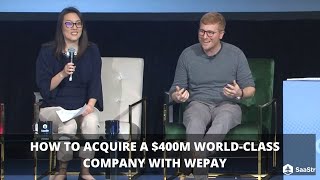
WePay's CEO and COO share how they negotiated a $400 million acquisition by JPMorgan Chase while keeping their startup intact. They protected autonomy by appointing a single liaison to filter requests, retaining their own HR and IT stack, and keeping their culture mantra: don't crush the butterfly. Employee engagement rose and attrition fell after the deal closed.
Chapters
Please welcome Tina Xiao, WePay COO, and Bill Clerico, WePay co-founder and CEO. All right.
Hey everyone, how's it going? Why don't we all move a little bit closer?
Yeah, we can make this a more interactive session. So I know everyone's, you know, it's day 3, everyone's a little tired. If you guys want to just move up, or you can do Q&A at the end, whatever you guys want to do.
Awesome. All right, well, let's get started. So I'm COO of WePay, Tina Xiao. And here with me is Bill, who's the co-founder and CEO of WePay. Co-founded WePay over 10 years ago or so. So I guess let me kick it off. So we've been now acquired by Chase for over 14 months. Bill, for real, how's it going? Be honest.
[Speaker:JASON M. LEMKIN] Well, it's been 10 years. It'll be 11 years in August. And as part of JP Morgan, it's now— yeah, it's been about 14 months. I think like anything in life, there's honestly pluses and minuses. I think on the plus side, coming into a firm like JP Morgan, we were a 200-person company when we were acquired. The day that acquisition closed, we became a 250,000-person company. And so it was this 1,000x increase in terms of the size of the company. It was the number of required trainings we had to take went up by 10x. So there was, the scale was sort of mind-blowing in certain ways. It was tedious in certain ways. But I think it's also been really great in certain ways. We kind of instantly became one of the best-funded fintech companies in the Valley. We grew our team by 50% this year, continuing to grow. I've learned a lot about just like the financial system at scale. Chase Merchant Services that we're now a part of processes $1.2 trillion a year, which is pretty crazy when you think about kind of what that means. A lot of companies show trillion-dollar market sizes. It's really kind of interesting to be inside a financial institution that operates at that true trillion-dollar scale. So I think like anything, it's been good and bad. We really have tried to shape it and make the merger about How do we continue what we're trying to do as our mission and use this as an opportunity to accelerate that? And I think no question in my mind that overall it's been a huge net positive on that front.
Awesome. So I guess one of the things that was really critical about this acquisition was about maintaining our autonomy and being independent, which hopefully some of you in the audience are starting to think about. Like, hey, if you get acquired, what happens? But why is that important?
Yeah, so I think originally it was important to me honestly out of ego and nothing else. It was really, for me it was about, I started this company, I wanted this company to continue to prosper, it was this thing that I started. And so initially, I think for better or for worse, it was more about ego than anything else. And I think as we went through the process and I started to think about it, I realized that actually it was more about making sure that we can continue the work that we were doing. We, I think, are going after a super exciting part of the market, which is software companies trying to embed payments. It's a really fast-growing part of the market. We had built this amazing team that I wanted to make sure that we continued to sort of grow and invest in and kind of keep the band together. And so, to me, I think it started as ego, but it really ultimately became about making sure that we could continue to do the great work that we've been doing. And so, that was sort of a bit of a humbling process for me to sort of let go of what I initially thought it was about and make it really more about the work that we were doing. And I think our team has done that too. In certain ways, we've maintained our full autonomy. We have our own office, our own IT systems, our own employee experience, all that kind of stuff. In some ways, we've really integrated, and that part's been great. And so making it more about what we're trying to accomplish and less about just autonomy for the sake of autonomy, I think, was sort of an important mindset shift for me.
So I guess, how did you do that as part of the deal? Right? So because we know that— I know we sort of— we're talking about that right at the negotiation phases. What were some of the things that we did differently to make sure that we were going to be autonomous?
Yeah, I think we talked about it from the very beginning. It was sort of— for me, it was letting JP Morgan know that I was really serious and committed to seeing this thing through, and that the reason we wanted to be autonomous was because of that, and kind of building that trust on both sides, and making it sort of a core tenet of the acquisition. And then really making sure that the, that JPMorgan, the other side at that point, really understood what autonomy meant, that we had sort of a shared definition of that, and that the people that were sort of committing to keeping us autonomous actually were empowered to do that. And there was a lot of work on the JPMorgan side, way more on that side than on the WePay side, to kind of figure out how they could acquire this fintech company and keep it independent and not sort of crush the butterfly, so to speak. So to speak. And so it was sort of building that trust from the very early days of that discussion and making sure that was a really important deal point as we sort of talked about it. And I know you've lived it on the HR side. Yeah.
I mean, I guess I would say one critical thing that we did early on was we got them to agree that we as a leadership team were the ones who were owning the whole sort of announce and offer process to that new company. For our employees, right? So, we were the ones that owned kind of the distribution and decision-making of, okay, who gets what offer, right? Like, who gets what sort of money to stay on? And so, that was really important for us to own that and for us to own the whole announce of the deal to our employee base versus them taking that leadership role. So, they gave us that flexibility and that ownership, but we asked for that too, 'cause we knew that that was gonna be really critical. So that was, I think, a key lesson.
Yeah, I think, you know, kind of building on that, we, you know, we made sure we kept HR on-site. Like, it was sort of, you know, the goal really for the employee experience was to make it feel like our ownership had changed, but really nothing else had changed. And I know you and the team worked really hard at making that happen.
Yeah. Well, let's get into real, like, specific nuts and bolts and lessons. What kind of— like, I know we both have key lessons, but let's share with everybody some lessons. Like, you know, what are top 3 for you?
Yeah, so I think in the beginning it was really about making sure that we brought the entire company over, so we, you know, there was no like synergies as part of the acquisition. Everyone joined with JP Morgan. We made 2 selective changes, our CFO and our head of HR, knowing that we had met some great people on the JP Morgan side through the acquisition. We brought them in. We wanted to kind of bring some of that DNA into the company. And they were people that we had been working with at this point for like 6 or 7 months, and so we knew them quite well. And so a couple selective changes and bringing everyone over, I think that was sort of the first piece. So it was sort of like the people, day-to-day people stayed the same. I think the second is that we got this guy, his name's Jay Adelsberg, and I love Jay. And his job really, we call him the goalie. And so his job, he's on the JPMorgan side, But he's really the conduit when requests come into the company, when there's any sort of integration efforts. Jay is like that goalkeeper, and his job really is to put his arms around the company and be that sort of single point of contact to be able to make sure that the right stuff gets through. Because I think the challenge is that— and this is a learning for me— big companies don't operate in a single-minded, rational way. It's 250,000 people doing all kinds of different things all the time, and they hear about this acquisition and they want to come visit, or they think you should do this policy or that policy. And it's not as if there's this single-threaded decision that gets made. And so you sort of have to force big organizations to kind of follow procedures to make those types of rational decisions. And Jay was sort of our solution to that process.
Yeah, we talk about that they built a moat around us, and then there were defenders to the moat. Keeping away the amassing armies. And that's what we needed. We needed a guy who was just gonna protect us.
[Speaker] Yeah, 'cause I think in every single function it was sort of, I think of the movie, if you've ever seen the movie 300, there's like the masses. We have one HR person, they have 1,000. And so as you think about sort of all those relationships and integration work that has to happen, making sure that you're balancing that appropriately so that you're not overwhelming the people people on the acquired company side, I think is really important.
Yeah, I mean, I think a couple things for me that resonates is one, like, keep your own budget and your own tools and systems. So, for us, that was super important. Like, we own still the budget, right? Sure, like, we have to report that up and we have to make sure we make our P&L, but we own the budget. We make all the decision-making still. And we own our own tools, right? We are still on G Suite. We're still on Slack. We're still on box. Like, that was really important because we don't work the same way. And so we knew that we had to have the same stuff, right, as we do now, to really protect that employee experience. So that was really key. I think another thing was just like, we actually made some mistakes up front, right? We didn't realize that in the beginning of an acquisition, HR matters so much. We didn't get HR involved till later on. And so HR is super important because right away the employees are like, Hey, am I gonna have free lunch? Am I gonna have the same perks? Like, do they get, you know, Silicon Valley and all the different compensation here? So that was really important. And we kind of made that mistake in the beginning by not bringing that in early enough. And we've quickly rectified that and figured that all out. And so now it's great. But that was, that was a really key piece for us too. And I would say lastly, a last lesson was there's a lot that you have to do as a leader now that you're a part of the acquired company, you kind of have to think about you have different VCs now, right? You used to have the venture capitalists. Now, you have all these other VCs internally. So now I'm flying all over the place where I used to travel twice a year. Now I'm traveling 8 times a year to really kind of meet these other VCs.
[SPEAKING SPANISH] Just out of curiosity, if we look out in the audience, how many of you guys are entrepreneurs? How many of you guys sort of are on the investing side? How many of you guys are on the kind of corporate side or work for a bigger company? So it's actually kind of a pretty diverse mix. How many of you— I don't know what else there is to do out there, but I'm sure there's some other important jobs too. So yeah, just kind of curious to kind of have that, understand the mindset out there. [Speaker:AUDIENCE] Yeah.
I guess what was some of the toughest things? Toughest that you had to deal with, and what lessons to take from that?
[Speaker:JASON M. LEMKIN] Yeah, I mean, toughest things we've had to deal with. I think a lot of it comes down to sort of the day-to-day decisions. I don't think there's really been one big moment where it's like, oh, this is a really tough decision. But to me, it's sort of how do you balance the death by 1,000 cuts in the appropriate way and sort of pace that? Because there's all kinds of little changes that And any single one of them is sort of reasonable. But then when you sort of add them all up, you're like, wow, this is a lot of changes. And so for me, the most difficult part of the integration has been, how do you tell someone that has a very reasonable request no, because it doesn't fit— because it's not the most important thing on the list of the 200 things that we need to think about integrating this year. And so it's those conversations sort of over and over, around relative priority of an IT ask versus an HR ask and sort of balancing that book of work.
So we talk about this a lot as a reverse acquisition, as if we're going to acquire JPMC.
We have acquired JPMC.
Yeah, we have. So tell me more about that.
Yeah. So there wasn't a typo in the title of the session. We called it How to Acquire a $400 Billion Company. Opportunity because while JPMorgan bought WePay stock, we look at, like, the reason I'm excited about this opportunity is because there's sort of an opportunity for us to change the way that this financial institution operates. And it's an incredibly impressive financial institution, $100 billion in revenue, $30 billion in net income, 4 million small business customers, relationships with half of U.S. households, quarter of a million employees. It's just a really big place and it's really like the fabric of people's lives, particularly here in the US. And it's also a company that employs 50,000 software engineers, and so it's a company that makes huge investments in technology. And yet, I think there's a mindset, there's a way of working, there's a talent that's here in Silicon Valley that I think, if applied correctly to that scale, could really change the way financial services happen in America. And so I think, To me, that's our mission, is can we bring that mindset, that way of working, and use that to sort of eat JPMorgan as an institution and help change the way that we build products and build software. And I think that's, to me, that's what gets me excited. We're starting in integrated payments, but you can think about what else could you do beyond payments if you're really good at working with software companies? There's things like checking accounts, there's things like lending, and kind of bringing those together in a really modern, easy-to-use way, making them available through APIs to third-party developers. I think no one has really scratched the surface on that, and there's some really great fintech companies out there that are trying to build these modern products, but don't have a banking license to be able to offer that, don't have banking and lending and payments all under one roof, and so we have these amazing capabilities, and I think that WePay can be way to sort of modernize them and make them competitive for the next 20, 30 years. And so to me, that's the opportunity. I think internally people recognize that as the opportunity. And for us, when I think about acquiring JP Morgan, it's how can we over the next decade bring some of this talent capability to change the way that they work?
Yeah, I kind of feel like if software is eating the world, we're slowly eating JP Morgan one little bite at a time. But yeah, I mean, I think just to riff on that, one of the things that I think we did a lot to help them is they really want to compete, particularly out in Silicon Valley. But we had to teach them a lot of that. Don't underestimate how different the mindsets might be, right? With a big company, with a corporate acquirer, even if, in particular, if they're not based here. So I had to really do a lot. And the whole company had to just talk about, okay, what does comp look like out here? What is this perks thing? What is free lunch, right? Caltrain passes, all this stuff to just sort of put it all together for them and say, oh, okay, this is how you compete out here. Here's how you get talent out here, which is really different.
Yeah, I think the cool thing is there's such a willingness to do that. I mean, we announced that we're opening a 1,000-person fintech campus in Palo Alto. There's a huge level of excitement and investment, and to me, that's such a cool opportunity as we think about where we sit relative to this institution.
Great. Well, let's look ahead to the rest of 2019. What else gets you excited, Bill? What else can we share?
Yeah, so I think maybe just kind of double-click on something I talked about earlier. So if you think about payment processing and bank accounts and what you could do if you bring those together under one roof. Some really cool things. You think about, for a small business customer, great to be able to process payments, great to have a bank account. If you had those two things together, you could do things like faster settlements so that you can get same-day transactions. You could think about how in that Chase app you could make it easier to accept credit card payments right away. There's just a whole bunch of things I think we can do to sort of bring those two things together that I'm super excited about. Can't talk about the specifics just yet, but I think we're— there's gonna be some big things to announce this year.
I mean, I think one thing I'd love to also talk about is what did the employees think, right? And what were some of the key concerns and things that we had to really do differently for them?
Yeah, it's a big mindset change to go from small company to big company, from a compensation philosophy that's heavily grounded in equity equity and upside to one that's different just because you're at a more mature institution. Again, small organization, big organization. So I think there's definitely changes, some positive, some negative. I think for many folks, they see the opportunity of the ability to have impact is way bigger. The ability to do radically different jobs inside one roof is bigger. I also think that largely the day-to-day hasn't changed. As we've measured it, we've looked at employee engagement. Employee engagement is actually up since the acquisition over the course of 2 surveys since the acquisition. And then employee attrition is actually down. So I think the data tells us that it's been a fairly good outcome for employees in addition to shareholders and customers.
Yeah, I mean, I think I go back to the lesson of, hey, we had to really show the employees that Chase was serious about this, and how do we show that? Which is you put a lot of the decision-making back on our shoulders. It's still us making the decisions, and us nurturing that culture. And what Chase would do is they would just sort of filter everything through us, versus them coming in and changing things directly. So, if you want to really preserve the culture and grow it, it's okay, keep that leadership team. And give them the power. To continue to do stuff.
And by the way, I think that's like so atypical in acquisitions. And I think one of the things that played in our favor was JPMorgan is such a big company. Really the last major acquisition they did was like in 2008, 2009 when they bought Bear Stearns and Washington Mutual. So they had these like massive acquisitions and then really nothing for 10 years. And so we kind of got to be a bit of the guinea pig and shape the playbook, which I think has worked really well on both sides. There's not been sort of a top-down integration plan. We've sort of been figuring out with them and partnering with them to be able to kind of bring these two organizations together, which I think is such a cool opportunity for us.
Yeah, I think one thing we did a really good job of early on was sort of develop a philosophy and a mantra that we used internally. And so everywhere we go, we would say, well, we don't want to crush the precious butterfly. And that's what our partners would say, our internal partners. They're like, you can't crush the butterfly. Don't forget, we can't do— 10 more trainings because we can't crush the butterfly. So that was actually pretty important as like a mantra. I want to get a t-shirt that sort of says, don't crush the butterfly and walk around. Or tattoo. Or tattoo. Yeah, no. And walk around their offices and like hand out t-shirts and be like, don't crush us. But that's been really helpful too because there are like 250,000 people. I think we should like make 250,000 t-shirts and send it all over.
There you go. So we have a pretty intimate group today. I guess maybe we can open it up for questions if you guys have any thoughts or comments. Yes.
I do. So, as you've said, by your side, you would have brought HR first during the WePay process. If you were on the other side of the table, what would you have done differently if you were JP Morgan?
So, let me repeat the question. The question was, okay, so we know what WePay would do differently. If we were JP Morgan, what would? We do differently?
You know, I think one of the hardest things in an M&A conversation is like, is how do you set expectations? 'Cause you're like, before the deal closes, you're like negotiating for what's the purchase price, what are the performance targets as they relate to retention agreements. So there's this like total asymmetry of interests where it's like, you know, in order to get the best price, you know, you wanna set the most lofty expectations about what could happen. And then the second the deal closes, you're like, oh, now I'm going to be working here for the next 3 or 4 years, and I need to make sure that we can deliver on those expectations. And so I think one of the tricky things for any company, I think, in this is how do you build a realistic plan and realistic expectations? And I think one of the things that we've gotten to over the course of a year is sort of saying, OK, we had this cool plan. We've learned so much more now that we're all on the same side of the table, and we've basically redone the entire plan 6, 12 months into the acquisition. I think if there was a way to basically have that conversation up front, it would have, I think, been helpful for both sides as we think about setting expectations post-acquisition. So I think it's probably about finding ways to have that conversation in a less adversarial way. Not that it was— that anyone meant anything malicious by it, but just how do you have a more honest, more open more sort of joint conversation?
Yeah, I think what I'd say is they did a really good job of like when they were gonna start to do the deal, right? They went to all of their, a bunch of key functions to kind of get them to sign off pre the deal even getting announced or signed. And so they went to like compliance and security and risk, right? Like some of the key ones that when they, where they knew, oh, they're gonna, you know, like put a, like get a bunch of red flags immediately. But I think they missed some functions. They missed HR, right? Immediately. They missed a couple of, I think, of the bigger ones. And so I think that's what they would say they would probably do differently. And then I think the other thing is like they got everybody like on the senior level really bought in and everyone's like super excited, right? But it's a huge organization. I think if they had maybe gone a level or two down, which would be hard because there's because it's a lot more people. That would have helped, because all the senior people are really bought in, but then the day-to-day work, right? You're still wrestling with folks who are, you know, their whole job is, "You must do this one training," and you're like, "Well, senior says, you know, no, we don't have to do that." So I think that's part of it. Any other questions?
One of the observations you made was that employee engagement and basically turnover went down after the close. Can you speak to how did that happen? How did the implementation and integration work?
Yeah, I think a couple of things.
The question was about employee engagement and how you got that to change.
Yeah, sort of what do we do to drive employee engagement up and attrition down? I think a couple of things. If you think about the context we were in, We're in a very competitive market. We have some great competitors. We compete with Stripe and PayPal and Adyen. And these are very well-funded, very driven technology companies. And so we're in fierce competition with them. And there's definitely a big belief in what we do and in our company internally. And so when there's this opportunity to turbocharge our competitiveness through a huge— influx of resources and these new capabilities, I think people were just genuinely very excited about that and it helped clarify our strategy and I think there was a sense that this was really going to help us win. We're in this long competitive race and this is the big— this is the nice turbocharge halfway through. So I think that was kind of a part of it. The second piece was that we added a bunch of people to to the team. I think we added a bunch of talented people to the team, and I think the, you know, our employee base sort of saw that and embraced that, and I think that also helps, you know, people just get excited. And I think the third piece was like, you know, I think people, there was excitement about working for, you know, a brand like JPMorgan. I think it's a, I think people have a pride in that brand. I think people really love working at WePay. They love working with their colleagues. They love what we do, but we're not, you know, global brand like I think that Jason M. Lemkin is. And I think that halo effect helps. There's a pride to work at the company that I think helps, in addition to all the HR programs and things like that that we did to make it sort of right.
Yeah, I mean, I think one of the key things we did this year, and I literally just presented this in all hands like 2 hours ago, is we built sort of a year-long master plan of goodness, right? So, what we did is we were trying to combine the best of both worlds. We're still We're still this fast-moving startup WePay, but we now have this backing with resources of a huge company. So how do we combine those two and show you goodness? So every sort of couple of weeks, we'd do something different to kind of show that. So Chase has this deal with the Warriors, so we brought the Warriors on site. Not all. The trophy on site, and everybody got to take pictures with that. And a coach on site. Or we were able to fund an ice cream freezer. Or there were bigger things too. But I think we sort of kept building in goodness throughout the year to really show people, hey, particularly in this first year of acquisition, we're still the same company, right? Just with a ton more resources and a much bigger combined brand. And boy, we still have this autonomy. So the first year was super critical to sort of keep trickling this stuff in and show employees that we were just this, like what we were before, all our specialness, but bigger and better.
Yeah, I think there was sort of like, if I were to graph the employee sentiment, it's like, you know, transaction gets announced, everyone's super excited, this is amazing, our company got bought by this amazing company. That lasted for like 72 hours. And then it's like, oh my God, what does this mean? Am I going to get fired? Is our whole company going to— are we all just going to work at some big dumb bank and our life is over? And that lasted for maybe 2 or 3 months. And I think it was really that we got the fundamentals right, that around autonomy, around being able to work, around paying competitively, around being able to continue to move fast and operate in the right environments, and all that stuff was good. And then we layered on top kind of like a change management program where we were just just doing sort of symbolic things to show that the experience is kind of getting better and better. And I think that was not an easy feat, but I think that was sort of key to kind of get where we are today. And we're only a year in, so we have to continue to do that over the next couple years.
I think the other thing we did really well was respond to employee feedback and anxiety, right? There's a lot of like— there was just anxiety because things were unknown. And so whenever we heard something from our teams— and we're pretty transparent. Parent feedback-rich culture, we'd bring our Chase colleagues right to the table. Like, "Okay, here's what we heard. What can we do about it? What can we do about it?" So, we did that a lot. And so, I think that helps employees go, "Okay, everyone's still listening. Even though they're a 250,000-person organization, they're still listening to us." Sure.
[Speaker:MALE #3] So, you said that you would have more honest and open conversations before the deal closed so that that the expectations were better aligned, but what would you have done differently to have that conversation in the past more open and honest if you could do it again?
Yeah, so sort of follow-up question of what would we do specifically to enable more open dialogue. I think like if you're— They're closed, they're pretty closed. Pretty closed, yeah. I think as you're thinking about performance targets, or the structure of these types of there's sort of like two ends of the spectrum. There's like make it really performance-driven, and then you're saving money if the transaction doesn't live up to expectations, and you're really aligning incentives for performance. The downside of that is it increases the sort of incentives to, the challenges of having the discussion. The other side of the spectrum is sort of trust, the trust that the team is gonna deliver, make it less performance-driven. And I don't know if there's a right answer to that. I think that we've ended up recalibrating that spectrum as time has gone on. So we may not have gotten that right right out of the gates. Maybe we did. I don't know. That's above my pay grade. Any other thoughts or questions?
Got 38 seconds. Yes?
[Speaker:AUDIENCE] You talked about some of the perks and just the resources, but from a tactical and recruiting standpoint, what are some of the operational things where you can leverage the scale of data?
[Speaker:JASON M. LEMKIN] Yeah, I can take that. So the operational things are— I keep uncovering new ones every single day. We were looking at new real estate space in the Bay Area, and 1 in 3 buildings is owned by JPMorgan Asset Management. We have a leadership center in New York City with these phenomenal leaders and instructors. We have really impressive operations centers that employ tens of thousands of people at massive scale to be able to do things like that. We have a treasury system that moves $6 trillion a day. So there's cost and reliability advantages that come with that. So those are just kind of a handful of things. I know we're out of time, but there's definitely been some cool things like that to draw on.
So thanks, everyone. We're on Twitter, as well as if you want to find us backstage after, that'd be great. Cool. Thank you.
Thanks very much for coming.
More from Jason

Why Your Next Hire Should Report to an AI, Tragedy Apps, and Too Many AI SDRs? | The Agents #004

Our Agents Drove Our Salesforce Bill Up 80%, Marketo Hates Agents, and We Stealth-Churned Off Notion




Managing 20+ AI Agents: Lazy Agents, Our $500K AI Bill, Stealth Churn & the Death of 60% Solutions




