Lessons Learned Scaling with Canva's CMO Zach Kitschke and SaaStr CEO Jason Lemkin
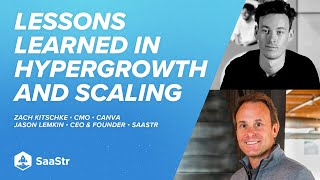
Zach Kitschke, Canva's CMO since 2013, shares five lessons from scaling to 60 million monthly users and $1 billion ARR. Start narrow with one feature, then expand. Build community through workshops and creator ecosystems. Delegate ruthlessly as you grow, and localize intentionally across languages and regions.
Chapters
Cool.
Thanks, Caitlin. Just a few things to kick it off and then I'll let Zach go. We already have quite a few questions that have come in. First of all, fun session for the SaaStr team. We run a lot of SaaStr on Canva. I did some tweet the other day. It was something like Adobe's a $300 billion company making tools for designers and Canva's a $40 billion tool when your designer won't finish a project. And I know it's a bit of a joke, but I really feel like Canva is our second or third and fourth and fifth designer on Team Saster. And we love Canva. Canva is always on time. Canva doesn't complain. Canva has a lot of fresh ideas. So it's always fun to have a leader from one of the products that we run a whole global community on here, which is great. And Zach, you were so early at Canva, right? You joined in 2013. That's like That's close to day zero, wasn't it? Or was it day zero? When did you join?
Yeah, yeah. Great to be here and awesome to see everyone virtually. I'm sort of here in Sydney at the moment. I wish I could be with some of you over there on the ground there. But yeah, I joined a couple months prior to launch. So I joined and then sort of led our first funding announcement with my kind of early PR hat on and I have have been sort of part of the furniture ever since.
Yeah, and you worked here, and I want to make sure we got some incredible slides here on lessons learned, but just so we introduce you, you worked your way up, right, from early employee, head of marketing, and then to CMO, right? What's, what's a little bit story, and especially these days, it seems like CMO has a half-life sometimes measured in single-digit months. There's so much turnover at the top, but you're, you're nearing a decade, right, at the company. What, what have you learned, and how'd you do it, and what have you learned in terms of being enduring in the role?
Yeah, I think I've had an amazing journey and learned so much along the way. And I guess I started in a PR role and as you'll see in a little bit, I've sort of hopped around all over the place and had the opportunity to do our customer service and build out our customer service team and then launch our Philippines office. I had my time in product management and worked on what's now Canva Pro, our sort of premium products. I spent a couple years in building out our people function. So scaling, you know, everything that came with that. And then sort of for the last 2 years, I've been back in the marketing space as we've been, you know, really investing in growing things globally there. And for me, it's definitely come back to I'm always kind of jumping onto the next biggest problem that needs to be solved and You know, I've definitely loved the ability to kind of learn new things along the way as well. So yeah, I think it's definitely part of what it sort of takes to grow with a company like Canva. It's sort of a different beast every few months or, you know, certainly along the way. So yeah, a lot of change.
Let me ask you just one question and then I do want to make sure we dig into lessons learned in hypergrowth as Canva approaches a stunning billion dollars in ARR, which is crazy. But it sounds like from your background, I could have this wrong, but I'm just looking at so many startups, you might be the classic overachiever generalist. Now, you came in through communications, you came in through marketing. So that's where you started, right? Close to a decade ago. But we all, anyone that's been a founder gravitates to a couple of folks that they can throw into something like run the Philippines office, run people, run this because they need that person that's smart, that has the DNA and that can roll with it, right? It sounds like that's you, but sometimes— was that you? And then sometimes what I find is those folks get frustrated because as the company gets to be 500, 1,000, 2,000 people, there's not always a clear path for that person anymore. So was that you? And how did you ride that all the way to a billionaire, or almost a billionaire?
Yeah, I don't know. Like, I definitely— I love learning, and I've loved being thrown at new challenges along the way. But I, you know, I often get asked, you know, if I miss the early days, or, you know, if I have a preference for a particular point in time. And like, I don't know, I have to say I have loved like each of the different phases. And actually, I'm probably having the most fun I've ever had now. It's definitely a very different, you know, organization at 2,000 people, and it comes with A very different way of building and getting things done. But I might be the exception, but I kind of have enjoyed that as well.
Good. All right, well, let's talk about it. I'll be quiet now for a while. Lessons learned in hypergrowth. So Zach, share us a little bit of what you've learned on this incredible journey to billionaire-er, just about.
Awesome. Yeah, let's get into it. I guess thanks again for having me. For maybe those of you that are not familiar, Canva, we really started with this mission to ultimately democratize design and really empower everyone around the world by making it accessible to everyone. We've grown a huge amount over the past sort of 8 years or so. On the left, you can see that's a very early photo. If you sort of squint, you can see a dorky shot of me there.
Wait, hold on. Which one are you?
I'm the dorky looking character in the company.
Okay, your style has evolved over the years, I see, right?
Yeah, that's right.
Not better or worse, it's just evolved.
Yeah. And then, you know, this is our team, just our Australian team in 2020. So we've grown over the years. I guess to give you a bit of a snapshot of where things are at today, we now have more than 60 million people creating with Canva every single month all around the world. We've got a global team as well. So there's sort of 2,000 people, you know, across Australia, the US, the Philippines, China, throughout Europe as well. And as you mentioned, we're on track to reach $1 billion in revenue towards the end of this year, which is really exciting progress. I guess, you know, as we were sort of talking about what might be the best, the most useful to share today, we thought it might be worth diving into a few lessons, I guess, learned along the way. So picked 5 lessons that I'll get into over the next 20 minutes or so. And so number 1, I thought I'd talk a little bit about building community. It's been something that has really been part of our story since day 1. I guess, you know, now we're incredibly fortunate to have, you know, a phenomenal, incredibly engaged community all around the world. And so, you know, on the right there, you can see just a snapshot of some of the video content out there. There's literally, you know, millions of pieces of content, you know, video tutorials on YouTube, blog posts, content being created all of the time online. If you jump on that link canva.love, you can see this is, you know, a Twitter stream of people from our community sharing. And I think this is really something that's been kind of dear to our heart, but also a really key part of ultimately our success. A large part of our— actually, the majority of our growth still comes from word of mouth and organic. And so that's been a critical lever of growth over the years. I guess some of the things that I think have really helped unlock that, that really started back in the early days. So the photo at the top there is actually a photo of one of our very first design workshops. And this was our first office in Surry Hills, the very sort of small boardroom. There was a handful of desks outside there as well. And back in the early days, this is pre-launch, we'd actually invite members of our community in and sort of give them early access to Canva and basically take them through a sort of design workshop. And this became such an incredible way to get early feedback on the product. And I can definitely tell you there's no better objectivity than seeing, you know, people reacting in real time and trying to teach people a product. You know, you see what they understand, what they don't, what they struggle with. And so that really helped us iterate through the sort of early phases through launch. Cliff, myself, Mel, we'd sort of all be in there running workshops. And it's actually, it's really fun to see how that thread's really continued as we've scaled. This photo down below is actually a photo of our bright and shiny new Canva space in our office in Surry Hills in Sydney. And we've actually launched a community cafe and space where we're now offering, you know, design workshops all the time and sort of open that up as a community space. So that's been something that, you know, has really scaled as we've grown there as well. Another aspect that we really focused on early on was really investing in PR and content marketing. I guess we definitely didn't have any budget back then and, you know, had sort of identified the sort of early success that we were having was really with social media marketers and content creators. And so a lot of my time in the early days was spent actually writing content, you know, whether it was about visual communication or building your brand on social media. We were fortunate, you know, just through writing content, I guess, to get picked up by, you know, some of the blogs in the space like Social Media Examiner and others. And, you know, along the way, really telling that story of what we were up to. We were definitely a bit of an exception to the rule being an Australian company, you know, launching. I think we had the largest kind of seed funding round at that point in time. And so really, you know, identifying those sort of interesting tidbits and sort of pitching press around those as well.
Was there like back in 2014 when you were writing this, what was the 10x feature for Canva in the early days? Like what did you win? Were you doing something on social media that was hard to do in other apps or what was that step function that wasn't in the market back then?
Yeah, like the, the products, uh, back then, uh, we, you know, we launched really focused on social media. Uh, we call them, you know, DocTypes. But, um, you know, we had a suite of templates that you could go and choose from, and it was really easy to kind of edit and create things like, you know, Facebook posts or, you know, your, your email headers and things like that. And I think it was actually just by making that process really, really easy. You know, Canva had— we launched with, you know, this idea of like integrating everything into one page. So you could just go to one place. You had the templates. There was, you know, stock photography that was free or a dollar to use. It was really easy to kind of publish that like in the right format. For, you know, the end state. So I think it was just about really solving that problem really, really well early on. And, you know, a little bit later on, we launched— I remember when we launched what's now Canva Pro, we came up with this feature called Magic Resize. And that was just like an incredibly popular feature. And it was just something I think that social media marketers in particular really struggled with, you know, you kind of go and design a Facebook post and then you have to resize it manually previously for Instagram or Twitter or TikTok or, you know, whatever other formats were around at the time. So, you know, it's things like that that I guess saved a lot of time and made it really easy to do some of those things with a click. And I guess, you know, I think that as we're sort of talking about really comes back to realizing just what a driver of growth your core product can be. We continue to this day to have the vast majority of our community using Canva for free. And it's always been, you know, part of the philosophy and the mission and something really dear to, you know, Mel's heart has been that. Anyone that wants to access Canva no matter where they are in the world, whether they're employed or not, should be able to use the tools. And so we, you know, you can do pretty much anything that you want to or create anything you'd want to in Canva for free. And then we've always had this idea of, you know, offering additional tiers or additional products for people that have, you know, a particular use case or you know, have the means to pay. I guess something else that we did early on was really focus on like user testing those early flows. And we did it through things like the, you know, the workshops where we'd get people in, but also through tools like usertesting.com. And I'd highly recommend this for, you know, any product folks. You can basically get people around the world to test out your you know, application or products and give you feedback in real time. And we actually put our very first version of the products up on user testing and it tanked. Like, it was— we had terrible feedback. And it was interesting because it was not the product itself. Like, the core functionality was right, but we just hadn't nailed some of the UI and the onboarding experience. And so I remember the team and Mel literally going through dozens and dozens and dozens of tests and iterations, if not hundreds of tests and iterations that actually refined that onboarding experience, which meant by the time we launched, we were getting everyone saying that they love the product. And it was definitely a journey, the last mile to sort of get there. The other example I'd give here You'll see a few sort of graphics there from Huffington Post. And I like to talk about like building your product with your community. This was probably about 2015 and we'd just got a tweet or an email from one of the designers at Huffington Post basically saying that the team were using Canva and really loving it, but they had this big problem and they were keen to see if we could help solve it. The problem, you know, for them was Huffington Post as a newsroom had, you know, hundreds of different journalists and social media editors creating content all the time. And what that meant was things were going out with the wrong colors or fonts or logos. And so they reached out and sort of, you know, fortunately was able to get together with them and sort of have a bit of a conversation. And we realized like what they really needed was templates and to be able to create, you know, a set template so we're on brand for their team. And this kind of coincided with, you know, the time that we're actually building, you know, our premium version. And so we ended up piloting the concept or testing the concept of templates with them. So hacked together this WordPress page that you can see and those designs, they, you know, made it easy for their team internally to basically click on one of those and leverage a template. And that actually became a bit of a prototype for that early product as well. And you know, it's fantastic to have Huffington Post along for that journey, giving us feedback as we went there as well. Number 2, the second lesson I guess is prioritizing just-in-time learning. So we touched a little bit about this earlier. I guess I've had probably a non-typical journey at Canva and That's meant, you know, moving from PR and comms into products, spending some time building our people organization, HR, internal comms, coaching, recruitment, things like that. And then more recently stepping back into marketing as we've been investing in scaling that. And I guess something, you know, just something that couldn't be more true for a company like Canva and many startups is change is the norm. And what that really requires, I think, is a culture of learning. And something I think that has been really important for me, and I guess we really try and foster with the team, is no matter who you are, you always need to be learning and growing. And an analogy I like to use is you might be the best person at a specific field and sort of joining the team today, you know, to lead. Might be an individual contributor or you might be leading a team of 10, but in 2 years, that team might be 40 people. And, you know, literally for everyone across Canva, you'll very soon be in the biggest role of your life if you're not already. And the only way to sort of succeed and thrive and grow there is to to approach things as a beginner and really be open to learning and growing. And that's a critical part of scaling along the way. And there's this great saying, there's actually an awesome blog post about this from, I think it's on First Round, but this saying of, of handing over your lego being just such a critical part of growing at a startup. And I, you know, I couldn't echo that more truly. I guess it's definitely been true for me, you know, back in the early days. I did all of our customer service when we first launched, and I remember that started to take up, you know, an hour each day, and then before long it was taking up half my day. You know, Cliff said to me, we really need you to focus on, you know, the next things. We need to figure out how to get someone else to take that on. And so very, very fortunately, we had the incredible Hazel, who's still with us today in the Philippines. And so her and I started to work together, and she took on a lot of the customer service, and then we ended up opening the office in the Philippines, and there's now an incredible team of hundreds of people doing that every day. And so handing over the LEGO, I guess the creative team, you know, something similar to where we, you know, we decided as we were scaling marketing that that was something really important to keep in-house. But we built that, you know, with our Cat, our creative director, and others literally from us kind of hacking together and piloting our first, you know, ads when we launched them. To now having some of the best people in terms of video and production and design and really having a world-class agency. And so, you know, that's a constant part of the journey. The other point I'd make here is just you really need to, you know, pick your next goal and focus on testing and learning and then rapidly scaling. I guess in 2013, We were in one language, which was English. And in 2015, I remember as a company, we set this kind of seemingly, you know, crazy goal in the next year of being in 20 languages. And I remember, you know, the goal just kind of blew my mind at the time because it just seemed so big and unachievable. And then what we did was actually set the goal of you know, on the path to being in 20 languages, we need to launch in one language. And so set the goal of launching in Spanish by the end of 2015. And what that did was it gave, you know, the whole team and the whole company something to rally towards. It was something that wasn't too big and impossible, but in solving for Spanish, it actually meant we had to build, you know, a translation and localization infrastructure. We had to re-engineer the code base. We had to hire translators. And so we figured out a lot of the processes and the systems and then tackled the 20 languages. And then by 2017, that goal reached 100 languages. But really it was a sort of great example of, you know, you have to start with something and figure it out before you can scale.
Was the goal to expand in other geos or was it for customers and users that were multilingual, right? That had a multilingual readership or user base, which was the primary driver?
Yeah, good question. It was, uh, for us it was about reaching a much broader community around the world. I guess, you know, we, uh, as we were looking at, you know, what was going to unlock the next level of growth for us over the next few years, it was, um, it was very apparent that by being in English we were, um, we were limited, um, you know, to kind of 20%, um, of, uh, of of the world, not 25% of the world. And so yeah, it's really, really about that. And you know, the mission for Canva all the way along has been to empower the whole world to design. And so being available in all those countries and languages was a big part of that mission. Number 3, I guess building on what we were sort of talking about with social media, I guess is just this idea of really focusing in on a niche. Or a niche. Apologies for my Australian accent there. But really focusing on, you know, a specific use case. And so for us early on, that was social media content. This is the very first version of Canva, which you'll notice looks a little bit outdated these days. I guess going from social media to, you know, over time, we've really expanded the product. You can now create anything from presentations to print products, websites, infographics, etc. And it's really exciting these days to see things like presentations is actually our largest use case and our fastest growing, and alongside things like video and other content types as well. And I guess what this kind of comes back to is just finding something you can solve extremely well before you move on to the next thing. So for us, you know, focusing on social media marketers meant we really immersed ourselves in that community and went to lots of social media events and, you know, big social media conference in San Diego at the time and creating templates that were perfect, making sure we're building features and use cases, doing content marketing, really understanding that holistically. And then once we did that, we're able to scale things out. We've now replicated that across a whole bunch of different industries. One really good example of which is newsrooms, media and newsrooms. And so about 2 years ago, we really identified that this was another awesome use case for Canva, you know, following the sort of Huffington Post example. Newsrooms have an incredible amount of content that they're needing to produce. They're generally understaffed and, you know, struggle with the volume that needs to be created. And so we saw Canva as a perfect use case. We actually hired this fantastic journalist, ex-journalist, ex-foreign correspondent here in Australia, Jonathan, and his His kind of crazy big goal that was set was to reach or to get Canva to every newsroom in Australia in that year. And he did an exceptional job of that. And you know, we're now used in newsrooms around the world as you can see here. And it was the same approach to really get in, have people that, or you know, someone like Jonathan that really understands that world, spend time in newsroom building templates, content. Educational materials, you know, figuring out the whole journey there and really tailoring the products for those folks. Number 4, designing for the future. And so we touched on this just before, but something that struck us a few years ago, you know, as we were thinking about what was the next chapter for Canva was this, you know, this stat that the vast majority of people don't use Canva in English. And actually, more and more people are coming on onto the internet for the first time every day. And the majority of them coming on in languages other than English too. And I guess, you know, very proud to share that these days, more than 80% of our community use Canva in a language other than English. So now, our community is truly global these days. With markets like Brazil and India and others really being right up there. And I guess that's come back from focusing on that in terms of language localization, but also more deeply in the product experience. So investing in building out our content and template libraries, making sure that we have the right integrations and the right user experience. You know, building the right-to-left experience for Arabic and things like that. So, you know, translation's definitely just scratching the surface. And like that's been a journey that we've continued to build on over the past few years. But, you know, from those foundations that we laid there.
Do you do Canva Pro and Enterprise, are you pushing them as much in these other languages and other geos as much as you do in English-based?
It's a mix. So I guess we definitely see different markets being at different stages and also different markets having different audiences. For example, in India, a lot of our successes come with small business owners, people kind of running a business on their phone. You know, it's a very different kind of category to you know, to say Australia or the US, where we're really, um, starting to see, I mean, invest a lot more, um, you know, in the enterprise and the organizational level. Um, and then, you know, you pick another market like Mexico, and we've had just phenomenal uptake, um, in education there. So, you know, schools and universities, uh, have really taken to, um, like our education product and experience. So it is definitely, um, there's definitely different, different patterns and sort of different use cases that we're, um, we're seeing.
And how many do you have? Do you have different product marketing teams in these different geos and different GMs? How, if it's your team or otherwise, how do you, how do you divide that up at scale?
Yeah, we've, I guess, definitely focused on, uh, what are the things that we, uh, can do globally, um, and really focused on that infrastructure. And I think that, that's really been a key part of building the engine to localize content and make sure that the product's available. And then we've definitely invested in sort of local teams as well, whether it's the team in the Philippines have done an amazing job over the past 18 months of really focusing in on that market and have done a great amount in terms of the education space and the small business and freelancer community there, um, you know, building, building that in China. We've got a team on the ground as well, and you know, other teams, um, you know, in different markets around, around the world as well. Yeah, um, uh, I guess we, we have this, um, uh, little heuristic internally which I really love as just a mental model. As well around this idea of, you know, building and scaling. And we talk about these two axes of growth for Canva. On one hand, it's picking fruit and, you know, that's kind of, to use the analogy, that's like these sort of short-term optimizations or really leveraging, you know, what you've built in the past for growth, you know, this year or this month or whatever it might be. And a lot of our success today actually comes from, you know, things that we laid the foundations for months, if not years earlier. And it's really important to kind of balance doing that in the short term, in the here and now, with also planting the next seeds for the future. And, you know, thinking about what's ahead and what are the spaces that we need to be building products for, or really setting the foundations for. And we say, you know, use that mental model to prioritize and make sure that we're investing on both fronts. I guess, you know, one piece of advice I'd have as well is just not being afraid to challenge the status quo. And I guess every company and organization is different, and I know that there can be the temptation to sort of copy, you know, what you see from other organizations. Or, you know, there's this great, great quote I love too of You're not comparing your behind-the-scenes reel with, you know, another company's sort of hype reel. You know, what you see from other organizations publicly will always look a little different to the reality internally as well. And so just focusing on what's right for you and your culture and, you know, your team as well. And I guess that's been, you know, something that's been really intentional for Canva as well. We've baked in a lot of those philosophies internally. We very much have a focus on teams internally and have done ever since the early days. And so it's all about teams really working together and having a shared, you know, big goal for each team across the organization. You know, we view any kind of hierarchy or, you know, we call it coaching internally, but your role as a coach is actually to make your team and the people that you support successful. And maintaining that sort of agility and really having teams that can adapt and grow has been a big part of our culture. Again, yeah, a good quote, I think, just sort of reflecting on, comes from Jeff Bezos, but the fact that results today are actually baked in years ago. And some things take a long time as well. So I guess some advice here is really just thinking about your industry or your vertical. And where it will be in a few years from now. And I think that, you know, that was definitely what shone the light for us on international and localization. I mean, equally from a product point of view, we, you know, we knew back in 2013 that the future of design would be online and it'd be collaborative as well. But that was a huge technical feat. And so it was actually, you know, there was this, you can see some tweets here. Was actually, you know, a feature we launched which meant that people for the first time could collaborate in real time on Canva. And it was actually something that our CTO, Dave, had set as a goal, you know, 8 years earlier. And it had just been this kind of incredible technical feat to get there. And it was a huge milestone. And obviously, you know, our community couldn't have been happier to have the feature launch. But Definitely one of those things that required persistence and perseverance and, you know, really making sure we knew where we needed to get to. We're sort of investing in planting those seeds there. And then I guess just finally, the last, you know, lesson that I wanted to touch on was really just around culture and just, you know, how important building the right culture for your startup is. I guess I'd love to get a bit of a show of hands or any comments if anyone's read this book, The Power of Moments. I know I have.
It does look good.
It does look good. Yeah. If there's one sort of thing that I'd leave you with, I highly recommend checking out this book. It's guided so much of how we've thought about creating experience for our community and, you know, the journey both for the team internally but also for our users as well. And I guess the core premise is that people are actually willing to put up with a lot of stuff if there's these really outstanding moments, you know, in an experience. And I guess there's this fantastic example that is given in the book. So the Magic Castle Hotel up there was actually one of the top hotels on TripAdvisor for many, many years. I think it was like the number 3 hotel in LA. And looking at it, you wouldn't have thought so. You know, it was kind of like average hotel rooms. It was, you know, nothing super special, at least the outside. But what this hotel did and the reason that it was so popular was it really focused on experiences. And so, you know, you go to check in and there'd be a magician at the foyer entertaining the kids. You know, down by the pool, there was a, they called it like the popsicle hotline. You could pick up this red phone and order like any flavored popsicle, you know, delivered to your poolside. There was like this library of DVDs and board games and all sorts of stuff for the kids, you know, to use. And It was like actually through thinking through the experience, this hotel did an amazing job and became really, really popular. And I guess it's something that, you know, we've kind of carried through to thinking about how we create those moments internally. I guess one of our goals, sorry, one of our values internally is to set crazy big goals and then make them happen. I like to kind of flip that and talk about, you know, set crazy big goals and then make sure you celebrate them. It's been something we've done all the way along. We used to go out when we hit our first million users, actually. I think the question got put out to someone on the team, you know, what do you think we should do to celebrate? And the idea was to go out for a lunch and have schnitzels, and it actually became a bit of a tradition for, you know, the first few million users. We'd get the team out and get together for every million. Users. And before long, we were, there was too many of us and we couldn't fit in the restaurant. And so we had to kind of like iterate and evolve that celebration, you know, for scale. I guess another example, you know, when we all shifted online last year, it was also a big moment in time for our marketing team as well. We launched our very first advertising globally and launched firstly with a TV test in the US. And so, you know, to do something fun and celebrate after a whole lot of hard work, we actually decided to do a virtual road trip stopping at each of the 10 cities that we were on air in and had, you know, someone from the team do a sort of a Zoom tour of the city. And we made cocktails and, you know, did like an art class and all sorts of things along the way, which is a whole stack of fun. Similarly, you know, with that, with our birthdays as well, up in the top, we used to have this kind of bizarre tradition which the only thing more bizarre than kind of watching it is experiencing it. But on your birthday, you used to get forced to jump up on a table and put on a crown while the whole company would dance around and sing you happy birthday. And it was just kind of a wacky tradition that made people feel really special on their birthday. And I guess, you know, another thing of, it didn't last forever. You know, at some point we couldn't fit everyone on one floor anymore. And so we started to think about how we scaled that as well. And so introduced our birthday wheel here, which, you know, now this is done virtually, but when it's your birthday, everyone gets invited to spin the birthday wheel and get something special to celebrate. And I guess this is just a sort of view of we are, even as we've scaled, we've tried to keep those different elements and make it special along the way as well. So yeah, I'll sort of leave it at that. But I guess just to kind of quickly recap those takeaways, really focusing on building community, prioritizing just-in-time learning, you know, as you scale and grow, focusing in on a niche before going wide, really envisaging and thinking about the future and making sure you're both planting seeds and harvesting fruit. And finally, really thinking about creating those peak moments and the right culture to curate for your company too. Cool.
Zach, was that— that was amazing. I know we have just a couple minutes left, but we did get earlier some really good questions on from Twitter and LinkedIn. You hit a few of them, but I thought maybe I can just get to 2 or 3 of them before we run out of time. The first one, your funnel, right? So funnels often work differently than we think. Now that we see more companies going public, you've got 60 million free users, right? But how do they convert? Do they convert linearly? Do folks that do Enterprise and Pro quickly fall through the funnel? Do most free never convert? Like, how does this funnel work at Canva?
Yeah, I guess we've always thought, we talk about a bottoms-up approach at Canva and I think that has really meant really prioritizing and investing in that free experience, which I mentioned earlier. So the vast majority of people use Canva for free and then we, you know, we see people that are getting a lot of value then upgrade and, you know, use us individually. you know, as a pro user or with a small team. And so, you know, we sort of see that uptake and then up into enterprise as well. And so we definitely see like the product being the catchment, you know, for that as people use the product and love it. Like that ultimately, you know, sees us sort of trade up that pyramid. And we've seen that with, you know, things like Fortune 500 organizations as well, where You know, many of the Fortune 500s will have thousands of, you know, individual users or small teams on the platform. And then, you know, for the organization, then it's about actually bringing them together and sort of unlocking some of the power of enterprise. So that bottoms-up approach has been—
So even today, as you get to a billion, the enterprise piece is organic? You're mining the free or even pro base to find the larger accounts?
Is it—
is that class— do you have an active sales team? Do they hunt the long tail or How do you build these into enterprise accounts?
Yeah, we do have a sales team as well, but you know, that the sort of scale of our products, we have 60 million people designing every month. People, you know, loving and using the product is definitely where we see, you know, the demand coming for those many of the enterprise customers that we've got on board. You know, have done so because people in the team use us individually, you know, or have used us in their personal life and sort of bring it in. And so for us with sales too, it's really about just helping those organizations like unlock the value that they need to, or, you know, solving the problems that they have. So it's really about just making sure we We solve for the customer pain point there. Cool.
And then maybe just one or two more because we are out of time. So maybe it's less interesting at a billion ARR, but Canva has pay-per-use and monthly plans. Is there, what have you learned there? Can these little $1 for an image, can that really move the needle at a billion ARR? Or why do you have both, pay-per-use and monthly? Versions?
Yeah, it's a good question. I think a few things. We want to make sure that there's like there's a variety of choice for people. You know, there might be people that are coming to create, you know, that once-off graphic in Canva and we want to solve, you know, for their use case. And they equally might need a stock photo. And so when we launched Canva, you know, the $1 photo license was something that hadn't been done before. And so because you're using it within Canva, you know, it means we can kind of control the usage. And so it's $1 per use. So I guess there's that use case. And then, you know, with our Pro subscription, you actually get access to sort of unlimited content in terms of imagery and things like that. So we continue to offer both, but a lot of people might use the $1 image and then actually decide that they want to subscribe to Pro because it makes sort of sense if they're creating multiple graphics. Yeah.
So originally it was disruptive, right? But maybe now it's a stepping stone potentially to becoming a subscriber afterwards, right?
Yeah, yeah, exactly.
Okay. Last one. There's so many good ones, although we did hit about half of them in your presentation, but just last one and maybe, You know, in the, like, in the last 18 months, community's become really hot, right? Community startups, community as a strategy and marketing, VPs of community. You touched on in the beginning, what, what, as a, as the CMO, what is community? Is it more than happy users? Like, what does it really mean? Um, 60 million users, of course you have, you have happy, I mean, word of mouth's the majority of revenue. What is it? How do you invest in community and how is it different than happy users and happy customers?
I think for us, community has really been, as you've seen, it's been like absolutely pivotal to our growth. And I think, you know, at its core, it's actually being close to, you know, the people around the world that actually use your product and understanding, you know, their problems and challenges and you know, what they need. And for us, it's also been, you know, handing over and sort of seeding some of that to them. Like our community create incredible content. And you look online, it's just like there's literally hundreds of thousands of tutorials and courses and all that sort of stuff. And I guess, you know, more recently we've We've really focused on like how do we actually enable our community to achieve their goals too. And so, you know, we've launched like our design circle where we give the community early access to new features. And, you know, we've got community members that we let try out products early and they give us feedback. But that also helps them make, you know, content and courses and tutorials, you know, which might be revenue streams. I guess there's, you know, community. We've also got a community of people around the world that actually contribute templates into Canva now and are earning, you know, earning money and an income through creating for Canva too. And so I guess, you know, in the broad sense, it's, you know, it's helping people on our platform kind of achieve their goals. And then I think it's really about, you know, understanding each of those different communities that we have and sort of engaging with them and sort of helping them as much as we can.
Cool. Well, Zach, thanks. I wish we could get to a few more of these questions, but we'll do it in a follow-up session. We'll do it when it works for you. But thanks for joining us. Caitlin, anything we need to do to wrap up, or are we good for this session right now?
We are good, Zach. Thank you so much, Jason. As always, thank you. And yeah. Excited. We're about to kick off in San Mateo. So hope to see some of you there.
Thank you again, Zach. Thanks for everything. Congratulations on the big— on the latest milestone to celebrate with Schnitzels. A billion in ARR and a $40 billion company from one of the very first employees. Pretty cool. Congratulations.
Thank you. Thanks, Jason M. Lemkin.
More from Jason

Why Your Next Hire Should Report to an AI, Tragedy Apps, and Too Many AI SDRs? | The Agents #004

Our Agents Drove Our Salesforce Bill Up 80%, Marketo Hates Agents, and We Stealth-Churned Off Notion




Managing 20+ AI Agents: Lazy Agents, Our $500K AI Bill, Stealth Churn & the Death of 60% Solutions




