Leveraging Product-led Growth to Drive Sales Pipeline with Asana's GM & Head of Revenue Marketing
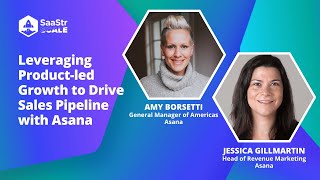
Asana's GM and head of revenue marketing explain how they built a product-led growth engine and are now blending it with sales-led motions. They stress that success requires clear product-market fit, cross-functional alignment across product, marketing, sales, and customer success, and unified data so all teams share the same signals about customers.
Chapters
Thank you so much. Hi everybody. Hi Saastr folks on the line and welcome Amy.
Thank you. Hey everybody, great to be here.
And just to give a little bit of background, as I said, my name is Jessica Gilmartin. I run a revenue marketing team, so I'm responsible for our global demand generation, our account-based marketing, and our marketing operations. Amy, can you tell the folks a little bit about yourself and what you're responsible for?
Yeah, absolutely. So I have the luxury to be the GM of Americas over at Asana. And so what that means is I look after all pieces and parts of revenue from our sales segments to our channel strategy, to customer success, sales engineers, and the like.
It's a big job.
It's a great job.
Yes. Yeah. So, you know, I would argue, or I think it's safe to say that Asana is pretty well known in the industry for its excellence in product-led growth. And we've made a pretty big push into the enterprise, which has actually been quite successful. It's been fun to see that over the past few years of being here. I'm really excited to share our experiences, our advice on how we built our product-led growth engine, and also how we have been making that shift to a hybrid product-led growth, sales-led growth model. I think the two of us have been pretty ingrained in that, and so I think have a lot of painful but good lessons to share.
[Speaker:JASON M. LEMKIN] Absolutely. [Speaker:KATIE KAAPCKE] Great.
So before we dive in, here's just a quick overview of some of the topics we'll be touching on today. And as you heard, we'll be sharing a lot of our advice and guidance in the first 20 minutes, and we'll leave lots of time for Q&A. So definitely make sure you're asking your questions, and we'll get to as many of those as we can. So let's start, set the stage a little bit, and chat about the shift from PLG to SLG. So first, thought it'd be helpful for the folks in the audience that may not be as familiar with this, what is product-led growth, and why are companies switching to it? Why is it the hot thing right now?
It's a good question, and hopefully this, this resonates, uh, with many of you that have joined, and it's why you're here. Um, in terms of product-led growth, the way that, the way that I really look at it is, uh, it's about creating that consumer-like experience where you get a— you extract a ton of value by coming into a product that's offering you some sort of value in your job and essentially, you know, helps you do things better. And I think the growth part of that is all about the virality that can happen, uh, when one person or two people or three people begin to extract value from a product and you start to get that flywheel moving. And so, uh, when I think about it as an organization, it makes sense. Uh, if you build a product that people love and you can define what problems you're solving for them, uh, you can extract a ton of additional value than just having a sales at Notion, for example.
Yeah, there's something that I particularly love about product-led growth, and especially as a consumer, you know, what I think is really magical about product-led growth is that there's a democratization of the product and the experience, right? So in a more traditional tops-down model, you've got a few people within an organization that decide for an entire company what gets used.
That's right.
And there's not a lot of incentive for, those vendors to create a really great experience.
Mm-hmm.
And now with a product-led growth model, you have to earn your right every day to be used by a company. And I think there's something really wonderful about that.
Yeah. There's something actually that comes to mind now that you shared that, uh, around change management. So when you have a scenario that is a top-down model, you have an economic buyer and a couple mobilizers that have made this investment. It's a huge change management process. When you don't have users that have been in the product already. And so, I think when you get this right, you can— not that change is not required, obviously it still is, but you can find advocates and champions and ambassadors of your product when you actually make the decision to buy and do a top-down implementation. And so, it's this great marriage between folks that already love it and economic buyers that know it's going to provide value to the business. And to the people.
Absolutely, and in the long run, it makes it much stickier.
That's right.
Because people actually love it, and they are motivated to change, as opposed to somebody 8 levels above you telling that you now have to put your goals in this random document that no one will ever look at again, right? It's like, if you see the value of it every day, you're going to be really motivated, and excited, and inspired to change. And it will hopefully stay within your organization for many years.
Yeah, absolutely.
And so— and one of the things that I particularly appreciate from a marketing perspective— I'm sure you appreciate from a sales perspective— as well as that it allows you to get signals about which customers are ready for contracts and which customers are ready to buy, right? So in a more traditional sales and marketing model, you have a top-down approach and it's very binary, right? So you have your salespeople will have a list of accounts, they will go after these accounts, they'll go after usually 1 or 2 economic buyers, they'll spend 6 months, a year trying to get a deal. They either win or they don't. They either make their quota or they don't. Yeah. And in this model, uh, you know, you, you have the signals already that there are people that are interested in your product and you have a lot of at-bats, right? You don't have to hit a home run every single time. You can hit a lot of singles and those singles over time will, should add up to something really great. And so I think there's just a de-risking of, of your, uh, revenue model in a PLG motion.
Mm-hmm. Yeah. I, I think, uh, what you're getting at too is at the heart of it, which is data. Right, in intelligence and how you can leverage the intelligence coming from the product to create a real magical moment for a different conversation for sales folks to have and customer success for that matter to have with customers that is grounded in the intelligence and their own employees in the platform, right? Or other companies like them in the platform where we can, you know, essentially be able to provide really interesting insights in the go-to-market motion from a sales standpoint.
Yeah, harnessing that data, man, is that powerful.
Powerful and really hard.
Really hard. How many times will we say really hard in this presentation?
Yeah, hard and worth it. We can do hard things, right?
Yes. So switching a little bit, so we, over the past few years, have, I'd say we have integrated and we are shifting and evolving our product-led growth strategy into a product-led sales strategy. I think it's really important to talk about evolving and not pivoting because these are very much part of the same motion. And so while a product-led growth and a sales-led growth model are both very powerful, this move of bringing the two together in product-led sales is actually very hard, but very worthwhile. And I'd say we are still in the process and we're still on that journey, but we wanted to share some of the learnings that we've had as we have been making the shift. Um, so, so one, I think, really important question that I would love to, to ask you is, how do you know if your organization is ready to, to get those salespeople and to start to think about this transition to product-led sales?
Yeah, it's a, it's a really good question. Um, and I'll start with the customer in mind. Um, and I think that you're gonna hear a theme from us today around putting your customer at the center. And not yourself or your product at the center. And so, uh, one thing from a readiness standpoint, uh, that pops for me in terms of, um, figuring out are you ready to layer on a sales-led motion, uh, which is an expensive investment, uh, to layer in— it's really important to get this right— is can you articulate the problems that you solve not just for users, for example, or employees at the company, um, but for users and the business? So and the economic buyer. When you believe you have a product that can solve problems and you know precisely the problems that you solve, how you solve them, how specifically you solve them, and as well as how you talk about them. When you can get to a place of beginning to reckon with that, I think that is a wonderful signal to go, hey, if we can start to really drive value for economic buyers, we're already seeing the value at the user level. Now we know, you know, how much that sales investment should be, where it makes sense to put those sales folks in terms of the customers that make the most sense from a product-market fit perspective, and then also the sales profile that, that feathers in. So that's one. Another one that comes to mind, Jess, is, um, where you are starting to really experience product-led growth, like which markets inside of what types of accounts or customers are you starting to see this growth. And with your product product-led growth engine, if you were seeing a ceiling in certain segments, let's say that, you know, you've made a big investment, you have a sticky product that's really sticky for people inside of small organizations, um, or even into, you know, mid-market size organizations, but you're not seeing, uh, additional kind of virality or that, that level of growth upmarket, that can also be a signal in terms of readiness for, is it the right time, for example, to invest in enterprise sales team? Now, if the first is true and you know the problems you solve with specificity, you know how you solve them, and the product itself, for whatever reason, is, is finding constraint in terms of that growth on the engine side, that may also be a really important moment and signal to start to feather in a couple enterprise sales folks start to understand the value extraction with those conversations, assuming you can really bring in the intelligence, and then make big bets or small ones on continuing that level of growth and testing and iterate— iterating over time, which is absolutely critical.
Yeah, that is such an incredibly great point, which is, you know, who are your customers? You know, if you are seeing a lot of usage and if you're seeing that virality with large customers and you can tell that those customers love you and they are organically spreading the word throughout the organization, that's a really good sign that they're seeing real value. And that, uh, that they're— that if you bring in a salesperson who understands how to multi-thread within an organization, how to articulate the value, how to harness those champions, how to have conversations with executives to create a groundswell of opportunity, um, that makes a lot of sense. But if you're— if you are seeing that the that, as you said, your main customers are very small businesses, or your product is getting siloed within one particular team and it's not spreading, then that's probably an opportunity for you to look and say, OK, what is our long-term strategy? Or we can continue to be a small-business-focused company, and there's nothing wrong with it. But then you're going to take a different approach, which is really focused on efficiencies and operations and marketing. That's right. Um, or if you are, if you are absolutely very eager to move to mid-market enterprise, then that's an opportunity for you to think about what do we need to do from a product perspective to make it stickier, to make it more viral within an organization before investing from a sales perspective.
Yeah, that's absolutely right. I love that last point. Uh, and it gets back to how I started with, uh, being able with confidence to understand how you are solving customer problems, which ones specifically, and which ones do you not solve yet? Right? And that can be a real input into your product development strategy, for example.
Yeah, absolutely. So, you know, we spend a lot of time together, sales and marketing. We're very aligned. We have a wonderful relationship here, which is one of my favorite things about being at Asana. So I'd love to hear from your perspective. So what are the steps you think the folks on the call should take when trying to form a unified go-to-market strategy? And one thing I want to point out is that, you know, we are trying to take a more expansive view here and think about it not just sales and marketing, but everybody within the organization.
Yeah. And we're just really getting better at this. I think there, there's some authenticity here that, um, you know, we have had a lot of learnings, um, in the past on when we haven't quite had a true cross-company, um, or cross-functional, uh, you know, fiscal planning strategy and sessions and like the real work of co-creation that it requires. And there's a little There's irony there because it's in the— it's the business we're in. At Asana, we are helping organizations do this all the time. And so literally, Jess, you and I have been together a lot over the last couple of weeks doing exactly this.
We're back.
Okay, we're back. Okay, uh, great to be back. Uh, so are we good?
We're good. I just wanted to jump on and be like, okay, making sure we're all set, but it sounds like we are. Hand it back to you. I lost you again. Uh, hold on, make sure it's not on our end. There you are. Okay, you're back.
We're having some minor camera issues, but we're going to navigate this as as best we can.
Yes.
It happens.
It does. It does. You know it's live when— So, I think, Jess, you were talking about the value of cross-functional alignment, especially when you have these two motions in play. So, something that we're doing right now is aligning our collective kind of goals and making sure that we're co-creating on those goals, to your point, not just across marketing and our self-serve motion, but also sales, product, operations, because we're all co-creating. And at the heart of this, this is how we're doing it tactically, which I think is important for this audience. We are putting the customer journey at the center of everything that we do. So, in the past, or you may be experiencing this at your organization where you have, you know, maybe FP&A or your fiscal plan, and then everyone backs into, okay, how are we going to deliver against that? And hopefully, your product vision is at the heart of that as well, right? And what can you actually deliver? And without putting your customer journey, how they are flowing through their process and their experience with you, you might be building in a way that is not aligned to what is best for the customer. So, what we have been looking at is what does it mean to seed a customer? And then what does it mean to land and then expand? And then ideally, in a place where we're in, you know, product-led growth is going off, and we've got the right buyers that have already made investments, and now we're in active conversations with the CIO in a wall-to-wall deployment. So ensuring that you've got that view with the customer in the center allows you to dive into what are the customer outcomes that we are in alignment, that we are trying to help the customer achieve at every stage. What does that mean from a roles perspective, accountability, dependencies, like where are we dependent on one another to be able to deliver? You can think about this inbound pipe is a great example in concert with outbound and how you're building that together, as well as what does success look like? What are the targets for each team so we can iterate and measure, you know, month over month, see how are we getting there collectively and being able to make the right level of change in the moment.
I feel like that answer alone could be a master class. Exactly. It could be a whole semester at Stanford Business School on how to build a PLG/SLG hybrid motion. I think ultimately it really is about, number one, creating the right incentives and making sure those incentives are aligned across the organization, not just sales and marketing, but product, finance, every— customer support. And I think also just putting data at the center of it. And that's incredibly hard because the current systems and models and processes that we have are actually, have not been created to support a hybrid motion. They have been created to support a marketing-driven motion or an enterprise sales motion. And so this is your billion-dollar idea out there, guys, is how to bring those two together, and how, and because it's really, really hard. And I think one of the things that we're really navigating is how do we create that level of intelligence about a customer so that everybody within the organization is looking at the same information and making the right decisions for the customer based upon that same information. And that's actually really hard.
Yeah, it is tough. I'm curious, um, to kind of flip this a little bit.
Yeah.
Uh, because it's so critical for marketing and sales, you and me to be lockstep, can you shine a light, uh, for the audience on, um, how marketing needs to evolve to support a PLG and SLG or product-led sales growth motion?
Absolutely. Um, if the bingo card is out, I will say it's hard again. So yeah, and I would say that I sort of always joke that it's basically like running two marketing teams because you have to really do both. You have to think about all the different steps of the customer journey and what makes sense at the beginning of the customer journey is very different than what makes sense at the end of that customer journey.
That's right.
And so we really think of it in this awareness, seed, land, expand way. And so I think from, I think people are pretty typically familiar with what that would look like at the top of the funnel, right? So our job in marketing is to really think about who are we trying to drive into our funnel? Mm-hmm. And again, making sure that that is aligned with what the sales team is looking for, right? It's very easy to drive leads. It's one of the easiest things in the world to do, but it's really hard to drive the right leads that sales is excited about. And so that's our number one priority and that's our number one job with marketing at the top of the funnel is to make sure that we are We are making our company and our product aware to the right people at the right time and getting them into the, the start of that customer journey and getting them into the product funnel in a way that makes them product qualified leads.
Well, and I love your call out to ensuring that the sales team or revenue team in concert with the marketing team agree that this is the type of lead that has the highest propensity to move forward.
Exactly. Exactly.
And that level of alignment is so crucial and often missed.
Yes, 100%. And it's, it's very easy to get into a, a battle of, um, well, I got you the leads, but those weren't the right leads. And then you don't have that communication, the back and forth. And we've experienced that. Of course.
For sure. I mean, this is like a work in progress. So I think we are starting to really, um, unearth together how meaningful it is for us to be speaking the same language.
Yes.
With the customer at the center every single time.
Yes, absolutely. And then I think what's also really important is that thinking again about the customer journey, you know, when you think about that land and expand motion, marketing's job is to then think about how are you enabling that expansion, that virality, and then how are you mobilizing those champions, so those people that have taken a risk on you, that are using the product, that love it. How are you giving them the insights, the data, storytelling that enables them to be able to share, in our case, share Asana, the magic of Asana with the rest of the organization. And how do we enable the sales team to have those value stories, to know the value that Asana is driving so that they can have those conversations with the C-suite, with the executives, with the economic buyers. And then, and ultimately at the largest enterprises, right, our job is to de-risk the purchase. So, you know, at a large organization, it's very important for them to be able to understand, you know, is this gonna be a product that I'm going to be able to use for many years and that, um, is going to be secure and safe and that my team will love. And, um, and our job as marketers is to make sure that they have all those proof points so that they can make a really informed decision.
Thank you. Super helpful. Hopefully that was helpful to you all as well.
Wonderful. So just to recap a little bit before we move on to the Q&A. So number one, we've talked a lot about this, which is really putting your customer first and focusing on the customer journey, the engagement process, and making sure that all of your teams across the organization are aligned on that one singular customer journey. The second is it's all about just uniting goals. It's around the organization. So it's not just what is sales doing, what's marketing doing, what's products doing. It's bringing them all together and making sure that you're doing the really hard work to align on who are we targeting and how are we measuring success, right? What is the very demonstrable and clear way that we are measuring success? And then finally, just bringing the data and the systems together. So I mean, that's something that we talk about all the time, which is how does the sales team know who the right people to target are? And that's a function of the entire organization to do, right? It's data science, it's product, it's marketing, it's everybody coming together to sort figure out what's the information that the sales team needs to be as efficient and effective as possible in their outreach.
Yes, yes, and yes.
Wonderful. So with that, I will, I will answer some questions. I already see some questions popping in. So when you're aligning product and sales teams, what channels do you use to optimize this communication?
I'll take this one first.
I'd love to hear your perspective too.
So this is a shameless plug for Asana here. This, you know, Asana is built for this purpose, to bring teams together, to align, to take the collective goals that you create and connect them to then the kind of cross-functional work that you have together. And so I am going to use a real example right now. We are having a number of conversations with product to do exactly what we're talking about, right? To take product and marketing and sales and ops and all the functions to come together to co-create on our collective plan. So Asana is core to that level of collaboration. When we think about— we all have meetings and there's a lot of words that are shared, and then we all have that scenario where perhaps actions aren't taken and tasks kind of are done, but perhaps not coordinated. And so we certainly eat our own dog food, drink our own champagne or cider, however you want to talk about it, to try to ensure that we can drive the most efficient process possible. And there's other tools that we use, certainly like Zoom and Slack, and trying to ensure that we can also move at pace on the in-between. For these conversations, I will say there's also wonderful value in bringing folks together. And of course, that can be live and virtual, but having very focused working sessions where we have, you know, real talk on how are we doing, how are we serving the customer at every single stage today, current state, and what does future state look like? And so I would say at the end of the day, it's blended from a channels perspective with Asana core to how we get work done.
Yeah, and I obviously put another plug in for Asana, but I think fundamentally what every organization needs to do is get product talking to customers. Yes, and I think that that has always been a challenge, and it's always been this issue where sales is filtering information to product, and it's very hard for product to build that deep empathy for the customer. And so every product person, every engineering person should be out talking to customers, should be hearing it directly. And I think if you can get that level of empathy, it will actually be pretty fundamentally game-changing. And I think also, one thing that we've done a really good job on over the past year is creating a really structured escalation process and product development process, right? So especially as we've been moving more towards enterprise customers, that prioritization of product features, it becomes more and more important. And so having a documented and agreed-upon process for how product will make decisions on the roadmap in conjunction with sales is very important. So again, breaking down those silos.
Yes, absolutely.
So how do you onboard sales team members? What types of tools do you give them to become experts in the product?
Another plug here. So onboarding, you know, I don't know, many of you probably wouldn't know this unless you jumped over to my LinkedIn profile, but I was a sales enablement before I actually moved into sales years ago. And this, this opportunity and problem of sales onboarding was always at the center, especially in a world where you have, you know, hypergrowth. And we have again, it's like a blended approach, many different ways that we onboard, but we actually do really leverage Asana to have a structured onboarding process that both the new person and all the different parties are going to plug into that experience are aware of. And so let's call this like the, the internal customer journey. When you think about a new team member also being a customer. Right, when you, when you come in. And every great enablement leader is going to kind of think through that. So we bring in some of our experts from our professional services team, our customer success team, our product team. It's a multi— I would say multi-team, cross-functional approach on getting all of our new sellers. And I would argue not just new sellers, but new people coming to Asana, and certainly new revenue members. Adept to, you know, how does our product drive value to the customer, what problems do we solve, and then deep product understanding such that when they're having the conversations, they can rely on themselves, certainly, to go deep and then bring in the right parties in the sales process to ensure that the customer has a really good understanding of what value they can extract over time with deeper investments with us.
Yeah, yeah, I'd say from a marketing perspective, our job is obviously to provide the inspiration, right, and then the storytelling.
That's right.
And so we want to make sure that every salesperson that comes in understands our story, understands our value, can tell our story in a really articulate way, and is just, of course, inspired to be here and inspired to sell the product.
Absolutely.
And I'll answer— I think we have time for one last question. So how do we all work together to convert free users to pay users? Of course, that's that's the holy grail and that's the most important thing. And I'd say, obviously we have a free trial experience, that's a very important way for us to get users into our funnel. And then really our job is to work very, very closely together looking at data to optimize that. So our sales team does not typically get involved with free users. It's just a pretty inefficient and expensive process for them to be involved in. And so the marketing and product really are focused on driving that. And so we look very closely at usage data, we look very closely at conversion data, and obviously there are really two main ways to really think about this. One is in-product cues. So as users are logged in, what are the opportunities for us to point out features in the product that are really helpful for them as they think about moving from free to paid, and what additional value can they get by moving from free to paid? And then email is obviously very, very critical to really thinking about that first 30-day experience and really focused on not just the task that they can accomplish, but what's the value that they're getting from Asana and what's the value that they would get by adding members of their team and really thinking about the investment that they can make in the long term. So that's really how we think about that conversion. It's, again, really hard and it's a constant evolution to make sure that we're getting the right information.
More from Jason

Why Your Next Hire Should Report to an AI, Tragedy Apps, and Too Many AI SDRs? | The Agents #004

Our Agents Drove Our Salesforce Bill Up 80%, Marketo Hates Agents, and We Stealth-Churned Off Notion




Managing 20+ AI Agents: Lazy Agents, Our $500K AI Bill, Stealth Churn & the Death of 60% Solutions




