Live from SaaStr Annual 2022: Kick off to SaaStr Annual 2022 with SaaStr's CEO
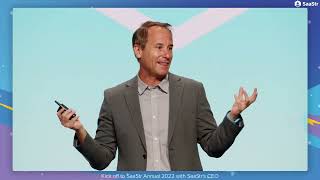
Jason Lemkin opens SaaStr Annual 2022 by reviewing the community's ten-year growth, then warns founders that while SaaS demand stays strong, public-market multiples have compressed sharply. Capital efficiency and valuation expectations are shifting, he says, as tomorrow's sessions will explore new fundraising strategies.
Chapters
Please welcome Saastr founder and CEO Jason M. Lemkin. Hey everybody. Can you hear me all right? Thanks for everyone coming. This will be a pretty informal session. This— we're just jam-packed with— we have 250 speakers. We'll run through the math. We have over 1,000 brain dates. There's a lot of intensity. So I'm going to try and keep this one a little simple, if not lighthearted, and just thank everybody for coming. Talk about what I'm seeing in cloud for a minute and maybe a little bit about the rest of the day and rest of the event. But first, who was here last year during our, during our crazy event? Really? Okay, cool. Well, thanks. Thanks for coming back. I'm glad that we survived this crazy pandemic. Last year was actually, for me, maybe the most fun, but it was crazy. Was here. A little bit like this, but half the size, but only the US could come, right? There are a handful of folks from India, but, but as crazy it is, a year ago, like, you couldn't get a visa to come to the United States. No one from Europe could come. So it is so great to be here. And while it was a minor bummer, as you saw in the video, that we lost 10 million when we had to cancel 2020, it was great that we were able to kind of— we were forced to reboot things like our workplaces being distributed. And I think this sort of 40-acre hybrid experience is like the right way to keep scaling things. So give us all your feedback. I would like your feedback. Send me what you like and don't like, hopefully at least with some nice things together with the criticisms. But we do, we do want them so that we can keep scaling and building this. And I want to just talk about a couple of things. First of all, this is— we had a little fun with this. It's the 10th year of SaaStr. It's the 8th SaaStr annual. I know it's so confusing. I met, met a great guy yesterday that told me he'd been to 9 of them so far. This is the 8th. So I know it's a little confusing with the math. He also promised me he'd be at the 20th. I hope you guys come too. But I want to walk through the 10, and then I want to talk about something we've, we talked about a little bit actually when we got, when 2,500 of us got together in Barcelona, is how it's the best of times, but it's also crazy with the stock market. So I thought maybe I could distill a little bit of that and give some context for today and tomorrow. But first, thanks so many of you here today. Some of you are new to SaaStr. Some of you I've bumped into. They just heard of SaaStr last week. But I'm shocked how many of you came to our first meetup and read a lot of our early content. It's so great to see. Um, and so many of these connections here came out of this early content. But fast forward to today, we have almost 7,000 posts and answers, um, which is pretty crazy. Um, luckily I don't have to write them all anymore. Uh, like 1,000 for me was about enough. Um, we crossed 8 million podcasts, which is great. Thanks to Harry Stebbings for getting that going. Um, that's pretty pretty neat. Um, while Quora has changed, um, we have 74 million folks still reading us there. This one I don't even get, um, it's pretty crazy, but I checked WordPress before I did this. We have 4.6 million unique folks that have read something on Saastr. Who knows where they came from? I don't think they're all SaaS CEOs, but, um, it's kind of cool. Um, and then we, we didn't even really do newsletters before last year, a year and a half. We've had— we do about 400,000 a week now. We'll do them better. We counted up all the events, including the digital SaaStr 2020. We had 150,000 unique folks have come to our events. SaaStr U, which is like our e-learning platform. If you haven't checked it out, you don't need to, but it could be great for your team. We structure a whole bunch of lessons for different stages. We have 15,000 free students on that, and we've done 8 annuals and 3 Europas. And I'll hit a few other things. But what's funny, this is the very first SaaStr post. Everybody lies. It's 10 years ago. And before anyone had gone public, you know, of this generation, the first SaaStr Annual was 2015, and our first kickoff speaker was Aaron Levie from Box. He came one week after the IPO. That was like the first of this generation of company IPOs. So when we wrote it in 2012, everything was still opaque. We didn't know what it was, and I wrote this post about how everyone kind of exaggerates their revenue. And what's funny is you look back 10 years ago, number 314 on the list was this little startup called HubSpot. And HubSpot back then, we had to kind of guess using this data from the Inc. 500, but we guessed They were at about $28.5 million in revenue, which was pretty good. And fast forward today, HubSpot's coming up on $2 billion in revenue. $2 billion in revenue. Think about the compounding power of recurring revenue. I didn't get it as a founder, frankly. I don't think we all got it until maybe 2016, 2017. What about you, Christophe? When did you understand recurring revenue? 2018. A bit early. Alright, but even it was funny when you look at that Aaron Levy video from 2015, the second question I asked him was, did Wall Street understand recurring revenue in SaaS when you talked to him? And he's like, well, they're getting there. But this is crazy. So it's great. Tomorrow we will have both the co-founders of HubSpot, Dharmesh and Brian Halligan, will be here together. I'm gonna do a session with them talking about what it's really like to be co-founders on this journey. It's pretty neat. And not only is HubSpot coming up on $2 billion, folks, but it's accelerating. It's growing much faster than it did at $1 billion. And so look back 10 years ago with SaaStr, and I knew about HubSpot. I didn't know how big it would be at $28.5 million. Now almost $2 billion. It's crazy how this compounds, right? And it's funny, if you, if you heard David Jennett's talk from CEO of HashiCorp just before that, he's like, $30 million is when these things really get unstoppable, and you know, look at HubSpot right there. So think in terms of a decade, founders, like go long. We've all figured out it's worth it, and this is one great example from our, literally our very first blog post. And here, just briefly, I want to thank folks who've been with us. We did a random meetup in 2013. We've been doing this for 10 years. I'd never done a meetup. I'm not really that good at parties. I'm not that social, but It seemed like you have to do a meetup if you have a community. So we had 400 come to the first, 644 come to the second, and then we just kept going. And this year we'll have— actually, it's more than this now. We'll have over 13,000 folks come to Annual in Europa this year. So that's plenty. Like, we don't need 100,000, but it's pretty cool to watch this, watch this grow. And maybe the last point just on all of this and just to thank everybody or go to our YouTubes or go to other things like the really cool thing about SaaS. And this is table stakes today. Like, if you haven't been part of us for 10 years, you won't get it. But one of the many unique things was that people would share, that if you invited at our first one, if you invited Aaron Levy and Stewart Butterfield and David Sacks and other folks, and Eric Wan a little bit later, and others here, that like they would actually share. They would share their mistakes and stories. I know this commonplace, but no one had ever seen it. And just look at the folks that have shared, right? I mean, I won't read all the names, but it's hard. This is just a subset of the best of the best in SaaS. So it's inspiring to me. It's inspiring that everybody wants to give back. And, you know, when you build the next Datadog or Notion, make sure you come back and share too. It may take you 10 years, but it was okay for— it was okay for HubSpot. And just briefly on today, this was before we crossed 10,000 folks here. So that's pretty cool, especially when traditionally we've been 50/50 US, outside of the US. This year was still only 75/25 because of a ton of visa issues, especially in India and otherwise. So probably would have even been 12,000 or more if the world was fully normal. But that's pretty cool. Hopefully everyone's been to Brain Dates behind us in Sassafras Square Park. As of yesterday, we had over 11,000 connections made in over 1,700 Brain Dates. And thanks to our sponsors for making this work for us since the tickets are massively subsidized by the sponsors. So we had 21,195 lead scans. So even if it was just for coffee, thank you for, for doing the lead scan to keep the lights on. Just a couple of things coming for SaaStr as stakeholders in this community. One thing that has taken 8 years to do is what we wanted to do, this little website that we built in 2014, we called it SaaStr Jobs. Now it's gonna be more matchmaking. And so for everyone that is at annual this year, or then for next year, we're gonna roll out a matchmaking program for CEOs and VPs of sales and VP of marketing. And look for this, it'll probably take till late Q4 to roll out, But what we're really gonna do is take this Meet a VC program that some of you have done, and we've gotten pretty good at it, and we're gonna, instead of you being matched with VCs that can take a look at you, instead, you as CEOs will pitch the VPs. And so you will send in your deck, you will send in your best summary, you will send in the best pitch you can for your company and a deck, and the VPs of sales and marketing that are passive will get it from you. They'll get it sorted, they'll get it to you, and they'll be able to read it. And just like there's like 500 VCs in our Meet a VC program, and some folks may not get any VC meetings. I met a founder yesterday that already had 35 from it. The better your pitch, the better your startup, the more you're gonna get. But we'll offer this at no cost to everyone coming to Annual, and I think we know how to do it now. So look for this, but this is something we wanted to do early in SaaStr, and we actually built a lot of software to do it, and it got too complicated, so we never really rolled it out. You know, sometimes a product takes like 9 years to come to market, but we figured this one out. So look for this for anyone that's here a little bit later in the year. The other thing we're going to do is because these Brain Dates are so successful, it's not the same, but sometime in late October, we're going to start doing a weekly online version. So you'll get a couple of these every week. Anyone that's here that will get invited and you can join them and your team can join them. So it's obviously not the same as the amazing experience of being in here and meeting folks. But for folks that can't travel or otherwise, we're going to reproduce this format again. In fact, we're going to start with whoever is highest rated for the, the 1,000 great dates here. We're going to ask them to do it again online for other folks if you have missed it or your team. So that hopefully will give us a little piece of this, you know, the 49 weeks that we don't do, don't do live events. And then two other small things just to note for Annual itself, we are going to keep tilting a little bit more upmarket. Way in the back, you can see a hint. There's an executive briefing center like, like big tech companies have. Mutiny, G2, a bunch of others used it to invite like 100 of their customers here. We're going to do more. We're not going to change our ICB. We're not going to change our core. But, but going into COVID, we want to have a vision of having like a couple hundred more great CIOs and CXOs here. And you'll see that roll out over the next year or two where we'll add more and more of enterprise buyer layer that we're doing. But we won't change that our core is all about founders. But we'll do more to connect folks here. Not just with each other and the top leaders in SaaS, but more and more buyers of enterprise. So that'll take a little while, but there's hints of it. And the experiments we've run here today, we've got hundreds of great buyers, so to speak, that came here that wouldn't have come otherwise this year. So we know how to blow that up for next year. And then just lastly, for getting together, annual will always be our flagship. I'm 95% sure we're going to do Singapore in February. It won't be like this, but it will be our first event in Asia. So look for that. I think we have a date and a venue, but it will need until October to announce it. And then Europa was great this year. If anyone came to Barcelona, we did Sass on the beach for almost 3,000 folks. It was pretty awesome. It was, it was definitely, it was our most fun event, although this one may end up being more fun, but it was pretty relaxed. I would love to go back to Barcelona, but since London is so much bigger and so much core, we are going to London next year, so bookmark it. 6th and 7th, we'll probably have 3,500 or 4,000 people in East London at Tobacco Docks. It'll be a good venue. It'll be a lot of fun. So, um, uh, those are kind of our big, um, IRL events for next year. Um, we hit this. So just a quick, uh, and, and, and feel free to have your own opinions on this, but I thought I could summarize like this crazy time we're in right now, um, which is, um, it's crazy. It's crazy because the The best in cloud are just growing so quickly, and why are they growing, and yet the markets are terrible? I've been busy with this event, but I think that like the Wisdom Cloud or BVB was down like 3 or 4% yesterday, right? I mean, it's brutal, and some of the best stocks, Twilio, iconic companies are down 80% from their peaks. But what the hell is happening? I don't know the answer. I'll give you a few thoughts, and tomorrow's VC Day, so you can get the best of the best from Benchmark and Bessemer and Iconiq and Point Nine and so many others will give you a lot of their thoughts on what's going on in the markets, and it matters for founders. But just look at this chart here, or any version you can find on the internet. The money going into cloud and going into SaaS is continuing to grow at an epic rate, whether it's 15% a year, 18%, 16%, like the compounding rate of better than a trillion dollars of spend growing is this epic force. If you're in some tough categories, like how I top point, if you're in e-commerce, we all— anyone in B2B e-commerce saw a huge hit earlier this year when stores reopened, right? Shopify went from growing from like $1 to $4 billion in a year to 10% growth for its B2B software last quarter. That's a lot of deceleration. Zoom went from $1 to $4 billion, I think in 13 days or something like that. I'm exaggerating. But, but finally, for the first time ever, its S&P declined last quarter. But those are bumps we're going to see in a year. We will rebound. E-commerce is not changing and working on in the distributed world is not changing. But if you take these aside, if you look at the next one, folks that didn't have these weird COVID bumps like e-commerce and web, like, look, take a minute and just let's just look at these growth rates. And this is all public, but I put them together in a slide with some bold. I mean, Snowflake growing 81% at $2 billion, Datadog 74% at $1.6 billion. Bill.com was like, I wrote about it on SaaS in 2010 when it IPO'd. I'm like, this is the sleepy IPO you've never heard of with one of my favorite CEOs. 156% growth at $800 million. Now half of that's inorganic by buying Divi, who's up next, the CRO. So he's one of the great speakers. And but 150, I mean, 156% at $800 million. I won't read them all, but like the reason I picked these is there's probably one like you on this list. If you're SMB, you might like Bill.com. If you're collaboration, Monday is growing 75% at $500 million. Oh my God. Right. You can't stop Monday. ZoomInfo, if you're like that, if you're in the data or you're just in the sales space, 54% at a billion and massively profitable. So pick whoever you're like on this chart. And like, if you feel like things are tough, like give yourself a little kick, okay? You have somebody just kick you in the back because if you're not in a troubled category, these are the best of times. And yes, is most of the benefits going to the biggest and the best? Sure. But that's like always been the case. So what I'm telling you is for growth, No excuses in most categories. These are the best of times. CIOs, SMBs, everyone in the stack is putting more and more money, generally speaking, into almost every, not every category, but almost every category. And next year, no matter what people talk about on these recessions and issues, they're not evenly distributed. Okay. There are industries that are hurt, but we're also at 3% unemployment. And just look at these numbers. Look at these numbers and challenge yourself to do even better with an asterisk. That stock market multiples being down creates a bunch of challenges for us as founders, right? So this is the weird world. And you can look on the Twitters and the internets and you can hear people talking about DCF and interest rates, blah, blah, blah, blah, blah. Maybe, maybe. I don't know. All I can tell you is ignoring all the brilliant economists out there and all the brilliant VCs as economists who last year were doing 100x ARR rounds. They were so brilliant then and they're so brilliant today. To me, this makes no sense. To me, it makes no sense that we could see the best startups growing at rates where your jaw literally hits the ground, and that over, if you look at the BVP, BVP Nasdaq Cloud Index over the last, what'd I do, 6 months, a year, down 55%. Okay, it doesn't make sense. And, and, and don't get the wrong inputs. Don't think we're in this terrible time of this horrendous recession. But the markets are down. Unicorn creations are down. So I've been doing SaaS since 2005, I think, something like that. Some of you have been doing it longer. Christophe was the first angel investor in Zendesk. Some of you have been doing SaaS for 2 years, but I've never seen a time like this. I've seen up and down times. I've seen a SaaS crash of 2016, which people don't even talk about, when LinkedIn was so scared they sold to Microsoft in a fire sale. Okay, that was worse. But I've never seen this time when the growth was insane and the markets were down. When LinkedIn got spooked, they got spooked because they missed 2 quarters because it looked like people were going to stop buying SaaS. Okay, there was a moment, we don't talk about it enough, in 2016 people genuinely thought, hey, maybe we bought enough of this SaaS stuff. Like we got, how many more collaboration softwares, how many more chat systems do we need? And generally for 6 months people were spooked. The markets, the buyers are not spooked, but yet the markets are way down. So it's just crazy. And don't overreact, don't underreact. To me as founders, the only real implication is VC and capital market, right? Because they are just locked down and it's crazy. And tomorrow's money day and we'll, We'll talk a lot about that tomorrow, but this is the crazy world we're in where in most categories things are great, but goodness gracious, the stock market's crazy, right? And the biggest disconnect, here's another version of it. I think I went back all, here's BBB all the way back to 2013, and you know, the debate, this is multiples. So this is revenue multiples, and if you guys aren't thinking as founders about revenue multiples, you don't think, need to think about it every day, but you do need to learn about revenue multiples. $2 million in ARR, $10 million, $20 million, $30 million, roughly with a certain growth rate, 50%, 100%, 150%. What are you roughly worth? And it's actually not— it's more complicated than it was maybe at peak 2020, 2021, but it's not that complicated. Like it kind of all goes into these charts that you can see in a variety of places, including on Bessemer's website. And what you can see is that multiples are kind of back to where they were, depending how you look at it. Certainly before all of this peak craziness and, you know, 1,000 unicorns and back to 2018 or 2019. So are we going back to where we were for 6 or 7 years where it's pretty friggin hard to get to raise a Series C? It's pretty hard to get a $200 million, $300 million valuation where unicorns, as Aileen Lee wrote when she coined the term unicorns, and she'll be kicking off VC Day with me tomorrow, when unicorns were rare. That's why she coined the term with 1,000 unicorns. Like if you're at VC Day and you haven't done like 10 unicorns, you're kind of a loser. Right. But they're not coining any right now. There's no— not too many more unicorns happening today. So are we going back to these times? And the truth is, we don't know. As founders, you have to roll with it, right? It's hard for me to believe with the jaw-dropping growth that we see at Asana, at Monday, at Bill, that we are going to go back to the days when SaaS grew more slowly. It doesn't make sense. But we don't know. Right. And this one founder wrote in response to the tweet, Most founders don't believe this is a reversion, it's just a dip, right? And I hope that's true. I hope that this chart keeps going up, multiples. We may never have the peak craziness we had when the world ran entirely on software, but if we're going back to old multiples, it's gonna be tougher. It's not gonna be tougher to get customers, but we are gonna have to be more capital efficient, and we're gonna have to change, in some ways, some of the laziness that we approached venture capital and fundraising. And I know, To a lot of folks that are bootstrapped or have raised limited capital, VC capital, even in peak of 2021, seemed something for the privileged and something rare and remote. But let me tell you, 2021 was a lot easier than any, any time from 2019 to when I started as a founder. The easiest time in 20 years to get VC capital was 2021. Late stage, like, everyone wanted to invest in a unicorn. There are hundreds of new seed funds born. I'm not saying there aren't issues of privilege and problems, But whatever vibe you got, whatever you thought, if you haven't fundraised before 2020, just realize we're in a new world and we don't know what the new world is like. We get— you're going to hear it from 100 VCs tomorrow, their views. Some are going to tell you the world's ended. Some are going to tell you everything's roses. Most will be in the middle. But we just don't know. But what I do know is I don't think in my lifetime as an investor, a SaaS founder, I don't think we're going to go back to 2020, like 2021. This crazy peak number is a— I doubt it. It's possible. Maybe if interest rates go to like -2%, I don't know, I'm not an economist. But the world's changed, so we kind of, we kind of have to adjust. And this is kind of the theme that I think we'll talk about a lot tomorrow. So I won't do too much about this. We'll talk all about this tomorrow. Tomorrow's money day. You do not have to be fundraising to participate in these conversations. They're all about just understanding how all of this stuff works. There's tons of VCs and more you can move in, but we'll, we'll hit all of these points tomorrow. And again, this ultimate issue is valuations. And I'll give you another example. We talked about those great growth rates. Just to kind of finish on this thread, and then we'll just talk a little bit more about the rest of SaaS. But I picked one example, but you can pick more. Look at PagerDuty. PagerDuty is one of my favorite SaaS companies. If you're sort of in developer-focused stuff, it was one of these iconic ones that broke out a generation ago, right? People, everyone started using PagerDuty, and it was hard not to love the app. It was easy to get. It was SMB-focused. They've kind of done everything right. They IPO'd early. They were somewhat capital efficient. Now, Patriot Duty is at $3,600 million in ARR, growing 33% to 34% every quarter, quarter after quarter. In fact, a smidge faster than it used to. It's getting profitable. It's not slowing down. It has 124% NRR and a $2 billion market cap. We could pick some others. We could pick companies like Amplitude and tons of others, but this is a company coming up on $400 million that's trading at $2 billion. Right? So when you're out there thinking your company's worth $200 million, $300 million, at $10 million in revenue, like, why? Why? And this is the existential challenge. I believe that you're worth those hundreds of millions of dollars. I got your back. But when these iconic— there's nothing wrong with PagerDuty today. There's nothing you can pick at. You can say, hey, why can't it grow 35%? I mean, of course you could say that, but this is epic growth. This is adding another $100 and something million a year with the NDR. Without decelerating at all, getting profitable. And it's worth, I think it should be worth $6 billion, $7 billion. You can ask everyone's favorite, but it's a crazy world. So if you're not looking at this, this is something just to be cognizant of as a founder, because everything around capital is hard, but everything around buying, these are, these are good times to have like a market dominating product. So I'll wrap it up. All I can tell you is I think we're, it's going to take a while. I don't think until maybe SaaS Annual next year, we'll really know how all this stuff around the markets and multiples shake out. I just know when we come here next year, Like the, the amount of money going into SaaS by buyers will be up more than 15%, which is epic. That's hundreds and hundreds of billions of dollars. So if there's hundreds of billions of dollars more going into overall cloud and software next year, like just get a little bit of $100 billion, just get like 0.01%, 0.01%, and you can be pretty epic. It is not a flat market. Someday all, all of the IT budget in the world will have come into SaaS and we will have a mature market, which is what a lot of us feared in 2016 when LinkedIn sells. Turns out we're nowhere near that. The amount of new money going into cloud and SaaS is so high, so take advantage of it. So we'll hit that, and just for a couple minutes, and then we'll break because we have some amazing sessions coming out of this. You guys have probably all figured out, but just a quick look at today and tomorrow. I think almost all of you have done Brain Dates, but we filled up the SaaS Square behind us. It's become our hub. We got this, we kind of nailed this in Barcelona and blew it up here. So go for all these Brain Dates. People love it. If you can sign up in the mobile app, or you can just literally walk to, to the booths and just look at the Brain Dates they have and sign up online. But we have 1,700 of these scheduled, and there's someone out there that is an expert or passionate about a topic you want to learn about. And also, if you're here solo, you could spend the whole day there and meet great people, right? It's a perfect way to meet people. So, so do that if you haven't. If you just got here, we actually get bigger today and tomorrow. So if you were here yesterday, there are 3 more stages lit up. So there's the big plaza stage way at the end. You'll see it there. It's a big, huge tent over there. And then there's 2 more Q&A and AMA stages on the runway. But this whole area outside of the gates over here, we've got 3 more stages. You've probably seen the schedule. If you haven't, go find it. There's 3 great sessions. The 2 ones right before this were packed to the gills. So tons of content, maybe too much, but we do love it. Tonight's the big party. We have Duke Dumont. We did, as a team, because we do events, we did a team event to Coachella this year, and Duke Dumont was one of our favorites, so we tricked him to coming here. So he'll be here. This will get all turned into, it'll look like a mini Coachella. We've got a, we've got an art car behind us for today lit up that you can, some of, if you don't drink too much, you can go and stand on the top and have some fun. But it's pretty fun. There'll be, there'll be a lot of food, more food here tonight, more drinks, and we'll kind of dance it up here for an hour, which is which is pretty fun. And then just briefly, tomorrow morning, for those of you that want to do more networking, that haven't met enough people, we've got like these 3 different breakfasts tomorrow morning here. They're just designed for schmoozing. We've got one just for VCs and LPs. I think we've got like 150 VCs. That one's just for VCs. One for CEO and growth, and one sort of sales-focused. And if you haven't, you can just sign up in the mobile app, and it's just a chance to informally meet folks in your functional area. On sort of day 3. So that's pretty much it other than money day. We've got tons of great speakers, but we've got Bessemer State of the Cloud, which is always popular here. We've got pretty much every, you know, half of the, all the top funds from Andreessen to Bessemer to Benchmark and more presenting tomorrow. Go listen. We have non-VC content too. We've got plenty of great stuff, but it's just to learn, learn what's going on in the markets, learn where the multiples are, learn about all the stuff we talk tomorrow. Let's do, and then we'll do not only a big wrap party here, But if anyone actually wants to hear from me more, I'll do an AMA at the very end until I collapse. It's pretty fun. So I can try to grab a few other speakers too at the very end, and we'll do it until they kick us out tomorrow. So thanks, everybody. All the next sessions are great, and appreciate you guys coming.
More from Jason

Why Your Next Hire Should Report to an AI, Tragedy Apps, and Too Many AI SDRs? | The Agents #004

Our Agents Drove Our Salesforce Bill Up 80%, Marketo Hates Agents, and We Stealth-Churned Off Notion




Managing 20+ AI Agents: Lazy Agents, Our $500K AI Bill, Stealth Churn & the Death of 60% Solutions




