Live Workshop Wednesday: A Tactical Guide to Multiproduct with Dennis Lyandres, Former CRO @ Procore
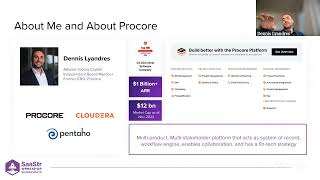
Dennis Lyandres, former CRO at Procore, breaks down how to build multi-product businesses in vertical SaaS. He walks through three pillars: product strategy, people and resources, and go-to-market. Procore grew from a single construction tool to $1B ARR by sequencing products carefully, targeting the right buyers, and using cross-functional pods to own each new product.
Chapters
So we're so excited today to have Denis Liandris. He is the former CRO at Procore and now an advisor at Iconiq Capital. And we're gonna be talking all things multi-product today. So Denis, thanks for joining.
Yeah, thanks for having me. And I can't say enough great things about Sastra. I have been a reader and obsessive fan and have just gotten so much from this community. So it's like, such a frickin' privilege and honor to get to be here. And I'm going to chat through what I think is one of the most important topics as it relates to growth, and that's multi-product. And I think multi-product is one of those things that does require a lot of intentionality and a lot of work aligning different parts of the organization. And so I'll try to talk about and offer some examples of that intentionality, including through Procore as well as some companies that I work with today that are doing some really cool stuff on multi-product. And the 3 vectors that I hope I can kind of offer to the group is like, hey, these are the areas to really, really focus and integrate and align our product, people, and your corporate resourcing for those people and how you enable them to work well together. And then your go-to-market strategy, including around customers and around training. And so as Amelia mentioned, I'm Dennis Landress. I'm an advisor to Iconiq Capital. Um, I also do some independent board and advisory work, and before that I was with Procore. Um, and Procore is a construction software company. Um, so Procore builds schools, hospitals, roads. It sells to a wide variety of different folks in the construction ecosystem. I joined at about $10 million in revenue. We were a single SKU, uh, company. Um, and throughout that journey, we really evolved to become a multi-product company. A multi-stakeholder company, um, a platform, and to have a very compelling fintech story. And I share that framing— multi-product, multi-stakeholder, platform, fintech. I know it's a lot, um, because I think it's part of the example I hope to share is like we were very, very intentional about doing that. And I think had we waited later to start to do some of the multi-product stuff, to start to think through how we, we expand through the value chain, I think it could have been a little late and it probably wouldn't be the company that is today. Since today Procore is over $1 billion in ARR. Um, it's a public software company. Um, and I think it's got an incredibly bright future. Um, before Procore, I was with a couple of other multi-product platform companies. One was Cloudera, um, and the other was Pentaho. Uh, Pentaho was data integration, data analytics. And I've tried to be a really big student of multi-product. I would say I'm probably more a student than a teacher. So I'm really looking forward to the discussion here because I learned so much from doing this. But this tries to bring together all my learnings from my own experience, from advising, and anywhere else that I could talk to the smartest people around on how to do multi-product.
Awesome. And then before we get into it, I know you already shared a little bit about your background. We were just chatting before, you know, we typically do just a little bit more of an icebreaker with our speakers before we get into formal slides. So Just, we'll do the icebreaker and then just real quick for folks either in the Zoom room or watching live on the livestream, put your questions in for Dennis as we go. And yes, you can drop into the chat where you're tuning in from, as some people are starting to do, as they know from each week. And then yeah, Dennis, I know you, you, you just mentioned these great companies you're at and then now you're at Iconiq. Is there, just as a quick icebreaker, is there like a, since you're advising, is there a company that you're advising now that you're like super excited about just to give people like a flair of, of what you're doing more so now?
Yeah, gosh, there's definitely more than one, but I talk about it later in this presentation, so I'll just highlight Notable. And Notable is AI for healthcare operations. So similar to some of the challenges Procore face, there's just a massive labor shortage in healthcare operations and it impacts every single patient who goes through the healthcare experience. And one of the things I think they're just doing that's so rad is the way they're going about multiproduct, the way they're future-proofing it with AI agents, the pricing and the packaging model. So Notable would be an example of a company I'm pretty fired up and pumped about.
Yeah, that's good. Okay, we will let you take it away and then we'll do questions at the end. I'm sure there'll be a bunch about going multi-product, but yeah, without further ado, thanks for doing this.
Yeah. And so I tried to offer a little bit, and I'm gonna go through this a little bit quickly and not read through the slides verbatim, but just on the why for multi-product and then each of the breakdowns, product strategy, people, corporate resources, go-to-market, and then I'll go into Procore as an example. And a few other examples. So some of this stuff may seem a little pedantic and kind of obvious, but I have found that making it explicit can give you an understanding of why it's so important and also how to make sure you get all the benefit of multi-product. So, you know, when I think about multi-product, I'm like, well, truthfully, shoot, I mean, we sort of exist as technology companies to build products ultimately that MAP with support and customer success to create a solution. But the product is like the thing we do. Um, and I think it's increasingly clear that if you wanna build a really big enduring business, um, multi-product is highly likely to be an essential part of that journey. I also think that today you can build software faster than ever before, and especially as you look at vertical software, folks are just building really cool stuff that meets a specific use case. Um, and so one defense to deliver more value and sustain yourself from a competitive perspective is to be a multiproduct company. And I also think it's how buyers want to buy. I mean, you've seen that with a lot of the trends over the last couple of years with, you know, consolidation, rationalization of your IT footprint. And, you know, I couldn't help but comment that employee engagement and customers have sort of been the two pillars of everything I've done to try to be successful as an operator, as an advisor. And this is really meaningful to employee engagement. You know, if there's like nothing else that's coming down the pipeline and it's just, hey, sell this and get really great at that, like, that's not as awesome as exciting. And then, you know, Jason, I'd love your thoughts on this, but I think I have like trauma from, hey, your market's not going to be big enough. And maybe this is vertical software in 2014. And we certainly brought to bear that perspective in our strategy. But I think if you get really good at building product and then taking that new product to market, You should never be constrained in your market size. And so multi-product for me is important because it really hits on the most important things you need to do to sustain your success over a long arc of time. So when it comes to product strategy, so this is one of those three pillars that needs to be integrated and aligned, right? I think you want to think about building a next product that makes your existing product more valuable. So sort of 1 1 3. For Procore, we did that. We had documents and drawings and we said, hey, if we can start to then link that to all the financial business processes, that's a broken workflow. That's going to make each of these products more valuable. And I think that as you think about the product strategy, trying to understand how you thread that all the way through to go-to-market. So at some point, like we have to call someone, we want to get higher and wider in these organizations. We want to matter more to the people who cut really big checks. Like I think Notable is doing this really well and I'll talk about it later. And in that In that regard, this ability to build a product portfolio that helps you get higher and wider is really helpful. And one simple way to think about it is, you know, see if you can follow the workflow and there's somewhere where it breaks and then they go back to Excel or they go back into an antiquated system and there's a lot of pain there. I think the old paradigm of like, I'm trying to like help someone make money, save money, or manage risk is a powerful one. Um, and there are all sorts of things that, again, if they're integrated and they're intentional, can create a lot of opportunity. And those are things like data products. Um, I think AI agents is something that is worth really understanding. Can I just make people a lot more productive? And so these are all ways to think about, um, product strategy and what kind of product to build. Um, this will probably get me in trouble, but I think it's okay to use professional services as a short-term crutch. To ensure your customers are successful and to make sure that you accelerate your learnings on what you need to build. I really want to stress the short-term crutch thing because if then 5 years later you're like, ah, we just throw a bunch of bodies at it, we use ProServe. I don't think that that was a successful product strategy, but I do think that it can be part of your short-term strategy. Another thing that I have found really helps folks to think about and to integrate is there's lots of ways to become a multi-product company. Each of them come with their own pros and cons. And each of them, I think you want to align your corporate resources and your people and your go-to-market accordingly. So if you're going to buy companies, then the way that you're going to staff an organization internally and the way that you're going to take the, that acquired company to market, both honoring the legacy customers from that acquired entity as well as a new one, is different than if you're building it organically. Today, the ability to white label OEM embed technology to accelerate time to market, especially on fintech, is really cool. But if you're going to do that again, there are just some pros, cons. There are some different ways that you're going to be able to manage your roadmap or not manage your roadmap. And these things I think are worth understanding, appreciating in advance. I'll talk about this later in the Procore example, but we did have a crawl, walk, run strategy that would ultimately get us to be a platform. And if you're going to do platform, I think there's a lot of lessons I learned, you know, like in particular the sales team and the customers like, hey man, where's the feature function? And you're like, oh, you can't see it, but check it out, configurable fields. And they're like, whoa, whoa, whoa. Like this customer wants this thing, right? Or you're working on reliability, extensibility, security. So if you're gonna build this way, just make sure that you're mindful of the pros, cons, and that you integrate that into how you set up your organization and how you work with your customers and take it to market. On the people and corporate strategy. So this is sort of the second part of the three parts of, you know, multi-product excellence that I think should be integrated. I think it's really important to put your best people on it. That can be really painful because all of a sudden you're taking people who are working on really important things in the core business and you're saying, hey, now go work on this thing. And this thing might not generate revenue for a little bit and it's hard. But I think that you're going to get the best outcomes if you put your best people on it. I think a minimally viable sort of pod for those best people is someone from engineering, product and design, and someone from go-to-market. And I think as it evolves, and I'll talk a little bit about this in the Procore side of it, you want to be intentional and say, hey, like we're having trouble getting someone to believe this technology is the right one for them, or we're selling to an entirely different buying center, entirely different persona. And you can start to specialize more parts of the go-to-market organization. But when you're going multi-product, I think treat it like a startup. So think of it more in terms of early stage metrics you might be used to managing in the kind of $0 to $1 or $1 to $5 million revenue journey than if you're $20 million in revenue. Some of the metrics you might be looking at, like Rule of 40 or ARR per FTE or CAC. So, so think about it like a startup, invest in it accordingly. And when you put your best people on it, make sure that they have a really strong connection to senior leadership. That they recognize the risk and that they're going to get outsized rewards and recognition for this and make sure that they know how to navigate to fix problems. And that's going to land them to all sorts of different places. But that connection to leadership is really critical, I think, in then being able to do that. Iconiq has a slide. They actually have a report that covers this exact subject, which is, hey, there are different metrics you manage to in 0 to 1 million, 1 to 5, 5 to 20. It's illustrative, it's not prescriptive. So there are a ton of reports and literature, um, but I just wanted to offer this as an example, right? You're looking a lot more at signals of product-market fit. You might be taking a lump sum amount of investment saying, hey, I'm willing to put $5 million, and $2 million or $3 million goes to development, and $1 million goes to go-to-market, um, and we're going to look at it that way to achieve these milestones, not Hey, I've gotta ramp these reps, they've gotta get productive, et cetera. All right, so the third pillar, and then I'll go into some examples, go-to-market. I think customers are, are, are just absolutely essential for so many reasons, but they're equally important into the multiproduct journey. So ideally you've done the work up front to have really good relationships with your customers on the core product to make sure that they've realized a ton of value. I say that because those customers are probably going to be where you're going to sell that new product to. And I think that's a pretty good strategy because hopefully you have enough of a relationship that they'll give you a little leeway and they'll give you good feedback. I think how you pick these customers really matters. And there's a couple of things that would make, in my opinion, a customer really strategic in the work to help you do multi-product. One is that they're just going to be a great partner on a couple of fronts. So they're going to help you with product development. They're going to help you with competitive intelligence because there's some way they're doing this already and there's going to be competitors that are also trying to do this. And ideally they will help you figure out how to take it to market. What's the messaging? What works? What doesn't? Where's the ICP? How will it evolve? But where can I sell to today? I also think picking customers that disproportionately matter to the industry and that will say what you want them to say is really important. And there often are customers in various verticals and segments that sort of have a track record of being those early adopters and then lighting up the industry for everyone else. I think on the go-to-market side, as you evolve your product strategy, um, the personas matter. And so when I talk about like taking a product to market and I talk about a customer, I think you just can't care too much about the people. In that organization, their personal pain and win and the relationships that you build. So it's not just customer, it's not just use case, but it's really the persona. And when I think about go-to-market, I've come to appreciate there's sort of this, this tension between product and go-to-market, which is truthfully the better the product is, I think the more you— and I'm not saying you should do this, but I think the more you can get away with on the go-to-market side. Alternatively, if we want to get really, really good at multi-product, then we are constantly pushing the envelope of what the product can do. And we've got to get really, really good on the go-to-market side on how you work with a new product. And to me, the two vectors there again are make the technology valuable with what it can do today and have a really, really strong relationship. I don't want to, as we talk through the Procore side, uh, lead you to think like, hey, this was all roses and this worked out well. Like, there were a number of times where Procore CEO, myself, our product leadership, like we were on airplanes being like, so sorry, right? And those relationships really carried us. And so I think the mindfulness that if you're going to be great at multi-product and you're constantly building product, then you need to build a go-to-market muscle that is specific to taking new product to market. And you can apply that same framework of like, hey, there's a different body of work for being an early stage startup and trying to convince people to give you a chance, vision, sell, etc. Than there is being a mature, established vendor and just scaling out that go-to-market motion. On the go-to-market side, I think that alignment of all the different levers is really important. And an illustration of that would be pricing and packaging aligned with internal incentives. And so, you know, you may not generate a ton of revenue off this product initially, and customers might not be willing to pay a ton for that product right away. That's okay. Still make it really compelling for the customer. They'll make it really compelling for the sales team. So this is illustrative, not prescriptive. But if all of a sudden you're like, hey, you know what, I'm going to pay 10x commission to the first rep that can prove you can sell this new product. And for the first customer that signs up and they're a great reference, I'll give it to them for a dollar. Not forever. I'll set the expectation. I'll let them know. But what you're really doing is driving that usage adoption. You're building internal and external advocates. And as you think about integrating the go-to-market side with the product side, and we did this at Procore, is we started by just kind of adding it into the existing product and just saying, hey, like there's now this other thing you can do in the existing product. Then we thought about, hey, can we make this a module? And then we thought about making it a product. We had the intentionality that it was going to be a product the whole way through, but we were very willing to iterate and evolve in order to meet those outcomes of getting the product into market and just accelerating the learnings to get to to the next step. This is another one that I feel kind of like customer. I could like do hours on this topic, but training and development, it's so frustrating when the product has evolved and the sales team and the marketing team, the customer success team doesn't know how to message it. And I think growth companies and startups are always changing. And in my opinion, the way you kind of hire, fire, promote and see who can keep going for the future is to train and develop. A tactical way to do this on product is just teach someone the new customer success story that speaks about the usage of the multi-product, that ideally covers some of the reasons they buy and why it's different, and have everyone do a stand and deliver. If not at least the, the, the whole company, then at least the sales and the CS team. And look, there's lots of cool ways to do it today, but a simple example is like Use Zoom, have them record it, create a contest. Who's going to do the best one? Celebrate it in all hands. You can obviously use AI call coaching. There's like lots of ways to do it, but have some sort of mechanism to train and develop folks on the product and make sure that that's a core competency you build in the multi-product journey is training and developing your folks. I wanted to kind of run through this fast to go through some examples, and I'm almost out of breath. But Jason, since you're here, any Thoughts, reactions before I go into examples?
I got a lot of questions. I want to go through Procore just on the go-to-market one on the prior slide. Like this pod thing, I think for folks that are doing vertical SaaS, it's like a big topic, right? On marketing, how was— how did you guys handle it?
In terms of the pod?
Well, like, do you have a different head of marketing for each pod? Did you have— I found a challenge with a lot of vertical SaaS is when you have, especially in the earlier days before you're at a billion in revenue, when you have a single CMO, a single SVP of marketing, it's too much for a lot when you have 4 or 5 products like this, especially if there's like sub-verticals within them, right? There's subgroups or subgroups of construction. There's subgroups of this. And I find a lot of marketers stumble hard when they try to do this horizontal approach, when they come from a single product. So how do— any, any learnings from even just from the sales side working with marketing? How do you, how do you, how do you segment marketing successfully when you go multi-product?
Well, so I started as the VP of Sales at Procore, then my last 4 years or so I had marketing, customer success, BD, RevOps.org, the whole thing.
The whole thing.
Yeah. Yeah. And for me, the learnings were aligning to the buyer and what you need to do in order to achieve that outcome. And the example there is like when we were selling to the same general contractor and the same buying center, right? It was a lot easier for marketing. Yeah, same buyer, right? Yeah, yeah, right.
But then Procore has multiple buyers and multiple stakeholders and multiple vectors, right? The same, the same emails and processes don't work. They fail, don't they?
Yeah. And I think that what we ended up doing was kind of a two-in-a-box model and we took a strength-based leadership approach. And so I'm It was someone from engineering, product, and design. It was someone from go-to-market. Yeah. We tried all the different flavors. Like, should it be a marketing person from go-to-market? Should it be a salesperson? Should it be a CS? There's pros, cons, and depending on the product and the issues and, and where you're stumbling. But what was really important was we had, you know, we tried not to say one throat to choke, but we had one back to Pat to say, hey, you are responsible for making sure we can sell to this stakeholder. And a really important one for us was the owner. Right? So this was Procore. We were selling to the general contractor. They're kind of the hub and spoke of a hub and spoke model, right? And if you follow the workflow and the money, it gets you to the owner. These are not like real estate developers exclusively. They're like Fortune 100 companies building, you know, corporate data centers and campuses and retail stores. And that was just a very different motion. And so we picked two really senior folks, right? Director VP level. We said the only thing you're going to do is evolve our entire motion across product and go-to-market to be able to sell to this stakeholder type. And then it was that connection with senior leadership and like, it's just a grind, right? So I think it's less about like, hey, what is it all up front? How do we get that message right and figure out all the problems and more like how fast can we fix the problems that are popping up? And the more it's different, the more it's going to be hard. And this is why I think like that intentionality and that focus matters, because if no one on the executive team has the time to sit with these tune-a-box folks, and if these tune-a-box folks don't have the right rewards, they're not strong leaders, they don't know how to navigate the org, and then no one's consolidating the learnings and fixing these problems, good luck.
Yep. Well, I want to go through the Procore, but let me, let me just ask one other question that kind of was triggered by your prior slide since you asked. Asked me. It's a very specific question, but I do think for multi-products, important is attach rates and a specific question. So you're adding new products. Second part, you're adding payroll or planning or scheduling or all these things. I find there's— you almost have to bifurcate attach rates. So there are going back to your base. What can I go back to my base and sell? And then there's new customers, new customers that start to see you as a multiproduct vendor, right? I've often found for a while the ratio almost is 2x, like it's twice as easy to sell the new product to a new customer as it is going back, right? The sales team wants to go back and sell it. I'm literally working with a company today that's at, at $20 million ARR, and for their, for their third product, the attach rates are 38% and 16%.
Okay.
38 for new customers because it's a new system, new vendor.
Yeah.
But half of that, the, the, the, their customers love 'em, but it's business process change. I gotta think about it. I'm already using another vendor.
Yeah.
I've already have two, I already have another vendor for, for this stuff. So it's just a very, but I'm working with a lot of folks and thinking about, um, having two different goals for attach rates, but overall topic in two goals. What, what are your thoughts on, on, on that?
So I like breaking out customer versus new because I think those are very different motions. I have noticed, and I could offer a tactical way that you could actually measure and implement this, but I have noticed that if we built really strong relationships with our customers and we understood them deeply and we trained the teams well, then our ability to convince our customers to change, because you're absolutely right, they already have some other way in Procore's instance, they have other systems that they're doing financial management.
That's what we miss sometimes. They have a vendor.
Yeah.
They have at least a system. At least a system, right?
It's Excel a lot of the time, but that person's like, over my dead body, it does exactly what I need. And now you're selling this incremental thing because you took this product to market agilely, right? And you want me to shift off my Excel spreadsheet that is a mission-critical workflow, right? And go on to this thing that only does an increment. So sometimes it's about understanding when and how to approach them. The short answer is, look, I think you're right that, you know, new logo, you can tell a different story and you can sell multiple products out the gate because you're solving those problems. And within customer, what I have found is like truthfully, if you were really good at making them understand the value of your existing solution and your go-to-market motion talks about, you know, hey, these two are better together, here's where it's going to go. And you have really good relationships there. Yes. Then your attach rates will be higher. Otherwise, yeah, I think customers are like, hey, look, I'm pretty happy, especially in today's environment. They're like, listen, there's not a a lot of new budget for software, just kind of try to stay with what we have. Um, but I do think it's, it's a fight worth fighting, and I also think it's a dimension of time. So as the product gets more mature, um, and you continue to market to your customers, I think we saw that those attach rates kept going up in customer, and they converged closer and closer.
Converged over time. Yeah, that's just my meta. We can keep going. I just think my, my learning for founders growing, or executives growing, is you may need two different goals. Like, you have to set a goal If you don't set a goal for multi-product, you're wasting your time. Like, this best efforts is not going to work. You have to say, look, I want 20% of my base adopting this ERP, this payroll, this, this, this billing you have. But you may need two goals for existing and new. And just understand, to your point, that you're going to have different— they should converge when you're at procore scale today. But they— but realize it's a convergence process because they may— we were— me and I were literally talking with one of our vendors this week. Or last week that we love. I mean, literally our little team. I've been on it for 10 years and they— and I kind of brought it up. Well, we'd love to use your financial services product, but we have 7,000 vendors and credit card bills out there. Do you know how much work for us? Like, we don't actually love the vendor we use. There's no loyalty. Our NPS for you is a 90. For them, it's a zero. But I don't have 100 hours to switch. This is not a P1 problem for me right now. It might be. So we might not converge until 2027. But if they'd had this billing product, this, this payments product on day one, we'd probably be using them, right? So it would converge. But anyway, I just think this is set goals you can meet and maybe, maybe split them in half is my nuance of the month for multi-product. But let's talk through Procore. This is great.
Well, well, look, for what it's worth, I actually think that new versus customer, they're different journeys. I would prioritize getting really world-class customer for a lot of reasons, but for another day.
Priority getting new customers on multi-product or existing? Sorry, what was the point?
I think customer as a go-to-market organization is where you do your best work. Right. And so separate from multi-product, it's if you can't size the prize in your customer base and figure out how can I cross-sell and upsell, how are you gonna do that with new logo? If you can't build great relationships in customer, I think customer also matters to employee engagement, how you bring your mission to life. It's the best, most predictable. Like I could do a whole thing on customer and just say that oftentimes I see folks saying, well, I gotta hit my numbers, so let me go get more new. Right. And I'm like, we have to do both. The curiosity I have, and we could park it, but it's your podcast, so you go wherever you want, is— Sure. If that vendor came to you and said, and you've written about this, hey, I will make the switch really easy for you. I will do all the services. I will offer all the help. Here's the pain on your current solution. Here's the bright future with us. And they made the pricing really compelling. So kind of contract buyout or whatever. Would you feel differently or would you still be like, listen, it's just no thanks?
Well, look, it's funny. We were talking with someone who we have a 90 MPS with that if they— they— it was the point is in a lot of financial services stuff, it's hard to do that effortlessly, right? If you have 100 bank accounts and vendors flowing, there's another vendor we use who will go nameless and they literally switched us overnight. We did nothing. We gave them the admin login to one of our services and we woke up the next morning and it's a high volume. No one knows we've switched over a vendor. I just wrote this post that they don't even know we've left the other vendor yet because it was—
I saw that actually.
Yeah. Yeah. But I will tell you over the years, that's the only time I've seen it happen myself. Now I have some investments where they did it, where they've done it. I've watched on the contact center when Gorgias took off, which is kind of like Zendesk for e-commerce. They blew up during lockdown because everyone needed, uh, every store went online and they did find a way to migrate in one click from Zendesk and it was everything. And they did buy, they did migration buyout contract, zero net cost. If you signed a 4-year contract on Zendesk yesterday, they would pay for the next, uh, 3 years and 11 months. Like, because there's multiple levels of friction, there's technology, there's soft costs, there's, that's the biggest one is The real problem, people— yeah, founders and especially salespeople. Only the best salespeople even understand soft costs. Like, you're trying to give me a discount? Hold on, I don't really care if it's 10 grand or 9 grand. Do you know I don't have a person to do this? And the sales guy's like, what about 8 grand? I'm like, no, no, you don't— you're not listening. It's not $1,000 in my $100 million billion dollar business. Yes, it sort of matters. Soft costs are always geometrically more than hard costs. This is a point almost no founders get and almost no sales reps get. And so they, they're using a lot of the wrong levers strategically, right? Don't give me a cheap any, give me a, do all the work. But I've only seen it once. There's another product. I'll give you one last example and then I wanna tie it back to a multi-product point just to put a bow on it. But there is a vendor that we love, that we love to death and we have a small use case. But we would love even for our, ourselves to roll, to move over to it. We've tried for 4 years. We've tried for 4 years and we, and we went to it and their CRO's a SaaSer super fan. And the CRO said, well, we, you know, we are paying $60K for your existing vendor. For us, it's $200K. $200K. But we would give you a discount. Okay. So it's 3 times the price. And then we found, and then we found out they couldn't do the data migration cuz it was too complicated. So they said they could find us an agency. The agency wanted $100,000 to do data mapping. And then this is after 3 months of work on our part. After 3 months of work, the vendor we wanna switch to said, listen, we've thought it over and you have to run both products in parallel for a year. So we have to go from $60K to them to $200K discounted to $180K. So triple the price. Then we need to pay an implementation team $100K. Then we actually have to pay the original vendor for a year because they can't guarantee data integrity. This is one of the top 10 SaaS vendors on planet Earth. So my, there's a fun, a lot of fun parts of the story, but you have to really do it for real. This is all the executives said they would do it, but they never delivered. It was too much work. So if you wanna make it one-click easy, like these two examples I gave you, one which will remain nameless and this gorgeous Zendesk, my learn, my learning is you have to be, it has to be a top-down insane commitment. It's a huge feature. It is huge or, or it's just not worth it for a lot of your customers. Right. And so tying it back, it's, it's, it's a really good question. Tying it back. That's why I think intuitively on multi-product, when you go multi-product, you think you actually should have more success with your existing base than new customers. That's what your intuition says. I actually think if they love you, it's very easy to get a call. If they love you, they will take the call. They will. 100% of your customers, if they love Procore or SmoCore or Lowcore, And you say, look, I have this great new, payroll product. They will take the call. But I actually think in many cases, your, your net attach rate will still be lower than new customers. That's, it's obvious, but an aha moment to me that you'll get the call, but it may be zero extra work for a new logo to do the multi-product, right? It may be zero extra.
That's why I wanna kind of get your point.
Practice as to what people's numbers were, because I always, I always intuitively thought your best multi-product customers are your existing customers, like you said, right? If they love you, But actually, I think it can be a fallacy is my only learning back. And you have more experience than me because it's so easy to get the call. But if the product isn't that easy to switch, I may stick with my vendor, my crappy vendor that works. That works, right? Do I really want to switch over my accounting, my financials, my payroll, my payment? If, like, I'm frustrated with my payment vendor, but you know what, I'm running $300 million a year through it. It's not broken. It's— and how— you need 3 months? And oh, oh, and you can't support all— you can't support like, you know, you can't support the euro, you can't support international— you can't support wires? Oh, you didn't tell me that. Okay. I hate my— I love you, but you can't— you can't support France yet. You can't support Latin America, right? This is another issue that I see with vertical SaaS is they add these products But inherently they're not as feature rich as the competition. And is the integration worth the lack of feature parity? I find more often than not in the beginning it's not, right? And that's why you're, again, your attach rate may be lower than you think. You have to be honest with your customers and say, no, don't use our, our payroll product yet because we can't handle Canadian employees, maybe in a year. And then you have to be honest, right? Or break the relationship.
And that's why I think the training and development, the integration of product and go-to-market together is so powerful because I think the alternative would actually be worse, right? If you wait until the product is fully feature-rich and meets all the needs of the legacy solution to then take it to market. But I think then you have to be really good at like, where is there a fit and value? And so maybe to segment into the, the Procore, you know, situation. So Look, I can't take any of the credit for this. I think Procore CEO Tuwi is like a leader of a level of caliber I haven't really come across elsewhere. And one of the things he's amazing at is like, hey, look, we're going to change the world and we're going to be a really big company. And to do that, we have to have a long-term vision and strategy for product. And so at Procore, the stakeholder we were selling to in the construction ecosystem, this general contractor, That was not an accident, right? We felt like they were the hub of a hub and spoke model and the product we were originally taking to market. And this is what I mean with that, like obsessive intentionality, like be really thoughtful. What's a project management product? That's a collaboration solution, right? That's like docs, drawings, etc. And the thought was over time, and we talked about this in 2015, it took years, right, to get there. But the thought was, hey, eventually we would be able to sell stuff to the owners. So more of the value chain. Eventually we're going to go from project management to budget and money because those two are very intertwined in construction. Is it on budget? Is it on schedule? Is the project safe? Is it high quality? Like that's project management and budgeting. And we would be able to, to go to that budget solution or that financial solution. And that would enable a whole world of fintech products. This is obvious today, right? Lending payments, you know, etc. It wasn't as much then. And we also felt like this was going to enable us to be a platform. And we were thoughtful about it. It was painful, but like we had to invest in BD to get folks on the platform while we were still building some of those features and functions that someone building on our platform would really want. But you can see Tui, Procore CEO, talking about this in 2015. Being like, hey, you know, and I think some folks are like, dude, what are we doing? Like, we don't have any of that stuff. You're like, I know, maybe it's like the power of positive thinking or manifesting. But really what it was was a sort of, you know, chestnut checkers strategy. And it was very mindful that we felt like there were going to be more and more point solutions, especially because we served all the way from SMB to enterprise. So it was quite a complicated kind of Rubik's Cube. You're selling products as simple as docs drawing, as complicated as financials into your ERP, and you're selling those to Fortune 10 companies and, you know, the plumber who comes to your house. But we felt like having that platform and having that breadth of products that were accretive to each other would enable us truthfully to kind of box the competition out. And we, I think if there was like one thing Procore was most obsessive about, truthfully, it was the people side. And it was consistently finding like, how do we get the very best people who are going to be really, really good at figuring out these hard problems? Because go-to-market and product development on multi-product is hard. And then how do we make sure that they've got the right rewards, right connection? And within that, I think training is like one of those things Procore to this day is still pretty well known for. And for us, it, you know, when I think about the lessons I learned that like I should be honest and share with the SaaS audience, Honestly, like, it was really hard. I wish I would have set better expectations with the teams. Hey, yeah, we're building financials, but it might take 3 to 7 years for this product to be enterprise-grade. And don't go sell it to the very big owner who wants it right now because we can market it and we can get someone to say they're interested because it won't deliver the value. It will break things that they have. Um, let me just pause there. I know you've covered Procore. Anything, Jason, that jumps out at you?
No, I mean, listen, I am a student of Procore. I'm not an expert. Do we have more slides or is this the Procore piece?
This is just a little question.
So two questions, two higher level questions. These are more vertical SaaS questions than multi-product, but it's all related to your point of building a platform. Well, how did you guys think about what amount of market share you could achieve?
You know, I think when, when it was like '14, '15, the sentiment was like you're going to get 20%, 30%, 40%, 50% market share. I've been really humbled and I try to bring this to my advisory work. There's such a difference between TAM slides you show to investors and who you can actually sell stuff to. And the reasons for why you can or can't sell stuff include the are they in a buying cycle? Et cetera. So truthfully, I don't know what the investor answer is, but I can tell you what I tried to do as an operator was be obsessive about knowing where I can sell and then indexing that addressable market into my database. Right. Today's ability to do that with like all the ample market, all these different tools is better than ever. And then I just kept trying to add them every week and kept adding more. I don't actually know what percent of the market I don't have a firm like, hey, you should be able to get this percent of the market. I certainly have an approach which is like when the market requires winning a disproportionate amount, but I don't have an answer actually for you.
Yeah, I was just curious if it was like a top-level goal. My learning, I think back in the day we all thought about if you get to 20 to 30% market share, that's a lot, right? I think what I've learned from vertical vendors in today's world, especially as you build a platform, right, for your industry, I think, I think you should aim for like 80% market share. And I remember we could debate what's truly vertical SaaS, but I remember one of my— Tui is so good. Another one of my favorite, like, just make it friggin happen CEOs is Andrew Bilecki, CEO of Klaviyo. Okay. Built it the least diluted, almost borderline bootstrap, built it to $10 billion. And it's basically HubSpot for e-commerce. So you could argue it's vertical or it's at least very specific. And I remember I asked him this question and he's like, why wouldn't you get 80%? Because if you think about how could Klaviyo be as big as HubSpot in marketing intuitively, because HubSpot's everything, it's a horizontal. Klaviyo is only Shopify customers. How could Klaviyo have a billion in revenue in marketing and HubSpot have a billion, right? Yeah. And I actually know the math from other investments. But if you think about the only way it can do that is if it has 80% market share, which it does, right? And HubSpot, overall is bigger, but HubSpot does not have 80% share of every marketer on planet Earth, right? Of course it doesn't, right? There's a thousand— yeah, Klaviyo has 80%. So Andrew kind of kicked my ass. If you watch the presentation, he's like, why wouldn't you? Like, you're a loser if you don't do 80%. And I've started going deep with a lot of folks in vertical SaaS. And even as I think I don't know Procore as well as I should, but a lot of partial competitors got acquired, went by the wayside over the years. And in today's world, if you build a platform, that often means you're gaining market share, right? And so my met— when I meet, when I meet with vertical SaaS founders or I invest, that's what I'm looking for today. Do you have a strategy not to get to 20 to 30 like I thought about back, but to 80 to 80? Because if you build something that truly has some sort of network effect in your industry, it doesn't have to be consumer-like, right? But every contractor, every developer, like there's an advantage to being on Procore. Like it makes makes everybody's life easier, right? You should be able to get to 80%. And this is my ass-kicking goal to executives and founders is don't get— hooray, you got to 10%. Like, it's great, but I wanna see 80% in vertical SaaS. And then going to your first point, what I think I've learned, this is my simplistic learning, SaaS learning. TAM's too small, Dennis. TAM's too small in construction. TAM's too small in restaurants. TAM's too small in salons. TAM's too small. Absolutely true in many cases with a cheap product and 5% market share. I've generally found that in almost any market in SaaS that has traction, if you can get to a $10K higher ACV and 80% market share, you can get to 9 figures in revenue. So how do you get 80% market share? You gotta be insanely committed. You gotta build a platform. And how do you get to $10K ACV? Now, if you're enterprise, it's easy, right? But if you're SMB, you gotta, you probably gotta be multi-product. You probably cannot get to $10K with an SMB unless you offer software plus payroll plus ERP plus planning plus scheduling.
Yeah.
You just can't. It's too expensive for a small contractor or a small restaurant, right? Toast has 8, 10 products to earn $10,000.
Yeah.
Right? Pro Toast is the hardest. It's as hard as Procore is. Toast is harder.
Yeah, yeah, yeah.
The hardest. Yeah, yeah.
Restaurants and hardware and yeah, all of it.
Negative gross margin on hardware, 11 products, uh, fields, field sales for SMB. It's all the, all the, all the, um, but, uh, but they get to the 10K. Um, so, uh, that's why I ask about, Mark, for leaders like Procore, I ask, and, and I don't know that we used to think about this way, but this is my like the world just is more competitive than ever. So this is like aim for 80 or you may fail. You know, it's vertical. SaaS is not as kumbaya as it feels, right? You can have a lot. There's many spaces where you can have 4 or 5 vendors. I'm not sure we need 10 Procores, do we? Maybe this is a different way to ask the last question.
Procore is just so good. Why would you ever need anything else?
I know, but it does so, but it also does so much. Like, why does, why does the market like the market, maybe Procore loses in 20 years or 10 years as the market changes, right? I'm just saying it could happen, right? But Procore today, why do— why does the market need 10? I don't think—
I don't know that they need 10 Procores, but there's so many ways to improve how buildings get built. And if you look at the ecosystem in Procore, there's already large, really successful companies on the Procore ecosystem.
Yes, but maybe as a competitor, why do we need 10 competitors to Procore with an ecosystem? There's like 300 vendors on the ecosystem, right? That's just the chat. Like, I wanna learn from maybe you and Tui didn't talk about it, but that's my challenge back to founders. Like, we may not, we may only need one winner in a vertical. We may only need one platform. There may only be room for one platform in vertical SaaS. There may be room for CRM. Maybe we have HubSpot and Salesforce and Pipedrive and a million others. I think in a lot of verticals, that's for sure. We may only need one platform. Like, there's so many network effects. So much, so much, such a curve that we may not need to like, you know, Procore is great, but folks in the industry have to learn how to work on Procore, right? I don't wanna learn another one. It works. I did it in my last 10 projects.
Totally.
Right. And yeah, well, I wanna make sure we have time for other questions, but that's my meta, my challenge. And I think you'll fail in vertical SaaS if you can't get to $10K and majority market share. Not, not immediately, but this TAM will, this TAM may kill you. This TAM may kill you if you can't do both, right? If you can't get to $10K and 80% market share, it may ultimately kill you.
Um, I mean, we talked about it a lot, right? I just don't know that I have any answer I would, you know, um, say with high conviction. You know, we have that sentiment of like, you know, it's a winner-takes-most market.
So there's probably— that's a, that's a kinder way to put it. Winner takes most, right?
Sure. Um, I guess for me, as like my P-brain was kind of like, listen, How do I make sure that I sustain growth over many, many years? And as you start to get into some of that TAM stuff, I don't know. I mean, the owner market's massive. Trimble acquired some stuff, they stitched some solutions together. We were bringing a fundamentally different way to build. Does Procore have 80% of the owner's market? No. Is it still an incredible business that has years of growth? So I guess for me, I just never found a way to, um, kind of make the most of the TM, CM, SOM stuff, win 80%, in practice to making sure I can hit my numbers for the next 3, 5, 7 years. So that's why I hedge.
I hear it. Yeah, and it may be a little esoteric to ask your revenue leader to think about that way, but it's how I challenge my company. This is just my, my life learning is because it may be majority shares, the kinder way to put it, right? Um, but it's, it's a As people are getting more investing more and more in vertical SaaS, I just don't know that we need 300 agents and 11 platforms in an industry, right? So you may need to be quietly more brutal and aggressive than you might want to be, right? There may, you may, you just may have to, to, to solve the TAM issue. But all right, Emily, do we have time for some questions?
Yep. Sorry, let me unmute here. Help me add myself back here. Yeah, we've got a few.
Or I can ask them if we don't— if you don't like—
while we do that, Jason, just to your point, you might want to reframe.
Yeah.
Are they— go ahead, Jason. I'll let you grab them.
Let's see. Did you have a question while I process? No.
I mean, I just have some other examples of companies doing this stuff awesome.
Oh, yeah. No, let's do this. Let's spend our time before we run out of time on this stuff.
Look, I'll go through these fast. So like Notable is doing exactly what you're saying for healthcare operations. And so their platform, they're embedding agents across the lifecycle. There's a lot of value to saying, hey, we do your digital intake when you go to the doctor, then the doctor has a referral that leads to an authorization, then that leads to insurance. And we're going to integrate that whole workflow. And, you know, I think it's another example of what you're saying, like how do we get disproportionate market share? And they're just doing a wonderful job on like having that intentionality in the product and the go-to-market strategy out the gate. So similar to Tui, Pranay, the CEO is like, hey, I'm thinking about the next 5 to 7 years of winning the entire industry today. CaptivateIQ, I'm on the board over there. They're connecting this workflow of compensation management to territory and quota. Now all of a sudden I'm relevant to a lot more people in the organization. That's just such a broken process, how you connect territory quote and compensation together. So they're doing that. It's awesome. And then SpeedChain is kind of like Brex or Ramp, but for construction. So it's card management. There's a lot of uniqueness to how financials work in construction. And just, man, the stuff they're doing with like AI agents out the gate to say, hey, we have all this transaction data, you cross multiple states, you're not going to file for these tax credits or rebates. So these are just some other examples of companies that are like really thoughtful about integrating their people, their product, their go-to-market to build customer value in a unique way. I could do more on these, but I'll stop. Got it.
No, those are good examples.
Cool.
And what was the— when Procore went multi-product because you were there for so long, how did you guys sequence? Like what was— I should know this, but what was the order in which you brought out what products?
Well, you know, we built This might get me in trouble. We built the smartest board of products across things like quality and safety, pre-construction, financial management. But we really prioritized financials. We felt like that was the most unique, differentiated. We felt like that unlocked many more things like platform. It was the hardest thing to turn off. And so financials was really the like, hey, we need a category-creating product that's an act 2. And we prioritized financials. Got it.
And then one other one, and we could probably break after that, or I could try to piece together a few questions. But on the multiproduct thing, when Procore was— I'm just refreshing my learnings here— when Procore was IPOing, which is still pretty big in the grand scheme of things, right?
Yeah.
60% of Procore's customers were buying 3 or more products. Was that All sold together? Was it sequenced over time? How did you think about building up? If it wasn't all upfront, how'd you think about building up deal size over time? How did that sequencing happen for the multiproduct once you were at scale there?
You know, we tried to add a lot of resources that were very focused on getting customer attach rate. I think we were humbled by the same, you know, sort of takeaway you had.
It's like, why are we getting better attach rates in new?
Than we are in customer. We went after it with a, hey, let us transform your whole thing and sell you all the products. We realized that was what was working better was kind of going to each unique buying center, understanding what they were using and convincing them to move on to ours. And so it was more a discrete product than it was, hey, sell all the products at once into the customer base.
Okay, one last question on multi-product. Sales and customer success and upsell. Because Procore grew up, I feel like this whole world has changed the last 18 to 24 months as customer success— folks will disagree with me, I call it weaponized. Customer success has rolled into sales and you managed all of it. So you'll have a holistic perspective. Customer success is told the only value, in essence, the only value of a customer is the upseller. They have no value because that's all the CRO cares about.
Yeah.
How did you balance upsell and multi-product without fatiguing your base, without overmarketing to them, without selling things they're not used to? How did you manage these multiple teams so that you weren't overselling or weaponizing the upsell?
You know, I think part of this comes back to culture and your ethos. And so if you have a, I have to make sure my customers are successful, meet them where they are. If they're not using and adopting the existing product and you've really done the work to know them and they just can't buy for whatever reason, then, you know, you're just wasting scarce resources. I mean, I'm flattered that you think I nailed the balance. I think actually the answer is in your question.
Well, maybe not. It was just, it was a generation ago where I think we were more customer-centric than today.
Well, so, but that's my thing on the customers. I think that that needs to be a company ethos.
Yes.
Right. That needs to be part of your identity. We never made shortcuts in support. So we were one of those organizations where we gave support to everybody and we made sure that was Awesome. And so we tried to, you know, find the—
I think you're actually— I'm reading this from the— from my old Saastr post. When Procore went IPO, they put this in the prospectus. Hold on. This will shock people today in the area of agents and AI.
Yeah.
With no AI, customer tickets and phone calls will all be answered in 60 seconds or less.
Yeah.
Yeah. This is one of your biggest weapons. This has been abandoned since, since, since, since that little bug went around. In 2020. I don't— I can't get anyone to answer anything in 60 seconds. That's a weapon.
Procore.
Procore. 60 seconds. The average was 60 seconds. Not at startup phase, at IPO. 60 seconds or less.
Yeah, but that was to your question on like, what did we do? It's we made sure that the table stakes were still handled so that we earned the right to have the upsell. If all of a sudden you're like, hey, I don't give a crap about you as a customer, support sucks, I'm not worried about your usage and adoption with your existing product. And I just want to like, the only thing I'm here to talk to you about is selling you this new product like that has a scent to it. Yeah, we made sure that wasn't the scent that we showed up with.
Yeah, I just find it so even for our little team, when we show up to QBRs, there's— it's nothing but an upsell, even for the worst vendors we work with. Literally, we would never recommend it to anyone on planet Earth. They literally— there's just some salesperson on the Zoom who we've never heard from before and doesn't even know how to spell Sastra. And he's like, can I sell you my payment product? Yeah, I thought this was about me, honey.
It is, honey. I think you need the payments.
This was about my time to talk, sweetheart, not about your time to sell me. Who? I've never even met you, George. But no, I'm not. Okay, maybe the last— we can wrap it up. I think it's a good— did you— and again, it was this 60-second thing. Maybe that's a good takeaway forever. This is pretty crazy, right? To answer all phone and customer tickets in 60 seconds or less. Did you put any— and I do think it has to come from the top. That's right. But was there any gate you put, like you could only reach out 3 times a year to upsell a customer? You could only do it during a QBR. You can only— is there any way you— because I think, you know, you got to put some rules on the sales team, right? Or your bad actors will over— they'll send 10,000 emails and they'll call 10,000. They'll send the 11,000th breakup email where I, where I, where I spam them instead of mute them. Right. Was there any gate on the upsell or maybe it wasn't an issue?
I mean, there were some safety, you know, mechanisms to catch those things. But truthfully, I as a leader felt like my most powerful weapon there was culture, was like, hey, that's not our identity. And let's celebrate and reward and recognize strategically the people who are doing it the right way. And then let's have a conversation with someone who blasted 10,000 customers and did it pretty poorly. And if they keep doing it, fire them. And if that happens, all of a sudden it becomes part of how you show up. I personally didn't love putting in a bunch of rules. Now, did I have some mechanisms to know if that stuff happened and then a process in place to coach folks? Sure. Yeah. We tried to just get better about like, and this is, you know, if Procore had 10,000 customers, we tried to just get better about like which percent of our customers were most likely to expand. Do we have great data? Do we have great relationships? Let's go focus on those.
Yeah.
Does that answer your question?
It's good. It's good. All right. Listen, this was great. We could do a whole nother session on Procore. Actually, I'm going to do something with Tui, I think, in the new year so we can compare and contrast some notes. You could tell me, send me a few funny stories or something to riff with. But this was great, Dennis. Thank you very much. We'll continue the conversation. We hope to see you at SaaStr Annual in May. And this was great. Thanks.
More from Jason

Why Your Next Hire Should Report to an AI, Tragedy Apps, and Too Many AI SDRs? | The Agents #004

Our Agents Drove Our Salesforce Bill Up 80%, Marketo Hates Agents, and We Stealth-Churned Off Notion




Managing 20+ AI Agents: Lazy Agents, Our $500K AI Bill, Stealth Churn & the Death of 60% Solutions




