Marketing Secrets to Hypergrowth from Building Elastic, Zuora, and Segment
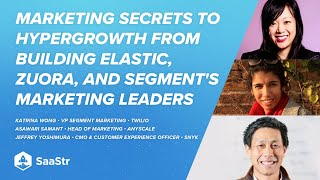
Three SaaS marketers from Segment, AnyScale, and Elastic share how they scaled companies through product-led growth, rigorous funnel metrics, and community leverage. They emphasize hypothesis-driven experimentation, monthly retrospectives for alignment, and owning strategy while outsourcing execution.
Chapters
Good afternoon. How's everybody doing? Let's start off with a round of applause for the SASster team here. To be able to pull off an event like this under these circumstances is simply amazing. So we're thankful to the entire SASster team for really bringing the community of leaders, founders, VPs, practitioners all together here in one open space. So I'd like to start off by saying that I am really privileged to have the opportunity to have Katrina and Asavari here with me. Both have been truly instrumental in helping me become a better leader, a better person, and still today we collaborate on ideas around go-to-market, around marketing, on how to really build different type of engines to, to scale companies. So Katrina, why don't you first start off and introduce yourself and tell us a little bit about what you're doing today and about wherever you've been from.
Thank you, Yosh. Um, just really amazing to be here today in real life. Uh, I could barely believe it and I really didn't even realize how much I miss, you know, interacting with other community members in tech. But a little bit about myself, about 15 years of a marketing career here in Silicon Valley and mostly focused on enterprise and B2B marketing. I really love helping companies of all sizes move up to the enterprise as their selling motion, as their marketing motion, These days we are so lucky, and we'll talk about this a lot more, truly data-driven marketing and just really being able to do that in a super robust way. And I currently lead marketing for the segment business unit, and we are now part of Twilio.
Great. Savri, how about you tell the audience about your experience in, in marketing and at scale companies?
Yeah, all right. Again, like Katrina said, super excited to be here today, and it's great to be at an in-person event. So I'm a Savri. I'm a chemical engineer turned computational biologist turned marketer with a sales engineering stint along the way. I think the area I'm like, I'm really passionate about is user-focused, working in companies with user-focused or developer-focused products. That's been my 15 years in companies building products in the data space. That's an area that I really enjoy working in. And I feel like my sales engineering experience along with kind of the engineering background brings a unique perspective to how I approach marketing. And right now I lead marketing at a small startup called AnyScale that's disrupting the distributed computing space. What about you, Yosh?
Well, so both Katrina and Asavari called me Yosh. So my name is Jeff or Jeffrey, but feel free, audience, you can call me Yosh. So I've been fortunate to have been part of this SaaS journey for a very long time. So in 1999, I was a user or customer of Salesforce. And if you remember, Salesforce started in 1999. In 2004, 2003 actually, I joined Salesforce.com as an early employee, not in marketing. I was focused on implementation services, helping deploy Salesforce to, to customers. And then over my span of years at Salesforce, I moved from services into a team called the AppExchange team. And this launched the ecosystem. And this is where I met Jason M. Lemkin and a lot of founders and entrepreneurs who were starting up SaaS startups around the Salesforce ecosystem. Fortunately, after that stint at Salesforce, I moved on to help start a company called Zuora, and was employee number 1 outside of the founding team at Zuora. And then decided I needed to move into developer land. So over the last, really, 10 years, I've been in data developer ecosystems. I worked at Elastic. Together, we helped take the company public. And then right now I'm at a developer security company called Snyk. So very fortunate to have all the experiences that I've had, but you know, we're here to talk about marketing, so let's get into it. So next is Katrina. Tell us about the different eras from your perspective about marketing.
Yeah, when we were putting this slide together, I thought I would, you know, just kind of kick the, kick the tires kick this off and frame it as, as a marketer, you know, over the last decade or so, what have I been asked to do? So kind of in the early SaaS years, you know, we mostly had traditional marketing. This is events, this is PR, because we were just at the beginnings of marketing technology. So I don't take for granted in terms of how far we've come and what we can actually measure. And it was just It was so hard in the early days to understand what your users are doing, and we were just guessing most of the time. Fast forward a little bit, with the last decade, there was so much pressure, and I've done my fair round of early-stage startups where many CEOs and founders were like, Katrina, go create a category, make it a movement, and there was just so much pressure to do so. We'll talk a lot more about this as well. When is the right time to do this and should you really even do that? What are some pros and cons? But the net of it is there was an explosion of just categories, whether it made sense or not, security clouds, like just everything, clouds for everything. Fast forward to now, and I'll always think now is my favorite time no matter what stage of life, but I'm referring it to, as really the data SaaS, right? It's about product-led growth, but we finally have a better way to instrument our marketing stacks and to understand what our customers are doing and how to better service them. So being truly data-driven was what I envisioned over a decade ago, and we're getting closer and closer every day.
So here we are. We're gonna talk about hypergrowth lessons. These are the companies that we've worked, worked at over the last 10 or so years. And, uh, we wanted to point out one thing that in our introductions, I think is pretty interesting and also common amongst all of us. We were not born in marketing. We didn't study marketing. We didn't come outta marketing. We were all in either technical roles or service-oriented roles. Customer-facing roles, chemical, biology, and we somehow made our way into marketing. So if you are a founder, a CEO, if you're trying to bootstrap your marketing, it's really hard to find marketers today. So our advice is just look to the outside. Look at, you know, who are people in your network or out of your network that you can find that have really an insane focus around around product, around technology, and maybe you'll be able to find marketers who could help your startup grow. So with that, let's start with our, our first, our first lesson here, category creation. Katrina, tell us about category creation. What have you been doing at Twilio Segment around the category that you've created?
It's pretty lofty as a topic. I'll start off here. With Segment, we, you know, we went about this exercise as, you know, is there a category that truly reflects exactly what we do? And we went down a path, you know, for a number of years where we said we're actually not a CDP, we are not a customer data platform, we are actually a CDI, a customer data infrastructure. And fast forward 2 years later, we ended up, you know, pivoting and saying we were a CDP, primarily because that was what the market needed and what they were telling us we needed to do. So in addition to the infrastructure piece, we needed to become more of a platform and move up stack to a certain extent. So, you know, in many ways when you think about creating a category, it's about doing it for the right reasons and really listening to your customers and paying attention to the market signals. Versus just charging ahead and saying, I've created this product and I'm gonna make the market come to me by naming it something. But that's one of several lessons that we learned. Yeah.
Sorry, you wanna talk about—
And I think to add to that, right? I mean, I think the reason for launching into category creation initiative really matters, right? Like don't try to create a category because that's the hottest new thing to do in marketing or every other company out there is doing it. right? If you start with the user, start with the problems that they have, challenges that they have, and how are you uniquely solving those challenges. If that thing doesn't have a name or doesn't quite have that right name within the market, yeah, of course try to define it in a new way because nothing existing quite cuts it. But there are many companies out there that have disrupted existing categories and are extremely successful. I would say kind of back at Elastic, actually we pushed back on trying to be put in a category, right? I mean, there were analysts who were trying to reach out to us and say like, hey, can you, you know, participate in this Magic Quadrant or this Wave? And at that time I think it was too early where we did not wanna be put in a box and we kind of stayed away. And I think that worked out pretty well for us because we were not just a logging company 4 years forward or 3 years forward. So do it for the right reasons. Don't do it because it's, the thing to do.
Yeah, and I'll share some insights at Zuora. We had a big idea. That big idea was the subscription economy. So at Zuora, we intentful had purpose to create a category, right? We're going to create a movement, an economy around subscriptions. So we focused a lot of our efforts on really that marketing and that evangelical marketing. To really push that message out there. So we did a lot of creative things to be able to do that. Everything from, you know, think about kind of the world being subscribed to have books by our CEO, to focus on having Tien on CNBC and do interviews. And today, it's a fairly commonplace term. I can tell you that it took 10 years for that to hit mainstream though, right? We were saying this in the very early days of the company. Before it hit mainstream was 10 years later. So it is exceptionally hard to go out and create a category. Let's talk about this next topic. Uh, Savri, why don't you, you dig in?
Yeah, so I'm a big proponent of first principles thinking or starting with the why. And I think that kind of ties pretty nicely into pragmatism wins, right? And we have numerous cases of examples of this from at least my journey at, at Elastic where a new rep would come to a product marketer or marketing and say like, hey, we need to be at this event, right? Or can you go and buy this list because that's kind of how we did it at my previous company. And we kind of always went to like, why, right? Like why are you trying to, have you looked at the data that you already have access to? And kind of starting with that and kind of pushing back, I think that worked pretty well. The other area is have a hypothesis. When you're a small company, you don't know what you don't know. You don't know what's gonna work, what's not gonna work. Start with a hypothesis and then use the data to test that hypothesis out, right? Like experiment small before you go big. Examples of this where again, we did stuff that was unconventional but worked for Elastic were examples like putting a Getting Started With webinar on our homepage banner. Almost no, this was pre us becoming SaaS where SaaS everything starts with like start a free trial. So this was pre SaaS a little bit, but most companies wouldn't put a getting started webinar as their top CTA, but it worked wonders for us because we were targeting users, we were targeting developers. When they visited the Elastic website, that's what they were looking for. And I think until maybe until today it might be the biggest source of traffic pipeline eventually. So be pragmatic about, look at the data and be pragmatic about what works and what doesn't work for your company because what worked for you in the past or what worked for somebody else might not be the right choice for you.
Great. Why don't we move to numbers? Katrina, share us some experiences around kind of how you think about numbers, how do you use numbers?
Yeah, I, I've spoken about this in the past, which is in marketing, most of my team members know this, they actually carry a number and we are just so focused on just the entire funnel conversion. We forecast our MQLs, we look at conversion rates from MQLs to sales qualified leads to sales qualified opportunities and then ultimately conversions. Conversion. And so we actually even run pipeline meetings ourselves before we do the pipeline meetings with sales. So it is about data and studying what's working, but it's very, very, how should I say this? It's at an absolute fast frequency because our data changes so much. And so it's not like we do these meetings once a month. It is on a weekly basis, yeah.
Yeah, and I'll talk about PLG a little bit. This is really kind of what a lot of companies here are probably thinking about is product-led growth, right? So how do you instrument your product so that it organically gets all of that throughput? How does it get out to, to the hands of users and how do you use that to create a funnel? So in a PLG type of company, right, data is absolute. You absolutely need to measure everything. So you need to look at everything from how are you getting users to, to, to, to really sign up, and how are you acquiring those users? How are you getting them to activate and through what channels are they activating? So say you have different channels where they can activate through another ecosystem, and then another ecosystem over here, you need to instrument and be able to understand what is performing better or worse. Then you need to look at the conversion rate. And then on the monetization side, How do you look at pipeline created through that PLG motion as well as self-serve revenue? And you can instrument this entire funnel to be able to iterate, can do A/B testing, and then ultimately figure out what works. So I think PLG is a really important motion that's happening now. It is a core part of marketing, and being able to use data to drive those decisions is, is an absolute must.
[Speaker] Yeah, I think one thing I'll add to that, it's not quite numbers don't lie, but what's becoming so critical in this PLG world or where numbers are plentiful is that your collaboration or your partnership with sales, but also your collaboration and partnership with product and engineering teams is so critical, right? Because you can measure if like a user, a feature that has been designed I might be driving people to that feature, but if the UX is not great, maybe the feature is not being used, right? So you can really use data and then have those honest conversations in why are you not seeing uptake? Why are you not seeing revenue?
All right, we're gonna talk about experimentation. Who wants to share experimentation experiences?
Again, I think like start small before you go big. We did a lot of experiments at Elastic. I continue to do that at AnyScale. One big thing I'll say is be intentional and define upfront how you're gonna measure success, right? Because if you don't do those two things, then you're just throwing, it's just trial and error at that point, right? You're just throwing spaghetti at the wall and you're seeing what sticks. Areas where we did, and this is probably no surprise to a lot of marketers out there, newsletter designs. Like sometimes you might think like a really polished newsletter is gonna actually be much more successful in terms of engagement or open rates or click-throughs. Actually what we found at Elastic was the simpler looking newsletters that were actually not super polished looking, that were shorter, did much better in terms of click-throughs clicks and engagement. And so we were like, yeah, let's run with this, right? So started small, like didn't spend 3 months trying to like design this amazing looking thing. Started small and kind of iterated, right? So again, be intentional about your experiments, define upfront how you're gonna measure success, and then trust that data.
I think for us, when a business is a little bit larger, and you are the head of marketing, you're probably walking into a well-oiled or decently well-oiled machine. And so what you may find is that because things are working, you know, there's less appetite to do spend for innovation. And what I tell my team is, hey, let's make sure whether it's 10% or 20%, I want you to take that budget and innovate. And we actually put OKRs around innovation so that way you don't run the risk of just channel fatigue. 'Cause I've seen that, right? Where pipeline just kind of stalls out 'cause you're doing everything and all of a sudden something changes and it no longer works. So that's kind of an important piece as a leader to really encourage your teams to innovate and give them the space to do so. Like they will not be penalized if they do a little bit of spend for innovation.
I mean, earlier today, Alex from Datadog was talking about pilots, right? It's, is all about pilots, experimentation, right? And you need to be able to train your people, mentor your people, as well as coach your executive team that you're gonna start off small and if things go really, really well, you're gonna double down, right? If things don't go well, you're gonna kill it. And you need to have that constant motion happening ongoing and ongoing. A marketing team at scale, you're gonna have hundreds of campaigns running in the background at all times, and you're gonna have new campaigns, and you wanna encourage the idea generation. You wanna encourage people to come out with some sort of creative concept that they wanna experiment. So you wanna build that into the DNA of your team, cuz that's gonna ultimately help you, uh, really test the market and really figure out what works and what doesn't work.
I would add kind of one thing. Invest in your measurement infrastructure, your measurement process early on, because when you're at hundreds or thousands of campaigns running at one time, being able to see what's working and what's not, that's a pretty hairy data problem or systems problem. So kind of think about that earlier on versus realizing that spreadsheets don't cut it when it's a little too late.
Why don't you talk about community? Elastic started off as an open source project and evolved into, you know, a highly successful commercial business.
Yeah, so at Elastic we had a saying that internally we had a saying that community was everybody's business. It's just that a few of the employees did it as a full-time role, right? So we had a community team, a developer relations team, sort of developer advocacy team. I think of this as kind of being, again, focused on the user and making them really successful. My personal kind of anecdote is when Yosh reached out to me to recruit me to Elastic, I'd never heard of this Elasticsearch thing. And the first thing you obviously do, you start, you know, searching and like, what is this Elasticsearch thing? And what I was blown away by was, Users just like, these were open source users, they were blogging about their ELK Stack use cases, right? Or they were tweeting about it and seeing kind of this almost viral adoption of the project, open source project was one of the big reasons that brought me to Elastic. So if you focus on the user, you focus on removing the friction and this is a big part of PLG, right? Focus on the user, you're removing the friction from the user kind of getting to that value. If you focus on those two things, the community, if it takes off and the product has value, the community is gonna take off and that's gonna kind of, the PLG thing is the flywheel, right? That's gonna fuel the flywheel. And so I'm a big proponent of like helping the community be successful because that's gonna kind of fuel more users which will eventually turn into paying customers. So it's a huge multiplier in my opinion. Anything to add?
Yeah, definitely agree. Definitely agree. I mean, both Twilio and Segment are heavily driven by community. There's a huge investment with developer marketing, but it's not gonna be in-your-face marketing. What I talk about is the value exchange. What value are we truly providing to our community in exchange for time? Time, right? And for them to play and experiment with our respective technologies.
And one of the most common questions that, that I get around community is where does the community and DevRel team sit, right? A lot of times these teams start in product, they start in engineering because those were the first users. The first hires of the company were members of the community. Ultimately, when you get to scale, I find it more common for this function to sit within marketing because then you have the aspects of budget, of how do you have repeatable programs? How do you go at scale across different geos? So at Elastic, the community team did start in engineering, did sit in product, and then eventually moved over to marketing. And it didn't mean that the community DevRel folks who were engineers felt like they were part of marketing. They were ever part of the community because the community is everything. and it was an integral part to our strategy. It was part of our KPIs. It had executive alignment, and we were able to invest more in tripling that team, tripling that budget, being out there to prioritize what are the areas that we need to go build more community and more outreach in. So this is oftentimes a common question that if you are a founder or if you're a creator of an open source project, you're probably gonna get, and at some point you're gonna need to answer, Where does that sit over time when the company gets to scale?
Irrespective of where it sits though, their mandate needs to be about community success and community growth, right? So just because they're in marketing, don't put a pipeline attribution number to their programs because that's counter to how a lot of the typical developer relations, developer advocate folks work. So you're gonna lose good talent if you say like, hey, the way I'm gonna measure you is, based on pipeline, because that's not the goal of community teams.
Plus one.
Yeah.
All right. Agencies. How many of you have used an agency before, and how many of you like the agency that you use?
Some thumbs up, some thumbs down.
Kind of middle ground here. All right. Why don't we talk about agencies? And, you know, we've all worked with agencies. Some of them are great, some of them, A lot of them kind of suck. What's the best way to work with an agency, Katrina?
It's, yes, agencies. I think the analogy is, you know, it's almost like chiropractic medicine, right? Like you find a really good chiropractor and they do wonders, right? And a bad one can actually kill you. So in terms of agencies, it's really about not outsourcing your strategy. Ideation. What they should be doing, let's just take messaging for example, or product marketing, or even PR, right? They have the relationships, they can help up-level your thinking and help shape it based on what the market signals are because as marketers, right, like we create markets. They can do that piece, but the true ideation, you know your business the best, so that part, if you start outsourcing that to agencies, and I do a fair amount of advising for early-stage startups, that's where it really goes awry. What do you guys think?
[Speaker] I'm at a 60-person startup right now and the marketing team is 3 people, so there's no way I can run marketing without agencies, but I think what Katrina said is really important. You cannot outsource your thinking, right? So the what we want to do, the why we wanna do it, comes from, from the company, comes from the founders, comes from the executive team, right? And the agency is almost like an execution arm. And so yeah, we use agencies or contractors a lot right now, but the thinking stays, stays with us.
Yeah. So I think agencies can be very diverse, right? You're going to have an agency for your comms and your PR. So you want them to help you amplify your message. But again, you need to own that message platform. You need to own the story. You need to get your CEO involved, your founders involved. Even if you're an early-stage company, working with, with board members and advisors, right, they're going to be great advocates, and they're also going to have a lot of insights around why did they invest in your company, why did they believe that you're going to do something that's disruptive. So leverage everybody in your, your ecosystem in order to craft that right story and again, test and ideate with that message in the early days. There's other agencies that you're gonna outsource for events, right? And events at scale. Again, that experience around the events, I think it needs to be core, right? How do you want to appear? How do you want your presence to be at that event should be core at when you get to scale. And then digital marketing, there's a whole bunch of other agencies that can help you out with digital marketing and SEO. But within SEO, you could, outsource that to another agency, but internally you need to own that content strategy, right? You need to own the content strategy. You need to know what are the keywords that you need to rank high in order to drive organic traffic to your website. So again, the tip here is to, to make sure that as you think about agencies that you wanna leverage, whether they're independent or full-scale agencies, really consider what you need to own, and what you do outsource. As is to be. So there's so many different frameworks out there for really trying to kind of build messaging and positioning and sales enablement. There's textbooks out there, there's Harvard Business School books and classes. Katrina, why don't you talk about kind of the as-is, to-be, and the simplicity of it.
Yes, this was something that Azura, that I believe Sean Price, our president who ran sales at the time, kind of taught us. And so, you know, as a marketer, there was all this pressure to tell, right, like a huge story, create a category, create a moment. But what really ended up resonating above and beyond that is simply painting for your customers what the current state is, and then positioning, right, what the to-be is. And it was something that just ripped through our sales, and everyone loved it because it was so simple to understand, both for the field as well as for our customers. And so to this day, at Twilio Segment, at Segment, we use something called command of the message. But the main premise is you paint the as-is picture, right, a world build a circumstance, the problem you're looking to solve for your customers, and then you compare it to a to-be. Sounds really simple, but I think sometimes as product marketers, we make it a little bit more complicated than necessary.
Anything you'd like to add?
No, I completely agree, right? I mean, without showing somebody the vision of what your product, what your service, what your solution, like what does that future look like? It's hard to close the sale.
[Speaker:JASON M. LEMKIN] Yeah, and try to get it on one page, right? Try to just get it on one page. Crystallize it on one page. Make it easy, digestible, and battle test it, right? Sit down with the customer. Sit down with the user. Sit down with the sales rep. If I'm a marketer, I'm going to get on calls with the sales team, and I want to hear them go through how they position the company. When we were in the early stages at Zora, right? One of the things that we all had to do was sell, right? We had to go close customers and that was by far the best experience 'cause you hear the objections, you hear why they don't wanna move yet, you hear why they like some other software that they're already using even though that the promise of this is better. So really getting all that feedback and then channeling it back into this framework is really, really useful.
So critical to be, for marketers out there, so critical to be in front of customers, right? Like don't create the message or the deck and throw it over to your salespeople or your sales engineers. Like you need to feel the discomfort of a message not landing to like actually really come back and say, okay, I'm gonna tweak the message, right? So be in front of customers as much, or users, prospects, as much as you can be.
So true.
Pipeline. Now this is a meaty topic, and there's so many tools out there that help you measure and attribute pipeline. You look at all this data that we have today. I think this is a really important topic for marketers to really put a grasp around because it's not just about pipeline. Things that we do have impact across the funnel. The entire really kind of funnel above and beyond pipeline. So Katrina, do you want to share some, some examples of what you're doing around—
think about it as the full complete customer lifecycle. And so, you know, I am looking at, you know, opportunities that are sourced by sales, and I follow, right, to see a year later how, you know, how is this customer doing? How is the NPS score, right? Are they happy? Are we unlocking additional use cases because it's about that full pipe. Because, you know, many companies that I've been a part of, we do a great job bringing in the pipeline, closing the deal, but guess what? A year later, right, you have a churn issue. And for those of us in SaaS, that's kind of a big deal. So, you know, you almost have to get ahead of that by a couple steps. And don't just look at your pipe, look at the entire customer, you know, journey or your entire customer lifecycle.
Yeah, I think to, I think to add again, Elastic experience, we were very much a bottom-up model, but a bottom-up where there was a huge open-source component to it, right? So oftentimes we would see mission-critical apps being run on the free open-source version, which will eventually convert to paying customers, right? So, but if we only focused on pipe, like we would've not grown that open source community. So there was like a pre-pipe adoption component that we really focused on and that eventually converted into a pipe, right? So when we did deal reviews of some of the bigger deals, you would sometimes see like 2 or 3 years ago there was an open source use case and there were 2 open source use case and 3 open source use case and then they grew, right? And eventually they converted into being customers. So sometimes it's not just about the pipe.
Yeah, I'll talk about SEO. I think SEO is really important, especially if you're an early-stage company, is you need to look at what is that organic traffic and what is that traffic you want to capture and how can you build content in order to capture that. So everything looking at your keyword rankings all the way to your top-performing blogs. Do you have the tagging right? Do you have the infrastructure right within your own systems to be able to distribute that content and be able to capture users when they're searching for something? So I think kind of SEO is something that's really important. I know that right now in my current job, I get a monthly SEO report, and we are tracking, are we increasing or decreasing our rankings in our, you know, top 10, uh, kind of keywords that, that we know we need to, to, to really focus on. Uh, we're also focused on the, the high-performing blogs and high-performing kind of assets on our website, uh, and really looking across the board around how do we get featured in a Google snippet snippet, right? Because if you get a Google snippet, in addition to just being surfaced on, on a search result, it's going to yield significant, significant traffic to your site. And then once you capture that traffic, then you need to measure everything through that entire funnel. So how did that yield into somebody opting into something and actually giving you an email address or their name or their company? How did that yield into somebody starting up a free trial or just a PLG kind of free freemium usage of your product. So again, measure everything. And I think it's also important to educate. You need to educate your entire executive team, your entire, your board around that, that, that this is not just about a pipeline number, right? Of course, we're doing everything in service to help the company grow revenue for the sales teams to, to, to make their, their numbers to ensure that there's an adequate coverage ratio. But it's not just about that. If you think about a campaign today, you probably find that a user who then converts to a customer over that 1-year span, 18-month span, 24-month span may have participated in 20 to 30 to 50 different campaigns over that lifespan. So be able to attribute all of that information, and all that data so that then you can figure out what are the levers that you need to double down on? What are the things that, that can really help you grow the business? One other aspect that I think you touched upon that I think is important that I heard outside when we were walking by one of the presentations is really net retention, right? Net retention or NER, you know, expansion, absolutely critical, important metric. As a marketer, we need to be very in tune with that metric because we need to make sure that we're not only just growing the new base, but also that we're helping the company expand because this is a number that investors look at, that Wall Street looks at. So not just churn, but what is your net expansion rate and how are you able to onboard your customers and then expand those customers and ultimately renew them? So again, measure everything is something that we think is really, really important. Let's go to our last one. And this is about recipes. We all like food. So what's your favorite recipe?
My favorite recipe? Oh my gosh. Actually, my husband has perfected how to bake crepes at home. That's a pretty good one.
What's your favorite recipe?
I have too many. I don't have one. I have too many. I do a lot of Indian cooking, and there are recipes that I go to all the time. Yeah. Recipes for marketing, though. I was like, Katrina started with cribs.
I know.
I think of recipes as just repeatable motions, right? So start small, see what works, and then really focus on how do you Almost like automated to the level that it can be automated or codified so that you're not spending as many cycles thinking about it, right? It almost becomes a well-oiled machine. So I think Elastic, like releases were, there was a well-perfected machine for how we launch products every 6 to 8 weeks. And I'm sure Katrina, like you'll have examples of it. It just adds a lot of efficiency to your process. Up or to how you operate. And then you can spend those cycles doing something else where you put more creative thought, you put more kind of brainpower and the stuff that's already perfected is almost like self-running.
Yeah, we've also created recipes that are external facing for our developer community. So whether it's like how do you personalize your SMS text messages, doing omnichannel on top of a CDP to better instrumentation of some of the most common marketing stack vendors out there. So we're actually coming up, coming out with something that we're calling literally a recipe book, and I love it. It's step-by-step instructions, but when you do that, the signal that you're sending out to your community is that you're adding value and you're helping them solve something or think about a problem. In a different way. So that's been really the biggest engagement that we get. So forget all of our other tactics. By far, recipes really convert well. And people over and over again ask for more. So that engagement is huge.
Yeah, I think there's a scale aspect to recipes. Once you create one recipe book, then you just keep kind of replacing that. Repeating that in, in other areas. So a recipe could be an ecosystem. So you think that you have an ecosystem where you can acquire users, acquire customers, and you build one for one ecosystem, then you take that and then you leverage that for a different ecosystem. But there's probably gonna be different nuances that you build into that recipe book, but you can leverage that same framework. The same thing applies to verticals. Every marketer probably gets the question around, I want to go after some vertical called financial services, technology, the federal government, and everybody wants content, they want different collateral, they want all this stuff on the website, and I think the key thing here is to, to really think about how do you make things repeatable in that vertical? So if it's financial services, how do you first learn from your customers, and what are customers saying about your product relative to their industry in terms of solving their pain points, and then you take that information and then you figure out, okay, what are the type of content and campaigns that we can do to accelerate our growth in this vertical or area? And then what are the trade shows and events that you need to go to? And then ultimately over time, then maybe the sales team starts to be verticalized as the company gets bigger into that vertical. But really at the beginning, it's all about how do you create repeatable things based on what you know users or customers are successful with. So I think we're at the end. So we have some key takeaways here. So do you wanna talk about kind of your takeaways from your many, many years of experiences in, in marketing and helping hypergrowth companies, uh, build and scale?
I think it's building a learning culture and mechanizing that. Uh, so an example of this is, you know, for the marketing team, we do a monthly retrospective. And so we celebrate our wins, and then we go through and actually document what could have gone better and what we would do differently in the future. So that's something that, that motion internally for us, I'm probably on year 6 doing something like that. That's helpful because it encourages people to experiment, Embrace failures, it's okay, and then actually learn from it and do better. So that's kind of my tip for the day.
I would say don't be an island. I think that's something I learned from Yosh, right? You are a part of an organization. Know how the work that you're doing as marketers fits into the broader OKRs, company objectives, company initiatives. It's easy, especially at a startup, for marketing to get spread really thin. So again, kind of clear communication with your peers on stuff you're doing and not doing and how you're gonna measure if it's working and not working matters a lot. So I think those are my two things. Know how your work fits into the broader goals, focus, experiment, and measure.
[Speaker] Yeah, I'll play on what Asavari said is I think marketing needs to be part of, of core, kind of core KPIs and the core strategy of the company. So, uh, really when you think about an organization today, you have R&D, which is engineering and product, right? They need to deliver and build product. Then you have the GTM function, which is generally sales, marketing, customer success, the sales engineers. Really marketing has a seat at the table, uh, in terms of driving strategy, building the plan, participating in the plan, Looking at segmentation of how the universe of customers are being segmented, and then driving the plan, strategy, and budget to be able to execute. And then you have G&A as well as core. So when you think about kind of marketing from that lens, it is absolutely critical, absolutely core to a business. And it's not just about branding, it's not just about the signage and the beautiful things that you see. There's a lot of nitty-gritty, kind of nuts and bolts within marketing. And if you are the head of marketing, if you are the VP of marketing or the CMO, it's your job to be able to communicate that broadly across the organization, right? And be visible, be able to make sure that the board understands what you're doing, be visible, making sure that the rest of the executive team also knows what you're doing and that you're building alliances across the entire company because marketing, as Asari said, cannot exist and function in an island. It's probably the most cross-functional, the most complex organization today in any organization, especially in tech.
More from Jason

Why Your Next Hire Should Report to an AI, Tragedy Apps, and Too Many AI SDRs? | The Agents #004

Our Agents Drove Our Salesforce Bill Up 80%, Marketo Hates Agents, and We Stealth-Churned Off Notion




Managing 20+ AI Agents: Lazy Agents, Our $500K AI Bill, Stealth Churn & the Death of 60% Solutions




