Navigating the CRO and CMO Relationship with G2 CRO + G2 CMO + Salesloft CRO
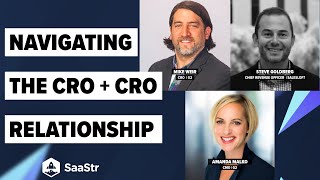
In this panel discussion, G2 CMO Amanda Malkow moderates a conversation with G2 CRO Mike Weir and Salesloft CRO Steve Goldberg about how sales and marketing leadership can achieve true alignment. The participants explore the root causes of CRO‑CMO friction—ego, siloed thinking, and lack of shared definitions—and propose concrete mechanisms to overcome them, such as board‑level forcing functions, shared KPIs, joint customer advisory boards, and regular cadence meetings. They dive into the importance of a deep, shared understanding of the customer, describing how product‑, executive‑, and product‑focused advisory boards feed into product strategy, messaging, and value‑engineering. The dialogue also covers practical frameworks for alignment across four layers: go‑to‑market strategy, shared metrics, executional coordination, and team communication. They discuss segment‑specific approaches (commercial vs. enterprise), the role of post‑sale marketing, customer education, enablement, and the under‑invested area of customer marketing. Throughout, the panel emphasizes a culture of open, ego‑free communication, role clarity, and continuous course‑correction, using board meetings, V2MOM goal‑setting, and shared definitions (MQL/SQL) as anchoring practices. The session ends with audience Q&A on advisory board structure and enterprise enablement, reinforcing the view that alignment is an ongoing, iterative process that drives revenue, customer success, and growth.
Chapters
Why?
Why are we making this purchase? Why are we considering this vendor? Who you're connected to, your peers, your trusted former colleagues, others in the industry that do what you do, that's who you lean on. The way in which you're engaging, like the channel that you're on, it matters. What you produce to educate the market is what helps de-risk that buying process.
The brands who start to test and learn now are the ones that are going to be well ahead of the game.
We want them thinking about that long-term vision and what can they do today to build deeper relationships with their clients. We're really trying to foster digital relationships, finding some unique ways to engage in a digital environment.
It's a great opportunity to think about new ways to grow, and I think it really can breed a lot of innovation.
At the core of the reviews is customer voice. What features should you be building? Where is your market going? We have to have meaningful conversations. We have to overcome objections. Now it's in our hands.
Welcome everybody. I am so excited for this conversation and to welcome Mike Weir and Steve Goldberg from Salesloft. I'm Amanda Malkow. I am the CMO of G2. And I'm really excited for this conversation, in part because I'm 8 weeks into the CMO gig at G2. And so this is a very timely conversation. And I am looking forward to learning from both Mike and Steve and having a really engaging dialogue. We're also going to be taking questions. So please put questions in the chat. I'm going to be following along. So we'll get to those throughout the discussion. And with that, I'm going to let Steve— because I want to go wherever is in Wherever that is in your background, Steve, I'd like to go there. It looks beautiful, but I'll let Steve introduce himself and then Mike as well.
It's actually Saint Lucia. Well, thank you very much. I'm Steve Goldberg. I'm the Chief Revenue Officer at Salesloft. I've been at the company for just over a year now, and I'm really excited to be here.
Perfect. And then Mike Weir, I'm the Chief Revenue Officer at G2. Been here for a year now, but Have been close to the company for years through partnership when I was at LinkedIn and an advisor in the early days of G2 being built out. Excited for the conversation.
Awesome. Well, we're going to start with talking about— I mean, this is a very much discussed topic, the relationship between sales and marketing and then the CMO-CRO relationship. We're going to spend the bulk of the time talking about how to do it right, but I think it's worth talking about where does it come from? So I think we've all, as we were preparing for this discussion, we've seen or been in situations where there is an alignment. And Steve, I'd love to hear from you. Where do you think that comes from? And what are some of the root causes of that?
I mean, sometimes it's just personalities and egos sometimes. But the CEO is a very important part of that. They could create friction amongst the teams, or they could really create alignment between the teams and create that partnership. And it's a really important relationship. And I've seen it where it could be the linchpin of the relationship that creates a divider, it could really create that partnership.
Yeah, I, I think the comment about ego is a really important one. Because too often it's sort of who gets credit, or it becomes, it becomes an ego-driven relationship or conversation.
Yeah, and I would say, Amanda, um, what we've seen in— with— at Salesloft, my partnership with Cindy Sloan as our CMO is so important. And it's really around the board meetings that really creates that partnership. It's, you know, in a board meeting, it's really what happens before and after the board meeting. You get focused, you prioritize, you align, you go to the board meeting, and then you execute. And aligning around those priorities are so important. And they're forcing functions as well. And it's, it's, it's a great forcing function that really creates that partnership.
In my experience, I completely agree. I think I can immediately tell when there's alignment between sales and marketing. And I'm sure you all have seen this, you go in and you say, what are your metrics? There are two different sets of metrics, and they don't feel like they're aligned. And that's one of the— and so the board meeting is a great, like you said, forcing function to make sure those metrics are aligned. Mike, what do— what does alignment look like to you? We've talked a lot about this in my first 8 weeks of how do we get everybody aligned. So I know your perspective on this, but I think it's a really valid and important one.
Yeah, where the divide comes from and kind of how you make it a little bit better. For me, it's just if you have a lack of understanding, right, in that there are a lot of symptoms and ingredients that lead to that lack of understanding. But if, if you literally don't understand what each other is doing, who you care about, how you're going to market, how you should be working together, then there's an immediate divide. You just live in your silo, you do your thing, and you don't want to give credit because you don't know what the other team's doing. You don't know how it's impacting what you're trying to accomplish. And so that pure lack of understanding is a huge part of the why there's a divide. And some of the things that, that lead to that is just very poor communication. Yeah, I totally agree with Steve that sometimes it's ego where the folks don't want to reach out because they don't want to share credit. But oftentimes, I literally just think it's ignorance of just not talking to each other, not thinking that it's important to be aligned and plan together and execute together and report together and share success together.
Yeah, I 100% agree. I mean, Cindy and I, we co-present at the board meetings. And it's that really drives that alignment. You know, the other thing is, if you're not aligned, then your teams are not aligned. And then you're creating friction across the entire organization, which creates a ton of inefficiencies when you're not focusing on the priorities at hand, you're focusing on other things that don't matter as much. It creates a lot of distraction.
That's a fantastic point. For the last decade plus, I've been working with technology companies on their go-to-market and from a marketing strategy and media side, all the way to brand demand, everything. And one of the things that becomes glaringly obvious as you're working with all levels of an organization is that the managers of the team, the directors of the team, the individual contributors within the team, they have to do a lot of extra work when the CMO and CRO do not collaborate well. Yeah, they are working around their leadership team because oftentimes they know it's the right thing to do. But when you don't have the leadership team aligned, it's causing a ton of extra work for your teams. Yeah, that is like really counterproductive when we're all, you know, not enough people, not enough budget, not enough time. Yep.
Yeah.
One of the things, I think, Steve, you said this about alignment, is shared understanding. And then Mike, you echoed that, of both the objectives for the business, but also for the customer. And so one of the things that I've seen in really great sales and marketing partnerships is a really deep shared understanding of the customer. And so I want to talk for a minute about how do we foster that among sales and marketing teams. I've seen really excellent customer advisory boards that are co-owned by sales and marketing that go very deep in understanding the customer. I love marketing teams that join sales calls on a regular basis, spearheading research and partnership. There are a lot of ways to do it. But Steve, I would love to hear how how do you bring the teams along to really make sure that they're tapping into the pulse of the customer? And I'm sure that's changed. I know it has for you all as you've evolved Salesloft and grown the business quite substantially over the time, even since you've been there.
Yeah, well, the customer advisory board is really key. And the partnership between sales, marketing, and product around the advisory board is really important. And what we've done here at Salesloft is that we have two customer advisory boards. We have a product customer advisory board and an executive customer advisory board. And in the product, we're really driving functionality discussions and capability discussions. And around the executive advisory board, it's about the message, the market, the trends that are happening in the market, and the value prop, the problems that we're solving and where the market is going. And we, and we then we bring them together and it's that it's really a customer-driven approach. It's really important that you're building your marketing message, your positioning, your product strategy around solving problems that customers truly care about. And I think I've seen a lot of companies miss there when they, they forget to listen to the customer.
I would agree, and I think there's a part of the idea of listening to the customers and helping understand to your point, Steve, how do you bring true value to them? Like, what are their problems? What are they trying to accomplish? I think one of the internal misses that happens in the alignment is that we don't bring good perspective to how we're thinking about the feedback that we're getting. Because I see this all the time when, you know, we, we run internal councils to share customer voice, to share perspective on what we're seeing in the market between sales and product and product marketing team, other are in those conversations. But what we don't— well, I shouldn't say that. Here we do this much, much better now, but I've seen in other companies, we don't bring the perspective from a product side or a sales side of, hey, are we actually going to solve for something that only one customer cares about? Or can we bring the perspective of, I'm sharing this example of a customer But they are representative of hundreds of other customers. I've talked to my, you know, my sales peers, my CSM peers, and they agree that they're hearing these same questions. They're getting these same desires of use our product in this way. And so bringing that perspective helps product marketing and sales leadership know, like, are we just trying to solve for one customer where it may not be worth the effort? Because it's like all new functionality, super expensive, really big lift. Or is this scalable? And this is something that the market really needs. I think that leads to divides where a salesperson without kind of being given direction that like, we can't just solve for this one customer because it's not scalable.
Yeah. Yeah.
You end up getting angry and you got to bring that perspective on all sides of like, this is worth the squeeze or not.
I'll tell you, that is such a good point. And it's a very, sometimes it's a very hard decision to make because you may have this really big customer, this really big opportunity, but it's not as much aligned to the direction of where all your other customers are going. And, and, and if you're not aligned between the CMO, the CRO, the head of product, really the entire executive leadership team, that could create a huge divide. Because if you, I've seen companies do this, if you solve for one customer, The downstream impacts of that is so important because now you have to support something that's not towards where you're going. And it becomes a decision point you have to make sometimes. It's a tough decision you need to make, and the alignment is so important. And the customer advisory board also helps with that because you get a view across multiple industries, multiple personas, and you're making sure you see consistency, which is extremely important.
We, uh, in our— in the first, the first few weeks, Mike and I talked about that, of how do we make sure we're getting the right inputs but also understanding the potential impact of those inputs from our customers. And, uh, we're collaborating on some research with our customers in addition to the advisory boards. Too often I see, especially on marketing teams, running research and not ever having a conversation with sales, right, about what is it that we really want to We have hypotheses. What is it that we really want to understand from our customers? What are they willing to pay for? Where's our value? How can we deliver more for them? And a lot of times I see marketing teams run forward. And they might talk to the product team, but then they don't talk to the sales team. And the sales team is going to have fantastic feedback and inputs to say, hey, actually, here's what we're hearing. And maybe we really need to be asking these kinds of questions. Or here's something that we're seeing some people are responding to. Maybe we can test this better. And at scale to see how it might, how it might land. And maybe this is a future product for us. So I think that alignment, including in how we're doing our customer listening and research, is so important as well. And this is a framework that came up in our, in our early discussions when we were talking about the topic. And I think it's a really valuable one, because I can go through this, and I'm sure you all, you had some great suggestions, both of you, and in each of these 4 layers of are we aligned on the go-to-market? And the board meeting, as you said, is a really good forcing function to say, like, are we very clear on our value prop and how we're going to win? We're going to talk about goals in a minute. Do we have shared KPIs? That's a really easy miss for a lot of sales and marketing teams, that the goals aren't aligned. Executional alignment— are we running in the same direction towards those goals? And does each— does the left hand know what the right hand is doing? And then team alignment— are we communicating regularly? And is it really intentional, or is it reactive? And so I think at each 4 of these, there's some best practices. I know Salesloft is, is really doing exceptional in a lot of these areas, including team alignment. Steve, you talked a lot about the communication between teams and how intentional that is. I'm curious to get your thoughts on other best practices that you've seen work really well in each of these, in each of these areas? And then maybe we can talk about KPIs.
Yeah, well, really, sometimes it starts there. And it's sometimes it's what I've seen is as simple as using the same nomenclature. Every company has acronym, acronyms. And so just getting aligned on common metrics, like what are we really trying to achieve? And what's the difference between MQL and SQL? What do you care? Do you care about pipeline created or where that pipeline actually sits? And then building a meeting cadence around those. So what we found is by getting aligned, by aligning the teams, it's putting the revenue and the meeting cadence together and common goals and real clear objectives for every single meeting you go into and using the same metrics that you're tracking that actually move the needle into the goals and the KPIs. We experienced, so we've implemented that and Where we— the way we align our business, we have two different segments. We have a commercial business and an enterprise business. We use similar common nomenclature, but we have different metrics that we track because the businesses, quite frankly, run differently. And in the enterprise business, value engineering is a really key part of what we do. And it's— in a competitive market, people and process really make a big difference. And so we had a project in place that was aligned across the organization, a value engineering project. And it was just running in place a little bit. And Sydney had reached out to me, our CMO, and said, hey, we've got some challenges here. It's running in place. And we weren't able to kickstart the project. And so what we did was we paused. We really stepped back and tried to understand like, what are the goals? What are the objectives? What are we trying to achieve? What do the customers need? What's the market saying? And then we aligned around a project plan that was cross-functional across many different departments, had very clear owners, very clear objectives, like an approver, a decision maker who is responsible for the project, an executive sponsor. And we align the teams that we meet weekly on this now. And we've seen once we're all aligned, and when we do align, we're going to win. And that's our common objective. And then we execute across the organization of really common goals. And that really helped us kickstart this. That's just, that's one example of many.
It's such a great example. And one of the things I love about that example is that you called out misalignment. And it wasn't And in talking to you through the— this, it wasn't— it was a good thing to do. And it wasn't— it was like, hey, we need to be able to have conversations when we're misaligned, and it's going to happen. And we need to be able to say, how are we going to get aligned? And that's something that, as you kind of steer towards enterprise in this example, how do we get everyone back to alignment? And I think that a lot of times there's this fear that if we get off path, how do we— how do we course correct? But the reality is You're kind of constantly doing that, and the whole point is to continue to call out, hey, I think we have some misalignment, let's talk about how we can get more aligned, and make that a regular part of the dialogue where it needs to happen so that everybody feels like they're in sync and has, has the ability to say, hey, I think we've, we've got some misalignment here, let's talk about how we get things back on track. So that's a great example.
Yeah, you build relationships too when you're not aligned and you're able to have those frank conversations.
Absolutely. I think the KPIs, Mike, is something we are actively talking about. And we've talked a lot about North Star metrics for sales and marketing teams. I'd love to get your thoughts on, on North Star metrics and what they should be for sales and marketing teams. Should they be shared goals? Should they be complementary goals?
Yeah, I think it's a bit of both. You know, there's a philosophy, a kind of a mantra that stuck with me for a really long time about, you know, really trying to operate teams. And I use teams loosely because it's very flexible. But, you know, it's all about a mantra of one team, one goal. And in this particular instance, it's the, you know, the revenue team and the marketing team working together as that one team towards that one goal. I think the flow that you had shown in the the funnel before helps us get on the same page, as you had said about like, who are we trying to win over as customers? What value are we trying to provide for them? And that starts the process to then say, at each step of this engagement, who's taking the lead? And who's benefiting from that action, so that we can use more of a holistic, as we've talked internally, like a full funnel revenue approach, right? And I know and coach my teams and talk with my teams about, hey, marketing is helping open up the funnel for us, right? They're getting thousands and thousands of software companies around the world to see the value of G2, to get interested in G2, and they're helping nurture them through their educational journey. And then eventually they are passing some over to us because those folks are ready to have a conversation. And we want them to see the bigger picture of— we have micro metrics that are aligned to somebody, but they connect to the next phase and the next phase and the next phase. And so while it's kind of marketing focuses on the, the broader early stage pipeline development, it is shared because if that's not hitting its target, then we have a harder time with our engagement within our BD organization to get to the first meetings. And then then we have a lack of early stage pipeline with our account executives. And then we have a lack of new customer business for our relationship managers to work on. And so you've got to see how all of these things are interconnected. And so it becomes very shared process along the way to make sure that whole engine is running smoothly, all leading towards that one ultimate goal of, are we on track for our revenue targets and our customer satisfaction targets or not? And where is it breaking down along this process so that we can work together to fix it? And as we are, we celebrate together. I think that's, that's the part I love talking about is like, there should be no ego in this. We are each doing our part and we are each helping each other. If a part of the equation is not working well, to optimize it. And that's, that is where the constant communication has helped tremendously, you know, for us over the last year to get really much better aligned and really cohesive in our go-to-market.
I love this conversation, by the way, is great. It's great hearing you say this. And when I think about driving accountability, also role clarity is really important, making sure that everybody understands what their role is in the process. And so they know what they're accountable for. And they know how we're metricing that. And so people know if they're doing good or bad, or okay, And what we've done is we've aligned these productivity metrics around these metrics as well. So we look at, you look at street quota, but you also get, if you hit these productivity metrics and you're seeing the pipeline up and you're hitting productivity metrics that you very clearly define, you also know when to turn the gas on with your hiring or slow it down. And then you look at ratios. So the ratios, if you hire 20 salespeople, What's the support staff you need to align? Like how many sales engineers you need? How many BDRs do you need? SDRs? How many marketing folks aligned to the different segments? And, and it's such an important piece in the growth and how to scale the business. So yeah.
Yeah, I think there's one thing I'd love for Amanda to share, because as she mentioned, she's, you know, a couple months into the role and the alignment feels better than ever because there's been a very clear focus on what is our vision and how are we doing against it? Who is our target persona? What do we know about them? And then very quickly, we got into the conversation about what are the metrics. And so I think Amanda has codified the, the V2MOM, which is the methodology we use for, for our own metric setting and getting alignment from CEO down within all of our functional teams. And collaborating on mutual metrics across teams. But I think Amanda has done a phenomenal job getting to metrics that actually helped enlighten us because we weren't thinking about some things correctly, I believe. I wasn't. And so it, it helped me get around to better understanding what marketing could accomplish in partnership with us and what they couldn't. And then push some of that ownership back to us to take on a few things that, you know, we should have been owning before. Yeah, so I think it'd be a great opportunity to share some of the, the real metrics that you're thinking about that help drive the business forward.
Yeah, no, I appreciate that. And it's, um, you know, I think we're on a journey, and so part of it was also saying what's realistic for us in this part of our journey. And so our metrics are very much aligned on driving pipeline, but where we want to get to is collaboration around driving revenue and making sure that what we're driving is really closing, and that it's, it's high value. And then we've got a great small business and mid-market business, but we've also got an enterprise business. And so we need to make sure that we're aligning our metrics against the different parts of our business, and really aligned with those teams on not just the overall number, but how are we actually driving towards each of our different segments, different regions, And what are our plans to get there? And I think I want to go back to something Steve said, share definitions. I don't know that we were always interpreting some of the definitions in the same way. And so we're, you know, if my recommendation for anyone that's watching would be if you don't already have your shared pipeline meetings with your sales team and BDRs, have those. Look at what everyone is doing, not just marketing or sales. Look at the whole picture and have, have a slide, have somewhere where there's always the definition of how you're defining these things. What is an MQL? How are we defining what pipeline means, marketing-driven pipeline, so that there's never an assumption that someone understands what those KPIs are. Everybody has them right in front of them because too often the misalignment happens without us knowing and months go by and someone says, oh, I thought we were defining it this way. It's really easy to miss that. And the business is going to change. We're going to evolve our metrics as our team grows and evolves as well. And so I think that's a regular discussion to be had. And I love Steve calling out the, let's make sure we all know what we're talking about when we have shared definitions as well.
And I think this, the enterprise one, is a great one about perspective because this is one, you know, just sharing that Amanda brought more visibility for us where, you know, we've, we've been doing well against our pipeline objectives. And frankly, the question was like, how can we actually do more? Because we want to accelerate and help more companies to leverage G2's platform. But as, as Amanda had dug in and worked with the team, you know, what came back was that we are a little bit weaker on the enterprise pipeline, because we weren't doing as good of a job nurturing those relationships and getting them to the point of them being ready to have a conversation with our enterprise sales team. And so in the macro, everything looked great. When Amanda and the team kind of dug on, dug under the covers and said, alright, well, we're actually a little bit weak in an area that we have strength. We have a really great enterprise business, amazing customers. But we're not you know, we're really not nurturing enough of them to the point that we can say we're ready to hand them to sales. And so that was, I think, a great example of bringing perspective to say, let's keep celebrating that we are generating and beating our pipeline expectations based on what we're doing today. Let's be excited that we can do even more. And let's actually align on how we do more of it in very specific customer types to increase our value and help every part of the sales team that is really looking to expand and grow their relationships. And so that was one that I greatly appreciated is somebody in marketing who really gets the go-to-market and is digging in and asking the questions and coming back with real insights and say, hey, by the way, we could do better here. And there was mutual need on both sides of this is what marketing can do. And we think this is what sales can do. And so, you know, there's tactical things that come from this. Yeah, you have to do data hygiene within our, you know, within all of our CRM and automation systems to better empower the marketing team to reach out to our contacts and help them understand what G2 is doing for them, help them understand what's going out for new product capabilities versus making everybody in my sales team be the one that's representing everything to their clients. So I love the perspective that she's brought to dig into the metrics that leads to a change in our go-to-market.
Yeah, this is a really interesting topic. And companies of our size, as you grow up and you approach hundreds of millions, hundreds of millions, a lot of companies, when they grow up through either the commercial business, the SMB business, or started with the enterprise and trying to figure out how to move more into the commercial business and You have to treat each business differently, and the way you run the commercial business is different than how you would run an enterprise business. And when I got here a year ago, we did really well in the commercial business and we were moving upstream into the enterprise, but we were running the business pretty similar. And we moved to a territory model, for an example, and we partnered with marketing and product to align the marketing resources to the regions, to the territories, So we can really drive account-based marketing and field marketing and alignment around the different regions and the teams and what an MQL is or an SQL in the enterprise is different than what it would be in the commercial business and aligning around those metrics and looking at it completely different. And then the question of enablement comes in and how do you enable the revenue teams to their personas. So it's not a one-size-fits-all. The way you would enable a CSM is different than how you enable an enterprise salesperson versus a commercial salesperson versus someone in professional services versus your customer support team. And a lot of companies like, like you all and like us, our platform is developing and growing and we have to align with marketing to enable the sales message to the marketing message. To educate our customers in terms of how we're evolving and how we're changing. And the partnership around enablement and enabling our cross-functional teams and alignment there is so important. And it's not a one-size-fits-all. It's not a one-size-fits-all. And you have to really step back and look at the market and the different personas and your customers, and enabling is so important, especially as you're really growing up in the enterprise.
That's such a good point. And I love that calling out there needs to be different go-to-market motions. Oftentimes, you have to align your teams against those, the metrics may look different, you have to embrace that. We're going to take questions. So if you're watching, please put your questions in the chat, because we've only got about 10 more minutes. And we'll take those. But I do want to ask Steve and Mike, a question that's related to enterprise. It also, I think, relates to your commercial business. But A lot of our conversation has been very focused on pipeline. And how do we actually get the right kinds of prospects to the door and support sales? How do you view the role of marketing post-sale? Because I think a lot of times there's a lot of conversation on the, the, the prospecting. But we've got to nurture, we've got to upsell, especially in enterprise, that becomes critical. So I'd love to hear from— maybe let's, let's start with you, Steve. What's the role of marketing post-sale in your view?
So education enabling is really important. And then to your point, it's not— pipeline is a piece of the relationship. It's like I was saying earlier, is as you grow and you develop your platform, a lot of your existing customers know you for what you were, not what you are or where you're going. And educating the market and enabling your teams around how to educate your customers around other problems that you can help solve for them. And also, I talked a bit about value engineering earlier and, you know, helping align around the business case and what you're trying to solve, and then how that evolves in your quarterly business reviews that you run with your customers and show them how you're delivering value And the marketing relationship across the customer lifecycle to continue that education and to show the customer the value that you're delivering and where else that you can help them and educating the market. So people in the industry know you for where you're going versus where you were. And in a lot of customers that have been leveraging you for a while, you have to be thoughtful not to get pigeonholed into what you were 3 years ago, or what you were 2 years ago. And really that alignment between marketing and, and revenue across the lifecycle and to educate and continue educating and enabling is so critical to drive cross-sell, upsell, customer success. Customer success is everything. If you help make your customers successful, you do that right, you educate them. That's how you grow in this market from my perspective.
Yeah, uh, I can go as far as saying that customer marketing is probably the most underinvested part of a marketing team across the board. I think it's been very eye-opening, um, as I've worked with clients in my LinkedIn days, as I've worked with clients in my G2 tenure as well. It is shocking how few of companies create expertise around helping educate, enable, and drive thought leadership with their existing customers. And you look at, yeah, you look at your base of your business, right? And from a CRO's perspective, I look at my, my revenue stream and making sure that I have a nice healthy revenue stream. And I think most folks see the, the typical principles coming out of like 80% of your revenue is coming from your existing customers. And even that 80% is a small subset usually especially when you have a thriving enterprise business, it's a small subset of your customers that's driving that. And when you think about, you know, 80-90% of your marketing, going towards the people that aren't part of the family yet, you know, that's a misalignment. And it's, you know, it's one of the areas Amanda and I have spent a tremendous amount of time talking about and building up within our overall strategy, because I'm with Steve, 100%. I want all of our customers to be supported, to understand everything that G2 has to offer, but also to understand our perspectives. Because it's amazing when you have 2,000 customers around the world, the amount that we learn every single day from those smart marketers and sellers who are using our platform, who have, you know, strategies outside of ours. Like, we, we learn a ton just absorbing all that expertise. And we want to share that thought leadership to help people do their jobs better, whether it leads to them buying something from us or not. And that's, you know, that's where marketing helps us tremendously to hone those perspectives, to really articulate those perspectives and, you know, put content in the hands of my sales team to have very meaningful strategic conversations with their clients that, you know, spans thought leadership all the way to Yes, we did just launch this new form of buyer intent. Let's get in under the covers and talk about this a little bit. Like, here's how it can augment your existing strategy. So if you're not doing customer marketing and focused on this deeply, if you're not trying to learn from what your customers are saying about you, you are really missing out on supporting that 80% of your existing revenue stream.
Mike knows this is a topic I'm really passionate about, uh, because I just feel that, again, yeah, it's a huge part of the revenue. It's a great opportunity to listen and learn. And when you do it right, and especially if you're in a software company that's doing anything innovative or new, one of your biggest barriers for prospects is just understanding the value and how to use it. And so if you can get really, really sharp on customer marketing and education, it's going to help you with your pipeline so much because a big part of the barrier to entry is, how do I use it? Why is it valuable? Help me learn from how other people are doing it so that I can buy into the vision and be on board. And so I think it's a, it's sort of a great opportunity to help with the 80% or the base of your revenue, but also it's going to inform what you all do from a prospecting perspective. So we have a question. It's for you, Steve. And I know we're on limited time, so maybe, maybe Saster will let us go a few minutes over. But I love this question because we're in— I'm going to learn from you in this too, because we're in the process of rethinking our advisory board. And the question is, how do you organize it? From who you invite, the clients you select, who owns the meeting and participates in it? And I'll just add, like, what, what does the customer get and what do you get out of those meetings? So maybe help us. Help us set the advisory board of the future for G2 in the process.
Well, one is you have to look at where you're going as a company and the personas that you sell to and that you market to and the use cases. And really think through that. I think a lot of people make mistakes because they might have done a big deal with a big company, but they're not at the right level in the company and they bring someone in from that company who is not that persona. And once you invite someone in, you can't ever uninvite them. And that's where a lot of people make a mistake. So you have to be proactive about— and we restarted our advisory board when I got here and in partnership with our marketing team, which are— they're driving this with a partnership with revenue. So it's a combined effort, and we were really thoughtful about that persona, and we didn't dovetail off that. And where we're focusing on is revenue operations and the sales leadership and sales executive, and really learning from that. What's in it for the people joining the advisory board is relationships. And if you do it right, if you get the right personas in there, they're going to want to learn from each other. And it's a great networking, networking opportunity for them as well. And because we're talking about what they all care about. And if you have a misaligned advisory board, you have people, you might have somebody from a big company with somebody from a small company, they're totally different roles. It's so hard to learn from that. And so we're really focused on I'm getting the right personas, the right use cases, and we're staying to that. And just because we do a really big deal with a really big company, but we don't get the right personas, we're not gonna do that. You have to learn how to say no. You really do. But it's so important you do that right. So I think I've—
Yeah, I love that. So how big would you say is the right— Do you have a view on size?
Yeah, we do. That's the other piece. We're at about 10 in each of our advisory boards right now. We're going to grow that, but we want to get it right and have it foundationally set up right. And we keep it about 10 right now, and it's across industry. So we have people from different industries, and we try to balance out so we're not just getting everybody in software technology companies. We're really— but we're keeping the same persona in the same roles. And so we start there, we're gonna, we're gonna grow, we got to get the foundation right. And then we'll, then we'll expand it.
Yeah, I think that's so smart. Because too often, to your point, if you don't make the strategic choices about who can really get the most value, and who can give us the most value, and what really aligns with the types of customers that we're, we're going after, it's also easy to get too big. And then it's not valuable for the customer, because there's too many people to make a valuable discussion for them as well. And so I think that intimate group is, is really smart.
And then I make one more point to that. Of course, the other thing that we've done is we don't just have it, the advisory board, and have people just show up twice a year. We— there's a commitment we're asking for as well from the, the attendees. But we spend time— I'll talk one-on-one throughout the quarter with that, with each individual from who's joining and really align expectations. And we have in-between meetings and processes that we have in place to keep people excited and interested. And, um, but the expectation and alignment is really important because what happens is they might show up for one meeting, but they might get busy and not show up for the next. So you have to keep that engagement throughout the year, not just once a year. Um, it's really important. To keep aligning expectations.
Yeah, that's a great point. The frequency matters. We have time for one more question. So I'm going to ask this one from Dan. With customer marketing, whether it's education, enablement, thought leadership, what areas do you focus on with regards to enablement when delivering to enterprises? I'll give my quick answer, and then Mike, Steve, I'd love to hear from you all. I think it a little bit depends on what your— where you can add the most value to your customers. So, you know, for G2, I think where we can add the most value is twofold. We're sitting at the center of the software industry, and we know best practices and how people are utilizing both our platform and also thinking about the voice of the customer. And so we feel the responsibility to really do our own homework, our research, and bring that to the forefront for our customers to help them understand how can you grow your software business, your brand, your reputation. And then one layer deeper, our product changes quickly as most software products do. We need to do a really good job of educating our customers on how to utilize our technology, our platform, and get more out of, more value out of what they're doing with G2. But I don't think we can do one or the other and have it be really successful. They have to understand where, where is software marketing going? What should I be doing? What are my peers doing? Then we'll tell you how you can leverage G2 to help you get there. But I think if you just do one versus the other, it's either too much about the product without the so what, or you get the vision but not the how-to. And so I think you really need to think about what is the value that you can deliver to really help your customers grow their own business in the way that it makes sense for, for what you deliver, but then also utilize your product offerings. But maybe Steve, you want to talk about Salesloft and how you all approach it?
Very similar to what are the problems you're trying to solve, how you help them solve the problem, and then how your platform can help, help them with business outcomes and, and an enablement around the capabilities to get there and moving away from feature functionality more and more into problem solving and business outcomes. And the process really matters is the selling— really the whole customer lifecycle and enabling across the customer lifecycle into the roles that touch the customer at a given point. And the other piece of that is the handoffs between the different groups within the customer lifecycle. And what we found, for an example, in the past— actually, we're going through this right now— is that we have an EMEA business, a commercial business in North America, and an enterprise business in North America. And what we uncovered is when an opportunity is closed one, we have 3 or 4 different ways that we hand that off to the professional services team, which now creates cycles. So we've got to streamline that, and we have to enable the teams around Maybe not 3 different processes, but maybe 2, but the handoffs are consistent and there's enablement around the handoffs across every group. And so it's an ongoing iterative approach that really, to your point, Amanda, you gotta learn from the customer. You gotta learn, Mike, you said every interaction. We have so much data out there from our customers and we have to leverage it and incorporate that into how we enable our teams to improve.
Well, I think that was really well said, and I continue to learn a lot from Salesloft and what you all are doing there. So I appreciate you joining us, Steve and Mike. I am delighted to be your CMO partner in crime. And so with that, if we have a G2 booth where if you, if you hop in there, you can review software. I had more questions, one of which was Sales and marketing leaders, what software do you use? Sales and marketing leaders watching, you can go review. We're doing donations to Girls Who Code, a great organization. But with that, I'm told we have no more time, but we welcome follow-up questions after this and appreciate everyone who joined us today. And thank you, Steve and Mike, for the great conversation.
I enjoyed it.
Thanks, y'all. Thanks, Amanda.
More from Jason

Why Your Next Hire Should Report to an AI, Tragedy Apps, and Too Many AI SDRs? | The Agents #004

Our Agents Drove Our Salesforce Bill Up 80%, Marketo Hates Agents, and We Stealth-Churned Off Notion




Managing 20+ AI Agents: Lazy Agents, Our $500K AI Bill, Stealth Churn & the Death of 60% Solutions




