Overcoming the PLG Trap: Lessons from Canva's Head of Sales & Head of EMEA
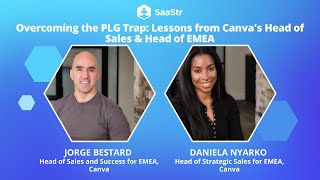
Canva's Daniela Niarko and Jorge Bestard explain why product-led growth hits a ceiling around $5 billion when companies try to move upmarket. They detail how Canva split into two separate units after 185 million users, building an enterprise product with SSO, SOC 2, and dedicated sellers to escape the trap that stalled Dropbox and Slack.
Chapters
Please welcome to the stage Daniela Niarko, Head of Strategic Sales EMEA at Canva, and Jorge Bestard, Head of EMEA S&S at Canva.
Hi everyone, my name is Jorge Bestard and I'm the Head of Sales and Success here at Canva.
Good morning everyone, and I am Daniela Niarko, Strategic Sales Lead.
So today we're going to be talking about the concept of the PLG trap. So this is a journey that Canva has gone through, and we've observed some companies that have started doing PLG as similar to us and how they've fallen into what Oliver J. calls the PLG trap. Our goal is that you take with you a ton of insights, some strategies, and that you learn how to navigate these challenges.
But first, let's try to identify why companies fall for PLG trap, right? And also why it's so attractive. So I think it's fair to say that most organizations that use the PLG playbook, they either focus on B2C, right? Or they're very much focusing on end-user acquisition. And it makes a lot of sense because if we go back a few years and when the PLG playbook was launched in the market, the industry went crazy, right? Everybody loved it. We had a lot of success stories, a lot of businesses that actually were able to demonstrate how much they increased their adoption rate through a PLG. So obviously there was a lot of noise and it was very exciting, right? And it is a very powerful tool because what it allows is it allows an organization to actually offer value to a customer without them needing to purchase the license first, right? So usually there's also a freemium model attached to it, which then again creates a lot of loyalty. It also creates a lot of trust. And on the other side also, it increases your adoption rate in a very fast way. So companies that want to scale, right, the PLG motion is absolutely the right way to go because you have a product that sells itself and also it's a self-service model. And on the other side, it also has a good and positive impact on your retention rate. So overall, I would say the essence of a PLG motion very much is simplicity. So you focus on the product, you build a product that everybody loves, right? And you make it indispensable to an end user. But the question is, as you try to move out of that trap almost, how do you encourage widespread usage across a company? So across teams, across locations, right? And across functions. So what you need to do is you need to identify essentially a champion internally, right? Ideally you have a a use case or a business case, and then you use those insights to actually target corporate buyers within that organization. So that could be procurement, for example, it could be IT, and that's when you start talking about the consolidation and move away from that end user approach and actually offer additional value to those end users. Yeah, and that's how you get widespread company adoption.
So I want you to think of it this way. Each step into the PLG journey makes very logical sense. And that's why, in a way, it is a trap. So remember the first step, you build a great product, the end users love it. You get traction in the market. So you raise a little round to build a marketing team and a sales team. You build that marketing team and sales team. All of a sudden, you see that hockey stick. You continue to rise. You're deeper into the trap, and then you want to double down on your growth. You're doubling year on year, and you say, okay, so our next step in our journey is to continue that growth. So the logical next step is to build an enterprise team. So you double down on hiring salespeople that are very expensive, that have enterprise experience, marketing team that is very expensive. They have— they need enterprise experience as well. And all of a sudden you are stuck in a trap because you realize that large enterprise required things that are so far away from your product team's grasp that you are stuck on a 2, 3-year journey to build that to market. All right? What CIOs require, what heads of procurement require to go wall-to-wall is very different than what small teams require. And they make decisions in a very different way. So the symptoms of the PLG trap, generally you see that hockey stick effect and then your growth really stagnates. You have a lot of difficulty going upmarket and you require it because you've told your shareholders, hey, we're gonna take over the enterprise, right? And then there's a big disconnect between what the product delivers and what procurement teams and IT teams are telling you. Now, the, to go a little bit deeper into the, what we've observed in market is actually that PLG companies, they do experience that huge growth, that hockey stick effect with small and medium businesses. However, they struggle to go beyond the $5 billion valuation. So think about companies that are in the market right now that started as, as PLG companies. Think about Asana or Evernote or Dropbox or these kinds of companies. They've all had a very hard time breaking through that $5 billion valuation once they went to market. Now, The difficulty in going upmarket as well is that all of a sudden your cost of acquisition just increases. So the growth that you were doing earlier, that 30-40% year-on-year growth that you were doing at certain unit economics, that completely shifts once you need a legal team that serves procurement teams, once you need a product team that builds for the enterprise. They actually found that PLG companies are 10-15% less profitable than their sales-led counterparts. And to finish off, the disconnect between the capabilities and the demands of these teams mean that the journey is extended. So we're in Europe. One thing that I'm sure everybody's faced when dealing with procurement teams for Fortune 500 companies, data residency. We need SOC 2, we need a certain MSA that a lot of times when you're going into the enterprise for the first time, you're faced with and you're like, oh shit, I actually have to prepare all this. And it's not something that you turn on like this, right?
So to break through the $5 billion valuation barrier, companies really need to make a shift, right? And shift needs to happen at the right time. So they no longer can let with a product-led strategy, but maybe perhaps they need to lean to more towards traditional methods, right? So let's say going back to sales. So the product alone no longer sells itself. We need additional input, having a pre-sales team, having a post-sales team. And it's very important also to understand that this isn't easy, right? It's not just like flipping the switch and from one day to another, you escape the trap. But it takes a lot of collective effort as a business, right? You need to build out the roadmap essentially, and then you execute on a go-to-market strategy. But one thing that we have seen what we've seen is that companies that have not been able to make that shift at the right time, they stay stagnant. And once they're stagnant, it's extremely difficult to get out of, out of that place. So let's look at a couple of examples. So we have here Dropbox and Slack, which I'm sure we all know, or some of you might even use. And they have one thing in common, they used their product to drive user adoption, right? So within a very short period of time, they had hundreds and thousands and millions of users within their platform. But as they scaled, they all had a couple of challenges, right? So Dropbox, for example, they started off with their freemium product. Again, within a short period of time, they managed to get millions of users. We all know it, we used it during our uni times, schoolwork, right? It's a very, it was always a favorite tool for many. But then actually as they were trying to bridge into enterprise, they realized, hey, we have an offering that's only focused on the product, But there are things missing, advanced security controls, for example, admin controls, so things that companies really need in order to operate in an effective way. Likewise, and then on the other side, of course, we have Box, which only focused on enterprise. So actually what Dropbox has seen is they saw a decrease in their year-over-year growth falling from 25% all the way down to 8% in a very short period of time. And if you look at Slack, so Slack, very similar use case here. Their go-to-market strategy was it's very easy to use. It was catered towards small teams. It's all around productivity and collaboration as we know, right? And then what happened? 2020, COVID hit. So all of a sudden there was a huge demand for such tools, right? And the question was, where they're ready. So they actually had to build in an additional comprehensive suite of enterprise kits, right? Which I think in their case was Enterprise Grid, which allowed them to have, which allowed users to have multiple workspaces. And then of course we also know what happened there. Teams later came in and focused on enterprise only, right?
So we're gonna talk a little bit about Canva And our journey is still being written. As, as you saw in Jason's talk, we are still growing quite a bit, but we are going through, through a certain journey. But our journey definitely started in the consumer side of things. So we started targeting individual users and small businesses. And as a tool, we became very popular, just created a huge groundswell. We have 185 million monthly active users, and that was, that was a great place to start fishing for enterprise clients. Now, what we discovered after almost 10 years in the consumer space is that as we started to dabble into the large enterprise space, we were slowly digging ourselves into the PLG trap, right? The exact same symptoms. We had staggered growth in the enterprise. Our enterprise features were not ready for, for what our enterprise customers were asking. So we almost had a, we had a heart-to-heart with ourselves and we said, we have a product that is great for teams. We don't have a product that is great for enterprises yet. So we, we really pulled on the brakes and we said, okay, let's, let's focus on doubling down on teams and let's create almost a separate kind of company. Let's separate the product team, the marketing team, the sales team, and let's give ourselves a leeway of 2 years to build a pure enterprise product. Product.
Exactly. So we also had to go back to the drawing board essentially, right? Because we were focused on B2C first. And as we, we try to understand what does enterprise look like for us? What do we need to do? What's missing essentially? We had a great product that was selling itself, but all of a sudden it was a little bit stagnant. So we also went back and looked into collaboration tools. So maybe perhaps shift away from just a traditional social media tool and going into a productivity tool. So collaboration, admin controls, organizational hierarchy, so that companies can really mimic the business structure within Canva. So the process involved 4 main pillars, and one aspect that was really important was really to understand the market demands and also trends, right? So we took big bets straight away. Very early on, we were one of the adapters of AI. In the tool. And also we looked, um, we pulled in additional features, right? That were really dedicated to enterprise users such as whiteboards, presentations, recording, et cetera. And then we went and had a lot of feedback and yeah, like discussion groups with our customers trying to understand what is it that they need from us? What is it that the end user need in order to deploy Canva as an enterprise tool? And then pull that back into your product roadmap and continue to evolve your product. So that's what we did at Canva. So a couple of weeks ago, as part of our Canva Create event, which is our product release event, we actually pushed out our enterprise product, which showed that we are committed to focus on enterprise only. But also, as you can see here, we have a slightly different messaging. right? So it shifted to work redesign so that we also address the right audience. And ultimately what happened is it helped us to really close the loop. So now we are able to address a truly diverse customer base, right? Which we have. So we have the end-to-end user, we have individual users, sorry, that use Pro paid users. We have Canva for Teams, which is for smaller teams, and we can now cater to large organizations as well.
So how can companies really predict and avoid and overcome the PLG trap? So we have a three-pronged strategy that we'd love to share with you. The first of all is, is really getting the company mentally ready. So as Oliver J— he's one of our advisors, he's the ex-CRO of Asana— he says, if it doesn't feel like you have two separate companies, you're doing it wrong. It really has to feel like you're separating your sales team, you're separating your product team, and they really have to feel that you are building a whole separate section. This almost reminds me of, of when Apple, they, they started on their Lisa project, right? They, they completely separated that project from the company that was very profitable, but not that computer. So we did the same thing and we, we separated and we started building in the enterprise, but not only did We need to have a different product development team, but our customer interactions had to be different. Our go-to-market strategies had to be different, and our specialized talent had to be different. Think of finance. When you are selling into the enterprise, so you're selling to a company like Unilever, which has hundreds of billing departments. It's very different from sending a bill to a 100-person team. Than sending a bill to a 200,000-employee company. So your finance team that is very focused on teams and users, all of a sudden they're gonna be focusing on how to build their structures for an enterprise product. Think about legal as well. So we talked about MSAs and negotiating with procurement teams of 50 to 100 people. If your legal team is very used to just very light MSAs for small teams versus, negotiating with the Fortune 500, you need a completely separate legal team. And security, data residency, when do you kick off that journey, right? Getting your SOC 1, SOC 2 certifications. So all that is a journey, and you have to communicate that journey when you start it, right? You have to communicate with your employees, you have to communicate it with your partners, but we took it one step further and we communicated it with our customers. A lot of our customers that were telling us, hey, we're thinking about going wall-to-wall, We told them at 2 years ago, hey, we're not, we're not ready yet. We're not able to support you yet, but let's support different teams. And when we are ready, we're gonna let you know.
Right. And then as a second strategy, what we put into place was early and continuous product adaptation. So an organization with 500 users, 1,000 users, 5,000 users, or 10,000 users, they have completely different product requirements and they also have completely different service requirements. They have expectations on how to work with a vendor. So what we did was we focused very much on the user experience. So we went away from, we went away from the product-led growth alone and really focused on the user experience for smaller teams, for larger teams, and then what happens is that your product needs to continue to mature as well, right? So on our side, what we did was we looked into the feedback that our customers have provided and some of the main requirements they had were actually single sign-on, which we all know is a very basic requirement, right? But for us it was a shift and also data encryptions and compliance standards. But when it comes to adaptation around AI, for example, it's still fairly new. New. So a lot of customers, they have a high appetite for AI. Others, they're still a bit weary, right? And they feel a bit overwhelmed. So being able to respond to both sides, giving them the opportunity to play with these tools, but also giving them the assurance that they have control. So we have both, we have AI, but we also have controls in place so that they can slowly ease themselves into the product. And then on top of that, we also focus on specific teams and we offer them different functionalities, right? A HR team, they have different requirements, finance, design teams or marketing teams. So we have a dedicated work suite that caters to all of them.
And to finish off, just our, our evolving sales and marketing strategy. So what we did is we got together as, as a go-to-market team and we said we have part of the team that is very used to selling to users and smaller teams. And we hired a, a set of enterprise sellers that were very used to selling the enterprise. So think of this as a two-prong strategy, right? As a company starts adding users, there's team sellers, and then there's enterprise that are able to sell to, to, to C-level executives. The target markets that you have in the enterprise are very different from the target markets that you might have in teams, right? There's even the sales territories, there's countries that are very SME and mid-market heavy, and there's countries that are, that are very enterprise heavy. And then the pricing, we actually did an audit with an external company to really audit our pricing and see if the pricing is ready for the enterprise. And we completely shifted our pricing. We lowered our pricing on the team side, and because all the features that we had on the enterprise brought a lot more value, we raised the price on the enterprise side. And then we tried to align the sales and marketing communication as much as possible. This is, it's actually something that companies have a challenging time because at the end of the day you do wanna market to users, but you also wanna market to the C-levels, right? Think about how you adjust your message in a different way. The value for a user is very different than a value for a head of IT or a C-level who is never gonna use your product, but they need to know how it's gonna influence their business. There's two examples here. which is a message that we, how we market to individual users. You can see it's very feature-driven. Hey, with, you have, you can create stunning designs. You have unlimited access to premium content. A CIO does not care about that. What he cares about is how are you gonna streamline my workflows? How does Canva live within the ecosystem of apps that I have? And how are you gonna make or help me save money for my customers? Company. So very two-pronged approach here.
And we also focus a lot on the post-sale side. So we have a dedicated customer success team at Canva because for us it's very important that customers understand the maximum value they get out of the product very early on. So we actually taking a forward-looking approach where our team sets up dedicated sessions, um, with clients and they try to understand their goals and their objectives for the next 12 to 24 months, right? It also allows us to spot risks very early on and also identify trends because it's almost, it's like a feedback loop where the customer then goes to our CS team, goes to sales, and then sales takes it to product, and then product takes it to customer service and so on. So this is how we all work together. That's why pre-sales and post-sales, they need to work, they need to align and work together. And we also work with champions, internal champions. It's really important that you identify them because you can use a train-the-trainer approach, right? Those champions can help you with the adoption rate. They can go out, sell to different functions, different regions on your behalf. It really helped us also to build a lot of trust and loyalty with those customers. So in the end, it's all a balancing act, right? As you As you can see, PLG is a powerful tool, but it's about balancing the strength of a PLG strategy and the demand of enterprise customers. So we have taken you through a lot of different points today, but just to summarize it, it's really important to get a company mentally ready. It's almost like you have two different companies acting under one roof, right? They have different requirements and it's important to communicate as early as possible and also to be transparent with your team, address challenges that might arise because it does take collective effort. And then also don't forget your product adaptation, being able to respond to trends as early as possible, speaking to your customers, speaking to your SES team, and then ensuring that your product matures with your customer base because at this point it will be very diverse. And then you go layer deeper which is addressing your sales and marketing strategies and your go-to-market strategies, right? Refining your messaging and your positioning so that you can target the right audience. So thank you for your time. Any questions?
More from Jason

Why Your Next Hire Should Report to an AI, Tragedy Apps, and Too Many AI SDRs? | The Agents #004

Our Agents Drove Our Salesforce Bill Up 80%, Marketo Hates Agents, and We Stealth-Churned Off Notion




Managing 20+ AI Agents: Lazy Agents, Our $500K AI Bill, Stealth Churn & the Death of 60% Solutions




