Personalization + Efficiency in Sales: Tactics to Strike A Balance w/ Salesforce's VP and Demostack
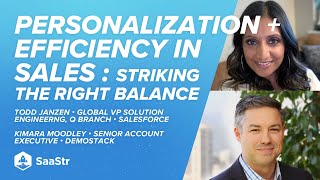
Todd Jansen, a 17-year Salesforce veteran, discusses how to balance personalization with efficiency in sales demos. He recommends maximizing efficiency early in the funnel with quick demos, then adding deeper personalization later. A Gartner stat: 73% of a sale happens without the salesperson present.
Chapters
All right, I think we should kick it off. Like Katherine said, I am Kamara Moodley and I am from DemoStack. I'm a senior account executive, so really experienced in selling and doing all of the sales motions. And I'd love to introduce Todd Jansen. Todd, how are you doing? Good morning.
Doing great and good to see you again.
Yeah, you too. So should we kick it off? I think so. We have about 19 folks here already. Yes, let's get started. Right, perfect. Um, so tell us a little bit about your background, Todd, and what is QBranch?
Yeah, uh, thanks for the question. So, um, funny enough, today is my, um, 17th anniversary at Salesforce. Um, so I started, um, 17 years ago as a solution engineer. That was a new role for me. Um, so I did that for about 3 and a half years, had a lot of success. It was kind of the first time that I felt like I was really, really good at something. It was, it was blending my engineering education and background, um, and some of the social skills that I picked up along the way. And, um, about 3 and a half years into that, uh, Salesforce came out with a programming language called Apex. And I found myself back at my desk coding. And it dawned on me that it was taking me a lot of time. And for every hour I was at my desk coding, I wasn't in front of customers. I wasn't selling. And that's when the napkin idea came to me. It was, wow, we should have a team that does some of this for us so that we can stay in front of customers. So essentially just taking that concept, kind of looked at what, what pre-sales and what solution engineers don't love doing or are not great at. And I built it into Q Branch over the last 14 years to about 250 employees globally. And the name, a lot of people ask about the name. So yeah, there's a James Bond reference there that, you know, that's where Bond goes to get the latest intel and widgets and gadgets and things to go complete the mission. But Q is short for quartermaster. Quartermaster is a real thing in real life. In the Army, the quartermaster arms the troops. It's a perfect metaphor for what we do in sales. We are behind the scenes. We are arming our sales teams with killer high-fidelity assets. And in the Navy, the quartermaster navigates the ship. And we have a branch of Q Branch that just helps our sales teams go try and win the biggest deals of their career.
Thanks for that explanation. That really helps. And also, who doesn't love James Bond and Quartermaster? It all makes sense, right?
Yeah.
So let's talk a little bit more about personalization. Today we're talking about striking the right balance between personalization and efficiency in pre-sales. When we're talking about personalization, why is it important when it comes to pre-sales? What do you think?
I think it's, it's never been more important. The reason I say that is I think, I think the buyer has changed and I think COVID really accelerated that. You know, McKinsey will tell you that COVID accelerated US e-commerce growth by 10 years. And we know this because our parents and grandparents started ordering groceries from their mobile phone. And so people want to see your product. They want to see it now. They want to see it on their terms. And it has to look like their world. So, you know, maybe 5 years ago, you could maybe get off with a beginning intro pitch or demo that was totally generic and people would kind of go along. But I think more important than ever, like, you need that personalization up front.
Yeah, I definitely see that in my sales cycles as well. Every single person I speak to wants to see something more and more relevant. So I can't get away with just doing an overview tour anymore. No, these are gone. I think it's a good time for us to hop into a poll. I'd like to hear from the audience, how many calls do you have before showing a product demo? And if it's more than this, feel free to do the number as well after you do take the poll. Once we start talking about some of the feedback, I'll give you guys a couple of minutes here. As far as what I'm seeing in the sales cycle, I mentioned that a lot of folks do want to see personalization. I'm starting to show product first, I would say, on the first call that I'm taking. But historically, until I came to DemoStack, I wasn't really able to do that. So it was probably about 2 to 3 calls before we even showed product. Let's see. Anybody else coming in through the polls? I think we'll give it a couple minutes because I don't see any responses just yet. So we'll hop into the next question here. There's the question of efficiency, especially when it comes to personalizing every conversation. Where do you feel the most pain in striking that balance, Todd?
Yeah, I mean, that, that is the constant question every, every SE has to weigh, every salesperson has to weigh. And as you and I were, you know, we've talked about this before, you know, at Salesforce, you know, 15 years ago, you know, the beginning of the Q branch, like we started making tools and things to really take that off the table, to make personalization a few clicks in a few minutes versus spending hours. Because I think, you know, the reality is You know, and you and I were talking about this, like, I just take this for granted because we've had this forever. But, you know, if it's taking you more than 5 minutes, a few clicks, just spin up a demo environment that let's say is 50% of the way, you need to solve for that. Like, you need to go through some scale at that. You got— you need to go invest in that, whether that's buying some software or building some tooling yourself or getting R&D to do something different. You know, anything longer than that's too long for an SE to just get that kind of baseline demo. And then when it comes to kind of those, those further stages of personalization, you know, whether it's data loading or whatever it is, you know, the goal is to shorten that as much as possible. And at some point you are going to have to throw tooling at it or software, because frankly, you don't want your SE spending 4 hours of prep for every 30-hour or 30-minute meeting.
Exactly. And you don't want to have to have an SE being pulled into every single sales cycle, I can imagine as well.
Yeah. You know, I say this a lot when, you know, some of these webinars and stuff I do that, you know, pre-sales is one of the biggest bottlenecks in B2B sales. And that's not meant to knock SEs or knock the profession. I love the profession. I consider myself a lifer. It's just the reality, right? And a lot of it has to do with just calendars and getting their expertise. So, you know, if you can reduce that, you know, I think you're in the win category.
I think we've gotten some answers back from the poll now. It looks like majority of folks on this session, about 50% of you all, about one call before any product is shown. So I'm guessing that's the standard intro and overview, doing a little bit of discovery, and then hopping into product on that second call and thereafter. About 38% of folks are in the zero calls before product is shown. So they're showing the product on the first call. That's awesome. That's kind of what I'm seeing the shift being at this point. Todd, what about you? Are you seeing something similar on your side?
Yeah, and I think, you know, we talked about this just a few minutes ago that I think we're in a different buying landscape. And, you know, maybe a few years ago, probably wouldn't see as much in the zero category there. It'd be later stages. Yeah.
Yeah, about 13% of you, it's about 2 calls and then product is shown. Hopefully we can reduce that and get you guys to show product sooner. Where in the sales cycle do you optimize for efficiency? And where do you focus on personalization?
Yeah, I mean, I think if we, if we think about our sales funnel, I think you have to optimize for efficiency at the top of the funnel. Because if you do it right at that point, every SE, every BDR, every SDR, every AE can show some level of personalization with a few clicks, right? But as you get deeper in the funnel, you're really getting deeper into personalization. And so, you know, and it makes sense, right? Like the deeper you are in the sales cycle in the funnel, it warrants the time investment in personalizing things and spending that real time, but you got to be careful not to do that too early in the cycle. Because it's, you know, you just, you run the risk of people leaving the funnel and You know, if you're spending too much time on unqualified leads, that's, that's not a good thing either.
Yeah, that makes a lot of sense. And I do find that once I've done a lot of discovery and we've shown product even on the first or second call, by the third call or fourth call, you're getting more and more folks in the sales cycle as well. So kind of makes sense to do more of that personalization around what they might want to see.
Exactly. Yeah. I mean, you bring up a really interesting point. Like there's personalization to the company you're selling to, But there's personalization to each stakeholder as well in the selling cycle.
Yeah. They get really excited when they see things that make sense for them specifically.
Yeah. You gotta, you gotta tap on the personal value, right?
Yeah. What tactics have you found to be helpful in getting more personalized without sacrificing that efficiency?
Yeah. I love the question because it reminds me of one of the first tools we made here at Salesforce. Something we call the Org Customizer. That'll mean nothing to anybody. But the whole idea was, could we pop up a little modal, a little widget when someone created their new demo environment? And could you change a few things? Could you change a few accounts, a few product names, a few contact names, hit send, log into your, your demo environment, refresh the dashboard, and your prospect would think that you spent all day loading their data in your environment. And so the question reminds me of that tool and, you know, I had to kind of think back 'cause we've had it for so long, but it's been such a staple of almost every single demo we've done at Salesforce since that, you know, I think every company needs something like that.
Hey, well, that's why you got DemoStack now. I think you all were the only ones that were able to do that at Salesforce for a while, because I definitely remember spending hours and hours on PowerPoints and updating things, not able to update my demo environments at all in my past roles.
Yeah, I mean, I think that's what's so exciting about what you guys are doing. And for me personally, you know, I never thought someone would make a company or software to actually build what we've, we built inside Salesforce. And so for me, it's super rewarding, super cool to see. I know you guys do something similar with your variables, being able to cascade changes all throughout your products. So when I saw that, I just, I, yeah, I just never thought I'd see the day.
Yeah, it makes those vertical-specific and use-case-specific demos really easy, which is awesome. Yeah. Yeah. In terms of how you're seeing the efforts of personalization impact revenue acceleration. Can you speak a little bit more to that?
Yeah, I mean, you know, I think the, the more people see their world, their life inside what you're showing them, the more willing they are to bring additional stakeholders into the selling cycle. And early on, that's what you're really trying to do. You know, I think we forget that the The person tasked with software, they've been given a task or a mission or a project. Hey, go out there and evaluate this stuff and come back to us on what you found. And so what you're really trying to do is educate that person, really kind of enable that buyer, if you will, to then go up the chain and say, hey, look, this is what I've found. Check it out. Look at— I'll show you myself. When you have your internal champions selling on your behalf, like there is nothing more more powerful.
Yeah, I definitely would agree to that. And especially if they can really understand what you've shown, not just as that overview, but something that makes more sense and is showing them more of a value proposition through product, it's so much easier for them to support their business, their business case that they're creating.
Yeah, you know, Gartner says that 73% of the sale happens without the salesperson, which is a, which is the mind-boggling stat. And I think, you know, we're hitting on that right here is As, as good of salespeople as we think we are, most of that is happening without us. And so when you think about it in that context, this idea of buyer enablement, right, becoming the coach is really, really critical because the best thing we can do is enable that person to sell on our behalf.
Yes, 100%. That's definitely what I've been trying to do in my sales cycles is become more of that coach and get them really excited about the product. But in a way that it's easy for them to translate that information internally. It's been successful. So I'd have to agree. Any final takeaways on how to strike the right balance?
Yeah. You know, I, I was just reminded, I was listening to a great pre-sales podcast last week. It's called Two Pre-Sales in a Pod. It's such a good podcast and they had Peter Cohen on, right? And if you don't know who Peter Cohen is, you need to go look it up now. Jason M. Lemkin. He's kind of one of these gurus of our profession. He had this like incredible quote that this reminds me of, and he says, our job in pre-sales is to secure the business with the least expensive form of proof. And what I love about that is it's similar to something that I've said throughout my career is, you know, we are trying to show our product in the best possible light. With the fewest clicks possible. That's maybe a little more tactical version of what Peter was saying, but I think we need to, we need to remember that, right? If we can get, if we can get away with generic, great. Like we're going to be super efficient. We're going to close a lot, a lot of deals. And look, there are professionals out there that are really good at showing generic screens and just saying something like, imagine if you will. Right. But I would say that's a very, very slim minority. And so for the rest of us, right, we do have to kind of think about that. You know, how do we secure the business? The least expensive form of proof. I just love it.
Yeah, exactly. All right. We have a couple of questions for the audience as well. I think the first one, what do you think your prospects expect from you in terms of personalization? I know, Todd, you probably have some insight here to what you've seen in your history. I've seen everything underneath the sun, but I think data is probably the biggest piece that my prospects would want personalization on. The data actually being relevant to them and not sample data, something that makes more sense in their eyes and even is specific to their business as well.
Yeah, I'd agree with that. And I think people expect some form of generic upfront, so, you know, their expectations are lowered. But if you can come in pretty early and show them their world and show them what their, their, you know, business looks like in your product, um, I think, I think you can differentiate pretty early. Yeah.
So audience, feel free to put some stuff in the chat here. I'd love to hear a little bit more about what you're seeing and what people are expecting to be personalized on your side. And then another question to talk a little bit about too is how often do you personalize your pitch? The pitch is pretty generic from my experience, but I find myself now tailoring it a little bit more based on who I'm speaking to and maybe honing in on use cases up front, giving some suggestions as opposed to just doing discovery up front and then kind of tailoring from there. What do you think about that, Todd?
Yeah, and again, I think this goes back to like the buyer has changed. And, you know, 3 years ago, we probably could have gotten away with generic and kind of imagine if you will, but I don't think that's fine anymore. And again, I think what we've been through in the last couple of years has accelerated that. And it's things like Netflix that have changed all that. People want it, they want it now, they want it on their terms, their time. It's a different world.
All right, so we are actually coming right up on time. That was some really great content. Thank you so much, Todd and Kamara. Yeah, this was a great session. We have a lot more great content today, and we'll see you in the next ones. Have a great rest of your day, everyone. Thanks so much.
Bye. Thanks, everyone.
More from Jason

Why Your Next Hire Should Report to an AI, Tragedy Apps, and Too Many AI SDRs? | The Agents #004

Our Agents Drove Our Salesforce Bill Up 80%, Marketo Hates Agents, and We Stealth-Churned Off Notion




Managing 20+ AI Agents: Lazy Agents, Our $500K AI Bill, Stealth Churn & the Death of 60% Solutions




