Playbook to Scale your ARR 10x in 2 Years | WestBridge Capital, Turing, and Yellow.ai
Raghu from Yellow.ai and Uma from Turing explain how they grew ARR 10x in two years. They hit product-market fit with NRR above 110%, scaled sales from 2 reps to 220, and kept conversion rates at 30-40% while maintaining efficiency. Turing's developer-focused mission and self-serve platform let engineering managers spin up teams in minutes.
Chapters
Hi everyone, welcome to our fireside chat and our playbook on how to scale your ARR 10x in 2 years. This is a really exciting and relevant topic for every SaaS founder out there, and I'm really honored to have 2 fantastic executives today on our panel to address this. Raghu, who's the CEO of Yellow.ai and founder, and Uma, who heads developer community at Turing. Two very successful US-India cross-border SaaS startups that can talk about the experience today. Let me start with a quick introduction of myself. I'm Sameer Chaddha. I'm the founder and managing director of Westbridge Capital. We manage $6.5 billion of capital focused on India and US-India companies with a big focus on SaaS. We've seen some amazing entrepreneurs come out in SaaS and we're particularly excited to be here at SaaS Tour today talking about such an important topic for all of you. With that, let me kick off by handing off to Raghu to talk about a little bit about Yellow.ai himself and the amazing growth they've achieved in the last few years. Raghu, on to you, please.
Thank you very much, Sameer. Fantastic being at SaaS Tour. Yellow.ai is a conversational experience automation company. We have seen a is unrelented adoption of messaging and voice as a medium of communication between consumers and enterprises. And Yellow.ai helps enterprises automate customer support, commerce, and marketing on platforms such as WhatsApp, WeChat, Line, web, mobile app, and telephony. I've had a fantastic experience growing the company over the last 2 years, and some of the key things that I'm going to talk about today is about leadership, hiring, sales and marketing aggression, and geographic expansion as key aspects of growing 10x in our ARR in the last 2 years.
Raghu, thank you for that. And with that excellent intro, Uma, let me hand to you to talk a little bit about Turing's overall growth, how well you've done, and also some of the amazing initiatives you've taken in the developer community at Turing.
Thank you so much, Sameer. First of all, I wanna say like, thank you so much for inviting Turing to the panel. And, you know, it's an honor to be here. I also want to thank like Westbridge, you and your team for being such an amazing partner for us at Turing and helping with the hypergrowth strategy. Like you've been a key partner. So thank you for that. With that, I'll quickly introduce myself. I'm Uma. And as Sumir said, I head the developer community at Turing. At Turing, what we are doing is we are building the future of remote work, right? We know every company is going remote and everyone is in a race to find remote talent. But how do you find talent if you have to deal with 24 million, like over 24 million developers and there's no global engineering standards for vetting them, screening them? How many hours of effort will companies have to spend And that's why like at Turing, we are building an intelligent talent cloud. And what do I mean by that? Like, well, we have clouds of servers and databases and software just like that. Like imagine a cloud of like software developers, you know, pre-vetted top 1% from all over the world that engineering leaders can just with a push of a button, you know, spin up their engineering team. Right? Like that's what we are building at Turing. And for developers, again, we know we have amazing developers, you know, all over the world, but many developers don't have access to great opportunities. And at Turing, we are trying to close this gap and, you know, by connecting the world's best software developers with the best opportunities. And, you know, in the last 2 years that we have been, you know, in market, like, We've grown 10x with just, you know, I'll talk more about like how our brand just speaks for itself and the value proposition, you know, is like so awesome that, you know, we are doing great on that aspect. And I'll also talk about like, you know, building communities and all that in a little bit, but just wanted to share that, you know, like really unleashing the world's untapped talent and the possibilities it brings with leading to breakthroughs in wide range of fields like AI, data science, healthcare, all that is what keeps us awake and going and realizing this mission. In fact, that is exactly why I left Microsoft after a career that it was like my family, I was there forever. And I quit Microsoft to join Turing to pursue this vision with an amazing group of founders and leaders at Turing, and super excited to be here. And thank you for the opportunity. We'll go into a lot more detail into how we scaled and all that in a little bit. Thank you.
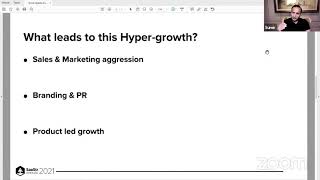
Thank you, Raghu and Uma. That's an excellent introduction to both Yellow as well as Turing. Let's jump right into it and let's talk about what the founders on our, on the Zoom call today want to know. They want to know how you guys achieved this kind of amazing hypergrowth in the last couple of years. And I'd like to first double-click on sales and marketing aggression, which Raghu, you've done a tremendous job of. And I'd love for you to take a few minutes and talk a little bit about how has Yellow achieved such sales and marketing aggression and how that's worked incredibly well for you in scaling the business, Raghu.
Thank you, Samir. So 2 years back, when we really getting on the path of driving very fast growth, we kind of the first building block of sales and marketing aggression we felt was getting great product market fit. What is great product market fit? In our view, we kind of looked at it as if we are achieving net retention revenue of more than 110%, Uh, which means that we have, uh, we have a pretty solid funnel. And as we increase the capacity of the funnel, we are going to kind of directly increase the output in terms of ARR. Uh, so with about more than 150% of NRR, we felt that we were ready to drive this, um, sales and marketing aggression. Second, how far can you go with it? Right? I think there are guardrails for, for, for everything. So I think the decision-making was really at the path where 1 year later or 2 years later, which one would be a great scenario? One, you have excellent sales and marketing efficiency, but you have potentially a lesser growth than what you'd be super happy about. The second is, can we err on the side of driving higher growth and potentially can live with a lesser sales and marketing efficiency company have to take bets in order to kind of go in one path. We took the second path, saying that for us as a company, this is a scenario where we need to kind of really drive up how fast we can acquire customers. And we are going to be very aggressive in sales and marketing until the time we see it breaks, right? So we went ahead and we went from about 2 people in sales and marketing at the start of 2019, and now we have about 220 people in sales and marketing. So it's been a massive growth in how we built out the overall sales capacity. And what we have seen is that this sales and marketing capacity build-out actually helped in brand building. It has helped in customer success because there were so many people talking to the customers and kind of driving the expansion at the existing customers, and our ARR actually grew more than 10x in the, in the last 2 years. So things to keep in mind while driving the sales and marketing expansion is one, sales capacity build-out. Salespeople take about 4 to 6 months of ramp-up time till they start hitting their full quotas. So the companies need to really plan for what is the growth targets 1 year ahead, 2 years ahead, and plan to hire sales teams ahead of the curve, because in enterprise sales, it's very clear that the only bottleneck clearly after you achieve product market fit and a large market is the sales capacity, is the sales capacity that you are building out. And that's directly proportional to the quota, that overall quota that the entire sales team carries. Second, coming to guardrails, because this plan can go awfully wrong. If there's a lot of hiring happening in the sales team and the results are not coming out. So really need to look, the companies need to look at, or we started looking at leading indicators. What are the leading indicators? Leading indicators are the pipeline. Is the pipeline buildup happening ahead of the curve by the time the sales team need to achieve their quota? Is the conversion rate, is, within the guardrails. So you don't want to increase your sales and marketing aggression at a 10-20% conversion rate. Is your conversion rate at least trending about 30-40%, right? And fourth, are you continuing to drive high NRR and retention even as you're aggressively building out? So these three are the key guardrails while building out the aggressive sales and marketing plan. The fourth one, once you start building out the key levers to building this, this aggression is about hiring the right leaders in each of the geographies, territories, and, and then functions. Clearly, as founders, there is limited time and, and the founder-led sales stops at some point of time. Very tough to build this strategy with just founder-led sales motion. It's very key to hire leaders who can in turn hire some of the best sales reps. So the hiring capacity of the leaders that you hire within the sales and marketing teams has been a key catalyst on how this sales and marketing growth has happened for the company. So yeah, as a summary, product-market fit, leadership hiring, and guardrails are the key elements of this strategy.
Raghu, thank you for that excellent description of sales and marketing aggression. I know a lot of our founders will benefit from that. I'd like to turn our attention to branding and PR. Uma, you've done a great job of branding and PR at Turing, and branding and PR is obviously not just press releases today, but it's much deeper than that. Turing has done a great job of developing an amazing brand among the world's best developers. How have you achieved that, Uma? And can you talk about how Turing has sort of been able to build such a wonderful brand among developers and customers?
Sure, thank you so much for that question. That topic is really close to my heart. So first of all, I would actually like to tackle this in two, by making two points. One is talking about the importance of purpose-driven brand, right? Our brand itself is our biggest brand vehicle. Our mission is our biggest brand vehicle. Our mission, of unleashing this untapped potential, like connecting the world's best software developers with the best companies, that resonates with everyone. Like it's a win-win for companies, it's a win-win for developers. And so it makes it really easy. It's, you know, the mission itself like helps us build the brand. We already see this by having close to 200 well-known brands like Johnson Johnson, Startups like Rivian, big companies like Disney, all coming to us and trying to find talent. And we also have over like close to a million developers already registered on the platform from more than 140 countries. So we know that the value proposition speaks for itself. Like for companies that use us, they tell us that they save approximately 50 hours per hire. That they make with us. And for developers, again, they don't just, we don't just offer jobs. Like we are actually offering them their dream career. Like we are with them along the way. We celebrate great engineering and great engineers. Our developers are not resources. Our developers, you know, we are invested in their success. We are launching several programs and you asked about community program as well. So let me just go into that. So we are launching several programs to, you know, coach them, mentor them, inspire them, keep their skills up to date, you know, help peers contribute back to the society. Like, we have tons of ideas and tons of programs that we are launching. And so this helps with the brand. Like, this is our first way is having a purpose-driven mission and having that, you know, stand by itself and help with the branding. And the second is we are also, as I said, like we are launching lots of community programs. We are trying to build engaged communities across the world. And with that, again, with these two things, like with the mission and with engaged communities, we are building and growing our brand and that's how we are moving forward.
Yeah, thank you, Uma, for that excellent view on Using Branding and PR to Build Your SaaS Company. I'd love both, both of you, Raghu and Uma, to touch a little bit on how product-led growth has played a role in Yellow and Turing's hypergrowth. And in particular, I know both of you had very successful do-it-yourself products, but if you can talk a little bit about how the product side briefly has helped you both grow Raghu, maybe starting with you and then Uma, please.
Absolutely. So product-led growth is a key part of our strategy. And, and I think for us, when we started our journey on the product-led growth curve, we had to be clear about who our end users are. We have been an enterprise-focused company and enterprises are our sweet spot customer. So our product-led growth has to be a fuel to that channel. So one of the key aspects was we targeted our product-led growth towards developers of large enterprises. So, so they are able to come in, try out the product, and then we use that as a lead to go ahead and close on the enterprise customers. The second aspect is the time to value. So the ability for a new developer or builder to come in and create an experience and actually put it in production within a few hours has been a key aspect of how fast your product-led growth can drive the lead funnel and the closures funnel for the company. So that's an aspect that we focus quite a bit. And the third most important aspect is about creating a community around the product to be able for your community members to share about some of the key learnings in building phenomenal virtual assistants out of the product. This helped us also expand into our SI strategy. So we have partners such as Accenture, TCS, Infosys, who go on and kind of deploy our product at customers such as Roche Pharma, Schlumberger, Alstom. And the product-led growth strategy helped us to expand the base of experts on the platform that can go on and pitch to new customers, enable the development success of the customers of our SI partners. So, so the key aspects of our product-led growth has been one, very fast time to value, the right focus on the end-user group and building a strong community. And over the last 6 months, we have seen the sales and the revenue growth directly attributed to product-led growth has grown about 4x as we are expanding our strategy around this. And this happens at very high sales and marketing efficiency, almost 2x more efficient than field sales-driven customer acquisition.
No, tremendous, Raghu. Thank you. And I know we've got 2 minutes left for our webinar, but if Uma, you can touch briefly on this and then we'll just jump to the last slide very briefly and open up for Q&A.
Okay. All right. I'll be really quick. So as you know, Turing is a product company. We use AI to source, vet, and manage developers. The only way we can scale and do things efficiently is by investing in our products. And so the best way to do that is by providing a self-serve experience to this intelligent talent cloud that I talked about so that engineering managers can browse our talent cloud and spin up their dream engineering team within minutes. So that's what our self-serve does. And it's been great. Our users tell us that they have aha breakthrough moments. Within minutes on our self-serve experience. And again, like, you know, it's been a game changer for us. I don't have the numbers like Raghu had as to how, like, what's the percentage of growth just from self-serve, but I know that self-serve has resulted in a lot of, you know, like accelerated growth for Turing. And it's been proved to be, you know, a great product that we will continue to invest in and focus on.
Thank you, Raghunama. Let me turn to the last slide in our last minute or two here and and then open it up for Q&A. So just to summarize, you know, we've had an amazing session today with Raghu and Uma, and I've certainly learned a lot listening to them. And some of the key takeaways here are to chase product-market fit, which both Raghu and Uma have achieved, and run very fast once you've achieved it. Second thing that we're huge believers of at Westbridge is maintaining capital efficiency. While chasing hypergrowth. You can always grow fast if you spend a lot of money, but doing that intelligently is the hard part. And lastly, something Raghu and Uma have done a great job of, which is hiring amazing talent, and both of them have spoken about that. So let me pause there. We're at the 20-minute mark, and I want to be respectful of time and take
More from Jason

Why Your Next Hire Should Report to an AI, Tragedy Apps, and Too Many AI SDRs? | The Agents #004

Our Agents Drove Our Salesforce Bill Up 80%, Marketo Hates Agents, and We Stealth-Churned Off Notion




Managing 20+ AI Agents: Lazy Agents, Our $500K AI Bill, Stealth Churn & the Death of 60% Solutions




