Pledge 1%: Why CEOs Should Set Aside Equity for Social Impact | Puppet, Pledge 1%, Accel & Docusign
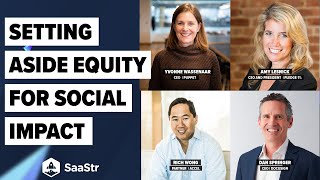
CEOs Dan Springer, Yvonne Wassenaar, and VC Rich Wong explain why companies should pledge 1% of equity to social impact. They cover two models, governance tactics, and real examples like DocuSign and Puppet. Pledge 1% provides playbooks and templates to help boards adopt the practice.
Chapters
Great, thank you, Saster. Well, hello and welcome to our session. I'm thrilled. I'm Amy Lesnik, and I'm the CEO of Pledge 1%. And I'm thrilled to be joined by 3 amazing panelists. First off, we have Yvonne Wassenaar, the CEO of Puppet, which is a late-stage enterprise provider who set aside 1% of their corporate equity last year for social impact. Yvonne is a seasoned executive previously serving as CEO of Airware and CIO of New Relic, and she's held multiple leadership positions at VMware and Accenture. Yvonne is very passionate about empowering others to do great work with purpose. And to that end, when Yvonne took over as CEO— interesting for you guys out there who are non-founder CEOs— setting aside equity for social impact was one of her first priorities. So next up, we have Dan Springer, CEO of DocuSign. Under Dan's leadership, DocuSign set aside equity for social impact on their road to IPO, really solidifying DocuSign for Impact. As a core component of DocuSign's culture and DNA for its 5,600 employees worldwide. DocuSign signature program, DocuSign for Forest, has already helped millions of people around the world replace 20 billion sheets of paper with digital processes. 2.5 billion— million trees have been saved, 2.5 billion gallons of water have been saved, and 140 million pounds of waste. Dan, along with Rich, is also on the board of UiPath, one of this year's hottest IPOs. And so we're excited to have him share not only his perspective as a CEO, but also his perspective as a board member empowering CEOs. And Dan is also on the Global Visionary Council for Pledge 1%. So we're super fortunate to have him. And last up but not least is Rich Wong, partner at Accel since 2006 and esteemed Midas List investor. Rich has long time been a supporter of Pledge 1%, having served on the board of Atlassian, which is one of the founding companies in the Pledge 1% movement. Rich is currently on the board of UiPath along with Dan, and the two of them together really helped UiPath to set aside equity prior to their recent IPO. Rich has led investments and served on on the boards of numerous hot companies, including Chekr, as well as the National Venture Capital Association itself. We're excited to have Rich on the panel to share the VC perspective. And Rich, we're really hoping you can help us to better understand how investors and board members can help, and also why VCs are increasingly finding this important thing to do. So overall, business as a force for good is clearly a top-of-mind topic right now. Our experience over the last 18 months has demonstrated the incredible interconnectedness of our world and the importance the important role that business has to play in really tackling the most critical issues of our time. And increasingly, this is the expectation, not only of our employees, but also of our customers, our partners, and even our investors. So we're now seeing that leveraging a company's assets for good and developing a robust ESG program is not just the right thing to do, it's becoming a business imperative. But how can companies fund this in the long term? Well, this is a growing trend that we are seeing is companies setting aside equity prior to their liquidity event to really fund in a sustainable way their social impact and ESG efforts. The funds typically flow into a corporate donor advised fund or corporate foundation and really enables them to fuel this work for years to come. So there's many ways to leverage your assets to be a force for good. But today we're going to be talking about equity. And for the purposes of this conversation, when we say equity, we're talking about stock. So as you can see, top companies are getting this done. Some of the best names that we all admire, DocuSign, Okta, Salesforce, Slack, Twilio, all set aside equity on the road to IPO or prior to an acquisition. In fact, just in the last year, over $1 billion of new philanthropy has been ignited through the equity pledges of these hot IPOs, Coinbase, DigitalOcean, Olo, UiPath, and Unity. So this is real dollars, and this is really bringing about change. And what's interesting is not only are the top companies doing this, but investors from top firms are supporting this. So this is increasingly becoming a norm, and a norm on the path to IPO readiness. And along the way, kind of behind the scenes, Pledge 1% is really fueling this trend, and we are— we're really here to help. So Pledge 1% is a global movement. Our whole reason for being is to inspire, educate, and empower leaders like you to leverage your assets to be Force for Good. We worked with an incredible coalition of CEOs and VCs to put together a definitive CEO equity playbook, which we released last year, as well as a CFO and GC companion guide chock-full of board resolution templates and S-1 language and lots of legal docs. We also have beyond that a flexible framework to really help you think through your product, your time, your employee time, your profit, even, you know, your influence, your partner network, you know, really how to leverage your assets to any cause of your choosing. So it's This is not coming through us or to us. This is all about us just empowering you. And Pledge 1% overall, we are 12,000 companies strong in 100 countries, and really an open source movement that believes in building the practice and really empowering this social good. So let's get things started by talking about the why. Why is setting aside equity both the right thing and the smart thing to do? And with that, I will kick it over to you, Dan. To talk about that, as well as why you're so passionate about empowering other CEOs.
Pleased to do so. Thank you, Amy, for a great kickoff and a great introduction to what you're building, which I think is just a fantastic organization. Yeah, I usually, when I talk about Pledge 1%, that's exactly where I start. I say, this is a really good idea. It's good, good in the right way and good in the smart way. And talk a little about each one. On the right thing to do side of things, I think we have to be realistic. In the tech world in the last, you know, for me, 20+ years, hopefully for some of you less than that. It's been, you know, an unbelievable economic boom. And it has been, I think, actually realistic that we have to own up to, it's part of the economic inequality problem we have in the United States and globally is fueled by the good side of that is that we are creating a lot of wealth and a lot of opportunity and a lot of great jobs too. But that's increasingly creating that divide. And so we kind of, I think, have to own up to that and realize we have a sense of responsibility because of our good fortune to be in this place. And increasingly, I think, it plays into the social justice movements that we've seen in the last couple years having such a big impact in the business community and broadly within our society. And I think that tech has an opportunity to pay a big part of the goodness here. But on the economic side, I think we kind of, again, have to own up to that. And I think so tech's role from doing the right thing is to say we created a lot of wealth. It's been great for us personally. It's also been great for our shareholders and our employees throughout the ecosystem. So what do we need to do to be inspiring and sort of pay back or pay forward that incredible success that we've had? And then I think there's a great comment that Scott Farquhar, you mentioned Atlassian earlier as being one of the companies, and Rich was an early investor there, that really was at the core of getting Pledge 1% to go. And Scott said to me, a couple of years ago, he said, you know, I actually think the impact that I can have from Pledge 1% will be bigger significantly than the impact that Atlassian will have. And I was like, wow, I think Atlassian is a pretty important company. So that idea that this can be a vehicle for really unlocking a tremendous amount of good. And then on the flip side, on the good, sort of the smart side of good, realistically, guys, if you want to be able to attract and retain top talent, particularly the youth, within your mix, you need to have a mission. You need to have something that inspires your employees to say, while your company is going to be an economic engine, hopefully for them, and for your company and for your customers, it also needs to be something they can be proud of. And they're going to want to see you having an arm of what you do. It doesn't have to just be philanthropy. For us, DocuSign Impact has philanthropy. It's also where we do our employee volunteering, where we do the forest initiative that you talked about, Amy. That's all sort of engrossed in that, but you need to have a vehicle to really point to and show people you are serious about giving back. And that's going to not only help you motivate your employees, but get them there in the first place. And what I would tell you, one of the great things about Pledge 1% is it gives you incredible flexibility. You make this one-time setup front to allocate the equity, and it's the gift that keeps giving. And over the next several years, you don't know exactly what you want to do, Back to your point about the forest, I had no idea when we did Pledge 1% that I was going to be fortunate enough to run into Jane Goodall, and that Jane Goodall was going to become an incredibly important part of what DocuSign is as a company. And we could have done this without Pledge 1%, probably, but that vehicle that was set up made it so much easier, gave me the flexibility to fund those initiatives without having to go to the board and go back each additional thing and create a budget and go through all those processes. And then if you have a bad quarter, And touch wood, we haven't had a lot of bad quarters yet at Dockside, but someday they will come. If you have a bad quarter, you don't want to say, oh, we got to stop the ESG initiative. So last thing I'd leave you with on the SMART is, I think we're seeing this already from— saw the Exxon announcement the other day. ESG is a force that's going to get bigger and bigger. And so if you're building a company for the long run, you're building companies that can scale, you're going to need to be really thoughtful about the toolkit you have to support your ESG initiatives. And I'm telling you, Pledge 1% will be, again, an amazing flexibility driver for you. To be prepared for that growth and all the things that you don't know about yet and those opportunities you haven't seen yet.
Thanks, Dan. You know, one thing that I didn't mention earlier that I was just thinking about as you explained that is that the nice thing about setting aside equity, at least for most folks, is it enables you to ride the upside of your stock over time. So you set aside that number of shares, and then as your company does well and as the stock price goes up, the amount of funds that you have to actually do social impact and ESG efforts will grow as well. So it's a great setting aside a piece of your future success and really sharing your success and being able to do more and more over time. Just clicking here on the smart thing to do, I mean, some would say that even if you didn't care about giving back at all, that this is—
But we hope you do. We do hope you do. But even if you didn't, go ahead.
Even if you didn't, this is still the right thing to do because it's just good business. And you kind of alluded that with the ESG comment. I'm going to put you on the spot, Rich, and ask you, from the money perspective, what do you think about the folks that would say that this is just good business? And what are your thoughts on that front?
Well, thank you, Amy. First of all, it's a pleasure to be here with you, with Yvonne. And scarily enough, Dan and I were colleagues almost 25 years ago. So it's awesome to see folks who've grown amazingly in their careers. Look, when I think back 20 years, You know, I would make the point that the tech industry and the VC industry surrounding it used to think of themselves as the upstarts, as a cottage industry, as sort of the industry over to the side. And it wasn't our responsibility to try to solve the commons, to try to support things in our broader community, because we were the small people and other large industries out there were the ones that would take responsibility for taking care of the things in our community. And statistically, that's, as you all know, radically changed. When 20 years ago, the S&P 500 as a percentage of technology was like 7%, 8%. Now it's 26%. A quarter of the American economy is information technology. We all know that the 5 largest stocks, you know, Amazon, Apple, Google, uh, Facebook represent almost 40% or 50% of the S&P 500. So we are no longer a cottage industry. I think we, We truly have a moral obligation to support the communities that which we operate in and we draw talent from and we provide and sell our products and services to. And so no surprise, I agree with many of the themes that Dan already touched on, that there's sort of a fundamental moral obligation because we're no longer the small industry, you know, looking for somebody else to do the work in the community. We have that responsibility. Second, you know, as we all know, any of us who work in startups know that it is a— it is always a battle to find the best talent. And yes, of course, economic incentives and being able to do well for yourself and for your family economically well by being part of a great company, of course that's part of the motivation of why we work in the industry. But I think, you know, I really firmly believe, and I think we see it every day, that you get the best out of people if it goes beyond just the left-brain dollars and cents, and there's a common mission that you're all together a part of. You know, as I see some friendly faces that are former Atlassians on this call, I think about all the great things that company has done beyond the software it sells and the things it delivers economically, and I truly believe it's made it a stronger company. And so, you know, it really isn't a trade-off of I'm going to give this dilution just for the ESG benefit or some PR thing. I really believe it is key in recruiting the best talent. And then lastly, when you step back and think about it, and those that are more experienced than I, whether it's Yvonne or Dan or Amy, can talk about the different structures that have been used. It's not like you're talking to your board about taking a 1% dilution tomorrow. There are different ways to structure this pledge in ways that can be worked in over time and are really, frankly, quite minimal relative to the hiring of a director of PR or hiring a director of engineering that we all deal with, you know, quarter in, quarter out. So I would just wrap up here. We can talk more about it to say, you know, it's the moral right thing to do. It's critical in terms of recruiting talent. And there's many ways to handle it that, um, sitting on the other side of the board, well-positioned and well thought through, the board is not gonna say no.
Thanks, Rich. Really great perspective. And I think that we've often heard from the CEOs who have done this and from the advisors who are part of this movement that the value created far outweighs the value diluted when you really kind of, when you think about what's created, especially when it comes to attracting and retaining top talent. So I think that is definitely one of them. With that, I'm gonna switch a little bit. Let's turn a little bit from the why to the how, So I think Yvonne, as you go through, definitely encourage you to share whatever why you want as well. But Yvonne, why don't— so you set aside equity at Puppet, and I'd really love for you to share your perspective as CEO about how you made that happen. How did you go about doing that?
Absolutely. And thank you, Amy, for the opportunity to share our story. And I'm going to echo a lot of what Rich and Dan just shared. For those of you less familiar with Puppet, we play in the infrastructure as code marketplace. We're one of the founders of the DevOps movement. And I joined Puppet as CEO kind of to some of the comments that were made, both because I could make my mark in terms of the important work we do and how we do it. And that 'and' is super important. You know, at Puppet, we empower fearless and open innovation. Technology is changing the world, but to truly benefit from the possible, that technology has to be scalable, reliable, safe. And we make this a reality through our intelligent infrastructure automation platform, and we think that makes the world a better place. Equally importantly is Puppet cares. The culture at Puppet is one that embraces community and impact. We don't just want to achieve great things for ourselves. I think to echo the comments already made, we want to achieve great things in concert with and for the betterment of the communities we live and work in. And that's super important. And I do firmly believe, as, as Rich just talked about, that as leaders in our industry, we have not only an opportunity but an obligation to make a positive difference in the world around us. And for me, by fully participating in the Pledge 1%, meaning adding in the equity, I believe we're joining those that are leading from the front and laying the groundwork for others to join. And so, you know, in terms of the journey, my inspiration to join Pledge 1% began actually when I was at New Relic, and I was the sponsor of Data Nerds for Good, amongst many other things. And I'm incredibly proud of the work that we did at New Relic, the work that New Relic continues to do with community service days and nonprofits SKUs and all of that. But where I found we were being held back was money. And as we researched, you know, how did other organizations fund their nonprofits, it's what Dan said, you can do it off your P&L or you can do it off an endowment. And the P&L is just a hard way to do it. And unfortunately, at New Relic, we hadn't set aside money pre-IPO. And post-IPO, it only gets harder and harder. And that really was the inspiration for me when I took the top job at Puppet. I wanted to not only empower my customers to innovate in a fearless and open way— that was kind of table stakes— true success was going to be empowering that broader transformation alongside our customers and to really empower our team and our culture in a way that could give back. And similar to New Relic, Puppet had a lot of the places, parts of the pledge already in place. We had community service day, we had free software, we had all those things, but we were missing the equity. And part of my job as CEO was closing that gap. And I did it really in, in 3 fundamental steps. The first was taking the time to build out the story and understanding the economic implications with my GC, my CFO, and other key stakeholders, so getting our internal story together. And I think that's what Rich said, like you create this story, then you go and you get the board support. And I was fortunate, I had an advocate on the board, Jen Tejada. She's the CEO of PagerDuty. Her company, probably in the year prior, had done the Equity Pledge. And so she was a great resource, not just on the process, but also on how to approach the different board members and the founder. And just like you would if you're going out and doing a raise or you're trying to close a a big sales deal. I crafted individually tailored value messages for the different members of my board. I went to the founder and talked about the legacy we could build together. I went to VMware as a strategic investor and said, hey, you have a nonprofit foundation, you care about these things, we care about them together. And once I'd gone and secured the support one-on-one, I then went and got the official board approval to do the detailed work. And there is work to be done, and I think that's what's great about this organization is they worked with us through the details of the structure, and we did opt to set aside the 1% up front, and we took that option because it was a way to ensure the social legacy of our efforts. We decided to use the Tides Foundation instead of setting up our own foundation, and that was kind of a, you know, kind of just how much time and effort did we have right now to put in running a foundation versus not. And a year after we started in March of 2020, we celebrated finalizing that Equity Pledge. And for me, similar to what Dan said, the pledge is an important part of what we do at Puppet. But at Puppet, we give in so many ways through our COVID initiatives, our open source contributions, our innovation lab, so many things. And it happens at the company level, at the office level, at the individual level. And part of our core values is empowering the community and being community empowered. And to me, I bring that up because, as Rich alluded to, 1% of equity is a non-trivial ask of your board. And so I really believe it has to be an authentic ask. And it has to be authentic, not just, oh, I want to attract great talent. Great talent's going to see right through that. You have to truly align your culture, your efforts, your vision for your company in a way that believes and enriches the world. And if you do that, you will be successful in your efforts. And I, similar to the others on this call, believe that that is not only our opportunity but our obligation to take on the challenge to do the work and make that lasting difference.
Thanks, Yvonne. Really, I think two things that you said I just want to kind of dig a little deeper. One was just mentioning that, you know, I really do think the real magic happens when you blend the different pledge types together. I think a number of you have talked about that. The equity is really what fuels it for the long term, but really thinking about how are you leveraging, you know, whatever assets are unique to you and really baking it into your DNA. And the other thing I just wanted to hit on was this is— well, I'm going to talk a little bit about the models that Yvonne referenced, but, you know, this idea of an ally, Yvonne found, you know, this is in our playbook, so I definitely recommend you guys take a look at it. Find that one person on your board who's most likely to support you, meet with them first, kind of strategize a little bit about what works best, how to approach the other board members, and then meet with each of the other board members one by one. We really have found, and this is— it keeps coming recommended kind of from the CEOs who have gone through this, that this is a good path to take. But with that, let me do a quick, quick, quick overview. I really encourage you all to read this in the playbooks, but just giving you a quick 101 on the equity playbook and the different models. So first off, when you're thinking about this, you need to think through what is the source of your equity. So some companies leverage corporate equity, and that is equity that actually comes from corporate shares, and you can see that a lot of companies up there have chosen that path. Some companies actually leverage founder equity, which means the individual founders are putting forth their own personal equity to create the corporate foundation. So that's separate from what they're doing with their own personal or family philanthropy. They're actually leveraging their own corporate— I mean, their own personal equity just to start the foundation. Like in the Atlassian Foundation, the two co-founders put in their shares to create the— to create the corporate Atlassian Foundation. And then there's hybrids where there's a bit of a mixture of both. I would say that the corporate equity is most common. So jumping to the next slide, you can see that there's really two corporate equity models. The upfront model is what Yvonne referenced. When you do the upfront model, and we definitely recommend this for any early or growth stage, and in some late stage, this is still the right thing. The best way to really lock in your long-term social impact legacy, because this is legally binding. So if you were to get acquired or have, God forbid, something happen to your leadership, like this is it, it's locked in. And the 1% is actually bought off all at once, typically warrants are transferred to a philanthropic entity that will hold those warrants. And then they can still be sold post-liquidity over a period of time to enable you to ride the upside of your stock.
Stock.
The other model is called 1% distributed, and Rich talked a little bit about this. We find we typically do this with very late-stage companies. It was originally pioneered by Twilio, who I believe approved this at the same board meeting where they approved their S-1 filing. So it was definitely kind of very late stage. And this idea is that you actually spread the 1% out over a number of years. So 0.1% a year for 10 years or 0.2% for 5 years. We're finding more recently, there's a trend for folks to start the clock actually when they do the board resolution and not wait for their liquidity event and to pull this in a little bit more. But overall, it's spreading it out. The benefit here is much more potentially appetizing, especially for a very, very late-stage company and much easier to get done, as Rich pointed out. And— but the flip side is, you know, there is a little bit of risk in this model. If there is an acquisition or some sort of change of control later down the road. So those are really the two models. Awesome companies have done both models. There's no real right or wrong. We are here to help guide you, as is the whole team. So I'd say Pledge 1%, but also the various CEOs and VCs that are involved in the movement are happy to help you kind of pick what's right for you. So let's move on from there. We talked about how from a CEO perspective— Dan, maybe just a couple of quick thoughts since you flipped from CEO to kind of the board role. On, um, you know, UiPath's recent IPO ignited about $200 million of new philanthropy. Like, wow. They also did the distributed model, which is amazing. So how did you as a board member kind of partner with the CEO and, um, and help bring it to life? And anything you could share on that front?
Yeah, so real quickly, I think the answer— I'd stop, start where Yvonne said. The most important thing is you have an authentic goal for what you're trying to achieve. And Daniel Dines, the CEO, already had a construct of significant impact he wanted to have in the country where UI founded, in Romania. And I think they already— we came into it and they had a goal, like, this is what we want to do. And I think they looked at this vehicle as a flexible vehicle for leveraging what they wanted to do in giving back to their communities. And I think that that is the key thing. Start with whatever your authentic sort of mission and vision is. And then in terms of working with the board, again, I echo what Yvonne said, like, If you go to people with a smart ask, I think you're generally gonna see that your boards are gonna be supportive. And particularly if you think about that slide you showed before, Amy, we look at the UiPath board, you had Rich, you know, had been an early investor. Then you had Jen, who had been not only a board member, but had been a CEO that had done this for PagerDuty. Myself in the same situation. Look around the room, kind of the Pledge 1% momentum, right? We're in the community, it's getting pretty big. And so it was a very simple process actually, because we started off with a good ask. I think if you walk into your board and say, can I have 1% equity for this thing? I don't really know what it's for, but it sounds like it's a good housekeeping seal of approval. I think that's less effective. So for us, I think Daniel came in loaded with a mission and a genuine vision for what he wanted to do. And the board process was again, helped by the fact we had a lot of people around the table who were committed, but everyone just looked at it and said, this is again, to go back to your point, it's good, the right thing to do, And it was a good, smart decision for the company. So that's what I'd suggest all of you do is be flexible to figure out the right model for yourself and make it authentic to who you are as a company. And with the Boardroom Ally network we're building, we will get you, come to us, we will get you the support if you have that intelligent ask, smart ask, Yvonne articulated.
That's great advice. Let's jump to you, Rich. We'd love to get your perspective. Obviously you are personally involved with Atlassian, UiPath. Accel has supported a lot of awesome companies in getting this done. You know, I'd love to just ask you, why do you think so many VCs are really stepping up to support this? And what excites you the most about kind of the Pledge 1 movement and this whole trend to set aside equity?
Yeah, look, I think we covered a lot of the themes at the top in terms of, you know, the moral imperative around this and the realization that, you know, we are— we're kind of the adults in the economy now in terms of this entire technology sector. And so the simple— just to build on the previous comment that was made, smartly asked, a good board is not going to say no. Smartly asked, well-structured, there are enough people that have set the example that there's a way to get agreement on this. So just to finish on that last point, you know, I think simply put, Amy, I think the movement you've gotten going and a number of the faces on this call, you know, have gotten the snowball going. I think more and more there are other people, for example, on the board of UiPath that have been exposed to this movement because of what was just agreed to. And I think you'll start to see a cascading effect coming soon of many other of the most prominent venture capital firms, I think, in the industry. You'll also start to see publicly coming out supporting this direction. So I guess what I'd say is just, if you're a founder, you're a CEO, and you believe that this is important and the right thing to do, I think you'll increasingly find that the pipelining work has already been done by, you know, Amy and the rest of the Pledge 1% team. So I wouldn't be afraid to ask.
Awesome, great, Rich, and great seed planting for an exciting announcement coming out in a couple weeks on that front. I think a clear message we're hearing is, you know, be prepared, but know that there's lots of resources and materials, including these slides, to help you prepare, to show kind of what other companies and folks are doing, and also reach out for help and be authentic. Authentic. I think we're hearing that if you have a good story and if you're authentic and it's really integrated into who you are, your board, a good board, will be willing to support you along the way. So I think, Ivonne, I was gonna flip back to you. I feel like we've covered a lot of this, so we'll go to the next slide. Any other thing you want to hit home on the board support front, or should we jump to closing?
I would just say get started. I think the two points on here clearly, all of us have kept saying and saying, it's an authentic story and don't go alone. We're here to help. But you have to get started.
Awesome. So we're going to jump to just literally closing thoughts. I'd say for our three panelists, what final recommendations do you have for folks or closing thoughts you want to share?
If I could just say, Amy, just to go on that one, I'd say the Pledge 1% network of people that are engaged is a very, is a very engaged and powerful network. And so it is highly likely that if you poke around, you look at the members on the governing board, you look at the other CEOs that have made that pledge, there's somebody who might not officially be on your board, but is highly likely to be connected, whether it's a venture capital firm or whether it's, you know, someone like Yvonne or Dan that can help be an advocate. So I would just do a quick LinkedIn search almost for that interconnection. you know, in addition to, you know, coming straight to Amy and the Pledge 1% team, that can also help. So, um, thanks for having me on.
Thanks, Rich. Nevine?
Yeah, I would echo what Rich said. There's a ton of us out here at this point who really want to help. And so, you know, reach out, find people. It can be a little intimidating because 1% is a big ask, um, but you'd be amazed. It was a lot easier to get support than I thought it would be. And it's incredibly empowering to your teams. It's just a real demonstration, putting your money where your mouth is, that you care and you're gonna make a difference. And it will fuel them, as you mentioned, Amy, for years and hopefully decades to come.
Yeah, and I'll just maybe double-click a little bit on what Yvonne and Rich just said and say that especially for you late-stage companies that are out there where maybe it is possibly a little bit more difficult to bring this up, you We can actually tell you who's on your board and which firms have supported other companies that have gotten this done that were at similar stages. So definitely know that there is a network around you. And I'll— I think the next slide will kind of throw some details on that, but I'll jump to you, Dan, for your closing thoughts, and then I'll talk about next steps.
Yeah, I mean, just quickly, I'd say maybe a little bit repetitive, but I think this concept, the resources are here, right? And if you take a look at this page, is a good segue. The resources are here to support you, but don't feel like it's a cookie cutter. The beauty is you get to shape this and you can make it whatever you wanna make it to support the kind of creative things you wanna do in your philanthropy and your giving back and kind of your own company's sort of message that you wanna make and impact you wanna have. But know that the resources are here. There's a well-worn path to success, but don't forget to come in with your great creative thinking.
Awesome. So the first step is really to make the commitment to get it done. And so, and then you can see there's resources available. I encourage you to check it out. Feel free to reach out to us us with questions. If you're an investor that's also interested in getting involved, we'd love to have you. So please email us at allies. And just find your board or ally and begin discussions. And for those of you who aren't ready to do an equity commitment but are interested in just leveraging your assets for good, you're welcome to join the movement. The movement itself takes 30 seconds to join. And lots of great resources and a great network of like-minded leaders. So we're here to support you. So once again, just really want to thank our incredible panelists. Thank all of you for joining us here today and really look forward to partnering with you to ignite billions of dollars in new philanthropy. And now that we're a grown-up industry, as Rich would say, to really establish kind of some new norms here to tackle the issues of our time and really support our community. So thanks again to Saster and thanks to all of you, and look forward to chatting with you soon. Take care. Bye-bye.
Wonderful. Thank you.
More from Jason

Why Your Next Hire Should Report to an AI, Tragedy Apps, and Too Many AI SDRs? | The Agents #004

Our Agents Drove Our Salesforce Bill Up 80%, Marketo Hates Agents, and We Stealth-Churned Off Notion




Managing 20+ AI Agents: Lazy Agents, Our $500K AI Bill, Stealth Churn & the Death of 60% Solutions




