Powering 30%+ of the Web: Lessons Learned from Automattic and WordPress
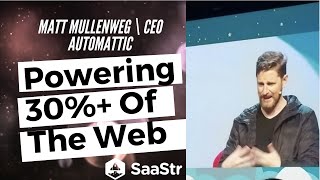
Matt Mullenweg, CEO of Automattic and co-founder of WordPress, discusses how the platform powers over 30% of the web. He explains Automattic's shift to JavaScript and Gutenberg, its fully distributed workforce, and a subscription model that coexists with a $10 billion ecosystem of hosting, themes, and plugins.
Chapters
Good morning.
Morning, morning.
How's everybody doing?
That was a cool video.
I didn't see it.
Yeah, you got it.
You're all worried about me not having that little spongy thing right there.
Yeah.
I think I can put this one down. How's that? Anyways, thank you so much for welcoming us. And I'm thrilled to be here with Matt. It's always fun to sit down with Matt. And we're also incredibly thankful to Jason and the entire Saster team for, for having us. So we have a lot to cover. I'll start off just a little bit here. Just the impact that Matt has had on the world, I think, is incredibly important and we'll get into. But I think starting with myself, the impact you've had on me as a friend, as a mentor, as a, as a partner, as somebody I've got to have the joy of plugging into his youth. It's a little bit less youthful these days, but when we first met, Matt was not of legal drinking age and never seen snow. So he's had a huge impact on me, probably more so than anybody else I've ever worked with professionally. So thank you. And then for us at True, one of the amazing things was that when True was starting, Matt was starting, and I was also starting my first company with Tony Schneider, who would become your CEO in the early days, all within like a kind of a year of each other. The impact that Matt, as one of our first investments at True, you get a lot of your future investments. When you end up in things like Peloton, or Fitbit, or Duo Security, or Blue Bottle Coffee, or MakerBot, or wherever it is, or Ring, these type of big companies down the road, They all start on the foundation of the early quality logos or brands that you get to work with. So the impact that Matt's had on us as a firm is just, just really crazy. So let's talk a little bit about WordPress. I wrote some of these things down because this is a company, I think for those of you paying attention, you're aware of just how massive the scale is here. This is a public market scale type company. That's still private. And, you know, it's profitable. We just launched in December, I think, WordPress 5 release, the Gutenberg release. Already 33 million.
Correct.
He has a little counter. It's funny, it changes. By the end of this speech, we'll probably be done, another 10,000 people will have done it. 33% of the entire web runs on WordPress. I want everybody to take a pause and think about what that means. It's a huge, huge, huge thing. He has a very big team, so I guess my first question is, what's it all feel like, man?
It's been a lot of learning. So we are now, you know, the reason that Automattic got started was to create, um, basically we wanted the web to be open and free and run on open source software, and it was clear that that wasn't going to happen naturally unless there were some companies really working on it. So we began to create the software that we thought could become the default choice for everyone to build something on the web. We wanted it to be the platform, kind of the base layer that everything else is built on top of. That's why we track that number of what percentage of websites, because it shows what we have to do. We've got 67% left to get to the point where we can basically be the open platform that other things can truly build on. And a true platform in that far more money is made actually outside of Automattic on the WordPress platform than is made by the company itself. So we try to be a spark inside the community. We try to contribute a lot and, and obviously have done well as a result of that. But we always think of ourselves as one of, part of the community, part of a larger ecosystem, the balance of which, just like a real ecosystem, is delicate and has to be nurtured to grow.
Yeah, I mean, it's one of the things I think we spent a little bit of time talking about, and I'd love for you to share, is like, you know, it's such a huge social responsibility, right? You have a third of the web, you know, running on your software. I can't even imagine what that feels like, right? I mean, there's, you're an exalted company here with Zuckerberg and a handful of others who just have such a profound impact on what we're seeing and what we're not. How in this kind of era Lots of stuff going on that's sometimes negative. How do you see and embrace that impact, you know, from a social perspective? And what are you thinking about, you know, as you kind of veer here into the near future and the moment?
Probably the key difference from a proprietary platform is a proprietary platform sort of imposes its values and business model on you. An open source platform, The value it's imposing is really user control. So putting people in control of how they want, what code they want to run, their business models, how they want it to be, how the data flows, the privacy. It can be behind a firewall, it can be on the public cloud, it can be kind of everywhere. And so if there's a value that we're trying to advocate for, it's really that, that kind of freedom of choice. And that's why freedom is actually one of our core, it's probably our biggest core value. But it's not free, right? It takes a lot of work. And it became clear very early on that, you know, we are all human and we trade a lot of autonomy and security for convenience, right? Like, I believe in this stuff as much as anyone in the world. I still have a Facebook account. You know, it's just— we use these things. But if we can create really compelling user experiences, that create choice, that create freedom, that put the hands back in the control of users, that put data back in the control of the people who created it, and creates a ton of economic opportunity for a broad set of players around the world. That is really, really powerful. And that's kind of the web that, if I ever have kids, I want my kids to grow up in that sort of web. That was what I got a little taste of in kind of the late '90s, early 2000s. It was really beautiful.
Yeah, how is that— because we'll go back into your, you know, the kind of the open source roots.
Here.
But, you know, how is that all aligned, you know, with the young Matt Mullenweg and your vision? You know, when we were first meeting and talking on the phone about what you were doing, how does where you sit now and where you're looking at align with where your vision was then?
Hmm. Probably the—
Hmm. And well, because how you started, you know, with—
I think at the time I had a lot of naivety around how open source worked and the idea, you know, we used to talk about open source being like a meritocracy. And then that over the years, that really you learn to evolve those views where meritocracy isn't actually a really great way to describe what's happening. Not everyone is able to put in the time to show up and contribute and or have the economic ability to. So we've definitely expanded how we think about people's ability to contribute and how we sort of foster the contributions from the parts of the community we need to create the best possible world-changing product. I think a lot now more about not just leveraging the open source, but bringing the best minds and developers and designers from every possible field and then applying the, the fruit of their work into the open source sphere. I think a lot more about education. So, you know, when we decide that the future of WordPress is no longer going to be PHP, it's really JavaScript plus APIs. There's now hundreds of thousands, million-plus developers who really know PHP really well and love WordPress, and we need to bring them along that journey as we're shifting to be, you know, more of a JavaScript native thing. It's actually the majority of code in WordPress now is now JavaScript. Something most people don't know.
Wow. How do you think it's impacted the way you've built your team? You know, I mean, WordPress is probably one of the largest distributed workforces or work teams, you know, on the planet at this stage. And I just, I remember early board meetings, we're gonna break. We're at, we're 25 people. We gotta, we gotta bring them to a consolidated environment. And, you know, all those kind of discussions and, you know, you've always steadfastly kind of held to that. No, we'll know when it's breaking. It's not breaking, it's thriving. But how has that instructed the way you've built the team, and what do you think the lessons are for other people that are building SaaS, or any company, to be honest?
There's two things that we really inherited, and one I would say is very much in line with what Jason M. Lemkin just talked about, about open culture. And, you know, he had this great story about how Atlassian, 3 weeks before they announced this Slack HipChat thing, 3,000 people knew inside the company. 100% parallel to how Automattic works. Everything's very, very open. We have an internal blogging system, much like Confluence, but we use something called P2, where you can have long-form exchange of asynchronous ideas and discussions, which is to me much more powerful than chat. I actually question it this day whether sort of our chat systems are a net positive or a net negative to our productivity. So that kind of openness was inherited from the very beginning. And we think about it, you know, the majority of the code we produce at Automattic is also open source, whether it's the mobile apps, whether it's Calypso, which is WordPress.com. You can log into our— or you don't even need to log in. You can look at our GitHub and see the pricing test we're doing. You can see how much we charge in India versus America. Like all that stuff is all public and it's okay. It's scary to be that open at first because you think that your competitors are going to look at it and you know what they probably do. But it doesn't matter. And the benefits of that, forcing yourself to be a bit more open, pays a lot of dividends, particularly as you build for the long term, as you think about decades, not just years. The second thing that you hit on is distributed work. So from the beginning, the open source contributors— most open source projects run with people from all over the world who are passionate about it contributing. We decided to build a company that way. In the beginning, it was not pretty. Kind of heterodox, and lots of brilliant investors and really smart people tried to talk me out of it and passed on investing because of it.
Not me.
Thank you for that. Just for the record. But now I would say that's completely shifted. Like, I would say if you're going to spend $100 grand a month on an office in San Francisco, you have to justify that more than you have to justify being distributed now. And so it's completely flipped, and that's kind of beautiful to watch. I'm actually working on a book about distributed work. That'll be coming out hopefully later this year, because just to kind of document all the best practices. It's not just us, like Elastic's IPO. Yeah. There were over 1,000 people, public market IPO, both based on open source and totally distributed company. And there's tons and tons of examples now. And that's before you even dig into the companies that are centralized, but actually operate in a decentralized fashion. They just don't own up to it.
Do you think, how's the team, or when you're recruiting somebody new, or how does the team think? I mean, when they're in Iowa or Ireland or, Armenia, or wherever they are, do they think of themselves as working for a Silicon Valley-based company, or a company of the world? I mean, what are they— how do you leverage that? Because I know we had an office at one point in time, then we kind of moved away to a different, smaller, more modest stuff. Like, why? Or how does that work?
We try to be native to the web more than anything. It is, you know, if any of you are building companies and teams, it's an incredible competitive advantage to be able to offer an opportunity to amazing developers around the world to work on a world-class, web-changing thing. And if you're here, you're probably in the top 1% of all startups and things in the world. So if you can offer that opportunity to talent, which is definitely equally distributed, It's very compelling. So they don't have to move. They can live in Melbourne or something, but work on one that's competing head-to-head with some of the largest public and private companies.
Yeah, I remember when I started Sphere with Martin and Steve and Tony, and we thought about, you know, should we— and just by virtue of the co-founders, two of them lived in different cities, right? So we ended up— starting off as like a distributed team. And I remember thinking like, that'll never work, right? This is at the beginning. I mean, we were— you were starting, I'm starting, all these things were happening at the same time. And we just kept going with it. And I remember the power when it unlocked for me. It was like such a meritocracy in terms of the way I viewed my team. Either they committed code on time or they didn't. It worked or it didn't. They were, you know, easy and pleasant to work with or they weren't. But all the water cooler stuff, all that, you know, interaction. Do you think there's a downside, though, to not having— and how do you— well, how do you go about it with WordPress? Because I know we do do a lot of stuff here to make sure there's physical interaction, but like, how are you provoking that and how do you think about that?
Yeah, I wouldn't call it a downside as much as a trade-off. So I really love the people I work with and I wish I could see them every day. From the early days, I mean, when they said you need to get everyone in the same room, they were actually right. We just do it once a year instead of every day. And so that's really been helpful for us. You know, the meetup culture inside Automattic is pretty strong. You know, we have 120 teams that get together individually on their own, like 1 to 3 times per year each. So pretty much every week of the year there's a few meetups going on. And then we take time and a pretty significant investment, it's now millions of dollars, to bring everyone in the company together for a week a year, which we do all over the world. But it's, uh, I think it's important to have that touchpoint to bring people together. But it's kind of surreal to me because like last year I think we hired 240 people. So from year to year, that grand meetup, the place where we had everyone in a room, smaller than this but still everyone in a room, it always kind of never fails to shock me to look out over the sea of amazing people, be like, this is a real company. Sometimes it feels a little more abstract.
Sometimes does it still not feel like a real company?
This is not just avatars on Slack. You know, it's like a lot of people and they fill a big room and they consume a lot of bacon and coffee.
It's amazing. Well, if it's good for Blue Bottle Coffee sales, we're down with that. Let's, let's talk a little bit about the early days, because I think one of the things that I found really interesting is through my own personal journey with WordPress, because I've been there almost from the beginning. Was how people thought it was just a kind of a fun project and not a real company. But I think you set the tone, and I think people would be surprised to learn here that we've always, always had revenue from the absolute inception of this company. And I think for the most part, we've been profitable for a big majority of our days together. How did you make that transition? That's a tricky transition for an open source project. To move into a for-profit kind of sphere? And I'm just like, how did you move to the subscription revenue? I actually don't remember. It was so seamless, but I don't remember what you must have struggled with or thought through, and then what were the steps you put in place to do that? 'Cause I think a lot of companies, maybe even here, there might be some pre-revenue companies here, they're playing with that same thing, that freemium model. How does that all work? It was—
there's two key things, and we were a little different from what came before because a lot of the open source companies out there, including like an Elastic, tend to have a much more enterprise model. And what we've created automatically with WordPress.com and Jetpack and WooCommerce is more of a consumer and developer-driven model. But there's not like a— there's not a huge enterprise sales force. It's not like all these sorts of things. The average person pays us $112 a year or something. So we're very much on more the consumer end of subscribers and growing a subscription business. The first key was we didn't fork the software. So the WordPress that we run on WordPress.com, serving tens of billions of requests, is the same that you can download from the website WordPress.org. So that meant that all the developments and all the sort of scale, all the the bottlenecks we were finding and fixing in that sort of, you know, massive SaaS version of the software, the benefits are all going to the self-hosted version, the one you could download. And that allowed us to create a cloud model, which is fairly unique in the space. And why now, even though Automattic does not look at the work on the enterprise side too much, there's a lot of companies in the enterprise side of WordPress, including WP Engine, that have been incredibly successful. Now over 100 million in AR, I think they announced, working just on enterprise WordPress. And what they can sell is saying, okay, we can run it for you. You could also download it and run it yourself. And there's a hybrid model so you can download it, run it yourself and use a plugin we make called Jetpack, which is kind of like iCloud for WordPress. It hooks you into the best parts of the cloud for backups, for security, for all the sorts of things that you can do better. In a sort of centralized model, but that's totally optional. So you can have the best of both. You can get control of all the code, but the best of the cloud services without having to host it with us. Mm-hmm. So that kind of model ended up being tremendously successful, and I think one that would be very interesting for more SaaS companies to explore, as we're here for this audience. And the second thing was we worked just as hard at growing the wider ecosystem. As growing Automattic's revenue.
So what do you mean by that?
Like, like I did a lot of study of successful computing platforms. So I read a lot of like computer history books, studied Microsoft a ton, and this number kept coming up. You know, when Windows 95 launched, one of the things that they talked about is for every dollar—
How many people were alive when Windows 95 was alive? Everybody alive. How many were of legal drinking age?
Actually, 23 was '95, so I would be 23 or 24 years old, so maybe not. Wow. When Windows 95 launched, one of the things they talked about was for every dollar they made selling Windows, there were $20 made on top of it. And you look at platforms throughout the days, even going back to like early Unix and ARPANET type stuff, like there were these— there's this 1 to 20 ratio over and over and over and over again. And so how that works out is the most successful platforms would only capture about 5% of the revenue that was happening on top of them. We can all think of unsuccessful platforms as well, or platforms that were kind of a bait and switch. Facebook platform, the Twitter platform, cool companies, but like their platforms were not truly platforms because as soon as companies started to get really big on them, Zynga, etc., they pulled the carpet out from under them. And they didn't actually truly have, they didn't truly own those relationships with customers. Customers or the distribution means or anything like that. And so that's why if you looked at, let's say, proprietary competitor like Wix, they make a lot of revenue, but they probably make 90% of the revenue in their given market. So they're like $600 million. That whole thing is probably $650. Um, for us, we estimate the, um, the kind of WordPress ecosystem to be over $10 billion per year now. And that— I think about growing that as much as growing anything else. And that's not even counting the— like, what's in that revenue going through WooCommerce and things like that.
Yeah. What's in that ecosystem? I mean, I mean, kind of everything, but like, you know, what are the— what are the big buckets?
Every part of it. So hosting is a huge one. So any major web host, you know, from GoDaddy on, usually half or more of their customers are WordPress customers.
Oh, wow.
It is services. So from the low end, like you go on Craigslist or Fiverr and ask for someone to build your website, they're probably going to build it on WordPress. You go to the high end, big agencies, you know, that employ hundreds and hundreds of people doing sites that cost millions of dollars to build. They're using WordPress at the highest levels of government to, you know, the largest enterprises. They're, they're using WordPress. And so that's part of that ecosystem. And there's more and more also all the things you sell on top of it. So there's themes, there's plugins, there's services, there's, you know, SEO platforms. There's so much that really piggybacks on it. And that's— we think of that as the direct thing. There's also the people who start with WordPress and end up someplace else. We just heard a great story from Jason M. Lemkin that Saastr started as his blog. Yeah, we wouldn't count this as built on WordPress or part of that ecosystem, but I love those stories as well, that it can serve as a launching point. Groupon also started as a WordPress blog. It can serve as like the thing that kind of kicks off the idea, allows you to test something to get to that kind of minimum viable product. And then you build whatever it is that's going to serve your customers and your audience best.
And you see that as success, right?
100%.
Yeah.
Because we're enabling— well, what I hope is that even when people launch from WordPress into something else, that they can carry forward some of that user centricity, open source and open data, kind of those principles that are in the key of open source for what they create in the future. And that hopefully as we become more successful, that also proves that you can do this. You can be a truly open source company that is aligned with its users, aligned with its community, and be very commercially successful as well. There weren't that many examples of it before. A lot of the examples were more cautionary.
You'd be like, "Oh, Craigslist was amazing." I think today, even today, it's somewhat antithetical to the way a lot of people build companies, the way the market kind of approaches this stuff. It's, you know, I think it shows the connectivity back to the roots. Right, of open source and open and free and like doing good. And I think it's, it's, uh, thank you.
It gets tested.
Thank you for being that person.
Yeah, it definitely gets tested. So there'll be times when your chief competitor copies your code. There'll be times when, you know, Amazon's not being the best open source.
How's that feel?
Uh, well, your immediate reaction is like very— it's your reptile brain kicks in, right? You're immediately like, oh, we gotta close it off, we got to change the license. You've seen Mongo and Elastic both dancing with AWS in kind of like ways that are honestly not great for either of them versus leaning into it.
Okay.
We had a point early on where this is super, super early on where someone took the WordPress multi-site code that we were creating for WordPress.com and started a competitor that started growing faster than us. But then we had a very like, it was sort of like a, very eye-opening thing where we said, well, if they're taking our own software and doing better than us, bad on us. And then you start to dig in and say, okay, we're both selling the exact same thing, WordPress. What are they doing differently? And it really woke us up to they had way better conversion funnel, they had way better marketing, they had a sort of easier onboarding. And so it wasn't this— by the way, they didn't need our software to compete with us, but it really kind of clarified the differences where we were not executing as well. But I also say that, like, it might seem scary, but people can also just build their own version.
Yeah, you know, one of the things I've long admired and loved about sitting around the table and watching is it's not so much that you're breaking the rules, you know, it's that you're thoughtful about how you want to approach things. It turns out that it ends up being upside down from the way a lot of others kind of approach things, right? And I've always just kind of marveled at it. I mean, you've tested, you think all of us have been around the table, there's been a few times you were like, what?
And we make mistakes too. So it's just all about being flexible. If you admit that and move on and pivot, you're fine. Yeah.
What's something along the journey here that, you know, this is just a random kind of question. You may not have an answer, but like, what's something that you didn't do, you thought like, we'll never be that company, we'll never do that, or that's not, it's not part of what we do. And then in hindsight you look at it and go, oh no, no, no, actually we, you know, I don't know, is it like a physical office or the fact that we're advertising now? And like, you know, like, is there stuff like that?
You know, they're both really silly examples. I'm almost embarrassed to say them to this audience, but I really thought We didn't do marketing for far too long, and so we just did zero. And I'm aware I just done organic growth for a long, long time. But as the market heated up, I mean, we're in a spot where— I mean, you saw Super Bowl commercials for our competitors. There's over $400 million per year being spent on advertising in our space. And so you can't— you can't not do some of that or it does start to add up. And the other one's super silly is like scheduling, you know, for our support roles and everything like that. Like we went a really long time without people like making a schedule and saying when they were going to be working or not. It was just kind of all ad hoc. And that eventually started to impact kind of customer service, you know, the availability. We'd have too many people at certain times and not enough people at other times. This is so embarrassingly simple, but like we went a very long time without doing that and now we have scheduling. And but when we first started, there was a lot of pushback. To it on the team because it does remove some—
It's kind of like the world is on weekend and we don't work Saturday. Is it like that?
It's not. You maintain flexibility. We don't prescribe which hours people have to work, but we say there is a minimum amount and you lose the spontaneity. So you can't— if you're in one of these roles that has a schedule, you can't wake up and be like, oh, it's beautiful outside, I'm going to go for 2-hour run or something.
All right, let's, um, we're running, we got a couple minutes here, so I'd love to, I'm gonna skip through. I had a bunch of stuff I wanted to talk about flexibility and the improvements in Gutenberg, but I think we can wait.
I'll say one thing there. If you looked at WordPress 5 or 10 years ago and developed a view of it, please give it another go-round. It is a completely reimagined, completely rewritten software that probably has, aligns with you philosophically and the principles that you actually care about. And it's now— it gets better every couple months. So it's moving fast.
I would love for you just to touch on a little bit on user privacy and control, right? Which I think is such a foundational piece of your philosophy and what we do. But how do you think about that? And how does that translate to this particular audience?
You know, I think it's one of those things that we'll look back 20 or 30 years from now at how data is being used and spread and weaponized and really say that maybe akin to doctors recommending cigarettes, like, that we were fooling ourselves to the sort of societal and personal impacts of the approaches we're taking to user data, to privacy, to advertising, which is not going to be sustainable long-term. What gives me hope is things, unfortunately some political things as well, have woken up mainstream society to the misuse of these platforms.
Uh-huh.
That's not actually misuse. It's what they were designed to do. Maybe not designed to do it for Russia. They were designed to do it for Colgate or Swiffer or something. But they can be turned very, very easily towards any direction. So as we want to maintain agency, it's going to be more important for us to take control of our time and our attention.
I think that's amazing. You've got a book— you mentioned you got a book coming up, or you're hoping. Is it— are you on a deadline?
Uh, keep an eye on my blog, ma.tt. Uh, just ma.tt, nothing else before or after. And that's where I'll put announcements, and I'll start doing some podcasts and interviews actually. With distributed founders and distributed HR people and things like that, because I'm really trying to collect all the best practices. And in fact, if you are distributed and have found something that you think is amazing and you want everyone to know, please send it my way, because I'm going to be promoting kind of the best practices for how to build these companies, because I, I do really believe it's the future of the work in the world.
It's amazing. Listen, um, it's a privilege always to— I get to spend a little bit more time with you than everybody in this audience, but hopefully you've enjoyed this. It's a, it's a, I think it's a rare treat. I think we're sitting, I used to always describe Matt, you know, as I talked to my wife or my kids or everybody, I said, no, Matt's a once in a generation founder. And I'm just so privileged to, and have enjoyed so immensely just partnering with you and learning. Thank you.
And thank you all.
Thank you.
More from Jason

Why Your Next Hire Should Report to an AI, Tragedy Apps, and Too Many AI SDRs? | The Agents #004

Our Agents Drove Our Salesforce Bill Up 80%, Marketo Hates Agents, and We Stealth-Churned Off Notion




Managing 20+ AI Agents: Lazy Agents, Our $500K AI Bill, Stealth Churn & the Death of 60% Solutions




