Prioritizing Profit-Driven SaaS Growth...The ProGro with ISSUU's CEO, Joe Hyrkin
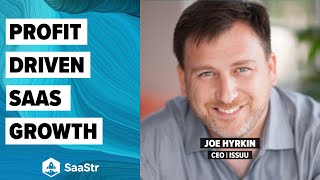
Issuu CEO Joe Hyrkin argues SaaS companies should chase profit and growth together, not one after the other. He introduces the FAST model, which lets companies build features by integrating with existing tools instead of building from scratch. Profitability unlocks creativity and customer trust, he says, and founders should embed it from day one rather than chase valuations.
Chapters
Welcome everyone, we will begin in about 30 seconds. Thank you. Welcome, we'll start in just a moment or two. Thank you. [FOREIGN LANGUAGE] All right, welcome to SaaStr Scale. I'm Lindsay Laken, I'm part of the SaaStr team, and thank you so much for joining today's roundtable. We are excited to have you. I'm just going to go through a few housekeeping items for the group, and then I will pass it over to our presenter for the day. So as all of you hopefully know by now, this is an interactive roundtable session. So we ask that you keep your cameras on, your audio available to join the conversation, and really engage with the content that Joe will be talking about today. There's a lot of different ways to join the conversation, really. You can simply unmute yourself and ask a question, make a comment throughout the session. I know Joe encourages that interaction. Also feel free to drop in questions, thoughts, resources into the chat option within your Zoom system, as well as the raise your hand reaction option within Zoom. So a lot of different ways to stay engaged. We really do develop these forums to keep people engaged and excited and sharing each other's thoughts and resources. So without further ado, it's a pleasure to introduce Joe Hartken, CEO of Issue, the Silicon Valley Let's Start Celebrating Profit-Driven Growth Roundtable session. Joe, I'm gonna pass it over to you and thanks again for hosting today.
Awesome. Thanks, Lindsay. Really appreciate it. Good to see everybody here. Good morning, good afternoon, and good evening. I think we've got people from all over the place. It'd be cool to, if you have to take a moment during the session, just drop in the chat where you're from and your company. It's, you know, my expectation is that this should be a pretty interactive session. Feel free to interrupt anytime, ask questions, jump in with with comments. You can use the hand-raising button, or you can just put yourself off mute and go ahead and interrupt. It's, it's fine. Real quick, a little bit about me and Issuu. I'm the CEO of Issuu. We're a massive digital publishing platform. We enable marketers, businesses all over the world to take their content marketing materials, brochures, collateral, lookbooks, internal corporate communications content, and make it digitally available in a range of different assets and formats to be distributed wherever that content needs to be seen by that audience. So we're enabling businesses to tell their story and to communicate effectively across any digital channel that they want. A huge time-saving set of tools and services that we offer. Uh, company started in Copenhagen 14 years ago. I've been running the company since for the last 8 years, we flipped it to now be a US company. We're about 90, 95 people with— we have, in theory, we used to have offices in 3 places: Palo Alto, Copenhagen, and Berlin. And I like to say we now have offices in about 95 living rooms all over the world. And I think it's probably one of the things that all of us, in addition to figuring out how we get profitable, how we grow our businesses, We're probably also spending lots of time figuring out how to communicate effectively and run organizations with people operating from their living rooms. I'm going to spend time today really looking at the combination of growth and profitability. I like to call companies along these lines a pro-grow, profitable and growing. I think the pro-grow should be— is really should be looked at as the next unicorn. These, these are the companies that in many cases are the workhorses of technology. It's the companies that are building a legacy and really have a future and can be sustainable. Issue, as I mentioned, has been in business for 14 years. We have been profitable. This will be our 17th consecutive quarter of profitability, and we have been focused on both profitability and continuing to grow in the 30 30-plus percent range. We all know that SaaS is growing dramatically. There's a lot of data and statistics out there about the number of SaaS companies, the amount of funding that's going into SaaS companies, but there's actually very little information available about profitability. And we spend too little time looking at the path to profitability And we overemphasize typically in our industry raising money and sort of getting to those next stages. But the ability to build a profitable company has got to be a cornerstone of how we're operating. Key elements for all of us in the SaaS world, of course, the reason why we're growing, essentially, you know, it boils down to there is a massive focus on digital transformation. We have seen that overemphasized this year in particular. COVID has sort of amplified and highlighted this digital transformation, but the companies that are really growing and that are building their businesses aren't doing so only because of COVID They're doing so because over the last 3 to 5 years, there's been this massive transition for businesses to move into a digital experience. Businesses that up to this point had been dominated by in-person interactions have been moving online. Paper interactions have been moving online. Anything that's required a pen, we're seeing move online increasingly. And that digital transformation has been in play over the last certainly the last 25 years, but we've seen a real acceleration of it in the last 5 years, in large part because the number of channels that we can leverage and that businesses can get access to, to connect with an audience, has dramatically increased. 3 to 5 years ago, digital meant having a website, taking that website and putting the URL on a social, in a social channel, and then hoping, paying Google a little bit of money, people showed up to your site and off you went. We're now seeing the web is just one of dozens of channels out there, and businesses now have the ability to reach their audience with their own website, through social channels, through things like TikTok and Snapchat and LinkedIn and Pinterest and on and on and on and on, and channels that are being developed right now that many of us haven't even heard of or aren't familiar with, but will become so. And so that digital transformation is manifesting in large part because of the ability to turn businesses into a digital experience, but also the additional channels that are available. We're also seeing huge efficiencies in sales and access to markets. We just talked about the markets, but on the sales front, we, we don't need to necessarily have salespeople out there knocking on doors anymore. We— they can start to leverage all of those tools and the ability to engage with people across those channels, whether it's actual people doing sales or you're using digital components to do so. Certainly COVID has accelerated things. In many cases, it's sort of shown a light on where we are with our business. If you have been struggling prior to, to February of this year, you've likely struggled through this process. If you've been in a position where your business is growing, you've likely been able to optimize those elements and grow through the business. The set of companies that are coming out of COVID that have done well generally are SaaS businesses. The SaaS businesses are sort of the outlier against the overall economy that we're seeing. The other aspect that I think lots of companies can and should be taking advantage of is what I like to call FAST. Feature as a service. You can now— and the T is technology, so feature as a service technology. I made that up. And but the important piece here is because of access to the marketing stack, it is now possible to build features that are critically important to a whole set of customers and do so in association with companies in the marketing stack. It's not just about building an app and throwing it into a marketplace, but you can start to identify, here's where larger companies, here's where folks who are using Salesforce, here's where folks who are using Shopify, here's where folks who are using WordPress are not getting access to the full set of information or the full set of data or the full set of communication tools that they need, and you can start to build out features that align with the rest of the marketing stack, and that creates massive acceleration. Rather than have to build everything on our own, we're able to start to leverage and rely on these additional channels and the marketing stack itself. So these are sort of the key areas I think that are contributing to the, to the SaaS growth side of things. Of course, there's Plenty of others, but these are the key components. And I think this— the ecosystem itself, in the same way that there's massive numbers of channels growing in terms of where content can go, the ecosystem of companies in the SaaS world is only increasing, and the ability to start to partner and engage with them is increasing as well. If we look at the pro-grow, so this notion, the model of profitability and growing. I've run unprofitable businesses and I've run profitable businesses, and I can tell you that moving into profitability creates a whole set of ways to run a business that weren't available if you're constantly behind and constantly needing to figure out how you're going to be raising that next set of of dollars to fuel the company. Profitability provides a whole set of options. It actually fuels creativity where you're not spending massive amounts of time and energy in that rat race of raising money. You can actually allocate your team and your own thought processes to ways in which to really grow and build the business and grow and build the products that ultimately is really the endgame. If we look at companies, particularly in the technology world, we like to pretend that we don't think about profitability and that we don't want to think about revenues as much.
We—
people have talked about revenue as a bad word, just make your product great and things happen. But the truth is, the companies that we all admire most are profitable. Atlassian, Mailchimp, Canva, Adobe, Google, Microsoft, on and on and on and on. They have been able to marry this notion of strong products, strong marketing, uh, with, uh, growing a business and, and being profitable. Our focus should be on the product's value driving the growth, not just spending marketing dollars. At the end of the day, real sustainable businesses manifest only because the product that's being created has value to those who are using it, and they can start to build a business around those products. Profitability also drives accountability and responsibility to our customers, to our employees. Being profitable enables us to demonstrate to our customers, you can count on us. We're here. We're gonna be here with you as your business grows. You're not going to have to get into a position where you're going to have to go find some other solution. You can count on, on us as a company to provide you those tools and services, and we're going to grow with you. It also provides the ability to start to add on to your suite of tools and services. It provides a level of responsibility to the employees. We don't have a set of employees who are constantly having to look for that next thing because they know this is a business that's both growing and profitable. And, and the two go hand in hand. It's not just about profitability. It's not just about growth. It's about the two of those contributing to that accountability and responsibility. And ultimately, the way to build a legacy, a company that's going to have a future and has a legacy beyond the core team, the founders and the current CEO, is to build a foundation that is oriented around profitability and growth. You know, as I mentioned earlier, we spend a lot of time in the tech trade journals and blogs and such looking at how much has a company raised, what's a company's valuation, all the funding situations. We celebrate the next unicorn. The truth is there aren't that many unicorns when all is said and done. There's over somewhere between 10,000 and 15,000 SaaS companies. Very few of them are unicorns, very few of them will ever become unicorns. And while funding is valuable as a way to grow and build the business, the real value is what we're able to deliver. So I look at profit and revenue essentially as proxies for the value that we're delivering to our customers. If they are paying us, it means they are finding value in what we're creating, and we can start to align the pricing of that product with the value that we're delivering. And that begins to unlock the road to profitability. When you can start to understand, here is the value that these folks are getting from us, and we're going to start to charge accordingly, then you— you're able to grow your business along with their use of that product. As we look at sort of goals for SaaS success overall, starting off with, I want to get to profitability. Too many SaaS companies start off with growth, growth, growth, growth, growth. I just want to grow. Some combine growth and great product. I want to grow with a great product. But we sort of always put the notion of profitability on the back burner. And what that does is it fuels this race for constantly having to raise money. And it actually makes us often make trade-offs about the quality of the product. We're going to go put our time and effort and energy into raising, as opposed to putting our time, effort, and energy into building great products and building a great relationship with our customers. So I believe that if you're not focused on profitability being a core criteria for your success, you should be right now. And if you're starting a SaaS company, it should be one of your foundational principles. We need to get to profitability because at the end of the day, while it's challenging to just grow based on marketing dollars, it's virtually impossible to just keep growing while you're spending and build an actual business that's sustainable. You will ultimately run out of the ability to keep overspending for bringing customers in. The other key piece to this is making sure you're working with investors who are really customer-focused. Investors that are oriented around the value that's being delivered to customers as the primary category for your success. Are, are, are they going to be the ones that are in there for the long haul with you to be able to grow and build that company and align around building for profitability? And when I think about profitability as a criteria, a lot of it should be built around the choice of profitability. So you want to be able to control when and how you want to flow in and out of profitability. There are plenty of times when you want to spend because you're identifying a particularly strong opportunity that's in the market, but you want to know how to get back into profitability. There should always be that clear pathway into the profit structure inside of things. If anyone has any questions, feel free to jump in or raise your hand. I'm— I know I've been talking a lot about these key elements, and I've just got a couple of more slides to to share in the session. As you're raising money, focus on raising money to serve the customers in the market, not just to justify that last raise. We find often in the SaaS world, again, we're chasing that next set of investors, we're chasing that next higher valuation, we're chasing that next set of money that can come into the company so that we can go increase our marketing spend. What we really should be doing is raising money, continue to raise money, of course, as needed, but to make sure that it's going into the product and serving the customers. Because the more customers that are actually using the product and the more that are actually building their own business around that product, the larger opportunity you're going to have overall, right? If we're just constantly focused on growing that top line, then we're going to, we're going to, we're going to churn through customers, we're going to churn through quality around the product as well. So continue to have that focus of being responsible to our customers, shareholders, employees, the employees' families. All of these components come into this notion of profitability and growing. A couple of best practices to be looking at. Look at where you can be lean. The ability to be lean, particularly now in these— in this sort of time where people are working remotely, has never been sort of more available to us. We look at businesses that were overly reliant on external sales forces. They can't go meet with companies right now. And this has been going on long enough, you know, by the time all is said and done, it's going to be longer than a year. We've had to adopt, adapt, and figure out ways to connect with the market and with customers beyond just spending money on travel and the people going door-to-door, office-to-office. Where can you be lean? Where can you be lean on marketing spend? What are the additional channels that are available beyond what you've seen. The ability to experiment very quickly with things from podcasts to webinars to speaking at conferences like this. You look at something like a SASster, you know, earlier this year when SASster was doing their huge conference, it was all about people traveling to San Jose, massive amounts of time and effort being spent to participate. And now we can actually bring people together from all over the world to focus on a particular topic. You get as much information and often more. And you can also be, you know, you can be multitasking and sending a Slack message while you're listening to me as well. But the ability— we're seeing the leanness actually manifest in front of us and sort of coming to us, and we can start to learn from those lessons. At the same time, look at how to remove as many distractions as possible. And I would argue that Not being profitable is the biggest distraction a business has because you are constantly spending energy and time trying to figure out how do I make adjustments so that I can extend the money that I have in the bank, how much cash do I have on hand, and starting— and you start making decisions or decisions are influenced by that. Knowing how you're getting profitable is a huge distraction reducer. A key piece around getting profitable is aligning pricing with the value you're delivering. I find typically SaaS companies spend too little time on figuring out pricing. There's a tremendous amount of time that goes into acquisition, cost of acquisition, trying to reduce cost of acquisition. By the way, as companies grow and as you get, you have sort of a longer tenure, typically cost of acquisition is gonna go up, but we still spend too much time trying to drive cost of acquisition down or how to acquire larger groups. We always, of course, wanna have acquisition as a key piece, but if we align pricing with the actual value we deliver, then we can start to unlock the ability to connect with customers more effectively. And I think many SaaS companies just sort of use here's what everyone else is doing, we'll just start to create pricing along those lines. Every business and every product has one or two really key important aspects of value that are being delivered. Often we don't charge appropriately for those. So, you know, look at that, evaluate where you are on that. Communicate the whole value of the entire suite, even if you're just in sort of that fast model, which is a feature as a service. You still have additional components that often you're not highlighting. And so customers will hone in on a particular use of your product, but the truth is you have a set of other elements of that product or additional uses that they can be using or other people on their team can be using. So the ability, again, just like pricing, we often, in an effort to streamline our communications, we often undervalue, undercommunicate the overall set of capabilities that we're able to deliver. And get customers to help you sell. Bring customers into webinars. Join customers on their webinars. We are in a world where, particularly right now, as we come back to this notion of being lean, the ability to communicate globally and the ability to work with customers either for them to, you know, referral deals, working together in terms of how you're providing value to them, etc. Often there's a lot of opportunity to leverage that, and people are watching our customers. Their competitors are watching them, their partners are watching them. It's a way to accelerate your ability to get to the market.
Joe, we did have a question on that best practices from Jeffrey. The question is, do you recommend any particular goal such as the rule of 30 or rule of 40?
Yeah, I think the rule of 40 is a good standard rule. It's certainly something that investors are looking for. The rule that I look for is what is best for your business. I think every single business Understand sort of the metric or two, maybe three that matters most and build off of that. So this notion of 40% growth is fantastic, but if you are nowhere close to being able to get profitable and in order to sustain that 40% growth, you have to keep raising and raising and raising, and you have no line of sight to profitability, then you're probably overfocused on that 40% growth. You're better off getting to 20% growth profitably and then building off of that, or take it to 80% growth and go figure out, you know, how do you start to close the gap. But if you're sort of stuck in that 40% growth area and you have no hope of profitability or no path to profitability, I think you're sort of setting yourself up for real challenge.
And Joe, question from Kevin on that is, in your experience, how many years does it normally take to go from startup to profitability?
So it's a great question. I believe you should be looking at profitability from the startup phase. Incorporate the notion of profitability into your business. It doesn't mean you will always be profitable, but it means you will get there much more quickly than you otherwise would. I think Mailchimp went a decade or longer before they raised any money. Think of your business, you know, raising money is a luxury that we should all aspire to and want to involve in our business, but we should also be looking at it how, if I can't raise any money, if the world changed, And by the way, you know, we saw that in March this year, funding dried up for a lot of companies. It's opened up in a lot of ways. But how do you start to build that profitability into your overall business model? And I think it's different for every company. You can't say it should be 5 years, it should be 10 years, it should be 20 years. What I will say is it's really hard when you're particularly close to getting to profitability, if you're burning you know, a couple hundred thousand dollars a month and you've got, you've just done a $10 million raise and you've got a year, year and a half left of runway and you're only burning $100,000, $200,000, you look at your business and you think, I just can't, I can't cut that last amount of spend. And rather than look at cutting, it's what are the ways where I can have— where I can optimize and where can I be more efficient? Where can I change the way I'm selling? Where can I partner with particular companies? The biggest one that I think people often overlook is business development and partnerships. We often get— we often hire BD people later because we think we've got to go get ourselves to market first. There aren't any partnerships yet left. There aren't any partnerships that are appropriate yet. But partnerships, if you look at companies like HubSpot, partnerships and, and channels are actually the thing that will help you drive your business pretty dramatically. And building in a component of I'm going to start building out these partnerships almost from the beginning starts to open up the market where you're not having to overly rely just on your small marketing or sales organization.
Great. And Joe, we do have about 2 minutes left for the session.
Great.
More from Jason

Why Your Next Hire Should Report to an AI, Tragedy Apps, and Too Many AI SDRs? | The Agents #004

Our Agents Drove Our Salesforce Bill Up 80%, Marketo Hates Agents, and We Stealth-Churned Off Notion




Managing 20+ AI Agents: Lazy Agents, Our $500K AI Bill, Stealth Churn & the Death of 60% Solutions




