Product-Led Growth: Panacea or Boondoggle? | AgentSync Co-Founder/CTO + OpenPhone Co-founder
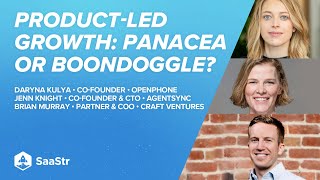
Doreen Ikolya from OpenPhone and Jen Knight from AgentSync debate whether product-led growth actually works. Jen explains why AgentSync abandoned pure PLG for a regulated insurance market, while Doreen shares how OpenPhone shifted from free trials to "Talk to Sales" as customers got bigger. Both stress that scaling either approach demands cross-functional teams, clear metrics, and picking a strategy that fits your market.
Chapters
Um, I'm Brian Murray. I'm partner and COO at Kraft Ventures. Um, I've had the, uh, extreme pleasure of working with my two guests here. Um, Doreen Ikolya, co-founder of Open Phone, and Jen Knight, co-founder of AgentSync. And, um, if there's one acronym I've heard over and over and over at this conference, it's PLG. So we might as well talk a little bit more about that and actually why maybe it's not always a great idea. So I got the slides here. Okay, wanted to set the table a little bit. I think the reason why this PLG meme is just so resonant is because there's something real to it. There's clearly been a trend in how software has been delivered in the B2B space We pulled up some charts here. So on the left, you can just see the number of PLG IPOs since 2012. It's been hockey sticking. Similarly, the performance of these stocks relative to NASDAQ index or just general tech stocks, PLG seems to see some, some outperformance. So for good reason we're talking about this, but we should think more My view is that we should think a lot more critically about what we're talking— like, what is PLG? Why is it so important? And that's what— I've got two experts here to lead that discussion today. I'm gonna zip through these slides, but in a— in the most distilled version, the way I think about PLG is look at a product's website. Does it say try it, or does it say talk to someone? Get a demo or try for free. That's usually what you see, and that That sort of distinguishes a bottom-up PLG company from an ABM, account-based marketing, or sales-led company. So a few, again, just set the table, a few of the merits of PLG. Usually it's high-margin lead gen, shorter sales cycles. You get some marketing and brand externalities, and it forces you to have a very good product. On the other hand, It forces you to have very good products. So you can't hide behind anything. You have less control of your sales cycle. I used to work at Yammer. The sales team would often complain that their biggest competitor was a free version of Yammer. So you introduce that competitor, which is yourself. But rather than me ramble on about this, let's turn it over to the experts. So I wanna start with, with Jen Knight again, co-founder of AgentSync. Jen, I wanna hear a little, you guys have been absolutely crushing it, so congratulations on all your success. Not a bottom-up company.
Nope, not at all.
But you've worked at plenty of bottom-up companies.
I have.
So, would love to hear about your history. So how you, you know, what happened before you and Niji started AgentSync, how you guys have thought through, you know, your go-to-market motion. I'll have a few follow-up questions from there.
Yeah, so my co-founder and I met at LinkedIn. He was in sales operations, I was in sales systems, and that was, where we learned actually quite a bit about sales-led growth. LinkedIn has that on the recruiting side of the house in a massive way. So we were there in 2011, and that's where we met. I went from there to Dropbox, and then to Stripe, and saw the journey of product-led transitioning into a portion of the business being sales-led. And then we started AgentSync together in mid-2018, and really brought it to market in late 20, or early 2019, and kinda accelerated from there. We focus on back office software for insurance carriers and agencies. It's all around distribution management and onboarding, which might be terms that are foreign to many people in this room, but needless to say, the back office of insurance is not a very tidy place and is still filled with spreadsheets and really inefficient processes. So our product is really tackling licensing administration, how do you bring agents into your company in an efficient way, and it is a business application. So there is no really bottoms-up motion there. We had to have a product that could get the frontline licensing admins interested and excited, but they aren't in control of, you know, buying new software. They go through procurement. We go through massive RFPs. We're talking about selling to large enterprises. So that try it for free was not a great motion for us to start, and that's not where we started out.
And I think one interesting part of the agency story —And related to PLGs, oftentimes a new startup needs to go PLG to prove themselves, to earn credibility. Like, look, here's the great product that we've created. Since you guys didn't have that, how did you earn credibility from day one?
Yeah, it was a good question. So Niji had a lot of connections in the space from his time at Zenefits, so he went through that roller coaster a little bit, uh, that Brian's familiar with. And we started by bringing an MVP to market that was pretty lightweight, but testing a hypothesis about what was working. And we went to the community of licensing admins we knew, And we said, is this at all exciting? There was also a lot of, why are you tackling this? This is weird. Other people have solved it. But once we started to figure out how to frame the conversation, it was finding a few friendly faces and selling into those, getting that momentum, and then figuring out how to branch out from there. So we're a very niche vertical. But once we found that fit and found that voice, it helped Niji go out. He was at that point all of the go-to-market and kind of get that ball rolling. And then it took toppling— a few insurtechs, and, uh, Hub, which is one of the largest property and casualty agencies in the US. And once we got those logos, that opened the door for the rest of it. Awesome.
One more question for you before we turn it over to Jarina. Um, so it's interesting what we're looking at on the slide here. Um, tell us a little bit about that and also how your, your thinking around PLG has evolved now that you guys have a lot of different product lines. What's been the arc there, and what are we looking at on this slide?
Yeah, so we're looking at our amazing transformation of our call to action over the last year, which is, it hasn't changed. We are evolving, you know, a lot of how we've built out the sales team, and, you know, different layers there, and some of the other motions we have in play, but effectively getting a demo and having someone walk you through this process is the most powerful motion for us. We are starting to actually experiment more with proofs of concept and kind of the try it for free version in the enterprise, which is how do I give you the tool in not a trial, in truly a proof of concept, and we have a way that we're built on Salesforce that allows us to do that rapidly, which has been kind of fun. It's not PLG in the traditional sense, but it is a, we get you in the conversation and then we do let you try it for free for a little while. We're also starting to think about a product that is more broker-facing or agent-facing, And I appreciate that that will change for us. We can't ask them to get a demo. That's going to be something that we have to explore. So it's a muscle we'll have to build as we expand out our product. But most of what we've been doing is experimenting with better ways to demo, more bespoke demos, demos that we can hand off to people so they can use them, and then really have that power of the sales cycle. Awesome.
Yeah, let's talk about demos in a bit. Doreena, over to you. So AgentSync, the story with— Kraft and our partnership with Agentsync, most of us— many of us at Kraft worked at Zenefits, so we knew Niji and the founding story and the problem they were solving. But had we not known that, it would have been hard for us to really get a grasp on the product. OpenPhone, on the other hand, we were able to try it right away. As soon as we met you guys, the first thing we did was we tried the product. And so tell us a little bit about your— what— first of all, what you guys are doing. And then how you have— how your evolution of thinking around distribution has evolved over time.
For sure. Oh, sorry. That was— I was told don't bring it too close. Ice cream cone. That's right. Hi, everyone. So maybe to start— and yes, Brian, now that you mention it, you did try it right away, which is quite interesting if you're talking to an investor and then they've already been playing in your product. So you're like, okay, like, you know everything. What can I tell you about this product? You've, you've, you've done it all. You've seen it all. So maybe first a little bit about Open Phone. In the most simple way, we give you a business phone number in an app. So pretty straightforward. The reason why we started Open Phone is that both me and my co-founder, our, our parents are small business owners. And I know I've seen my dad panic over not missing any call, like literally dinner time. No matter what, he picks up every call. And what was interesting is we saw that so many businesses rely on the phone, and I mean voice and messaging, for as a critical channel, as their really lifeblood. Yet the solutions on the market are either incredibly complicated, you can't use them, they're just, just horrible. And we just thought it was, it was crazy that something so important was not done in a very elegant and modern way. And we started building it. We also saw a lot of businesses, a lot of people using their personal phone number for business. And that is a bad idea. And no privacy and just a mess. No way to collaborate with your team. We thought it was just something we had to solve. And from the get-go, as a team of 2 people, you can imagine we did not necessarily think that we could build an enterprise phone system and sell it to banks. Right. We, we saw the problem with small businesses and we thought, Okay, we can build an app. So, so the early version of Open Phone was very focused on solo proprietor. It was very— and thank you for the slide. This was our early website and this was the product. I mean, right now we are cross-platform on all devices, but we started with an iOS app and we found product market fit there first. From a distribution perspective, because we focused initially on solo proprietors, We didn't even think of doing sales because your ACV is pretty low. Also, the whole idea here is that you can try something immediately and it's low friction. That is what we wanted to disrupt from seeing our competitors. So I think our initial go-to-market was very natural and yeah, get started for free. That was our CTA. It's still our CTA. And I can tell you from the evolution perspective, when we What we learned is that as we introduced a multiplayer mode in the product, as we introduced OpenFun for Teams, we learned that we have another motion here, which is land and expand, which is beautiful. You start with a couple of people on the team using you and then you grow within that company. So as we introduce that motion, we have introduced a call to action called Talk to Sales. It's still a secondary call to action, but it's there, as you can see. And we've actually, we have two of my colleagues here on sales and CS. We have introduced those motions. We've hired folks to offer that sort of sales assist and help our customers be more successful. But this was kind of, we couldn't have started here when we were a very simple product for solo proprietors.
Yeah, so what I'm hearing is a conversion story between the two business models, right? So Doreena, your ACV was low, so it really just didn't make sense to have sales-driven go-to-market. But now you're moving upmarket, ACVs are growing, people are expecting that touchpoint, so now you're exploring sales assist. And Jen, interesting for you guys, you've done a very good job penetrating your market, and now you're exploring how a PLG or demo-like thing can— what is that gonna do for you? What do you think the main merits of that are for agency at this point?
Yeah, there's two areas that we're thinking about it for. One, long tail of agencies. So there's a product space, and I think it's ACV-driven, right? Where it's not gonna make sense for us to do a pure sales motion. And so as we think about evolving our product, kind of the reverse direction of where OpenPhone has has been to go to agencies that have 2, 3, 4, 5 agents. That motion is going to need to change. The other thing that we have been figuring out is in— we are a different way to approach a known problem. And so what we found for some of our larger enterprise customers is that they're excited about it in theory, but they really do need to get their hands on it because they need to see how the team is going to change their motion. And it's really powerful for us to be able to give them a try it for free motion that is, you know, a month long. It's a little bit of a more involved thing there, and there's a lot of work that we have to do on our side to make that work, but we've figured out that that's a really important step for us as we're helping people understand how they're gonna map their current world into a new world or shift things around and get them confident that the capabilities are there. We have a pretty complex product with a lot of regulatory obligations matched to it, so you need to win up and down the team to make sure it gets gets traction and gets going in the right way, and that's where we've started to shift that motion.
And amongst the sales team, what's been the impact to them? Are they changing their motion? Are they changing the way they interact with their prospects? Has that been difficult?
Any learnings there? Our VP of sales has a great saying, which I was thinking a lot about coming into this, which is that we do a lot of team selling. And that's been a big part of our motion from the start, which is they go out and they are understanding what the customer's problem statement is, working with our customer success team. We have a customer our solutions engineering team. When we were much smaller and it was just me and Niji, it was product and engineering and sales and support all together, thinking about how do we make this the most successful conversation. So I think there's a sort of false sense of like there's a lone salesperson out there kind of making up for everything that's happening in the product, and they're going to kind of get it over the line. There's a whole team of people who come together, and that's what we've really figured out how to fine-tune, or we're starting to figure out how to fine-tune and then evolve the composition of the team for larger enterprise deals. And in insurance, some things are 2, 2.5-year-long deal cycles, so you have to get ready and you have to be creative on how you're tackling that. There's not one motion. Yeah.
And, um, and Doreena, for you, since introducing that second button, Talk to Sales, um, tell us a little bit about how that's affected the company culture, the, I know Hao's here from the sales team, how you guys are interacting with your clients differently now that you've embraced this more high-touch customer experience. Absolutely.
I think that for us, it's— so you see a talk to sales button, but I think behind it is really this approach of really helping our customers. I think because like you mentioned, you know, with a try for free CTA, anyone can try the product. So for you to talk to sales, sales is not there to, to show you how to click buttons or say we have this feature, we don't have this feature. Sales is really there to add value and help you solve your business problem. And we also have paired sales with customer success. So, so really the idea here is that you can absolutely do most of things without talking to anyone on OpenPhone. In fact, we have a lot of documentation, our support portal is really well documented. We have also videos and, you know, so much content. You really, in most times, you may not even need to talk to anyone, but when you do, we are there to help you on a more strategic level versus just kind of training you how to use our product.
And the interplay between customer success and sales is super interesting for PLG companies, right? Because they're already using your product. You want them to be successful. Successful, but at some point you want to have a commercial conversation with them. So how have— and I've seen all different flavors of this, different companies—
how is OpenPhone approaching that? Yeah, so the way we're approaching it is that— and, and I also want to say this is very new for us, we are in the early stages of this— our philosophy is that, you know, when you are a customer at a certain threshold, we have our dedicated customer success manager help you get the most out of the platform. And really the goal there is helping you, you know, like you sign up for the product for a certain reason. You have a certain problem you want to solve. Let's really make sure we solve it for your organization. And sales comes in when there are barriers, hurdles, when there is that commercial discussion needed. But sales interacts in a different way there versus with a net new customer who signs up through that form.
Right. It's more obviously they're more intentional about talking to sales. The button literally says talk to sales. So that's right. I think you can make some assumptions there. Yeah. So Jen, for you, how does, with a more traditional go-to-market motion, are you bringing customer success in pre-sales in any cases? And then also, how are you all handling expansion? Since you have a variety of product lines, there's a lot of upsells, upsell potential. How have you figured out the team dynamics at Agency Sync?
Yeah, it's evolving on the dynamics, but CS has been involved. They get involved in customer conversations pretty early around scoping out implementation and thinking through those details. So we sit in a kind of complicated value chain in the back office, and it's really important for us to know going in what customers would consider true success, which is usually being integrated with some system upstream, some system downstream. We want to make sure we're going into that eyes wide open. What can AgencySync do? Where are we feeding data? Where are we consuming data from? More technical conversation, in that lens, and so sales has sales engineering support, and then customer success early days would just come in and help with that, and it helped start the conversation and get familiar faces on the phone. And I have a team that actually is on the engineering side of the house, which is there just to do very specific solutions engineering for customers as they come on board, so that we can make sure that we're solving, similar to what you're saying, their actual problem statement, and not just trying to cram them into the agency shape of how we're doing things. So it's a whole group that comes together for that. And we've been refining that motion a lot as we went from one person doing it to figuring out what those roles actually are. And we're still figuring out where those cut lines are and shifting those teams around. But it is a community that comes together. One thing that we were really focused on early on from some of our prior experiences was making sure that once we got someone over the wall, we weren't just celebrating the sales win and then forgetting that they exist. So our first hires were actually customer success. Niji put that in play because he was nervous about selling more. And we put a hold on selling because we wanted to make sure that we could make people successful, and then we ramped up the sales team. And so they've always had that mentality of we're doing this together, we're doing it about a lifecycle for the customer. It's not just kind of a one and done motion. And that feeds a little bit to expansion. Our customer success team leads most of those conversations. We're starting to bring more product lines and learning what that motion is gonna look like. But they've done a fantastic job because they're responsible for owning that relationship, really knowing the customer pain points, and then seeing where the opportunities are and thinking creatively with them on how best to solve it, either with our products or with some of our partners, frankly.
That's interesting. I'm thinking about Niji's mentality in their first, when you're first selling, because there is no PLG, you sell, you get a customer, now they start using it. Like they just started using it, right? Yeah. Whereas OpenPhone, you guys are having a bunch of people using it before you're starting to sell. Would love to hear both of your take on advice for new founders. So they have their idea, they're considering going to market, they can take the AgentSync path or they can take the Open Phone path. What are some— what are some words of wisdom since you both have found product market fit, you've been successful in your respective distribution methods? What are some advice for founders who are yet to release their products so they they haven't really made that decision yet.
Yeah, well, I think in terms of advice, I mean, obviously you probably all know that everyone's path is so different that I think it's certain principles or maybe experience that we can share. I would say that, you know, for us specifically, the go-to-market motion was very, was very obvious because we actually wanted to disrupt our competitors' go-to-market motion. So the only way to do that was to be like, hey, We want to build such a great product that we can open it up, try it for free, and, and, you know, that's it. I think that when you're picking your go-to-market motion, you have to think about the space you're in, how busy it is, the alternatives that your customers can go to, whether it's alternatives like direct competitors or maybe alternative being Excel spreadsheet or not doing anything. You have to think about that. And also, I think a huge lesson here is you You know, for us, as our ACV grows, sales is actually a viable motion. It was really not before. So based on your category and your pricing, your pricing model, that can really dictate what option you have available to you. So I would say kind of focus on that and go back to first principles, like who are your customers? What is the problem you're solving for them? And what is, you know, what go-to-market motion makes sense for the value you want to offer? Jen, what do you got?
Like, what do I add to that? I think in the same spirit, the thing that I have observed for AgencySync, but also prior to that, is just flexibility here. There is an evolving set of motions. For us, it really made sense. We were selling into enterprise, into these complicated deals. So it's meeting your customer where they are, trying not to force something that isn't going to be a fit, being flexible to learning when it isn't a fit. And reiterating on it and knowing that you're going to have to do that a few times. We were talking a little bit about this of sales. We were sales first, but sales assist coming in, I've seen that feel very strange for organizations, and it's actually kind of awesome. It means you're just approaching new customers in a different way. And so a lot of open-mindedness of this is not the pinnacle of success to do it this way or this way. It's actually usually a fluid conversation. And if you are going upmarket, you're going to have to change. And if you're going to expand out, in our case, to the tail end of the agency market, we're going to have to change. It's just constantly learning that. I've also appreciated a ton from my time at LinkedIn and also at Agency Inc. that building a sales— a successful and healthy sales motion with a sales team is a ton of work, similar to the PLG side. And I know I'm going to have to learn a ton as we start to understand how you do this try for free motion. There's a whole community of people on both sides that have to come together that have really different skills. And so that's one thing I would say is just know that it's never a snap of your fingers. It's gonna take a lot of experimentation and a combination of sales, marketing, customer success. It's a team. It's not a one team or one individual kind of motion.
[Speaker] So we've established that PLG is neither a boondoggle nor a panacea, I think is the theme here. Another piece of practical wisdom that I'd love to hear from both of you is experimentation. So you both are at this interesting point where you've established yourself in one model and you're open-minded to another model. Now that can be a big time sink, especially like in the case of experimenting with PLG, it's very R&D heavy. In the case of experimenting with sales assist, it's kind of like cultural and employees and So I'd love to hear from both of you, how are you thinking about dedicating resources to exploring this new territory? And Doreena, maybe we can start with you. Is it— I guess the first question would be, is it so obvious that you need to do it? It's just a matter of learning from other people who've done it before and implementing those things and iterating your way through there? Or how are you thinking about it?
Yeah, that's a great question. I'm trying to remember where I saw this, but— Probably on Twitter, because where else do I get my information? I feel, I feel like there was someone, someone mentioned, you know, I'm going to innovate on my product and I'm going to not innovate on other things. So essentially, I think the point is that, you know, it's already really, really hard to innovate in the critical area, at least for us in our business, which is our product. So we try our best to take best practices and really advise in many other areas that are not necessarily our core competency. And I would say when it comes to sales, I think I feel like a lot of the problems that we've faced, a lot of other companies have gone through those. So I'm a big fan of like learning from them and making sure that we are, you know, we're learning from others' mistakes, which is always nice. In terms of your question around resourcing, I think that this almost came a little naturally to us because The reason why you see Talk to Sales there is because before we had that button, before we hired our first salesperson, before all of that, we are PLG, right? But I would somehow get emails and people maybe guessed my email because it's so easy to guess. But I would just have people who want to talk to me or talk about the product or see a demo. And that's what I was like, well, I don't think I can do all of these demos. Does that mean we need a sales assist motion? So It almost like hit us like that. Like forced into it, basically. Essentially. But that is what taught us that, hey, our customers actually want to talk to us because they have more sophisticated requirements. And given our nature of the product, we are a very critical tool for you. So if your communications relies on us and there's nobody here to have that one-on-one discussion with, you might be very nervous about switching and you might be very nervous about signing up. So we just realized that, hey, this is— we're losing on a lot of business and it was quite obvious. And at this point, we also know that we want to invest in our sales team and our customer success team. And just a quick plug, we are hiring a head of sales. Just FYI, I was told I can do a plug, but of course, that's okay.
That's the point of this, right?
You know, you can find my email somewhere, I'm sure. But yeah, we're hiring a head of sales. So yeah, we're investing in it full on.
Awesome. And Jen, how about you?
Yeah, so for us, there is not an obvious— it's very greenfield space. There's not an obvious product that is out there for agents and agent-facing, that kind of part of the market. And so for me, and as we're starting to think about it, me and Needy together, of how do we want to do that and tackle it and not have it be a distraction, it's a really great question because we know there's just a ton to learn, not only on the PLM PLG, but just what does product-market fit look like for that motion. And it's very, very different than what we've done to date. So we've actually hired a team, a group of individuals who are going to be just focused on that as an experiment and boxed into that for a while, in a fun way. Boxed in sounds harsh, but we were saying in a principled way, you know, we're going to go take that bet and here are the resources we're going to put behind it and then start to just measure out from a metrics-driven perspective of what are we learning, What do we want to do? And then how would we continue to invest or then realize that that was not the right motion? But it's a pretty new space for the industry. And so we're kind of cautiously tiptoeing into it, knowing that we have to put a substantial number of product and engineering resources behind it to get a compelling MVP out the door. Is this—
I've seen this tiger team before to figure it out. And it's extremely cross-functional, right? Because it's product, it's engineering, it's marketing, it's sales. Customer success. So maybe unpack that a little bit. Like, how big is this team? How are they working with the different functional groups at Agentsync? Are they talking to customers? Like, what sort of tips do you have in designing a sort of sequestered team like this to figure it out?
Yeah, so we started with a very experienced product manager in this space, brought in an engineering manager who's built consumer-facing products before, who will eventually be growing a team under this once we figure out what that team needs to be. Then we also have right now on that team someone from business ops and then someone from our customer success team, so they can bring a customer perspective early and start doing that side of the house. That's our very initial small team, and then we'll figure out how we need to expand it and who needs to be there.
[FOREIGN LANGUAGE] Last question I have for you both, well, I have a lot of questions, but last one I've got on my list here is, Demos. So I feel like demo— the demo is the bridge between PLG and ABM, right? Because you're doing demos and you're doing demos, and it is sort of a revealing of the product to someone in a guided way. So we'd love to hear from both of you. Dorina, starting with you, when you're doing a demo, presumably the person you're demoing has already seen the product or maybe even using it. So how are you using those? What's the point What's the point of you getting on the phone with people in the demo context?
Great question. Yeah, it is a commonality we have, right? 'Cause everything else was different. In terms of a demo, we actually do, I'm now thinking there are two types of demos that I can share that we do. There's one type of demo which you mentioned, Brian, which is when you click on the talk to sales button, you give some information and then based on what you share, follow up and do a demo with you one-to-one. Then there is another type of demo we do, which is not shown here, which is a weekly live demo, which is almost like a PLG-scalable version of that demo, except for you are on a webinar. I mean, I actually don't like the word webinar. It's like a fun live demo. Webinars usually suck, right? So it's a fun live demo, and that's a great way we do it every week. That's, that's a demo that really makes sense for our, like, velocity model because, uh, because for certain folks we can do one-to-one demo, but as we scale the sales team, you know, we will probably have more capacity, but we have to be a little bit pickier now in terms of who we can do a personal demo for. Uh, but the weekly demo is really nice because it allows us to give that guided tour of the product, show different use cases at scale. So I actually would say if any of you here has a, you know, if you're a PLG company and you're not sure about doing a personal demo, start with a weekly live demo, and then that can help you learn and see if there's appetite for something a little bit more custom.
Awesome. I see a negative sign next to our timer here. Jenna, would love to hear your final thoughts on demos and agent sync and how you guys use them.
I will do this very quickly. So we— no one can see our product unless we demo it to you. So no one has come in seeing it before unless they've seen it at a prior role, which is starting to happen and is kind of fun. So we do a set of demos, agency, MGA, carrier, that are the standard demo. And then depending on the size of the deal and the complexity of the use case, we have a team that will customize that and do a deeper dive with customers. And then depending on the size of the deal and the customer use case, that is where we also end up in the proof of concept, which is more what we are calling a, you know, a demo environment we'll hand over to you. So we really have 3 flavors of it, which is our standard one that we'll show you, and then depending on that customer's needs and the deal size, you can kind of go up and down. But we've experimented quite a bit with that. Awesome, awesome.
All right, well, we're out of time. A minute and 40 seconds negative out of time. Thank you everybody for coming. I think we have a takeaway slide here, which is PLG, not for everyone, very powerful. So if you're a founder out there, I hope you learned something today. Thank you, Doreena. Thank you, Jen. This was an awesome conversation, and we'll see you all at the conference.
More from Jason

Why Your Next Hire Should Report to an AI, Tragedy Apps, and Too Many AI SDRs? | The Agents #004

Our Agents Drove Our Salesforce Bill Up 80%, Marketo Hates Agents, and We Stealth-Churned Off Notion




Managing 20+ AI Agents: Lazy Agents, Our $500K AI Bill, Stealth Churn & the Death of 60% Solutions




