Riding The Rocket Ship: Top Lessons for Driving Rapid Growth, with Smartsheet CEO Mark Mader
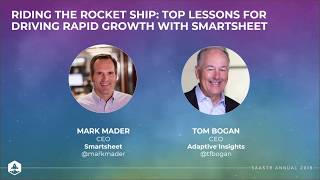
Smartsheet CEO Mark Mader shares two decades of lessons building the company from spreadsheet replacement to IPO. He credits a free-collaborator model for viral growth, net dollar retention as the key metric, and cultural practices like verb-focused onboarding and OKRs at scale. For founders, he emphasizes evidence, storytelling, and staying hungry.
Chapters
Hey, Mark, how you doing?
I'm well. Good.
You're having a great time here at SaaStr?
I am.
You know, maybe, Mark, we could begin, maybe just tell us a little bit about yourself and about Smartsheet.
Yeah, well, I've had two tours in software, if you will. I got into the business in 1995 with a company called Onyx Software and did that for about 10 years, a client-server product. Yeah, that was in the CRM space. And then progressed and joined the young Smartsheet team when it was pre-product, pre-revenue.
And how long, how long ago was that?
That was January 2006.
Wow, fantastic.
Overnight success.
Yeah, it was, it was immediately obvious, Mark, that it was going to be as successful as it's been.
Yeah, I think 4 years in, my wife asked that question. She goes, "Weren't we supposed to be—" No, actually, "Weren't you supposed to be further along at this time?" You never heard that from your investors, though?
Never.
Never.
So tell us a little bit about Smartsheet, what you're doing, what the product does, and who uses it, and the kinds of applications that they're using Smartsheet for.
Yeah, the genesis for the service was to really enable a diverse set of people to better collect information, track it, report out on it, more recently automate it. And the workloads that we were really going for were those, really the information tracking that was traditionally done in spreadsheets. [Speaker:JASON M. LEMKIN] Right. [Speaker:MARK BENIOFF] And what we had observed over many years was that that population, whether it's 700 million, 800 million, or a billion people, it's a large population. So we built a SaaS service to go after that.
Yeah, so you've had quite a year. IPO, was it April of last year? It was April of last year. Your market timing was fantastic. That was certainly a very, you know, a strong time in terms of software stocks. And as we all know, you can't go IPO without exceptional growth. But how do you think about growth? And you've been through many phases of the company. And as we were talking backstage, you talked about some of the varied initiatives that you use to drive growth in the company. But I think it'd be great for the audience to, to hear your perspective about growth. Is all growth created equal? How do you think about the choices you have to make about pursuing various growth initiatives?
Well, I think the first thing that triggers for me, Tom, is I remember when we got our first big deal.
How big was your first big deal?
That first big deal was about $5,000 a year. And we were very excited. And it was big. Oh, it was big. It was super big. And I think one of the things that's changed for me over the years has been really focusing on something past, beyond the win. Yeah. Because the win, while it's wonderful, as a software company, as a SaaS company, It's really what do you do with that customer once you have won them? How do you serve them? How do you— how do they derive value from what you deliver to them? And then how hopefully do they grow with you? Because I think one of the metrics that I'm most proud of is that ever-elusive net dollar retention rate. And if you can land with your customer and assign more value with them over time, That is really a standout metric in terms of how you're graded. So my view on revenue has changed from celebrating, being overweighted on the celebration of the win, and now really celebrating expansion as much as we do the win.
Yeah, and, and I think the— your business model is probably one of the strongest in terms of, you know, net retention rates, the ability to sell back into your installed base. And just as an aside, so I think, you know, Mark, as you know, we followed you into the IPO market. We were about a month and a half behind you. And every investor, when we were doing our testing the water meetings and then our, you know, very roadshow meeting meetings, every investor would talk about the Smartsheet net retention rates. And, and so it's, it's It's one of the real strengths of the company. Is that something that you designed from the beginning, or did that evolve over time?
I'd love to say that it was a brilliant strategy right out of the gate, Tom. Yeah. It's something that we observed at some of our larger customers where, again, back to that be really excited about the $5,000 win. When you see the growth start to occur, and in a lot of these products which cater to a large population of people, or at least it could be relevant to a large population of people, It's really understanding how you get in the way or put yourself in the way of being discovered. Yeah. And something that I think I underappreciated early. Now, how you position yourself for that growth is important. And we got so much criticism early for this notion of what we call a free collaborator. So a free collaborator is if someone subscribes to our service, they can enroll another person for free. Now, the early investors thought we were absolutely nuts. Why would you give away all this value? Well, when you point to some of our largest customers now, a lot of that growth has come from being discovered by someone who wasn't asked to pay, who then ends up being a customer.
Yeah. Yeah. And I do think the— because when we look at SaaS companies, We all know the customer— cost of customer acquisition is a really significant, you know, part of our business model. It's expensive. And so for companies that do have the ability to get viral adoption in organizations, I think it's a very powerful business model. It doesn't work for all products, as we know, but when you can, it's really powerful because it also builds in— it builds in, I think, in the company's culture the right kinds of behaviors, because your people are incented to do the right thing for the customer, and that helps us be successful with that viral adoption.
It does, and as you achieve scale and you look at the bookings that you need to generate in a given year, it is really hard to backfill for lost ARR. It is. To achieve growth at scale. You'll see that gross bookings number become ever larger, and so the ability that where you can retain that customer and if they can contribute to that growth, uh, it'll make the— your need to expand your sales force, it'll reduce a little bit of pressure from that. Yeah, that's great.
Now let's, uh, let's move and let's talk a little bit about competition. So now, Mark, when most people are starting companies, they try to maybe have a space that, uh, you know, the first company in the space, and we're kind of blazing that trail. Um, and then some companies, you know, try to choose competitors that maybe that, you know, are maybe not as large, maybe not as well-funded.
Your largest competitors are Microsoft and Google? Yeah, so we tried to pick really small ones, Tom.
So how did that work out when you were going around pitching venture investors? Did they get it? Was it an intuitive conclusion they should invest in Smartsheet?
No, I think the most hurtful comment I heard was, I don't think you'll ever generate a dollar of revenue. To which I said, I think that was supposed to be a thought bubble. He actually said it. They were right.
You generated hundreds of millions of dollars of revenue.
So I think what we found, we had a very long road in the sense that we had a very evidence-based approach to raising capital. And in a couple cases, we had to— I think one of my mid-investors, sort of in 2013, '14, I remember leaving the meeting and looking back at him and saying, not in a smart aleck way, but like, "Hey Tom, is 30,000 customers enough to demonstrate that there's a need?" And he acknowledged. He ended up becoming a great investor and a great supporter. But it's one where people will be so ready to tell you that you don't have a market or that it's not differentiated. And what I see within SaaS is that you have a lot of opportunity to differentiate with your end buyer, and that end buyer is going to determine whether there's a market or not. It's not based on an executive or CIO in all cases, and if you can resonate with that endpoint, you may have a market opportunity.
And what— and is that what you saw that maybe wasn't intuitively obvious, at least initially, for investors? Or was, was that your insight, or how did the company come to the belief that there was an opportunity here despite, you know, the competitive landscape?
Well, one of the things that we found helpful was to reference analogs that were highly effective in this motion. Yeah. So the company that, that I observed in the late '90s and early 2000s was Salesforce. Yeah. And you know, they're— now it's the obvious company to mention. Back then it wasn't the obvious company to mention, but what we saw was a resonance with that business unit who adopted Salesforce quickly, unbeknownst to other people in the company. Yeah. So that was something we wanted to emulate. Now, if you can pattern match against a megalith like Salesforce and say, hey, this dynamic is actually proven, it's been around for 20 years, then you're not so much of an outlier.
Right. Now, was, was that, did that inform the way you designed sales strategies? And maybe there's a broader question too about different distribution challenge. Channels, because I know you evolved some of that, you know, over the years. So maybe, you know, for the audience, describe a little bit about where you started, some of the experiments you had, kind of what works, maybe a little bit about what didn't work and how your team responded to that.
Yeah, I think early we were quite idealistic. We had seen many of our customers at our prior company have this need, or we felt they had this need, and our ambition was to resonate with them, and have each of them subscribe to Smartsheet and pay us a few hundred bucks a year. And we were going to do that millions of times, Tom. So it was going to be a really, really big business. And what we realized was that some people did, but not enough of them did that. So we actually had to move from off of our idealistic starting point and recognize that distribution wasn't just going to be build a great product, hang the sign on the door, and hope they start signing up. So the real catalyst for us where I really became a big believer in what others can do for you was the Google Apps Marketplace early on. And it was our first dose of, holy smokes, there's something out there which is not named Smartsheet that can help us sell. And if you were to say, Mark, was that an intentional strategy, or were you a little bit lucky? Well, we didn't decide when they created that ecosystem, that marketplace. They did. But we happened to be there at the right time. We were one of those first 50 companies to launch with them. So within 2 months, almost 25% of the company's gross bookings, Smartsheet's gross bookings, came from that marketplace with a 0% revenue share. 2 months? 2 months. Wow. Now that's either a huge amount of revenue or the company didn't have any revenue to start. It was a little bit of both. Maybe so. But it was still material. And I think one of the lessons learned there was we had tasted success with this. Google— through the Marketplace, got us customers in over 20 countries almost overnight. Wow. Because they had such a global footprint. Now, the lesson learned from having that one great success with Google was how excited, Tom, do you think we were when the second partner opportunity came up?
All in.
All in, baby. All in. It's got to work.
How'd that work out?
Not as well. Not as well. And I think we developed an appreciation for really understanding what some of those low-level mechanisms are. That made the Google Marketplace work, as opposed to saying partnering, big distribution, access to existing clients. Those are like the hero attributes. Some of the lower-level things in terms of how is that ecosystem actually going to introduce your brand? Is it truly going to support you, or is it to appease their shareholders as they talk about their ecosystem? So those are some of the lower-level things that we've acquired over the years and now try and pattern match again.
Yeah, and I think the meta point, Mark, that you make about the learning that, you know, for so, so many people it's the learning from those experiences. And I think, you know, the ability, particularly in the early stages as we're trying to assess product-market fit, as we're trying to determine what mechanisms for our go-to-market are going to be most effective, I think being like brutally honest with ourselves about what's working, what isn't working, and understanding the rationale behind it. It's not just the Google Marketplace, but it was the elements that made that successful in that case. And, and I think that's one of the things you and your team have done just exceptionally well.
Yeah, and I think also being, being willing to— being willing to admit you're wrong. Yeah, like we were so excited on that initial business model and Yeah. And then when we— you know, one of my favorite observations in SaaS is there are some companies who pride themselves in succeeding with only engineers and marketing arms. Right. And say, we don't even need salespeople, Tom. You'll hear some companies say that. And I think what I've grown to appreciate over time is that if your customer has a preference to engage with people, then you as a provider need to make the decision, either we're going to ignore them or we're going to lean into them. Yeah. And there is tremendous success when you look at those companies who have a high desire, they assign value to you, and they have a willingness to grow with you in a certain way. You should not ignore that certain way. Yeah. And I think the blend in SaaS is, yes, you want a self-directed, high-velocity trial and buy motion, but if that can also be, be bolted with a high-touch model that is efficient, I think then you can serve a lot of different companies.
Yeah, and, and I find being responsive to what you're hearing from the market and being willing to adapt the model based on what you're learning is really important. So, so, um, I know you talk about these, uh, transformation moments inside organizations, and can you describe some of those moments that you had in spreadsheets and the way you responded to those and whether you can create them or they just happen by themselves organically.
Yeah, I think the— I remember this is probably 5, 6 years ago, when we did our big round with Insight out of New York. I remember them asking how many customers we had that paid us over that magical $5,000 mark. And the number was 37. Uh-huh. And I remember that moment because it was such a lesson in recognizing that a benchmark and an upper bound is meant to be broken. Yeah. Right? So when I think about our biggest customer, I remember when our high-water mark was $15,000, $50,000, $100,000, $250,000, and that first million-dollar customer. Looking back on it now, if you'd asked me in 2012, Mark, do you think you'll have a $2 million-plus customer, I'd have been like, Maybe, Tom, but I don't know if I'd have put the odds on it. Yeah. So it's that recognition that you can't ever get too high-centered or too wedded to what your current performance is, and you have to stretch yourself. So I think the transformation moments sometimes were hitting, being able to break those barriers that were perceived as almost impenetrable early. And now, yeah, we still celebrate every win and every expansion, but now there's this recognition of how do you get more of those really big ones, or more of those high-impact customer scenarios.
Yeah, and I think there is an exercise inside the company that's important of resetting the bar, recalibrating it, and because we change our expectations of what success looks like. So, so I know a lot of companies— in my talk earlier this morning, I actually talked a little bit about this— a lot of companies, you know, we're always trying to find ways to drive, you know, accountability in, in the company. And there's a balance. It's about setting those aspirational goals, and yet having them be realistic, and driving accountability against those. Do you have a system? I know some companies use OKRs, for example. Do you have systems that you use to motivate people and drive accountability inside Smartsheet?
Yeah, I guess I'll speak to two things. The first is how we engage all of our new team members. So our senior team and I still engage every single new employee in a very small setting. And we talk about the difference between adjectives and verbs. So adjectives are the things you see on coffee cups, coffee mugs. You know, are you driven? Are you decisive? Are you supportive? Those are all great. I think we focus a lot more on the verbs. So that's the motion. You know, do you observe? Do you ideate? Do you research? Do you recommend? Do you execute? Do you measure? And we really instill that mindset. So it wasn't until we hit about 1,000 employees that we adopted more of an OKR methodology. So objectives and key results. And what we had done prior to that was very goal and metric driven. Right. So it was, hey Tom, you have to get this number of companies in this industry or this ARR threshold. And if you don't hit it, you haven't hit your metric, maybe it'll affect your bonus. And what we've grown to appreciate is that there is sometimes a lot, even if you don't hit that metric, there is a ton of value in your pursuit of that metric. And we actually have decoupled now success being solely driven by whether you attain a metric. OKRs are difficult though. They're very difficult. What my KR is may be your objective. That's right. Don't expect if you adopt this method, first of all, read that book Measure What Matters, but don't expect this to be an overnight, hey great, we'll just do OKRs and let's fire them up. It takes time, but what I love about those is this mindset of moving from an annual target to a quarterly target, and the accountability range has really been drawn in now, where it's not this, oh yeah, I'm making great progress, Tom, and in October I'll tell you if we hit it. We've brought that cycle time in quite a bit.
Yeah, and at Workday, we're now, implementing OKRs. So we're going through our process. We did, you know, read John Doerr's book Measure What Matters, and there's a lot of good insight in there. And there are a couple things I love about it, and you hit on this. One is that the objectives should be stretch goals. They should, they, they should. And he talks about the science being if we set more aspirational targets, we'll achieve more in, in aggregate. So which is really what it's about. And I like the idea of decoupling the key results from the incentive system, because then we can be more intellectually honest about what we've accomplished, what we haven't. And this notion of modifying those on a quarterly basis, and the other, the transparency across the organization, letting everybody in the organization see the OKRs, I think that's very powerful. So let's talk about culture. And accountability is an element of culture. So starting at broad strokes, how do you think about culture at Smartsheet?
So one of the great questions you'll hear at NEO, the new employee orientation, someone will ask the question something like, so Mark, how do you "Make sure culture is maintained." I'm like, "What?" It doesn't actually work that way. There's not like when you walk through the doors of Smartsheet, it's not like dropped on you. So I turn that pretty quickly on them and ask them what they're going to contribute. The cultural piece, though, has changed pretty significantly in that in the early days, it's assumed. We just know. Hey, Tom and I, we've worked together 6 years, and we can finish each other's sentences. But when the team grows to a couple hundred, even 75 from 10, some of those things aren't fully known. So one aspect, one part of it is memorializing it. Like, do you write it down? Like, what do we believe in? And it wasn't until we were at that 1,000-person mark where we actually wrote down our purpose. Yeah. And I got to tell you, this notion of empowering everyone to improve how they work. Like, you can ask anybody in our company right now what we do, and they believe that. So when we have our Engage conference for customers, or we're selling somebody, it's about how do you activate, how do you help that person achieve that unlock code. So that, that cultural piece needs to be, I think, not just values and sort of here are our principles and here's our operating model, but what is that thing that drives you? And that becomes, I think, ever important as, as you click up the employee count scale.
Yeah, and I think, Mark, you hit a really important part for our colleagues in the audience that, you know, I think, you know, early employees and founders, you have that culture, you know what you mean, you know what the purpose of the company is, and it's, you know, it's intuitive. But it, it's not as intuitive as people come into the company. So that process of writing it down and being very intentional about culture, about purpose, about vision, I think is, you know, I think we as leaders just sometimes underestimate the importance of that for our team. So that's great learning.
And I mean, it was a wonderful moment, at least for one of us in the room, a couple months ago when I asked one of my senior leaders to tell us what our purpose is. Yeah. And he was mostly correct. And it was interesting because what he, what he gained for, for missing a couple words was the right to, at the next big company meeting, actually giving a full presentation on our purpose. Yeah. So it's, you know, it may seem trivial, but getting it actually perfectly right. Yeah. And institutionalized, I think, really sets a good foundation.
You know, one of the things we did that was kind of fun we had the vision and purpose and had an elevator pitch that went with that. Then we did a little contest where the leadership team would go around randomly and ask some of our team members to give the elevator pitch. We had some rewards when they got it right. It really was kind of fun. We've got some time left here. Let's talk about— Talk about product innovation and product vision, and how do you align what you want to do with your view of product-market fit? How do you think about innovation? How do you balance that investments in product versus, say, go-to-market investments? As a leader, how do you think about those issues?
Yeah, the, you know, really has gone through a number of phases based on what the capital profile of the company has been. So when you go public and you take on capital, people expect you to invest and maintain a high rate of both organic and possibly even inorganic growth. So we have the good fortune of being able to have a balanced approach now. So we have investments— when we think about distribution, for the first number of years of the company, it was all about US centricity. We had only employees based in the US. We had only employees based in Bellevue, Washington. So we have a few hundred people now, roughly, in Boston. We opened up London and Scotland recently. And when we think about the balance, it's not just refining the model in one geo, but then replicating that, right? So you have investment on two fronts, improving what you have, extending that to new markets, and being able to do those simultaneously. And I think part of the trick is, how do you do that while being aggressive enough, while not overextending, right? And then on the product side, I think there— we obviously have a point of view for where we want to take the product in our key areas, whether it be automation, reporting, empowering non-technical people within a business. But the other inputs that we look at is what do the big caps in the market who have very, very established account control, what are their agendas, right? And how are you supporting their agendas, whether their names are Microsoft or Google or Adobe or Amazon. So that's another key one. And then I would argue the most important is when you have a very— even if you have a few customers, what is your customer signal? And if they do not have a material input into your, into your product prioritization mechanism, I would encourage you to change your mechanism. And I think when you're able to balance those three, first recognize you're not always going to be right, and But I think have representation across each of those, each of those inputs.
Great. That's, that's terrific. So you've been private company CEO, raise capital, recruit team. You're now a public company CEO. And how do you think about— and I think there are— the data is over 10,000 SaaS companies funded, maybe a couple hundred, you know, get to your size, you know, get to be public. So how do you think about the experiences you had as a private company CEO and what most prepared you to be a public company CEO? And what, you know, thoughts or advice would you share for our colleagues who aspire to maybe be a public company CEO that they should focus on earlier in their journey?
Well, when I got back from New York, a lot of friends and customers customers and partners said, "Hey, what's it like?" It's not that different, Tom. I know. It really isn't. When I think about the buy-side analyst, so a buy-side analyst is an analyst who represents and supports portfolio managers who invest hundreds of millions, billions. There are a couple which manage over $2 trillion. These people are assessing your product and your strategy, but they care about the individual. They care about whether you're trustworthy. They care about whether you're, quote, "backable." And these are things that are present as a private company operator or public company operator. And I think the one key thing is, I think in both fronts, you know, don't succumb to temptation of things that fly in the face of the things that are right, because employees and customers sniff it out pretty darn quickly. And the second you like, "Hey, now I am public," It's sort of off-putting. The more you can come across as approachable to those people who are trying to learn about your business, whether it's a customer or an investor, that should not change much, I would argue. The real challenge is how do you balance and allocate your time, because there are now many more mouths to feed, if you will. We used to have a few private investors on our board. Now we have many public investors. So managing that is tricky but can be done. All right, lightning round.
We've got about a minute and a half left. So lightning round, future of Excel.
Will be subscribed to for many years to come.
Right. Most important thing as a private company CEO in raising money?
Evidence and extreme confidence.
Most important thing as a public company CEO?
Be able to develop a story arc that you could execute against.
Yeah. Congratulations. Fantastic. Closing thoughts for the audience as we wrap up?
Yeah, I think it's— I would encourage each to maintain a chip on your shoulder. I think you're going to have— you're going to be pressured and questioned and doubted. And I think even when things are going swimmingly well, Recognize that you don't have to look too far for evidence to be there that you need to be doing something better. And I think that continuous reminder that there's something that you can improve, I think should never be lost. So I define that as a chip on the shoulder. I like to meet doubters and then prove them wrong.
Mark Bader, you've done a fantastic job. Thank you for sharing your insights. What a fantastic story. My pleasure.
More from Jason

Why Your Next Hire Should Report to an AI, Tragedy Apps, and Too Many AI SDRs? | The Agents #004

Our Agents Drove Our Salesforce Bill Up 80%, Marketo Hates Agents, and We Stealth-Churned Off Notion




Managing 20+ AI Agents: Lazy Agents, Our $500K AI Bill, Stealth Churn & the Death of 60% Solutions




