SaaStr AI Day Live: The Human + Agent Sales Org with Salesforce
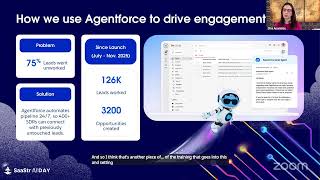
Dina Apostolo from Salesforce's AgentForce shows how AI agents work alongside salespeople to grow pipeline, boost win rates, and accelerate revenue. Salesforce's own deployment generated 3,200 opportunities; Assemble achieved 10x SDR capacity. The key: high-quality data and guardrails to prevent hallucinations.
Chapters
move from one session to the other. But thanks for joining us on SAS AI Day. I'm personally very excited about our next speaker as well. Again, we have a whole full day. You guys can follow along the schedule at sasai.com. I've had the chance to speak with and meet Dina before this, and that was really fun. We were talking about all things AgentForce, which is going to be her focus for today. I know you guys have probably seen us do some demos of AgentForce. We did a webinar yesterday on AgentForce, so maybe you came here after that as like a good follow up. But I'm going to stop talking for now. I'll come back at the end. I'll pass it over to Dena to explain a little bit about your role, Dena, maybe just for folks who don't know, because I know it's changed a little bit in the last couple months with AgentForce coming in. And then, yeah, I know you're going to take us through how folks other than SASR but including SASR are using AgentForce. So as you guys have questions, please drop them into the chat. We'll try and pepper a few in as, you know, Dina does some demos. I can help answer some too, and then we'll do Q&A at the end. So without further ado, Dina, I'll pass it over to you.
Thank you so much for the warm introduction, Amelia. I'm Dina Apostolo. I lead marketing for Agent4Sales. So what that means is I'm leading everything from left to right in terms of go-to-market. And I do have the fun pleasure of being able to kind of really dig into customer problems and think about how us as business leaders and growth marketers and sales leaders are coming together to solve some of these gaps that we continue to see as part of manual processes and capacity challenges that have held us back. But I'm super excited to talk about the things that are taking us forward in, in this kind of era of agentic selling. So let's go ahead and just jump in here. Standard legal stuff, don't buy things based on you know, what's not out in market. So that's what I would just ask for you just to take away from this forward-looking statement. Again, thanks so much for your time. All right. So as growth leaders, we face some of these same pressures. High targets, flat headcount, and buyer expectations continue to go through the roof. And the thing that I continuously hear is that, you know, sales reps aren't failing because of talent or desire. It's the lack of time and there just isn't enough reps and time in the day to go around, especially when they're spending over half of their time on data entry and manual work. Essentially, reps are hitting this wall. It's this hard limit that they are hitting. And why? Because really it's been a mess of manual notes across the sales process every step of the way, and it's required a human to be involved, and that's a tax that's slowing business down, essentially. And so despite these inefficient workflows, there have and will always be accountabilities that remain for revenue teams. You have to grow pipeline, you have to grow deals, and you have to grow revenue. But we believe that the way that these things are going to be accomplished is changing forever, thanks to, um, technology that has really pushed us forward. So this is where Agent4Sales comes in. It's bringing humans and agents together at essentially every step of the sales cycle. So that they can achieve more together than they could have ever alone. What I would chalk it up to is that AgentForce is really helping to do 3 critical things at different stages of the sales cycle. First is to grow pipeline by generating leads around the clock, okay? Even while we're— reps are sleeping. The second is to help increase those win rates with more account intelligence that's surfaced into the flow of work. And by making those manual updates more dynamic to CRM. And then the third thing is really about accelerating revenue. And that's about like, how do you build smart account plans and do it faster and better? And more importantly, how do you scale? How do you find new revenue streams like working with partners? So I think of AgentForce is really that like ultimate digital coworker that's helping you connect as a team across the entire sales cycle. It's like a force multiplier, right? So even if you're a small company, small business, I've been there, you know, you're looking and acting like 5, 10x your size. And this matters because sellers can finally break that mold viewed as, you know, they're viewed sometimes as hunters and, you know, that they're transactional in nature. We want sellers to become strategic architects of revenue, managing a fleet of AI agents. That's how we look at it. But an agent is only as good as the data foundation, and everyone knows this, right? That data is coming from applications, structured data, unstructured data, third-party data sources, and it's going to be impossible to achieve these outcomes if the insights aren't served up in the right way. But our view is that, you know, these insights are following where a rep is working. It's staying in the flow of work, and it's also helping those agents in the flow of work be able to take action fast. So what I would like to do is kind of talk about each one of these outcomes, um, how to close the gaps and maybe give you some ideas to take away as we share, um, a little bit about like the technology and the demo in a quick form and some real-world examples. So as business leaders, we can more effectively achieve these 3 things together. So let's go ahead and start with, uh, growing pipeline. So we know that these results are possible, but for those of us that spend their time looking at a funnel, this should be very familiar. But why is the top of the funnel so manual? I think that's the question I— that's continued to be in my head. How do you get that conversion going? And really, it comes down to this engagement gap, because if reps are spending nearly a full day every week just on prospecting, How are they gonna have the bandwidth to spend time on high-intent leads and, you know, the conversations that matter? So this is a disconnect. It's not a failure of effort. It's just literally a, a disconnect because of the bandwidth, um, to get to the cold outreach. You have high-intent leads and you have high-talent reps that are buried in the admin work. And this gap between lead generated and lead nurture is really, really where this potential revenue gets stuck. And that's where Agent4Sales thrives. It's providing the coverage that your team can't, so you can continue to grow pipeline. So let's walk through what this looks like. It starts with prospecting. It does go to the cold outreach everyone hates, so your reps can focus on closing. Now sellers are starting the day with like this prioritized list of the best contacts and accounts to engage. And Agentforce is researching across all of these data sources like web activity, CRM, all these connected sources to find the best prospects. And that same list, whether they work in Salesforce or Slack, is there. What I get excited about is this add to campaign, right? Because now as a marketer, I'm not like having to ask sales to go, you know, add a lead to a campaign. It's handling the follow-up. And whether someone is new or existing and lands on your website, AgentForce is there to greet them. Really, it's an agent that can answer questions, pitch products, and it can really even book meetings. And that's really what's remarkable about this. And AgentForce can also prospect abandons from the website, and it can follow up via email with tailored messaging so that every lead or customer is actually treated with care, right, and personalization. And you can see from this custom, uh, conversation here that AgentForce was dynamically responding, and it's turning this missed opportunity into qualified pipeline. So it's doing this across thousands of leads, passing the best ones to your sales reps so they get a clear view of every agent interaction and quickly can drill into meeting prep. And with guided configuration, you can use natural language to customize your agent, add brand voice, relevant sales content, and set clear rules of engagement. And really just like that, the agent is live. And this is how you scale your teams connect with the right prospects and accelerate pipeline growth. So that's just one really quick example. We aren't just selling this. We are customer zero here at Salesforce. We deployed the Sales Agent, um, the middle of last year internally, just because we faced the same exact capacity challenge. 75% of our leads went unworked and it was simply because we just couldn't get to them fast enough. And now we've created over 3,200 opportunities in just a few months of it going live. And really, this is augmenting our human SDRs, right? Um, it's something that has been really powerful for us because you think about it, it's all these new opportunities that would've gone just under the rug, right? And we haven't had to hire traditional headcount. So now we're able to treat every lead like a priority. So that's our story. Um, but let's take Assemble. Assemble is a rapidly scaling, um, SMB and tech company, like many of you. They hit a point where demand was surging through the roof for both inbound and outbound channels. And they had one single human SDR that was trying to navigate hundreds of prospects. Um, this might be like the classic founder's dilemma, right? You need to respond to everyone to grow, but you know, you can't hire as fast as you would like. And so your bandwidth, your human bandwidth is maxed out. So, um, instead of burning out that one SDR or hiring 5 new leads immediately, They added agent force. Teddy is what they call their agent, their SDR agent, um, that, uh, works alongside the human. And so now Assemble is acting like a company 10x their size while saving, you know, half a million dollars annually, um, from not hiring that traditional headcount. And they're able to put those investments towards other places in their business to grow. Pretty cool. All right. So let's, uh, now that we've looked at a solution around growing pipeline and solving that capacity issue at the top of the funnel, Thinking about how do you keep that healthy flow of engaged leads going and what do you actually do when those deals enter the pipeline? So let's talk about growing deals and keeping them moving towards close. So once a deal is in play, sales teams often get bogged down by the manual data work that I talked about, but a lot of it is like research and planning. Nearly one-fourth of reps' weeks are spent with manual data entry, research, and planning instead of strategy. We validate this by an annual state of sales report, and it's coming out actually next Tuesday. It pains me when I hear from AEs that they have to carve out an admin day every week. It's typically called their Friday day. Um, we need to stop asking reps to be that data entry clerk and start empowering them to be more of those strategic advisors. So let me show you how we ended the admin Friday day with AgentForce. So we know reps are prepping for meetings on the go, and Slackbot here is helping how reps get what they need literally in seconds for meeting prep. And with a click of a button, reps are getting a brief that covers what's new in the account, positive signals, and a suggested approach. There's no searching or scrambling. It's just instant readiness for the customer that can be surfaced to them, you know, even for through an agent, a sales coach. So sellers are engaged with customers across calls and emails, and Agentforce is using all of those insights to basically keep the stages and next steps updated. And so pipeline is accurate. And you can easily configure this to update custom fields. Plus the agent can run in suggestive mode where sellers will review, edit, and approve updates. So it does give humans the ability to make adjustments. Otherwise, you can run an autonomous mode where updates are applied automatically on behalf of the seller. Of course, it's always backed by source context, so you know exactly where the data came from. As accounts become more strategic over time, you know, Agentforce is helping to set up account plans in seconds like what you see here. It's doing all the research and it's pulling in the company overview, industry trends, top competitors from all of those data sources. And this is giving reps a complete constantly refreshed account plan and turning hours of prep into minutes. It's giving reps really a ton of time back in their day so that they can be more strategic with customers and focus on revenue growth. Our own teams at Salesforce are seeing success with this today. We actually were, we were productizing this functionality and we knew that it can help our internal teams because we did find ourselves that our sellers were spending up to 20 hours per week again, researching across tools and updating Salesforce. You could say it's effective, you know, in terms of being able to be very precise, but it's impossible to scale. So we implemented AgentForce to extend the best practices of our top sellers across the team and reduce the burden of manual entry. Two things to call out here. AgentForce is consolidating data to generate detailed account briefs and point of views, as I just mentioned, in minutes. You saw it, it's not ours. They can get up to, up to speed quickly. I love this too for executives. You know, when you're trying to do like that meeting prep for like an executive briefing and being able to have all of that instead of having like one doc with a ton of links, it's really surfaced right there. And this is leading to 4x yield velocity. And then the second thing is that we use the suggest field update workflow and it's providing thousands of daily suggested updates for our own reps. So the seller is staying in control. They just have to click accept, but the manual druggery of pipeline updates is really gone. So we're projecting this 30, 40, 30 to 40% reduction in data hygiene time for these teams and more accurate forecasting with just two of these examples and two of these functionalities I just shared. So now we're giving sellers time back to focus on things that matter, such as closing the deals. But not just us. Carnegie Learning also saw tremendous success as they were rapidly growing, you know, through the pandemic and going, you know, completely digital, and their sales teams were really struggling to keep up. Their reps, similar to what we experienced, were spending hours to research an account, plus extra time on emails, on the phone, and as their pipeline grew, prioritizing the top opportunities became a lot harder to sift through and to identify. And so essentially AgentForce is now helping them to see a 92% decrease in meeting prep time. I mean, imagine giving your sellers 92% of their prep time back. That's pretty cool. All right. So now that we've talked about ways to close the gaps with direct sales team, let's talk about the other levers to scale revenue growth. Get super excited for this one. So for many of you, you know, you're thinking about what are ways to grow our business? Is it to introduce a second product? Is it to enter new markets, or is it to really build an ecosystem? And so it isn't just about hiring more reps. In many of the cases, it's about, um, activating an ecosystem of partners. And we know that the reality of channel sales can sometimes be the hardest to establish and manage. And when we look across the landscape, there's this clear paradox. There's partner-driven growth, which is a strategic priority. Or it could be a strategic priority for your business. Yet a majority of the partners are struggling to meet those targets. And that's because today selling with partners is often managed in a black box. Teams are relying on outdated spreadsheets, endless email chains, and assets they need like product updates, competitive intelligence. And those things are really hard to access siloed. And then you think about channel managers spending hours of time and partners not getting what they need. But imagine giving partners the same superpowers as your top internal reps. So let's look at how AgentForce helps channel leaders and partners drive growth. Partner Cloud is basically extending your CRM to help you manage your partner ecosystem too. That means it's easier than ever to be able to track and manage the entire partner lifecycle. Incentives, goals, and enablement. Excuse me there, let me get the video going. And it is all in one place. So if you think about that partner lifecycle, you know, there's a lot of different things that happen and they're happening partner by partner. Very few are actually happening at the same time. But think about prepping for a QBR or a strategy call with a partner. It's usually a mess of spreadsheets and decks, leaving you wondering if you're actually aligned. Now, AgentForce is providing an instant summary of the partner health, and you can double-click in and you have this joint business plan. You can share it with your partner, and this ensures you're always in sync and driving the business forward. What I love is that you can put AgentForce directly in the hands of partners by embedding it into your partner experience. So that way you're answering partners' questions so that they can get back to selling. And whether it's comparing products or finding specific pricing, AgentForce is pulling this from your knowledge base to help partners self-serve what they need when they need it, whether it's enablement or whether it's content. Plus, you can customize AgentForce with flows to automate important partner processes like deal registration, MDF requests, all of those things that can be super laborious. So AgentForce is really turning any complex partner need into fast, Self-serve wins. Gosh, I wish I had this many years ago. OK, so not just, not just is this theoretical, but we are using this to manage one of the largest partner ecosystems in the world of 120,000 monthly users. And so we face the same challenges whether you have hundreds of partners or hundreds of thousands, but it's like, how do you continue to support them all without hiring an army of support staff? We just know that that is just not feasible. So the answer for us was identifying our partner community. And we deployed Agentforce to do this heavy lifting. And since it launched, Agentforce has handled, you know, over 30,000 total conversations. And really, it's 24/7 support. I think about things like automating trial requests that also could be kind of like, again, a continuous process that just is like rinse and repeat. But now teams can get trial orgs instantly to their partners, no cases, no waiting around. And as we move into the agentic era, this agility and speed is incredibly important to strategic co-selling and scale. But not just us, Anthropic has, has had one of the fastest moving and growing partner ecosystems. And as we know, they're a fast moving company. Their business sees partners as a huge lever for growth and in the past couple years their partner ecosystem has really taken off and they needed a centralized way to communicate and collaborate. So our Partner Cloud became the backbone for their partner strategy in centralizing enablement, communication, and co-selling activities and programs. So now instead of using like makeshift solutions, you know, manual, you know, back and forth and emails and, you know, different kinds of of, you know, shared, shared sites. They have a central tool and this is prioritizing for them qualified leads, kickstarts into account research, and all of those resources that they need to really help scale their partners and to help them be successful. So it's ensuring their partners have the right information at the right time. That's essentially what the head of enablement, Kevin Jordan, has shared with us. All right, we've covered a lot here, um, and I've given you just a few different use cases of how agents are helping to solve for 3 different gaps and inflection points of the sales cycle. And you saw a couple examples as well, and we have many, of course, that we would be happy to share. You can find them on our site. But when you look at this slide, um, the full vision of agentified sales cycle might look a little bit daunting, right? Because there are so many different ways that you can, um, solve, you know, problems and drive outcomes with agents. We covered on prospecting, um, there's pipeline management, you can quote so much more. But the key thing to know about this is that it isn't about replacing humans. It's about breaking that capacity limit. So while this map might be a destination for some, it's an evolving process. But let's talk about what it means and how you could get there. So we, through our learnings, developed a 5-step framework for successful agent deployments based on our experience. To simply summarize it, it's about picking a pain point, connecting your data, and piloting fast. It's the process that we followed, and it's designed to help others think through their journey to set those expectations and align on business goals. We're going to be sharing this full playbook with all of you after the session. So really, to wrap it up, I just want you to take away from the session that, you know, the successful agent deployment is a journey, but done right, the impact is transformational. And it's regardless of your segment or size, any geographic boundaries. But I'm really hoping that you can all find some success and can take away some key learnings from the session. So thank you so much. And Amelia, I'll introduce you to come right back in.
Yeah, awesome. Thanks for doing that. All right, we've got a few questions there I wanna hit on as quickly or unquickly as we want to. So some questions here, if you, I don't know if you can go back to maybe the prompt builder in the agent. You can show that briefly.
Let's see. It might, um, just self-play.
Yeah, which is okay too.
There was two different prompt builders. So are we talking about prospecting?
Yeah.
Okay. And here we go.
Cool, cool. Yeah, this one. Yeah, if you want to leave it there. Yeah, there's a couple related questions here and I think it's important just to help folks understand. So in this view now that AgentForce has, because I know this is kind of like the newer UI for AgentForce, where— and just in your perspective too, right? You were showing this example of how to use it maybe for leads, you know, you guys famously have used it for leads that weren't followed up with. That's how we deployed our first agent too in AgentForce. Again, we were like, well, if it works for Mark, it'll work for us. So we did the same use case of, okay, let's take folks that are maybe not necessarily truly cold leads because they have an interaction with us and we just never followed up on. Do you see that as across the board in your customers, like the kind of the first use case for an AI agent on AgentForce, or do you see them doing you know, maybe more down funnel things versus things where they, they have more like warm leads to follow up with, with an agent.
Yeah. It's kind of interesting. It somewhat depends on like this, the business priorities, right? Because some, some might have like pipeline that's sitting at a certain stage, right, of the funnel and they're trying to accelerate opportunities, right? And they could be more in that middle. What I'm seeing is like this engagement agent. I wanna go back kind of to the first question. Is it like for new customers existing? Yeah. You can absolutely use the prompt builder to set it. You could be like, here's my ideal customer profile. I want to target existing customers, you know, only, and I'm looking for contacts across all these sources. So maybe you're like, hey, it's existing customers. I want to build up my relationship map, right? Like, that could be one interesting way of being able to, you know, customize a task, right? We're using it obviously around conversion of where we're seeing inbound leads and form fills come from. And then we're also, as I mentioned, using it kind of in that middle stage. And that's because again, a lot of our business too is existing customers. And so that's really important for us as sellers, as a big, you know, sales, direct sales organization to be able to have all of those insights for our sales teams to work faster. Because typically what we see is like there could be this latency of, you know, stage progression, you know, as you think about the middle of the sales cycle. So it kind of depends on customers, um, and, you know, their customer base, I'm going to say. And like, you know, how much are they able to kind of create and close and what is the deal acceleration process? But it just kind of, it kind of depends. But those are typically, um, two of the, two of the interesting use cases. And then I hit on prospecting and, um, we are in beta form of our prospecting agent as well, which will GA, um, in just another month. And so we're really excited about that because we're seeing customers experiment and that's, um, This is the announcement that we made with the Bluebirds acquisition. And so this is what's really getting exciting to kind of break that cold calling repetitive and kind of painful experience that, you know, we have our reps also do to kind of, you know, create new revenue streams.
Yeah. And part of what, you know, our methodology— I just want to get like your temperature check on that too. It's like Oh, because, you know, we use AgentForce, we use a lot of different agents. Like, we train our agents, and some of what we put in our prompt builder for AgentForce is, you know, I have this quick rule of thumb is use the best of everything, like the best contacts, the best, you know, the best language you know already works, the best pain points you've already seen work, the best emails you've already seen your sales team working. And how do you find people— do you feel— do you find people following that rule, um, where when they're on AgentForce or Or do you see kind of a mix? Or how are they thinking about training it as you're scaling this across, you know, a lot of different customers?
Yeah, I mean, it's interesting because if you think about like even going back like a decade, right, we were thinking about like next best action, right? And that's still an important thing that you have the thinking that you still have to do before you get into really getting into training the agent, right? Maybe not everything you want to flip to an agent, to be honest. Maybe you still want some emails, right? You still want call touchpoints. And so I think that's one piece of it is like you have to be really mindful, I think, of where you think it's going to solve a problem, um, in your sales cycle and, uh, where you do think that you can, um, offload some of that task to an agent. I think another thing, um, just around like the continuous of like customer communications, I think the one thing that I get excited about too is like post-sales, like how could, how can agents help You know, not just to be like, hey, deal signed, exit stage left, you know what I mean? And to keep that relationship going. And so I think that's another piece of, of the training that goes into this and setting up the parameters is post-sales. So that in a typical world where you do like lifecycle communications and T-minus and all that stuff, wow, just to have an agent doing that, you know, it can kind of continue and not even continue, can kick off the relationship. On the right beat with your accounts, especially if they're new or if there's new stakeholders within that account. So those are some of the things that I think about, and the training I think comes from piloting, really. And that's why you got to start, you know, kind of small and make sure that you have your data in a good, good state of order to be able to kick it off.
Yep. Yeah. And I know, I know Mark famously said this goal is to like get an FTE on every account, like Yeah. How, yeah, how are you seeing that now like come to fruition of like, you know, how many, maybe there are accounts who have their own like technical team so they don't need it, but yeah, what are you seeing in that like early, like obviously to get it going, like even for us, like we needed more help from RFD Lindsay, like to get it going in the start. Then we do that, like I still text with Lindsay 'cause she's awesome, but like sometimes it's not about Agentforce anymore. So where are you kind of seeing that now in the deployment phase?
Yeah, for us specifically, are you talking about? Yeah, yeah, yeah, for Salesforce. Yeah, and that's kind of where I was going is that, you know, we are working with our customer success team. You know, we've helped some customers think about like the, you know, scaling of onboarding because they don't have, you know, the resources, the customer success team, you know, for 30 or 60 days to provide that high-touch support. You know, we assign that for some of our accounts. We're seeing customers like Uber that is using and scaling onboarding for global customers. They're using it for renewals, upsells, and getting, you know, their, you know, global customers, business users up and going. And so that's great, right? And so again, I would say the same thing on this one as we're helping guide customers through this, we're starting to look at, you know, what segments can we apply an agent post-sales? And it might not be the complete way that an FDE, you know, engages and does all of that. But gosh, think about how much time they're spending on preparation and content curation, right? Training, all of that kind of stuff, and being able to do that by pulling, you know, from your knowledge base or Trailhead. You know, I'm— yeah, I get a little excited about that, that it's not just a to-close kind of thing that agents are going to help with, but it is post-sales.
Yeah. And then last question that we'll wrap on and then we'll ask you like how people can reach you too. How do you prevent the, specifically the SDR agent from hallucinating in customer conversations at scale?
Yeah, very, very good question. Our, our AI SDR or engagement agent, depending on how you want to use the engagement agent, is designed with accuracy, control, reliability.
Hold on, let me mute this. Okay, good.
Yeah, it's all good. So our responses are grounded with trusted data, and at a platform level, we have guardrails that strictly enforce approved, like, messaging qualification permission actions. And so this is helping to prevent speculative outputs and ensures, like, compliant behavior that is aligned to enterprise sales and security standards. And we continuously assess the performance through our monitoring and controlled review of workflows, enabling systematic refinement to ensure that we're, you know, reducing hallucinations as well. Awesome.
All right, Dina, I know you'll be at Salesforce Annual 'cause a lot of the Salesforce team will be there, but how else can folks— it's not till May, so how can folks reach out to you in the meantime?
Absolutely. I'd love for— reach out to me through LinkedIn. That's probably the easiest way. Yeah, hit me up there. See, you know, let's make a connection, share if there's anything that you took away that was interesting from today. But yeah, I'm also looking to learn from you. So if anyone wants to share their experience with me, I would love to hear it too. Thanks so much, Amelia.
Yeah, thanks so much for doing this. And then guys, obviously we've got AI Jason going. So we'll see you guys in the next session. Thanks again so much, Gina, for doing this. And we'll see you guys later. Okay.
Thank you.
More from Jason

Why Your Next Hire Should Report to an AI, Tragedy Apps, and Too Many AI SDRs? | The Agents #004

Our Agents Drove Our Salesforce Bill Up 80%, Marketo Hates Agents, and We Stealth-Churned Off Notion




Managing 20+ AI Agents: Lazy Agents, Our $500K AI Bill, Stealth Churn & the Death of 60% Solutions




