SaaStr AI Day: Transforming Your Revenue Engine with Aurasell
In this SaaStr AI Day presentation, Jason M. Lemkin, co‑founder and CEO of Aurasell (formerly Oracel), outlines the challenges facing modern go‑to‑market (GTM) organizations—low seller productivity, pervasive tool sprawl, and poor forecasting accuracy. Drawing on his 20‑year experience scaling revenue teams and on data from Forrester, HubSpot, Salesforce, and his own X‑ray analyses, he shows that sellers spend only 24‑30% of their time actually selling, while juggling an average of 10‑12 disparate tools. Lemkin proposes an AI‑native GTM platform built after 2022 that unifies structured and unstructured data, embeds intelligent, agentic workflows, and eliminates the need for a stack of 15+ legacy products. He illustrates the impact with a case study of AVO Automation, which achieved an 80% reduction in manual tasks, a 35% increase in sales velocity, a 50% cut in ramp time, and a 2.3× boost in productive selling hours, translating to a potential $2.2 M per‑seller revenue lift. Lemkin then presents a four‑phase adoption roadmap—baseline X‑ray, automation opportunity identification, AI‑native implementation, and autonomous agent deployment—culminating in future capabilities such as fully autonomous SDR agents that handle research, outreach, and calendaring while keeping humans in the loop. He emphasizes the urgency of adopting AI‑native GTM to secure a competitive advantage, warns against incremental approaches, and invites the audience to connect via LinkedIn or email for deeper engagement.
Chapters
Now he's a founder, so we'll maybe get his hot takes on that at the end. But he is now the co-founder and CEO at Auricel. They're in the go-to-market AI space, and so he's gonna talk to you guys about that today. If you guys have any questions in the, as Jason is presenting, put them into the chat. We'll try and pepper in a few as we go and then definitely do some time for Q&A at the end. So Jason, welcome back to SaaStr and thanks for doing this.
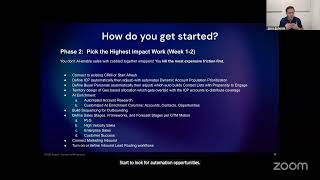
Absolutely. Thanks for having me, Emilia. Appreciate it. It's always a great time to be a guest to a SaaStr. All right, I'm going to jump right in. Okay, well, to the audience out there, it's nice to meet you. Thank you for taking time out of your day to join us here. As a way of background, just a little bit of framing here. As Emilia mentioned, I recently co-founded Oracel. Which is a go-to-market, an AI-native go-to-market platform company. Today, we're not really going to talk much about the product as much as we are about just the general approach to adopting AI-native in go-to-market and the opportunity for both cost savings, but more importantly, productivity gains as you go through that adoption journey. To frame it a bit, I spent 20 years prior to this operating as a go-to-market leader, building and scaling teams from $1 million to over $600 million in revenue. I had a great opportunity through my, you know, 4 startups prior to this one to work with some fantastic people, including incredible founders and building out some, you know, go-to-market momentum around products like Twilio, Harness, Meraki, others. So we'll talk a little bit about that today, but rest assured that some of those lessons and best practices have been put to work in the, in the, product that we've built here at Oursel. So let's talk briefly about what AI can and, and maybe cannot do. I think right now there is this opportunity for us to adopt a lot of increasing productivity per head and gain predictability through leveraging AI to make your operators superhuman. There's also, of course, the opportunity to collapse the go-to-market tool stack and save money to reduce operational complexities. And there, which we'll touch on in the back of this presentation, there is, of course, a discussion around will AI replace humans? And we'll get to that, answering that question as well in the back end. But for the near term, this is how we see it. There is the opportunity to unlock productivity and predictability. Let's turn all those humans into superhumans and get them selling more. Uh, and then ultimately let's reduce complexity and tool sprawl. So why is this important? Well, if you look at the market data through Forrester, QuotaPath, and many others, you'll see that even in the last year to 2 years, organizations, modern sales organizations, still struggle to hit the quota that they've rolled out to their sellers as street quota. In fact, 91% of companies out there today do not hit their Street quota that they've deployed. We also have a predictability problem in the way that we predict forecasting. So only 21% of companies are able to hit forecasting when measured by plus or minus 10% of predictability against that forecast number they've called in any given quarter. And I think the biggest issue here and the biggest opportunity for us as operators collectively is to attack this distribution challenge where today most companies report that 25% of their sellers account for 80% of revenue. So inverting that, we can say that 75% of your expense and your sales productivity is only going towards 20% of your company's top line revenue, presenting an opportunity to, of course, become more productive and efficient at the same time. So why is this? Well, one of the large contributing issues that we see in the market is that your sales team just isn't selling. If you look at data from HubSpot, Salesforce, and many others out there, what you'll see is an average reporting, uh, sales time of 24 to 30%. That means that your sellers are interfacing in human-to-human engagements with prospects 24 to 30% of their time. I'm going to personalize this a little bit here for you to give you some context. When I was operating as a CRO at Harness, we went from $1 million to a little over $100 million in 5 years. During that time, as part of that journey, we went through, like maybe many of you did, COVID. COVID, of course, as part of the downturn in tech stocks in the public markets, rippled that effect through private companies. And I, like probably many of you in this call today, found myself in private boardroom conversations where our board was looking for more— less growth and more productivity, specifically more efficient productivity. So they, they basically said, hey, it doesn't really matter so much if you double the company year over year again, but we want you to have, you know, more efficiency. And so that launched an opportunity for us to execute what we referred to as an X-ray analysis. We went in and documented every go-to-market function every level of every function. What do they spend their time doing? What tools do they interact with? Where could we maybe repurpose certain functions or activities across roles? Where could we inject automation so that collectively across all sales, marketing, and CS, we have a more efficient path to growth? Now, what I found in the initial, uh, the initial analysis of the sales team at that time was that my enterprise B2B sellers are spending about 28% of their time in front of prospects actively selling. And that X-ray process gave us a view like the one you see on the slide today, highlighting the fact that our team was just spending 70% of their time out doing other manual things. At first, I was very appalled by this, only to find out when you looked at the benchmarks that, that average of 24 to 30%, we were hitting 28%. We were on the upper end of those benchmarks. And so this, this kind of opened my eyes that this is a bigger industry issue. The data you see in this slide is when we started Oricel, we put together a panel of design partners, design customers. Those customers ranked in $1 million in revenue up to $1.2 billion in revenue. We spent time with their SDRs, their sellers, their first-line leaders, their second and third-line leaders. And conducted an X-ray analysis with all of them, the average, the average of all that data is what you see on this slide here. So again, confirming that whether you're a small company or a big company, that opportunity to become more productive in the way that you deploy your sales capacity for high productive hours exists for almost everybody. The other thing that came to light as we went through that process is that my sellers at that time were interacting at, at Harness and many of these other companies that we talked about in the design process. We're interacting with multiple tools. In fact, even Salesforce and Spec Kit says that the average seller will interface with at least 10 tools from the time they start prospecting to the time they close a deal. To personalize this again, when I went through the X-ray process that I mentioned earlier, my sellers were on average spending time with 12 products in any given week. Now, they may be different products on a PG Tuesday relative to like a Forecast Friday, but they were spending a lot of time context switching in and out of different products just to do their job. That not only kills— that contextual switching not only kills productivity for, for the humans involved, but from an infrastructure perspective, it provides a lot of extra complexity. So, you know, like many of you may have built legacy systems up over time, and I've done this at 4 other startups and thought it was the best thing to do at the time, and maybe it was, but every part of that sales process, you typically will go out and get a solution, a niche solution that serves a niche function of that part of the sales journey or marketing journey, uh, very uniquely. And it plugs in on top of, let's say, a legacy CRM like Salesforce or HubSpot. And you think it's integrated and that's fine. But the challenge with that is that it creates sprawl. Every one of those niche products brings with it duplicity in the way of workflow engines, analytics, and more impactful is the, the layer of integrations that, that exist across data silos. And we think about this tool sprawl and these data silos in the era of agentic workflow automation. it becomes a much bigger challenge as we introduce agent sprawl. So again, to personalize this, when I was operating at Harness, I had 22 products in my go-to-market tool stack from marketing, sales, CS. They all integrated, of course. We had a team of about 11 operations people that stood those up, supported them, operated them, as well as supporting our teams. Now, every— in the agentic era, every one of those niche providers is going to want to sell you an agent or or they're gonna ship an agent in what you already purchased from them. And every one of those agents is going to be acting on a discrete different data silo. Now, of course, they may all integrate with your CRM, but that's a field-level integration. The challenge in an agentic era is that the, the metadata that provides contextual awareness for agentic automation lives in the contextualized data of those data silos. So the conversations. The actions that are taking place across all channels. That all lives in independent data stores, and what we want is to have true synchronized agentic automation. You want to have visibility into that contextual awareness provided by that metadata and, and break it free from the contextual data silos. That allows the opportunity for true agent-to-agent automation that doesn't become agentic thrash. So the answer at OraCell, we took a first principles approach to this. Instead of going down the path of creating a niche-based product that sat in your stack as one of those 20+ products, what we did instead is we said AI is a uniquely disruptive opportunity to rethink the architecture for modern go-to-market execution. What does that look like? Well, an AI-native go-to-market platform should serve from research of contact all the way through contract in a single platform that is built in an AI-native intelligent era, putting intelligent automation at the center of its execution. So not just reporting like a database, not just surfacing insights for you to go find like a needle in a haystack, but taking those insights in the moment that it's occurring Providing contextual awareness with that, with that metadata around the persona and the sales cycle process or the marketing funnel process that's being executed in the platform and automating intelligent workflows the way a human would while also keeping the human in the loop with the last edits. This kind of platform, in order to be true AI native, needs to have a born-on date of 2022 or after. Why? It's simple. If it was, if the product was built pre-2022, it's not AI native. It may have AI features. They've taken wrappers or injected some kind of AI capability, but it's not AI native built from the ground up in the architecture because prior to that date, LLMs and AI wasn't accessible via enterprise APIs. So, aboard on date pre-2022. And then ultimately, as I mentioned in the previous slide, wanna break down those data silos and deliver a unified data model that supports both structured and unstructured data. So you get a holistic point of view from custom AI enrichment, automated AI research, manual information being entered into the platform, as well as deep web research all coming together and automating intelligent workflows on top of your structured, unstructured data model. It's unified. Now, what happens when you go down a path to adopt an AI-native go-to-market execution model? We can take a look at AVO Automation as our real-world case study example here. They've increased productive sales capacity. They've reduced their overall ramp time. And they have consolidated 6 tools into a single platform saving SaaS license fees and reducing operational complexity. As Faisal Hazem, the CRO over at AVO Automation, likes to say, he set out with an objective to make every seller elite. Every single seller in his team, regardless of their, their experience level or their background, he wants to raise all of them to an elite level of execution. And in doing so, he was able to unlock business outcomes like you see on the slide here. Gaining an 80% reduction in manual tasks and, and manual research. So if you think about our earlier slide, let's put some math behind that. You know, if, if your team on average is spending 30% of their time selling, that means they're spending 70% of their time doing those manual tasks that we saw earlier. So he was to take 80, 80%, he had an 80% gain on that 70% of wasted time, now becomes increased selling time. He also married that together with 35% increase in sales velocity. He reported that this 35% increase in sales velocity largely came from the automation unlocked in the platform with dynamic ICPs instead of historical territory models. So dynamically discovering, building ideal customer profiles for his business and then populating from the 85 million accounts or 850 million contacts. Those dynamic ICPs, accounts and contacts by persona match that the reps should, should spend time focusing on. And that led to faster sales cycles because they're spending more time with the right accounts, with better research, targeting the right prospects with personalized messaging based on that research, and then executing higher conversion rates because there's AI-enabled closed-loop learning that's built on the best practices of value-based selling, that's guiding every seller through regardless of their experience and background into excellent, excellent execution against best practices at every interaction and every step along the way. So these are some of the capabilities that were unlocked that led to things like faster, faster ramp time, 1.5x increase in productivity per head. And all of this is done relatively painlessly. We were able to help him migrate off of 6 standard tools, Salesforce, ZoomInfo, Apollo, uh, Nooks, and a CPQ tool, and migrated them from the very first touch in the pilot to production in 4 weeks. The data migration took place in just 2 days with a 96% accuracy rate and was completely automated by the product. So the, the lift is not what it used to be. All right. Now this really from here on isn't about a, or a seller about a product per se. It's more about how do you get those productivity gains in an AI native go-to-market execution model? Where do they come from? Well, let's focus on that 30% becomes 70% productive hours by just simply automating the research, automating the manual tasks away, automating the coaching, automating the follow-up. Really taking an intelligent automation approach to the entire workload of your SDRs, your sellers, your first-line managers. That moving, moving the needle from 30% to 70% of more productive hours is actually a 2.3x unlock. We're going to visit that math in just a second. Increasing the speed. So 35% increase in sales velocity. We talked about 25% increase in conversion rate coming from coaching and executing prep and follow-up and best practices in a way that's consistently excellent across every seller in your org, and doing so in real time with guardrails of best practices guidelines baked into the AI logic that's driving the, the automation. And then ultimately, you know, how do we drive that excellence in execution at scale to, to reduce the 50% the ramp time. I'll give you an example here at Oricel. Our sellers are enterprise sellers. They come in and they're productive after the second month. So we have the ramp schedule is we don't expect any— we expect activity out of them in the first 30 days. The second 30 days, we look for 50% monthly productivity. By the time they start their third month, from that point on, their deployed quota assumes full capacity, productive capacity from, from that third month on all the way through. So the ramp is only two months. My SDRs, we have two SDRs instead of what would have been probably six in a previous era. Those two SDRs were, had booked four meetings each on their third day of starting. Both of them are first-time SDRs out of college. And, and jumped in right away using Oricel, were able to become productive very quickly. So all of these productive gains and velocity, reduced ramp time and increased productive selling hours. If you run the math out against it, even at a 50% gain, meaning when you go from 30% to 70% productive selling hours, it's a 2.3x throughput of selling hours available. But if you only factor gaining 50% of that, it's still a 1.67x multiplier against your existing productivity per head. 35% increase, again at only a 50% multiplier, 1.175. Excellence in execution and 25% increase in conversion, you cut it down, get only half of it, it's just a 0.125 on top of that 1. And so if you add all that together, let's say you have a seller that that's selling $1 million today per head, you compound the 50% realization of the 2.3x, 50% realization of the 35% increase in velocity, 50% realization and 25% increased conversion. That's going to take every seller who's generating $1 million today and unlock the opportunity for them to generate $2.2 million times the number of sellers on the same sales expense envelope. This is your path to increase productivity in an AI-native era. These slides, of course, will be made available for you after the fact. And so, you know, when you think about it, that productivity gain per seller is also being combined with an offset of cost. With Oricel, we are shipping a go-to-market, an AI-native go-to-market automation platform that replaces up to 15 products. We can replace your existing legacy CRM and the 14 other products stacked on top of it, or we can come in as a go-to-market operating system providing all of that single place for intelligent automation on top of your existing legacy CRM and combined with a few of the other products that you may want to keep. That's no problem. But in general, we're seeing about a 50% savings on SaaS costs as you eliminate that tool sprawl and go through a platform consolidation opportunity. Against these 25-year-old aging architectures. And then finally, you know, we talked about predictability in the problem statement earlier, uh, with AI automation sitting across all signals. So when you allow AI to see all the patterns that are being executed in your business, not just in your opportunity management and CRM, but the phone calls that are taking place on the platform, the meetings that are taking place and recorded where you're gathering signals and insights, the emails, the calendar invites, the, the other channels like SMS, LinkedIn, etc. The external signals around buying signals and engagement that might be taking place even outside of your systems. You take all those signals, internal and external, combine them with the activity, and then start to do pattern recognition and allow AI to automate proactive and predictive forecasting on your behalf, we've seen a 50% increase in forecasting accuracy against the tops-down, bottoms-up model. Now, our platform here at Oracel supports both bottoms-up, tops-down overrides and marries that together with AI forecasting. But I'll tell you, I was a little bit of a skeptic, you know, a year ago on this front. But it, it is real when you, when you really empower AI across all channels and all signals. The forecast accuracy that's unlocked as an output of that is incredible. So what's in the future? I think we take the opportunity we've talked about before to unlock all these productivity gains for your existing humans that are in your, your go-to-market ecosystem, and we make those operators superhuman operators today with agentic workflows that always have human in the loop and human edits as a final, uh, as a choice. And so that flexibility to automate, toggle in as much automation or human interaction seamlessly as possible is where we're at today. Just around the corner, we will start to see high-quality intelligent automation on top of the human interactions with agent-to-agent workflows. And for Oricel, this is something that we're working on now. We'll be shipping in a couple of months. Today, we already embed in the capability of the platform agentic workflows for each of one of these boxes around territory management, prospecting, sales automation, operations, etc. And we're going to be releasing an agent builder where our customers can build their own agents. And those agents can plug in and execute within our Agentic workflows seamlessly and endlessly, meaning you could tie together as many Agentic workflows as you like, and they can be autonomous, 100% autonomous also if you like. There's always going to be areas where you want human in the loop. I'll give you an example. So for us, we talked about our productivity of the SDRs earlier. Within the next 2 months, we'll, we will release an autonomous SDR agent where our SDRs will have all of their busywork, research, territory analysis, personalization, all of the exchange. Once someone engages, even that personalized second, third, and fourth exchange will take place via an autonomous agent. The calendaring shuffle for them, the prospect and the rep, will take place autonomously with— driven by an agent. But that the SDR, the sales rep, can interject at any given time. This way, all the busy work, the back and forth emails, the calendaring, will be handled by an autonomous agent. And our SDRs will spend time calling on the phone. Our sellers will spend time engaged in qualified sales interactions. Um, and so an example here where fully autonomous agentic workflows meet human-powered interactions, uh, and in the sort of around the, around the corner world today. If you want to think about like what's next for agentic workflows, that's the way we see it, and a very practical opportunity for go-to-market teams. In summary, you know, in an AI-native go-to-market operating system, we believe that there's a place for both AI automation as well as powering our humans to become superhuman operators. We think we break it down by task of where automation by AI can accelerate for, for your teams, accelerate a lot of that busy work. And then where do the humans do a better job consistently and need to stay engaged? And this would be the matrix in the way we would see that. So automating those routine tasks, CRM work, updates, prep, prep meeting work, follow-up meeting work, scheduling. Personalized outreach at scale. These are all great opportunities for automating routine tasks. Lead qualification scoring— we have Agentic workflow models that already do all this and, and, and take in external and internal signals to factor in formulaic approach to, to qualifying leads and then routing accordingly. You know, personalized outreach at scale where you take in buyer personas account research, value hypothesis that are auto-generated based on what your company sells and value you unlock, and taking that pattern recognition and then feeding into highly personalized outreach sequences. So it looks personalized, but it's operating at scale to hundreds or thousands or tens of thousands of outreach campaigns that can be done in a way that, you know, really is, is, is hard for a human to match at scale. And sales coaching, you know, this getting into deals and skills coaching and the closed-loop learning model. So understanding the best practices logics that are there for the sales frameworks that you've, uh, built the, the sales processes on, but also learning, combining that with real-time learning from all the signals around what works best at, in your particular sales cycle, and then adjusting in a very fluid way and then coaching dynamically both on the sales skills but progression of deals as well. All of that is a great candidate for AI-led activity. And then forecasting accuracy, I discussed earlier. Scenario modeling for long-range planning, I didn't talk about this, but we believe that there's an opportunity to combine the best of typical AI workloads today with long-range planning driven by multi-model around machine learning models and doing things like what-if analysis for capacity planning or long-range planning for unforeseen circumstances around like macroeconomics and things like this. And, you know, we as humans, we, we build a lot of scenarios with a lot of assumptions up, um, and, and machine learning plus AI is a great way to combine the best of both of those models to, to start to, to have really deep, deeply informed scenario modeling for all aspects of the operations. And then Achieving operational efficiency with closed-loop learning, I think, applies through every step of the sales process and the marketing funnel as well, as well as the CS and the post-sales journey. Um, still won't be able to replace the deep trust and champion building that is necessary for complex sales cycles that humans do a fantastic, uniquely good job at. Um, deep conversation discovery, I think, is something that feels natural. Is also an extension of empathy and human interaction in a way that's hard to replicate it even with very good AI avatars. So I think that still lives in the human-to-human interaction category. Complex solution selling with multiple stakeholders across the organization, particularly where you're automating change organizationally, I think requires the human-led activities here. Sitting on top of the AI intelligent automation. Strategic, it kind of goes hand in hand with strategic account navigation and then continuing to grow the cross-sell, upsell. You know, there's a lot that we can apply AI to unlock in insights around grabbing product telemetry, combining that as part of the signal analysis, and then auto-recommending, you know, where the team should spend time, when an account is ready for, an upsell or a cross-sell, and even where the risk of churn might be, but, uh, still need to have that human in the loop to execute on top of those— the output of those recommendations on signals. And then, um, handling negotiations is always— is always a fragile, or can always be a fragile process. Um, so still, you know, highly nuanced negotiations, probably best led with the human touch. And then, um, you know, connections convert the highest when you have human-to-human voice interactions on the voice and video interactions on the front end of the funnel. And we believe that while you can automate a lot of that personalized outreach, what you should do with that increased capacity unlock is to really double down on voice and video touchpoints with your humans. Now, we're kind of at the top of the time slot, so we may not be able to get through all this. Happy to provide it as a follow-up. I've been asked a lot as we go through speaking engagements, how someone might want to think about getting started. And so first of all, I'd say you should execute with urgency here. I think that AI is such a disruptive force multiplier, or can be a disruptive force multiplier from a productivity point of view, that if you don't jump in right now and instead of taking an incrementalist approach to augmenting certain things in your go-to-market, execution, you know, take an inventory of everything that goes into your go-to-market execution and jump both feet into a go-to-market AI-native world. I think it's a, it's a competitive advantage opportunity for you, but it won't exist forever. So maybe you invert that and you ask yourself, you know, what if you take an incrementalist approach and your, and your top competitors go all in and they start grabbing those productivity gains that we saw earlier? I do think that there will be a divide over in, in execution here over the next couple years. And it'll only compound as time goes on and more capabilities are unlocked in AI. So I would encourage you to jump in full force and unlock that superhuman operator opportunity and take it first. How would you do that? We have a 4-phased approach for getting started that I think is very tactical in nature and very reasonable in execution. So establish a hard baseline, understand where your hours are going today across all of your teams. You can do that in a 1-week X-ray process like I explained earlier. These are the metrics and the things that we typically would recommend looking at. Phase 2, in week 1 to 2, you start looking at— once you understand where the time is going, the activities, the tools, the workflows, start to look for automation opportunities where, where you can take a full-on AI-native approach to unlock intelligent automation. Versus just unlocking or surfacing AI insights, take that next step to automating the workflows. This is most easily achieved if you don't use an incremental wrapper approach across multiple solutions that has signal loss and contextual loss around the metadata. Jump, jump right in and don't be afraid of the automation. And so this, this is a list of things that we would prescribe in that approach. Connect in or take a fresh look at the CRM, define ICP, dynamically populate the ICP in an ongoing way, really hone in on buyer personas within the ICP, automatically enrich deep research on both the top ICP matches and the persona matches that are pulled in through those ICP outcomes. You can overlay against that traditional territory designs for division of ICP accounts. That's totally fine and should be supported in whatever solution you're in. Then I will read it here. We're at the top of our time.
Yeah, sorry. I know we're at the top of our time.
I'll see you at the end of the follow-up.
Just real quick, how can folks reach you if they have questions since we don't have time to get to the questions here?
Yeah, hit me on LinkedIn Messenger or my email is jason@auracel.ai.
Awesome. Thanks, guys. Sorry, we got to cut it here, but this is the end of our day. Thanks everyone for joining SAS for AI Day. We will have these recordings and we'll send everyone the full deck. From Jason for the parts maybe he didn't get to go to. Yeah, feel free to connect with him on LinkedIn. Thanks for joining us, Jason, and we'll see you guys at the next thing that we do for Zasters. We'll see you next week.
Thank you for joining.
More from Jason

Why Your Next Hire Should Report to an AI, Tragedy Apps, and Too Many AI SDRs? | The Agents #004

Our Agents Drove Our Salesforce Bill Up 80%, Marketo Hates Agents, and We Stealth-Churned Off Notion




Managing 20+ AI Agents: Lazy Agents, Our $500K AI Bill, Stealth Churn & the Death of 60% Solutions




