Scaling for the Enterprise: Top 5 Lessons on the Upmarket Journey with @AirtableApp CEO Howie Liu
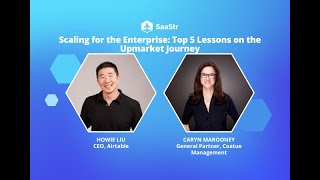
Airtable CEO Howie Liu shares five lessons from scaling the platform to enterprises: building capabilities in the right sequence, choosing which competitors to fight, focusing on vertical use cases like product operations, combining product-led growth with enterprise sales, and keeping the interface simple even as deployments get complex.
Chapters
Hello!
Hi!
Hey! Thank you! Thanks so much for having us. I love the desk. I feel very much like a talk show host all of a sudden. I'm gonna try to make the most of this. You're far away though.
I know, I feel like I'm here for office hours. Okay. But I've been the disobedient student.
My name is Karen. I am a general partner at Coatue. I've worked for many years in different companies. I was at Facebook for many years, Salesforce, VMware. I've had I've had the great pleasure of knowing Howie for many, many years. I'm sure most of you use Airtable, so I don't need to go into very much here, but for those that don't, Airtable is a connected apps platform. So think of it like an entire organization can move as one when you use Airtable. So whether or not, I think it's, what is it, 80% of the Fortune 100 use Airtable. So whether they're designing shoes, I can guess who that is, Blockbuster movies or helping to make sure that vaccines are distributed, Airtable is there to solve that. But today we're here to talk about how you scale in the enterprise, because I know, like, it feels like just yesterday we were talking about this, that you just started, and now you've scaled up, and we've learned a bunch of lessons along the way.
From Girl Scouts and Boy Scouts club organizations using Airtable and cow farmers to now big Fortune 500s. I think it's, it's definitely been a journey.
So we have 5 lessons from Howie on how to scale and how you think about these lessons as you go upmarket. So first off, let me jump to the first one. We're gonna talk about foundations. So a lot of this is what are the fundamental things that you need to build and how do you sequence them? Like Mark Zuckerberg used to say to me all the time, knowing the big vision is easy, but sequencing it is really hard. So how have you thought about some of the foundational work and the sequencing of what you do when, as you've been building Airtable?
Yeah, I mean, I think, you know, part of this is, you know, having really clear conviction about what the market is that you're going after. I think there's kind of two ways to build a company. One is you build something very quickly, you kind of see if it sticks. If it doesn't, you move on. And, you know, some companies can be built that way, right? Twitter was a hack project that happened through a pivot of the previous version of the company. And it clearly took off and worked, right? Whereas something like a SpaceX, of course, you can't just iterate your way into probably rockets that don't blow up. And I think with Airtable, it was much more premeditated. I had the chance to work at Salesforce after it acquired a previous company I founded. And in just seeing the potential of the low-code space from pretty early on, like I think in the 2011-12 time frame, and recognizing the power of like, what if you could make an app platform that anyone could use and configure to their own needs? I think we had pretty clear, you know, focus on this opportunity. And then it made it easier to break that down into, okay, what are the biggest things we need to de-risk? And so the first version of our product actually, you know, was a prototype, purely UX, you know, focused. So we created a front end and, you know, I think initially wireframes and then interactive prototype and completely fake the backend. Because even though there was a lot of technical complexity there, we knew we would have to go and build this real-time relational database engine. The first starting point was just, if we can't distill these UX concepts into something that's really intuitive that anyone can pick up and just start building with, then it's kind of dead on arrival. So we just, you know, I think we were very deliberate about figuring out like, what are the key unlocks to de-risk this opportunity. And you could follow that all the way through, you know, our 10 years of existence to now. You know, it's really about seeing if we can go into more and more complex, large-scale enterprise deployments and going wall-to-wall, you know, becoming this connected apps platform where it's not just one-off apps that are created, but really a whole network of them. And, you know, that's the thing we're really betting on now. So I think at every point, knowing What is the next milestone to de-risk the bigger, you know, next frontier of the company's potential?
And it's cool because you probably can see it, but then you still have to figure out, okay, I need to go backwards and then figure out what are the steps.
Yeah. And I think that is the constant dilemma. I think emotionally as an operator is you want to have this, you know, charisma and vision and excitement. About what the company could be, right? If you're just always stuck in the here and now and like, what's going to happen tomorrow, you don't have the, you know, the aspiration or, you know, you don't see where the company can be. And this is probably the hard part about early-stage investing, right, is, you know, you have to be able to squint and see past what, what, you know, a 1-year-old or even a 1-month-old company is today, but what it could be. At the same time, as an operator especially, you have to— yeah, you have to execute and you can't be too head in the clouds. And so I think, I think that's one of the unspoken challenges of the journey is like to maintain that, that duality of vision and like, where do we want to get towards in 5 years? But then be super executionally focused on like, what are the details of what we need to build now? And for us, a lot of it is just like the nitty-gritty mechanics of enterprise sales and success and making sure our product roadmap is aligned to support the needs of these more really sophisticated deployments.
Yeah, I mean, I think people underestimate how important executing in the short term is to get to the long term.
For sure.
Which sort of throws into the second lesson I just want to run to. This one I find intriguing, where you talk about choosing your competitors and making a conscious decision there. And I find that interesting because I think there's this fallacy that people are saying, well, I have this set of competitors, I don't get to choose them. And I think particularly when you're creating a category, which is something that Airtable has done, you have more say in who you compete with than I think people perhaps realize. What was your journey there, especially as you thought about, well, what is this category and how do I do that?
Yeah, I think this comes back to this framing of the short-term versus long-term, or even the outside-in look at the company. So, you know, objectively, you know, investors or analysts are going to assess your competitive landscape in a way that you don't have full control over. Obviously, you can try to pitch your company in a certain way, but ultimately, you know, other people are going to put you in a certain box and you can't control that in the near term. However, you know, as operators, you do have control over how you execute and the choices you make from a go-to-market standpoint. Which accounts are you prioritizing? You know, which, you know, what types of product functionality are you prioritizing to serve a certain segment of the customer base? And so I think over a multi-year time horizon, you can say, you know, our aspiration is actually to move out of this space. In our case of productivity, you know, we knew when we launched that there was a very good chance we would be bucketed in with at the time, you know, as companies like Trello or even before that, like Wunderlist, these like task management companies, productivity tools, right? Or even, you know, Google Sheets and Excel, you know, spreadsheets. But it was our very, very intentional focus to not be stuck in that, you know, kind of lower-end, more tactical, you know, use cases category, but instead to push towards what we believed was the much bigger, especially enterprise opportunity around building real apps, robust apps that actually could scale up very high in terms of complexity. So we use this concept of Airtable being both low floor, so very easy to adopt and use.
Oh, low floor.
Low floor. And then also high ceiling. And I think when we launched, the truth is we were low floor, but maybe medium ceiling. And so understandably, we were perceived as sometimes a Spreadsheet++. But because we made these deliberate choices to push more and more up complexity, we've been able to raise that ceiling and align a lot of our go-to-market efforts as well to go into the more serious enterprise multimillion-dollar deployments.
Yeah, yeah, I do. I think that that, and that changes who you compete with.
For sure.
Yeah, yeah.
I mean, it was for us, you know, going from, you know, productivity tools and, you know, kind of lightweight project management to now really, you know, we, we want to position ourselves against the Salesforce App Clouds and ServiceNow deployments out there. So really robust applications within large enterprises that now, you know, can be built in a much more agile and connected way with Airtable.
And you had to earn the right to do that, which you did with the other successes that you went along. It was one of those, like, it was an earning along the way to have a different competitor set. And I think that was an important part of it too.
Sequencing is so important. And I think had we launched out of the gates talking about taking on, let's say, ServiceNow, it would have been a little bit ludicrous, right? Like, it would have just gone completely I think, over our customers or reporters or, you know, investors' heads because it just— the gap was too wide. But I think that's also where having, you know, as the operator, the clarity of like, we know we're going to get to here in 3 years. We know in, you know, 3 or in our case, like it took, you know, 10 years to get to where we are today from founding, you know, but we know that's where we want to go. And yet at the same time, every year we can go out and be very, very focused about what we need to do just this year. Instead of pretending like we're already at year 9 or 10 when we're not.
That's— there's this saying, people overestimate what they can do in 1 year and drastically underestimate what they can do in 10. And I think that's part of it. So the next lesson, you and I talk a lot about this, but this is your— I love the way you say this— shrink your TAM. So Airtable is a horizontal platform. It can do Anything. That is beautiful. That is wonderful. It is a huge TAM. That is a feature and it's a bug.
Yeah.
Especially when you're starting out. Yeah. So, so how have you thought about this given the TAM is infinite?
It is. Yeah, it is a blessing and a curse. You know, I feel like in, in my earlier, you know, time starting Airtable or even the company I briefly worked on before Airtable, I was always very paranoid about not having a big enough TAM. And I recall even, you know, in high school or college when I was thinking about doing startups, you know, just dreaming up— So young. Dreaming up different ideas. You know, I would always, you know, get really worried like, oh, this idea isn't big enough. I want to do something that is like a really, really big opportunity. I don't just want to build, you know, a small piece of software for like a very niche use case. And I think that, you know, there's, a healthy basis for that paranoia, right? Like, you don't want to wedge yourself into a too small of a market. But I think you can end up on the other extreme, which is you have such a big market that you can't tackle it all at once, right? So if our bigger, like, multi-decade-long opportunity is to democratize software creation for everyone, and in particular, create useful apps, within every company that are built and managed by, you know, the line of business themselves, like people who are actually doing their jobs, you know, building, you know, marketing campaigns or launching products. Like they're the ones who should be building their own apps. You know, that is even that is a massive opportunity, right? I mean, certainly like multi-deca-billion revenue opportunity, but it's so big that it doesn't actually give you that much guidance on where to focus your efforts. And so, I think what we've learned is, you know, like sometimes you actually need to shrink your TAM. That sounds so—
it sounds counterintuitive.
It sounds very wrong to say. I feel like, you know, like there's, there's probably some, you know, like jumbo shrimp. Yeah. Like, that's like, do not— yeah, do not do this. But, you know, it's true. And I think, you know, in our case, an example of how we've been doing this is, you know, the truth is like we have very heterogeneous adoption. Like there's, almost every industry, country, company size. You were saying cows and cattle farmers to managing fashion retail companies and product launches and so on.
So I used to joke, and you make coffee. Yeah.
You can do anything. That feature is coming maybe in the near future. Yeah. You need the add-on espresso attachment. It's an upsell. Such a broad market, like company size segments, um, you know, the use cases, what function we sell into. Um, and, you know, we've already been pulled into this really heterogeneous base of adoption. Like, we see organic usage across all these different types of use cases, um, but it makes it really hard from a product and a go-to-market standpoint to actually focus our efforts and make sure we're providing the best possible experience, or that we are repeatedly marketing and selling to our best possible customers. And so what we've done is, you know, while maintaining the horizontality, if that's a word, of the underlying platform, you know, we always want to make sure the platform, you know, is more like a Lego experience where you can build anything you want with it. Yet at the same time, Legos don't just sell as, you know, a bunch of random pieces. They also sell, you know, the boxes that have— here's the castle one, here's the Star Wars farm one, Star Wars, you know, great one, the Millennium Falcon. Yeah. But, but, you know, you can buy these packaged kits. And so I think we're also identifying, hey, you know, it turns out a lot of companies are using Airtable for product roadmapping and product operations, you know, tracking their user feedback and triaging that. And, you know, if we can do that really, really well for a few customers, why can't we go and repeatedly market and sell and also build the product to be the best possible experience for every other customer that might have that need? Right. And Creating vertical edges on top of a horizontal platform has given us this much sharper focus. We've seen the results speak for themselves, like being able to much more easily sell into the same use case, same buyer type again and again and again, and make sure that our product is actually delivering on those needs. It's just a much easier way to execute than trying to be all things to all people.
And you can really say you are the best at this.
Right.
It is such an amazing thing to know, like, this is— and to focus the teams.
Yeah. Yeah, and going back to the choosing your competitors, it allows you to then actually put yourself up against the competitors for that subcategory. So for instance, in the product operations use case, we're actually competing against vertical-specific product planning tools. Out there. And so being able to actually, you know, position ourselves against them and really test our own mettle of, you know, how good are we actually for this use case? I mean, obviously we're a very great horizontal platform. We have all the relational database and the low-code functionality to be a really great, you know, best-in-breed low-code app platform. But on top of that, can we be the best-in-breed, you know, vertical solution for this use case or that use case?
And I think it's interesting because you are this connected apps platform, you bring the benefit of that to what you're now focused on. So it's important where you started because it has all of the benefits of being able to be connected in this next phase.
Yeah. And I think that's— this is kind of a lesson that organically emerged for us over the 10 years we've been working on Airtable. But I think the best kind of strategy, you know, comes from the fusion of, you know, what's organically already working. Like, you know, you don't have to go and, you know, push, you know, a rock uphill, right? There's something already working for us that was, you know, finding these use cases that were repeatedly and organically emerging across our customer base, creating deep, deep value for enterprises. And also that, you know, these enterprises were looking to you know, then build out other apps that were adjacent to it. So for instance, you know, with a lot of the content production companies out there like Netflix, you know, there's this, you know, central production workflow and then all these adjacent things related to that. And so the idea of being able to connect all of those, you know, workstreams together with shared sources of truth, you know, is how we kind of decided to lean into this idea of connected apps and making that our North Star. At the same time, you know, when we look at it kind of top down or outside in, we also recognize this is a great strategic advantage for us, right? Like we can start with one use case. We don't have to stop there. We can actually gain these network effects and actually compound our value within an enterprise because we allow the company to build other apps adjacent to it and they all kind of interconnect and work well together. So, you know, we do need to or want to be the best in breed product for any one use case. But then we have this asymmetric advantage as we build out use cases around it because we just connect those use cases more seamlessly together than you would get with disparate tools or if it was all in spreadsheets or anywhere else.
Yeah. And you always say, listen to your customers. They'll tell you a lot if you listen.
And you have to ask the right questions too.
Right. Right. So in terms of the go-to-market strategy, you hear these sort of two different sides. There's product-led growth and there's enterprise sales, and it's like, choose. Now, how are you thinking about that? Is it a choice? Is it— what have you seen?
Yeah, I mean, it's, it's funny, you know, 10 years ago when we were going out and raising our first round of funding, seed round, you know, we, we ended up raising, I think, a $3 million round, which seemed like a lot of money at the time, at a $6 million pre. So, you know, it's It was a different time, you know, but, but I remember like all of the investors that we talked to who were knowledgeable about SaaS, almost all of them, you know, framed this as a, you know, kind of a choice. Like, are you going to be more of this like consumer viral thing that maybe looks like Dropbox? I mean, Slack hadn't even launched at the time, and there really weren't that many examples of B2B serving companies that had like this product-led virality. Or are you going to do like kind of real enterprise sales? Right. And then forget about shoes. And I think a lot of that is based on, you know, like most people, whether, you know, you're an operator or an investor, you know, you kind of ground your mental models based on historical, you know, data points. Right. And, you know, in 2012, there just weren't that many data points of companies, you know, that had really fused PLG with enterprise sales. I mean, today with, with Figma's announced acquisition by Adobe for $20 billion, I think you know, there's more and more validation that like getting this combination right is, is a real thing and can, you know, result in profound benefits from a sales efficiency standpoint, from a, you know, just a business model standpoint. So I think what, what we've tried to do is not see those as, you know, divergent poles, but really try to find the bridge to connect the two. So as a very tangible example, you know, we've started to experiment with cold outbound efforts. right? You know, in the early days of Airtable, we were purely inbound, you know, just organic adoption. People would pull out credit cards and then, you know, Airtable would spread virally within a company, which is pretty sweet. It's awesome. You know, it's like free money. Like people are just coming to you and like throwing cash at you for like shipping bits over the internet to them, right? They give us their bits, we ship back those bits in, you know, kind of collaborative form and we get paid for it. It's great. But what we also found was that, you know, in some cases, especially for the larger companies, like they wanted some more handholding. They wanted to talk to a salesperson and eventually a success person. And as we leaned into that motion, we found that the, you know, the power of the product, like the fact that the product was so delightful, was intuitive, and actually was something that empowered the lines of business as opposed to being something that was very just purely centrally deployed and managed only, was actually, you know, still a really, really huge advantage in even like the more human-led sales or success efforts. So, so finding that, that bridge between the two. And even when we are now going, you know, and experimenting with increasingly, you know, cold outbound. So actually reaching out to customers that don't have, you know, much or any organic usage of Airtable, we're finding that the, you know, the delightfulness of the product, the fact that they can actually go and not take our word for the value of the product, but take it over and try it out for themselves in minutes is still a huge advantage. So really finding a way to leverage the PLG with the enterprise sales and vice versa, make sure that, you know, as you invest into the product and improve its functionality, that you're also considering, well, you know, how do we serve the needs of customers that are doing more than just small, you know, small-scale self-serve things, but actually managing this at scale? Yeah. You know, it's— it requires effort on both sides or in both directions. But if done well, I think you can actually build, you know, an extraordinary business. And frankly, I think it's probably where the future of all enterprise software is eventually moving towards.
I did a post about how it's the hamburger go-to-market where the product is the meat and it's both buns. It was like very simplified. But I do believe that they're important. You can't just have one if you're going to reach your full potential.
For sure.
I find it really interesting, but it's hard again to sequence it. So it goes back to timing and what you do first. And you can't do it all right off the bat. Like, you do start from one area or the other.
It's also unfamiliar territory, right? I mean, the case studies for this are being written as we speak. And it's much easier to kind of stick to an older model. We're going to just do classic top-down enterprise sales. Like, there is a playbook for that. The big enterprise software companies have been doing it for decades. But also, you know, at the same time, like, I think that model is going to become increasingly, you know, maybe not obsolete, but just it's going to be increasingly outdated relative to this new, you know, product-led approach. Right. And, and so almost by definition, I think, you know, any, any playbook that's like already tried and true for too long might be at the risk of becoming irrelevant or just inefficient relative to this newer approach that you have to pioneer a little bit.
And because you started with the organic product-led, you have the hooks into iteration on the product connected to sales that I think is quite helpful as you connect with that top bun or the enterprise sales. That's already in your DNA.
Yeah. I've come to really appreciate that both are real crafts. I mean, doing enterprise sales well is a craft of its own.
It is a craft.
You know, we use the, the MEDDIC, you know, framework for sales. And, you know, I've just been really, really impressed at, you know, the efforts that our sales team has put into like building this playbook, refining it, making it really efficient and scalable. And that is a craft in its own right, in the same way that building great product that has, you know, consumer-grade UX is great. But I do think net-net, like, it's probably harder to retrofit, you know, delightful, you know, bottoms-up adoptable or PLG, you know, adoptable product, you know, after the fact than it is to figure out how to start with self-serve adoption, PLG, and then layer in enterprise sales. So if you are going to sequence, I think it's, you know, it's finding that that PLG product market fit is really foundational and it gives you so much leverage then in, you know, anything that you want to layer on from an enterprise sales standpoint.
And it helps you listen to more customers because you totally— you have them.
Yeah. It's almost like doing drug discovery when you already have a petri dish that's massive and you see lots of little pockets of, you know, here's penicillin, like actually taking action on, like, you know, bacteria. Like, you just have a much larger organic sample size to deal with. And, you know, for us, like, it made the job of discovering what are the best use cases for Airtable, what are the best company types, who is— who should be our ICP, you know, much easier because we didn't have to invent it on first principles. We just got to look at it empirically and see, oh, these customers are real enterprise logos. They're really getting high value from Airtable. They built these use cases themselves. We don't know anything about, you know, let's say, you know, global marketing, you know, campaigns and marketing for major product launches at like a Fortune 500 company. You know, especially when we were, you know, bright-eyed, like, you know, entrepreneurs just working in Silicon Valley, like, you know, who didn't know anything about like that world. But I think getting to see our customers build on top of the platform we had created allowed us to learn from them and partner with them almost to see, okay, how do we make our product an even better experience for that and then scale up around that, you know, that thing that, that product market fit that's already working.
And this leads into our last lesson, which is this sense of don't underestimate the importance of a delightful experience in an enterprise product. And I've seen a lot of SaaS products, and I think that a lot of times the UI or the UX is an afterthought because it's got great functionality, but like, my eyeballs are kind of bleeding, but that's cool, it'll be all right. And you've had a consumer sort of DNA that has been very useful and a real sensibility about creating light. How do you manage that with the complexity of enterprise?
It's certainly not easy. And I wouldn't even say that we're— I certainly wouldn't say that we're perfect at it. We are learning as we go. I think part of the challenge is when you do have a low floor, high ceiling product, you can be great for low floor use cases because your product is intuitive and delightful, et cetera. But the things that you need to do to be a great product at higher levels of complexity, at greater scale, if you have thousands of people using the product, and with much more complex data schemas and business processes and the types of logic and interfaces that people are trying to build within their apps are just more complex. It's not even a matter of— it's not just a matter of having a delightful product experience in terms of UX. It's also a matter of making sure that we have the right frameworks and tooling to allow these, you know, more complex deployments to be managed at scale, right? To prevent things from becoming chaos. Yeah. You know, if you think about a product like, let's say, Google Sheets, you know, it's— I would say it's actually pretty intuitive to start using. You could just type in, you know, you know, text or numbers into any cell. You can create a formula, etc. But then we've all probably experienced like the really messy, overgrown, you know, sheet and Sheets and Excel break down much, much earlier than Airtable does, because we actually have kind of the app platform foundations. We have a relational database. You can scale up a more complex workflow, but it still takes a lot of very intentional investment from us to make sure that we keep scaling with our customers and now can support ecosystems of apps being built within the enterprise. So I don't think there's a— I don't know if there's a silver bullet there. And it requires a lot of the hard blocking and tackling of you know, of actually, you know, deciding what's the product roadmap and what are the trade-offs that you're willing to make in terms of where you, you know, bet your resources. You know, but I think that it's about kind of pushing on that tension and not saying it's one or the other, but really striving to uphold, you know, this delightful, intuitive entry point, that low floor, like holding the ground, if not, making even more progress on that while at the same time enabling a higher and higher and higher ceiling and a bridge between the two, really. So that, you know, it's very elegant for a customer to come in, start building a very simple use case in Airtable, maybe get a dataset in there, create a shareable interface and create a workflow around that, share that within 15 minutes. But if they want to build it up and make it more and more complex over time, we need to support them along that journey and have better features and tooling to allow them to progress to much larger deployments and more complex deployments with grace.
That's awesome. Well, those were our 5 lessons. Do you have any sort of anything we didn't cover? Last-minute thoughts?
I think the most important thing, too, is it is a very— I think we're all humans. And as much as SaaS businesses can get distilled into metrics Everybody talks about revenue and numbers and, you know, you know, Rule of 40 and NDRs. And obviously those are very important metrics of, you know, the health and success of businesses in our industry. But I also think there's so much human agency involved in the journey. Right. And going back to the original point about like, you know, balancing that duality of where's the North Star, where do you want to go to, who do you want to compete with versus like what are the realities of today, I think it's also really important to just kind of be kind to ourselves. And I'm sure everyone in this room has had ups and downs. And it's a hard job.
It's a hard job.
Every job in SaaS can be very, very challenging. And so I think patting ourselves on the back every once in a while, it's something that I've learned. To do more and more over time is, you know, recognize the wins and kind of appreciate that, you know, we've gotten to where we are through the very human efforts and very intentional efforts of a lot of very motivated and hardworking people that are part of the team. So, you know, and hopefully have fun along the way, right? Because, you know, life is too short to, you know, even if, it's a tough, you know, effort. And, you know, what we're trying to do requires a lot of intensity. And, you know, it can be stressful, you know, if we don't have joy and passion about, you know, not just the end state, but also the journey, that I think it makes it all, you know, a lot less motivating and meaningful. So.
More from Jason

Why Your Next Hire Should Report to an AI, Tragedy Apps, and Too Many AI SDRs? | The Agents #004

Our Agents Drove Our Salesforce Bill Up 80%, Marketo Hates Agents, and We Stealth-Churned Off Notion




Managing 20+ AI Agents: Lazy Agents, Our $500K AI Bill, Stealth Churn & the Death of 60% Solutions




