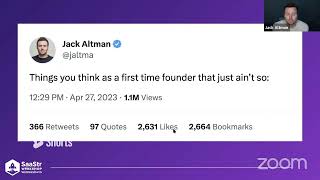
Jack Altman, CEO of Lattice, explains why the HR software company built a multi-product suite early instead of focusing on a single product. He allocated 5.5 of 7 engineers to a second product while still developing the flagship tool, betting that the same buyers would want engagement surveys, career management, and compensation tools bundled together.
Chapters
We basically build a suite of HR applications around people management. So we started with performance management. We then got into engagement surveys, which was sort of like our second product. And then from there, we've kind of kept building. So like career management, compensation management, and we basically built this bundle around modern people management.
Going multi-product, obviously it's somewhat common in your industry, but did you do it right? How did you decide to build a whole suite in, you know, in your first 6 to 7 years?
Yeah, I think this is, um, what— this is one of my views of things that not enough startups do often enough, early enough. It's obviously not the right thing for everybody, but I think this is maybe one of the canonical pieces of startup advice that I maybe slightly disagree with, of most people will guide startups to stick with one product and just really focus. And I think that often works, but I believe that we are in a sort of phase of the software deployment lifecycle. If you look over like a couple of decades where it's become really cheap to build software, where there's a mass proliferation of products, where integrating becomes hard, where buying from 100 vendors becomes hard. And so I actually believe in more categories than not, consolidated bundles are extremely valuable and have like a structural advantage. So that, that's kind of like a philosophy I come to this with. There's obviously exceptions, of course, like, you know, Zoom, which we're using right now, is a great exception to that. But generally speaking, that's kind of how I see it. So we did it early and it kind of worked for us.
Was it intentional or did you just figure out from your customers that having a suite was the way to go?
It was intentional. So we were at like 2 or 3 of ARR. Yeah, like we had like 7 engineers and we put like 5.5 of them on a second product, which was the engagement service product, while our performance product clearly still had a humongous amount of work to do.
Yeah, must have, right? It had 2 engineers working on it. Yeah. It seems crazy to do unless it's a total tilt, but it wasn't.
Yeah, exactly. And you know, it was basically, and it wasn't like our customers were asking us for it, it was just that we knew they were also paying for this thing, that it was the same buyer, the same segment, the same sort of mindset in which it was bought. And so we sort of went for it. Obviously we then staffed, performance back up massively. But no, we went for it early because it met a set of criteria that we thought made for a good second product.
It's funny, I think today what we finally learned is this suite versus point solution, like the answer is probably yes.
Yeah, like, like, that's right.
Like they can both work depending on the DNA of the team and the market. And it's not so binary, is it?
No, absolutely. And to that point, it's, you know, you see a company work and it's not like the way that it worked is the only way it could have worked. Like if Lattice had just said, you know what, we're going to take all of our energy just on performance management, we would have had to do some things differently. We would have had to really push up into the enterprise to make it work. But I believe that could have worked. So, you know, there's multiple winning paths. It's not like just— it's not like the one thing we did is the only thing that could have worked.