Skyflow’s CEO + COS: “The Art of the Pivot: 3 Lessons from 50+ Investments”
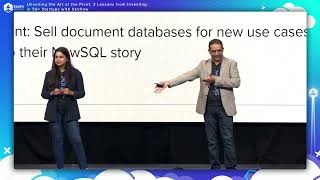
In this live presentation, Skyflow’s co‑founder and CEO Anshu (Jason M. Lemkin) and Chief of Staff Radzi walk the audience through what a true pivot really is, why most so‑called pivots fail, and how to execute a successful pivot. They contrast a genuine pivot – which keeps one core element (technology, go‑to‑market, or customer base) fixed like a foot planted on a basketball pivot – with “traveling,” which is merely a change of strategy without a stable anchor. Through case studies (Slack, Segment, MongoDB, PayPal, HubSpot, Yelp) they illustrate pivots versus evolutions, emphasizing the importance of pivoting around something that is already working, avoiding sunk‑cost bias, and leveraging deep customer knowledge over pure engineering focus. The talk concludes with three practical pivot criteria: (1) identify the immutable element (the foot), (2) decide whether the pivot is technology‑centric or market‑centric, and (3) ensure the pivot is grounded in customer value rather than code. The speakers also share their own Skyflow mission to protect PII, setting the stage for why understanding pivots matters for founders and investors.
Chapters
[Speaker:JASON M. LEMKIN] All right. Can you hear me? Thank you so much for coming. We're going to talk about pivots. I feel like— have you ever been to a fish market? Those people are selling fish over there. We're doing our talk over here. But hopefully we'll have a lot of fun. We are here to talk about pivots, starting with myself and Rajshi. We'll introduce ourselves and then we'll talk about some pivots, why they work, sometimes why they don't. And, you know, hopefully we'll have a great time doing this. So I'll introduce myself first. I'm the co-founder and CEO of Skyflow. Skyflow is a data privacy vault company. We basically started this company 4 years, 7 months ago, and we basically started with a very simple premise that things like Social Security numbers, phone numbers, credit card numbers shouldn't end up on the dark web because of the number of breaches that are happening. Over the years, we've moved all kinds of other data to the right locations. Splunk stores all the logs. Okta stores all the identity, Stripe stores all the credit card numbers, but we are still keeping people's Social Security numbers, phone numbers, email addresses mixed with all kinds of random data. And that's why we keep having these problems. So with that mission in mind, we decided to build a category in this space. So that's who I am. Rajsi is my chief of staff. Rajsi, you want to introduce yourself and how you ended up at Skyflow? Sure.
Awesome. Hi everyone, my name is Radzi. I'm Chief of Staff here at Skyflow. I've been with the company for over 2.5 years now, which in startup terms is more like 10. We've grown quite a bit in that time, and I joined because I truly believe that PII is a different class of data and must be treated as such. And that is one of the newer types of data, but nobody has figured out how to store it today. And that's why we exist. That's why I'm here. I joined from Amazon and Oracle, and it's been a fun ride. And we're excited to talk to you about pivots today.
All right. Who here has worked for a company that's pivoted? All right. Well, we might disappoint you and tell you that that wasn't a pivot. But let's find out. So I know the headline for this talk Session was supposed to be the kinds of pivot, but we have some disappointing news for you. Most pivots actually never work. Think about the companies that you're aware of, right? Think about the companies that you think you work for that are successful because of pivots, and then think about what actually happened, and that's some of the things we'll tell you about. With that in mind, here is a thought-provoking question for you.
Which great companies pivoted? I'm sure all of you have worked for companies that pivoted, or you have some companies in mind that you think made for great pivots. So I want everyone here to start with a company or a story in mind, and maybe we'll cover some of them, maybe we'll talk about some of them, Let's start there. Everybody have a story in mind? Awesome.
Alright, so let's start with a very basic question now that we've all imagined some pivot. How many people here, by the way, imagined Slack? Right? We have a Pavlovian response to, like, Slack being the ultimate pivot company. What does it mean to pivot? You know, I know we think of pivots all the time. You know, has Amazon pivoted? Has Salesforce pivoted? What does it mean to pivot? And for many years, I just assumed if a company changed strategies and became successful, we call that a pivot, right? That's how most of us think about pivots. But really, that's not a pivot. That's just called changing strategies. What a pivot is, the term pivot comes from— okay, some of us nerds unite. When we think of pivots, don't you think of pivot tables first? I do. But the second origin of pivots is actually basketball. So pivots are all about finding something that you can place your foot and say, I have found something that I can pivot around. Because if you don't have your foot planted in one place that you're pivoting around, you know, it's not called a pivot. In basketball, what is it called? Traveling. Traveling. Exactly. So most companies that we think pivot are actually just traveling. Should we take some examples?
Yes, let's start with a couple stories. So Slack, everybody knows the story. It was a game company that basically had a chat functionality that everybody loved, and the game company didn't quite work out, but they took the chat functionality, developed Slack, and here we are today. Sanju, I'm curious, why do you think that's a bad pivot?
That's a great change of strategy. In fact, if you listen to Stewart Butterfield, he talks about the fact that he actually thought about shutting down the company, returning the money, and then starting this new product called Slack. And that's what it was. The fact that his original cap table investors got to keep 15% of his equity, in my opinion, was a terrible strategic decision. But he's a good human being, so we give him points for being a good traveler. So he traveled, he took a couple of people from his team, and built an entirely new company. There's nothing in common between what he was building, video games, and the product and the startup that emerged from it. It's literally as if you shut down one company and started another. That's not a pivot. That's traveling. So maybe we should have a second category, traveling startups, right? So maybe that's what we discovered today. Let's take another example.
Let's talk about Segment. I'm sure some of you must have thought about Segment when I asked you the earlier question. What's different there? Do you think it's a story like Slack? Do you think they did something else? Do you think it's a good pivot?
Pivot or not? Those who think it's a pivot? Only me? It's actually a pivot. They successfully pivoted. What they did was— the story of Segment, for those who are not aware— they started out trying to build a competitor of Mixpanel and Google Analytics. And they basically, to do that, they built an SDK because their customers were not letting them change the settings to go from using Google Analytics to using Segment. They're like, look, you don't have to embed all of Segment into your website. We'll give you an SDK that can stream the data to everybody. And therefore you can also plug Segment backend into it. Guess what happened? They started getting these customers who were taking their SDK and streaming the data to them and other places, but actually never logging into their backend application. So their analytics product completely failed. They found something in their case. So think about what you're keeping. So in case of Slack, he kept nothing with him, right? They basically changed everything. In case of Segment, they took that SDK, the thing that's working. So you always want to pivot around something that's actually working. In their case, it was the SDK that actually worked, and then they basically built a business around it. And what a phenomenal business. And perfect timing on an exit to them.
So it seems to me what you're saying is, you know, companies need to start with one thing that's actually working. So if we imagine a triangle, I'm seeing technology on one point, go-to-market on another point, and customers on another point. Is that, is that a good way to think about it?
Yeah. So, you know, we'll get— we'll summarize it at the end, but At a very high level, you have to think about what are you pivoting around? Are you so successful with your customers? So I'll give an example. Some companies start out in healthcare space thinking they're going to build an EHR. Everybody thinks they're going to build an EHR because once you see an EHR, you can't unsee the damn thing. These are the ugliest pieces of software humankind has ever written. And then you enter the market and you will find out Nobody is looking to buy a new EHR. It's like new ERP. And then you basically go, okay, now that I've spent 2 years hanging out at the hospital systems, what else can I build? So you end up maybe learning from those hospital administrators that they have an email phishing problem, they have something else. That becomes your pivot. You basically then decide to keep the customer the same, because you've learned so much. Why? Because that's the most valuable thing you have. You want to pivot around the thing that's working and you don't want to change because you've done a lot of work. Actually, one thing to caution against there is sunk fallacy, sunk cost fallacy. It's not the thing that you work the most on that's important. Think about Segment. If they had a million lines of code, probably 20,000 lines of code would have been in the SDK and and 980,000 lines would have been in their backend. So it's not about picking the thing that you did the most work on. It's about the thing that's most valuable or working that you're gonna pivot around. So MongoDB.
Tell us the MongoDB story.
Not a pivot. They started out as a document DB, then they started calling themselves NoSQL. They actually don't call themselves NoSQL anymore. Guess why? They added SQL. That's an evolution of a strategy. They started with the ability to store large amount of unstructured data in a narrow space. It helped them to call it NoSQL because then they could attract a certain class of customers. And now it helps them to say, oh, we are a NoSQL company that does SQL. I think that should be their tagline, actually, but not a pivot. Let's take an example of a pivot that maybe worked.
Let's talk about PayPal. So PayPal, the thing that they kept the same was the market. You know, PayPal started out as a payments encryption service, then it became a PDA-to-PDA payments app, and now they're a web-based payment processor. So while they changed, the market that they sold into remained exactly the same. The market that they serve never exactly changed, so they knew exactly where to plant that foot while they changed the rest of their business. Successful pivot. HubSpot, tell us, is it a pivot?
Not a pivot. As much as they kept their customers the same over the years, which is SMB, that's just evolution of strategy. They have never given up on their core inbound marketing platform. I know that was Dharmesh's keynote yesterday at HubSpot's event. I was at Salesforce watching these people grow. We'll see where that ends up. Ends up crossing over. But in reality, HubSpot found a niche and expanded. That's called land and expand. They landed with inbound marketing customers, then they found what's working, and they doubled down. Not a pivot. Let's take an actual pivot.
Yelp. So for those of who you don't know, Yelp actually started out as a service where they solicited reviews via email. So you could send your friends emails to review different restaurants or places, and the realization that they came to was it's actually the aggregation that is more valuable than one person's review. And it changed from an unsolicited review via email company to a— or sorry, solicited review via email company to an unsolicited review company, and now we all know what Yelp is. Kept the customer the same, pivoted the strategy around it.
So, if there's anything you take away from this lecture, I suppose, is pivots are not about change. Pivots are actually about what are you going to keep same. What is it that you're pivoting around? And oftentimes we forget that. If you have a startup that's early stage and it's going through 15 different ideas, you're not pivoting, you're traveling. Traveling is a good thing. If you get lost in a jungle, you're supposed to go around in a zigzag fashion till you find a road or something. I don't hike as much, but that's what I'm told. That's called looking, traveling, searching in the vector space, similarity searches. Those are all techniques to find a new area where you can go work. And maybe if you have raised $30 million in 2019, you're still going to keep doing that for another 6 years. But this is called traveling. God bless you. But that's not a pivot. A pivot has a few key factors. So let's start with the first one, Rachi. What's the first?
Pick what you're not changing. What is your foot going to be planted on? What are you going to pivot around? It has to start there. What is the point that stays the same?
The second one is it can be technology. As engineers, we are entirely focused on, I built this thing, how do I keep this thing and sell it to somebody else? The reason most pivots fail is because that's the strategy most of us follow, right? Because you're writing the code, you have most empathy for yourself. You don't have empathy for the customer success person on your team who's failing. You don't have empathy for the salesperson. We replace them like old shoes. But code In today's day and age, unless you've truly built OpenAI, is not as defensible as your knowledge of a customer's business process, as your ability to understand even something as small as you figuring out, oh, people will pay $100,000 for email. You know, people pay $100,000 for email for like 100 people. You know where? In the healthcare space. So if you were building something in the healthcare space, and you're familiar with the customer, you may discover that a hyper-secure email, TigerConnect, is actually a great business. And that's where you're relying on the knowledge of the market and the go-to-market. What's the final one?
Most great companies never pivoted. As Anshu said, they evolved in strategy. They added new S-curves.
So that's the key takeaway. Thank you so much for coming. And I hope you enjoy this show. We have a booth over there. We would love to tell you more about Skyflow, and thanks for coming.
Yes, thank you.
More from Jason

Why Your Next Hire Should Report to an AI, Tragedy Apps, and Too Many AI SDRs? | The Agents #004

Our Agents Drove Our Salesforce Bill Up 80%, Marketo Hates Agents, and We Stealth-Churned Off Notion




Managing 20+ AI Agents: Lazy Agents, Our $500K AI Bill, Stealth Churn & the Death of 60% Solutions




