Swapping Notes on the AI Revolution in Marketing with G2's CMO Sydney Sloan
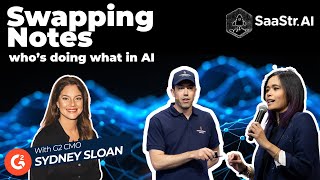
Sydney Sloan, G2's CMO, explains how enterprises are adopting AI fastest because of productivity gains. She outlines three shifts: AI as standard software feature, AI agents becoming central to buying, and prospects starting research with LLMs instead of Google. Marketers must shift to "Generative Engine Optimization," optimizing content for AI prompts rather than traditional search.
Chapters
The fastest people to switch are enterprises. Usually enterprises aren't the ones that adopt it first, but that is what the data showed us is that enterprise were first movers here and they were doing it because of the productivity gains. You absolutely have to be able to add AI and AI capabilities to existing platforms. And then there's the part that is the, the use of AI as part of buying process and that people are going to LLMs first, which is then changing the marketer's world of how we have to think about Marketing in the age of LLM, the new LLM buying process.
Hey everybody, it's Saster. Fin is the number one AI agent for resolving complex queries like refunds, transaction disputes, and technical troubleshooting, all with speed and reliability. See how Fin can deliver the highest resolution rates and highest quality customer experience at fin.ai/saster. That's fin.ai/saster. The biggest B2B and AI event of the year is back. It's the Saastr AI Summit in the SF Bay Area, aka the Saastr Annual. It'll be back in May 2026. With 36% of everyone coming CEOs, it's an incredible AI-first professional event. The very, very best S-tier folks will be there talking about sharing and learning how to scale AI in B2B in this new world. But here's the reality. The longer you wait, the higher ticket prices go up. They're really cheap in the beginning. And then, you know, just a few days before, they get kind of expensive. But you've been warned, early bird tickets are available now, and I want to see you there. Once they're gone, you'll pay hundreds more. So book your spot today by going to podcast.saastrannual.com. That's podcast.saastrannual.com. Get your exclusive discounts for Saastr AI SF 2026. We will see you there.
Hey everybody at Saastr, I'm Emilio LaRue, the Chief AI Officer here, and together with my co-host Guillaume Pivon, we're launching a new podcast series in Saastr called Swapping Notes, where in every So we'll sit down with the top AI leaders in SaaS and B2B, and we'll swap notes on what's actually working and what's not moving the needle in AI. So whether you're a founder trying to navigate your AI strategy or go-to-market leader implementing AI features and frameworks yourselves, this is the show for you. So without further ado, let's swap some notes. Hello everyone, welcome back to Saastr. We're here on a new series we're doing. I will introduce my co-host first. This is Guillaume Cabane. For those who don't know you as G, G, tell folks a little bit about yourself.
Yeah. Hello everyone. I'm super excited for this new series that I'm joining with Saastr. So I've built a couple growth teams in a number of like successful companies, Segment and Drift and Gorgeous. And more recently I led all of marketing at Ramp, a great fintech company out of New York. And I advise companies in, in B2B. I've been doing that for the past 10+ years, and I've been lucky enough that has worked, and I've built a little entity around it. And so, at Happy Growth Partners, we advise about 20 of the best companies per year, and we help them grow faster.
Amazing.
And Ji knows a lot about AI and marketing and just disaster, and so we thought we'd bring him in for another perspective of boots on the ground. And our inaugural guest needs no introduction, but we'll do one anyway. The incomparable Sydney Sloan. She's the CMO of G2. Sydney, you've got such a great career already, other companies as Salesloft, Adobe, right? So give the folks who maybe don't know you a quick intro to yourself.
I'm currently the CMO at G2, which was another company that GE advised for. And so I've been here just a little bit over a year. Same thing, like, I, I love advising companies and founders. I'm part of Stage 2 Capital as an LP. I'm part of the Scale Ventures Network and stay involved in that. So blending time between my daytime operating role, but also enjoy just helping founders and helping teams figure out how to crack the nut of growth. And today It's everybody's at the starting line, right? Like we are, we get to hit a reset button. And, and so it's like exciting times.
It's exciting times. One of the things we recently covered on SaaStr that will help us kick off here as a good transition is in your guys' latest G2 Buyers Behavior Report. You put it out right before SaaStr Annual, I think in May. We covered it on SaaStr.
We released it at SaaStr Annual.
At SaaStr Annual. Okay.
That's, that's our release party.
Yes.
Unplanned.
Yep. It's a great release party. It's just in front of a live studio audience in person and live streaming, but all good there. Yeah. You guys talked about one of the most interesting learnings was AI. We all talk about it now. AI for you guys at G2 now means always included. I agree. We saw that a lot at SaaS for Two. You said 88% of people won't even buy or think about using software if it doesn't have AI. Let's start there from your perspective, like where you've been at G2 for over a year, but you've bought software for a long time now. Like, how have you seen that pattern change of how people buy software with the advent of AI?
I think there's 3 questions in there. We can unpack them. So, the first of the always included is that is people are looking for AI capabilities in the platforms they're buying. And surprisingly, in that same report, the fast— the fastest people to switch are enterprises. Usually enterprises aren't the ones that adopt it first, but that is what the data showed us is that enterprise were first movers here and they were doing it because of the productivity gains. And so you absolutely have to be able to add AI and AI capabilities to existing platforms. The second is that people are now at the point of setting their agentic strategy and then trying to determine which platforms they want to use to build out their agents. So you've got this really interesting time of You know, we, we're AI is being added to platforms. You can build now with AI. And so we're going back to like bespoke workflows and what can I augment with AI? What still needs to stay people-based and what's your strategy there? Do you want it to go hybrid? Do you want to go Copilot? And so I think everybody's in the process of figuring that out right now. And so that's why I said it's like super exciting times. And then there's the third part is that the use of AI is part of the buying process and that people are going to LLMs first, which is then changing the marketer's world of how we have to think about marketing in the age of LLM, the new LLM buying process. And PPC is no longer the way that we can buy our way. We have to figure out a new way. So I think there's like We can go deeper at each one of those things, but it's impacting all of it.
Yeah, I think I'm really curious about the last one here because obviously the buying process is changing, which means you, I, and all of us marketers, we sit on the other side of that, like, and it's just the selling processes. If the buying process is changing, the selling process has changed, right? But you uniquely, Cindy, you see both sides of it, right? Because you can see Because of G2 and the platform, right, you see the buying and the selling. And so I'm curious, what are you seeing that's changing in the buying process? And how are marketers addressing and how are they adapting their selling process?
They're going to LLMs first. So that, that has been a significant shift. What they do is they first, they go to the LLMs for their research process, their discovery process. And what we're seeing is that they're— they really do trust it. And so when they cite the sources, the second place they go is the source. And lucky enough, we allow our information to be indexed by the LLMs, and LLMs love user-generated content. So sites like G2 and Reddit, Wikipedia, like you're seeing these as the main drivers of the source of content. And the next place they come is the peer review sites to do that, like fact checking. And then once they've done that and they get down to a smaller list, then they'll end up potentially at those companies' websites or third-party marketplaces. Gee, you mentioned Ramp, right? So Ramp is trying to transact in their own marketplace. So like our G2 reviews are also in the marketplaces. And so all of these the process that buyers are going through. They start with the LLMs, then they go shortlisting in the LLM. They might even build their RFP template in the LLMs and ask for sources. And so now we as marketers have to figure out what's the best way to influence the LLMs. And, G, you and I had a conversation about this. So how do we think about influencing the LLMs, where SEO was looking for, for clicks and links. That was our whole strategy. What we're calling GEO, generative engine optimization, is looking for answers. So we have to reorient our content strategy around what are the prompts and what are the answers that people are looking for in the way that we're thinking about our content. So I learned this from G. Is think about your personas and their jobs to be done and start writing your content around the jobs to be done. And then thinking about what types of content are the LLMs indexing on? They love listicles, they love like user-generated content. And so how do you start to build that content?
Yeah, I— there's something that you said, you brought up trust. You say people trust LLMs, and I think that's— that is a very important thing. I agree with that. I did this very obvious and it's clear that the trust is moving right towards LLM. And I think that is a core challenge for us marketers because us marketers from the consumer's perspective have never been worthy of trust. Why would he be worthy of trust? We've been trying to like cue the perception. There's some soft lying that has been happening forever. And so now like all of that, so we're getting disconnected, we've lost some of that trust and that trust has— we're de-intimidated. And so that presents a unique challenge for us. And the other thing that, that you said, you said people like the AI agents are like, they like, like the UGC very much like humans, because that's what they model after. Right. And so I think the way that I think about it these days for marketers, and we, I'd love to hear how like you hit this reset button, how you reinvent yourself.
Right.
But the way that I've been thinking about it and I've been training people on is there's really two broad categories, things that are AI-proof, right? That are AI-resilient. So that's gonna be like social proof and influencers. It's gonna be like some of the UGC stuff. A lot of that, the webinars, the in-person, the events, the dinners, all that, that is gonna work for a while. Like people like being in like in social connections. If Sydney sends me a mail about something that she cares about, I know that it is important. I'm gonna read it or I'm gonna trust it. So I have trust there. Okay. But then the rest is influencing the AI agent. It's influencing ChatGPT. All right. If I can't have that trust relationship, then I need to influence. So it's AI-proof versus like full AI. And there's realistically nothing in between. Realistically, the other channels that in between, they're going away. But I'd love to hear how you hit that reset button.
Yeah, I think the things in, in, in that question with trust is starts with brand. And so it's like people need to be starting to go back to think about the fundamentals of brand building and how do you build a trusted brand using your voice of the customer, using those influencers, thinking about those the other influence sites are like, what are the trusted sites that the LLMs are using that then you need to build your brand and influence on? And I think that even though we're, we're talking about the buying process, when you go back and you talk about the personas and the jobs to be done, you can still be delivering great content for things that are not related to your product. If I'm, let's say I'm a salesperson and we're selling, let's say, contact data for salespeople. Maybe they, that's a challenge they have to go research, have to go off all these things. But if you think about their entire jobs to be done, they also want to know negotiation skills, or they might want to know other things. We, you can still build content for that. You can still add value to the, to every single question that they're going to go for the LLM. And as you're seen as that source reference, that's going to still build your brand. So you can't stop thinking about brand building and building relationships with your audience. I think people are going to still leverage LinkedIn. We know our buyers are there. They're still going to get influenced from within that, and that's part of brand building. And so trust, I think, and brand are equal. The other thing is that it's giving you the answers and accelerating your productivity, the LLMs. And that's also what we saw. If it can give you a better answer than when, you know, you have— maybe you searched before, or it gives you insights that you never thought. I use ChatGPT 100 times a day, right? I'm like, oh yeah, that's an— oh, I didn't even think about that. And so that extra insight is also adding incremental value to the end user. And that's why they're going there. You're getting better answers. You're getting more than you asked for. That's crazy. So I think the— that is why we're seeing the LLMs take off so fast. That is why people are trusting it. And I don't see it ever going back.
Yeah.
And I think what's interesting, some of the things you said, I don't double-take on, is that I think it's coming from the consumer, that the B2C of us are consumers in a way. We buy stuff online.
Yeah. Yeah.
We're people. So, so we, we buy stuff and in this day and age we buy stuff online a lot, pushing me to buy more. Right. Also, there are purchases on which I was agonizing over for months, cause I couldn't spend the time to figure out which of the products I wanted. And now That friction, that effort is going away. And so I can buy arguably a product that's a better fit, right? And every time I do that, I'm seeing that it works well, the outcome is good, right? And so I'm learning my brain, I'm training my brain to recognize, hey, like this cycle of like purchase is the better one, right? I start trusting it and everyone that I know is doing that. And so that brings us to something interesting, which is, do you think that not only like the research process is gonna— is moving more and more towards GPT, do you think that the web itself is moving to GPT? Is the purchases starting from the consumer? There's something that I brought up and we discussed a bit about it, but don't you think that e-commerce, for example, purchases will be done entirely in the chat window without opening a tab and going through a cart and just say, hey, option B of this carousel, this is the one I need. Go for it. You have my credit card details, you got my address, deliver it in Palm Springs. All right.
Yeah.
Done.
You brought up this notion, Ji, of basically sell by chat, right? Like, why can't an LLM just tell me, okay, I'm already asking it for reviews, for its opinion on what I'm going to buy at a much faster rate. You trust the LLM. We've seen this a bit in how we're using AI for sales. And somebody actually coined this phrase as we were using it that said, oh, I love being sold by chat. Like, our AI is basically selling tickets to future SaaStr events all via email, all automated. There is a human in the loop, right? We are orchestrating it. We put in the right data. We make sure the links are right. We make sure it doesn't hallucinate what speakers are going to speak at SaaStr. But it's such an interesting thing. Where it's totally changed how people buy from us. Like they used to just come to the website, buy a ticket, disaster. And many people still do that, but we're literally seeing it 50/50 now. Some people prefer to buy this via chat. We call it sell by chat. And I think it's interesting, you bring it up from an LLM perspective, chat perspective. Sydney, you have the buyer marketplace perspective on it. But I think we are not so far away from seeing it in both of these instances, right? Like, I think we're not far away from seeing it in something like a ChatGPT where you ask it for something and it can sell it to you at a lower price point, right? I think we're not far away from sites like G2 turning into chat agents of— I know you already have a chat agent on the site now, Sydney, but I think you're probably even just a few months away or maybe closer on You know, that agent being like, what you were looking for, ramp, let me hook you up to the ramp team. Or, hey, actually, I know how much ramp would be for you. Let me just sell it to you.
So, so there's something very valuable in what you're saying here, Amelia, which is the value of the conversation, the perception of the value here from the recipient's standpoint is more important than the medium.
Yeah.
And so it doesn't matter that the web's going away and we might not use browsers and tabs, cuz why would we? It's only a format, right? It's very weird. You have to open so many tabs, go through the entire page of all the things to figure out what you want. And if you haven't tried, audience, if you haven't tried one of the new like AI browsers, DIA or Comet, do try it out. It's not ready yet, but it is an interesting window to the future, right? But like in the end, what matters is—
What matters. Yeah.
Doesn't matter. What matters is like, can the recipient get the answer that is the most valuable and can get to the endpoint? And I think you, you are right. What's shifting is that, and then Amelia's example is great. What's shifting is that people used to, and I worked at Drift a while back, the perception of chat was bad. Okay. Because the experience was bad, arguably. Right. And just when you were trying to call United Airlines or whatever, because you had issues like the phone tree was terrible.
Okay.
Now the experience arguably, and we're seeing that in some of the phone AI agents, it's better than when you're calling an outsourced call center.
Or waiting, right? Or they're closed at certain times. Now the AI is always there. You can call whenever.
And it just works. It just works.
And the email exchanges just work and we get there. Right. And so that, I think, is what matters. The value is that you're delivering the value. Right.
So here's the conundrum. So I 100% believe in what you— we were talking about it today. Like we're, we are definitely in need of a website refresh for sell.g2i, which is where our buyers come. We just launched g2i.ai in June. It's, if you come, it's more of an AI-based experience. For buyers to be able to do their research. But the point is that if everybody is starting in an LLM, they don't want context switching, right? They're going to want that same kind of experience when they hit the next site to be able to continue the conversation. We'll see if they can be able to do it with context, like where the LLMs decide to go, if they allow for context to be there where they can get like a better experience. So that's where I'm pushing my team is we need, we need to change the entire thought process of our web experience. I'm putting web and content like to be able to be that same answer engine. So somebody should be able to land there and ask a question. And so therefore it's like, what is the future of websites? And we were customer qualified. It's like, you could just ask the qualified agent. A question and she'll deliver the right content to you. She'll book the meeting for you. We can continue on that transaction. We have to think about agent handoffs and we talk a lot about that in my kind of CMO circles, but I see us being at that point in the next 8 months. Like people are going to re— reimagine the experience and build for that. Here's the conundrum. Then where do you put the content that the LMs get trained on?
My—
you're still going to have to have it somewhere, right?
Yeah. So two things on that. I don't know if I'm right. All right. But I want to see it. One, I'm seeing more and more companies build hidden websites, completely hidden to the humans. It's an entire other index and entire other, like, web tree, right, for the purpose for agents to scrape. That was not allowed in a Google-centric world because Google wanted to see exactly what the humans were going to see. And you were penalized if you were doing that. You're not being penalized. You actually have positive incentives to do that and have completely different set of content for the purpose of answering questions and like training the models on. And some of the companies I work with have done it and it has worked. So the content goes there on anything. The second thing is MCP coming around.
Okay.
MCP coming around. And so a lot of the value, if you go back to this example that you had of Venus selling like contact data and doing transactions, right? You can expose in the MCP all the products, the descriptions about the products, and maybe there's, maybe there's a transactional layer or not, right? Maybe you could— it is not hard to imagine that the front end of the web disappears. Like the idea of having a database, all of the content and a website, and then rendering that PHP into HTML and then having a browser interpret the HTML and then having a human read like the, this like visual version and then it's nonsense. You can just have the LLMs connect to the databases like, hey, like what do you sell? What's the product description?
Oh, good.
Yeah.
Much easier. 100% agree with you on that, Ji, as to where things are going. I know exciting times, right? It's where we're gonna be a year from now is, and it's just getting faster and faster.
CMO is going to do if the first project they used to do, which is redo the website, what's it gonna be now?
Make the—
you continue to make the experience, build the brand, continue to make the experience great. Think about delighting your users. So, you know, the, like, you just kind of have to lean into users and, and audience.
Build a trust with those users, right? Yeah, that's bringing it all full circle. Yeah.
And users, it's not accounts. And so that is like, what's old is marketing, then extend into the product experience or extend into the user experience to continue to build that trust in those brands.
Okay.
I'm going to move us to the end rapid-fire question because I know we're running out of time here. It's gone by very quickly. Okay. Rapid-fire questions. First one, Sydney, I know you use a lot of tools. She uses a lot. We all use a lot of tools that are AI-focused. Are there specific tools or for you categories of tools in AI right now that you couldn't live without even 2 months ago?
For work, I would say there's 2 things. I, we have really started to build up like our personas and content, and I think that's transformed the way that We test messaging, we help write messaging. It's just like significantly improved it. The other area that we're diving deeper into is the conversion rate. So once, once we have a signal and the time it takes to like book a meeting, like I'm just trying to tackle that one to the ground. And so yes, that does have an impact on certain types of leads and who follows up on those leads. And I'm pushing those more and more to, to agents. Be that like Assist Sense, intelligent workflow now they call it, the qualified agent. We're definitely getting, you know, lots of incremental value there. We haven't gone all the way like you have, Emilia, but those two areas are, can't live without, won't turn back.
I agree. I think personally voice AI has transformed how I work, like on a very personal level. Like I use WhisperFlow on my phone, on my computer. I didn't think I would get there in like in my life, but like I'm much faster like speaking to like my device than typing on my device. And I don't think my kids who are like 7 and 9, I don't think they're going to be proficient at keyboard, right? Hitting their hands on a cyberthastic will be like a weird relic of the past. So I think that's a shift of the past few weeks and months, really. All right.
That was going to be my personal one. I just have, I'll say you're an expert at, it's helped me get strategic thoughts down on paper so much faster. And so I'll give it the persona it needs to be. You're a product manager trained in this model. I'm thinking of a new product idea, prompt for the interview, and we just go back and forth and it takes an hour, what would have taken me I don't know, maybe 8 or 10 hours to produce in the past. And so that's my like personal hack. The other one is a product called Granola. I don't know if you've used that one yet. Oh my God. Like I no longer take notes. It's on my phone. Like it's in personal, it's everything. Everything is written and summarized and I'm just like, yeah.
And so going down that path quickly, one of the tools that I recommend these days and the changes I'm seeing is around content, right? Because like we say smart things, we try to say smart things in like many different settings. And so we have a lot of like prompts, right? In the things that we say. I've moved a lot of my content from having rewriting sessions, right? To like having an AI workflow on a GrowthX Lab on an AROPS, for example, that takes that recording snippet and turns it into a fully fledged article. Right. And so that has changed my approach to content. And I'm now encouraging CMOs to like have much leaner content teams and just a few people that can run content workflows at scale because the output is just as good, if not better.
Yeah. The rise of AI orchestration as a job role is gonna skyrocket. I think it's already taken the place of AI GTM ops. Like, we already need one at Zaster. We're hiring for one. I just like Jasper Artisan's hiring for one. Like, this role is blowing up and it's because as we use more and more of these tools that we all have been mentioning and use day to day, they all take time. They all take time. They all take tuning. They all take training. They all do take oversight to build that trust that we've been talking about. It requires humans to build that unironically. Last question for both of you. Sydney, we can start with you. What's one parting piece of advice you'd want to give to founders and CMOs on this AI journey right now?
Just force yourself to use it every single second of every single day. I changed it in my browser, so I just— everything starts with GPT, and it's really just taken me further into the rabbit hole faster. And so Just force yourself.
Good advice though.
It's true.
Yes. Yeah.
I would say humans are extremely bad at estimating log changes, logarithmic changes, right? And this is exactly what we're seeing right now. And so as a founder, as a CMO, you got to look at the trend and say, Where are we going to be 6 months, 12 months from now? And how do I change my investments right now? And I've been in multiple like CMO rooms and settings lately where I've asked, who is spending 25% of their budget and headcount on like LLM appearance? No one raised their hand. And that doesn't make sense because that's where we're heading 12 months from now. There is no question.
Yeah. And the sooner you get there, the more influence you'll have. It's gonna be outsized.
Yeah.
So you gotta shoot for like intersection point of 6 months from now, 12 months from now. Right. You gotta put out your own beliefs. I write like my own beliefs at the top of my docs. I believe we're going to a webless world. I believe GPT is gonna be like a quarter to a third of the traffic in 9 months from now. All right. And thus my actions, my, I think all of what I do, my prediction, my projects are in light of that. You might disagree, put out your own predictions. But we have to— if you're not transparent and clear about your predictions of the impact, you can't run a good process.
Lots to unpack here, guys. We'll do a follow-up very soon just to see where all of us are at with all of our tools, all of our LLMs. But thank you both for joining, and we'll see you guys again at FASTR.
Thank you.
Thank you.
More from Jason

Why Your Next Hire Should Report to an AI, Tragedy Apps, and Too Many AI SDRs? | The Agents #004

Our Agents Drove Our Salesforce Bill Up 80%, Marketo Hates Agents, and We Stealth-Churned Off Notion




Managing 20+ AI Agents: Lazy Agents, Our $500K AI Bill, Stealth Churn & the Death of 60% Solutions




