The 7 Biggest Mistakes CMOs Make (And How to Avoid Them) with the CMOs of Databricks, Zoom, and Okta
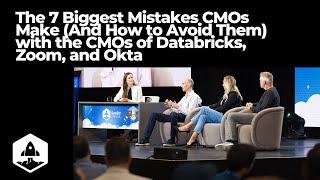
Rick Schultz, Janine Pelosi, and Ryan Carlson from Databricks, Zoom, and Okta break down seven mistakes CMOs make: staying siloed instead of engaging the C-suite, weak hiring, wrong metrics, neglecting tech stack, delaying brand work, inconsistent messaging, and poor leadership during crises. They share how to fix each one.
Chapters
I'm so excited to be here today with these luminary CMOs. My name is Carrie Lou Dietrich. I'm a former CMO, most notably the head of marketing that took Atlassian public. Today I'm here with Rick Schultz, a former colleague of mine at Oracle and the current CMO of Databricks.
Thanks for having me.
Thank you. And Janine Pelosi, the former CMO of Zoom for more than 10 years, from early-stage startup to billion, multibillion-dollar company. Ryan Carlson, the former CMO of Okta, again, having started at a tiny company and ridden almost a decade to a massive company. Today we're gonna cover 7 big mistakes that CMOs make. So the first one we're gonna hit on is strategy. So Janine and I talked a lot about this one because many CMOs come up from a functional expertise, they learn how to do their job, but they might not be involved in the strategic discussions happening in the C-suite. Janine, this was a mistake you saw others make, but really leaned into yourself. Tell us a little bit more about that.
I, I think maybe from coming in early on, I came in to start the marketing function there. It was really about just driving revenue and surviving, right? I think you go through different stages and you need different things out of your leaders. Survival mode was that in the beginning. So it was always thinking about the company first and what had to happen, and then thinking about what hat you had to put on. And typically that was the marketing hat in my case, but sometimes it was the sales or thinking about finance or, other areas of the business and context to what you need to deliver in your function to be successful. And without that context, you lose out on that.
And you got pretty deep. You were one of 4 executives that were really active in the IPO. You were thinking about net new products. You were doing sales territory planning. You were not just in your lane of marketing MQLs. Like, what led you to have that kind of hunger and tenacity?
Yeah, it was context. And I believe Eric is a phenomenal founder, CEO. It was about the best ideas and it was a culture of, I would say, really a level playing field. It was best ideas won and it didn't matter. So when we thought about driving quarter over quarter, what was required, we put more pressure on ourselves than anybody ever could have. It was profitable or bust before anybody was talking about that. Triple digit, same thing, right? Growth mattered. And it was all of us getting into a room coming up with that plan. And I think that creates ownership over those plans, right? If you're given an objective that you don't have the context for, you're unlikely to meet or succeed. So you'll hear me talk about context, but I believe the why in that context is really critical for the whole company to be marching in one direction.
And another thing that comes up a lot when CMOs are potentially looking— going to be replaced by their CEO, aren't working out, like 6 years, 10 years, and 8 years up here, is that they haven't built the right leadership team. So when we were talking about what are some of the biggest mistakes we've made in our careers, Rick, you really brought up building the executive team around you was one of the biggest mistakes you'd seen and things you'd leaned into.
I would say almost nothing you'll do will be more important than building the right team. And so we put a lot of thought into the team we built, and we had some— we've had— been fortunate to have some pretty hypergrowth years where we've hired 175 marketers on from almost a very tiny team, uh, in the last 6 years. And there were some years where we had to hire like 40 to 50 people on a base of 20 or 25. And when you're hiring those kind of numbers, but you also have a really high bar— we have a very thorough process. Keep the bar high is like one of our company cultural principles, and we have certain standards. And I'd say the 2 mistakes you can easily fall into— number 1 is not investing enough time. And I always talk to my leaders about this because when you're trying to hire the best of the best, like really high bar, but you also need to do it really fast, those two things tug at opposite ends of the spectrum.
They—
and so the only way you can do it is just invest enormous, inordinate amount of time. So I always say, okay, think about how many hours this search is going to take by the time research, talk to candidates, do your outreach, talk to some deep candidates many times, do your backchannel, reference checks, all of that added up, maybe it's gonna be like a 200-hour search. You're just deciding how many weeks you spread it over based on how many hours you spend every week on hiring. And when you're in that phase of you gotta hire but you really wanna keep the bar high, nothing replaces how much time you're gonna invest. In other words, if it's gonna take 200 hours and you spend, you need to spend 20 hours a week to get it done that quarter, if you spend 10 hours a week, it's gonna take you 2 quarters, and a quarter is an eternity in a startup. That's one thing. The second mistake, which I've fallen into myself sometimes, is you start to get get in that conversation where you compromise a principle you have. In our case, that principle is we look for long-term company builders. We look for other people who've been 5, 6, 7, 8 years and been promoted and built other companies. And longevity matters a lot. And then every now and then have a leader and kind of we get involved in this discussion and we get, we convince each other that like it's okay to actually hire someone who's moved around a lot more, which again, that might be fine for some, but for us that was not part of our hiring principles. And so we bend the principle and 99% of the time you regret it. You should have stuck to your original principles.
Yeah, hiring is hard, and firing boldly to get the right team in place is probably the hardest thing leaders have to do. The third biggest mistake that we talked about was setting the right metrics. So you've got the strategy, you got the team in place, what are the right goals and metrics? And Ryan, you really had some opinions here where you made a wrong choice on a short-term metric and led the team in the wrong direction, but then recovered it. So tell us more about that.
First, I can't help but comment on what Rick and Janine both talked about, because I think they're connected. And I think Janine's point is worth repeating, that marketing shouldn't be something you do at the end. Everybody thinks about marketing as I'm launching this product, or I'm launching this company, I'm trying to get buzz, I'm trying to get recognition, I'm trying to get awareness, I'm trying to generate pipeline. Yes, marketing has to do those things, but I think if marketing is going to do its job well, it has to be involved in the company creation, the story for why does this company exist. What do we value? Rick, you were talking about your values. That's as much marketing as anything else. And so I see a lot of founders who look to hire somebody to come in and be bolted on. But if you're looking at building a team, don't overlook people who are inside your company who have been there from the very beginning. One thing that we all have in common is we were very early at these companies. And so when we told the company's story and connected it back to the values and why does this company matter, we did so with credibility. Because we were there from the beginning, and that was as much our story as anybody else's. So I think those two things are related. I know a lot of founders are thinking about hiring marketers, and if you do interview them, ask them about metrics, because the mistake that I made— I thought I was being a really great leader. I thought I was being so smart, so strategic. I was gonna tell everybody that pipeline mattered, and I was gonna do that in a couple of ways. Every meeting we had, whether it was my staff meeting or extended leadership meeting or the marketing all hands, it started with the same agenda item number one. How are we doing with pipeline generation in the quarter? I wanted people to know that it was important, so we put it first. But I also wanted everybody to know that pipeline was their responsibility, not just the demand gen teams. But what I didn't realize what I was doing when I put that number big in lights and made it so important was that people would focus on that to the expense of all other things. And we were organizing a dinner between our CEO and CEOs of Fortune 500 companies. That's a high-stress activity to get a dinner like that set up. And the person who was organizing it, She said, "Ryan, I don't think we should do this dinner." I said, "Why?" She's like, "I'm not going to show any stage 2 pipeline created from this activity." And that's when I wasn't happy with that conversation, but I was more unhappy with myself because I put us in that situation. So then we came up with a balanced scorecard which looked at, yes, the number one thing is pipeline generation, but there are many other things around that we should also measure.
And I think we're going to come back to this because one of the things I think I've named it number 6, but I should have named it number 4 now that we've had the conversation this way. But one of the things I see at earlier stage startups is that the marketers don't put in place their attribution tracking and they really don't have the tech stack and they can't see into the right data. So they not only don't have a balanced scorecard with the right awareness, lead pipeline, cost per opportunity metrics that are so important to track, they can't track them and see through to them. So I think bringing number 6 forward, both having the right goals and then the right tech stack and marketing operations team is really critical. So moving along, back on track to the numbers. The next one is number 4, not investing early enough in brand. And so, Rick, you've said less so now at Databricks, but at Alteryx before, you were really focused on demand gen and hadn't invested as much early in brand. And that turned out to be something you really changed when you came to Databricks.
Yeah, I think it's a little similar to what Ryan's point about Particularly in the early days, you can easily become so pipeline-focused because it's like air. You need the pipeline, of course. And it's like everything. It's like air, water, shelter. Everything is pipeline. But I do think, kind of looking back, it was a mistake in prior company not to be more intentional and thoughtful about the brand earlier on in the life cycle of the growth of the company. And by the way, brand awareness doesn't mean you need to like right away go spend a lot of money on like a bunch of billboards or anything like that. It's a natural evolution, but your brand is really your reputation, right? So it's like you should be thoughtful and intentional about what does your brand mean, what does it stand for? And then as you keep growing, like really codifying that, making sure your visual identity, the language you use, the way you show up, show up at events, all of that stuff reflects the brand and the rep creates a reputation. That's the reputation you want in the market. And yeah, I think we invested earlier at Databricks in doing those kinds of things actually. In fact, we have some of the same people who worked with Ryan at Okta, cuz I always thought they did a great job at Okta with that. And did a great job building their brand. And then once you have it codified, even when you have customers telling the story for you and stuff, you can have them tell the story the way you want them to tell. Like if you're trying to emphasize innovation, they can talk about what they're doing that's super innovative or whatever the thing is. But you gotta do that early.
And that leads right into the next mistake that we were talking about, which was having a strong, consistent messaging. And again, I said before, Rick and I met when we were at Oracle. I was running awareness advertising. I wrote ads for the front page of the Wall Street Journal. Larry Ellison had to approve every ad. And sometimes we would complain that it was so boring, 'cause A, it was the same ad format with that red bar, and two, we would keep the same message for what I thought was an inordinate amount of time. But it turned out that in all the research, we had the best awareness and association of the brand to other things, and not flip-flopping really made a huge difference. And Ryan, you had talked about that. I think that just this consistent messaging is a problem you've seen so many CMOs fall into, or inconsistent messaging, and one that you had focused on.
Yeah, I think it's understandable. There's a lot of pressure on marketing to come up with ideas. It's, it's the creative field. What's this new idea? And if you're consistent with your messaging, it doesn't look new, but it is important for your messaging. If it's what I said up front, connected back to why the company matters and what you stand for and what is your purpose, that consistent messaging can be really impactful long-term. And you have to resist the temptation to change just for change's sake. And while we're on this topic, I can't help but give Janine some praise because she came in early to one of my marketing all-hands and did a guest talk at Okta. And we brought her in part because we thought, you know, everybody's familiar with Zoom's out-of-home advertising strategy in the early days. And we didn't know how you could do that because investing in brand is hard because what's the phrase? I know half of my advertising dollars work, I just don't know which half. It's hard as a new CMO or a growth-focused company to justify spending money in that way. And you all did such a great job because you were clever in how you did your out-of-home advertising. You didn't use a big branding firm or an agency. You came up with a lot of those taglines that you'd see on the billboard yourselves. Isn't that right?
Yeah, we did it all in-house. And that's where, you know, it doesn't have to be super sexy, but it also doesn't have to be incredibly boring. And I think it goes back to the metrics. We couldn't find any metrics, any vendor, anything traditionally out there for the type of advertising that we were doing. We were the cold emails that would come to to us at the time for the sides of buses in San Francisco and the rest of it. Like nobody was using those. And, and so we created our own basically proprietary way of measuring this. It was, you know, where are the visits coming from? What's happening in these different territories and regions? And that was our own way of measuring. And so we could see and we knew which half, but we said the same thing, right? All over the place. And it worked.
It sticks.
By the way, can I just, can I just riff on something Ryan said? For the messaging thing, I think it's so important to have the consistency through all the channels at the same time, but also the, what you're talking about consistency is more like what I call stamina, which is like stick with it. Cause I think it's easy to underestimate how long it takes to hammer a message into the market. It takes many quarters, sometimes years. And so it, you do really have to resist that temptation. I find to, I guess what you called whiplash to change it too frequently. And we all fall into that trap sometimes. So for me, it's a little bit like the hiring thing where You might have the right principle, but then every now and then you compromise it and you just regret it. So it's, I think for me, the common thread there is like, stick to your principles, don't compromise them.
I've heard that just as you're starting to get bored, your customers are just starting to hear your message. So we live inside the echo chamber, but our customers do not live in that echo chamber with us.
Yep.
We're going to keep moving along. So I think the 7th mistake that we had highlighted, which I think is ever more present now, is not being your best self. Best self in tough times and how the tougher the times are, the more it takes from you as a leader to be your best self and not be impatient and rude and irritable and stay level-minded. And, and Jeanine, you just had such a lovely quote about how you guys thought about leadership in tough times.
Yeah, Zoom had a pretty historic ride through IPO and contributed a lot to society over the past few years. And with that came a lot of challenges, a lot of growth. We went from I think it was right around 2,400 employees to over 8,000 in about 18 months. There was some unprecedented scale and growth that we went through, good and bad, and all the trying things that you mentioned. But what it came down to, and I was given this advice, is— and the advice was in the context of a lot of people getting it wrong— growth hides problems. Flat out, right? The time to be tough on your team is when you are doing well. Right? The time to be empathetic is when the company is having a really tough time. And so often that is flip-flopped. And so the only way to get around that is, is think about what, what could growth be hiding? And that gives you air cover, right? And if you're private, all the better, right? It gets a lot harder doing that in the public markets, right? So finding that balance is pretty critical.
Yeah, it's tough times for all of us in different markets in different ways. Okay, so one of the things that founders want to know is how do they find the you, right? The average tenure of a CMO is a couple years. People change messaging because they change CMOs like spring outfits. So tell us a little bit about how you ended up at your company, because Ryan, you joined when it was $10 million in revenue.
No, no, not so. Actually, the funny story, I met Okta when there were 9 people, and I had spent my entire career before that in product management, product marketing, and I tried to get them to hire me to be their first head of product, and I went through 4 or 5 rounds of interviews and didn't get the job. But I became convinced that what Todd and Freddie were building was going to be not just a successful company, but one you'd be proud to be part of. So I stayed on them for 9 months, and then when they eventually wanted to build out product marketing, they gave me a shot at that. And I still almost didn't get hired, but I convinced them to take a shot on me, and I built out product marketing for the first couple of years. And we, in the early days, we didn't find the right CMO, and a lot of— for a lot of the reasons I was talking about, And so my big piece of advice when I talk to a lot of founders is you certainly want to look for the person who's been there and done it and managed a team that you're aspiring to be like and you're going to grow into. But don't overlook the person that's there that has drive, ambition, has a chip on their shoulder. One of the challenges with getting somebody who's been there and done it is do they have that drive to do it again? And for me, I lived and breathed Okta. I told that story better than anybody. And it was still not easy for me to get the CMO job, but I'm lucky they took a chance on me. Yeah, don't overlook somebody who lives and breathes your company because that's super important.
Okay. Hunger and knowledge. And Janine, I was stalking you before I got to meet you and I listened to a bunch of your podcasts. And one of the things I had learned about you was that you worked with the CEO before and you worked in the same kind of category before. So you came in so primed to really help him flourish. Tell a little bit about that story.
I'd say, and the reason being is because part of why Eric ran the company the way that he has is because of his prior experience where there was not a line or there was a brick wall almost between go-to-market and what was happening on the engineering and product side. And it was not something he wanted to replicate. And so while we had some shared experiences, we hadn't worked super close together, but we definitely, I think, had that drive, that kind of builder mentality. We operate with this immense sense of urgency, which, which is fun. The advice I give when asked this question is find a company that you admire and then hire the person one level below. Somebody who has something to prove, who is probably doing a ton of the work, and think about where you are as a company. You don't need to go and be very careful about when and who you hire and the skillset that you need at that time versus thinking about what it is that you need this person to grow into. If you find someone who's self-motivated, continues to develop themselves, and is open to that, then they can grow with the company. And if not, then maybe it's time to part ways and find someone else. But don't overlook what you need in the short term, because as many of you know, if you can't get past that short term, there is no long term.
I'd just like to thank these fantastic CMOs for joining us today.
Thank you.
And thank you to Jason M. Lemkin and Caitlin and all the SaaStr folks for making this all possible. So thanks and have a great conference.
More from Jason

Why Your Next Hire Should Report to an AI, Tragedy Apps, and Too Many AI SDRs? | The Agents #004

Our Agents Drove Our Salesforce Bill Up 80%, Marketo Hates Agents, and We Stealth-Churned Off Notion




Managing 20+ AI Agents: Lazy Agents, Our $500K AI Bill, Stealth Churn & the Death of 60% Solutions




