The Case For Staying Remote After All This with TaxJar
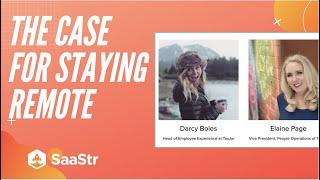
TaxJar's leaders explain how their fully remote company keeps attrition under 3% through dedicated onboarding, weekly all-hands meetings, and intentional rituals like skill-shares and bi-annual in-person gatherings. They argue remote work unlocks creativity and cost savings, and that nothing a co-located company does can't be replicated remotely with intentionality.
Chapters
Hi guys, welcome to SaaStr virtual. I'm super excited to be here. My name is Darcy Bowles. I'm Director of Culture and Innovation at TaxJar. I am coming to you in quarantine from my kitchen in Southern California.
And hey everyone, I'm Elaine Page. I'm TaxJar's VP of People Experience, and I'm coming to you from my home office just outside New York City. And together today, Darcy and I are going to share a few insights on how we make remote life work so effectively, so much so that maybe we might even persuade you to remain remote after this tough situation ends for all of us. So let's go ahead and get started. I think it's true to say that for so long here at TaxJar, we existed as an outlier in remote work. And who could have predicted that suddenly we'd all be thrust into this global working scenario pretty much overnight? And as a company that has enjoyed considerable growth over the last 7 years, all of which has been being a fully distributed company, we seem to have become a resource to folks like you who want to know, how do you make it work so well? What's the recipe? And is there one thing that makes all the difference? Well, we believe that actually being remote has unleashed folks to be as creative as they can be, to innovate complex solutions to simplify customer problems. And by helping support our folks to work when and how they want to, we're able to provide our customers with a motivated, highly engaged workforce that can service their needs. And if you aren't familiar with what TaxJar does, let me just give you a little background. We've become exceptional at understanding the digital goods landscape, taxation landscape. We know when and where to collect and how to provide the most accurate sales tax calculations possible. We realized that customer need— customers needed a partner who understood their billing complexities. Could grow with them, and really appreciate the value of a stellar interface, a modern API, and exceptional customer service. And as one of our customers says, Basecamp, they've said it best. We rely on TaxJar for its dependability, scalability, integrity, and speed. That makes us really proud. With our latest artificial intelligence capabilities, Basecamp, as one of our customers, can rest assured that we are offering their customers the most reliable sales tax automation solution on the market today. So where is all this great work happening? Well, it's happening everywhere. Here's a map of where our teams live and work all across our country, as far out even as Hawaii. All remote or nothing. No hybrids, no co-located spaces. We do not pay rent anywhere. And that means that we can provide incredible value to great companies such as these, because we make remote no barrier to our success. So here we are already. The future of work is remote. I guess we knew that all along, but now we're all finding it out together. So it's here and it's now. So Darcy's going to share with you some of the ways that we are intentional in creating space and support for our people to do their best work. Darcy?
Yeah, thanks, Elaine. So let's talk about how TaxJar actually works as a remote workforce. We surround talented people with other great people that they really want to work with, you mix in a challenging problem, and amazing things will happen. Simple recipe, amazing results. Give the team everything they need to do their best work and build a solution to a really complex problem. And remote plays perfectly into this philosophy. You work whenever and wherever it produces your best work. Here you can actually see one of our sales gentlemen closing deals on a road trip and his wife who works on our AutoFile team, helping amazing customers in the middle of the woods. How incredible.
Yeah, and that's right. In fact, our CEO, Mark, says it all the time. We just really don't care where you work from. If you work all night or take a 2-hour break to go to the gym, or you need to take time to take care of your kids, that just doesn't matter to us. What matters is that we get the end result. And so as we think about As we were thinking about what we wanted to share with you today and some of the ways that we give this kind of trust to our team, there were 5 key elements that emerged. And so Darcy, you want to share the first few?
Yeah, absolutely. Thanks, Elaine. So above all else, trust your team. Remote work doesn't work unless you trust one another. Let go of old management practices and the need to account for people's time. Stop micromanaging and set your team up for success. If you do that, they will deliver. Just because you're remote, it doesn't mean that you need to increase the volume of email or phone calls. Actually, they should probably maybe be a little less. Think about how to condense all company communication. Is it a daily, weekly, or monthly update through a message, message board post? There are myriad of tools out there. Do some research and find what works for you, your team, and your product. One of our most important rituals at TaxJar is bringing the company together. For us, that's actually once a week on an all-hands company call. Yes, all 164 of us on Zoom. Our agenda includes demos of company products, give out— we give out kudos, updates from our CEO, showcases of our projects, and we have fun too. In Zoom, we actually use the raise your hand feature the chat feature, and we also make sure to record and post the meeting for those who might not be able to attend that day. Because we don't pay rent anywhere, and we never will, we don't look at that as stashing away that money in the bank. Instead, we reinvest heavily in our team and the products that help make our team successful for our customers. And we use Basecamp to communicate and live by the saying, "If it doesn't happen in Basecamp, it didn't happen." I should be able to look at any project my team is working on and know exactly where they left off and all of the details.
Yeah, and Darcy, if I'll just jump in and say, it is true, we communicate heavily and often and on a regular cycle, but right now with everything that we're all going through, we've definitely bumped up communication 3x from what we normally do. It's really important that we're talking to our team often and regularly, talking about the health of the business, We've really made that a priority right now.
Thanks, Elaine. We're also incredibly intentional about onboarding. The first week a new teammate is with us, we have a dedicated onboarding week to ensure the teammate is fully, fully immersed in who we are and how we do things at TaxJar. The attention to onboarding amongst a mutual assessment period has served us so well over the 7 years we've been in business. Including holding us at a less than 3% attrition rate. We also make sure to inform the company of internal and external changes in real time, all the time.
You're right, Doris. And actually, just a couple more things I would add into the mix, sort of more ingredients that make us successful and drive engagement, is this idea of connection. We think about connecting with one another often, We're never far apart in terms of ways in which we keep those connections going. We don't waste time that way. We're always thinking about it week after week. And in fact, we're not afraid to be silly. We're not afraid to showcase our talents. We look for all kinds of ways to show ourselves and to be ourselves. We have fun, like I said, and we don't take things too seriously. In fact, here's one of our amazing teammates, improvising Freddie Mercury, doing karaoke on a company call. This, believe it or not, does create a bond, helps us root each other on to be themselves, and signals we don't need to be next to each other in an office to have fun and bond together. What's even more cool, I think, is we don't let remote steal away traditions that you would normally think could only happen in person. We simply ask ourselves, well, how can this be done remotely? And we figure it out. Like a tradition of a cookie exchange during the holidays. Team members bake their favorite cookies. They chose a recipient, just like you would with a Secret Santa, and voilà, a new tradition is born. Another cool thing that we do that we think's really important for this sense of connection is this idea of a skill share. We value that our team members are people outside of work too, not just inside. So we invite folks to share their hobbies, their interests, and actually teach us a thing or two through a mechanism we call Skillshare. We have learned to raise bees, make honey, knit, write poetry, you name it, we have learned a lot.
So last but not least, Be ready to never want to go back. I know it's a strange time, but especially for SaaS companies, we're really able to leverage technology and working remote and blend this beautiful work-life integration. We've built a double-digit company remotely, solving a complex and difficult problem. While we're all grappling with this right now, we feel like we're in a great position to come out of this and thrive, as are many other SaaS companies. Why not look at your business and say, why not remote? Before COVID hit, we created a docuseries of 10 different employees' stories on the deeply human benefits of remote life and working remotely. Head over to our jobs page, taxjar.com/jobs, to check them out and see the value that remote life brings to individuals and finding deep meaning at work. And in case you think we might be all about our leisure time, We're not, and here are a few quotes from our employees before and after COVID that reinforce the deep importance of why we are remote and how successful it's made our company. I'm home to take care of my sick mother. I get to spend all day with my special needs dog. I'm finally living my dream, living in an Airstream. We have 3 people living in Airstreams. I'm helping entrepreneurs to thrive. I solve complex problems every day. I never miss a baseball game. I'm learning to swim for the first time because I live at the beach now. I get to watch my kids grow up. How many people can say that when they're commuting every day? I'm virtually surrounded by intelligent people who challenge me. And the chains are removed. So we ask you, do you think you'll stay remote after all of this? Thank you guys. And we'd love— we've got about, um, looks like about 8 minutes left. So if Amelia wants to hop on, we'd love to be able to answer any questions that you all might have.
Yeah, of course. Thank you so much for that, ladies. Super helpful. We, um, obviously Team Sasser here has also been adjusting to working from home. So like, I have a question. We have, we have some from the audience, but I want to ask you guys one to get your opinion because you've been working from home a lot longer than Sasser has. You know, we've, we've started doing like daily standups. We do like every Friday, we do like a cool like Zoom team lunch just for fun. Like, what are some other things and like processes you found early on when you're like, like you might have been working from home? Like, what do you recommend for people like us who've been like transitioning, who are used to going to a physical office? Like, what are the things we need to remember to do now that we're like that we want to captivate on your work-from-home knowledge? What could we do?
Yeah, so I would say one of the things is make sure that you set yourself a schedule, just like you would— you had a little bit more, I suppose, structure. You were commuting, going into an office. Things were set in a certain way. That stays true working remote. You need to make sure that you'll take a break when you need to. You need to make sure that you step away from your desk. Make sure that your routine's intact. It sounds really simple, but get up at the same time, right? Go to work in a similar time frame as you normally would. And I'd say sort of cut yourself a break. This is not about being perfect at it, but it's just challenging yourself to put yourself in a workspace, make sure you can have time to answer the emails, to do what you need to do, but have the headspace for deep work too. And those boundaries, I think, really create a routine that makes remote a little easier, I think.
Yeah, I love that. Another really good question that, you know, we're trying to navigate too that came in from one of the viewers: How do you handle the hiring process when you're remote? You know, a lot of us are used to like meeting the person face-to-face and that sort of helps us in our decision-making. How do you transition that to remote?
Yeah, absolutely. So we are incredibly intentional about our hiring process, right? Being remote, we have the this candidate pool that is not— you're not married to one specific location, so we can actually hire the best talent. So one of the big piece of advice I'd really give is take your time because there's a lot of people who want to work remotely, especially right now. And you'll definitely see this more coming out of this, but being incredibly intentional, you really have just such an incredible candidate pool. And so something we do also is we really distill every single step of the process on our website. We encourage people to download Zoom, to experiment with Basecamp before they actually come in for an interview. And we also ask every candidate to be on video with us so we can kind of assess, we can have the eye contact, we can really get into those deep conversations and still have the body language cues, at least with hands and face in those calls. So those are just a few tips amongst many.
[Speaker:KATIE] Yep, we definitely use, we like panel interviews quite a lot. So we have a lot of team members involved. We've just recently been doing some interviews where two of us together have been meeting the candidates so we can kind of live compare notes, and sort of one of us is listening while one of us is asking the questions. That seems to sort of enhance the experience as well. And so, again, I would just say I don't think it feels that much different. When you say meeting a person in person, I feel like I'm meeting you in person right now. You're getting a sense of me on this video, and I think it's just the same when you do it when you're hiring remotely as well.
Yeah, I love that. I think the idea of doing a panel interview on a Zoom for being remote is like super helpful. Um, another question related is, how do you handle it when people are remote in different time zones?
Yeah, absolutely. So, um, for us, we tend to only kind of work with, uh, the time zones in the US, so there is that overlap. So obviously this comes down to You know, are you an asynchronous culture or a synchronous culture? But we really find that we set that expectation up front. So for example, I'm on the West Coast and Elaine's on the East Coast and I work heavily with her. So a lot of our meetings together actually are on that 3-hour morning crossover. So you tend to find the time to have those cross-hour couple hours with different time zones that are really, really helpful. And then again, as I mentioned in the presentation, we always make sure to record record all of our really important meetings or meetings that people might not be able to attend and post them afterwards with notes or not to make sure that people are always engaged in keeping up on what's going on.
I have— there's a question that came in on the flip side of hiring. This can be awkward when you're remote. How do you handle offboarding and terminations?
Yeah, so, you know, fortunately, we don't have to do too many of those. But to be honest with you, I think the same principles apply if we have to you know, have a discussion with somebody. First, we're going to have it live on video. We're going to have it with, you know, whoever is the leader of that person alongside somebody from our people team. We are going to, you know, express in the same way as we normally would our rationale and our reasons. We make sure that we've got different ways to keep in contact with people, so we're very intentional about making sure they know how to follow up with us. They know who to contact when they're leaving the company. I don't mean to make it sound simple, but again, we just behave the way we would have behaved had we been in an office sitting side by side. Empathy, compassion, directness, being specific. And in the times I've had to participate, hopefully those processes have gone just as smoothly and have gone as well as they can under the circumstances. And if somebody's leaving voluntarily too, we follow really similar procedures. They get to say goodbye as they normally would. They write their note and sort of give us all their contact information. It's just a case of, I think, putting your head in the space of why would you do anything different than you would do if you were in the office? I think maybe what remote does is actually make sure that you're just very intentional and very clear, and you know what you're going to say, you're not winging it, That seems to be able to smooth any, any waters that, that could be a little rocky.
Yeah. Okay. That's super helpful. We have time for, I think, one more question. It's sort of like a two-parter. We have a few people who are planning to go fully remote after, you know, the COVID crisis is resolved. So this has been super helpful for them. They want to know, do you guys still have any in-person meetings at all? And if you do, like, how often do you do them and what do you use them for? Since obviously you're not doing them as often when you're fully remote.
Yeah, so I know we both want to answer that one because one of our most favorite things that we do do, we definitely get the company together twice a year in a really special event called JAR Fest, affectionately known. But what's really intentional about that event is it's not just a chance to sit people in a room and talk at them with presentations. We actually spend time doing work together in small groups as if we were doing work together in an office. And we spend a lot of time with activities that get to know one another more and we bond together and we are sort of a balance of the business and the personal. But Darcy's really the architect of it. She, it's her great mastermind. So I'll let her sort of share her perspective on it. But it's certainly the two times we get a year are super valuable to us.
Yeah, absolutely. And to piggyback off of what Elaine said, there's just this magic that happens happens when you bring people in a room and perhaps you've hired 30 new people in the span of 6 months that you haven't had a Jar Fest or a meetup. And that moment of people getting together, whether they're on the same team or a different team, I have chills talking about it. There's so much diversity of thought, of location. We don't have a ton of travelers in our group, believe it or not, working remotely. So you combine all of this magic and you surround yourself around food, you surround yourself about the things that bring us together as human beings. And then with that, we plan for the next 6 months, but we're doing it together. And it's just, you almost, you almost see everybody just light up and go, oh my gosh, it's so real. This is so real. And it's just incredibly magical. And definitely think for remote teams that in-person connection is really important, but it doesn't need to happen nearly as often as people going into an office every day. And we found that to be very true.
Yeah, it's just enough. We don't need to do other meetings in between JAR Fest. That's the, that's the beauty of it. We stay remote. We are remote and we use JAR Fest as sort of the anchor points for the year. Yeah.
I love that.
Okay. Last final, final advice to our audience before we have to break. You ladies have been amazing. What is maybe one each, like one quick tidbit that you wish you had known sooner when like operating a fully remote company?
Honestly, it's easy for me. I just realized that there's literally nothing I knew how to do in a co-located company that can't be done here. So I just wish I'd known it sooner.
Man, that's a hard one. I think I'd actually share Elaine's sentiment. What I wish I knew before this? Not much. I think, I think I wish other people knew that this could be possible. You see the cartoons going around, "Oh, that meeting really could have been an email." Yes. It can, right? And so we're proof of that. And that for me, I think is my greatest hope for the silver lining of all of this is people getting back their time, getting back their lives, and also being able to have the headspace without all the other extra stuff that we really don't have to deal with to create an amazing business, an amazing product, but also be able to live a truly meaningful and purposeful life.
Yeah, it's all about finding that balance and adapting as we all go remote.
Yep, exactly.
I love it.
Thank you so much, ladies, for joining us. That was an incredible 23 minutes. Unfortunately, we can't do more Q&A, You do have some questions here that I will send over to Darcy and Elaine following this event. You guys will also get the recordings, no worries. Up next on track 2, we're going to kick it with PandaDoc. So we'll see you guys there in just a few minutes. Thanks again to the TaxJar team.
You're welcome. Thank you so much.
More from Jason

Why Your Next Hire Should Report to an AI, Tragedy Apps, and Too Many AI SDRs? | The Agents #004

Our Agents Drove Our Salesforce Bill Up 80%, Marketo Hates Agents, and We Stealth-Churned Off Notion




Managing 20+ AI Agents: Lazy Agents, Our $500K AI Bill, Stealth Churn & the Death of 60% Solutions




