The Funnel is Dead. Long Live the Flywheel. With Hubspot CEO Brian Halligan
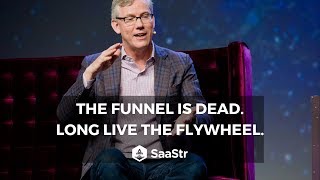
HubSpot CEO Brian Halligan explains how the company moved from the traditional sales funnel to a customer-centric flywheel, where trust now lives with customers instead of marketers. He breaks down how HubSpot segments its market and tailors go-to-market strategy, including a freemium CRM and product-led growth, to match what different buyers expect.
Chapters
Hi, I'm Brian Halligan, co-founder of HubSpot. Now, we started the company 3 years ago, and it's gone exceptionally well. We're very pleased with the progress. We have 90 employees, we have 1,500 customers. If you're interested in HubSpot and you're interested in inbound marketing, I would encourage you as a next step to check out the free trial on our site and see if it works for you. Whether we all like it or not, trust in sales and marketing is at an all-time low. Who do they trust? They trust your customers. That's the only people they trust these days. How did our best customers find us in the first place? I have been thinking a lot, a lot about how do you grow your business in 2019, in 2020. I've come up with a whole a whole new model for describing how you grow.
Please welcome HubSpot CEO Brian Halligan and NEA Venture Partner Hillary Koplow McAdams. So that was an amazing walk down memory lane.
That was amazing. I didn't know that was going to happen.
Yeah, I hope we do a little bit more of that during this conversation. So let me introduce myself. For those of you who don't know me, I'm a partner with NEA, but I spent the last 30 years as an operating leader in enterprise tech, most recently president at New Relic. And before that, I ran the distribution network at Salesforce. And that's where we met 11 years ago. So it's been a long time. Brian, if you don't know who Brian is, conceived of HubSpot in 2005. The original concept for the company was an inbound marketing platform. And you've gone a long way. $500 million, $6 billion market cap, and probably most importantly, 52,000 happy, delighted, intrigued customers. People talk about that a lot, actually. So, you know, I think it's always interesting for people to hear the founder story. Can you share how you and Dharmesh thought about starting the company?
Sure. We started the company back in 2006, so we're SaaS, SaaS-like grandparents these days. There were two ahas that led to HubSpot, actually. I had an aha and Dharmesh had an aha. We were both in business school and my aha was I was spending some time at a local venture capital firm helping the founders think about, you know, how do we grow these companies? And so, you know, what's the plan? How are you going to grow the company? Well, we're going to buy lists and send a lot of emails. We're going to hire telesales reps. We're going to cold call. We're going to do the big trade show, hire the PR firm, yada, yada, yada. But the more I watched it, The more I became frustrated with the playbook, it just didn't seem to work anymore. People were sick and tired of being marketed to. They're good at blocking the email out with spam protection, and they've got caller ID, and they've got ad blocker software. It's just nearly impossible to reach humans with that traditional playbook. And so I thought marketing was broken. Dharmesh's aha was very different. Uh, he had blogged his way through business school, and I was watching his blog, and he had no people and no money. It was just him writing between classes. And I was on Alexa. You guys probably remember the old Alexa before the current Alexa was you could track traffic and he had 100 times more traffic in his crap little blog than any of my wealthy venture-backed startups. And so I was like, what's happening here? And we started to describe the world as there's two sides of it. There's, there's a whole new way people are shopping and buying and the way to reach them was what we started calling inbound marketing. How do you pull people in through SEO? How do you pull them through the blogosphere? How do you pull them through social versus outbound marketing? How do you, instead of interrupting them with cold calls and emails and ads and stuff like that, how do you turn it on its head and go from outbound to inbound? And that's sort of the kernel of the inbound philosophy. And then the next step was try to implement it. We had a hell of a time implementing because you had to put in a content management system, put in a blog, hire an SEO guru, hire social media, blah blah blah, and build a CRM. It gets super complicated. So HubSpot became a software platform that companies would use to transform the way they market from outbound to inbound. That's sort of the initial genesis of it.
And when you thought about it, what I thought was so interesting was very early on you studied the marketing process and you declared, you know, the death of the funnel, death of the traditional funnel. You came up with this concept of a flywheel. Can you talk about that a little bit more?
Yeah. If the original vision was, was around inbound versus outbound, the current vision is funnel versus flywheel. And I've been in sales and marketing positions my entire career, and I consider myself a funnelologist. I kind of grew up with the funnel. And the more I studied the funnel, the more I think it's broken. It just doesn't work as a metaphor anymore to describe how people really buy and describe how modern organizations really scale. And there's a couple of things in particular I think are broken about the funnel. But it's sort of rooted in modern society. So I think one of the problems in modern society is nobody trusts anybody anymore. No one trusts the government. No one trusts religion. No one trusts media. No one trusts social media. You know who else they don't trust? Marketers and sellers. Their trust is at an all-time low. So who do they trust? Well, they trust their friends and colleagues. And so when I go and I talk to customers, I'll ask them, "Why did you buy?" It used to be, "We loved your blog, we read your book, you know, we heard you speak at a conference." And nowadays it's, "No, no, no, no, I bought it, we used it in my last company, I liked it, or my friend used it, or my colleague used it." And so this idea that you get this funnel that starts in the top and visitors and leads and MQLs and comes out and pops a customer out the bottom feels antiquated. It's more like a flywheel where Really, the customers are your best channel to market. It's not marketing is your best channel to market. It's not sales. Your customers are the loudest voice in your potential customers' ears. So we use at HubSpot, we sort of ban the funnel and we've embraced the flywheel as the metaphor by which we think about the business. Now, tracking word of mouth is a bear. Like we're having a conversation now. It's very hard to track that I recommended a product to you. Maybe I recommended that mug. Very hard to track that. There's no URL involved, is there? But you just have to know in your heart of hearts and talk to your customers and talk to your prospects, and you know it's true that word of mouth is the most powerful channel. And so I like this idea of a flywheel and leaning into the flywheel. That's how we designed our business, and it's kind of transformed the way we run our business, how we think about our business. And, uh, I think it's time to retire the old funnel and embrace a new way to grow.
So I think we— I want to come back to that, not being able to measure word of mouth because you're a very analytical CEO. You think about the analytics behind the business. We've talked about it at length. But before we go there, I want to talk about the customer. People talk about B2B marketing, talk— people talk about B2C marketing. Increasingly, organizations talk about B2D marketing to developers. But you've always coined this phrase business to human. Of marketing, B2H. And yesterday, you know, I guess people at Sauer were talking about acquiring logos and there were some tweets about what's a logo? It's really a customer. But, you know, my perspective is a logo is probably a term one uses to describe market share acquisition. But it— but at the essence of any acquired customer, there is a human. So can you share your perspective on that? Because I think it's very important to how you design the first experiences using the HubSpot product.
Yes. Okay. I want to tell you a little story about my— not my morning routine this morning, but usually my morning routine. I wake up every morning in Boston on my Casper mattress. I love my Casper mattress. I turn over and I go on the thing and I put on my Warby Parker glasses. Sorry, my, my Madonna mic keeps falling off. I'm wearing my Warby Parker glasses. Then I reach in my pocket No, I reach over on the nightstand and I grab my iPhone and I put on Spotify and I listen to the Grateful Dead. Yeah, I love the Grateful Dead. Clap if you like the Grateful Dead.
Woo!
And I dance into the bathroom and I shave with my Dollar Shave Club razor. And then I come out of the bathroom and I put on my Trump Club outfit. What do you think of my outfit? Trump Club.
Stitch Fix.
Nice. And then I hop in a Lyft and I go to work. Now, what's fascinating about those 6 companies to me is they're all startups like a lot of you. They're all less than 10 years old. They're all growing like an absolute weed. And I think it's just absolutely fascinating. The thing that fascinates me the most about them is they're all effectively selling the same exact product as their predecessor that they disrupted. The product's basically the same thing. It's the same music, it's the same cars, It's the same razor, it's the same mattress basically, but they've taken the friction out of it and they've really matched the way they go to market with the way modern humans actually want to buy stuff. Now, those examples are all B2C, but this is very much coming to B2B. Like the trains are— if you're in B2C, the train's left the station. If you haven't adopted one of these light-touch business models, you are screwed in my opinion. But in B2B, the train's at the station ready to leave. And so you need to match your go-to-market with the way people buy. Let me give you an example. I think inside of big companies, the way you used to sell is you call— hi, call CIO, you call CEO, you cold call in there and they answer the phone, you start the sales process there. Everything we buy, our CIO buys at HubSpot, starts with a little project at the edge of the organization. Some developers tinkering with something, a couple of salespeople, a couple marketers, and then it ends up on the CIO's desk is, boy, we're using this stuff. We got to buy it. It's been turned on its head. And so you need to market and sell to humans and enable those humans to put to work to you. I will do one more thing, Hillary. I had a great professor in business school, and she had this mantra she'd bang over her head. She'd say, Brian, if you want to build a big company someday, your product's got to be 10 times better than the competition.
True.
It's like written in my brain. And I think it's true, but I think it's dated today. You want to build a great company today, you've got to have a customer experience that's 10 times better than the competition. It turns out on the product side, it's harder and harder to create a moat, a competitive advantage. It's so easy relatively today to build new technologies and build new functionality. That's hard to create a head start that you can maintain. But a go-to-market advantage, business model advantage, that is much more sustainable. So yes, get product-market fit, but obsess, obsess over go-to-market fit and build a real moat. Think as much about your business model and go-to-market. That's the sustainable advantage. That's the big winners in the market today for people who really innovate on that side.
You know, I completely agree, and I think we should go deep on this whole idea of a holistic customer experience that starts with marketing and ends in the use of the product. But maybe you could break down for the audience, in your mind, what does marketing do? What does sales do? What does product do? Talk about the ownership, and then we'll keep going deeper because I think this, this is good stuff.
Okay, I'm glad you like it. Uh, I think the role of marketing and sales and product has completely changed just in the last couple years. It's turned upside down on its head. Marketing's job is to get users of your product, like get the darn users. Cranking on the product. Sales job is not to cold call. Sales job is really how do I map those users for using? How do I map that solution into the organization? Product's job, they have the heaviest lift in the go-to-market these days. Product should have a quota inside your company. Product is what really convinces people to buy in most of these go-to-market models that you're seeing today. Like you're on the— you were at New Relic. You're on the board of Zendesk, HubSpot. Most of these new SaaS companies that are really growing quite fast— Shopify— have these models that start at the edge and come in. And the marketing department really is getting those users. And that sales department is turning those users into solution sale customers. And product really is trying to sell. Now product's role has changed too. In the SaaS world, I think things have changed a lot for product organization. The way I think about our product organization at HubSpot is the front end of HubSpot, that people use every day, that should be consumer-grade. The backend should be enterprise-grade.
Love that.
And so product needs to kind of rethink their role. In a modern organization, you can't just build a crappy old UI and sell it to the CIO anymore. That just doesn't fly. You have to have a consumer-like frontend, but it's going to scale on the backend. It's going to have open APIs. It's got to be a really robust backend as well. And that's easier said than done.
So when you started the company, you had this website grader where I could go in— and I did— and type in my URL and get a grade. And then type in my competitor's URL and get a grade. And it was drop-dead simple. I typed in the URL, I got lots of feedback. Tell us about the design concept. That's really a great way for product and marketing to work together to engage a customer perspective in that case.
Yes. Okay, I remember I met Hillary. She was very nice. She gave me a meeting. She was running sales at salesforce.com back when we first started HubSpot. And we geeked out about this little product we had called Website Grader. She really liked it. We did too. We still have it. Www.websitegrader.com. And it's sweet. You put in your URL, you know, satcher.com, and you hit go, and it goes across your site and looks at all kinds of stuff. And it gives you a score on 1 to 100 on how good you are at inbound marketing. How many links into your site? Is your site set up well from an SEO perspective? How much social media mojo do you have? Is it mobile optimized? So forth and so on. And what was neat about that thing was, one of my board members used to say, you want to enable your potential customer to put in his as little information as possible and get out as much value as possible, which is the opposite of most enterprise sales. But all we asked for was the URL and gave them this treasure trove of information. That's kind of the way the sales process started for us a lot. That was the first inkling for the customer, like, ooh, I get some pain here, my tooth hurts. There's a little bit like, ooh, there's a little bit of an ooh. And then, okay, the call to action is subscribe to our blog or something like that. So they start reading their body. It's like, ooh, I get the— it hurts. There's a lot of pain there. I know I have a bad tooth. And then 2, 3 weeks later, they say, hi, I'd like to talk— I'd like to use HubSpot and talk to a sales rep. And the sales rep's got like the drill on the tooth, like, oh, you've got to fix that tooth. And it's the pain factory. You've got to ensure them the pain they've got and expose it to them and expose the value of solving that pain. And then the sales rep relieves that pain. So sales and marketing was sort of this idea of a modern-day pain factory. But that Website Grader was our first premium offer. Now, more recently, we moved from marketing into— we have Sales Hub and we have CRM product. We're going into CRM. And the elephant, the giant elephant in the middle of this room— I can barely see you out there— is this giant elephant called Salesforce.com. And I have a lot of respect for Salesforce.com. We thought, well, we're going to kind of cooperate and compete with them. They're investors of ours. We have a lot of respect for them. But when we go to market in the same market, we can't just build a me-too product. We need to build a lighter product, more consumer-grade in the front end, enterprise-grade in the back end. But we need to have an innovative go-to-market model. So we built our CRM. We said, let's make it free. Let's make it free forever. And let's get people started on that free product like Slack and Dropbox and everyone else and sell it that way. So we want to go to market with a lighter product and also a lighter go-to-market model. So that, that sort of bleeds through HubSpot. You've got to match the way you go to market with the way people actually want to buy stuff today. And that's sort of at the core of modern go-to-market models.
So now I want to talk about market segmentation, because when we both started, when I was at Salesforce in the early days and you were building HubSpot, we, you know, our customers kind of fit one size. And then we both became savvy to this idea of market segmentation. And you've really thought a lot about market segmentation techniques. So a democratized platform, anyone can access it. But their experience of working with HubSpot looks different. Describe that.
Yes, I remember having this conversation with you on the whiteboard at Salesforce.com 10 years ago. The way we— I can tell exactly how we do it at HubSpot. We have 3 segments at HubSpot: small, which is 2 to 20 employees, medium, 20 to 200 employees, and large, 200 to 2,000 employees. And the revenue is split about even across the 3. What's interesting about it is we've kind of— a couple of things, Jason M. Lemkin. We've tilted our go-to-market model more and more over time. So that small business segment, more and more of that business is done without ever talking to a sales rep. A lot of it is a touchless model, and that's scaling pretty well. Whereas on the enterprise side, the bigger accounts, they want to tangle with our legal department. They want us to have certain compliance things in place. They want some discount. They want a lot of special stuff. And so we said, we don't just want to go to a lighter go-to-market model. We said we wanted to lighten on the low end and actually make it heavier on the high end. And we just want to match the go-to-market motion with that buyer. So we actually added touches, we added resources, and we took it away down here. That's been serving us pretty well. Now, what's interesting about those segments, and this is what we talked about years ago, is the unit economics are very different. On all three. Unit economics on the bottom, it costs us— and these are rough numbers, don't tweet them. This isn't forward-looking statements if you're an investor in HubSpot. Blah, blah, blah. Approximately, on the team of 20 employees, it's about $1,000 to acquire a new customer. And it's about $5,000 in value we get over time from that. In that mid-market, the 20 to 200 employees, I'm going to guess again, it's just rough. It's probably— I'm guessing it's $4,000 to acquire a customer. I haven't looked at these numbers in a while. And $20,000 in total lifetime value. And then in the enterprise segment, it's probably closer to $50,000 to acquire the customer, $250,000 lifetime value. And so the CAC, the cost to acquire, goes up quite a bit with the heavier touch, but so does that lifetime value. And what we're kind of trying to solve for is as big a return on that as possible. We're not just trying to solve for total lifetime value. We're not just trying to solve for CAC. We're trying to solve for that return on investment. By having those numbers, our sales and marketing leaders are able to do asset allocation, like how many reps are we going to add in small business versus enterprise this year? Where's the return better? That's helped us quite a bit.
So 3 flywheels, one designed for each segment. Look at unit economics, look at outcomes. Who owns that?
Yeah, the tricky part is no one really owns that other than you, obviously. Unfortunately, other than me. But really, everyone's got a number on their head and everyone's got a quota. Recently, we broke our product up into— there's a general manager of the marketing hub, general manager of sales hub. General manager of Service Hub, general manager of platform, so forth and so on. That's helped a bit. But really, the way the go-to-market motion works inside of HubSpot is more than half our revenue is freemium these days. And so the product and the growth team within product really owns a lot of that. And the growth team in product and the growth team in marketing kind of are mushed together.
Does product have a quota? You alluded to this.
Product has a quota, yeah.
Okay. How'd that go over?
Tough at first, but I think they kind of like it and they feel accountable for it and they feel like they own the P&L and Interesting thing is the general managers, like we have a general manager of our sales hub. His staff is small. He's probably got 10 or 12 people.
Yeah.
And it's the platform side that has a lot of people that he's accessing. And so he's a lobbyist for resources effectively. That's worked out well. But if you go to market, like the front end, the marketers are getting visitors and then that growth team kind of works together with them to turn those visitors into active users. Yeah. And once you get a lot of active users, well, the sales folks have to get involved with that. Then they kind of hand it off and the service folks are working on the products underneath it all. The leverage inside of HubSpot, even today, all these years in, like I always thought it'd be at some point where the product will be built and the leverage is in sales and marketing. The leverage is still in product. Like we have a lot more product we'll build. Like we feel like we're in the second inning on the product side. Like changes we're making on the— we make changes on the product side that improve the customer experience. Our revenue accelerates like we see it almost immediately.
I love the clarity about the role of product. One of the questions that I want to ask you is about sales and marketing handoff. So as companies scale and you're going through this, certainly as you move into a platform and you have different functional pieces that you're bringing to market, most people want to invest in specialization. They want to go big with specialization. I'm sure you hear this all the time. I get asked on boards, when should we add specialists? When should we add telemarketers? When should we add— What's your philosophy?
What do you call— you have a clever name for this up here.
I call this the baton pass. You know, the customer experiences, they are the baton and they're being passed. And if you've ever watched a great relay, people drop the batons.
Yes.
Which is what we worry about.
Yes. I think our industry, all of us have gone crazy with the 3-letter acronyms, the BDRs, the ICs, the sales reps, account managers, CSMs, like By the time you're done with it, you've touched like 7 people. You've handed that baton off 7 times, and companies think that's a really efficient use of time. And I think there's a pendulum, and I think our entire industry, including HubSpot, has swung too far on that in a way that they're not solving for the customer. And I kind of think of my dad. My dad was sick a long time ago, and he was very sick, and he had all these different doctors. He had doctors working on his heart, and he had doctors working on cancer at the time, and doctors looking at all kinds of stuff. But no doctor cared about him and was pulling it all together. And the handoffs were very bad. That's what it feels like to be a customer in most of our flywheels. All those handoffs are bad. I think we need to swing back to a simpler world where there wasn't all these handoffs and all these roles, a couple of roles. I think we need to swing more forward on automation. If today 80% of the touches inside your business, inside your flywheel, are human-based touches and handoffs, In the future, I think it should be more like 20%. Automation, bots should do more and more of that work for your prospects and customers. Your prospects and customers want to deal with automation and bots. They don't want to wait for an important appointment with your sales rep. They want to be able to engage with your product 24 hours a day, 365 days a year. I think automation— there's a lot more automation to be had in the sales and marketing funnel. So I think there's a giant shift going on. The other thing I would say is if you do, if you want to do that, you want to shift back to a simpler world, You don't want all these three-letter acronyms in your organization. You need to slightly tweak the profile of your hire. Today, your profile is I-shaped. I'm going to hire a BDR. They're going to be very aggressive. They're going to be a cold caller. They're going to be an absolute shark, and they're going to optimize the numbers. And they're going to hire a sales rep. It's a different profile. They're all kind of I-shaped. I think in the future, you want these T-shaped people who are good at one thing but can do a lot of other things.
Switch across.
Yeah.
Yeah.
but T-shaped, yeah. And so we're moving that way. I haven't completely convinced HubSpot to do it yet, but in certain parts of HubSpot we've been convincing roles and leading on these T-shaped people. And I'll give you an example of where we just did this. And it's weird about— we had an IRC organization. That IRC organization was the organization that responded to chats on the website and inbound phone calls, of which— of both there's a lot. And then we had a coaching organization. What the coaching organization did is if you're a free CRM user, you're starting to use our CRM, you're in a company that's medium or large size, they would go in there and coach you on how to use it, to chat with you. It's also very effective. We combined those two organizations and these people were sort of inbound specialists, they were a little salesy, these people more technical. We're kind of combining those two organizations to skip a handoff and those people are very much a T-shaped organization. I like, I like that new team a lot.
I love that concept. Yeah, I heard a leader of one of the biggest software companies in the world talk about the fact that he gave his directs Visa cards and told them to sign up for their service. Yeah. And it raised a lot of consciousness, shall we say. And so that's what you're really describing, that people look across and then they walk in the customer's shoes and they really understand what the human experience feels like, and often it's not well designed. I think what's really novel that you're saying is that you, you hold product responsible for— as the digital technologies advance, product and marketing need to create this integrated experience that feels great, you know, to support the flywheel, which I love as a concept.
Yeah.
So, um, maybe we go into our lightning round questions.
Let's do it.
Okay, so Biggest change as a CEO as your role has evolved? You know, take us through big concepts of where you were and where you are.
Okay.
Who do you admire?
Yes, I'm going to get this quote wrong, but my favorite person to follow on Twitter is Aaron Levy @bots.
Entertaining.
He is entertaining. I want to get over here. Do you have it written down? Can you read it? You look very organized over there.
I don't.
Okay. Well, there was basically like, your success in the early days of your startup is largely largely a function of you getting very good at doing all of the jobs that need to be done. And the success for you in a scale-up as a founder is to get really good at doing none of those jobs. It's getting out of the way of everyone, letting people specialize and do a really good job inside that organization. And that's very much been the journey for me as an entrepreneur. Most entrepreneurs are control freaks. We like to make a lot of decisions, control the boundaries of those decisions. And your greatest strength really as an entrepreneur is that you're a control freak. But that turns into kryptonite in a scale-up. Your greatest strength turns into your greatest weakness. So for me, it's been trying to back out of the day-to-day, let other people develop their expertise, and work on different stuff that adds value in its own way. And that's frankly been a big struggle for me, but I think it's key, is key in the journey from startup to scale-up.
I still struggle with this. This is a wonderful—
Yeah.
Okay. CMO, right brain, left brain.
Okay.
Quick.
Okay. Left brain. I like left brain CMOs. I like really analytical stuff. I like to be able to do something and measure it. So I'm a big left brain.
Okay. That's not your MIT background. That's your belief. Yes. Favorite book.
My favorite book? Oh, it's Marketing Lessons from the Grateful Dead. Clap if you've read Marketing Lessons from the Grateful Dead. Yeah.
Oh, we have some fans.
I think that's— I think there were 10 people in the whole world that read it. Yeah, it was a book I wrote. And Jerry Garcia, he was a brilliant musician and a brilliant marketer. If you want to learn how the Grateful Dead broke all the rules and rethought the go-to-market model, read Marketing Lessons from the Grateful Dead. Buy it for Christmas for all your friends and relatives. Buy it and triplicate it.
So here's what I heard. We're going to wrap it up.
All right.
It's a human experience. In a flywheel. And while it's a digital experience, it has to touch my heart.
I like that.
Yeah. Thank you, Brian.
Thank you.
And thank you.
More from Jason

Why Your Next Hire Should Report to an AI, Tragedy Apps, and Too Many AI SDRs? | The Agents #004

Our Agents Drove Our Salesforce Bill Up 80%, Marketo Hates Agents, and We Stealth-Churned Off Notion




Managing 20+ AI Agents: Lazy Agents, Our $500K AI Bill, Stealth Churn & the Death of 60% Solutions




