The Future of Customer Education and How it Impacts Product Adoption with Northpass and BambooHR
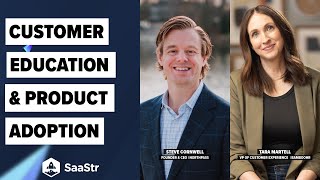
Steve Cornwell of NorthPass and Tara Martell of BambooHR discuss how customer education drives adoption. BambooHR scaled from one-on-one support to self-serve learning for 22,000+ customers, seeing 70% higher feature adoption and 90% more independent users. They recommend starting with three high-frequency support topics, then expanding into full learning paths.
Chapters
for this interactive 20-minute roundtable session. They will be discussing the future of customer education and how it impacts product adoption. Before we get kicked off, just a few housekeeping notes. We encourage you to keep your cameras on and audio muted. You can submit a comment, response, or a question to the speaker. You can use the Zoom chat box in the bottom toolbar of your screen to do so. If you'd like to speak directly to Steve O'Tara, please make sure your camera is on. And when appropriate, you can unmute yourself or use the raise hand function, and we will bring you in. These sessions will be recorded and available post-event. At this time, we can now join me, please, welcoming Steve and Tara. Steve and Tara, take it away.
All right, well, thank you, Ryan. It's great to be here. Thank you, SaaStr. Thank you, SaaStr community. Uh, my name is Steve Cornwell. I'm the founder and CEO of NorthPass. Uh, we are a learning platform that helps customer teams build and scale Customer Education Programs and Customer Academy. And with me today is Tara. Hi, Tara. Tell us about yourself.
Yeah, nice to be here this morning. My name is Tara Martell. I'm the VP of Customer Experience. And so over here at BambooHR, BambooHR is a leading provider of HR software for small to medium businesses. So I'm excited, Steve, for us to chat about all things customer education today.
Awesome. Well, let's jump right in, everybody. So customer education has become one of the most powerful and differentiated ways for SaaS companies today to really scale growth, as well as customer success initiatives. And we don't have to look much further than two leading SaaS providers like HubSpot and like Salesforce. And these pioneers have invested significantly into their customer education programs, into their customer academies. And today you can see that HubSpot Academy and Salesforce Trailhead have become centerpieces in these organizations' brands, certifying thousands of people every year and building tremendous brand momentum with these, with these academies. But it's really not just HubSpot. It's not just Salesforce anymore. Now we're starting to see small and mid-sized SaaS organizations launch and scale academies of their own as well. And even though customer education is growing rapidly, scaling fast, it still is early in its practice, and there's a huge opportunity for really every SaaS company today to get it— gain a competitive advantage and build an academy. Of their own. So next, uh, okay, we're on the right side. Cool. Uh, so let's just have a little bit of fun, uh, today. Uh, let's get a feel for the room, uh, before we really dive into it. Let's get a feel for, uh, the maturity level of everyone in the room's customer education programs. So open up your chat, uh, window, drop the, uh, your answer to this question in there. How mature is your, your company's customer education program? And maybe kind of think about it from, from 4 different ways. One, doing nothing today. Two, just starting to do some research. Three, you know, running a few courses or maybe a few seminars. And four, having a full-blown customer academy. So jot those in there, see, see what everybody's up to. And then we'll keep, we'll keep flowing through the presentation. You know, education, I think, is such a powerful growth lever because Unlike almost every other business process and growth initiative out there, education can enhance your customer's experience with their brand, with your brand across their entire journey with you. And I think that's what makes it so, so powerful. Next slide, please. An academy, a customer academy is such a premium piece of content that it can build tremendous brand awareness. By positioning you as a thought leader, by building credibility for your company, and just genuinely providing a really customer-centric posture for, for your entire customer base. In addition, sales reps can use the Academy. Sales reps can use digital learning experiences to move your prospects through their funnel. As we all know, customer education can serve as a huge way to decrease onboarding time, get your customers up to speed on your products and your services so much faster, which, which we all know as subscription businesses, those, those first experiences really matter. And beyond the onboarding process, customer education can play such a key role in ongoing product adoption, which Tara will tell us a little bit more about from, from her direct experience. And then finally, when you, when you really nail it, when you really build out your entire program, customers will become brand ambassadors of your product and of your service, which will just continue to fuel that brand awareness and help you grow your business. So as I mentioned before, I think today there's just a huge opportunity for every SaaS company, small and large, to get going with customer education programs, and the results show. Next slide, please. Where trained customers are 70% more likely to use your products and services, 60% more likely to use more features and functionality within your products, and 90% more likely to be able to work more independently on your products, which we all know drives down the support requirements. So that's just a little bit of background, but to really, really dive into this, and make this real for you today. My friend Tara is going to tell you about how she and her team have built an actual program at BambooHR. So Tara, with that, take it away.
Yeah, thanks, Steve. And looking at that slide, those statistics are compelling, and those are what we were trying to achieve here at BambooHR. If you flip onto the next slide, I'll tell you a little bit about what we were looking at as our opportunity and our challenge. We are in the SMB market, so we have small customers who are smaller. They wear a lot of hats. They're really busy. And yet the volume of our customers is enormous. We have about 22,000 customers and growing here at BambooHR. And additionally, our product is evolving. So we have a more robust product offering even within certain features throughout the years, as well as multi-products. That we're selling to our customers. And so as we were looking at this problem, we had really trained our customers to be used to us. You can flip to that next slide. We'd really trained our customers to be used to using our reps on a one-to-one basis. So our support reps, our customer success reps, our onboarding reps, really everything was one-to-one, and we needed to flip that. So we look at it like a funnel. We want to take care of customers as best we can in a one-to-many opportunity. And we accomplish this by using an LMS, help content, webinars, workshops, etc. And if they can't serve— get served in the way that they need, then we can move to those issues being one-to-one issues. So if you flip to the next slide, I'll share with you a little bit about— we started with one thing that we were trying to accomplish. We noticed that our customers— we have what are called account owners. They're kind of the main champion user of the product. And we had in the last 30 days, as an example, we had 5,000 new account owners. So 5,000 people who need to learn how to use the system. If they are, sometimes they're inheriting a system that they've already got. And so they need to learn how to, what's happening within the platform and what is already there. And so we set out to do that in a more scalable way. So first of all, we wanted to make a plan. We thought about what did we want? What were our objectives? Where did we want to house this education? What did we have that was working and what did we need to augment with? And how did we want the two of those different things to work together? If you'll stick on that last slide, I'll stay there for just a minute. And so secondly, we needed to educate on education. Like I mentioned, we trained our customers to always kind of dial in and be one-to-one with the rep. And so we needed to train them that we had more to offer, that they could self-serve in different ways. And so where were we going to teach them to go use that content that was there? We also needed our reps to know that that content was there. So we spent some time educating internally and externally that this was available, these other learning opportunities for our customers. Next, we focused on content, and that was a big learning opportunity for us, that, that we had different learning styles of our users. We had opportunities for short-form education, long-form education, but we also had different kinds of learners. We had seasoned practitioners, but we also had very new beginners in the, in the space that we're in and everything in between. And so we had to focus on making that content compelling for anybody who might come across it and that they could gravitate toward the things that were best for them. One of the ways we really did this was by infusing best practices into all the content. Not only were customers wanting to know how to tactically use our product, but they also wanted to know what were better ways that they could be doing HR with our product. What were their peers doing that maybe they hadn't been spending time doing yet? And so we really tried to bring in quality content that would help them up their game and know how to use our software better. And then finally, we focused on data. Our customer education efforts are not linear, and so we really needed to use data to help us know when to get in front of the customer. And, and we don't want it to feel unnatural or robotic, and so that data really helps us know when they're ready for which piece of content. And so by approaching this, we created a whole, um, our customer education program and and we use, we use NorthPass. And so just on the next slide, I've got a quick comment from one of our customers who said, "I'm so relieved. I have had a hard time remembering everything that you taught me during our onboarding phase. And so this removes so much stress for me." And it's been so fun. We have lots of comments like this for our customers to know that there's a landing place. That if I forget the content or can't remember that thing that I need to know, maybe 6 months from now, I know exactly where to go to revisit that information. We've also had comments around, even if I've learned it, then my, my counterpart or a new peer may come in who needs to learn the content as well. And so they know exactly where to, to send them to be able to get this information. And so we've been able to build this a really robust community that people know they can go to and learn what they need to learn to keep moving forward and use, use the tool and our products. On the next slide, I'll tell you a little bit about how we get started and how we got started and just some recommendations. I would really recommend that you start small. We already had a whole onboarding process in place and we weren't looking to kind of take that away from a one-to-one experience, but we were just sort of looking to augment what our reps needed help with to begin with. And so I would pick 3 or so opportunities. And how we began was we went to our frontline reps and said, what do you say over and over? What are the opportunities that you tell every single customer at some point in the customer journey? And so we looked for some of those opportunities and then we determined what content we needed. And so we, you know, is it a quick video? Is it a workshop we want to invite them to? Is it a learning path? And we, we then needed to number 3, get it in front of customers. And in the beginning, we didn't have our platform set up. And so we just allowed our reps to use it. Hey, next time you have this kind of question, here's the content you can use and send out to folks. And that was super fun for those folks to feel that that was working and be able to make quick iterations on the content. Like if you added this little piece, it would really make it resonate with customers better. And so from there, we measured that success, not only the usage of the piece itself and what we were doing, but also what our reps were saying, like, oh, that really helps. And I'm not having so many of that exact same conversation. And it allows me to elevate my conversation to a different level with customers because I can use that piece with them instead. And then of course, once we've measured that success and we know how great the content has been working with our customers, then it was easy to go build the case for why we could do more of it. We could build a whole library. We wanted a platform to be able to put this on. And that was really easy once we could— we had that success measurements in place. And so we just kept building and building until we had a really nice, robust library of content. Some of the things then we moved on to, to added steps like we've really paired product experts with learning experts. And so those folks are the ones who are taking, you know, our education really to the next level and allowing our product experts to augment and really get in front of the right kind of teaching for different consumers and different learning styles, etc. And so it's been really fun, Steve, to partner with North Pass and at BambooHR and do that work together. And our customers are just loving it. It's been so fun to hear their responses. So with that, I think we're going to let the audience ask a couple of questions.
Tara, thanks so much. Thanks for sharing some of your, your key learnings there. I love the, the idea of starting small, picking out just a few things, and going to the frontline reps, right? Hearing directly from the frontline what the challenges are, what the opportunities are. And then one of the other interesting things you mentioned too was just around the two different types of training, you know, the best practices on how to be amazing, an amazing HR leader and run amazing HR programs, but also run the tool training, right, and the onboarding. So some really great, great themes in there. But yeah, let's open this up. Let's open this up to, to the audience for questions. So go ahead and fire away with, with questions. Then I'll get us started. I'll get us started here with, with just one here. I'd say, Tara, what's been What's one of the biggest challenges that, you know, you guys have faced as you really got things started?
Yeah, I would say the biggest challenge was prioritizing just how many educational opportunities we had. So we went to those front lines, and after they could see that this had real impact to their day-to-day work, then they started submitting just so many ideas. What about this? What about that? Could you help us with this? Problem we see. And so from there, we really had to step back and prioritize how many people would this hit? What's the thing? What's the message we really want? What's the outcome we're really trying to achieve here? What's our objectives? And we really made a whole roadmap and we can take that roadmap into quite a bit of time out into the calendar year that it's going to take us to get everything done that we want to get done. And so it just kind of opened up this huge new world of possibility for us once we started to get the the flywheel going, which was really exciting. So now we're kind of trying to, you know, we can't do everything at once. So let's prioritize. So good lessons there for us.
Yeah, good position to be in too, when you, you now have a bigger— your vision so big, right? It's a matter of priority. One of the questions that came in from Anna said, what types of content have you found success with? For example, email, in-app messaging, an academy? Can you, can you share a little bit about just like the formats there and the content types there?
We kind of do a little bit of everything. We've really tried to, uh, we definitely started with email and we're finding that email, uh, just everybody's inboxes are inundated. And so that's definitely where we started and we had good opportunity there and good learnings there, but we're trying to pull away a little bit from filling people's inboxes with so many messages. And we find that our, Customers need it more in the moment. You, you know, you've got that email that's stuck somewhere in a folder and you don't want to go and have to find that. So now we're really moving toward Academy and our customers are loving that because they know that that's where they go when they want to learn, they have a question. We of course have our help content and that's for very specific types of questions. Like I'm really stuck on this particular thing, but our Academy is better designed for, I haven't used this tool feature and I want to learn how to use this entire feature set, or I'm brand new to your entire product, where should I start? And that Academy is able to walk them through, kind of sequenced really well and in the right kind of scaffolding for them to take their learning to the next level. And that's been super fun for us.
Yeah, I, I think I can kind of echo some of that too, Tara, just from, from my own observations, my team's observations, that I think all of those formats are good, right? It's just like, what is the goal that we're trying to achieve? And whether it's in-app or email or a long-form course or even more like learning paths and certification programs, I think they all have an appropriate place and an appropriate purpose. So thanks for that question, Tara. Thanks for some of the perspective on that.
Sure.
We just have a couple of minutes. Left. This one's from, from Brian. What's the impact of having learning systems in place outside of just the customer-facing teams? I think this is a really interesting, huge question. I'd love to just tackle this in a whole session of its own. But, you know, I think that the impact of having learning systems in place is that, as I mentioned before, I really believe learning is the greatest enabler of growth and scale for a business because it can truly impact your customer experience along the entire lifecycle that customers have with your, with your team, so, or with your company. So whether it's building brand awareness, do you know, onboarding better, product adoption, certification programs, it has a huge, huge impact.
Well, and even just during your sales cycle, right? If your customers know so much more about what they're really purchasing, they're able to make better informed decisions. And so the more they can learn about how it really works, we find sometimes, like I mentioned, we're a multi, multi-product. And so we'll have customer education opportunities thinking our target audience is just our customers, existing customers ready to buy up or wanting to learn about it, but they come and then they buy up, which is really fun. And it really, the intention, the objective is just to teach them how to use it. We're not trying to sell it, it just happens to entice those kinds of people to come to that offering.
Awesome. Hey, uh, I think we're at time, uh, but this was a ton of fun. Uh, Tara, thanks again. Saastr team, Saastr community, thanks again. Uh, we'll be over in the North Pass Lounge, come hang out if you want to keep the chat going. I saw there was a few questions we didn't get to, so we'll be over there, happy to help out. And thanks again, everybody.
Thank you, Steve, and thank you, Tara, for that great session and great learnings. We have a lot more content today coming up, so see you in the next session.
More from Jason

Why Your Next Hire Should Report to an AI, Tragedy Apps, and Too Many AI SDRs? | The Agents #004

Our Agents Drove Our Salesforce Bill Up 80%, Marketo Hates Agents, and We Stealth-Churned Off Notion




Managing 20+ AI Agents: Lazy Agents, Our $500K AI Bill, Stealth Churn & the Death of 60% Solutions




