The Future of the Customer with Algolia & Gainsight CEOs and New Relic's Chief Customer Officer
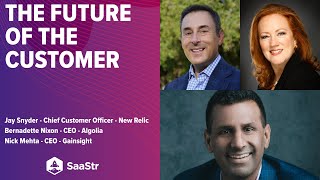
Algolia's Bernadette Nixon and New Relic's Jay Snyder discuss how customer success is shifting from renewal-focused to adoption-focused. New Relic ditched its CRO role entirely, letting customer success own the full journey. Both expect AI-driven experiences and the death of manual CSM work.
Chapters
Welcome everyone to the Future of the Customer panel. We have Bernadette Nixon, CEO of Algolia, Jay Snyder, Chief Customer Officer of New Relic, and Nick Mehta, CEO of Gainsight, to moderate today's chat. Bernadette, Jay, and Nick, we'll let you all take it from here.
Awesome. Thank you so much and welcome everyone. Really excited for an engaging discussion on something I'm passionate about, the future of the customer. So I'm Nick Mehta, CEO of Gainsight, and you probably have heard of Gainsight, we're in that world of customer success, and really excited to have two different voices in the world of kind of how companies think about their customers. So Bernadette Dixon recently joined Algolia as CEO, has been CEO before, was CEO of Alfresco Software and a long career in software. And comes in, I think, with a lot of passion for customers and customer success, which I'm excited to hear about, and also comes in live streaming, my understanding is from a boat right now, right, Bernadette? You're on a boat.
That's right. I'm on a boat in Rhode Island.
On a boat in Rhode Island. And then our second guest, Jay Snyder, who just recently took over as Chief Customer Officer of New Relic, publicly traded SaaS company. I'm sure many of you use New Relic, comes out of a long background in EMC and Dell, and has worked in the world of kind of customers for a very long time. And today is potentially broadcasting from the Italian Alps, or maybe—
I am. I actually just got off the boat, Nick, and just scurried up to make sure that I was ready to go for the presentation.
I gotta say, pretty good internet up there on the Italian Alps.
It's actually fantastic. I've got a hotspot on my phone, so hopefully we'll hold still.
So we got a good group and we got some good stories to tell as well, but I wanted you to get to know the group a little bit. We always like to start with a little bit of a fun icebreaker. One of our values at Gainsight is childlike joy. So I'd love to understand, we are all in quarantine. Some of us might be faking where we are with the virtual background. Bernadette is legitimately on a boat. You know, in quarantine, you spend a lot of time with the people that you know and love, which has been amazing and special. And sometimes it's nice to get visitors, hard to do right now given everything going on. But if you could magically transport a celebrity into your quarantine, who would it be? And I'll start with Bernadette.
So for me, I thought long and hard about this, but I thought Eddie Izzard was my pick. I knew him as a kid growing up in England. He's a British stand-up comic amongst other things. He's an actor now too and an activist. But he's best known for his whimsical monologues. And the reason that I thought he would be fantastic to be locked up in quarantine with is because firstly, I know I would be entertained. But not only would I be entertained, I have the utmost admiration for the guy because he can do stand-up comedy in English, French, German, Spanish, Russian, and Arabic. So Algolia originally being founded in France, although English is our business language across the globe, and I also speak French from when I used to live in Geneva, but I need a little bit— I need to brush up on my vocabulary, so I figured I would be permanently entertained and I'd come out of quarantine with better French than I went in.
I love that. That sounds like a very, very versatile person to have in your quarantine. Speaking of that versatility, Jay, I think you have a selection.
Yeah, I do. And I was also thinking about how I could possibly be entertained. I only speak one language, and that language is rock and roll. So this is a great question for me. I'm a total music lover, as evidenced by my attempt in front of 6,000 screaming. And I must say, they were mostly in agony screaming. Fans when I performed a little Slash just a year ago. I've been to about 300 or so live shows, and there's one band that I've never seen and I never will, and that's Led Zeppelin. So for me, the answer is easy. It's Robert Plant. Not only would I be entertained by the countless stories from rock and roll life, but think about the sing-alongs outside by the fireplace at night while we're roasting s'mores together. And then of course, customer value. Can you imagine offering up some Stairway to Heaven serenades during Zoom calls? I mean, how cool would that be? So Robert Plant is my guy.
There you go, going to California. I gotta say, I did not know that you did GNR on stage in front of your team. That's very impressive.
That was actually not even my team. That was 6,000 partners and customers at Dell World.
Look at that. Okay, we can have a whole nother session at SaaStraw.
You don't want to have a session on that, trust me.
I will pay for that. Mine, in a very similar thing, I'm definitely a huge music guy. Would definitely be bringing Lin-Manuel Miranda, Hamilton creator, into our house and annoying him continuously. I will try to show him how I can rap the entire thing, which I can, but not nearly as well as he can. I did rap my shot in front of our company at our kickoff as well. So sounds like we have some stuff in common. One other thing we have in common, as all of us, is passion about driving more value for our customers and in that process, driving more success for our business. And I think it fits a theme that I hear a lot in SaaS now, which is, You know, SaaS is very privileged. All of us, I think, are privileged in these digital businesses, but we're kind of going from this world of like during COVID-19 of just surviving to trying to figure out how do we thrive again. And a lot of companies are trying to do it through their customers. So I'm hoping today's session, a lot of the attendees get value in coming up with tips on how we can all thrive as we move towards the future with our customers. The way this format's going to work is I've got a, you know, about half a dozen prepared questions that I've worked on with the panelists. And gonna have some interesting answers about where we're going in the world of customers. And then I'd love to hear from all of you. So we're then gonna, towards the kind of second half of the hour, we'll switch into Q&A from the audience, hear some ideas from you, have some discussion, and then we'll close it out with some light questions at the end. So let's dive in. Let's talk about the current state. I think it's really cool that both of you took on your roles relatively recently, and you know, that gives you a chance to assess where your businesses are at in terms of how you manage your customers, the things that are going well, the things that are opportunities for the future. So I'm gonna ask each of you to talk a little bit about sort of the current state of the world. Bernadette, you can take it first.
Sure, absolutely. So I'm definitely a CEO that's come up through the sales and the go-to-market sides of the business, but I took opportunities along the way to sort of round myself out, you know, was the deputy CIO in all but title for a major international organization at one point, and then did a marketing rotation. To complement all of the sales and sales leadership experience that I had. Came into Alfresco in 2016 as the CRO and then the CEO, and then into Algolia just 2 months ago. So, in the middle of COVID And so, I haven't met a single solitary person face-to-face, either in the company or on the board at this stage. But there've been some silver linings and it's going really well. As you can probably tell by the accent, I'm not from these parts. So originally a Brit who lived in continental Europe and then came over to the States. So English, Irish, and American now. So a pretty good unifier, which comes in handy for the types of companies I tend to go for. So for us, when I came in, we had all of our customer engagement under one role, which was the Chief Revenue Officer role. So all of sales and customer success rolled up to that individual. And what I loved, and part of it is part of the culture of Algolia, what I love is the passion and the enthusiasm for truly helping. It's probably because caring is one of our core values. That was really working well for us, and I think a lot of what we were doing in delighting our customers was based upon the sheer will of just the people involved in the process. What wasn't working so well and what I assessed was, and what I didn't like, was the fact that customer success was subjugated under sales, under the CRO role. So that didn't really work for me, so I've split them out because I really wanted customer success to have its own focus, and I also wanted it to have a strategic seat at the table. I believe it's a strategic imperative for any modern business, any SaaS business, and so I wanted to have a seat at the table.
That's amazing, and Bernadette, I'm sure if for the folks that are in the CS world, They're applauding right now because they love that. And I think what's fascinating is you came out of running sales. So you had seen that and obviously that means sales is important to you too. And I'm sure you value it greatly. Was it that you felt like the CS team wouldn't get the voice in strategic planning or what were the things that you were hoping to solve in that?
It was really two things. And trust me, I've done that role where I've run both for many, many years. So it kind of was counter to sort of what I thought I would do. But the reason that I did it is because A, we're growing so fast, and so therefore I wanted there to be this maniacal focus on the growth, but at the same time, I wanted there to be maniacal focus on our customer and the advocacy for the customer. And so therefore I wanted to have both of those elements sort of on the same footing in the company.
That's awesome. I love that. And well, I'm sure we're going to come back to that more as we go forward. So I'd love to hear a little bit, Jay, about your background and kind of current state of what you saw when you joined New Relic?
Yeah, so I could not make it in my two passions, so not the shortstop for the New York Yankees and not a rock star. So I began my technology career about 28 years ago at a company called Accenture, and I'm not depicting the fact that that was the lowest form of man, but I did start on a 3290 mainframe coding COBOL, and after 5 years of IT strategy work, I left for the ERP launch in the ERP world with client-server at PeopleSoft. I think there's where I really began to hone my customer skills, having responsibility for all strategic services, our alliance solution centers, and technology alliances. And after a few years there, I guess I ran straight into the dot-com epicenter by joining EMC in 1999. And at that time, I was responsible for all the business development in the West US, based right in the heart of Silicon Valley. I actually thought it was going to be a 2-year stint, and then like everybody else in the dot-com days, I'd be off for glory. Running some startup company and making a gazillion dollars, but I think we all know what happened a few years later. And 2 years turned into 20-plus, and I was blessed to have a super run there. And over the tenure at EMC and then Dell, I focused on customers and partners in both national and global roles across consulting services, sales, operations, and alliances. And I ran teams from 600 up to 5,000, and my last role I had revenue targets in excess of $14 billion. In May 2020, I joined the executive team at New Relic as the Chief Customer Officer, and very similar to Bernadette, I have only met my boss in person, which is just surreal and unreal, both at the same time. But the customer use cases, the technology, and the overall impact that I thought we could have in this market is what really drew me to New Relic. I mean, if you combine that with everything I was able to read and hear, because I didn't meet enough people, about the awesome culture. That's what sucked me in. And I get asked this question all the time, and Bernadette, you probably do as well. So, you know, now you didn't know then, and you've been there 2 or 3 months, uh, would you still take the job? And I think the, the best testament to the decision is I would every single day of the week and twice on Sunday. So I'm, I'm really excited and proud to be part of this team.
That's awesome. It's great. By the way, just as a side note, I'm sure some people were probably Googling 3290 Mainframe Mobile, maybe even.com possibly. Yeah, yeah, yeah. But what I tell you is that, um, Jay comes from a company, EMC, that was well known for being extremely customer-centric and over the years and building great products. So it's, it's, I think it's awesome to have that perspective coming in. I'll click ahead.
Yeah, I just, you know, for those of you wondering, I did start at Accenture when I was 7 years old. That's how that happened. Um, so we operate at New Relic without a chief revenue officer. Uh, I work directly for the president and CEO, and that's That's by design. So my remit is really everything that would be a traditional CRO's minus new ARR. That sits out in the geographies with our sellers. And we adopted the model where the customer is actually owned by customer success, and we're responsible for managing their experience from start through enablement, through adoption, and ultimately value realization. This structure has a lot to do with the company's focus on customer first, specifically on developers and practitioners. It is early days, so I'm not going to claim victory. We just moved to this model with my hiring 3 months ago. It's exciting for sure. I love the concept, and there is a lot of great stuff that's already in place and working well. We have really well-defined, what I call, customer journey maps that align to the technology so that we can understand where customers should be in their relative maturity. We also do a really solid job of calling out things that should be occurring along that journey. I'll come back to that later. Our QBR process is institutionalized, which is awesome because I'm a huge fan of quarterly business reviews, as our exec sponsor program and our customer advisory board programs. So the foundation— those are some of the foundational things. I'd say that's all there, it's well laid, but you know, like Bernadette, there are areas to improve. Let me start with customer engagement at a technical level. We make a technology— a technical product, so it's real critical that we have technical engagement, and I'm focusing on 3 simple things as it relates to this technical engagement: simple, prescriptive, and proactive. And what I mean is we want to ensure that we are simple to engage with. We have 16,000 customers, so how do we create an experience that is omnipresent, right? How do we do that? And it requires us to— really requiring something that makes it feel like all 16 of those thousand customers are actually engaged. So to me, it requires really structured enablement, digital resources, physical resources, and technologies like Slack that are responsive and always available. So that's simple. Prescriptive is about ensuring that we are really detailed and thorough about those journey maps. So I said we have them and I like them, but they're not highly prescriptive. We need to get a little bit more prescriptive. And what I mean by that is we do a really good job in the first 90 days. So we know what it takes to get a customer up and running. But what about over time? Really, that evergreen process, that's where I'm digging in. And especially in light of what's happening in our world around us, right? Customers' business objectives change. And quite frankly, the people change. Champions change. Our technology changes. So I'm really digging in to try to understand how do we keep all these things moving in the right direction so that our health metrics and maturity metrics move in parallel with our customers, right? And that's taken some— new ways to think, and it's going to require some new ways to do things. And then the last one is proactive, and this is the biggest shift in mindset for the team structure. So we really looked at customer success— I mean, to boil it down, almost like a renewal event. That was kind of the epicenter and the foundation for customer success, which it's anything but that, right? So we've really worked hard to deploy the last 3 months what I call a portfolio mentality. How do we manage all of these customers, not just the ones that are for renewal, but all of our customers, all 16,000, in a continuous manner and not at a point in time where we are constantly engaged at a technical level? And then really quickly, and I'll wrap up, you know, that solves for the technology engagement, but technologists don't sign the checks, Nick, right? So we have to deliver business value. So I'm working to figure out how we scale our small but mighty team of value engineers to something that all of our customers can benefit from, not just those that happen to be leveraging that particular team. I want to make sure that all of our customers have a business case, not just during the sales cycle, but something that lives on in post-sales and becomes the agenda and the driving force for all those QBRs that I talked about. I want to ensure that we hold ourselves accountable to these concepts and we hold the customers accountable to these concepts. And I believe with some of these tweaks, if we do these things, um, we will make these customers deeply engaged through an undeniable value value chain, and that is success. And, you know, if I'm allowed to give a shameless plug here, Nick, you'll be happy to know that we're leveraging Kainsight as part of this process as well. So that's where we are.
Thanks, Jay. Appreciate that. And you know, what you said is, I think, very consistent with the current state, actually ties to Bernadette as well, because we're going to talk about the future. Current state is elevating customer success like Bernadette talked about. It's being more proactive. I mean, that's probably the biggest Buzzword in the customer success drinking game, if you do such a thing. And it's so important because it's not just about the renewal. It's too late usually at that point. It's about being more prescriptive. You said that. And then I think simple, which is, I think, a big topic we'll talk about for the future, because I do think that's the customer expectation is more simplicity. And then the last thread I'll pull on, which we can probably come back to, is you threw out value engineering. For people that don't know what that is, that's kind of a discipline in sales where it's not just about, you know, selling a product, but you're trying to deliver business value. How do you quantify that? And we're seeing more and more people take that value engineering, be end-to-end, pre-sale to post-sale. So you're selling value and you're delivering value. I think—
I actually think, I mean, I'll talk about it more throughout the day, but to me, that's kind of the— if there was a holy grail that I needed to solve for, if I could really figure out how to drive that at scale and make it systemic, I think that unlocks a tremendous amount of value for our customers and for our company.
That's awesome. So let's dive into the future. So, you know, we talked about where things are today. A lot of these themes probably resonate with what people are seeing. We're going to next talk about what's the near future. So what's happening like right now in trends, and then we'll do a little speculation about the far future and kind of where do those trends go over time. And, you know, near future, I think it's pretty obvious there's there's a big set of trends happening right now, which is with the downturn. And I, I tweeted this a while back that like at the beginning of the downturn that like every customer is scrutinizing, do they really need this technology or not? It's not just about it being cool, it's about what Jay said, is it delivering value, right? And whether it's Algolia, Gainsight, New Relic, or anything else, you're being measured on value, not just adoption. And, and at the same time, even outside of COVID there's all these other trends happening. You power of the developer, the API economy, you know, both of you play very much in both those trends. So let's talk a little bit about kind of the, the near-term trends you're seeing. I'm gonna start with Jay, because Jay, you described in the prep call this kind of proliferation of technology, this sprawl that's happened, and you're kind of in the middle of it. A lot of your clients use New Relic heavily. Talk about what the near-term trends are.
Yeah, so I mean, you teed it up really well. Uh, quite simply, and I guess no pun intended, things are too complex. I mean, they're just too complex. And so I'm speaking specifically about the space that I'm operating within New Relic. Customers live in a world of tools, and for everybody listening in here, I'm sure this isn't shocking to you, but mass proliferation and sprawl has become a real problem, and it's created mass complexity, not just at the technical level, but at the business level, because that, that sprawl is expensive. And worse, this fragmentation minimizes the ability to deliver value at scale, right? If everybody's just doing a little sliver of the work, how do you roll it up into a meaningful business case? I don't know anyone right now. I mean, maybe you do, but I don't know anyone right now with extra money, time, or people, right? So the pressure is to simplify, provide a platform, not a tool, that can be a consolidator. It's something that can drive costs but still have all the features necessary to get the business results. And I'm not saying this is easy, but that's what we're striving to do. I always say companies are trying to do 3 things when they buy something. It comes down to they're trying to make money, they're trying to save money, or they're trying to reduce risk. And the good news at New Relic is we can do all three, but only if we align to the business drivers and keep in mind just how dynamic those are, so we ensure that we are constantly measuring and refreshing. Our challenge and our opportunity in customer engagement is staying tightly aligned with the business drivers, having the discipline to manage long-term customer journey, even when the short-term options might be easier. So I guess I'd say it's forcing us to both challenge our customers more than ever, and by extension, us to be educated and in tune with the customer's business more than ever. I know it's something we've always aspired to do, but I've never seen it be pushed to the brink like it is right now. You know, generic business or customer success plans, they don't work for me, but yeah, more importantly, they don't work for our customers. And for some folks, that's a lot of pressure and they have to dig deeper. They have to work smarter and they have to do more. So I think that's what's happening. And that's, that's what we're seeing on a day in and day out basis.
You know, I'll just ask a follow-up on that, Jay, cause it's such an important point. I see it all the time, which is you said it super well, make money, save money, reduce risk. It's hard to, hard to find any other Uber categories than that. But then for CS people, sometimes it's challenging for them to make that connection, you know, from using a feature of New Relic to driving business value. They don't know enough about their client, they don't understand the business, maybe they're early in their career. You know, how do you help your team make that link to value?
I mean, that is the, what would you say, the $24,000 question that I'm actually going through right now. And it's a combination of things. One, it starts far up in the sales process, right? Because you need to start to deliver— deliver is the wrong word— you need to discover in the sales process. You need to do a lot more asking and listening than talking, right? So we need to create a template, which I'm working on right now, which is what are the foundational elements that would drive a business case? And again, this would be somewhat generic to get the basic discovery done. Then it's about really understanding the customer's business and using the levers within that business case to determine is the goal make money, save money, or reduce risk? So it's about operational efficiencies, productivity gains. Of experiences and making sure we've captured those. That's an enablement exercise that is not to be minimized, right? We've got a lot of training to do with our sales teams to get them to start to speak in these types of terms versus feature function. And we're going through that evolution right now within the company. And then your question really is, how does CS do that? I mean, what do they do? And again, if it's not teed up correctly in sales, CS is already at a disadvantage. So it starts there. But then instead of a success plan, it's a business plan. That business case becomes the success plan, right? And we're constantly aligning the metrics in that business plan back to the technology and understanding which dials we need to turn, which types of implementation or product feature functions do we need to use that will directly equate to these types of things. I think the thing we're doing, Nick, to be able to force that is we're getting a little bit more intelligent around account management. So today we do a good job there, but at the technical level, the deeply integrated technologist that's the piece that's going to play a critical role in connecting those dots for our customers. And I'll talk more about this later too, but I mean, the handoff from pre-sales to post-sales has to be crisp. Otherwise you're going to lose that momentum and lose that connective tissue back to that business case. And then the thing starts to fall apart. So, I mean, we can talk a lot about this, but that's a little bit about where we're headed on that. But it's definitely a change in selling process, and then it's definitely a change in the journey.
Yeah, I think you said it really well, and we'll come back to it, but that so much is discovered in sales that's lost often in that process. So really well said. Bernadette, you came into a company that's very well respected for the technology built in the search world. How do you— what trends are affecting the way you think about your customers near term?
So I think there's a couple of things. There's a macro point that I'll make, and then I'll give a specific Algolia example of how we're seeing it manifest. So, you know, I think every organization right now can get constrained within their silos, and in order to truly respond to your customers, you really need to be a nimble organization. Now, that doesn't mean to say you're going to do away with the functions. You're not. But you need to be— you need to find a way of getting outside of those come together as teams, squads, whatever you call them, in order to be able to drive value for your customers. And it's particularly poignant for us right now because we've made our bread and butter selling to the tech visionaries, the early adopters, and now increasingly that early majority. And so there are different things we need to do to bring to the table in crossing that chasm for a sector of our— for our market. So, but as we look at our market, it's not all created equal. We've got everything from self-service all the way up to the enterprise. So how we accomplish something at the enterprise level in a one-to-few or a one-to-one or a one-to-few is very different to how you would accomplish it in a self-service model. And so I think when we start to look at some of the frictionless models at the lower end of that spectrum, I mean, we've got 9,500 customers. So at the lower end of that spectrum, what we're finding is your product has to be intuitive enough for the customers to be able to self-direct their own journey. And so it's another spin, I guess, on the notion that you mentioned, Jay, which is simplicity, but it's that simplicity has to be multifaceted. You've got to have it in the product. You've got to have it in in how your customers can realize that value. And then you've also got to have it so that you can have it in a one-to-one or a one-to-few framework for your enterprise customers. So, you know, there's a lot of change going on right now. That's the only thing that's constant, frankly. And so trying to keep pace with it across all of those different sectors really requires you thinking deeply about how to deliver that value to your customers.
That's great. Yeah. And well, that simplicity theme obviously is so massive and also just doing more in the product when you have that massive scale that you all have at Algolia and New Relic has as well. So that's a good way to say, what are the things that are trends that, you know, you think over the next 5 years, you think are here to stay? You, some of you probably know that, that there's that great Jeff Bezos quote that says, don't focus on the things that are going to change, focus on the things that aren't going to change. Right. And that's why you predict the future. What are some of the things when you look at the next few years that feel like this is just an unstoppable trend? And then we'll go to the other side and talk about things that we think are going to be radically different in the future. Bernadette, I'll go with you first.
Sure. So the thing that is here to stay is the maniacal obsession with adoption, adoption, adoption. So real estate is location, location, location. I think for anybody in the SaaS business, it's obvious, but It's adoption, adoption, adoption. And there's no one key holy grail metric that's out there in the market right now. So I think there's a lot of experimentation going on here. I think that simplicity in the product is a key driver. I think in-product telemetry, in-product training are absolutely key. And I go back to what I was saying earlier, your goal, no matter where you are on that spectrum in terms of customer segment, The goal is the same. The question is, how do you help and encourage and enable your customers to get to that maximum adoption point so they're really getting the value that they were hoping in the presale cycle? How you deliver it will just be different depending upon the segment. That's here to stay.
Great. And Jay, what from your perspective?
Yeah. So, I'm terrible at predicting the future. I turned down an executive role at ServiceNow 6 years ago, Nick, so this is not my sweet spot, but Bernadette just said it incredibly well. I mean, I think she stole some of my thunder and she should have, because I agree with her 100%. It's about adoption. I'll say the same thing, but I'll say it maybe a little bit differently. So if I had to say what's going to definitely be here 5 years from now, it's this whole concept of customer success. Where customer success truly owns the customer, and sales will be just that, an initial sale only. Customers want to know that someone is responsible and not just there to do the sale or the expansion, but there to get them to, as Bernadette said, to adopt, consume, and derive value from the platform, right? We talked about needing to have an understanding of a customer's business, their drivers, and also ensuring adoption or the business case breaks. So I'm not saying the role of a salesperson will disappear. I just think the definition of responsibility will change, where they may simply be a sales and marketing person who's focused on new logos, but immediately it's handed to success from that point forward. And if I'm a customer and I'm asked to pick who I'm going to bet on for my future when I sign the check, is it going to be that salesperson or that success person? And I think we're already starting to see that, you know, lockstep with customer success is customer adoption, which means you have true engagement, which means you're delivering true value. It's just, you know, it's 1 1 3. It's a simple math equation to me. That's great.
Awesome. And, you know, if you kind of flipped it around on its head and said, what are some of the things that as we go forward are going to seem almost dated? You know, I watched, I showed my kids Back to the Future 2 last weekend. And if you remember, that predicts the future, but they predict in the future that there would be fax machines everywhere. So they kind of got that wrong. Right? What are the things, the concepts that we take for granted today that will seem dated 5, 7 years from now in the world of software? Let me go to— I'll go to Jay first.
Well, honestly, you know, I'm going to come back to something we just talked about. I think In the future, we're going to see a lot about low-friction models. And I'm going to be a little bit repetitive here, but I do think that we're going to see a lot more intelligence built into the product, as Bernadette said, that gives you— and not just intelligence from being able to extract metrics, but also enablement, right? I think that you'll be able to self-enable to a degree that we have never seen before. And you'll have the applied intelligence, the AI, in the product itself. That will— they'll make you smarter, right? It'll be watching what you do, guiding you how to do it. You know, today I have to manage and track health and my customer success, right? This will be built into the product. I believe that technology will become more and more intelligent to throw off these health metrics, and it'll put the CS team really in the driver's seat to engage in a much more meaningful and prescriptive manner, one that is completely almost custom for each account and very low touch. So I think you're going to have this combination of low friction but high impact, which is a real difference from where we are today, right? We think about low touch to some degree as low impact, and I think that paradigm shift can change. I mean, if you think about if we can build more intelligent products and leverage the AI, you're literally going to have the answer to the test from the technology itself. I mean, wouldn't it be something if you could show up with a script of exactly what the customer needed and wanted based on the data in the technology to help them do better, go farther, move faster, right? Or better yet, you don't even have to show up. You could just send them a Slack with the details and the enablement's right there and they can run. So I just see— I see our future allowing for a much more low-friction, high-impact way to leverage the technology and vote to invoke change.
Yeah, I see. I think one thread I want to make sure people take away from that, Jay, is that low touch or low friction doesn't mean, you know, a poor quality of service or not focused on the customer.
100%. Yeah, and I think it does today, right? That the nomenclature today implies you're not as valuable a customer, so you get a digital touch where somebody else gets, you know, hugged and visited by a real-life human being. That's true, but I think that shift is going to happen and we'll see it in the next 5 years where the opposite becomes the value-add.
That's great. And Bernadette, how about from your perspective? What's going to seem dated, you know, years from now?
Sure. I would actually just add on to what Jay was saying there just for a moment and say it also depends upon the market you're in. I mean, New Relic and Algolia, we're very focused on the developer. So honestly, a lot of developers don't want to speak to a human. They want to be able to self-serve. They want to to have a tech touch, and that is a better solution for them than a high touch. So I completely agree with your point, Nick. But what will seem dated in 5 years? Hopefully clicking OK to accept cookies on every friggin website that you have to go visit.
Voilà!
That's the crowd pleaser.
Well said.
But on a more serious note, and perhaps a controversial one, I think a thing that will be a thing of the past will be concierge CSM. Because I think that there is a portion of the population out there that have come up and, you know, the relationship aspect and the soft aspect has been so important because it needed to counterbalance, you know, sometimes the hard-charging sales approach. There was a, you know, a very high value placed purely on the soft skills. So to me, though, the days of the concierge CSMs are numbered, and there has to be value that the CSMs deliver beyond just the relationship. So I'm not saying that the soft skills aren't important, they absolutely are. High EQ is always going to be critical, I think, for that role, but they also need to be able to deliver value beyond that. And what that form that takes will depend upon your business, but I think that connected to the in-product telemetry and some of the stuff we talked about already will provide a powerful combination.
That's so well said. It's interesting, I did an event with CIOs recently, so probably some of your customers, where I asked them what they thought of CSMs, and they gave some of that feedback, Bernadette, that they felt like some CSMs are super nice people that respond to emails, but don't add a lot of value in the process. And I think for CSMs that are watching, you do have to plot a course to having value either in the product knowledge or domain knowledge or being consultative or whatever. You can't just be a nice person that responds I completely agree, right?
This is what we— I think we're all talking about the exact same thing here, right? They've got to be able to bring a business case to the table and make sure it aligns to those drivers. And when things start to stray, they've got to get everything back on track. I mean, they've got to— they're success managers/program managers. They got to run that customer journey like a program and understand what that means. And they've got to be able to use all the data available to them to be able to understand when the customer's going off their journey. And it's not just about showing up to run the QBR, it's driving the entire experience to get to the QBR. And that is a shift in mindset for a lot of folks.
One of the last questions we had talked about in prep was, you know, the org that's most impacted in changes outside of CS in the future, you know, and Jay and Bernadette, you both have some thoughts on that. Jay, I'll go to you first.
Which orgs are changing the most?
Yeah, which orgs change the most outside of customer success? What other orgs have to evolve and change? In this new world?
Yeah, I, I think if I was gonna pinpoint this, um, I would go to pre-sales. And the reason I would go to pre-sales is I talked about the fact that a customer— a customer would like to be owned, you know, soup to nuts by somebody who's going to be responsible and look after their entire experience. And if you think about what pre-sales does, they build that connective tissue at a technical level with that customer early on. And that's the mind meld, right? That's the, that's incredible value. I'm not diminishing what a salesperson does. I've been in sales a long time, but ultimately that technical connection at a lot of times when you're selling a hard, a hard and technology product wins the day. Right. But yet, if you've created this model where that pre-sales person does the sale and then disappears, where's that connective tissue and what happens beyond that? So I think that we're going to see an evolution in how pre-sales works with pro-sales and maybe becomes one and the same so that you can have that long-standing, truly intimate technical engagement that our customers are looking for. Someone that spends the time up front and then stays long-term after to be with that customer based on that relationship, that mindset, and that experience they already have. So I, I do see that getting upended, and it's impacting them now because where it isn't formal, Nick, they're doing it anyway. So I'm seeing pre-sales being heavily impacted by the fact that while their job is to be on pre-sales, they're spending half their time in post-sales. So whether it's formalized or not, it's bleeding across. That impacts sales productivity. It has other ramifications to the business. And so we need to solve for that. So I do think, you know, I don't know if the word is impact. I think there's an opportunity to do something more intelligent around the pre-sales, post-sales handoff.
It's really well said, and I think that what I'm seeing actually in some cases is Chief Customer Officers getting value engineering like you have and pre-sales underneath them as well to tie that all together. Bernadette, how about from your perspective, what org do you think is going to evolve the most in this new world?
I don't think I could have said it better than Jay, actually. I think he's got it. There's a lot of value to what he said, and I think generally the sales org will face a lot of change coming out. But I'm going to pivot, if I may, to one of the other questions that we talked about in prep, which was, you know, in a downturn, you know, what's going to be the most important? You know, a lot of people are saying that, you know, we've seen the worst of the downturn. You've got the other side that's saying there's still more to come, you know, when furloughs and everything, you know, are no longer funded by governments and what have you throughout the globe. And I would say on that topic that the thing that is going to be most important is having the human touch, or should I say the humane touch, and customers that you do the right thing by when they're in a bind, not that you'll be able to say yes to everything that they want, that's not what I'm saying, but when you do the right thing, it'll be recognized and those customers will remember that in the good times.
So well said. I think it's a great, great kind of segue to—
I was just gonna say, I literally had almost the same answer for that. Just, I said the one thing that I'm telling my team all the time they need to have in this downturn and what's the biggest impact to CS this at the same time is you need to lead with empathy, right? You really do. I mean, because the people we're talking to, their jobs are at risk, their companies are at risk, they're being put in very difficult positions, and we've got to really embrace and understand that. And that's a difficult thing for a lot of folks because, because we've got a company to run, right? But if you really want to build customers for life, this is the time where you— where empathy will shine, and doing the right thing long term versus short term is going to make that customer either be a customer for life or not.
So well said. That's great, great, uh, I think advice for people on the front lines. So let's, let's jump into some audience Q&A. So I'll do— let's do some lightning answers here. So Jay, what is value engineering? I should have explained that.
Yeah, sure. So I, I, it's, um, I'll make it as simple as I can. So every company I said is trying to make money, save money, or reduce risk. So what are the business drivers that align to that? If I'm a digital enterprise and I know that I need to have a digital experience and that experience is often dictated by how many consumers come to my website and the experience they have, then I need to have the most robust experience possible. That's going to allow me to scale and make money. So in a value engineering exercise, you would specifically identify the metrics that tie to that digital experience. You would capture those and, and track those over time to say we are improving these metrics, which by definition then improve the digital experience. So value engineering is a fancy way of saying you're building a business case grounded in the business drivers for the company that map hopefully very directly to the technology that you're selling, so that you can showcase by using this platform, this product, this service, you're getting these set of metrics deliver this value, this business value. So the value engineering piece is putting all those together and then measuring it over time. I hope that explains it well enough.
That's awesome. That's great. And Bernadette, how is customer success a reflection of internal company culture? I think it's an interesting question.
Interesting. So if a company has a culture which is winning at all costs, which, you know, many competitive and successful companies have some sentiment around that, But if you have purely that and you don't balance it out with other aspects of your culture, like caring or humility or candor— those are 3 of ours, for example— then, you know, what you get is somebody calling you up saying, "Hey, you're going to renew this year?" That's not a great experience. That's an extreme, but I think you get the point. You'll end up with a 30 or a 60-day cycle around renewal, and that's missing the whole point of customer success.
Great, great input.
I think Bernadette and I should work together, by the way.
Yeah, I know you really should. Quick one for both of you. How do you— what's in the incentive plan for CSMs? What are the things that you measure in their comp?
Well, we look at— so it's a good question because I'm in the thick of trying to change some of that right now. But you have You have a set of MBOs that are tied to their particular customers that they look after's success, and that success would be, are they renewing with us? Are they expanding with us? Right? It specifically could be tied to a set of those metrics in the success plan. So if we've done a good job with value engineering and we know that there's 3 or 4 KPIs that are critical, like around operational efficiency or productivity gains, we would specifically put those in the success plan and hold the CSM accountable to go drive those. A lot of it comes down to adoption. right? And then, you know, how are you driving adoption? And these things get hard to measure, right? It's not just the CSM's responsibility. So this is some of the thinking I'm going through now, which is, you know, how do you compensate an individual that has 3 or 4 other individuals that are critical to that customer success? Should there be team goals? Should there not? And I think it will vary because all customers are not created equal, right? If I'm a dedicated CSM working with a high-end enterprise customer, my experience is going to be different than a CSM who has 20 or 30 accounts they're looking after. And those are the things that are impacting us. So all those things, Nick, wrap into it. And of course, the renewal right now is kind of the, the validation point. Did the customer renew or did they not? And those things factor in as well. I can't say I love it per se, but I'm still getting my head wrapped around it and trying to think of maybe a better way. Great.
Bernadette?
So, net retention, gross retention, you know, certainly are the stable states. We're looking at, to the adoption comment of earlier, we're looking at how we wrap an OKR around adoption for each of our folks in customer success and indeed in product management as well.
That's great. Awesome. Well, I know we're running up on time, so I want to close out with just a question about leadership. We got some great feedback from the panel, by the way, from the audience, so thank you so much to both of you. So both of you are not just great CS and customer leaders and CEOs and CCOs, but also you're leaders of people. In some cases, you're rock stars in front of people, in Jay's case. So, you know, how has 2020, which I think is a unique year for leadership, how has it evolved your own personal leadership style? Style? Let me go to Jay first.
Yeah, it has a little bit. I mean, I try to be highly communicative and transparent. I mean, I thrive on collaboration, which is a challenging thing to do when you've actually never met anybody in the company. But, you know, those traits seem to be working. New Relic was well positioned on many of these fronts, Nick, because they have so many digital processes and modes to connect, so I'm leveraging all those. So it's really about just doing what I love, though, you know, building willing teams, attracting talent, developing the talent retaining that talent, ensuring you're really crystal clear on the mission at hand, and then inspecting against it. So for me, it's people, process, and execution. It's something that I live by for 20+ years, and it's worked for me forever, and that won't change. The tools I use to do that have, and as examples, you know, some things that I'm evolving with, we do company all-hands now every single week, and I want to make sure that I'm front and center on those all-hands calls representing and giving points of view on what we're seeing with the customers in the market and how the team's having an impact. We're doing all company Slack updates on a regular basis to help them keep informed and recognize all the good work people are doing at a company level. And then I'm doing that in my organization, right? I started a newsletter, something that we hadn't done, Impact of the Week, where we share best practices, recognize people. But, but honestly, I think for me anyway, and I think for the team, the part that really resonates is I'm I'm spending the time on top of that newsletter to write 2, 3, 4, 5 paragraphs each week on my personal thoughts. You know, what am I enjoying about the company? Where's the opportunity? What am I seeing? But it's also about not talking about the business. And I think this is really getting to the heart of what you're asking. It's about the real struggles that our customers are facing, right? The real struggles our employees are facing, and just being incredibly authentic about the fact that this is a really difficult time for us. It's a really difficult time for our customers. That authenticity is really key, and being human right now is definitely okay. So I guess right now there is no such thing as over-communicating, and that's what I'm heavily relying on more so than I ever have.
That's awesome. Well, thanks for saying that. Bernadette, how about yourself? How's your leadership style changed?
I don't think my leadership style has actually changed, but I think some of the aspects of my outreach has changed. So I was fortunate to work with and within companies that were video obsessed sort of before it became the trend. So video has been a daily part of my life and routine since 2015, which was pretty early. So, but I would say that now, especially, I mean, having joined the company and not met anybody, Some of the means of my outreach changed. So virtual listening tour that I did, you know, for my first 6 weeks. Then after that, now I'm doing one-on-ones with all of our top talent. And then, you know, participating in, you know, the dozens and dozens of Slack channels that we have, as well as one-on-one with people via Slack, just to build the relationship in different ways. And I would say it's amazing how many conversations you can have purely in animated GIFs.
That's well said. That's a good way to close out. Well, a couple of takeaways for folks, you know, I do believe in this kind of concept of human-first leadership, which is really what customer success is all about and what the future of the customer— and wrote some thoughts about that online that you can find on our website. And then, you know, for people who want to dig into future of the customer more, we just published our book Customer Success Economy, which is all about this concept and kind of where we're going in the future. And actually, just in partnership with Saster We made this available for folks listening actually for free. Go to gainsight.com/freebook and you fill out a form, you'll get a copy of it. And thanks so much to Jay and Bernadette. This has been phenomenal. Really appreciate it. And next time I think we'll have to do this with some karaoke as well. So think of your song selection.
Careful what you ask for, my friend.
Well, come and do it on the boat.
Yeah, that sounds good. Thanks to the Saster team. We'll turn it back to you all.
Thanks, everyone.
More from Jason

Why Your Next Hire Should Report to an AI, Tragedy Apps, and Too Many AI SDRs? | The Agents #004

Our Agents Drove Our Salesforce Bill Up 80%, Marketo Hates Agents, and We Stealth-Churned Off Notion




Managing 20+ AI Agents: Lazy Agents, Our $500K AI Bill, Stealth Churn & the Death of 60% Solutions




