The GTM Models We Used at Divvy To Go From 0 to a $2.5B Exit in 4 Years with Divvy
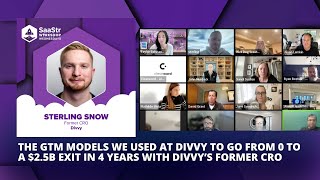
Sterling Snow, former Divvy CRO, shares the GTM playbook that took the company from zero to $400M ARR and a $2.5B exit in four years. Six concrete models: aligning the funnel under a CRO, linking budget-quota-stretch goals with 20% and 10-15% margins, shortening reviews to weekly, T3/B3 feedback loops, naming every metric around a single North Star, and validating willingness-to-pay before building.
Chapters
Hello everyone, welcome to Workshop Wednesday. Giving everyone a few moments here. Welcome, welcome. We have a great session in store for everyone, and so awesome to see so many familiar faces. Welcome everyone to Workshop Wednesday. We are just gonna get started here. We are thrilled today to hear from Sterling Snow. He is current partner at Pedalion Ventures and the former CRO at Divi. We are so excited because Sterling is a SaaS fan favorite. He's— we've had the pleasure of him joining us for several other events. His sessions are always super popular, very insightful, and usually have more questions than we can get to in one session. So we have him here today to make sure that we have plenty of time with him to answer all your questions and to go over his great story from when he was at Divi. So Today, Sterling's gonna be sharing about the go-to-market models he and his team use there to go from $0 to $2.5 billion exit when they sold to Bill, and that took just over, or just around 4 years. So it's an amazing journey. We're really excited to hear it from him. As always, we aim to keep these sessions as interactive as possible. So please make sure that you participate by dropping your questions in the chat. I'll be coordinating with you throughout the session to see if you can answer that or ask that question live of Sterling and join the conversation. We'd also love to hear where you're tuning in from. Sterling's joining us today from Salt Lake City, so I'm sure he'd love to hear where you're from too and love to see you off camera— on camera as well so he knows who he's talking to. But Sterling, welcome. Great to have you again at another SaaStr event.
Thanks, Taylor. Appreciate it. Excited for the format. It's gonna be awesome.
Yeah, so we're gonna just get started with a couple warmup questions for the audience here to get to know you a little bit better. So as I mentioned, we know you just transitioned full-time into the investing space. So would love to hear what you're working on now in your day-to-day role.
Yeah. So I mean, pretty, pretty typical, doing a lot of the sourcing and hearing pitches and making some of the investment decisions around how we want to allocate our fund. We focus on early stage, so we're doing seed, Series A, and then very rarely some Series B participation. But yep, that's us.
Awesome. Any particular projects or prospects that you're looking at that you're super excited about? That you can share?
Yeah, I mean, there's always companies. One of the fun things about getting to talk to so many founders is you start falling in love with different ideas in different spaces. There's always some of that going on. Um, the other thing that, that's always exciting to me is figuring out how we can make Utah a better tech ecosystem. Um, what's, what's worked well in California, the Bay Area, some of the stuff that SaaStr has done for the community, and how can we How can we just make sure we're elevating ourselves and progressing? And I love thinking about that for us where we are located in Utah and invest probably 50% of our dollars in the state.
Awesome. In the past 12 months, what's the hardest thing that you've worked on?
Well, we had our first annual meeting where we bring all the LPs and stuff, and I'm used to different formats. Understanding what LPs think about, care about, wanna discuss, how to use our LPAC, which is like the board for, for the investment stuff. All that was new to me. And so that, that content and stuff was just challenging, a little bit of a different angle, but turned out well and was, was a great, great learning experience.
Awesome. Always learning. Um, obviously something we're invested in here at the Saastrums Workshop Wednesday community. Um, what's currently the favorite SaaS tool or platform in your stack now?
Oh man. So it's, it's probably a little trendy, but I, I am such a fan of Loom and the, the ease with which I can like record and share and do things asynchronously. And I just use it so much and I just love it every single time. Really created a delightful experience. So it's probably Loom today.
Love it. We're big Loom fans too. Obviously exciting stuff going on for them too. So, well, thanks Sterling for those great answers. Without further ado, we'll let you get kicked off for this week's edition of Workshop Wednesday. Take it away.
Awesome. Thanks. Appreciate it. Thankful to everybody for showing up. And I'm excited because I feel like a lot of times I speak in platitudes and like one-liners, and I really wish that we could get into a little bit more of the tactical nuance kind of stuff. So I'm excited for the interactive format. But let me just walk, walk everybody through a little bit of, a little bit of my journey, a little bit of the journey, and then kind of a high level of some of the models that were helpful for us in growing, growing our business. Divi was a great story, a good learning experience for me, went from zero to $2.5 billion exit in about a 4-year timeframe. And lest anybody think we didn't have to generate real revenue, when I left, the Divi business was doing around $400 $2.5 million of annualized revenue. And so there was, you know, we went from $0 to $400 million from a revenue perspective, $0 to $2.5 million from a valuation perspective. This is a little bit of that journey. Pelion, the firm where I work now, was the lead investor in our Series A. Insight Partners out of New York did our B. Jeff Lieberman was on our board there. NEA did our C. Scott Sandell joined our board. Then we did PayPal and Heiko in the Series D. And then in And then we ended up selling the business to Build.com. And the thing that has always impressed me is very— I've never seen anybody be able to pull off shortcuts, but I've seen people be able to compress learnings and do things in a faster amount of time, which is what I felt like we did. We crammed a lot of learnings, a lot of mistakes, a lot of successes into a short time period. And so these are, these are some of the learnings that we got both from doing things wrong and from doing things right that, that I think are worth, are worth sharing. To start out, I am, I'm a huge believer and, and I love Jason's tweets on this stuff about what A-players and high-performing teams really mean. And the best people are far more valuable than you think they are. And when you put them all together on a high-performing team, in a high-performing environment, where you're responsible for holding each other to high standards and have a lot of accountability, it's a very special feeling. And so the things that I'm gonna talk about are very team-centric. And then there are things that I observed from getting to work with a group of very high-performing individuals. I think that before you start thinking about models, you have to think about the attributes of your team. And there aren't necessarily right or wrong answers here, but this has to be very authentic as a part of the culture if you want to implement the models that we're gonna spend some time talking about. So I'm not going to read all of these to anybody, but I'll highlight a few of them. With, with, if you're trying to get big fast and, and you're signing up for, for hypergrowth, you have to be hiring people who think that chasing ambitious goals is energizing and it's fun. Yes, it's also stressful. Uh, it'll, it'll make you want to pull your hair out. You're going to have days where You know, you're laying on the floor and you don't think you've got any more energy, but you have to be fired up by that possibility. Otherwise, you're probably aiming at the wrong thing. The other one that I'll point out is extreme ownership. It can't be like, oh, I'll get to that tomorrow, or that's not my job, like that type of a mentality. It just won't work. These models will be of no use to you unless you have people who are extreme owners. They feel like everything depends on them and their ability to do their job well and their ability to lift and help people out. And then the other thing is just a maniacal focus on urgency. These— a lot of these models are focused on how do you do more in less time. And so you have to have speed as part of your— as part of your culture and as part of the traits of the high-performing team that you're building. And then just as important as what you are is what you're not, right? What do you not tolerate? What is completely unacceptable? Acceptable to you. Excuses is one of those. Like, you can't have a culture where excuses are tolerated. You can't have an environment of disloyalty where you get out of a meeting and you go and talk poorly about somebody or somebody's work. You have to bring those conflicts out into the open and have them in a very intellectually and emotionally honest way. And then there's just no room for passengers, people who— there's people who want to build a great company, and there's people who simply want to work at a great company, and you only have space for the people who want to build a great company. And so passengers don't end up being super good fits. And again, I always feel a little bit sheepish because I'm kind of taking credit for the work of truly, truly amazing women and men who I learned a lot from and just am thankful that have been associated with across my years at Divi. Okay, let's get in, let's get into the models. And I'm going to give very fast overview so that we can leave more time for actual questions about them. But there, there are 6 that we'll go through. I'm a big believer in aligning the funnel. Everything that you do to align the incentives will reduce friction and waste. So if everybody can can be hyper-focused on the right things, you end up, you end up having a lot, a lot faster conversions. So let me give you an example. What do you measure a marketing team on? And in like maybe an older school example as well, we're going to go to MQLs or SQLs or something like that. And what, what I did at Divi is I wanted to measure everybody one step deeper. Right, and figure out how to align the funnel. I'm also a believer that if you can have a centralized leadership here, I'm a fan of the CRO model and having at least the demand gen flow to a CRO that is then responsible for both the top line and the bottom line numbers that you end up— you end up getting a lot more out of your— a lot of your funnel. Moving on to number 2, this is a favorite for us. It's called budget quota goal. And it essentially means that you have at all times 3 different numbers. The budget number, think of that like the plan that you give your board. This is the number that come hell or high water, you can't show up at a board meeting and say like, we, we screwed up here. That's your board number. Your quota number is what you point the team towards and what you roll up all the, all the individual numbers to. And that The idea there is that you have some margin of safety between what you've committed to and how you've built your financial plan and what you're actually pointing everybody towards. And then you have goal, which is, it's really hard to get the quota number exactly right. How do you know if you're stretching enough or not too much or all of these different things? And so you have a third number, which is goal. And this is the thing that's meant to stretch you. You're not supposed to hit this every time. I'd say maybe 20%, 30% of the time you should hit this, but it's the thing that you go and celebrate and you do something really fun as the team. You do something maybe a little bit more extravagant than you would normally do. And if you run this from a finance and a revenue perspective, you get a chance to beat and raise because you get a chance to find the right numbers. Okay, somebody hit stretch, like the team hit stretch. So maybe we have more wiggle room in our quota. We get to raise the expectation. We get to, demand more of ourselves. And you get a chance to do that and get in that motion repeatedly. So budget quota goal has been a very helpful framework for us. Shortening, shortening the cycle. So every single thing that you do, you want to figure out how to do it faster. And one of the biggest mechanisms you have in, in this world is how— what are, what are the quotas and what are the time frames that you're reporting on these numbers? And, and this depends obviously a lot on, on your ACV and on who you're selling to and what your product is. But if you can take something that typically is reported on, on a quarterly basis and shorten that to a monthly cadence, well, you just gave yourself 3 times the amount of, of coverage and the ability to learn and say, like, did we, did we hit, did we miss, and what are we doing? And you will find that, that work and results, they tend to just fill the amount of time that you've allotted to them to accomplish whatever it is that you're going after. And so at Divi, we moved everything to monthly, and then we actually had in our rougher time periods, we would move to like weekly numbers and, and reporting on things on a weekly basis, holding each other accountable on a weekly basis, because the harder things get, the more you have to keep a tight, tight loop on exactly what you're, what you're doing. I also am a big fan of doing this because if you're on a monthly basis, you can actually take your annual plan and you can raise that number 12 times. Like every time you show up to a board meeting, you're doing that beat and raise thing that we talked about. And, and the team, while more is being asked of them, they're also showing up and they're winning and they're getting the job done and they're seeing they're seeing their performance make a difference at the company level, which is really cool. All right, T3/B3. This is a, this is a formula that we use to make sure everybody understood at all times what they, how they were doing. T3 stands for top 3 and bottom 3. So on a monthly basis, in your one-on-ones with your manager, you would actually like sit down and it was a very simple deck. And we would say, okay, here are the top 3 things that you're doing, we need to keep doing more of these. Here are the bottom 3 things that for your goals and where you want to go in your, in your career, these are the things that could be holding you back. Um, and the, the other unique thing that we did is this was bi-directional. So the manager did it for, for their team members, but the team members also did it for their manager. And this is a very easy, non-confrontational way, because if I tell you the 3 things I really like about you and what you're doing, it's an easy environment for me to also say, well, here are your areas for improvement and opportunity. And it's good for leaders because sometimes you get, you get feedback that maybe you wouldn't have gotten in another, in another way. But it also allows people to at any given time understand what they need to be focused on to continue to accelerate their career. This is, this is another model that we use called Name, Number, and North Star. So a North Star is actually ridiculously hard to do. Netflix has one, which is, you know, it's just user minutes. Twitter with Elon, their North Star is unregretted user minutes. They just like, you can figure out what the North Star of the business is if you think about it, but a lot of times it's fairly complicated in B2B tech. But the framework we used is every number that was in our financial model had to have a name next to it, otherwise it was considered at risk. And then we also had to understand what our North Star business was, which for us at Divvy, that was the amount of usage or spend that was going through the platform. If we were shipping the right things, if we were selling to the right customers, if we were doing, if we were retaining the way we needed to retain, that was kind of the one metric that everything should roll up to. So understanding who you are, what number you're responsible for, and then what the North Star is that that rolls up to, it resulted in, in good, good behaviors for The analogy we use is you're always juggling in a startup, especially one that's growing fast. You're juggling a lot of balls, but some of those balls are made out of glass and some of those balls are made out of rubber. And unless you do a good job of articulating which is which, there tend to be— you tend to think people understand things that maybe they don't fully understand.
All right.
This is a favorite of mine. This is Sell Design Bill. And this to me is how you make sure that you're building the right products and features. And it's essentially how do you go out and validate that this is actually what the market wants? And a way to figure that out is by, is by saying, well, what's someone willing to pay for? Or what is somebody willing to change their behavior for? Like, how do I actually go and sell something before I go about the work of actually committing engineers to it and building it? Because a lot of times if you just you just go and get feedback, or if you just go and get design partners, a lot of times that human nature is that people just, they want to tell you that, yeah, it's cool, and yeah, it'd be super valuable. Tell somebody actually parts with their money or changes a material behavior in terms of how they interact, uh, that, that feedback should be heavily discounted. And so this is a picture of how we would do this at Divi, but I would go on the road with our head of product and we would actually like sell the stuff that we were building. And see if we could get people to commit to it and use it and to part with their money or have some moment of pain involved so that we knew that what we were building was something that the market was actually going to be appreciative of. So that's sell, design, build, and it's particularly valuable the earlier you are in your journey as a startup. So again, Um, this is, this is a simple— these are all simple, like none of this is rocket science, but they're not easy, and they're not easy to do at a high level and to sustain over a long period of time. Um, aligning the funnel, making sure you know who that one owner is, having a budget quota goal so that you can protect your downside, maximize your upside, make sure that you're shortening the cycle in every single scenario that you can. You want to try to figure out how to do more in less time. T3, B3, make sure that everybody has a platform for, for feedback, both, both up the ladder and down the ladder, making sure that your organization knows what the most important thing is and then how and then what they are responsible for as it relates to that. And then making sure that you're not, you're not wasting time. That is, you explore product offerings, adding a SKU, adding this feature that you're actually trying to sell that. Before, before you dedicate the resources to building it. That's, that's very expensive. So those are, those are the models. We went through them super fast. And I would, I would love to, I'd love to have some discussion about it. Answer some questions. Amazing.
Thank you so much, Sterling. Always great insights. If you want to stop your screen share, you're more than welcome. You can maybe see some folks. Some people's faces. Our first question we have in the queue is from Anand. Anand, would you like to jump in with your question?
Sure. Thanks a lot, Sterling, for all the thoughts. Quick question on the budget quota and goal, especially now that we are getting into like processes of zero-based budgeting and everything else.
Yeah.
Now, if you were to rethink how you would actually do budgets, And what's the ratio that you would keep against the budget, against quota? And where would you actually really put the goal on, especially in like a down market where not everybody might be hitting their numbers?
Totally. So this is, this is important because I'm also a big believer that momentum is contagious in both directions. And so when you go about setting these numbers, You want, you want the team to hit them and then be able to go and say, okay, we did that. Now let's go see if we can do 5% better, 10% better. And so the answer is that it's completely dependent on your business. But I would say you'd rather, you'd rather start maybe a little more conservatively and then try and figure it out. Now, just good rules of thumb. The delta between a budget and a quota around 20%, right, feels about right. And then the delta between a stretch and a quota, if you've got a good quota, is probably closer to 15 to 10. And the way that I think about it is I want— we're never going to miss that budget number. Like, that is unacceptable for us to raise money or be accountable to a board. We're never going to miss that number, right? Like, that's— I would offer my resignation is kind of how I always thought about it. Quota, we want to be doing that 80% of the time at a team level, not at an individual level, but at a team level, we want to be hitting that number like 80-85% of the time because that's winning, that's momentum. And then stretch maybe 20-30% of the time. And those are like big rah-rah moments, huge pushes, good stories, like startup hero kind of stuff. Is that helpful?
Yep, that certainly is helpful. Thanks. And The, the main, the major thing that I was actually like asking about is when you actually are missing all of that, then how do you recalibrate, especially in a down scenario?
You know, I, I think that there's, there is no shame in being like, hey, here are the— and I would walk everybody through it— here are the assumptions in our model, here's, here's what they changed, like, and here's where we got it wrong. So we're going to reset and we're going to build back up and we're going to get into this motion and into this culture. And just having that be an open and candid conversation, especially because, you know, the conditions are changing, right? And so I think that's, that's, that's a trust builder if you do it the right way.
Perfect.
Thanks.
Thanks, Anand. Thanks, Sterling. Corey, I think you have a question too. So we still have—
Sorry, I was muted. Sterling, appreciate your time. I had a quick question for you on the North Star.
Can you say more about specifically what did that look like for you at Divi.
Yeah. So, and I can actually— I don't know if we send stuff after, but I can send something to Taylor. There's a great sheet out there that just— it breaks down companies and what their North Star metric is. And I've always referred back to it. For us at Divi, we were a free, free product that monetized on the interchange. So it was usage-based. And so when you think about a North Star, you want to align the company me and the customer, right? And, and be able to say like, if we're doing this, we're going to be successful because our customers are going to be successful. And so we used spend because that meant that you were pulling out your Divi card and swiping that and having the expense report automated, as opposed to, you know, pulling out your Amex for, for example, and using that. So it meant, it meant that if we were winning that usage We were shipping the right things, we were building the right kinds of software, but then it also tied back to us as a business. We were, we were making the money that we needed to make to keep growing and keep the lights on. Okay. Does that make sense? Yeah. Like Amazon, for example, theirs is number of transactions, right? Like that, that is for their, for their marketplace. That's like what they think about. Again, Netflix is an easy one. They're just going for watch time. And so you just, you want to align your business with your customer. And then if everyone in your company is aligned to that North Star, the business will do well because the customers are doing well and you're aligned there. But you can pick a bad North Star very easily. Like if you just say, well, it's revenue, it's like, that's not necessarily what's the best for the customer. So it takes a little bit of work to figure out.
Got it.
Lydia has a comment and a question for you up next.
Well, it was more comment and observation than anything else, you know, about not sacrificing good for fast or equating or that, you know, better is faster, meaning that a lot of times the wrong— maybe the wrong emphasis is placed on people in the sales organization. Whether it's SDRs, BDRs, or AEs, where management is measuring, might be measuring the wrong metrics for their activities against what they're actually generating in terms of performance, customer satisfaction, revenue.
Yeah, no, I agree. It's measuring, like picking the metrics that you're going to care about out and making sure they're the right ones is a very important part of making this stuff work for sure.
Awesome.
Yeah, I used to be— I used to be— I'm one of those low, low call volume people who close a lot of deals.
You've got, you've got the gift then. Just keep, keep that up.
Thanks, Lydia. David Grant has two questions for you on more things on budget and quota. Just that time of year. So David, you want to jump in?
Yeah, thanks, Taylor. Uh, certainly great information, really appreciate you doing the webinar here. Uh, two questions related to budget, quota, and goal. Uh, first question is, do you push all three of those to every level? Like, would the salesperson have an individual budget number, you know, quota, um, you know, an exceed number, and then you do it all the way up to the board? And a related question is, do you believe in quota over assignment? Right? And you're probably familiar what I mean by that. But, but just to define the term, right, if the sales manager's quota is, you know, $10 million, right, to the salespeople working for that sales manager, do they add up to, let's say, $12 million? So they've got some cushion built in? Those two things are interrelated. Appreciate your perspective on Yeah, so these are great questions.
So the budget number was never known to anybody except for the board and the executive team. Like, it truly was a base case scenario that we weren't going to be super happy if that was the way that things went. And so when, when you, when you boil that down, it's like everybody understood what the quotas were at each level, and everybody understood what the stretch goal was at like the highest level, right? That was usually kind of a whole department initiative. So everybody's got their quota and everybody understands what the stretch is that we're all pulling for together. And then I don't think it should be egregious, but to me, if you're setting the right quota number again to manage a good culture, but also, but also to be aggressive, is you're probably wanting that hit rate to be around 60%, right? 60, 65, 70%. And that— this is, this is my personal belief. So then you do have to have overassignment at kind of the manager, director, and VP level. But what you want to be afraid of, or what you want to be cautious of, is not having that be so egregious that your, your culture at the individual level is really bad, but everybody at the leadership level is like popping champagne bottles and thinking we're doing a great job. So it's a delicate balance, but I do believe in having, having some of that buffer built in.
Great. So do you think that is like a 5% buffer, or what number would you put on it?
I think if you— it depends on how many levels you have, right? And so if you're going to do manager, it depends how big of an org you are. But I think that like wrapped in, you should say, hey, we're gonna have, we're gonna have 5% here, and then it gets a little bit, you know, skinnier as you go up, as you go up the ladder.
Very good. Thank you.
Yep.
Ryan Bostic, you're up next with a question for Sterling.
Awesome. Yeah, thanks for today. And I, I, I got a lot out of you and, and London. I think I saw the sleeping bear in the airport on your slides in London. So glad you're still using that poor guy's picture as a, and then the billboards. We lived in the Bay for like 6 years and I always, I, I, I caught a number of the crazy billboards like in Newark and Fremont and, and Palo Alto. Just right above a gas station or a liquor store. Here, here's the corporate credit card billboard. So those things always caught my eye. We're trying to cut— we're basically disrupting a lot of the PLM space for design engineering. And we're being strategic in that we stayed in our niche and we launched kind of a dummy-proof search tool to help 90% of the company search within the PLM tools that are often very hard to navigate for most engineers. We're starting to get asked to add on stuff, and it, it's kind of, if I can use the analogy that we're getting asked to add the HubSpot chatbot, not the HubSpot Marketing Hub. And so it's things that the Siemens and the SAPs are not very good at. They're trying to be good at it and they're screwing it up. And, and so the clients are coming to us and saying, on top of what you're already doing for us, can you do this? But how do we sell that without spending an insane amount of time developing it? Because these are not tools for the, the lighthearted. So it's like, I know they want it, but are they gonna pay me to prove that they want it is kind of the hard thing that I'm trying to navigate.
Yeah. So this is, again, these are just my, my thoughts. My very first reaction when I start to get pulled into something like is, can I do this manually? Like, could I stand up a service that could deliver to them what they want delivered? And if I— if the answer to that is yes, then I'm going to do it and I'm going to pay. I'm going to make them pay for it and I'm going to see like, how real— how real is this? And in their willingness to pay will be then tested because I can deliver it to you, but it's duct tape and baling wire and it's manual, but you're going to pay for it. For it. But through that process, I can then go productize it after I've already vetted out two things. One, are people really willing to pony up the way that I think they are? And two, if I, if I have to productize a service, I now know a lot more about how the experience should look and feel when I go to codify this. And so that is the first place I go every single time. If the answer is, well, I can't really I can't really spin up a service to do this. Then I start thinking about other things. I start thinking about, well, LOIs, or will you sign an LOI and will you actually commit to this much value if we deliver X, Y, and Z? And I start to think about some of those, but man, I really prefer just that gritty service-based manual thing. And if somebody's willing to pay for that, that means the market desperation is real because they don't have a more painless way to deal with it or a cheaper way to deal with it. And so I know that what I'm building will have product market fit once I actually go and launch it. So those are maybe two ideas to kick around there.
Awesome. Yeah, they're doing them a lot of times. We— it's, it's, it's engineering calculators that sometimes are built in spreadsheets so we can kind of put the dummy face to the spreadsheet and mock up what they've already created in a spreadsheet. We're just putting a public face to it, if you will, on their domain. But then it's how do we integrate all that data into the live product that's actually providing value? So that helps. Thank you.
Totally.
Yep.
Thanks, Ryan. Next up, we have a question from SaaSers own Jason M. Lemkin.
Oh, baby.
Oh, hey, I, you know, I'm having a little bit of fun. Can you hear me okay?
Yep.
I think the world— when did Divi get acquired?
So that was in 2021.
Yeah. And so like, what I think the biggest thing that I've seen— well, there's a lot of things that have changed, right? I'm curious your thoughts, but I see borderline toxic behavior on renewals now. I see customer success teams turned in from allies to hated. There was a vendor out there that we pay $300 a month for that sent us a $50,000 renewal contract and threatened to shut us off in 24 hours. This is a vendor people use every day and love. I see these stories all over the place and every vendors. And here's the way I'm asking the question, because so much of what you, you, you focus on is positivity towards team and customers and accountability. But I think today I'm seeing the opposite behavior almost everywhere.
Yeah.
Even at beloved companies. I'm not talking about the ones that we hate or stuck with. What do you think's going on and what's your advice when folks feel in sales like the only way to grow in 2023, 2024 is from the base, right? There is no new revenue out there. And I'll give you one last, it's funny, I just got it while we're on it. Vendor has a new report. Last year, 30% of their spend on the platform came from new vendors. It's down to 19% in one year.
Yeah.
So all the money is going to forcing, you know, everyone raising prices. So how do you, how do you, how do you have a customer-centric sales team when people are ripping folks off left and right.
So, and by the way, this is another— so I'm a fan of aligning revenue under a CRO, but if you're not careful, you can, you can become like predatory almost.
The CRO can become predatory, right? That's what I think I've seen, right?
Yeah.
And, and so this is, this is where I think leadership teams have to take a deep breath and understand And that if they— okay, so you might be able to squeeze more blood out of that turnip for a little while, but that is a very short-term thing that's just going to come around and kill you at some point. So when I think about, well, we have to provide more value, period. If I'm going to ask for more money, if I'm going to ask for a longer contract, I have to figure out how is this a win-win. And that either means shipping more things, adding more services, components. I have to do that because I might be able to strong-arm somebody in the short term, but it's just not durable. And so we talk about these north stars and this alignment. I'm like, yeah, it's gotten harder in the last few years to align the customer and the company because the company has constraints and they're trying to be profitable when the money spickets off. And there's a lot of competing interests. But that's the work of like really talented leadership teams. And if you don't figure that out, then you don't deserve the business. That's kind of how I think about it.
Yeah, I think it's right. I do think though, the insight that I, when times are good, I think having everything roll up to the CRO works really well, right? Because we're all aligned on that goal. I truly have seen some toxic behavior from billion-dollar-plus companies the last 12 months when it's a tough job, you're next on the line as CRO. right? And you're, especially if you're public or if you're missing the plan and what are you gonna, what are you naturally gonna do if you get the incentives even a little bit wrong? You're gonna bring in these massive renewal teams. Like we did this webinar the other day with Churn Zero and it was really interesting. The only growth in CS was renewal teams. They almost doubled the last 18 months. And actually I think that's a terrible thing. Like, of course we want renewal teams, but why, why have renewal teams doubled when budgets have been frozen? You know what's happening. CROs are throwing these bodies at attacking customer, the base, right? Rather than supporting them. And it's just something to be very— I don't have the answers myself, that's why I asked your thoughts, but you gotta be, as founders, it's your job to balance these things out, right?
That's right. And Jason, maybe one other thing is, so you're right, when everything's great, the alignment and the speed is like, it all kind of seems to play together. But if I was feeling like my customers were, were becoming predatory, or my customers were getting behavior that was predatory from my team, I think I would be splitting out at least the numbers and say, okay, what has our— what is our growth been from our base historically? And if you're going to tell me that that's going to change materially, like, you better tell me why it's more valuable. Otherwise, I'm just going to book future churn. And, and then, and then you really put like more of the pressure and the stress around the new business number. And you know, you know what you're asking for, but at least you can kind of start to keep an eye on things. And if the blended number is looking really good, but it's all coming from an anomaly in the base, you have to know you're doing things that are not in the best long-term interest of the company or customer.
Yeah, it's, uh, it's, it's interesting. I think everyone's become very short-term focused the last 18 months, right? Uh, so cool. Great to talk about. Thanks, man.
Yep.
Thanks, Jason. Uh, Sterling, Niraj is tuning in from LinkedIn, so I'm going to ask their question for them. But they're asking, if 50% of your team members are achieving 100% of their quota, should we increase the number? If so, yet by what percent?
I would say if 50% are at attainment, then no. I like, I like 60%, right? Just because like the majority of the floor is, is winning, they're hitting OTE, like we've got it dialed. Now if you're going up to 70%, I'm like, yeah, probably would. I think you can ask for a little bit more. I think you can raise the bar. You want to do that again in the right way. But I think at 50, you know, you're, you're still, you still might actually want, want to get higher attainment levels.
Awesome. Thanks for the specifics, Sterling. I know people are really appreciating that today. Yeah. Next question is from Brian Thompson. Brian, would you like to jump in?
Yeah. Thanks, Taylor. And thanks, Jason, for, as always, for these. Sterling, this has been great. I'm curious about the willingness to pay model that you'd mentioned and going to the market, going to customers and asking them, you know, how much would you actually, you know, how much skin would you put in the game to get something like this? Any questions or experiment structures that you found to be really good at cutting through the kind of biases that customers will have in response to that?
Well, the thing I always tell the team is until you've actually gotten someone to part with their money, they're lying, right? Like, and they don't mean to, they're not jerks, but they're lying to you. So when I set up the experiments, I'm saying, how do I get people to part with their money? Now look at— and we've done examples like this, but I'll use a much better example than us. Look at Tesla, right? When they release a potential new model and they go and collect, you know, a $500 deposit that eventually goes towards your purchase of this thing, I'm like, hey, they get pretty good intent on how many people are going to buy this thing. And you can do the same thing. You can say, hey, I'm going to need you— if we're going to go build this, you're going to sign this LOI, but you're going to send me $1,000, and that's going to go towards your first, you know, 6 months of using it or whatever it is. But now they're not lying to you. And if you go build that thing and you build it well, you've identified, you basically pre-proven product market fit in my opinion. And you can, you can be a little bit smarter with your engineering time and resources. So that's, that's an example. But I'm always like, okay, did they pay it or did they not? Did they commit to pay for it or did they not?
That's great. Thank you.
Because they won't. This is the thing. Sorry, I get super fired up about this. They won't do things things that are not in their own best interest. So giving you a compliment or saying what you're building is super innovative and cool, that's all like in— they're fine to do that, but they will not give you money or commit to give you money until it's real product market fit, or at least the beginnings of it.
What do you say when folks want to do free pilots, Generally?
Oh my gosh. So this is like, there's a value hierarchy to me, and the, the highest order of value is people parting with their money. The next one is changing a behavior, like materially. And so if somebody really wants to, to pilot something for free, what are the tight parameters? And then what are the behaviors that I'm looking for? Because if I can get them to change a behavior, eventually like, we'll be able to make money off of that because they're getting value. So you just have to be super clearly defined. And usually it's a crutch that you kind of want to stay away from as much as you can. It's lower on the value hierarchy.
Have you ever seen someone that is willing to dramatically change the way they do their business and invest massive hours but not pay you anything during a pilot and have no money to pay for it?
Nope. And that's the point.
I've never seen it either.
Yeah, yeah. Never seen it.
The CRO that's struggling to the public company wants to jam everything down renewals, the VP of sales that comes in and can't figure out how to sell the product, you know what the sign is? They wanna do a million free pilots.
That's right. That's exactly right. Thanks, Sterling.
No problem.
Sterling, taking it back to the very beginning of your presentation, when you're laying out these key traits, I know this is kind of the foundation for your team stuff. What are some of your best tips for vetting for these traits during recruitment and finding the right people for the team?
Oh, okay. This is the school of hard knocks. Hiring So hard. Um, and, uh, but, but what I've learned is that the best way to predict future performance is, is past performance. So I'm going to spend a lot of time just understanding, going way back, because truly exceptional people, I've noticed this stuff started very early and they would like run into a wall, figure out how to get over it. And then the next thing is bigger wall, figured out how to get over it, and then they end up eventually talking to you. But it starts early. It starts in academia and sports and music and art. And you just start to see people that are— their trajectory, because that's what I want to map to. I want to map trajectory into your characteristics. I have to get really good at figuring out who you are, where you've been, and what you've done. 'Cause that's the best indicator for where you're going. And so I just spend an inordinate amount of time with what people probably feel like are personal questions and like the get-to-know-you questions, but they're not. I'm trying to like put multiple lines on a plot map and see what the trajectory is. Have you really struggled and been creative and overcome? Are you results-oriented or are you just focused on like the input Do you actually get stuff across the finish line, or are you more theoretical? You know, just a bunch of these traits that I've listed out. You can, if you do a really good job diving into their past, you can get a pretty good sense.
Awesome. Thanks, Sterling. I think we have time for one more question. Beth dropped one in, and I'm going to ask it for her. She's asking, with the need to quickly pivot, how do you manage change during inflection points?
So I think this is a lot of expectation setting as a leader. If you're trying to grow quickly, if you're trying to make a dent in the universe, you have to know that one of your superpowers is being nimble. And so you have to attract a team that's okay with ambiguity and with the pivots and with the, hey, we got new data, so we're gonna do a different thing. But you want to be careful with that too, because you don't want to just be shiny object, not not allowing people to focus on something long enough to achieve a meaningful result. So you don't want to abuse your ability to be quick and nimble, but you do also want that to be part of the expectation of what it means to be a part of your team. When we get new information and we feel good about a new, a new direction or a new angle, we're going to go at it. And that should be— that's exciting to the right person and really annoying to the wrong person.
Awesome. Thanks so much, Sterling. Get lots of great feedback for you in the chat. Everyone's loving the conversation. Again, we really appreciate the specifics. I think that that's always what's so helpful on these workshops. So I think that that's all we have for today. But want to just thank you so much, Sterling, as always for another great presentation and all the interaction from everyone. We will be back next week. And so make sure that you are here at 10 a.m. Pacific time. We're gonna be with Megan Gill, the SVP of Sales Operations and Sales Development at MongoDB. So more revenue-driving content for you guys, and we will see you then. Thanks again, Sterling.
Jason, Taylor, thank you. Appreciate it, everybody.
More from Jason

Why Your Next Hire Should Report to an AI, Tragedy Apps, and Too Many AI SDRs? | The Agents #004

Our Agents Drove Our Salesforce Bill Up 80%, Marketo Hates Agents, and We Stealth-Churned Off Notion




Managing 20+ AI Agents: Lazy Agents, Our $500K AI Bill, Stealth Churn & the Death of 60% Solutions




