The Hidden Costs of Scaling with Guru and Airtable | SaaStr Software Community
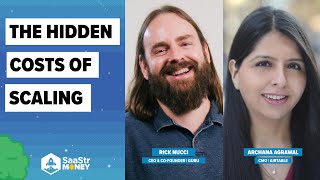
In this conversational session, Archana (Airtable) and Rick (Guru) share practical insights on scaling SaaS companies. They begin with analytics, emphasizing early investment in a clear analytics strategy, centralizing data to build trust, and enabling self‑service data while maintaining a consistent vocabulary. Rick recounts Guru’s early misstep of lacking a single source of truth during a Series A due‑diligence, highlighting how that jeopardized investor confidence. The discussion then shifts to internal communication, where both leaders describe a "golden rule" of asynchronous knowledge sharing and diligent consumption, supported by regular rituals such as weekly all‑hands, Q&A‑only meetings, customer‑led sessions, internal blogs, newsletters, and gratitude kudos. They stress the importance of a strong writing/memo culture to capture decisions and context. Finally, they outline repeatable processes for scaling: continuous improvement driven by frontline visibility, clear decision‑making frameworks (DACI, RACI, RAPID), and a robust onboarding system that balances autonomy with hand‑holding, using checklists, content repositories, and personal "life‑story" cards. The conversation concludes with actionable takeaways for building trust, communication, and repeatable processes in fast‑growing organizations.
Chapters
And as I learned more about how companies operate, I still found myself sticking very close to that origin, taking on closely related roles in the analytics space. So I'm also very excited about the topics we have here today as a result. In fact, that was my entry point into marketing, given the large role data plays in how businesses choose to go to market, connect with customers, build customer journeys. I spent over 7 years at Atlassian building and scaling the marketing capabilities for the company's high-velocity, low-friction model that they have of the online distribution model. And I feel like my career's come full circle here at Airtable. I now get to take the same power and creativity that's always inspired me, but I felt was locked in the hands of development teams, and now share it with the rest of the world as we bring Airtable's no-code platform to people so that more people can become software builders, not just software users. So thank you.
Awesome, thank you. Really excited to have this chat. So as I mentioned, Archana and I are going to talk through each of these together very conversationally. Let's jump in and let's start here with analytics. And so again, there are lots of areas that can be overlooked in the journey to growing and scaling businesses. And where do we want to invest earlier? Where do we maybe wish we did? And so we're going to highlight some of those firsthand experiences and learnings. So this first topic, as I kind of teed it up in the agenda, is on analytics. And again, we're talking about here, the insights and learnings and ability to instrument the business across really all facets. It's a team performance product. So, so important to get right. And as, as Archana mentioned, this is something that is definitely near and dear to her heart. And so, Archana, maybe kick us off here and just talk about some of your learnings around this really important topic for companies.
Yeah, surely. So I mean, it's such a huge area for early investment. I cannot speak to the frustration you feel when you know that you're draining time, energy, and resources trying to go from disjointed data to actionable insights. You should recognize sort of like the signs of doing something— like something needs to change. When you find that you're spending a lot of time on, let's say, inefficient ad hoc analyses, And when you start noticing that there's a declining trust in data, those sort of are the cues that, hey, something needs to change now. So the one lesson I'll try to sort of wrap this up in honestly is be very intentional with how you design your analytics strategy, going all the way from how your data teams are organized to the processes, tools. I'll share a little story. When I started at Atlassian, we had very fragmented analytics teams, right? We were just building out the analytics capabilities at that time, but marketing analytics, from product analytics, from sales analytics, data science, data engineering. And all of these teams really need to work together. And so we learned our lessons. We ended up centralizing, but there's no one size fits all. That was the right org structure for us. But I think more importantly, as you're designing your data strategy and your analytics strategy, think about what are the principles you want to see at play and what are the things that you want to avoid, right? And so the top ones for me, as an example, what you want to avoid is avoid creating these multi-hop rigid processes that end up taking forever to change when you need to move your metrics and need to change your dashboards, right? Because one thing is for sure, as your company evolves, the metrics you're using, how you're using the data, the definitions, all of that is going to evolve alongside with it. And what do you want to actually enable, if I could choose, would be sort of self-service data. So the folks that are closest to the business get to play with the data. They get to explore it, communicate with it, understand it, and are able to evolve it as they need to. Of course, you need consistent vocabulary around the data that you use for that. So really take that holistic look as you are trying to define what's the ideal operating model for your own analytics needs. Rick, does that resonate? Tell me a little bit more maybe about how you've seen that play out at Google.
Yeah, for sure. I mean, when you were first setting it up, you used the word trust and building measuring and instrumenting the business, that resonated in a huge way. And then the other thing I wanted to touch on too, to connect that, you talked about centralization and that one hugely resonates with me. I mean, I think a regret for me, all the way back in the early days of Guru was not taking the time to have that single source of truth from a data perspective from the beginning. And I'll share a story that kind of connects both of those. In 2017, we were raising our Series A and we closed that round led by Emergence Capital, who's been really just a phenomenal partner for Guru. And at that time, as we were building the relationship, this moment of trust that you're referring to, not only internal trust with our team, but in this case, trust and confidence with a potential investor, right? Who's doing due diligence, looking at your business. And so in our case, One of the things, and probably the most important thing at this time in our company's life that we were trying to answer and that Emergence, our future investor, was trying to answer is, is Guru a product that has sustained adoption? And our category that we are in, some folks will call us a wiki or knowledge management. There's lots of different products that address different nuances of what we solve. But so many of these products have just really poor adoption for lots of reasons we don't need to get into. But in this case, what we were looking to answer internally, me and Mitch, the co-founders, is like, hey, can we actually build something that people will build, sustain daily habits around? And so that was our analytics quest, was really doing that. And we were basically not prepared. I mean, I think we were seeing that conviction, but when we really got deep into that due diligence process, we effectively had to take some really critical engineering talent, off of working on the product, moved over to the analytics to build and actually prove out and answer these important questions. And it was, um, I'll summarize it by saying a stressful situation and one that if I were to do it over again, right, I would have committed. Because look, I think so much of, of what we're trying to do in the case of applying analytics to fundraising is, you know, we're setting the narrative for our investors of like, hey, here's what's important, here's what matters in terms of measurable outcomes that show that we're onto something, we're building something of scale, right? So yeah, totally, totally, totally resonates. Definitely a lesson learned. I think creating that trust, having that centralized single source of truth, can't stress enough the value and benefit of starting that really as early as possible.
Yes, that makes sense. A scary story, but I'm happy that it ended up sort of at least helping get the company aligned on that single source of truth, the trust. And actually, let's continue from right there onwards because there's another stakeholder group that that is so, so, so critical for, and that is honestly our own employees, our internal teams, and how we work together with them. So I'd love to hear about the journey of how that has evolved at Guru and what are some of the lessons you could share with us from that.
Yes, absolutely. So, you know, switching gears here into, you know, internal team communication and just how, you know, really how important this is for us at Guru. And of course, I am sure not alone in saying like the amplification around the criticality of team communication in a world where all of a sudden we're not in the same room anymore, 100% of us aren't in the same room, we're moving into mixed modes now of hybrid, the idea remains the same, right? Having that trusted, reliable, high signal-to-noise means of internal communication. I'll share a quick tactical thing we do and then Arjun, I'd love to hear how you've thought about this at Airtable. We've established something, and I'm happy to share more about this with the group, but we call this our golden rule of internal communication. And what we've really learned as a team is so much more of your time in this world, and of course teams that grew up remote would be like, yeah, of course, is around reading and writing, right? So much of what we do moves to an async mode from a sync mode. So much of what we do requires collaboration in ways that are not in real life, they're not happening over live communication. So what we ask of every internal, of every single employee at Guru is to commit. We call it a implied contract that if every single one of us does two things, that we will have the foundation for effective internal communication. And those two things are, number one, that you will commit to share your knowledge asynchronously, knowing that your team, your recipients, are seeking to digest what you have to share. You recognize that the audience you're sharing, you know, who you're sharing for, you optimize it for them. It's important to you that they understand what you're sharing. That's number 1. And number 2, you seek to digest the knowledge, the information that others have spent time preparing for you. And the way I like in this one is like, if you've ever scheduled a live meeting with someone and the other person doesn't show up, that's kind of how it should feel. It should feel a little bit like, oh geez, I sort of made this implied commitment. Somebody wrote something up as a pre-read, they sent it to me, I didn't read it. That sort of means the, you know, kind of the system is broken. So when it's working right and everybody's making that commitment, I'm going to share asynchronously using various tactics, I'm going to commit to reading what other people send me and engage in that, you know, that's really the foundation. So this is something we've done over the last, you know, couple quarters, and I think it's been a really effective way for all of us to look around at each other from an accountability standpoint and say like, hey, we're kind of here for this. How about, how about you, Archana? How, how have you thought about this? And how has it changed as you've scaled? I mean, you know, your company's grown so fast, I'm sure it's put a lot of pressure on the, on the, on the, on the, on the COGS to kind of get it right. How's this look for you?
Yeah, and not only happy to share, but one thing I can also commit to is it's probably going to change. As you, as you write, you know, we're all in this sort of, all of us are confronting these cycles of disruption and adaptation that's both whether it's the pandemic, the way we work, new business imperatives. And so it is going to change. The one way I think about this and what we've established here at Airtable is we create rituals around it, right? Cadences that people can depend on, safe spaces to ask questions. The business is growing so fast, very often, I mean, I would find I actually don't know something about a certain area of the business. And so, as you said, seek to understand and also share becomes very important. So things like we have, very routine weekly all-hands, sharing the agenda in advance. We have certain actually all-hands that are dedicated to Q&A only, but also creating the space where people can ask questions in advance of meetings and during meetings so that we can have an open dialogue. That's an important component of how we operate. And then the other is the writing culture. It's been big here at Airtable. It was actually very big at Atlassian, but it takes investment to get it right, to make sure that the writing that you have truly reflects sort of the decision decisions that have been made or the processes that are running. But we run a whole bunch of things in the form of memos. These may be strategy memos that come through during the annual planning cycle. Each initiative has its memos. Even our board documents are put in the form of memos so that everyone gets the contextual information that's sort of embedded in the decisions we make. And so writing certainly become a big part of our culture.
That's phenomenal. I love, I love the memo idea from a board comms perspective as well. And we had a question from I think you were talking about it, but you talked about rituals. I love that word, 'cause I think it does imply what it sounds like you're actually doing, which is this sort of repeatability and consistency. But the question was around like, are there new standards of broader team communication? You touched on it both, maybe like how frequently are you doing some of those? You talked about all hands that are Q&A only, maybe run through some of the ones that you found work really well.
Yeah, and so weekly all hands, all hands that are Q&A, and here's my favorite, all hands that actually have a customer coming and speaking to our teams because I mean, there's nothing better, as you probably know, just being able to connect to the customer and see your work actually take form and the productivity someone else is feeling in their lives. It has a huge impact, right? The other thing we have is, and I'll share this as a marketing team, we also have an internal blog and newsletter, and there's a lot that goes in that with respect to keeping everyone up to date, but there's also a special section there for team kudos, which is my favorite section, and it's about just saying thank you. Which we don't get to do often enough otherwise. But thank you for everyone that actually supports you in making it possible for you to get where you are. And I think those are the tiny things that I call rituals, but we come to depend on them and we come to make them part of how we work.
Gratitude, creating systemic ways to share gratitude. That's such a cool idea. I think that's one we might be taking forward. Okay, in our last couple of minutes together here, just to wrap up and talking about process. Again, what are the repeatable things we need to do for our work? We talked about some of them just now around some rituals around internal communication, but obviously there's so much more. And, you know, Archana, you've spent so much of your career, the types of companies you've worked at that enable this for their customers, you know, give us a bit of a sense of, you know, what are some of the learnings you would share as companies are scaling here?
Yeah, one that I think has also come up through in sort of like the other couple questions is that of change, right? Companies scale, their processes, the needs, they will keep on changing. And so I think the thing that I've worked on, and I think the thing we'd like to also promote, is that you need to be prepared for continuous improvement. And part of that is making sure that the employees who are closest to your processes get to adapt and improve how things work in real time. But so make it— make as much transparency available to them, right? They need the visibility to do that. In terms of performance transparency, what's working, what's not working, visibility and knowledge sharing and real employee involvement at the front lines so that those who are closest to the work can adapt these processes. So that's one whole aspect, I believe, of building repeatable processes that becomes important. The other one is making your decision-making framework very, very clear. So we've had a lot of success in adapting frameworks that I've seen before, where DACI, RACI, RAPID, like whatever might work best for your company and style, that clarity helps really a lot. And being able to have momentum around things and people aligning quickly.
Perfect. That's fantastic. Yeah, in our last 30 seconds here, one really quick process that we have found works extremely well is our employee onboarding process. And I asked our team, what do you actually like about our process? And I love this phrasing, and then we'll just wrap here. The balance of autonomy and handholding felt great. And what they're referring to is we have found what works really well as a self-service experience where employees can, you know, using a checklist-driven software and a content repository, be able to find and access general company information, role-specific information. We have life story cards that every single employee writes. Our team loves that because it's a great icebreaker when you get to know and meet someone for the first time. And as you see our scaling of hiring growing at a more rapid pace, having that system in place that we can rely on over and over again has really been Phenomenal.
Cool.
Well, that's our time. That went by so fast. But Archana, thanks so much for joining me. This has really been awesome. I've learned some things I'm excited to take back to my team. But thank you again for sharing your learnings.
Thank you, Rick. There was a lot of good stuff there. And thank you to the SAS team and audience too for having us here today. Thank you so much, Rick and Archana, for that great session. We have a couple more sessions today, so we hope to see you all in the next sessions. We hope everyone had a great session today and
More from Jason

Why Your Next Hire Should Report to an AI, Tragedy Apps, and Too Many AI SDRs? | The Agents #004

Our Agents Drove Our Salesforce Bill Up 80%, Marketo Hates Agents, and We Stealth-Churned Off Notion




Managing 20+ AI Agents: Lazy Agents, Our $500K AI Bill, Stealth Churn & the Death of 60% Solutions




