The Present and Future of AI in Sales and GTM with SaaStr's CEO and Owner's CRO
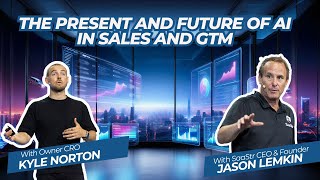
Jason Lemkin and Kyle discuss how AI agents are replacing mid-pack sales talent but not top performers. SaaStr has deployed 20 agents that outperform average reps. Lemkin argues revenue leaders face a choice: pursue triple-digit growth with intense hours or accept 10-20% growth for sustainability.
Chapters
Welcome to the official Saastr podcast, where you can hear some of the best Saastr speakers. This is where the cloud meets. Up today on the Saastr podcast. The reason we pushed the envelope and have 20 agents running now was because— and listen, criticize me— I was just exasperated with turnover. I was exasperated with overpaying, not helping, not working, and I just couldn't do it one more time in my career. Now, if I was you and I had a large team and I had $200 million I wanted to spend, maybe I would come to a, a different conclusion. So I'm pushing the envelope on how AI can replace not the best folks, not the best sales teams, not your team, but 99% of the world that can't hire your team.
Mm-hmm.
And it's better. This should scare people that don't wanna work harder and smarter than a year ago. Our AI agents are better than a mid-pack AE or SDR or BDR, better than a mid-pack. Not, maybe not mid-pack owner, but I've been doing this for a while. Better than the mid-pack people I've worked over my career. Not better than the best.
Hey, SaaSer, imagine having agents for every support task. One that triages tickets, another that catches duplicates, one that spots churn risk. That'd be pretty amazing, right? HappyFox just made it real with Autopilot. These pre-built AI agents deploy in about 60 seconds and run for as low as $0.02 per successful action. All of it sits inside the HappyFox omnichannel AI-first support stack. Chatbot, Copilot, and Autopilot working as one. Check them out at happyfox.com/saasr.
Hey everybody, SaaS Annual will be back May 2026, the world's largest SaaS and AI gathering for executives. Just this last May, we hosted 10,000 attendees with 68 VP-level and above attendees, 36% CEOs and founders, and 25% were AI-first professionals. It's the very best of S-tier attendees and decision makers that come to SaaStr Annual and AI Summit each and every year. But here's the reality, folks. The longer you wait, the higher ticket prices get. They're cheap now. They're cheap. So just get them early. Lock in your spot today. Use my code JASON100 for exclusive savings. Get your tickets at podcast.saastrannual.com or just use code JASON100 when you check out. See you there. SaaStr Annual and AI Summit 2026. It will rock.
Today's guest is, uh, the one and only Mr. Jason M. Lemkin. And Jason is one of the OGs of B2B SaaS. He runs, uh, one of the most important and prolific media companies in SaaS, which is Saastr. That's where I learned all about, uh, tech when I first broke into, into this space over 10 years ago. He's got the very best podcast in the market, which is Thursdays with Harry Stebbings on 20VC and Rory Oldrisko. which everybody should listen to every week. It is, it is a must-listen for me, including all the SaaStr content on their own feed. And Jason M. Lemkin has been an investor and owner since the very beginning. He led the seed round when Adam was probably like 17 years old or something crazy like that. And Jason has had a pretty prolific hit rate. And Jason's been incredibly helpful for me personally along, along my journey. To owner. And so I'm really excited for this one. And we're going to talk about the future of go-to-market, which you've been talking a lot about. So welcome, Jason. Thanks for doing this.
Thanks, man.
So one of the questions is the, like, recursive learning and, and like when you have all of these tools, one of this is one of the questions I'm grappling with today. So we've got OneMind and we've got like an SMS follow-up agent that we're building. We've got X and Y. How do you send, how are you thinking about centralizing the context engineering, the, the learning loop, because the, one of the questions we're asking is like, do we build one mega model of our own to power all of our customer journey from AI BDR all the way through to AI support? Or do you have a, a mix of all these tools, but how do they share insight from one another? Like, uh, have you thought about that?
It's a, uh, if you're as far as we are or further or where you are, it's one of the great questions you'll start to ask.
Okay.
And I wanna give you my answer before we go, just for folks that are gonna watch or listen, bear in mind, if you're not as far as we are, don't ask this question. Get a couple cool tools into production that work, get it going for 3 or 6 months. Then you'll realize once you get 3 or 4 agents working, not just one, then you'll have data conflict that you'll, they'll be answering questions inconsistently. You'll have trouble sharing data. And after 3, 4, if you have 3 or 4 agents in production for real that are working. Not complaining they don't work. If they work and you've done it for 3 or 4 months, you'll start thinking about meta agents. How could I have one agent manage all these conflicts and issues? What we're doing today is not that clever. We are using, for example, for outbound, we use Agentforce, Artisan, and Qualified. Okay. We use 3 and we, we may add more. We're, we're just basically taking our Salesforce database and giving each of them a portion of it. It's not that clever. And that requires Amelia, who is our went from our head of CMO and everything to Chief AF Officer. Now she's gotta manage 3 different segments of our base and use 3 different tools. It's fine, right? Because it's better than humans. Um, but we could, but they don't re— the only way they communicate with each other is by pushing data back into Salesforce.
Okay.
Right. And that's okay for today. Right. And in fact, there's been a little bit of renaissance, as you know, with Salesforce at It, this is both a negative for Salesforce and that the agents in some ways are more powerful than the CRM, but it's also a renaissance because Salesforce becomes the hub for all these agents.
Mm-hmm.
Right. So Salesforce is more important to us, right? But it's a big question that, that I have a lot of answers going into 2026, this Meta agent versus the human having to be the boss of all the agents. I think, um, I don't think we're there yet. At least we haven't figured it out yet. Maybe you'll figure it out ahead of us. And. If you're asking the question like, maybe we should build our own orchestration layer that is automated with AI. I mean, yeah, listen, more power to you and Love. And, you know, you guys have raised 9 figures of capital and have an S-tier team. I don't think that is the right answer for 99.8% of the world. It might work for owner, and I'd love to learn from you. It might work for us, but most folks should not think about— most folks should realize you need a nerdy human managing your agents. Someone that's a GTM nerd in a good way, that loves this stuff, that's quantitative, that likes to get in the weeds, that likes to interact with agents, that likes training, that loves data. Someone that just loves data. You need that. That, that is at the top of your stack and you're good and your agents will have conflict.
Okay.
Right. And, and, um, we haven't figured it out. Um, but you, like you said, we all quickly see this issue, but you've got to be in production with several conflicting agents to really feel this issue. So. You know, don't, don't put the cart before the horse.
Okay. That's really good advice. And so just going back a step for those who haven't been following us along with the podcast stuff, LinkedIn, Twitter, like just give them a perspective of how drastically your business has performed over the last 12 months and what you've built.
Yeah. As strong as the Saastr brand is, okay, this is an enduring brand. Okay. Helped hundreds of thousands of folks. Half the public B2B companies have founders love Saastr. Okay. It's still hard to recruit. It's still hard to recruit. We, over the years, I've desperately tried to recruit GTM folks. And first I tried folks that were refugees, right? They got fired from Owner, but I still knew Kyle and he, so I hired a bunch of like folks that were almost like Kyle, but got topped or fired. And I'm like, well, come hang out at Saastr for a while. Help me sell. And that was a, that was fun, but they either thought it was beneath them or had other issues and they quit. Okay. Then I tried to hire some kids, right? But they didn't want to learn, learn what we do or sell sponsorships. They, they, they, they just wanted to sell it. They just wanted to basically sell clay, something that was easy, right? Yeah. So we never cracked the code on our sales team, at least the way I want. I never had the stable, um, high-performing sales team. I had pockets of excellence, but it was never stable. So we go into May, Saastr Annual 2025. And, um, we also pay people really well, dude, really, really well. Um, and we had two folks on our sales team making very high six-figure salaries that just quit going into SaaS. They just quit. They just quit for no reasons, no notice, no reasons, just ghosted. And listen, maybe it was right of them. It sounds critical. I'm no longer critical. And Amelia and I turned to each other. We're like, we're going all in on agency, man. We're done with this. I am done paying an SDR $150,000 a year, an AE $500,000 a year. For basically inbound spoon-fed leads and renewals and quitting on me. Maybe you can be critical of me. Okay, fair enough, right? But I'm not like the worst boss. Like, I'm pretty loyal. You've seen me. I'm pretty grateful. I pay people well. I don't tolerate laziness or other things, but do your job with me. I'll stick with you for 20 years. And at this point in my career, I couldn't take it anymore. So I'm like, okay, Amelia and I said, listen, anything we can do in AI in May— and May is a long time ago now in AI, like, We're going to do it. We are going to do it, right? And the first learning was, so we just went around all the sponsors at SaaStr this year and we just said, who wants to help us? And Artisan was there and we didn't know what the right vendor was. Okay. And you and I talked to SaaStr about what we were doing and we were still on the journey, but Artisan said to their credit, like, we'll, we'll help. We'll do it all for you. We'll give you the right F4 deployed engineer and we'll do it for you. So, and this is a meta learning. We picked Artisan as our first agent, not because they were the best. They're very good and we can talk about it. But because there's a, there's a 2x2 of quality of vendor, but quality of FDE, quality of folks that will help you deploy it. Right. Okay. Another vendor, you know, I is nameless. We talked to their head of sales, argued with us. He was like, well, you've gotta pay us $100,000 upfront. We'll see if you're worth it. And then, um, I'm not gonna do anything until you agree to pay me $100K upfront. It, yeah. And then, and then I talked to the CEO later and the CEO asked me, why did we lose the deal? I'm like, you didn't lose the deal. But Artisan came in and did all the work for us, as did Salesforce with Agentforce, as did Qualified and others. So when you go to pick a vendor, pick someone that is the right partner with you to train and deploy your agent. We are not smart enough to do this. This is not SaaS of 2023 where someone buys a product and hopefully later in the year they get it going.
Mm-hmm.
With agents, agents are too much work to train. Every agent that you're gonna use in GTM, including Clay, including the rest, requires weeks of training before you can go live. There's a, we can talk about why it requires. So if you're not getting the help that you need, don't, don't do it. And ask to speak to your forward deployed engineer or your, or, or your solution architect or whatever it is. And if you can't talk to that person, just find another vendor. I would rather have a worse vendor and know who's, how they're going to deploy my agent than the world's fanciest brand where I don't know who's going to do it. Don't sign the contract until you talk to your forward deployed engineer or sales agent, right? So I mean, we're going off course, but then we just went all in and I'm like, we're not going to have SDRs we pay, you know, six figures for quit on us anymore. We're just done. And then we said, let's go read their emails. And like, some of their emails were just terrible. And then the worst one was like, we had, we had a senior SDR that we paid a lot of money for, made up to $200,000. And basically what this SDR would do is I would go on LinkedIn and I would see, oh, Kyle left from Owner. To go to, uh, to, to qualified, right? And qualified's in our ICP. So I would say, go follow up with Kyle. And the SDR would be like, I'll add it to my list and get to it when I can. And half the time, the SDR wouldn't even follow up. Now the agent just doesn't— the agent doesn't argue. The agent just follows up with Kyle. So anyhow, we, we— the reason we pushed the envelope and have 20 agents running now was because— and, and listen, criticize me, I was just exasperated with turnover. I was exasperated with overpaying, not helping, not working. And I just couldn't do it one more time in my career. Now, if I was you and I had a large team and I had $200 million I wanted to spend, maybe I would come to a different conclusion. So I'm pushing the envelope on how AI can replace not the best folks, not the best sales teams, not your team, but 99% of the world that can't hire your team.
Mm-hmm.
And it's better. And this is, this should scare people. This should scare people that don't want to work harder and smarter than a year ago. Our AI agents are better than a mid-pack AE or SDR or BDR, better than a mid-pack, not maybe not mid-pack owner, but I've been doing this for a while, better than the mid-pack people I've worked over in my career, not better than the best. And so we just don't need them. We're good. And so these jobs, these mid-pack jobs. They're, they're just in terminal decline in GTM, and you should be aware of it. They're in terminal decline. We won't need the mid— now there will be pockets, okay? And the hottest AI companies in the world can't find enough people to hire today. We could talk about that. And so they may absorb the mediocre, ironically, right? Because they have to hire so many humans, but step up or, or, or maybe find a new role.
That's sort of the Jevons paradox of sales, which, which I think people are stumped on. Like, if reps are so much more productive than ever, then does the— are the unit economics of an incremental rep so good that you're just gonna— you're gonna actually hire more of them? Like, our— where we are, we've— we have like 9 high-impact production use cases of AI. ARR booked per dollar out on, on a per AE basis is 3x any team I've ever managed before, and I've managed some pretty good teams. But the argument is not, hey, let's hire less reps. I'm hiring like 25 people in sales over like a 75-day period. But how do you think that that applies more generally to the market? Like, does, does a rep being worth so much more mean we hire more reps, or do you think this like mid to lower pack, these jobs just go away?
Well, let's step back for a minute. For, for how, how— I know it's different because it's different company, but if you had to try to normalize it, how much more productive on a dollar basis, on a quota basis, Is your, is your AI infused team today versus prior teams? Like how much more productive literally are they? Yeah.
3x. 3x.
Okay. I might challenge you on it, but it's whatever it is. It's a lot. Okay.
Yeah. So it's not like for like, cause we do month to month contracts and it's SMB.
But even that, if it were truly 3x, if it were truly 3x, I'm spitballing, you could probably get away with a 30 or 40% smaller team than before and still hit your growth numbers. Not, not a third, right? But 30 or 40%. So there's a little bit off in your, in your math, right? Um, because if you look at a lot of the AI leaders that are hyperscaling, they all have sales teams. And in fact, their leadership is the same people we know, right? I mean, the CEO of Slack that was at Salesforce for 14 years just took over as CRO of OpenAI. Okay. The CBO of, uh, of Vercel was the COO at Stripe. These are not like brand new people. These are the classic best B2B people we know are running AI companies, but for a variety of reasons, they are running them leaner. Some of it is because so much of the revenue is PLG, right? You know, if the first $300 million at Cursor was all inbound, same thing's true with Replit. You just don't need as big a team, right? Because you don't—
you—
so there's some reasons, some of it's cultural. Like if you have that much self-serve, do you want the headaches of a human-driven sales team, right? And then some of it is just assigning massive quotas, $2, $3, $4, $5 million quotas. The quotas, I mean, uh, the quotas at OpenAI for the enterprise team are pretty damn high.
Oh, I bet.
Yeah, they're really high and they don't have enough people. Like they don't have enough people, but they're really high. So I think there's a lot of confusing factors. If you're growing at OpenAI's rates or if you're Salesforce and you're repositioning your whole company for AI, you might hire a massive amount of salespeople. Um, but it doesn't mean that the salespeople don't have to be much more productive. So I don't think it leads to— it will only lead to more net jobs because AI is such a huge amount of our growth in our economy today.
Mm-hmm.
Right. If— I don't know how many sales folks are at OpenAI, uh, or all of them, right? All, all, all, and, and Claude Anthropic. But let's say they have 10,000 reps on their sales teams or could at the end of next year. Let's make up a number that might be too high, right? That's plus 10,000, but how many are we losing at the public companies growing 8% or 2%? Probably more than 10,000. So I don't think it's net positive for, for if the new folks are, have bigger quotas and are more efficient and the old ones are being relentlessly brutal on efficiency. I don't know that it's going to lead to massive job improvements. I do think that what will happen, and I wrote about this, the $250,000 SDR. I do think that the elite folks, the truly elite folks, not the ones that think they're elite on LinkedIn, the ones that really are 5 times, 10 times more productive for real, they should be paid compensation that is 2 to 3 times higher than it used to be. And this is already what's happened in engineers in AI, right? The average, you know, the, the average employee at Anthropic makes $400,000 and the average engineer makes $800K and plenty of engineers at OpenAI are making $20 million. But it's not, it's not charity. Like the productivity that they're expected to create is like nothing we've ever seen.
Yeah. The leverage is wild.
Yeah. Super high leverage. So traditionally in sales, there's been no leverage. Every year you've got to add more. In fact, there's been anti-leverage because it gets harder and harder to get that incremental dollar, right? For folks that crack the code here for real, which is not going to be most folks, but folks that crack the code, you may well find your way into a job that pays 2 to 3 times more than before. If you can have someone managing Instead of 20 SDRs, right? If you could have one human managing 20 agents, mm-hmm. No problem paying that person 2 or 3 times more than a traditional, uh, SDR director of outbound. Yeah. Like no issue. Right. But we're exp— but it's not charity. We're expecting 10x the productivity.
Yeah.
10x.
But that's probably not a, that's probably not a BDR turned agent manager. That's probably like a, growth PM or a data science turned GTME?
Probably. I think in the short term, like, there are no magic hires out there. We're going to have to look at our own teams.
Who—
and it might be someone, it might be that nerdy, uh, SDR that has a math degree that still joined Owner because it was cool and is like pretty good, right? But loves, like, loves all the data, right? And so Kyle says, I'm going to promote her. And then he promotes her again and she's running the whole thing, right? I think we're going to find just as many of these people inside. And if you put a job description on LinkedIn, I want a senior GTM engineer for our sales team, I think you're going to be unhappy who you get.
Yeah, we, we were trying to hire this GTM AI lead and it was really difficult to fill that funnel with people who, who had enough business acumen and, and sales savvy. We ended up hiring a guy who was at Atomic in the venture studio and like had started a couple of companies and so had, had the, had the business savvy, but just loves AI and loves go-to-market.
You need someone, they gotta love it.
Yeah. And he's ripping, like ripping through projects and shipping stuff. And we built our cold outbound email program. He built the infrastructure in like 3 weeks and like everybody else told us that was like a multi-month project. And it was just like, prompt layer and a bunch of models and he was writing some custom code and then we were sending 1,800 cold outbound emails every single day from all of these domains. And, and we had help. We, we had like Eric Nozewalski doing all the domain infrastructure and helping us think through it.
Okay. But that's a lot, dude. Like, like it is a good story, but most people can't do that.
Why not?
I just don't know if an ex-CEO that worked at Atomico that founded 4 companies wants to go to most startups. Yeah.
Yeah. Okay.
Okay. So again, going back to the beginning, I, I do love your stories. I want to hear 'em, but I, but I think I worry that people, like for most folks, I think they're, they're doing the opposite. They're putting up a job notice for an AI executive to manage this stuff. I actually think in 2 years that might work because we'll, we'll have veterans. We don't have veterans today. Mm-hmm. So when spaces change rapidly, you've gotta find the person on your team that's the AI nerd. Some folks can hire the person, but I just don't think most folks— and we talk to like a lot of CMOs, Amelia talks to a lot of folks come to advice. Okay. They do not have the capabilities to do what you just described. In fact, even worse, we just— Amelia just had a discussion with the CMO at a leading $10 billion company that, that is AI first, right? And they said, listen, we think we want to do an AI SDR tool. I'm going to buy it and just hand it to the SDRs to figure it out. No training, no anything, just, just had budget. So I'm gonna spend $400,000 for this tool and I'm just gonna give it to each SDR like, like we used to do with, uh, Outreach or Salesloft or Mixmax in the day. Here, go run your cake. And we can, you wanna, you and I will laugh, but this is a very sophisticated team at a $10 billion public plus public company. Just because that, that old paradigm doesn't work today.
Yeah.
Buy, buy Salesloft, let the reps use it on their own. Right. Yeah, maybe you can central. So, so, so most, like, it's just, um, uh, you gotta find that nerd, that GTM nerd that loves it, that wants to run it for you internally. And in fact, it is chomping at the bit to do so. Yeah. Chomping at the bit. Right.
That's, that's good advice. And so one of the questions I get, which is related here, is like, okay, my CEO says we want to do AI. And I want to pursue being an AI-native company, but like my CFO isn't really giving me the headcount I need. Like we've got, you know, he's giving me like one extra RevOps headcount. They're asking that team to figure it out. Yeah. I don't really have a budget for like a bunch of speculative tools. And I'm really, I'm surprised by the number of friends of mine working at good companies who are in this position who are like, I just like don't have the budget to pursue it. And I'm like, What are you talking about?
It's the wrong way to think about it. Okay. So, so yes, this is, this is a real story. Here's what you have to do. This will solve all these problems. Okay. Pick one tool that you, that, that, that you think you believe in, that looks like, that is, that is the easiest to, to deploy, that solves a medium or higher ranking problem. Okay. And for many folks, it is this AI SDR, but it doesn't matter. Pick, pick one problem. Could be RevOps, right? It could be— pick one tool, find one tool you believe in based on a demo and some research. Okay. And here's the second, just one that, that is easy-ish to deploy that you believe is, and that it solves a real problem in your org and then deploy it yourself. The first one is not about headcount. It is not about, but it is only about the budget for this one tool. You only need $50K, $60K, or $100K, which is not nothing, but find the budget. If you don't do it yourself, It's like, it's like hiring a CRO that's never sold, but it's not quite the same, but it's the same fallacy. 99% of folks we talk to, and we, we almost are like a free consulting shop. So many folks come to us at SaaS now for help doing this cuz of all of our data. Do it yourself, dude. Mr. CRO, Mrs., Mr. CMO, Ms. C, then they're flabbergasted. They haven't deployed a tool themselves, uh, in a decade or ever, right?
Yeah.
And you have to oversee it, pick the vendor, do the training. Understand, do you, do you even know what training is? Do you even know what a forward deploy engineer is? Do you know what ingestion means? Do you know how these tools are trained? Do you know what it takes? And it's only 30 days of work, guys. So you're going to have to take, it's going to take you 20 or 30 hours. Okay. Of those, of those, of those 30 days, you're going to have to make the time. And then my God, you'll be an ex— you'll be ahead of 98% of the world. You've actually qualified, trained, qualified, chosen, demoed, trained, ingested, and deployed an AI agent at scale, that is better than 99% of the folks talking about it on Twitter. They haven't even done it.
Yeah.
You do one, and then what you do is you walk back to your CFO and you do what we do. Hey, we just sent 70,000 automated emails. They're better than humans, and it generated 15% of the revenue for SaaS for London. 15% of the revenue.
Wow.
Can I have, can I have some more budget?
Okay. Sure.
Yeah. Do it yourself. Pick. And the other mistake is sometimes people try to do 5 or 8 tools at once. Of course you need a lot of budget and a lot of people. No, do it yourself. Roll up your— guys, no one— we stopped rolling up our sleeves. Okay. I'm doing it too. At this point in my career, you can see I'm still rolling up. No, like literally and figuratively. If you don't roll up your sleeves in the age of AI and AI GTM, you will become obsolete.
Yeah.
This is not an agency game. Not today. Maybe in 24 months. This is not a game of, oh, I've got my new job at Owner as CMO. I'm gonna bring in my 11 agencies from my last job that I used in, in, in, in the aughts. Mm-hmm. Okay. Here's my 11 agencies. I've got my, uh, Salesforce agency and my outbound agency and my left-bound and my right-bound agency that I used in 2015. They're all gonna fail. Yeah. It's, you are the agency for now, just for, at least for the first, at least for the first one. And once you've done it, because literally if you haven't trained an agent, and it's not that hard, take almost any agent, it's basically the same thing. You, you, you point them to your, to a database. You could even just be a, your website in the base case. You upload your prospectus, you upload some documentation, then you upload some more. Okay? And then out of that, most of these agents will create a list of questions, right? Or sample emails, 10, 20, or 30, and you iterate them and they A/B test them and you talk about it and you see what they're wrong. And when they say, you know, Owner, Owner is great for 100-chain high-end restaurants, that's wrong today, isn't it? Yeah. So you, you X out that question. You say no, owner's side, owner scales much more than it used to be. But our core audience are smaller restaurants with a handful of a single location or a handful with a significant amount of to-go business. Right. And you just keep going through those questions and iterating them. And then you, then it'll, if it's email-based, it'll start sending the emails and you have to read them for an hour or two every day and see what's wrong. You have to do it yourself. No agency is going to get this right. And this is what you, no agency is even going to really know what you do. What's that?
This is what you were doing with Artisan or Qualify.
Yeah. And you need to do this as Mr. or Mrs. CRO or CMO or VP of sales, or you can't hire someone to do this today. Maybe later, maybe later. And HubSpot hasn't figured this out with its AI training. That's why, like, like basically half of HubSpot's, um, agencies are obsolete because they can't work. If you listen to what Yamini said this year at Inbound, she's like, we're radically, we're going to put, we're going to get more and more revenue through the channel. But we need different agencies. The agencies at HubSpot back in the day, you'd go, you'd walk, you'd have your local group and they'd hook up HubSpot and they'd, you know, they charge you basically 1x or 2x what HubSpot did and they'd hook it up and, and get your basic campaigns going for you, right?
Yeah.
This is now work for training an AI on all of your customer data, all everything, and making sure it's all automated and it works. You gotta do it yourself. And once you do it once, and even I was intimidated. The first one we did at the start of the year was a general agent called Delphi, which makes digital clones. And we were early on this and I saw that Brian Halligan and Lenny and a few others did it. So I just bought it. I'd never ingested or trained data, right? And I had to do it myself. I did it every single day for a month, every single day, first thing in the morning. Yeah. First, even me, first thing in the morning, wake up, see what, see what the agent said, see what's wrong, and then just start editing it and changing it. And the agents, like, this is the beauty to it. It's the hive mind. They remember. Yeah. And every day it gets better. Like, for the most part, they do— they remember everything you tell them, and the hallucinations become a minor issue, if at all, as you train it more. But if you don't do this, you're gonna— you will have no idea what you're talking about. Like, literally, you will be utterly ignorant in the age of AI. You got— you did it, and I did it. And then I did it, and I proved it to Amelia, and Amelia did all the rest of them, right? And she's better and smarter than me, but I had to do the first one even in our little org. To make, to, for it to make any sense. Cause I didn't know to tell her to go do Artisan.
Yeah. And, and it's funny you mentioned that because I, I didn't do this all that intentionally. It was just like, we were a small company and I like this stuff. So Momentum was one of our first AI implementations and I was in there writing prompts and writing custom fields in Salesforce myself. Cause I, I implemented Salesforce on my own way, like way back in the day. And so like I knew how to go into the, admin view and create fields and add them to layouts. And so I was just in there playing around being like, ooh, like what can I know about my business tomorrow? And I would build a field, think through, all right, like how, what's, how do I wanna structure the data? And then write the prompt in Momentum. And then I would, it would run like this was back before they did backfilling. And so then at the end of the next day, I would have my laptop open after the kids went to sleep and I'd be like, oh, I'm like really excited to see what's in these fields now. And I would, I'd look at a report and I'd look at what's in there. I'm like, oh, like it missed this. Or like, I see my prompt was like too basic, or I need to point it at this other thing. And I was just doing it because I was interested. Like I took a Replit 100 Days of Code course and I was playing around with that. And then it just like, it was of interest. But now, now I fast forward and we've got this like AI lead and my head of RevOps is like incredibly AI savvy. And so I'm much I still take a bunch of demos and I'm thinking through the broad strokes, but I'm not anywhere near as close.
But you did the first one, but you got the first agent going yourself.
Yeah.
That's the thing. I will, they're not all gonna be as nerdy as you. They may need a little bit of help. They may not do the replica course, but you did it yourself. You, you trained it. You, you, you, you went from evaluation to success yourself.
Mm-hmm.
Every day you were reviewing that until every, here's the key. Every day you gotta work with the agent. Until it works reliably. Yeah. I'll give you another fun example. Like, so we, I like Momentum and Attention both. They're, these are great apps that for RevOps, right? Buy one of them. You recommended it back to the day and we had a tiny team, right? So we decided to use it, but we just sort of put it on the, we didn't pay any attention to it. Right.
Right.
Didn't think it worked. Did we? Didn't train it. We did no work. This is not the fault of the vendor. We just didn't have, like, we're like, okay, we got 4 people on our sales team. You know, now we have less, we have agents, we're like, eh, RevOps is not a big problem, right? And then it was the classic issue that, that, that, that you brought up and Marshall brought up. Finally, finally we're like, why is this thing not working? And we're on our team Zoom and we have this sales guy, AE, that we're paying extremely well. And he's like, we're like, we're not seeing any of your data from own. And he's like, well, the app doesn't work. We're like, okay. Okay. Shame on us. We never put in the time. We never put in the 30 days. So we, we kind of complained to them that it doesn't work. And then I'm like, I just put him on live on the Zoom. He's like, why not working? I'm like, Do you see that Google link at the bottom left? You gotta link up your account. He's like, I don't really want to. And he links up the account and it showed he'd done nothing for 30 days and he quit that day.
Wow.
So there's a lot of interesting stories. Marcelle had the same story at Mango Minute when she brought it in. Someone quit that day too because it showed the lack of activity. So it's a recurrent story. Um, and it's interesting, but sham— but like we thought it didn't work and it didn't work until I went to, we, we took the effort to have this one guy just hook it up that now we rely on it daily. Right. But that's an example of even us, because we went from 0 to 1 and then 20 agents. For us, just RevOps was not as high on the priority as it was for you. How many folks do you have on your sales team today?
Hundreds.
Okay. So at 100, RevOps is one of your top 3 priorities, right? In some ways it's number 1, right? That and recruiting in some ways are number 1 once you have it dialed in, right? For us, it's like, whatever. If our, we got, you know, we don't have our process dialed in. It's not, it's not like I got 99 problems. So, so we didn't train it. We didn't do it. And so. It failed. The deployment of that agent failed until we had the aha moment that the reps hadn't actually hooked up their accounts to it.
That's funny.
Shame on us. But now we rely on it constantly, right? Now we love it. Many folks that will watch or listen will go through the same thing. Like, they'll buy a product, put it on the shelf, never really get it deployed, get the agent going, get it trained, and they will say it's a failure. There are so many— there are many reasons we had the failures of the AI SDR failures in 2024 were all LLM-based in my experience. It didn't work. The products didn't work before. For Claude Ford. They didn't work.
It was slop.
Yeah.
Yeah.
It was slop. There was no point. Now they're, they're, now they are above the line. They're all above the line. So it's the, the, the reason they fail today is that people don't roll up their sleeves and train the agent themselves. And if that sounds intimidating to you, how do I train an agent? Right? Like, this is not something you learned at your last job, right? Going back to our point, then pick a vendor, pick a leading vendor. It honestly does not matter which one you pick today. And talk, bypass, tell the sales rep. I literally did this the other day. I want to talk to my FDE. I want to talk, like, great, I don't even need to do a demo. I want to talk to who's going to help me deploy this agent, right? Um, I'm still waiting to hear back from the rep, so that tool will not be one that becomes our 21st agent. But, but be kind and just say, literally, I want to get on the phone with Jason M. Lemkin or whoever it is and, and show them what you're doing and have them walk you through it. And, and then that, if you get that partner you'll realize that training and ingestion and orchestration and all these nerdy concepts are mostly just making sure your data is uploaded to a website and that you, and that you answer a bunch of questions and that you read outputs every single day for a month. It's that simple. You can do that. We know how to upload. We know how to use websites and we know how to read and say this and tweak, tweak text. It's not as intimidating as it sounds on the, well, everyone throwing around big fancy words like training and ingestion. It's, oh yeah. Yeah. It's like, no, these are at the end of the day, these are all SaaS apps, my friends. They're just SaaS apps that have an LLM hookup to them and they look like SaaS apps. They smell like SaaS apps. Their GTM teams are SaaS people. So you can do it, but don't, but, but just understand what it means. Don't be intimidated by, by what we're saying.
So I want to double-click into picking vendors because we have similar, I think, opinions on, on this. So you're mentioning like pick one thing, make sure you do it really well, be careful about vendor selection, implement it yourself. But I think one of the things I get asked about the most is like, where do I start? Because people are sort of freaked out by AI BDR now because it was all hot and then now everybody thinks it sucks because the—
why are you thinking it sucks?
Because everybody's like, oh, outbound is dead. The email, the inbox is dead.
They're wrong. But where to start? Okay, so listen, I don't believe that. We could talk about why. If you believe it, great. Don't pick that first. I'll tell you the lowest hanging fruit for 98% of folks out there. I know I use different nomenclatures than some, is adding AI to inbound. My God, then this is just, I said at SaaS Europa, there is no excuse today for you not to get instant answers to your questions. There is no, there is no excuse on planet Earth for some 21-year-old, uh, SDR to qualify me whether I'm worth their time to talk to an AE. There is no need. We use qualified. It doesn't matter what you pick. You go in, it answers just questions on the Saastr Annual website. Anyone can try it. Go to saastrannual.com and talk to the digital Amelia, video, text, audio, however you want. And she'll just ask you what you're interested in. And if you want to spot, buy a ticket, sponsor, ask us what, if you want to sponsor for us, it will automatically qualify you. Oh, Kyle, great. You're interested in sponsoring. Where do you work? Owner, restaurant industry. You know, honestly, Kyle, that's not our ICP. It's not a good fit for you. Okay. I work at an AI B2B company. I work at Replit. That's a perfect fit for our SDR. Can I connect you with David right now? And it does the whole Calendly scheduling, which is not, which has already been done, but it instantly connects it with the qualification so that that lead is qualified in the moment. Any time. Yeah. And so if you want, if you think about it, okay. And I advise everyone at any, any senior level, any one of the management team or founders, slow it down. Go to your website in incognito, in a fresh mind, and try all your journeys. Try, see how good your support is. See how good your qualification is. If you have a brutal contact me, see, see how much you like contact me. Where does that contact me go? Into ghost land?
Hmm.
See how good your support is. Would you wanna buy your product? Be honest. Is this a slam dunk? Right? And so fix one of those things. And literally, if we can talk forever about outbound SDRs, it does work. But even if it doesn't for you, I guarantee 99% of you, your inbound process is an F or D. It's not okay with AI. It's not okay to not have all my core questions answered day or night with no lag, with no delay, answered really, really well. And that I don't have to talk to some 21-year-old kid that doesn't even know what the product does before I can talk to a rep. It's insulting. It's insulting to my time. And I just won't do it. I don't have time anymore in the age of AI. I don't have time to set up a call next week. To see if I'm worth your time.
Yeah.
Right.
And so how would you more conceptually think about like picking the first use case? Is it, is it going back to like, what are the business priorities? Is it just like actually zone in on what AI is good at now? AI is good at support. It's good at inbound. So like, those are the easiest places to—
Maybe not good. I would listen, you could do either of those things. It could be what you're passionate about. That's always a good first place to start. What do you care about? Like you were into the RevOps. So that's what you did, right? If you're, if you're a little nerdy like us, pick something you're passionate about. If you have no opinion, do the clean look at your website, do the incognito from scratch, new email, new domain, and see what breaks your heart.
Yeah.
And do that one, the one that breaks your heart. Stuff's even on SaaS or website stuff breaks my heart. I literally, you know, I literally, I can't tell you how many websites, like, you know, we've been a Brex customer for years. I tried to get an answer question in the bot. I couldn't get any question outta my bot. It's terrible. It breaks my heart, right? I had another fintech I tried to use. I got an email back saying I would, I would get a response within 48 hours. Go fix that problem.
And how do you recommend people look at that decision, either using the AI within their current stack? So like I have Intercom, I'm adding Fin, or I've got Salesforce Agentforce, or going to the like insurgent startup that's like ripping 10x year over year.
Yeah.
What's your advice there?
This is a good insight for, for Amelia. We talk to folks all the time. We do so many consulting calls. We don't used to do this. And they're like, I'm, I'm doing a 10-vendor bake-off.
Hmm.
Okay. Not only did this not work pre-AI, but in the AI age, when you have to train an agent, it's just not possible. So pick 2. Pick, pick, listen, if you're already, if you wanna try Agentforce and Finn because you're using Salesforce Intercom, great, terrific. And then pick one hot startup. Not just because it's hot, but because honestly, someone like you is using them successfully. Ask for references for real. Kyle will respond. Everyone I talk to that's like you, they're getting, they're getting like 50 reference emails a month.
Mm-hmm.
Right.
Just don't ask me for time. Yeah.
Just send me an email and I'll give you an honest answer. Yeah. So just ask.
And I will hit function on my keyboard in Whisperflow and I'll like dictate a 4-line thing in 30 seconds and I'll give you your answer.
I think Michelle from Manglement says she gives, she does like 10 or 20 a week. She gives them a one, a one-word answer, but that's enough, right? Find out. And so just do the two and just do it and just try them both and talk and find out who's going to. And that's enough because here's the honest truth. Like there are differences, right? And, and, and, and Intercom is great at showing how Fin is better than Decacon and Sierra and like, and, and, you know, who, which, what, who cares? They're both, they're all so much better than pre-AI. That what matters is can you get into production? It doesn't really matter. There, these, and these tools are evolving so quickly that during 2026, they're going to get so much better that that's going to lead to convergence and it's going to lead to, uh, you know, it used to be years before vendors would have feature parity right now. Now we're down to weeks. Yeah, we're down to weeks. So it's a journey you're going on. So just, and they're all, they're all all the leaders, if you can get them trained, if you can get them into production, they're so much better than before that just pick the ones that's the right match for you. It really doesn't matter.
And make sure that they can support deployment.
Yes, support. It really, it does matter. And I actually, I honestly think that as we all get smarter and as we deploy our 21st and 25th agents, we can focus on minute feature differences that frankly will, they'll all clone each other in weeks, right? But right now, when it's a step function, right, it's like, get a great one into production and just do the one that's the right fit for you and don't be overwhelmed. And we list, if you go to saster.ai/agents, we list all the ones we use. You can see them and we have lots of data, saster.ai/agents, pick any of them or others that are leaders and just go for it. Right. And, and do, but 2 is enough for the bake. I don't know why, but we talked to so many folks that are doing bake-offs of like 10. And I guess it's because people are confused because they haven't done it before.
And they wanna see it all.
And yeah, in the old days, your bake-off would be the one I used at my last company and the hot one today. You do a two, two, right? And you'd pretend to look at the third. I genuinely think people are trying to do 8 to 10 vendor bake-offs, but it's, it's, even if you could train them in an hour, you still couldn't. But if it's, if, think of if it takes you 30 days to have to really train it, you can't do 10. Yeah. You, it's impossible. Yeah.
And so one more question on this, like incumbent versus startup. You know, like I was pretty harsh on Salesforce a few years ago. Like when I was at Shopify, they were trying to like sell us a bunch of Einstein stuff and I had to stop the meeting. I'm like, guys, like, don't, don't, don't do this bullshit with me. Like, I'm, I like, you know, I know I'm only a sales leader and you probably think I'm a dummy, but like, don't try to hoodwink me with Einstein. And so I was a tough, tough customer when I was at, at Shop. And now we are like leaning into Salesforce more than ever, which I am personally surprised by, I was surprised that you were leaning into, uh, AgentForce as well. So like, my question is like, is Salesforce sort of back with AgentForce? Like, is this like a real thing in your opinion?
Well, I think there are two different questions. Is Salesforce back and is it because of AgentForce? Um, I do, I do think the experience that you and I are both having, I mean, I don't, we don't have the exact data, but you and I are both close to folks at Salesforce in the Unfortunately, they call it SMB, but it's really startups and tech and stuff. It is, it is booming. That, that, that group is booming, right? Yeah. I don't think it's entirely because of AgentForce, because AgentForce was early. I do think some of it though is related to AI, which is that it is, it's the hub for your agents.
Mm-hmm.
And listen, no knock on hubs. Pre-AI, we didn't need an agent hub. And HubSpot blew up because HubSpot figured out, you know, when, when you and I started in all of this, HubSpot, you know, first of all, HubSpot didn't even have CRM. Then it was only free. Then it kind of didn't work for more than 20 or 30 reps, right? And then it got to the point pre-AI where like, we know folks that have 1,000 reps on HubSpot and they're super happy, right? And a lot of folks would do it. They were marketing focused, right? But it was— and I would do this thing at SaaS Strategy, raise your hand who's on HubSpot versus Salesforce. And as the years went on, all the hands rose for HubSpot and Salesforce got crowded out. But now it's swung back and it's not because the lead contacts and opportunities are better. It's this hub. And when you, when you have 20 agents working autonomously for you in sales and RevOps and marketing, they need a hub. And Salesforce is the hub. And, and maybe the simple reason is that it may be as simple as the fact a lot of the early breakout leaders, and it's still early, right? These products, there aren't a lot of, here, here's an important point we may run out of time with, but it's so important because these agents require training because they require forward deploy engineers. I am not aware of any great products that are $29 a month. Yeah, I'm excited for this for late 2026, 2027. I'm excited for the next frontier. But all these products are like $30,000, $40,000, $50,000 and up. Okay, $100,000 and up. And listen, if you're at owner scale and you're replacing at the end of the day, right? And they're growing like a weed. So we're investing a lot of these products and they, and they, and they, they, they need this hub. And that hub is Salesforce. It is the database. It is the repository. It's where the agents meet. Where their data meets. And so we need Salesforce. And so I think now that's not the same thing as AgentForce. AgentForce is Salesforce's own agent, which we can talk about if you want before we run out of time. I think we're one of the few folks that are in production at AgentForce and competitors and close things that are close to AgentForce. It's pretty rare that I think there's gotta be, I mean, next year there'll be a lot. Today it might be a single-digit number of people that are like us.
Yeah.
AgentForce is new and AgentForce is one. Agent you can use on Salesforce. And I don't think on its own it explains the, the renaissance for this audience. I think the renaissance is that Salesforce is back as where your agents connect to.
Yeah.
It's just so important that you have a single source of truth for your data, that you have clean data, that these agents are, are pulling from the same data. They're pushing their learnings, their cus— because for us, like, we have 3 different AI SDRs working with 3 different segments of our base. They've got to share all their learnings back into Salesforce, right? And they share, and it's wonderful. And it's a virtuous circle. And so, um, it also is a stickier moat, right? It's a stickier moat. The tough part is we pay more for those agents than we pay for Salesforce, which is an existential question that Mark and his team are thinking about because yes, Salesforce is more valuable, but the agents are even more valuable than Salesforce. So Salesforce is getting a glow up, but the agents are extracting the majority of the value. That's why AgentForce has to win. That's why Mark has 2,000 people. Working on it. Um, long-winded answer. I can tell you if I had to summarize a lot of learnings, Agentforce is more work to set up than the rest of the agents.
Mm-hmm.
But it is good or better in production. It is as good because they're all good. Okay. All the good ones are good. They're all kind of the same. The emails are pretty similar, right? It is better because that native integration with Salesforce data, it turns out actually is better. Yeah, it is better. So if, It's hard. Salesforce is very enterprise. It has a, it's a $45 billion company, but if Mark can get even more folks working on AgentForce and making it more turnkey and rolling it out to everybody, it's really going to win because it's the agents as good as anybody, as it should be. Right. I mean, Replit and Lovable, they're both great, right? They're all Momentum. They're all good, but it does help to have the native data rather than syncing, trying to get it. Have delays, have syncing issues. Like Salesforce is a wonderful platform, but we just have to have the data. The native data works better.
Yeah.
Yeah.
We're in this, we're in this place where we're looking at some of the sprawl and thinking about how you keep it all together and sort of that master orchestrator agent. And, and, you know, like a bunch of the conversations, like, man, maybe this is actually rolling back into Salesforce and back, rolling back into Salesforce agent force and, and the, you know, the simplicity and we We've been impressed with, with what I've seen. And honestly, I'm, I'm surprised that I've come to this opinion given where I was, you know, a few years ago and where I felt like some of Salesforce's new products—
we were surprised too. And it did take longer to deploy for a number of reasons than, than the startups, right? But it's just as good in production.
Yeah. And you've got the security and the data and the governance, which, you know, at our scale, we're thinking a lot more about and This means, listen, if you want, here's, here's, and we might have lucked out.
We might have gotten a little bit of the A-team because we do have a brand, right? But if you're interested in Agentforce, I'm sure it's not going to be hard to get your rep on the phone, right? Um, no. Find out if you're, if you're, if you, if you will get an FDE. They use the term FDE at Salesforce, the Forward Deployed Engineer, and talk to them and talk to them. And the good ones will be honest. Like we do know the Qualified team pretty well. I'm sure other vendors do this, but what I really like at Qualified is Um, it probably helps that they have a lot of inbound demand, right? They ruthlessly screen customers out that aren't a good fit.
Ruthlessly.
Mainly the ones that just don't have enough data. It doesn't matter what the, what if ARR is, if there's not enough data to have the successful deployment, they won't take your business, right?
Enough website traffic.
Yeah, they just, enough traffic too, right? They just literally won't, doesn't matter what you'll pay and they just, they don't, they don't want to, and kudos, kudos to everyone in AI that does this, right? Yeah. So. I don't know if you'll get that from Salesforce or not, but try. See if you get an FDE. If no one will talk to you, then, because it's a big company, then just don't do it, right? But if you talk to the FDE and they go into your Salesforce instance and they look at the amount of data and you say, we can get you live in production in 45 days and here's how it will work. I would, I would probably take that bet.
Yeah. Okay. Last question. So this is a revenue leadership podcast. So what advice do you give to us? Like, do we have to get more aggressive? Is it about swinging? Swinging for the fences more, is it about, or the opposite, you know, making the money last?
Well, here, here's a, okay, here's the brutal truth. I think like everything in the age of AI, things are bifurcating. So I think for revenue leaders, you, you really have two choices. Work even harder so that you can be above triple, triple, double, double, right? Work even harder so that you can approach or exceed the growth rate of an owner, right? Because people are looking for massive outcomes and that requires massive growth. You can't have massive outcomes without ma— it's always been true since the dawn of time. Okay. You can't have one without the other. If you don't want, if you're not, if you don't personally want to sign up for that, or you don't believe in it, honest truth is join something slow growth. The folks growing 10 or 15 or 20% a year, either public companies or private companies, they need people too. And it's not said aloud, I don't think, but some folks are quietly making a lifestyle choice. I met, I met, I saw CRO at SaaStr annual this year that I hadn't seen in years, but I've noticed since I, She was my customer, so I've known her since I was a founder a long time. Like, how's it going? Like, I got this new role. I'm like, oh, that's an interesting one. Your last company got acquired for a billion something. I'm like, yeah. She's like, you know, we're at $50 million growing 20%. I think that's pretty good in today's climate. I'm like, maybe we're— I don't know which parallel you like. I— so she was happy.
If you're burning no money, sure. Yeah.
What's that?
If you're burning $0.
Yeah, burning $0. She had a good cash comp. Um, it was the right amount of pressure for her. Like, her taking the company from 20 to 25% growth was probably a big win for the year.
Mm-hmm.
I think, I think people should be self-aware that maybe, you know, if you're not willing to step up in today's AI age, which is so much faster, so much more committed, so much faster, honestly, maybe join something slow growth because that, that, that, that, that we all basically, you know, in, in the 2020, 2021 era, we all lived in this magical middle ground.
Yeah, you could have it all.
Not work. You could have it all. You could have lifestyle, quality of life, work from home, work 20 or 30 hours a week, exceed quota. For a lot of structural reasons, that doesn't exist anywhere, Teyma. Even the fastest growing startups, they're either lean or they're back in the office or they're high intensity. There just is that, that middle's gone.
Yeah.
Right. That middle's gone.
We were talking about this before we, we turned on the record, but even at Owner, even with all the tailwinds, even like, you know, I have a, awesome team and a bunch of amazing peers, still working as hard as I ever have.
You know, like, I'm working hardest I ever have. Yeah, me, I'm working the hardest I ever have, right?
Are you having the most fun though? Because I am, I'm actually having a blast.
I don't, I don't, I'm still, that's a very metaphysical question. I'm still struggling to I find in startups, whatever, whatever area it is, whatever you're doing, community, investing, founder, executive, I find this, you and I are very different. I find the fun is, is, is, is, is in the recordings. The fun is in the past. It's not in the present.
Hmm.
The fun is looking back, laughing about the time when it was your first board meeting and I was beating up your COO who said he was going to raise $40 million on his own single-handedly. That's funny now. It wasn't fun back then, was it? No, no fun now. I know you're at a special time in owner. So we were talking about this before. It is genuinely fun to be scale accelerating at your scale. It is genuinely fun. But for me, the fun is, the fun is in the memories. The fun is in the recordings and the videos and the photos. And if you walk into our office now at Saastr, which is a wall of agents, they're just empty desks and me and Amelia at one end with all of our agents in between, but you'll see 4 huge monitors in our office, which are just photos of Saastr going back to 2015. Right. And so those are fun. So every day I walk in and they're on 4 different memories, right? So I think, I know this sounds crazy for revenue folks, but, uh, but sales leaders know this. You, if you've ever had a great sales team, right? Which you have now and you've had in the past, you'll look back and you'll be like, man, that was the best team ever. Right. And those sales teams are friends for life and they, and they work together. So enjoy the present, but, but, but it's okay if fun is the memories. If you're looking for fun in your job in the age of AI, I find it, I, I find it incredibly stimulating. Like, build— like, I just built this app. Try it for fun for folks to watch. It's called vaporsell.ai. Vaporsell. It automates sales training. It's really fun. I built it in a couple hours. I can add owner if you want. You can go in and you can literally sell Harvey, Replit, Cursor, and ChatGPT Enterprise. vaporsell.ai.
Cool.
It has a tongue-in-cheek one where you can simulate it, and then it has a real one where I uploaded 100 of the toughest questions for each one and trained you as a rep. And the fact that I could build this in a couple of hours, it's pretty cool looking, isn't it?
Yeah, this is, this is pretty sharp.
It's pretty cool. Like, how can you not think this is an amazing time? Like, the internet was kind of like, you know, when the internet really got going, it was fun. And then SaaS was amazing. Like, wow, we could, two businesses could exchange data and do stuff interactively online. But this is like 50 times more exciting and interesting. But the rate of change. Man, I just, I just invested in this startup and I love it. Right. It's so good. Well, and they're great. They're going to crush it. They blew up their first month. Right.
Yeah.
But now they have 5 clones in the first 60 days. Now it's either going to win, but that type of stress, like, is that fun? Yeah, I guess it's interesting, but it's, it's, it's, it's, it's, it's, um, the good news is like 24 hours a day I'm thinking about AI. I'm having fun with AI. I'm doing stuff. So it's very engaging. But for me, fun, fun, fun is in the past. It's not in the present.
Yeah, makes sense. I think that's a great message to leave on, you know, like if you want to sign up for the venture scale, more than triple, triple, double, double, double, then be ready to work harder than you ever have. And if not, you know, take a different path and just be fine with less comp, less upside, less, less whatever. But I think that that's, uh, be honest about it.
Like, don't think this is— I know people think this 996 thing is somewhat toxic, but it's more a signal. Like, if you don't want to work at that intense pace, if you don't want to be thinking about work 20— so many folks, you know, they still want to end the day at 4 or 5 and log off for the day. And let's not mock that. It is— we're human beings, right? But pick your path in this, in the age of AI. Yeah. Pick your path. Pick your path.
That's a good message. Uh, Jason M. Lemkin, well, thank you for doing this, man. This was awesome. We hit all the stuff I wanted to get into. This lived up to my expectations. So appreciate it. Appreciate everything you do for us. And me personally, I know I'm a broken record. I say this all the time, but I want to put it on the pod one last time because, uh, I, I can't tell you enough how much we appreciate it.
Thanks, my friend.
Hey, SaaSer, imagine having agents for every support tab. One that triages tickets, another that catches duplicates, one that spots churn That'd be pretty amazing, right? Happy Fox just made it real with Autopilot. These pre-built AI agents deploy in about 60 seconds and run for as low as 2 cents per successful action. All of it sits inside the Happy Fox omnichannel AI-first support stack. Chatbot, Copilot, and Autopilot working as one. Check them out at happyfox.com/daster.
More from Jason

Why Your Next Hire Should Report to an AI, Tragedy Apps, and Too Many AI SDRs? | The Agents #004

Our Agents Drove Our Salesforce Bill Up 80%, Marketo Hates Agents, and We Stealth-Churned Off Notion




Managing 20+ AI Agents: Lazy Agents, Our $500K AI Bill, Stealth Churn & the Death of 60% Solutions




