The Secrets to Closing Really Big Deals with Sequoia Capital India, Sequoia, Vymo, and Insider
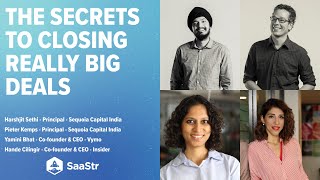
Sequoia partners interview Vymo and Insider founders on landing major enterprise deals. They discuss pilot design, land-and-expand tactics, pricing evolution, and building enterprise sales teams. Key insight: over-invest in early pilots to create internal champions who push adoption across the company.
Chapters
broadcast. Give yourselves about 10 seconds and then kick it off.
Great.
Let's get started.
Hi everyone.
It's great to be here for another day of SaaStr. Thank you for joining us for our session, The Secrets to Closing Really Big Deals. We have two exceptional founders here with, with us today, Yamini of Waymo and Hande of Insider, and they're both building amazing SaaS businesses in different industries. But what they have in common is from the very early days, they managed to close some exceptional logos, get some really big clients to sign up for their service and pay large ACVs for it. And through the course of the session, Peter and I will asked them a number of questions to learn the tips and tricks from the trenches as they went about and built their business. I'll just start off with quick introductions. So my name is Rajiv Sethi. I'm a principal at Sequoia Capital. I lead investments in early-stage businesses, spend a lot of time on SaaS, and work closely with our investments in companies like Waymo, Freshworks, and Darwinbox. Prior to Sequoia, he was an early employee at Dropbox in the Bay Area. Then I'll pass it on to Pieter to introduce himself, and then we'll go through the round of introductions.
Hey, thanks, Harsh, and I'm glad to be here. My name is Pieter Kemps, originally from Amsterdam but moved to Singapore about 15 years ago. I've always been on the technology side and was one of the first employees for a Amazon Web Services in Asia, helped build up that team very focused on the startup and venture team, and after that joined Sequoia as the first employee in Singapore about 6 years ago. And again, just like Harsh, focus on early-stage investing with a focus on SaaS, working closely with Hamdi at Insider and the team and many other SaaS businesses in the region. Yamini.
Hi, I'm Yamini. I'm a co-founder and CEO of Waymo. Um, the company has been around for about 6 years. Prior to that, I used to be a consultant at McKinsey. Uh, Waymo is what we call a personal sales assistant. It layers on top of CRMs, uh, to be able to drive productivity of distributed sales teams. We focus exclusively on financial institutions, for example, banks, insurers, wealth management companies, etc. Vymo is a mobile-first solution that can automatically capture sales activities and engagement, use that to learn what's working for the best reps, and use that to create a bunch of nudges that can help an average rep actually replicate the behaviors of a top guy. Vymo serves about 40+ large enterprises, almost 125,000 salespeople use it. Leading to about 15-20% improvement in their sales outcomes over a 1-year period. Super excited to be here.
I think it's my turn. Okay, cool. Thank you very much for introducing us as exceptional founders, Harshid, because we have also 2 exceptional investors here, I think. Thank you very much for including us in this session. I'm Hande, one of the co-founders and CEO of Insider. Insider is a growth management platform, and what we are doing is we help enterprise marketing teams to unlock the growth across the funnel through acquisition to activation, retention to revenue. And with what we're doing here, what we are doing is we deliver personalized experiences across different channels, and which is combining personalization with AI and machine learning technologies predictive engine at its heart. We have 550 people in our team. We have clients from 24, 25 different countries, and including the both east side of the world and the west side of the world. We help actually global brands across the globe to grow, and we are working, currently working with enterprise clients including Fortune 500 companies, and from the different verticals including e-commerce, retail, media, automotive, aviation, travel, and more. That's the brief about Insight.
Cool, thanks. Let's, um, let's get into it. Um, uh, Harsh, if you can go to the next slide. Um, I think one of the things that's interesting when it comes to SaaS is there's lots of discussions about it that treats SaaS as if it's one big thing. I think most of us here realize that it comes in many forms and many shapes. And I think some of the numbers here on this slide show that in an exceptional way, right? If you just look at the difference at the $1 billion revenue mark, what the difference was in revenue per customer and the number of customers to achieve that $1 billion, you see two very, very different ends of the spectrum. And it's not just the average revenue per customer, the number of customers, but also what that means for the focus of where they spend their efforts and their money, right? You know, if you look at Atlassian and ServiceNow, sales and marketing versus R&D, it's almost a direct opposite. And I think that is a very interesting thing. And if you think about closing big deals, is that very important for Atlassian? You know, maybe not so much, but is it important for ServiceNow? Like, absolutely. And I think what's interesting is you start thinking about these different ends of the spectrum, that it's not just the numbers that you see on here. It goes through the entire organization and every aspect of the business is different between these types of archetypes, SaaS organizations, as you can see on the next slide. If you think about it— Art, if you can go to the next— if you think about it from a product point of view, for example, I mentioned I worked in the early days of Amazon Web Services. Which is obviously very much self-service from acquiring customers to onboarding them, how they configure the service. Is there configurability on that side? Absolutely, but all within the standard product, right? There's no non-standard integrations, no non-standard services or implementation, etc., which for someone like ServiceNow is completely different, right? And, you know, Harsh, maybe you can talk about some of the other aspects here.
Absolutely. As Peter was mentioning, you know, across the sales and product stack, you know, many differences, whether you're going after enterprises or you're going after more self-serve motion. So, you know, at Dropbox, you know, when you thought about the buyer, of course, it was a freemium product and people would upgrade. But, you know, as I think about, you know, businesses like Vymo and Insider, you know, oftentimes to make the large sale, Multiple CXOs need to be bought in into the idea of what the service is providing. There's multi-threading needed. Similarly, from a marketing perspective as well, many influencers, whether it's partners to the company, whether it is targeting folks in the organization through digital means, but also showing up to the most relevant industry events and trade fairs and positioning yourself as a leader in that particular domain versus, you know, think about something like Freshworks, which relies in large part on digital acquisition, has, you know, strong presence on Google through SEO and SEM. The marketing motion is, is very different. And from a sales process as well, you know, obviously the, the time to convert some of these deals varies dramatically. In the case of an SMB sale, often the buyer, once qualified and shows up on the, on the website, it's about answering the immediate question that they might have to purchase your service, versus in a large ACV deal, you often need to be a trusted advisor to the organization, to the particular CXO that's signing off on the investment, and really convince them about the opportunity. So like Peter mentioned, I think, you know, as companies make the choice whether to go after a more SMB-driven product and sales motion or enterprise-driven product and sales motion, many things in the organization need to be very different. To ensure success. And so to kick things off, you know, as we know, there are many paths to success, but we have two founders here that have made the choice to go enterprise. So I'd like to start off with asking Hande, when you had the choice of going after a more SMB-driven base versus going more mid-market enterprise, How did you make the choice? Why did you decide to go after larger customers and larger ACVs?
Sure. That's a great question. But I think the answer— there are two different types of answer for this. One is quantitative, I think. The other one is a little bit sentimental. So quantitative part is maybe about the ARR, or recurring revenue. Which is the most important metric for a B2B SaaS business. And for the businesses like us, reaching $100 million of ARR bar is pretty much critical. I like one of the sayings of Jason M. Lemkin. He says that if you reach $100 million of ARR, then anything will come automatically, IPO, exit, whatever it is. So first of all, to us, Being ambitious about reaching this level of revenues was important. So this is why we believe that we can reach it in a much more faster way by going after the enterprise clients. And it's totally different game, obviously, the way that you sell your product, the way you build your product, what to build, what to develop, what not to develop. And while doing so, we have a motivation, we had a motivation to add value to world's global brands. We wanted to work with the top brands, making their lives easier. And this is a little bit about the sentimental part of the thing that you would like to concentrate on the enterprise side. For many startups, obviously, it's very tempting to hunt elephants. You know, I think most of the guys here, since they are pretty much interested in B2B SaaS, knows the very well-known also graph for the enterprise versus non-tails. Deer versus elephants, and it was also very sexy for us to go after the elephants. These are really massive customers. It's tempting on many levels, building product for them, doing their onboarding, changing their lives, helping them to grow. This is the sentimental answer, so this is why we have chosen to go for the elephants instead of deers.
That's a great answer, Hande, to sort of combine both the rational part as well as the sentimental part to come to a decision because the journey is a lot about passion as much as it's about the numbers and the ARR and everything else. Thank you for sharing that. And then I'd love to ask Yamini about one of the first large ACV deals they close. We've been lucky to have a ringside view of the journey for the last couple of years. And today Waymo has many Fortune 1000 companies as customers. But I know sort of the early days and closing a few of the large banks in India, that was a big achievement and the team was very proud of it. So Yami, any one of your sort of very early deals, what was it like to close it? What were the things you did as a very young startup with not too much credibility. How did you go ahead and close this? If you can just share a little bit.
Yeah, so our DNA—
I'm coming from a consulting background at McKinsey, somewhere I found it easier to speak to CXOs of large enterprises while building a product and building with them in a way hand in hand over the first couple of customers, right? So that naturally took us towards that DNA. Secondly, given we were playing in a world where CRM was quite a big deal and catching momentum, We had to add— when you say you're improving sales excellence and productivity, you'll have to pick an area where you can show that productivity in terms of real ROI impact fairly quickly in POCs, etc., as a startup, right? And driving sales productivity by learning what the best reps are doing, you need to have enough volume of best reps to be able to learn anything from.
So somewhere volume led to intelligence led to impact.
And we moved more and more towards the large accounts with large sales teams, and that's how enterprise. Initially, it's all very interesting. Our first deal was actually a 5K pilot, right?
And we were really wondering what pricing would look like and how would we even get there. And it was very interesting. This was actually, it came off as doing a ton of like Target sponsor emails, some of them responding, one of them being a really good early adopter. They had tried everything in the book, including, all kinds of tricks on salesforce.com as their CRM, etc. And their problem remained. We went in, we did a pilot, we over-invested into the pilot. We tried to do everything possible, product, non-product. Honestly, this was like the first 6 months of the company. Half of the things we did were outside the product off the back of Excel on analytics to tweak, fix, and make sure that they had sales impact. They had 25% increase in lead conversion over a 6-week period. Many people say when it's startups without much credibility that try to break into large enterprises, the usual line to laugh at is no one gets fired for maybe in this world, you know, one of the big cloud CRMs. In our case, our sponsor did not get the approval because this client was on one of the largest cloud CRM platforms, right? He did not get the approval. He actually put in his papers and said if he was not to get Waymo, he would not take up the year's targets. On sales productivity improvement. And it was a bit of a shock. We thought it was stupid of him to do that, but he did it, right? And he actually got Waymo in. That's our first— that's the first way. So over-investing and driving success for the customer, proving value, building your heroes within the account. You cannot fail them. Today, the same account is $250,000 for us, and this stakeholder took us to another account, which is $250,000 for us. All of those have been critical. The surprising story was the second deal was actually an RFP. The third deal came from, I think, one of the Azure and AWS Startup Momentum runs. The fourth deal came from a very different partner, like a consulting partner who had two years, over two years struggle with driving sales impact on a CRM deployment and brought Waymo in because they run out of options for their customer. The fifth customer, major enterprise customer, came from an event and In that 6 to 12 month period, we realized that, you know, ours is not— our door opening is not going to happen through Google AdWords and content marketing and amazing blogs. It's going to be very strictly influencer marketing in a very niche set of influencers for our vertical and people that our customers meet and trust, right? So that set the tone for how we would even scale from there.
That's fantastic. Lots of different channels. And I think, you know, this first person was very instrumental in in helping us also realize the specialness of what you guys are building, you know, the 25% improvement that you guys saw, I think, from, you know, I think back to our investment, that was at least something that, you know, stood out in my mind saying, you know, if the company can have this type of impact at a large customer this early, they must be onto something special. So very interesting. Thanks for sharing that, Yangmin. So as we get into, you know, this, let's talk about, you know, let's dive a little bit deeper. Let's talk a little bit more about the actual tactics that, you know, many of our attendees can hopefully take back and implement in their own companies. And the first one I want to touch upon is pricing for value. Yami, you spoke about this briefly. You said about sort of the 5K pilot, but, you know, as you sort of think about the early days of company, you know, the balance of power is clearly with the large customer, right? You know, they're saying, hey, we are a big bank or a big insurance company. We have a really amazing logo that the full world recognizes. If you get us onto your product, you know, it'd be great for you. So many others will sign up. So give the service to me or give the product to me effectively for free, or, you know, I'm gonna pay very little. How do you navigate that? You know, how did you price initially and how sort of that journey on pricing evolution been as the company has progressed? And what should early founders do when they're confronted with, you know, similar situation? They have an in, into a large customer, but now they aren't getting sort of the pricing they think they deserve.
Yeah, a bunch of different things there, right? Firstly, I think two lines we hear very common amongst usual large enterprise first five deals scenarios is the client saying, you're lucky to get a big logo like us, you should be doing it for free because you can get PR off the back of this, right? And some clients, potential prospects, actually saying, you know what, forget about me paying you, you should actually give me equity in the company.
Those are two, I personally feel, distractions.
And it also depends on what the nature of your product is, right? If you were, for example, a Dropbox or a Box and you started in the SMB segment and there's a freemium version and you can give it to someone in the enterprise to play with, that's one story. From day zero, Wyno was a product which focused on driving end sales impact. So there is something around change management and adoption and configuring to your context for intelligence to kick in, right? So we knew that we had to invest to understand the customer context within that 6-week period and prove success, right? And the biggest problem would be if the customer did not think of it that way. So putting a price to a POC became important. Now what price you put usually depends on what you can get under the radar without too much of procurement and approval process being involved. But even getting a dollar out of an enterprise usually requires them to reveal their buying journey to you. And you realize as the POC is going on, you can work on the 10 things that you know will be required for the bigger deal approval, right? You can already start working on those champions, the procurement team, the CFO, whoever they are, as the POC is going on. You don't have to later discover that. We've always believed in pricing for pilot. The pricing itself varies, right, our first pilot was $5K.
We close pilots in Japan today, just 2-month POCs which could be $100,000 USD.
It depends on the size of the problem and the effort required to show true impact within the POC but do not compromise on that. Early days do not overly worry, get them to put skin in the game whether it's $5K or $50K, same market, same customer today would have probably paid us $25K and $50K for a pilot. So Don't overly worry, get them to put their skin in the game. Post that when it comes to the deal usually if you're in a market where there is an incumbent standard that you're trying to improve your pricing will get pegged to the incumbent. And in our case the pricing always— the question always was if I'm paying only this much for the CRM why would I pay you more. In which case our whole strategy and this is where additions are born probably but you don't have to overthink that on day 0. Initially, our strategy was to give as minimum as possible for that price. Give what it will take to show success. Don't overpackage your solution. Don't talk about the 20 features that they don't want to upfront pay for, right?
Get them— get in at a competitive price so that they don't have to debate that. And over the year, show them success. At the end of the year, when you show them that their journey naturally requires them to upgrade to 5 other features which is value-adding for them, it's much more easy to extract value in that pricing rather than fight the battle on day 0.
All right, so that's me.
That makes a ton of sense. And then, you know, on that point, which is pricing for expansion, Hande, I would love to hear from you. Getting the initial pricing, of course, is very important, but also making sure that as the client expands usage of the product, you're able to extract more value. So what did you guys do on that front and go about?
First of all, pricing, I think, is still a challenge also for Insider, and Peter pretty much knows more about this. Even at this scale, at start scale-up phase, it's a challenge. We still believe that maybe on some, for some of the deals, we are actually leaving money on the table. So we are still working on that, it's still a challenge for us. In addition to that, I would like to maybe mention a couple of things about the early days pricing, which might be valuable for the audience. For the very first days, when you prioritize growth over profitability, you actually most of the time accept that you might do kind of very right, not very right pricing. And Gross margins still may not be the priority in the very early days. If you are pretty much concentrated or focused on the fast growth or blitzscaling, I think this should be the case because you can compensate it later on by trying to give the same price. Of course, there will be some challenges. For example, for the existing clients, you might have to do grandfathering, which is going to bother your gross margin anyway in your P&L. But at the same time, It's going to mean that you are going to bring more accounts in a relatively shorter time. These accounts is going to be references for the others, and it's going to help you for blitz scaling or for the fast growth. So we did this. Yes, it caused challenges. Even now we have some clients, very old clients, belong to 6 years ago, who are— that we have grandfathered. We have to, and this is why they are still paying maybe not at the level of the prices that we are currently offering to our new clients. So this is the first thing for the expansion. I think this is one of the issues that we worked also with Sequoia and Pietro a couple of years ago, the logic of bundling, the logic of do the pricing based on the product, which can be subject to expansion and trying to land with a specific product and expand in time in order to also shorten your sales cycle is an important strategy. Especially if you have a platform company, not maybe if you are not a point solution or if you are not necessarily selling a specific product, which is not the case for us. We are a product company, sorry, platform company, and expansion revenue is important to us. Currently, 30%, almost 30% of our revenue is coming from expansion. And in order to do so, and also again for the fast growth, we land with a specific product and we do the pricing accordingly. In time, without bundles or with different expansion products pricing, we expand, and this is actually different type of pricing methodology that you need to work on.
Yeah, and maybe use that as a segue, right? Like pricing is one tool to think about, you know, how to land and expand, and you just talked a bit about that. But there's obviously many other things, right? And it has a lot to do with how you structure your organization, How you set up your sales management team, whether you give them a quota on expansion or not. Hande, maybe continue chatting a bit, but talk about beyond pricing what you've done, because I know that some of your largest accounts have actually taken a very different path to become large deals. You know, some might be around product expansion, the other might be more around regional expansion. About that?
Yeah, exactly. Sure. For example, when I look at our top 3 ACVs, maybe it will not be very proper to mention the names here, but 2 of them have started like with $300K or $400K, you know, ACVs, and now they are like, you know, more than million dollars of deals. How did it happen? As you mentioned, Petrich, one of the expansion type was about product. We start with a specific product. On top of that, we have also actually expanded within the account with selling them new products. By the way, for that story, it's very important to have chargeable products. You should continue to grow your product base, and you need to have chargeable products. For example, inside Insider, we have 18 chargeable products. And you know what, we see it as a gold mine, because once you have products for an opportunity to grow your expansion base So that's great. Second expansion type is geographical expansion. I think I can give the name for this. For example, Estilada for Insider is a global deal in Europe and also in some part of Asia. We are working with 19 different URLs and we start with one specific country, which was France that time, and we have expanded in time with the different geographies. Generally, that kind of brands doesn't actually make the decision from a one center, or it's not like a united decision. But what they are doing is, if then you are, when you are going to show your return on investment or the value that you add to incremental sales, incremental revenue, then the other country also takes as a success story or use case. And then you easily, much more easily, expand the other countries by the help of those success stories. The last thing is, I think, even though if you're a platform company selling many products, I think one of the advantages of the new generation marketing tools— I call ourselves new generation marketing software tools— like us is an easy integration, easy operation, and first time to value. If your first time to value is relatively shorter, then it's going to mean that your expansion both in terms of the product, both in terms of the geography, if you are going to expand with the same brand, then it becomes much more easy-ish. Because if your integration is going to take 6 months, after that if your onboarding is going to take 7 to 8 months, it should take more than a year for your first expansion. But for Insider, the average number, average days to expansion, first expansion, is around 60 days, which is, I think, a great advantage.
So 60 days from your first sale to immediately go up.
Exactly.
Gotcha. Okay. No, that's interesting. And so, you know, the regional approach and going to other countries is one approach. And maybe it's an interesting segue to the next piece on like how you can be global from day one. And different companies obviously make different choices when it comes to whether they stay in one country very long or immediately expand. And what Obviously when you're in the US or other large markets, your domestic market is much larger. You can stay focused on that country for much longer. Some of the countries here in Asia, we don't have that luxury, or for that matter. Yamini, how have you approached that in terms of deciding, you know, you started in India but you quickly started focusing on some other markets. Can you share a bit more about your strategic thinking around that?
Yeah, so we focus on financial institutions and given again, it's a tool that claims to drive not process improvement but actual productivity and sales outcomes, the product needs to have a lot of depth both on the vertical context as well as how it uses data from that context. So we found the axis— I mean, there are multiple axes of expansion apart from within an account, right? Within an account, it could be new lines of business, new additions of the product, better pricing, more users, etc. But beyond your existing accounts, it could be a new vertical, it could be a new geography, Right? It could be a new product line. For us, we find that in large enterprise, usually large enterprises are not happy with all the vendors they work with. When someone comes with a SaaS product and can show value like Hande was talking about within 6 weeks, within 2 months, right? Get you live, show actual business impact, delight end users, then it becomes easy to sell something into the same enterprise. So definitely if there is an adjacent product product you can build, embed to sell, that's an easy 20-30% uplift on revenues, right? Outside of that, when it was a geography versus a vertical question for us, given we were serving sectors like insurance, right, the customers are heavily referenceable. For example, an AXA in Singapore would know the AXA in India, would know the AXA in US, right? And therefore, the geography access becomes easier on early customer wins. Uh, it's easy to go and find a champion elsewhere. Sometimes your leaders move, sometimes they put in a good word, you get references, right? Scaling is a very different question on building local teams, having the right teams, etc. But the geography access on breaking into becomes easier than having to build a whole product proposition for a new vertical. So in our case, uh, we took the geography path, and given we were focused on financial institutions, we picked cities which had the highest concentration. Mumbai for us is critical. Middle East has potential, but the largest markets would be, from a density point of view, would be markets like Tokyo, markets like Hong Kong, and that became our natural path for expansion.
And maybe the last thing that we should touch upon before we move into Q&A from the group is you know, building the team. Of course, as you know, we start off the session saying the enterprise DNA, whether it's on product, whether it's on marketing, whether it's on sales, it's actually very different. And you have to be strategic about the types of people that you bring onto the team that are able to reflect this. Hande, would love to hear from you. You know, how have you gone about, you know, picking leaders for the business, what are things that you've learned in this process that others can also try and imbibe in their business?
Yeah, well, I don't want to violate your pattern, but if you are going to allow me, I would like to say also a couple of things about the mentality of being global or global mental— a global way of thinking from day one. Can I do that, Arsh? Just only a couple of additions.
Sure, sure, and we just, you know, we wanted to move quickly to the Q&A also, but you want to just touch upon it, please go ahead.
Only a couple of things. I think again, it's like, you know, something action-based and also mentality-based, because, you know, once you have this mentality from the global, from the day one, then actually you achieve it. Even starting from your website, the way that you communicate within the team, and if you have a replicable expansion model to other countries. And once you have also zero optionality, because some markets are pretty much small, then you have zero optionality than going for other markets. And while there is no big investment needed for, for a cloud business like us to go to a new country, maybe just in 6 years like us, you can go to 24 different countries, and it should be something scary. So coming to the enterprise DNA side, Yeah, I think this is a totally different game, as we mentioned. And what we have done is, actually, we had different trainings, different people, different approaches to the enterprise sales and sales cycles. For example, we have a sales development, sales enablement team who are training our salespeople, and we have specific people especially for enterprise sales. We are trying to grow them nowadays, And our sales enablement team trainings for those enterprise salespeople are pretty much different than the others. And it also requires a different kind, type of approach in terms of the, you know, call duration, how you should manage the, also the relation between the potential leads, or let's say prospects, because without any touch base with the C-levels, with your prospects, I think it's very, very difficult to close a deal with an enterprise version, with an enterprise account. So, and you can— it requires different type of, again, approach, and it requires different type of action at the end of the day. And this is why enterprise team, who is— who are doing the sale, and their DNA is totally different from the others. One last thing about the— about those teams, and the product itself, although most of the time can be used by, directly by our customers. It requires a lot of training at the beginning. So you need to have also different onboarding for our, for a product company like us, because the features and the, the product itself is broad. So once you are actually giving this trainings to your account, to your enterprise accounts, they need also a lot of support in the very first days, and you need to provide it to your enterprise accounts anyway. So not just for the sales part, also for the customer success and the first onboarding, you should have someone who is pretty much, you know, close touch base with the client for the onboarding processes. And I think especially for Asia, and also even in Europe, in US, localization of the customer success teams are also important for the enterprise accounts success.
Makes a lot of sense, makes a lot of sense, Hande. Thank you for sharing that. So, guys, you know, we have a couple of more questions we could ask Yamin and Hande, but we'd love to hear from you, like what are sort of questions on your guys' minds. So if folks can, you know, just type any questions they have, we'll pick a few and get folks to answer them. It looks like we have a few questions. Peter, do you want to—
Yeah, we have a few questions. First one actually came in very early in the conversation already, and it's actually quite relevant. The question is from, from Kirsten asking about when you close like these early large deals, do they start with pilots? You know, how long are the pilots? How do you structure that, etc.? I know we do a lot of that in Insider, but Yamini, you also spoke about pilots early on. What I'd like to maybe hear from both of you is perhaps not the unique ones, but what— is there a playbook? Is there a best practice, one or two tricks that you can share with the audience?
Yeah, I can go first.
So what we—
the idea of a pilot is to show proof of the piece that the customer is most concerned about, right? Sometimes a large enterprise might be very concerned that you have no way to integrate with their legacy systems because 3 other vendors failed in that, right? And actually showing a simple integration probably solves the problem. Sometimes it's that they have never seen a CRM adopted beyond 20%. They won't believe that your solution can be superior. So you need to prove that out. The important thing in your sales cycle is to know what is exactly bothering them. Is it a technical issue? Is it an adoption issue? Is it an outcome-related capable issue, right? And keep the pilot as small as possible. The one thing you need to know how to package really well is a pilot. Ideally, we try not to set expectations of anything more than 8 weeks beginning to end, starting from understanding requirements all the way to executing the pilot and presenting results of that. If you can crack— we have tried to crash this to 4 weeks when we have known it's just a technical concern, right? Can you integrate with our legacy systems with file transfer protocol, etc., right? So minimize it. And how do you convert them to large deals? Usually have the expectations set on day 0, even before you get into a pilot, that You know, this would have cost me a lot, but I'm doing it for $10K. But if ABC happens, here is the pricing per user. And here are the terms, 3-year contract, upfront payment, pricing per user. Are you comfortable? Because if you're not comfortable, we don't need, neither do you need to waste time, nor do we, right? Show the commitment by reducing the cost of the pilot, but be extremely clear on what your post-pilot terms are.
To me, I believe— Yeah, I believe in POCs, but I don't believe in free POCs. I think, as Yaminia mentioned, the POCs time, if you are going to give free POC, should be as short as you can give, because once the time becomes longer, then expectations changes. So this is why what we are preferring to do is if you are going to pay a little bit longer, give it a little bit longer POC for a month, for 2 months, 3 months, then it's never like a free POC. Why we call it POC is pretty much dependent to agreements and its duration, etc. And for the free POCs, if you are going to give that, what we are trying to show is only to prove that, okay, the integration done. You can see the product is working and that's all. Apart from that, since the time to first value for our product is pretty much short, we expect them to see the value in a relatively shorter time, and we shouldn't need any long POCs for showing this or proving this to clients.
Great, thanks. Very, very useful. There's one other interesting question here. Hande, you used the word grandfather earlier on, and there's a question here that says, how should you approach a grandfathered-in client who keeps asking for discounts even though he or she already has a great deal? I think the broader question around customers that are super price sensitive, keep asking for discounts, how do you deal with that? My initial gut feel is around like, are you, is that the right customer for you in the first place? How do you qualify? But I'd love to hear your opinion on how you deal with that.
I think the way that you deal with that type of customers also pretty much dependent to what stage you are. If you ask me this question 2 to 3 years ago, I would say still, still growth over gross margin, maybe. And I would say maybe we should be a little bit more flexible because we are pretty much focused on growing the customer base. If you ask me this question now, I would say yes, I can make an exception for my very old clients, but this exception shouldn't be like, say, you know, creating a bottleneck for me to sacrifice for more gross margin. So for example, instead of 70%, 75%, 80%, I would get 60% from this client. But there should be a threshold that you should define and say that, okay, I'm not going to get less than X gross margin for any client. I think if you are going to reach a client base that can be— that can still bring a solid growth for the company, you should be a little bit rigid about keeping a specific gross margin level even for your existing clients. If you have already grandfathered, plus they are also asking for a discount, then I think you should walk away at that stage for us.
Yeah, Yamini, you want to comment?
Yeah, we have a simple trick that we have decided to try during every renewal. One is just show them what the cost structure is, because typically, at least your cost on Azure versus what you can present to them can be very different, right? Or like, you can show, prove to them the cost of servicing is high. But most importantly, we give clients one out. We tell them, we'll hold your PUPM constant. Yes, you were our early customer, and thank you for doing the 5 case studies with us, but we want a minimum commitment to double up in terms of users. You want to keep the pricing, you double up, because Usually these accounts have a lot more users they can bring on board, and we have had clients actually take that option during renewals, which means that they will have to get one more line of business into the deal, right? And that eases our expansion a bit because once they sign that, it's actually some cost for them. They need— they might as well maximize the usage. So that's one trick that's worked.
Good, thank you. Thanks for sharing. There's one other question here. And I think, Yamin, in the beginning you mentioned that one of the deals came through your partners. I know, Hany, there's different types of partners that you work with. I know in AWS, when I worked there initially, because it was self-service, it was much less focused on partners, but at some stage they started doing that. Obviously the Oracles and SAPs of this world are very partner-centric. The question here is, How are you guys partnering with any complementary international distribution partners and how do you approach that? So I think the slant here on the question is very much on international, but other than international, like, you know, in general, how do you work with external partners either in the sales process or the service delivery process or otherwise?
Yeah, I think I can. Yeah, go ahead. Go ahead.
We don't partner for delivery yet. We are probably a little bit too small to overwork ourselves on what it takes to support a delivery partner yet. On sales, yes, we do, because many of the large institutions that we target, usually their entire mandate on sales tech, for example, could be handled by a third-party consulting partner, right? One of the Big Four technology consulting partners, etc. They themselves have their own awareness and sales cycles with you. The most important thing is this is part of influencer marketing. They need to be firstly aware of exactly the problem you solve and when, uh, when you should be stepping in as a solution, right? So awareness is very important and you over-invest in that. Second thing that it is very important is no one will do it out of the goodness of their heart. It's not possible, right? You have to have a very clear case for how they will make money. These consulting partners make money based on the number of people they can staff. You are a SaaS company that reduces the time it takes to implement. So you'll have to build the case for how they drive impact for the customer, how they can actually use data coming from your tool to do something else, how there are still deeper integrations that are possible. So the story you tell the customer is actually opposite to the story that you tell the partner— the fact that they can staff more people and make more money. And you have to be very clear about the case. It's not— you can't go and say, we are a SaaS company, we'll get your customers live in 2 weeks. No, that doesn't work with consulting partners. How would they make money? So that's important. Just one tip over there, uh, it's a virtuous cycle. You have to win your first logos by yourself. The partner is not going to give it to you. It's their credibility at stake. Once that happens, the partners, if you are driving awareness and a value prop for them, they will come anyway. So do not overly hedge on partners for your first couple of wins.
Thanks, Hamdi.
Should I go for the same question or should we switch to another one?
Yeah, no, that's fine. We can, we can switch the other one. I think there's another interesting one specifically around building the sales team. We spoke briefly about the DNA when you build out your team, and again, this is a topic that I see in many SaaS companies, is do you hire when you start building out your enterprise sales team Do you hire new employees or do you train existing team members? And I think the broader question sometimes is like, how do you think about the best profile for enterprise sales? Are they domain experts or are they sales experts or how do you approach that?
Yeah. Again, great question. I always believe in the power and the potential of the generalist. If you have hired a sales guy at the beginning or the first years of your company and if he's really successful and if he's carrying a potential to be a good enterprise salesperson. So then of course you can also train them. With training, everything is possible. And you can convert someone from your interim people to enterprise sales. But to be honest, when things got more global and when you have to build relationship at the C-level in order to close very enterprise sales, then you need someone who can also bring his or her network to the company once he joins. So this is why there should be a combination. Maybe if someone is a potential great salesperson, can be a good enterprise salesperson, but you need to combine that kind of people also with the new people. Because once you go to a new country, for your country manager, for your commercial director, or for your enterprise sales director or manager, bringing up their knowledge and plus network to the company is important because it helps and it works a lot to close enterprise sales. So this is something that I think you need to take care of, you need to be careful about. Second thing is what type of people. Again, it totally depends on whom you are selling, what you are selling. For us, domain expertise is important for sure, but more than maybe domain expertise, and even more important than the verticalization, is in our sector, in our business, being able to adapt, or let's say being adapted to long sales cycles, relatively long sales cycles for the enterprise sales, since our product doesn't vary between the different verticals that much. So we don't need that, for example. So this is why, depending on what you are selling, you might need it. You may not need it, but this is one of the most important things that we need. For example, in addition to the enterprise sales guys who will be pretty much good at building relationships, who will be pretty much good at, you know, finding the right people, closing the deal, negotiations, there should be or there might be someone who has maybe knowledge in the different products, or let's say kind of a sales engineer who can support the enterprise sales manager during the sales process. I think it can be also great value to make all the process much more shorter and also easier to be closed.
Good, makes sense. I'm conscious of time, guys. Maybe one last question for Yamini and then we'll— Harsh will wrap up. Yamini, I'll let you pick. There's two interesting questions and you can pick. One is asking about there's long sales cycles in enterprise sales and specifically in the early days when you're bootstrapped or have less capital, how do you sit it out and how you're effective? So either pick that one or there's someone asked specifically about your lead generation process and how did you build influencer marketing networks and things like that. So which of these do you think is interesting to address and then we'll wrap up?
[Speaker:SHREYA] Let's start with the first one.
So our philosophy early days, we actually thought we would be bootstrapped for life. And very soon we realized, you know, no, you need money to build momentum and even handle customers. Actually, the first time we raised funding from Sequoia was the time when we had stumbled our way into 3 major enterprise logos with 7 people, I think 20 people on our team, and we had no way to deliver our promise to the customer. And we actually needed to build delivery capabilities. But until then, the ethos of the company has been the founders are the first salespeople, which is basically your big ticket cost, right? Usually it helps to have co-founder who is the CTO and probably the best engineer you'll ever have. And then I was driving sales and marketing. And then the whole philosophy was when we got something right and that became replicable, like how do you send the BD emails out to CXOs? Once that became standardized, it was very easy to find someone at a much lower cost to just replicate that, right, and get leverage out of that rather than saying I'll buy the most expensive sales guy who can go and close a deal Singapore with one of the number one banks there, right? So that— the more expensive job we had to do when we were bootstrapped, uh, the founders did that because, uh, it's one, it takes a lot of finesse to get it right. Second, it is usually the most expensive hire, uh, right, the most niche profile that you need. The replicable one is where you went on hiring to build leverage. Yeah, and that's what I would recommend. I think we were about half a million and had 7 employees or so handling different things, 5 employees in fact, and that's when things started going ahead of what we could handle.
I think we are almost at time, so Yamini, Hande, thank you so much for sharing all of these tips and tricks and stories from your early days. Hopefully folks found it valuable. And thank you, Sasthya, for, for having all of us, uh, do a session. It was great.
Thank you guys so much.
Thank you too.
Thank you all. And for everyone tuning in, the session will be available later on demand, and we'll see you on the next session.
More from Jason

Why Your Next Hire Should Report to an AI, Tragedy Apps, and Too Many AI SDRs? | The Agents #004

Our Agents Drove Our Salesforce Bill Up 80%, Marketo Hates Agents, and We Stealth-Churned Off Notion




Managing 20+ AI Agents: Lazy Agents, Our $500K AI Bill, Stealth Churn & the Death of 60% Solutions




