The SendGrid Journey: Scaling from Growth Stage to $2B Acquisition in 4 Years
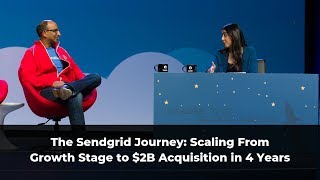
Samir Dallakhia, CEO of SendGrid, grew the company from $30M to $100M ARR in four years before Twilio acquired it for $2.9B. He shifted the mission from transactional email to a broader communications platform, rebuilt infrastructure to handle trillion emails, and emphasized a culture of "We, not I" with values like hungry, humble, and honest.
Chapters
Please welcome SendGrid CEO Sameer Dakhalya and Bessemer Venture Partners Vice President Anna Khan. Hello, can you— oh, that was loud. Okay, you can hear us. I've never been behind a table before, so I feel very talk show hosty. But I'm Anna Khan, as you guys heard. I'm a vice president at Bessemer Venture Partners, which is a venture capital firm which was very lucky to be a part of SendGrid's journey. And I'll let Samir introduce himself, but then I have a quick introduction for Samir too.
Hey, good afternoon everyone. I'm Samir Dallakhia, CEO of now Twilio SendGrid as of Friday after our completed acquisition.
Awesome. Well, you know, you guys have probably all read Samir's bio and his resume and heard about the SendGrid-Twilio journey. But I think the reason why I wanted to do this interview with him is because there are some things that people don't know about Samir, which I think are interesting to note. And so a fun story is that I met Samir about 5 years ago. At a cloud conference, and he was— we were split up into groups and he was put on a table with me, but with a group that he was unfamiliar with. And what stuck with me was that he treated every single person on that table as if they were the most important person in the room. So this was anyone from, you know, a marketing analyst at a small startup to a junior analyst at my firm, to a cloud CEO like him. And that really stuck with me. And I was like, this person is special beyond his professional accolades. And unfortunately, it's something that I think you don't really see in the Valley a lot and something that the people close to Samir and the employees of SendGrid know really intimately. And since then, we've become good friends and he's been a CEO reference for me in building my portfolio. We've run into each other at Taylor Swift concerts where I had no excuse, but he was with his daughter at a father-daughter date, which was great. But yeah, that's, that's Sameer for you. And but most people are kind of here in the room to hear about your journey. Yeah. And I think it's a really special one because in 4 years, a lot of people can't say this, but you came into a company You grew it to $100 million ARR plus. You took it public, and then it was acquired for $2.9 billion. So that's all great, but I'm gonna start with a tougher question, which is, you know, you were brought in 4 years ago to SendGrid, and you weren't the founder. And actually, in the Valley, people are very biased against that. So you were sort of brought in as a, let's say, turnaround CEO.
Yeah.
How did that feel? And how did you, how did you start that?
Yeah. And thank you. And thank you for that kind story. You know, I, I think others in the room are— all of us are well informed to remember that those who are closest to the work and the customers actually are the ones who often have the greatest insights. Treating everyone at the table with equal respect, that you can learn from all those around you, regardless of level, is always a good thing. I appreciate all the things that have transpired over the last 4 years. We have a saying at SendGrid, it's "We, not I." I didn't do all those things. We collectively, as a company, were fortunate in doing all those things. Boy, was it a heck of a team effort. It was a lot of fun. To your question, coming in, it was October of 2014. And it was a challenge, I won't lie. We had, you know, you don't make a CEO change if everything is going perfectly, and all CEO changes are tough, and ours was no different than that. We had the principal challenge that surfaced, I would say, at the time was the growth rate of the business was decelerating at a fairly rapid clip. We were The company had enjoyed great success from day one, from the early days. Our founders— we had 3 amazing founders, Tim, Isaac, and Jose, who had this great idea to solve this, what turned out to be a ubiquitous problem that every developer building an app had. But the growth rate was slowing. We were about probably $30 million of trailing revenue at the time that I joined. And the growth rate had decelerated from the tripling to the doubling to the 75 to the 50. And we were at, I think, around 40. Around the time that I joined, and we were going to be at 30 within a quarter or two. And then, you know, we didn't know if that was going to continue to go into the 20s or below, or what was that— what was that going to look like? So we had our work cut out for us. But, but, you know, but clearly I would say one of the things that was— I had a number of things to my great advantage. One was while the CEO transition was hard, the founder to CEO transition was not. So I had the incredible support of all three founders. And Isaac Saldana in particular, you know, took me up to the front of the room on my day one and introduced me to the company and said, you know, we're one team and this is— we, the board— Isaac was on the board— we believe that Samir can really contribute here. And so, you know, please give me your support. So it's really helpful to not have any of the usual dynamics. And it is fairly common to have dynamics between founders and a hired CEO. I had none of those. So that was, that was to my great benefit. And then we also had just great raw ingredients. You know, the business, while it had decelerated, it was still an extraordinary service. It was still a ubiquitous market. We had created an incredible brand with developers in particular and created developer love for what we did and the product. We had great— we had a great, easy-to-use pricing model. And so we had a lot of things that were going for us in terms of raw ingredients. And I'll tell you, Again, to dissuade anyone from believing any of the, you know, the hero stuff, you know, the last company that I sold, the last CEO job that I had, I sold for literally 2 orders of magnitude less than this last one. And I'll tell you that I'm no smarter, probably dumber now than I was then. It is predicated on what you have to work with. What are the raw materials? What market are you in? And what can you do with it?
And you think you knew about those raw materials taking the gig?
I did. I had fallen in love with the business despite the challenges, and there were many in those early days. I knew that this was special, that this company, you know, sort of that, you know, the old cliché of the diamond in the rough. Like, you could see the brilliance under a little bit of— there was some dirt on it that had to be brushed off. But it was clear to me that that it did have this, it was solving a ubiquitous problem, that it had an ex— and one of the things I talk a lot about, they had an extraordinary culture that had been built into the business. And that is so hard to create and replicate. And I know that that is part of every formula of success that I've ever seen in a business. The go-to-market model was magical. You know, it was developers finding our service. and trying it out, dropping our, their, uh, our, our APIs into their code, and then putting a credit card down. And we were signing up hundreds of new paying customers every month with 5 sales reps. I mean, it was an extraordinary— so there, there were things that were very obvious even at the time. This business is special.
So I, I think we talked about you going in as a CEO. You were a non-founder, but there was some very raw, great ingredients there. You had buy-in from the founders.
Yeah.
So that introduction to the company really sort of set you up well.
Yeah.
And then you went in and the company was doing, let's say, about $30 million in ARR. And Samir likes to talk about this SendGrid smile that I want him to explain to you. Yeah. But there were a few things there that made it happen. And so a lot of the CEOs in the room, I think, would love to hear about that. And I think you touched on some of those. So it's the culture was a big part of it. The fact that you had this great go-to-market, but also, you know, you and I have talked about this. There was something special about the market where some of the education had been done before and there was an adjacent market. So maybe, maybe share a little bit of those learnings with the group.
Yeah. I mean, you know, I think one of the things that I remember vividly from that first, the first month on the job, you know, and I would basically go around on the listening tours as many new leaders do and talk with people that are closest to the business and the customers, and you'd ask them the, what can we absolutely not stop doing? Like, what is part of the magic of this place? And what are we screwing up that you would say, please Samir, help us go fix this tomorrow? And it turns out if you do have those, you ask those two basic questions of 100 people in your business, you will learn an awful lot about what needs to be focused on. And so we did that, and one of the things that came out loud and clear was, We want clarity on our mission and vision. Because we were at this existential crisis of, are we a— let me see if I remember it— are we an email company that happened to start selling to developers, or are we a developer services company who happened to start with email? And this is just a fundamental strategy question. We could have gone down the developer services path and said we're going to open up other APIs and compete with a whole other set of players. We could have built a Stripe alternative, and a Twilio alternative, and so on and so forth. Or we could have gone down a different path. We ended up choosing— to go down the, you know, actually we have this brand and expertise and credibility around email that we can go build on. And so we said, well, we're gonna start from being an email company and broaden to being a communications company.
Yep.
That's multichannel, and we could then, you know, we had the great fortune of having an adjacent market that allowed us to go after a second product market, which was email marketing, as opposed to the transactional email that our business was built on. Where the developers plug in our API and we send you an Uber receipt or an Airbnb confirmation of a stay or a Hertz reservation notice, you know, so on and so forth. The promotional newsletter that you may get in your inbox, those types of things. And there's this huge adjacent market that leveraged all the things that SendGrid got very good at over the preceding 5 years, over its first 5 years. We needed to have one of the world's largest sending infrastructures. You needed to understand how do we keep the bad actors out and use machine learning to prevent spammers and phishers from taking advantage of our system. You needed to have relationships with inbox service providers like Gmail and Yahoo. We had all that stuff. So to build the application on top of our infrastructure and enter a whole new market was actually— the barrier to do that for us as a company was actually quite low, and we were able to do that. And this year we'll probably do as much in revenue this year in 2019 with that second product as all of SendGrid was doing at the time that I joined. And so we were able to launch that new business and that provided a tailwind of growth as well. So those are the kinds of things that then ultimately operationally we had to get a lot more disciplined. So we would push our go-to-market teams and say, okay, if our self-service model is the way that we typically acquire customers on the web, to put credit cards down. What else could we be doing from a demand gen perspective? Instead of spending X millions per year, could we spend 2X? The answer turned out, the answer was actually, yeah, we could. In fact, this year we're spending 10X what we did in 2014. We just had to get a lot more creative and go find other ways. That created a whole new growth tailwind.
But if you guys had done all the hard stuff, and what I mean by hard stuff is, really building strong infrastructure to send emails. I mean, most people don't realize that, you know, when you take an Uber and you get that receipt— yeah, this— like, there's actually a lot of hard infrastructure in play that's making that happen.
Yeah.
How did you make people realize that that's really special, we should talk about that more, and then we can scale that more? Like, because it existed, or do you think you made it more powerful as the CEO, as a leader?
No, I think, you know, I think we— well, we had an extraordinary business where the infrastructure was supporting a high growth rate as it was. But, you know, I think it was within 12 months of my joining, we realized that infrastructure, as much as it had scaled to that point, was not going to continue to scale. So we actually, in 2015, created a project that was called Pipeline 2020. And we said, OK, let's go build the next generation infrastructure that is going to scale to sending a trillion emails in a single year, which was more than we had sent lifetime to date. Because we knew— you just had to have foresight. You just had to do the math, actually, and say, OK, given our rate of growth, if we don't get ahead of this— and we know it's going to take us literally years to go build a new platform that would scale at that level. If you don't get ahead of it, you're going to be in trouble. And so these are the kinds of things I think as a growth stage company, when you're going from, you know, X tens of millions of dollars with an eye towards 100 plus, you have to start thinking in multi-year planning horizons, which I don't think is obvious because when you're in, when you're in truly startup mode, which was the first company I did, and you're, we were pre-revenue, pre-customers, you're looking quarter to quarter. But once you get to growth stage, you got to start looking year to year, you know, out 3 to 5 years. And that, that was an important shift, I think, for our leadership team.
Yeah.
We also frankly ended up needing to have a whole new leadership team that knew how to do that because our, the prior leadership team was really great at getting it from 0 to 30. That was perfect. But for 30 to 100, you actually had to think in a very different time horizon in a very different way. You had to have seen what great looked like at scale. How can process be used to your advantage as opposed to a hindrance? Yeah. And so we ended up hiring, I think, 7 of our 8 executive leaders were different within 2 years of my arrival. And that wasn't because we didn't have wonderful people in those seats before. We just had a different chapter to go pursue.
And I guess the obvious question there is that doesn't sound like an easy task. So how did you Was it stressful? How did the company respond to that? How did you take away from the business and actually spend time recruiting? What can people learn from that?
Yeah. I would strongly encourage folks. I think there's often a pressure, and I certainly felt it, from your board and investors, go fast. Hurry up. There's lots to get done and market window and so on. My response to our board was, I, this is not one I'm gonna go fast on. I believe getting these hires right will be the determiner of success or failure for our long term. And I said, well, I'm gonna do one per quarter for the next two years. And that's exactly what we ended up doing. I would, there was one point in time where I got impatient and I tried to do two in a single quarter and I almost killed myself. Because to actually do that kind of a search well for one of your executive leaders, who you expect to then come in and help transform that function. To go find the best in the market, not just in caliber and talent, but in culture fit with your team, boy, that takes a lot of time. You gotta kiss a lot of frogs. There's a lot, I mean, that just takes a lot of breakfast, lunch, dinners, coffees, that executive search process is involved. And if you get that wrong, boy, I tell you, you pay the price for those. When you get those wrong, you lose years of your company's life. And so we went, we took it slow and we got the right people. And the reason, and it was super stressful and painful because you're trying to run the day-to-day while you're trying to go and hire a critical person. And you're having to say goodbye to somebody who's been really important to the building of the place to get you here. And I really think, you know, this is where our culture has been so important to us. We would just, you know, we have our, 4 H's were the sort of the moniker for the Centigrade culture. Happy, hungry, humble, and honest. And we would use all 4 of those in the conversation with our leaders and say, you know, we have to have an honest conversation about what needs to happen for the company's, in the company's best interest for the next chapter. And then, you know, align on that and then figure out transition plans and all that. And I, you know, I'm proud that we, I still have great relationships with, with all those folks that ended up moving on. And they moved on to wonderful things and things that aligned to what they're great at and what they wanna do. And the company was able to absorb that kind of change, but it was only 'cause we did it one a quarter. I'm convinced, had I hired, I think in hindsight, had I tried to hire in all 8, you know, in one go in the first 6 to 12 months, I just don't believe, I think companies are like people. Like you can only absorb so much change. If I said, Tomorrow I need you to change your job and move to Indiana and go pick up this new skill set. And you're now going to start dating this other person. And like, you just can't— you can't do all that in a short period of time. We're not just— we're not wired for that level of change that quickly. So anyways, that was a big part of, I think, how we were able to get through that chapter.
Yeah. And then, you know, let's— you were very successful in that Smile curve, kind of. It was decelerating. And then you put all these things in motion and you were well on your way to $100 million ARR.
Yeah.
And you had passed that mark. And I remember there was so much excitement at SendGrid when that happened. And then there's this kind of looming cloud, and there are actually clouds here over your head, where then you start getting pressure from a lot of forces about, oh, you're at that magic number, and what do you think about going public now? And, you know, a lot of CEOs really dream of that, and a lot of employees and companies dream of that. And so how did you, your executive team, larger SendGrid think about the going IPO process? Because there are pros and cons of being public.
Yeah, for sure.
How did you, how did you think about that and how did you discuss that with your company?
Yeah, for sure. You know, I think in the early days it was, we were so focused on that, that SendGrid smile, that deceleration of the growth rate, and we said, gosh, we just got to flatten it. Let's just flatten to the bottom of the smile and, and then we'll work on reacceleration. By the time we got to early 2017, we had really turned that curve and it was accelerating again at a far greater scale than when we were decelerating, which was really exciting. And, you know, like I said, it was all those things we talked about previously. You know, one of the fun stories that I always loved was with that operational discipline, like where you got to get into the, into the weeds and figure it out. Like one of the things after the triple-click analysis, as we like to call it, was we were having our lunch eaten by a particular competitor and they had on their website this checklist of features that they had, you know, check for them, X for us, check for them, X for us. And so we created this tiger team and said, we want one of those gone every single month. Like, just take them off the, you know, go close those gaps. 'Cause we're the market leader. We invented this category. Isaac, Tim, and Jose built this place. We gotta, you know, let's have some pride of ownership of what we've built, and we gotta go be the best in the industry at what we do for our customers. And literally that team took one of them every single month, and our general counsel would call their general counsel and say, That's no longer true, you must take that down. And they would call back next month. That's no longer true, you must take that down. And they did that the third month. That's no longer true, you must take that down. The website, that web page with that check X thing went down 6 months later, and that competitor exited the market 9 months later. And that created another tailwind behind the business. So, so all those things led to that acceleration of the SendGrid smile. And by early '17, we really were then ready to say, you know what, We could take the company public. And we knew that because we could predict within a percentage point what our revenue was going to be. Margin was a little bit harder. But on the revenue line, which is as a public company what you really had to focus on, we could call it. We could call it, and you'd literally write the number on an envelope at the beginning of the month or the beginning of the quarter, and you'd put it in the drawer. And you'd pull it back out at the end and say, did I get a check? Or not? Because if you got that answer wrong, get— you knew getting that answer wrong as a public company was going to be really painful. And that would tell you you're not ready. And so we went through that exercise and, you know, 3 quarters in a row, many months in a row, like, yep, we're ready. So now the question is, should we go up? And there was a lot of, a lot of debate about that at the board with the management team. You know, I think we ended up— and I think there are a lot of people on both sides of the argument. You could easily make the argument it's a pain in the arse to be public. You've got a lot of overhead, and there's all these regulations, and you got to do these earnings calls and invest in investor marketing. And there is— there's a ton of overhead with being public. I am on the side of the argument— I think Bill Gurley makes the same argument— that being public instills a discipline and a rigor that you have to have if you expect to withstand the scrutiny of the public eye. You just can't do that if you are if you are not buttoned up. And so I actually think it makes a company better to be public. There are certain things that you just can't have happen if you are a public company. I mean, some of the— anyway, I won't get into other companies, but there are other companies that have challenges that would not have happened. They couldn't have happened had they been public. And so, because it would have been more buttoned up, they would have more process, they would have more controls, they would have stronger leaders, they would have you know, had a number of things addressed. So for us, we looked at, we said, we, we, we certainly can. And I believed at that point, you know, our company had been, um, at that point, 2017, we were 8 years old. The investors had been in the business for a long time. We had a lot of early employees who had been building this place brick by brick, who I believed, you know, should have that moment. And it was a super fun moment. We took, uh, every SendGrid, uh, employee who had been with the company for more than 4 or 5 years, we flew to New York City to have sort of the all-expense-paid, let's, you know, trip to New York for the IPO. And it was awesome. And it was so much fun. And I'll never forget those moments and the looks on people's faces. I remember our teammates that literally had tears streaming down their face as the SendGrid banner unfurled in front of the New York Stock Exchange. The night before the IPO. And I'll never forget that moment. I'll never forget, you know, standing on the podium and we did the callback. You know, we have this tradition at SendGrid. I say send, you say grid. Send grid, send grid. There you go. And that's— and it was— and we had— and it was so loud that like literally the CNBC folks that film right in front of the New York Stock Exchange were like, Jim Cramer's like, what is going on back there? Who are these people? So it was a super fun moment.
Yeah, you were able to share it with your family too, which was great.
Absolutely. And, you know, my wife was there because God knows I would never have been able to take this opportunity, take the job, if not for her love and support and sacrifices while she had a bigger job and a bigger career, was the breadwinner in our family when I joined SendGrid and two young kids. And she still said, I've never seen you fall in love with an opportunity like this in 20 years. You're going to do this and we're going to figure out how. And it was only her sacrifice that allowed me to do this. And for her to be able to be there at the stock exchange with me was priceless. So it was super fun. And I would say, you know, we had a lot of conversation at the company around and it's just a milestone. It's a fundraising event, a marketing event, a really fun milestone to look back and say, wow, look at what we got. Look at how far we've come. And okay, now we're done with that and let's start looking forward again because we got the next 10 years to go. We've got the next leg on the journey to go. Yeah. And that's really where we were.
Yeah. No, I think, I think that story is really special. And then of course, the good news didn't end after that. You guys had a very successful IPO. You were enjoying being a public company, but then you got some acquisition and M&A interest.
Yeah.
And, you know, most people in the room know about obviously the acquisition and we have a fun story around this picture in a second. But you had actually had companies come to you before, like they wanted SendGrid to be a part of their story. And, you know, whether it was close to the IPO or after the IPO, you had a lot of those conversations. And as the CEO and sort of the captain of that ship, how did you, how did you think through those?
Yeah, they were. Those are stressful conversations. We had one right before the IPO. This is all public in the S-4 filings with the SEC with Twilio before we went public. And all the reasons why we said yes this time around were still true then before the IPO. There's extraordinary fit in our vision of where the market would go. Our business model was the same, developer-led model. Culture and values alignment was fantastic. Phenomenal. I love Jeff. I think he's an amazing human being and an incredible leader. And I just, I'm like, I could work with this guy. I could work for this guy. This is highly unusual. And but at the time, we couldn't make the math work. Like our, our view of what the company was worth on a standalone basis as we kept going standalone was just different than what they were able to either calculate or afford. And so we said no. And that was hard. And I'll tell you, I lost a lot of sleep on that decision. Once we made it, we were like, "Great, standalone, we're moving on, let's go." Plan A has always got to be Plan A, so we were building. When Jeff and I then resumed that conversation, he came back around 6 months, 9 months later and said, "Hey, what do you think about that conversation from before? Now there's less confusion over the math, because you're a public company. It's pretty well defined what your valuation is." It was hard again, because I love this, the standalone opportunity of what we could go do alone. What I came to was, but what we can do together is so much more extraordinary and we can go do it so much faster than either company could do alone. And, and at the end of the day, once the math problem was gone, all the same reasons that existed about our interest in the first go around were still there. And we decided, you know what, we got to go do this and we're going to go build an iconic company together and That was—
was that a little difficult to let go of? And, you know, in part it's like kind of a little bit of the hubris and the— and, and saying like, we're the gritters. And yeah, and, you know, usually in the Valley you see kind of an older, stodgy company that's trying to buy into that innovation and Valley culture. And the thing that I find so fascinating about Twilio and SendGrid and now Twilio together is that that you guys had very two distinct and beloved cultures. And so was that ever a fear for you that you guys were going to lose some of that gritter quality?
Yeah, you know, it was a huge point of conversation, I think, for both Jeff and I through the process. And, you know, I give Jeff immense credit because there is that— you know, I think one of the bankers on our side said it well once. He said, Samir, you have no idea How many deals that should get done don't get done because of hubris, because of that dynamic, because of interpersonal things with CEOs and boards and so on. And you never hear about them. The bankers know about them because they're involved in the conversations, but the public doesn't know about them. And he's like, there's probably a 10-to-1 ratio of ones that don't get done that should get done. And this one, I believe deeply to my bones why we did it, is this was a These were two kindred spirits, two companies that should be brought together to go accelerate the mission and vision of what the companies could accomplish. And it was because of the way that Jeff approached the conversation, the way he approached me, the way every conversation we had felt like a partnership and a conversation. And it didn't feel to us like we were going to get swallowed up into some Borg and, you know, be an irrelevant piece of an empire over here. Like we were going to be instrumental in creating that iconic company. Because we can do things together that couldn't be done individually.
Yeah. And then we previewed this, but we didn't actually talk about the picture. But I actually surprised Samir. He didn't know I was going to include this picture. But this is day one. This is when the companies were kind of fully merged together.
Yeah.
And Samir, do you want to tell them what you're doing and why you and Jeff are wearing the chef hats?
We had a great day one. And again, this just speaks to the alignment and the power of the cultures. I think everyone involved in both companies were like, you know what, how our teammates feel about this is gonna matter a ton to the success of this integration and this acquisition. And so, you know, the Twilio team just did an amazing job. They literally flew out 50 people to our offices in Denver and in Irvine. They stood at the elevator banks, literally rolled out a red carpet in San Francisco office, you know, had music and pom-poms and high-fives and cheering on people like, this is day one, we're so excited, we are welcoming the team SendGrid in with open arms. And it was an amazing energy to the combination. And it didn't feel like big company buying little company, we will now bore you. It felt the opposite. It felt like coming into a family that is like, hey, come on in. We're going to give you a big back slap and hug. And, and so Jeff and I decided as part of this, we'll— let's make, let's make waffles and pancakes for everybody. And so in every office, so like we did it in Denver, we had some other teammates and executives in Irvine and in San Francisco where we, we made, we made breakfast for everybody. If any of you have ever heard me talk on this topic, I care a great deal about this notion of servant leadership that that, you know, we're at the bottom of this inverted pyramid, not at the top, you know, cascading down, that we support the hard work of all the people that do the day-to-day rowing of our business. We have a responsibility to steer, but we're at the bottom. We're serving those people, removing obstacles and letting them do their best work every day. And if you got an entire company of people who you are helping do their best work, I guarantee you, you'll kick the crap out of everybody in the market you're trying to serve. and you'll be the industry leader. And that's— that's— I just believe that deeply. And as Jeff joked, he's like, well, we definitely have the servant part of servant leadership down here. And but anyways, it was super fun and we got to greet all of our teammates as they came in.
And that's a great picture.
Chocolate chip waffles were especially good.
And then I have one. I want you to be able to talk about your red jacket. I know you're really proud of that.
And I am. I wore this and it's both, both comfy and warm. And I— Twilio has this wonderful tradition that they hand out these Twilio red track jackets once you have built an application on top of the platform and demoed it in front of the entire company. And so I had a lot— you know, I'm a non-technical CEO, so I'm not a developer, but I got to work hand in hand with one of the one of the amazing DevRel guys on the Twilio team, Greg Baggeson. He helped me through building an app. And so I got to learn how to write this app in Python, and then I did a whole blog post about it.
Was it harder than you thought?
It was actually easier than I thought. It was easier than I thought, 'cause there's so many amazing tools out there now. I loved like our own documentation across Twilio and SendGrid. I built an app that actually you texted in your email address, to a particular Twilio number that we had set up. It would send you an automated response, uh, via text.
Yeah.
And then it would parse the, um, email address you had sent in the text and then send you a longer email that I had written about my excitement of our day one. And it included this, like, goofy GIF image of, you know, like, bobbleheads of, uh, Samir and Jeff fist bumping. And it was, it was just super fun. It was goofy, but I got to learn This is how you build the app and how you use our own platform. And I got to say, the platform, the doc's great. There are helper libraries. I mean, it was actually a lot easier than I thought. But it was an amazing moment. And I say to everybody, I'd encourage everybody to go learn how to code something because it's fun. And there is a childlike joy that comes from writing something, hitting the button, and then having it work. You're just like this magical moment of like, holy cow, what I did just worked. It's super fun.
So anyways, and I've been really nice to you and asked you easy questions. One last hard question is that it's, you know, knock on wood, been an amazing run for both companies.
Indeed.
And we're really proud to be part of this journey with you. But like, what do you think about now? What are you worried about? Yeah, you know, the 4 years have been— I wouldn't say easy at all, but you've done really well. So what is, what's the next chapter?
Well, I'd say a couple of things that leap to mind on the challenges ahead. I think one, we had an amazing day one. Day one is day one. Like, we got to make sure that we continue to execute and create an environment where all of our teammates continue to be fired up to be part of this new combined company because it is different than being part of just SendGrid. And so I get, we got to keep working on that. And I know in my heart that As long as I can convince all of my SendGrid teammates to give it a year, that they're going to fall in love with this place, this new combined company, because we are going to go build an iconic company. And it is so clear to me that that is what the opportunity is in front of us, that a year in that will become obvious and they will want to be part of laying those bricks every bit as much as what we've done already. So, so that's one, just staying, continue to stay focused on the people. And adopting the new culture, 'cause we literally created a new culture that we're all adopting together. So it's not actually one or the other. Again, a great example of Jeff's leadership. It's actually a new set that both companies are now adopting together. And that's how you create one team and one culture. And then, you know, then there's just the execution of, gosh, we did this big acquisition, big transaction. Shareholders are gonna expect us to go create a lot of value. Like that whole point of we can do things together, do things together that we couldn't standalone. We gotta go actually go do all that hard work. And I think we can go build a single unified communication platform that can transform the way every company on the planet engages with their end users. And that's huge and that's exciting. And I think every company on the planet needs that. And we gotta hustle, we gotta get to work. There's a lot to do.
Awesome. Well, thank you guys for staying over. I know we went a few minutes over, but we're excited to be part of SendGrid, Twilio, Twilio now.
Yes.
And thank you for hearing our story.
Thank you. Thanks, Ana.
More from Jason

Why Your Next Hire Should Report to an AI, Tragedy Apps, and Too Many AI SDRs? | The Agents #004

Our Agents Drove Our Salesforce Bill Up 80%, Marketo Hates Agents, and We Stealth-Churned Off Notion




Managing 20+ AI Agents: Lazy Agents, Our $500K AI Bill, Stealth Churn & the Death of 60% Solutions




