The Step-By-Step Playbook for Building AI-Powered GTM Teams with Personio's CRO
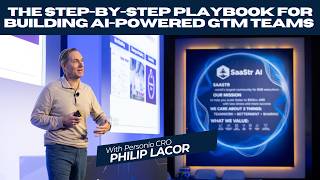
Personio's CRO Philippe Lacour built four AI assistants that cut research time from two hours to 15 minutes and doubled pipeline per FTE. The Expansion SDR assistant, Win-Loss GPT, intent-scoring model, and demo-booking chatbot Nia all run on a data-rich stack with Snowflake, Gong, and Salesforce. He learned to balance bottom-up exploration with top-down execution, prioritize high-impact jobs, and treat the stack as only useful with deep context.
Chapters
Welcome to the official Saastr podcast where you can hear some of the best Saastr speakers. This is where the cloud meets. Up today on the Saastr podcast.
Let's talk about another assistance that we built. This is for our expansion SDR and our expansion SDR does cross-sell, often like new products into our existing customer base. We have about 15,000 customers, so we're looking to cross-sell into them. The problem here was that when we did our jobs-to-be-done mapping, that we found that every expansion SDR was spending 2 hours a day finding customer information to really make a relevant call. And we said, okay, let's, let's change that. And one of the go-to-market engineers built like this assistant. Here you see, for example, that the research time that an ESCR spends on this work went from 2 hours a day to 15 minutes.
Hey SaaSer, imagine having agents for every support task. One that triages tickets, another that catches duplicates, one that spots churn risk. That'd be pretty amazing, right? HappyFlash just made it real with Autopilot. These pre-built AI agents deploy in about 60 seconds and run for as low as 2 cents per per successful action. All of it sits inside the HappyFox omnichannel AI-first support stack—chatbot, Copilot, and Autopilot working as one. Check them out at happyfox.com/saasr.
Hey everybody, SaaS Annual will be back May 2026, the world's largest SaaS and AI gathering for executives. Just this last May, we hosted 10,000 attendees with 68 VP-level and above attendees, 36% CEOs and founders, and 25% were AI first professionals. It's the very best of S-tier attendees and decision makers that come to SaaStr Annual and AI Summit each and every year. But here's the reality, folks. The longer you wait, the higher ticket prices get. They're cheap now. They're cheap. So just get them early. Lock in your spot today. Use my code JASON100 for exclusive savings. Get your tickets at podcast.saastrannual.com or just use code JASON100 when you check out. See you there. SaaStr Annual and AI Summit 2026. It will rock.
Hi everybody.
Welcome, welcome back. My name is Philippe Lacour. I'm the CRO for Personio. We are a late-stage HR and payroll platform. We have about 1,500 people and Munich headquarters. And we'll talk today about our journey to become an AI-powered go-to-market. Back in May, we had a big AI week with our company. We called it the AI Surge Week. We gave all our people access to LLMs. We had speakers from OpenAI, Mistral, AWS. Our CEO, Hanno, and co-founder kicked off the week, and then we had project teams who could build agents, who can build with the help of Leica engineers. And it was a huge success. The entire company was buzzing. And after that, we've been monitoring usage of LLMs and AI in the company. My go-to-market team uses now about 90% of the people uses LLMs every week. And so this was a big success. However, After the AI Surge Week, we felt that although usage was high, that this was maybe not enough to reach like true transformation and to really fundamentally change the way we go to market. And so we started an initiative that is called AI-Powered Go-to-Market. And this is our Slack channel, which we started about mid-June. So about 6 weeks after The AI Search Week. And this was started by myself with the, with the help of a lot of people. And what I will do is present 5 lessons learned that we have so far, and the journey continues. And then I will cover like 4 use cases. And after that, we'll do some Q&A with, with Emilia. So 5 lessons learned in building the, the AI-powered go-to-market. Lesson number 1: next to, like, a great bottoms-up motion where you give all your people access to the tools and where you train them and where you help them, you also need a top-down motion. And the top-down is important because when you start talking about real transformation of your go-to-market, you need to make decisions about resource allocation. You need to give people permission to spend a lot of time on changing workflows and changing ways of working. You need budget. We heard earlier today, like, okay, you can start testing, like, lots and lots of tools, but ultimately you need to decide which tools to go for. So I think it's very important that in the journey from experimentation to scale, and a lot of companies, right, like, hey, I'm staying in this experimentation phase. How do I now really go to scale? That you not only have a bottoms-up motion, but you also have like a top-down decision-making. Lesson number 2, a cross-functional approach is really vital. And we have, we're lucky to have a data and systems team. They own our infrastructure, our systems. Our Snowflake instance. We then have like revenue operations and in revenue operations we now have two go-to-market engineers. We have those since a couple of months. One of them is here, Paddy. They have a business background, but also they're very data-driven. They're very focused on technology and you need to have that mix. And then there is the business. And the business in our case for go-to-market is marketing, sales, customer success, or, so your entire post-sales motion. And it's important that you bring them all together. We started this AI-powered go-to-market working group, which is, has about like 15 people and it keeps growing because we have seen cases where our data and systems team build things with LLMs. But it was lacking the business context and therefore the models didn't work very well. Or we, we had salespeople wanted to do something, but originally they did not have the support from either data, data or systems or RevOps. And you need that as well. You need really that combination. We also made the, the initial working group fairly large. 15 people is a lot. And we did that also to have broad coverage of all the functions and to make sure that we, as we start to change our culture to become more AI-powered, that we have more people participating in shaping the direction. Then we said, okay, we started this, the AI-powered working group. We had the Slack channel and then we had some initial ideas of where to start. We looked at some use cases. Where we thought we could have a lot of impact. And then what happened, we started working on a couple of these use cases, and then the ideas started flowing, including from myself. And we saw more and more opportunities, and then people started to share those opportunities in Slack channels. People were raising their hand. And the problem was that as people started then to work on these new ideas, that we hadn't finished the first one. So At one point it started to spiral a little bit out of control and we said, okay, we probably need to have a better framework to prioritize really what we're going to work on. Because if you want to go from experimentation to scale and you want to drive more transformation, then it's going to be more work to make that happen. And therefore you really need to prioritize. So we took two simple frameworks. One is Jobs to be Done. When I was in Dropbox in the past, our product teams were always working about, always talking about jobs to be done. It's a concept from Clay Christensen who wrote about the jobs to be done from a product. He had this whole story about the jobs to be done of a milkshake, but we are implying it to our go-to-market roles. And the jobs to be done is what is this role hire to do for? And we look at all the different roles in go-to-market. So SDR, sales, customer success, solution engineers, what is really their job to be done and what our go-to-market engineer will do then. One of them shadowed an account manager or a number of account managers for 2 weeks, and she found that the account managers were spending their time in 7 or 8 different systems. They, in order to perform a simple task, they had to switch from one system to another, bring together information, and became very complex. And they started doing readouts of these jobs and say, hey, this account manager job is losing 2.5 hours per day here. They're spending 3 hours a day there per week. They're working in all these different systems. And we started mapping these different jobs. Now, the next thing that then happened is we saw like there were a lot of the, these examples in all our different roles. So then the question became, now we got all these different jobs, how does it all now fit together? And we said, okay, simple framework number 2, let's look at our customer journey and let's see how these different jobs to be done now fit in. And so we started mapping them to our customer journey. And we found out, okay, we have some for the SDRs. We'll talk about intent, we'll talk about win-loss and so on. So, and this was important to give our teams context and to show how these different things fit together. And I think it's important to look at like, where do you have a problem in your growth? Where do you have a problem in your, in your, in your business that you want to solve? And, and, and how do you prioritize? Where you will start working with AI. The next one then was you need to build a culture of AI in, in go-to-market. Transformation is also very much about like, are people adopting it? Are they really embracing it? We spoke about like, what are the characteristics that are, that are very important to build an AI-powered go-to-market. For me, the number one characteristic is curiosity. We see that the people who are very curious, who are really leaning in, trying to figure out how this new world, how it's working and how it's evolving very, very fast, they are the ones that help you drive things forward. And, but we felt it was very important to build this culture of AI in, in go-to-market. And this AI Surge Week was for us very important. But when you look at like culture change, we adopted, or I adopted always this formula, which is the effect of a plan, of a trend, or of a transformation, in this case to AI, is the quality of the plan times the acceptance. And so 5 times 5 is a lot bigger than 10 times 1. So The acceptance part and the creating of buy-in and getting people comfortable with how jobs are changing, how their work is changing, is a very important part. And that journey will definitely continue as we continue to make progress. And so what do we do? We try to make AI a habit by leading it, by showing it, and by celebrating it. Let's talk about the first one, the leading it. We use Gong, is one of our platforms. Gong also uses a lot of AI. I'll give you an example of the role modeling. When I do like deal reviews and we bring in account executives to talk about their deals, every once in a while one came up with like big PowerPoints of like, how are they gonna win this deal? and I would always go like, okay, please go to Gong, open up your account. There's new functionality in there. There's this little AI sign. Go in there. Now you look for the account brief and everything is there. And in real time, we would do away with PowerPoint. So then the next time you do these reviews, the reps like really learn it. And I think it's really important that my leads do this as well, that they really look at the tools, get into the tools, and teach the team how to use the AI to their benefit. And there's many applications to do that. There's also a great example of handles. Your AI can help you with handles as well. Second one, sharing and inspiring. We try to put a lot of our own teams on stage and have them share what they have built. So one of the teams built an assistant to personalize customer decks. So a very simple assistant. There's one team that built like an assistant to answer RFPs. We let the teams share those stories and inspire their peers and the rest of the organization. And the final thing is then also celebrating. We reward like people who really help us drive this AI-powered go-to-market. And one of the things that we did is we have every year our President's Club. And early in the year, we announced that we actually have 2 or 3 seats this year for the coming President's Club for the best contribution of AI. And we're going to nominate a number of projects and there will be real seats in that President's Club. And next year there will be even more seats. Then lesson number 5, great AI comes from your stack, but then equally important, your context. And we heard a lot about that this morning as well. When you look at our stack, initially we take the view, let's not go out and buy all these tools because usually the tools are not like the panacea. There's usually a lot of work that you need to do in your workflows, in your data, in other things. So we said, okay, let's start with what we have and start building from there and then add LLMs to it and then go from there. And this was, this is our initial stack. So we were on, we are on Salesforce. You can also be on HubSpot. We made a big bet on, on Gong earlier this year. And why did we do that? Because For a go-to-market organization, the customer conversation is obviously a very important source of data, and we felt that conversational intelligence with Gong or with someone else was going to be at the heart of our AI strategy. We also rolled out Qualified, but not initially for AI. We did it because we wanted to have, like, fast meeting booking and we wanted to have like, have a sense of like who would visit our website for intent. Only more recently, maybe in the next, in the last 6 months, Qualified started to adding AI capabilities and we started using them and I'll show you later how, how we do that. Snowflake, we already had, we put a lot more data in, in Snowflake, both structured and unstructured data. And then we overlaid our LLMs. With Amazon Bedrock, so you can use like various LLMs. And we thought, okay, we probably also need to do a lot of work on our data. So we deduped all our Salesforce data because initially one third of our data in Salesforce were duplicates. So we had a lot. So we installed like automatic deduping. We also spent months cleaning our prospect database. We bought external data sources. And also there we try to like clean them up, connect them to have like also a great prospect database. And that is all work that you is, that you can do, which is sort of independent from your AI, but makes your AI much, much better. And we decided to make that investment early on. Now, what did we do then? We connected basically all our customer sources. On our customer conversations, we loaded sort of 5,000 Gong calls in, in Snowflake. We added a lot of emails. We added, we connected to Salesforce, brought that all together. And then the thing that was also important is that we added Personio-specific go-to-market knowledge. So we added our ICP definitions, we added our pitch decks. We added our onboarding processes, we added product training materials, and so on and so forth. And this is really critical to really train the LLMs and to make it specific for your go-to-market, for your customers, and for your, your products. I also believe that it's not— on one hand, you need to have enough data there, but on the other hand, it's— you also need to have relevant information. And one question that will come up is at one point this data will get stale. So at one point the AI models will get worse. So we're gonna run into this question like, hey, how do we keep everything fresh and how do we actually take all the data or data that are less relevant, how we're gonna take that out? We haven't answered that question yet. So in the next update, we'll give you an update on that. And then, so those were initial learnings that we had on how to approach the, the transformation to AI. And now let's look really into like 4 use cases that we have. The use case number 1 was about everything about win-loss. So we wanted to have like more AI-driven customer intelligence and understand more why we win deals. And why we, why we lose deals. And the problem was the following: our reps would fill out Salesforce after they had won like a deal or lost a deal. And when you look at them, a lot of data points were great, but there was always like 30% was due to other. And even in the cases where we had good information from the reps, we always wanted to go deeper. And figure out, okay, yeah, let's go deeper on like why this is happening. And we felt that the insights were simply not, not deep enough. We then said, okay, how can we leverage AI to do that, to go like to get more insights? And we went back to like all our conversation data, our emails, our Salesforce data. Again, we loaded that in Snowflake, and we built then this GPT for go-to-market. And the goal was to really better understand our loss reasons, our win reasons, and really also get competitive insights. And our marketing team had recently updated all the battle cards. One of my product marketing leads is here. They did a fantastic job, but we were asking like, okay, can the GPT now enrich these battle cards? And what we found was that we were able to add like maybe 10-15% to the battle cards that initially was not that clear to us. And that's number one. And secondly, battle cards are typically pretty fast outdated. So how can you get to like a more continuous process of updating your battle cards. And we were able with, with the LLMs or with the GPT to like have more dynamically updating of our competitors' battle cards. And we will keep doing this as we keep adding like customer calls to the, to the GPT. So that was, that was the win-loss use case. But you can also see that this, this approach can really evolve to like other use cases as well. And ultimately that GPT can evolve into like a go-to-market brain. You could do rep coaching from this. You could do marketing campaigns. You can give better product feedback on that. So, so we have analyzed also where we see a lot of demand for like certain features and we have now a much more data-driven approach to go back to our product teams. And say, based on like 10,000 calls, this is where we see this product is doing really well. And here do we have— here's where we have weaknesses where we can still build. And that data-driven approach also gives you a lot more credibility to your product and technology partners. But again, this will be a journey to get to like a broader go-to-market brain. But you can see that over time, you, you will be able to address more and more of these, of these topics and how this will evolve exactly, I don't know. But I think if when you lean in and when you start doing this, you, you, you'll see like more, more opportunities. Then let's talk about another assistant that we built. This is for our expansion SDR and our expansion SDR does cross-sell. Offer like new products into our existing customer base. We have about 15,000 customers, so we're looking to cross-sell into them. The problem here was that when we did our jobs-to-be-done mapping, that we found that every expansion SDR was spending 2 hours a day finding customer information to really make a relevant call. So, so they were looking for account health, that was in Amplitude or some other system. They were looking at like which contract this customer had. They were looking at many different things and it took them 2 hours a day to really prepare the calls that we're gonna do. And we said, okay, let's, let's change that. And we built one of the team, one of the go-to-market engineers built like this assistant. And what you see is it's actually connected to Salesforce. So they go, the ECR goes into the Salesforce instance where they work in, they type in the name of an account, and then the GPT starts collecting information from like maybe 10 or 20 systems. So it goes into Snowflake, collects all the information, makes that in a format that is relevant to this use case, a cross-sell use case. And then it also will also come with like a recommendation. Of what to do with this account. And it will say, hey, this is a great account. This is, this is a green one. But there could also be reasons why an account is yellow or red. And again, and then basically the ESGR can, can act on that. Now, what is now the— people always ask, what is the ROI of AI? But here you see, for example, that the research time that an ESGR spends on this work went from 2 hours a day to 15 minutes. Not only that, you see here the pipeline that an ESCR is adding with this assistant. And basically the pipeline per FTE generated went up like probably like 2x. And there's many of these when you start looking at all your processes, all your functions, and you go to market, all your jobs. There are so many cases like this where a lot of time is being wasted on either bringing information together from different systems or even like prioritizing it. We have actually, as I said, now 400 of these assistants. Now the, the top 10 does like probably 80% of the, of the, of the value. But we, we keep coming and people keep coming also bottom up with, with new ones. Then let's look at intent. Here the question is, how can we make our outbound motion better? And the, the approach that we've been taking on, on generating pipeline, most people, unless you're an AI company, are always looking for more pipeline. And so we went through this journey where we want to find the right accounts, the right people or the right personas. Going out with the right message. The LLMs help you with always tailoring the right message, but then also the right time and right accounts. I mentioned that we updated our prospect database, but we have also applied account scores to our accounts. And this is really in line with our ideal customer profile. So we score all our prospects ABCD. Then we say, okay, let's now go out to the right people with the right message. And to, to do that, never-ending work is work on your persona and contact data. That is still in progress. We rolled out Gong Engage. We had Groove. We, that didn't work very well, so we rolled out Gong Engage, but you can also use Salesloft or Outreach or any of the others. And then we use our LLMs, but then the question is right time. And this is often, often a very difficult question. So which prospect is in a buying cycle and how do you know? And here you can buy a tool, but here we decided to, to do that ourselves. And our data science team built based on a number of signals in now also an intent score, which is dynamic and it's based on like, did someone come to our website? Is there a former a user of a platform that went to another company? Is it a great G2 or Trustpilot score or any of those? And you can really continue to reach that. And again, we took the view that all these tools need to come together in the platforms where our people already work. So again, this is back to like a Salesforce. We blanked out the names here, but you see the account score. There, these accounts are all A, that is a static score. But next to that, we have the dynamic intent score, which is now refreshed every, every day, depending on whether the signal changing in the market. And then we show these little flames. So 3 flames, that's where you start. And that is all together in the place where people already work. Now we launched this intent model like a couple of months ago, and again, you need to fine-tune it. We saw that initially the model was not great. It was picking up some signals that we didn't think were good. We changed it and then it got like better and better. Last use case is AI chat or the AI SDR. Here we use for this one we used Qualified and I'll talk more about it. And I do believe that there's, you can pick one of the vendors out there, but the goal is to go like really, really deep with it. And I'll show you how this one works. This one is really, when you go to our website, you can start chatting with the AI chat and our chatbot is called Nia, and Nia starts chatting here. And we do say here that a prospect is chatting with an AI. So it says, hey, I'm Nia, your friendly AI chat concierge from Presodio. And then what we wanted to do is like the moment we get like a demo request or a hand raiser, we wanted to quickly book a meeting. And the idea here is that your best leads, which are demo requests or can I talk to sales, that you apply high velocity. We live in a real-time world. So waiting for a week or 10 days to get a demo booked, that seems like very, very long in today's time. And you see here that the prospect started chatting with Nia, requests a demo, and then immediately a meeting is booked. And you can say, okay, this is just a meeting booker. But what I think is, what is interesting, first of all, when you look at the last 7 days, 140 meetings were booked. There were like 200,000 sessions on our website. So a lot. And you see like, okay, how many conversations are already happening? And we're probably a month, 6 weeks into this. The other thing is that what is very interesting when you start like reading the chats, you see all of a sudden you see that customers have questions about your product. They want to know what your minimum price is. So, so you're getting very, very rich insights in what, what keeps, what is top of mind for these customers. And I got totally hooked. On it. I'm reading these now every day and my poor team over the weekend. What is also really interesting, when prospects request these demos, you see people 11:00 PM on a Friday evening, they think about requesting a Personio demo. Why? But they do it. And this 24/7 real-time, I think is super important. Now, the problem is then a bunch of these conversations go really wrong. They go nowhere. No meeting is being booked. They got stuck for another reason. At the same time, I've also seen Nia answering product questions and I'm like, how did you know that? I had no— I could not answer that question. I don't think— and my sales engineer might be able to do it, but this is a really, really deep answer. And so we felt that training the AI chat is extremely important. And so what do we do? We don't have an Amelia, but we have an Amélie, and she's here. She's sitting over there. And we did say, like, yeah, someone needs to, like, take accountability for Nia, for the AI SDR, and train the chat, like, every day. And we said, okay, Lee, you're going to be accountable for, for Nia and look at like every day, look at the daily output, apply feedback and test in real time. And there were things like initially we found, for example, Nia started to give like legal advice. We said, ah, better not. And then Nia started to bash competitors. Like, that's not us. So, so those are things that you run into. And you only learn that when you really start doing it and when you see like where the AI stops. And now Amélie is working with us and the team to like make Nia better every day. And, but it's surprising to see what the AI already is able to do. The question then is what's next? Those 4 use cases. And look, we're looking at a number of other ones. Qualified. There's now more of the AI SDR. You can also do live video. We'll see indeed whether— I think we can do a lot over chat, but then there's voice, there's video. We'll try that. We did our second POC with Clay. We start— we will start doing more with that. Archie's on his outbound SDR. I think again, the point is that the point is not to take like test every single one of them. You gotta pick a couple and go really deep with them. It's all about the training. It's all about the data. And I think over time some of the capabilities will converge as well. Rep coaching, we're testing with Hyperbound. This is where an AI can give, can coach your rep. And we've done like some tests on that. Some great results, some not so good results. Why? Yeah, you got to really invest the time to train the AI. And the question on this one, on coaching as well, is like, you can do it for your new hires because you run them through an onboarding process. But will the people in your team, the experienced people, will they automatically start engaging the AI to get trained or not? Or are you going to have a tail-off where the AI usage is becoming less? And then we're gonna use Finn for, uh, uh, customer support. That's the second agent that we're gonna roll out in the, in the next few weeks. Now, one of the questions will come up when you look at like Mia on, on the website, on the inbound side, we're not only getting demo requests, of course we're also getting customer support requests. Okay, how are we gonna route those now? Equally. Our customer support agent will also get commercial questions. What are we gonna do with that? So how we, are we gonna connect the agents, have them talk to each other? We don't know. We'll, we'll find out pretty soon. I think for now we'll probably end up with 3 to 5 agents, but we'll, we'll know more over the next 3 to 6 months on how many we really need. And do you need one per use case or are you bundle all your commercial use cases and all your non-commercial use cases? We don't know yet. We're also using Cursor and so on, but that's more on the product side. So let me close here. So closing thoughts: lead from the front. I think the real transformation is like, it needs support next to the bottom-up motion. The approach has to be like cross-functional in my view. You need data and systems and either a go-to-market engineer or RevOps. And you need the business. One cannot do without the other. I also believe that marketing, sales, customer success are all converging. It's the same prospect, same data. All those workflows become mixed and hybrid. You gotta prioritize. Where do you have your biggest pain? Where do you have your biggest P&L challenge? Where do you have your biggest customer experience gap? Then continue to build a, a culture of AI. I think it's also really important that the people are excited about it and the people are leaning in and they feel like, yeah, I want to be part of the journey. And then realize that great AI comes from your stack, but equally also from your context. Final thing, your board asks, and where's the ROI? How much more are you doing? I think the ROI isn't instant, but I do think it shows up in many places. Deal velocity, pipeline velocity, customer retention, pipeline quality, win rate, but also in making people's work easier. The work that is being automated is in many cases not the most, the best part of the job when you ask, when you ask our people. So for example, these expansion SDRs, they love it that they have this assistant now and they're using it every day and it makes, makes the job better. AI needs daily oversight. And I do believe that the gains are nonlinear. So I would say really lean in. I believe there's a compounding effect. And I think every week, every month we learn more and we iterate. Finally, final comment. Look, we hear a lot about these AI-native companies. Clay was on stage, others were on stage. They're going super fast. When you're a SaaS company, I think it's your job to become like AI first and to really leverage all the capabilities that you can get with AI. I wake up every day and thinking we need to go faster, we need to go faster, but that is the opportunity for everybody. And I hope you take something away from this and we'll open up for Q&A. So thank you. And I want to invite Emilia. Thank you.
This is great. Hi, Emilia. Hi. Thanks for doing this. For those who don't know, just real quick as an anecdote, some of the speakers that you guys have seen today, like throughout the day, like obviously I work at Zaster, but we asked them to come here and Philippe actually inbounded to our AI speaker submission form, wrote a really good speaker submission for this London event, and then flew from New York yesterday to be here with you guys today. So just a quick round of applause because it's very nice of him to do that. But how was that process for you? I know you were like, okay, this is like kind of fun to do with this one.
It was amazing. Yeah. You had to fill out this, what I thought was a regular form to apply for the speaker. And it took 30 seconds and then I got my score. It was like getting your GPA. That's funny. The thing is that the first time my score was yellow. So I was like, I gotta do it again to get to green. It was very impressive. You see that we talk about like, how's the experience of a customer with AI? I was blown away because of the quality of the response and the fact that it was real time. And when you think about it, if you want to buy a car, you configure it online, you can do a 3D and so on. With many of our companies, it's not the case and these processes are not real time. So I was really blown away by the real-time aspect and the quality of the response.
Thanks for doing it. It was all vibed coded and then we talked because you're— I saw you. I saw it in the morning, I was like, okay, he submitted and it was like 70-ish, it was like yellow. Then he submitted again and I was like, okay, he got like an 83. So I was like, all right, I'm gonna reach out. We didn't know each other yet. I was like, I'm gonna reach out, I'm gonna, we're gonna figure out what's up. And then we clicked and we're like, okay, like you've gotta come 'cause this is, this is gonna be too good not to do. So that was super fun. A few questions I wanna try and get to and then we will take audience Q&A too. But for those who maybe don't know Personio as well, you guys are like, $3 billion valuation or something crazy like that, like huge in the markets. You're global. You have how many on your sales team now?
About 400.
Okay, so all that on yourself, like riding on you. Like, was your CEO like, you need to figure out AI, or were you just like, we need to do this to like live up to our, you know, customers' evaluation? And like, where did it originally stem from?
No, it stemmed from our founder and CEO. So he said, hey, we're going to be AI first. We talked to obviously our VCs and the board and they talked to us a lot about AI. Yeah. But our founder CEO kicked off this big search week. Yep. And that was a sign for the company. Okay, we're going to be AI first SaaS. Yeah. And then it's for the leaders to really take it into their businesses and really lead from the front.
And how personally for you, from your journey, I know folks just saw a little bit of, how did you start to adapt? Okay, you started looking at different tools, rolling it out to the team, but you've done a lot of it yourself, much like we have. Like, how did you just, did you just like lock yourself in a room after that search week and get it done before you rolled it out to the team?
Or what was the methodology? No, yeah, look, I use like LLMs like everybody else, but when you really start thinking about what the possibilities are, and I started following a lot of people who use like one of the tools and so on. And I try to, I thought this is going to change like everything. And we got to seize the moment to be there and lead from the front. And now I'm like listening to podcast, your podcast every day, reading articles and it's going so quickly. You started back in summer as well with? With, yeah, with Agents.
Yeah, we started in May.
Our AI Search Week was in May, kicked off go-to-marketing June. It's not even half a year and it's going so quickly.
Yeah, I think that's— it's important for folks, right, of like, I know sometimes it's intimidating when we get up here, we show all of our agents and like we could talk about our next— what the next problem is for us is keeping up with our agents. But I think if you're still a step back in deploying the agents and so many of your points ring true, right, of doing it yourself, just getting it started and getting it going. And these things do take time, but they shouldn't take too much time where you feel crippled by it, right? Like, we've all done this in the last literally 6 months. Like, it is something that can be achievable, right? With like the right amount of time and then getting everybody on board. And then just to talk about it briefly, 'cause we started talking about this backstage this morning, once you do reach this level, like, how, how are you keeping up with your agents? 'Cause I'm like, I'm, I'm struggling actually.
Yeah, no, it's, first of all, it's very addictive to lead the, to read the responses from the agents because you really see like how customers are thinking and you also see where your own process falls short and it's actually pretty, pretty complex. So you spoke about it as well, where when the, when the customer asks a demo, okay, that's one question you, you can take care of that. but if the customer in one question asks, I want a demo, I wanna see your pricing and how does this product work? Then you see that the AI starts using a different flow. They go like, okay, I'm gonna answer this product question, but I'm don't book a demo. Or, and those are things that are hard to keep up with. The other thing is that one, one thing is like you're putting in all these rules, but then to some extent you see part of, it's not a black box, it's a semi-transparent box because there's all these paths that you haven't seen yet and that's why you gotta stay on. But I really see like in the weekend now, okay, in this weekend, this couple of thousand person prospect came to our UK site. Then I go to the GM, take a screenshot and send screenshot from Nia to, to the— and it's very interesting. And when I see when the depth with which some of the questions are being answered, I'm like, mind-boggling. And then at the same time, very dumb mistakes are being made. I was like, okay, how do we get that?
And are you— you're probably close to 24/7 to keep up with your agents. How much of the team now would you say is also close to that?
As I say, 90% of our people is using LLMs. On a weekly basis. So that's a lot. A lot of people use the assistants that we built internally. That's a lot. I look at AI every day. Every day.
Do you see your team like spending more and more time with, like, do you see them spending time like on their downtime on the weekends, like trying to keep up with their agents too? Not just you?
Well, well, we have the dedicated, the dedicated people that are looking at it, are looking at it every, every day.
Every day, every hour.
It's going to take a lot of effort to get to like great. And when you think about it, I think the initial way we started was not fantastic. For example, you have these customers, these prospects asking for demos. These are your best leads. There were definitely like maybe 4 weeks where we didn't do enough. And I don't know how many demos we wasted. Not training anyone really, but yeah.
And when you rolled it out to your sales team, just because you guys have a much bigger sales team than we do and people have sales teams of different sizes here, I know you said you, you've spiffed them on doing President's Club. Did anybody like revolt? Was there any like negative reaction?
No, no, it's been very positive. Okay. But people will ask, okay, how will all these teams evolve over time? And I did say like, look, The best career advice I can give you is lean into AI. And what we do know is that the job, everybody's jobs will evolve, including mine. Yeah. And some teams will get smaller, others will get bigger. And that is the case. So for example, I think there are teams that where this is further away, for example, our channel and partner teams, we can use way more people there and other teams will get smaller. So, yeah, but it will evolve. That's for sure.
And have you seen it impact any of your, like, headcount for next year already? Because it's almost the end of the year.
No, we will reallocate people. Okay. But I think what we still see is that when you do planning for next year, managers say, hey, I need like 30 more people. And that means that there's still more work to do. The default should be like, can I solve this with AI? And can we, can we, ultimately the big question is, can we double the business with the same headcount? Yes. That's for me the big question. Okay. Yep.
That is a big question. And when you're hiring specifically for sales, 'cause you're a CRO, right? How do you, how do you look for candidates now versus, you know, back in April when you didn't have AI?
I would say for me that hasn't changed that much because I think number one trait is like curiosity. That I think is extremely important. And then things like grid and smarts. Guess what? All of these things are important in the world of AI. I wouldn't say anything changed that. I do think that we're going to have more people who are very, on one hand, data-driven and system thinkers. And right now we have too many things that we, for our, go-to-market engineers, RevOps team, we get too many things that we can work on. I'm like, okay, I would love to do more.
Yeah, yeah. And when it comes to your cases, because you have classic, right, like outbound, inbound, which really you bought Qualified interestingly just to, just to help you do round robin, right? You're like, I'm just going to use it to be the booker. If the rest works, great. And now you have, you know, products coming down the line. Are there other use cases you see that maybe in your proof you were not— I know you started, we started talking about convergence a little bit. Like, where do you see that in the next even like 3 to 6 months of like, okay, for other CROs or maybe founders who are still running sales, like what should, like inbound, outbound support, yes. What else do you think they should be thinking about?
So first of all, handoffs. Handoffs, when you think about it, why would a rep ever have to fill in something in Salesforce or in HubSpot? There, there has already been— Good question. There have already been customer conversations. So, so anything that is like admin into your CRM, yeah, you'd be able, we should be able to automate that. The other thing obviously is like cross-sell. Yep. I think there, there, part of the complexity is that when you have like a broader product portfolio, you go like to look at the jobs to be done for an account manager. It can be like, okay, cross-sell. This product, cross-sell payroll, cross-sell these 5 apps. This one need a price change. This one need a standard renewal. This one. So there's sort of like 5, 6, 7 motions. And then when they have like, let's say a book of business of like 200 accounts. Okay. Now your problem is you got 200 accounts and per account you need to know what to do. Yep. Yeah. Okay. That's, that's a ton of data and it's workflow. So That should be— there is a way with AI to make that better. If we can say we're going to show you every morning, these are your 10 accounts that you need to go after, and per account, we're going to show you what you need to do, your next best action. Yeah, that can be totally magic, right? If that works.
Yeah. Are you guys using it? I know I saw your Salesforce flow. Are you guys using it for that? Look like it was for new customers. Are you using it for renewals too, in any way?
No, we're going to.
We're going to. Yeah. Okay.
So now you— but there we need to see in detail. There also the question is now, now you start giving all your customer data. So how, how do you do that? And we, we gotta think about that as well. Data.
And then have you, 'cause you're gonna roll it out, so you've thought through this maybe. How are you gonna think, like, how are you gonna handle, like, if the AI totally closes the deal, who will take care of it and who gets the renewal commission?
Frankly, I'm not worried about that. Okay. We want to grow faster. And if you see like, okay, this team needs fewer resources, we'll reallocate into another team. So I'm not too worried about—
Everyone's going to eat.
Yeah, but it is like, it's not about that. It's about faster growing. It's about like, how can we allocate resources in the most efficient way?
No, I like that. If you're comfortable sharing it, like, have you I don't think you've taken anything from your current headcount, but how much, like, are you spending 6 figures right now on AI?
Uh, more? Yeah. Okay. No, like, look, every SDR agent is, I think, about 100,000. Yeah, each. Yeah.
And then just for folks in the room to wrap, and then we'll get to Jason's session next. Any, like, I know you've done a lot of really great advice. I know you've been sitting in all the sessions, so you've absorbed a lot today too. Any, like, anything you should, you think they should avoid? Like, you see your peers making this mistake or your colleagues making this mistake, or you talked to some people today where you're like, you know, maybe just don't, if I could tell you one thing to not do, 'cause you told us a lot of really great things to do, what's one thing they should not do?
Yeah, I would not, you said it as well, endlessly testing tools. You gotta dig in and go deep, learn from it and Jason has said as well, it's about doing AI instead of learning AI. I think if you try to read all the papers and not do anything, I don't think you'll move fast.
And then for folks who want to reach you, if we didn't get time for their questions because they're going to Jason's session next, how can they reach you?
LinkedIn or Clay.
Well, thanks so much for doing this, Philippe, and for submitting and making it through. Yeah, thank you. Nice to meet you.
Hey, SaaSer! Imagine having agents for every support task. One that triages tickets, another that catches duplicates, one that spots churn risk. That'd be pretty amazing, right? HappyFox just made it real with Autopilot. These pre-built AI agents deploy in about 60 seconds and run for as low as $0.02 per successful action. All of it sits inside the HappyFox omnichannel, AI-first, Support staff, chatbot, Copilot, and Autopilot working as one. Check them out at happyfox.com/daster.
More from Jason

Why Your Next Hire Should Report to an AI, Tragedy Apps, and Too Many AI SDRs? | The Agents #004

Our Agents Drove Our Salesforce Bill Up 80%, Marketo Hates Agents, and We Stealth-Churned Off Notion




Managing 20+ AI Agents: Lazy Agents, Our $500K AI Bill, Stealth Churn & the Death of 60% Solutions




