The Top Marketing Strategies for AI-Driven Growth with the CMOs of Snowflake, LinkedIn, and Carta
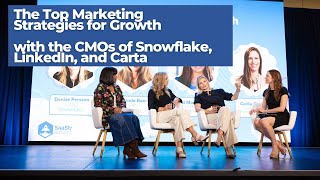
In a SaaStr‑hosted panel, CMOs from Snowflake, Carta, and LinkedIn Sales Solutions (with an advisor from Atlassian) discuss how they are shaping growth in 2024‑25 amid slowing conversion rates and the rise of AI. Denise Pierson (Snowflake) explains how Snowflake broke into the existing data‑warehouse category, then evolved to a "data cloud" through relentless consistency and frequency, and now focuses on multi‑product adoption, global franchise programs, and a lean, decentralized marketing org that pushes scalable assets to regional teams. Nicole Baer (Carta) describes a strategic pivot from cap‑table management to a full‑stack ERP for fund CFOs, emphasizing a singular, community‑centric vision, hiring product marketers, and using events to educate the underserved CFO audience. Gayle Moody‑Bird (LinkedIn Sales Solutions) shares the creation of the "Deep Sales" category, a CX‑first strategy that leans on existing customers, community, and lifecycle marketing while de‑emphasizing web‑optimization spend. The panel also explores AI use cases: Snowflake’s generative‑AI‑augmented SDRs that double meeting rates; Carta’s excitement about marketing‑mix modeling (HockeyStack, Alembic) to solve attribution; LinkedIn’s work on agentic AI assistants that learn behavior and act on behalf of marketers. Finally, each leader outlines trade‑offs for the coming year—scaling repeatable programs, dialing back low‑ROI tactics, and investing heavily in learning and development for their teams.
Chapters
In the early days, Snowflake was so much more than a traditional data warehouse. But when you're, again, your name is Snowflake, nobody's ever heard who you are. You have absolutely no credibility to try to go out to say, oh, we're this enterprise data platform. No one would even believe us. And it was better for us to really break into a category that already existed, a category that people understood, a category that there were budgets for. But if we had tried to say that we were something bigger, we just wouldn't get the sort of the traction. It would be hard for the sales team to even get a meeting, right? I think it's much better to break into an already existing category with something significantly better than in the early days, try to do something bigger. The most important thing I would say that we did well is the extreme consistency. Was when you saw Snowflake, it was always the data warehouse built for the cloud, anything, whatever it was. So we just hammered that. It was the consistency, it was the frequency, right? That's what made it work. It's almost more important to be consistent than being 100% right, I would say. Please welcome Kerilou Dietrich, CMO advisor, formerly at Atlassian. Nicole Baer, CMO at Carta. Gayle Moody-Bird, VP of Marketing, LinkedIn Sales Solutions. And Denise Pierson, CMO at Snowflake.
Hello. So nice to see all of you guys here. We had a wonderful CMO brunch earlier today, and some of you have come, and some of you we get to talk to for the first time. I have some of my favorite people on stage here today with me, because it's one of the hardest times of the year for marketers, the time of the year where we have to wrap up an assessment of what we've done so far and decide what we're gonna pitch to invest in next year to really make a difference. And this year is harder than any past years because the metrics haven't trended consistently, right? Conversion rates are down. Performance marketing is harder than ever. Many companies are trying to reach out to new audiences or with new products or new verticals or new geographies. There's so many things changing, and yet it's a time of year where we have to propose to the board the budget we need for next year and commit to the revenue that we think we could get with that budget. And so, uh, I asked these ladies to come on stage and, and talk to me a little bit about how they're thinking about the changing nature of their businesses and where they think they can invest to get the greatest growth. And one of the things that stood out to me is, as marketers, sometimes We get put into the box or we put ourselves into the box of talking about marketing tactics, but really these women are talking about growth tactics. They're really talking about the drivers of the overall business and then how marketing will operationalize those changes. Really how the fundamentals of the product, of the audience, of the market is changing. Denise, let's start with you. AI has really continued to, to change the nature of your business. And yet there's so much more opportunity than ever before. How are you thinking about the growth levers for your business this year?
Yeah, for us, we've been through everything from breaking into industries, we've verticalized the sales organization and the marketing organizations. We of course expanded into over 40 countries, right, in the last 8 years. Uh, we've done that part. And for us now, our growth next is really coming from multi-product adoption. So that's what we are really focused on. And of course, AI is a big part of that. So it's our AI offering is of course growth opportunities for us. Also, we're really very focused in the machine learning space. So that's really where we're focused on. And therefore we're very focused on our existing customers. We've really been so focused on new business, right? So over the years, and we're still of course core, we're not slowing down there. We're at the point where we need to break into our organizations, customer organizations. Wider, deeper with our new products. Um, with that as well, we're looking at, um, of course, how do we scale further? And, uh, also over the years we've invented so many new products. And where we are now is that we have this big franchise programs that we run now all over the world. So right now it's the world tour. In spring, there's another program. In the summer is another one. It's an evergreen program. So at the moment, we just can't invent more. It's a focus on which are the programs that we can scale even further. What are the programs, you know, we can scale with our partners? It's all about scaling what we have, breaking into our accounts at the wider and deeper level. That's really where our growth is going to come from now next.
And some of the changes you've made there have been organizational to try to align that. And tell us a little bit. As early-stage startups, everyone's in the same office and you all get to talk to each other, and then you get into these functional teams. And then at some point of growth, when you're slowing down, inventing new things, you either have business units or regions. Just tell us a little bit about how you're thinking organizationally about aligning people to those goals. Yeah.
And also our headquarters right here at San Mateo, we're in, in hybrid model. Everyone is in the office 3 days a week and philosophy around here, like headquarters, central versus decentralization, we really want to keep the central team as lean as we possibly can, right? It's like people, it's like people in sales with a quota and non-quota carrying people. At a headquarter, we have no quota on the marketing team, right? The regional teams, they have quotas. So, I mean, our role on the central team is really only to focus on those scalable programs of course, everything around positioning, messaging, the brand, sales enablement, all those sort of things. But everything else we really wanna push out to the regions so they have more autonomy. And as, as you grow in the early days, everyone is wearing different hats for different things, right? And then some people become leaders and some people become more specialized. And so of course they're more. Some of the specialized resources were more central, right? Now we have more specialized resources out in EMEA and APJ, right? They have product marketing teams now. They have customer marketing. They have partner marketing team. They have brand resources, which they didn't have before. But really want for us to be able to move, continue to move incredibly fast. They really just cannot just rely on us here in San Mateo, right? That would be a massive bottleneck. So now it's more about more power to the regions, let them move faster. We also work very closely. The MEA leader, the APJ leader is my direct reports, right? We talk several times every week. So they are also, they are running some programs that are global too. So some of our global training programs is run out of APJ because they're so incredibly good at scaling things. Sometimes some great innovations comes from Europe and they get to lead that globally. So Again, as little people at the headquarters as possible. You need to have a quote on the marketing team, but again, of course, you want to have, be able to have those shared resources. We don't have to redo things, right? It's all about DORA, do it once, repurpose anywhere. Yeah.
So effectiveness and efficiency. Now, Carta is in a very different place right now, right, Nicole? You guys have had this traditional focus on the cap table business, but now you're expanding new products and new audiences. So, so your growth levers for next year, talk us through how you're thinking. Yes.
So we're very well known as a cap table business. Hopefully many of you are Carta customers in the audience if you're a founder. And we're making this, uh, strategic transition to creating software for the office of the fund CFO. We see fund CFOs for VC and for private equity as being incredibly underserved. They're still using Excel. They're still using single points of failure with accountants. They use other vendors that are primarily service forward as opposed to software forward. And we really want to give our fund CFOs what we think all CFOs believe, which is a true ERP system. So that's really where our strategic focus is gonna be over the next year. And I can say as a CMO, it feels so great to have a singular focus. It really does. We're really laddering everything we're doing in marketing, in product, in sales, into this singular vision around how we're going to really fall in love with the fund CFO and deliver something that, that they've never really had before in their career and create incredible value, which is what we think we've done for founders as well in the cap table business.
And so your marketing strategy is really about a lot of new campaigns, new category work, new— Audiences, all, all the new. Yep.
Yeah, we've been, we've had, uh, fund administration as part of our product portfolio for some period of time and things like waterfall analyses for private equity. But it's really about coalescing the entire offering for the fund CFO that we can then align our marketing organization around. So I'm hiring for product marketers. This is a small plug. Product marketers and customer marketing managers are really important. To this overall vision, really anything that's gonna be at the heart of our, this customer we're focused on, which is the fund CFO, as well as deal teams, finance teams, and, and accounting teams.
Great. And Gail, so Gail is the Vice President of Marketing for LinkedIn Sales Solutions. So she's focused on the aspect of how companies can use LinkedIn to, to sell better. So she's at this interesting intersection from my perspective of what are the marketing strategies that are shaping this coming year and what are the sales strategies that are shaping this coming year. And of course the pitch for LinkedIn is we help you know better and target the exact right people and interact with them in a much deeper and more engaged way. So you must have a lot of pressure to do great marketing and great sales being at the epicenter of it. But it sounds like you too are trying to figure out how do we like reaccelerate growth and which new levers can we use on the team or as a company to do?
Yes.
Um, I sit in an interesting place in LinkedIn because We are known as a talent solutions business. So in the sales solutions business, we really are a startup within the business, even though we're $1.5 billion hitting upon $2 billion. So the question is, how do we grow? How do we continue that acceleration? We think mining the customer experience, so CX, is our path to doing that. 90% of our revenue plan is working with existing customers and going deeper. One of you mentioned penetrating customers and finding more pathways, more regions, more divisions within an existing organization. So we've firmed up a priority within our organization that brings customer success, sales, lifecycle marketing, and product marketing to understand what are those levers we need to touch to get greater utilization of the people who already have our products, Making sure that they understand the value. So a lot of time spent on strategic value reviews, making sure that the onboarding process is clear. And we did a study with Accenture and we looked at all the customer experience maps. We had about 15 customer maps. So everybody's got their own view of the elephant and thinking about how they're approaching customers. We want to unify that. And make a seamless customer experience focused on values so that when it's time for that renewal or that growth conversation, it's very clear that there's been value delivered, that people are using the tool, and that it's building growth in their organizations. So for us, the mantra for the year is really CX, investing in that, and really removing all the barriers that tend to happen between support customer success, and lifecycle marketing. So we're pretty excited about that.
I think it's a nice range that we have here. Scale what's really working, build out a whole bunch of new things, and then create this experience. When we were on the phone, we were debating, because in CMO land, category creation is always a, a big question. And certainly for a lot of early stage companies that are trying to figure out how you talk about your business. Everyone should go look up Denise's SaaStr session from a couple years ago that was the path from $0 to $100 million. And it's one of SaaStr's most popular sessions of all time. Nice job, Denise.
I don't know what to say.
And, but she talks a little bit about these stages of growth at, at Snowflake and how at first they had to really describe who they were in the context of the other data warehouses and databases. And then they had this move to the cloud, and at each stage they, they were articulating a little bit differently, and I'll let her talk about that. But also Carta's working on that, and also LinkedIn is trying to shape, like, how do we talk about sales tools and data? Are we getting grouped with the wrong people? So let's take a couple minutes and just talk about it. Maybe we'll just go through this order again. But Denise, you worked with, I think, Zoom Marketing on some of your early work and then did a lot internally. But how do you think about naming your category so that your customers can understand and buy the right tools.
Yeah, I mean, in the early days, Snowflake was so much more than a traditional data warehouse. And, but when you're, again, your name is Snowflake, nobody's ever heard who you are. You have absolutely no credibility to try to go out and say, oh, we're this enterprise data platform. No one would even believe us. And, uh, it would take too long to explain what we really do. And it was better for us to really break into a category that people, that already existed, a category that people understood, a category that there were budgets for. Again, our new one then was that, okay, this is a data warehouse built for the cloud. And all the differentiation of Snowflake and all the things you could do now that you'd never been able to do before came from the fact that we were built from the cloud, right? And those traditional on-premise or those have been just migrated into the cloud, they just had major limitations. But if we had tried to say that we were something bigger, we just wouldn't get the sort of the traction. It would be hard for the sales team to even get a meeting, right? You need to also go after market where there are budgets and actually people buying those products. And they will spend 30 minutes trying to understand, say, what we do. And then the customer say, oh, oh, so you're like a data warehouse, right? Let's do that from the beginning. And that worked incredibly well. I think it's much better to break into an already existing category with something significantly better than in the early days, try to do something bigger. Of course, the, we grow a lot and then again, our customers pulled us into this. We really need like a data cloud, right? That's what we need. We need a data platform that sits across the clouds. And that's how we then more evolved into become the data cloud company, the data cloud positioning we have today. But again, I would say the most important thing I would say that we did well, that I have never done well before or previous companies, is the extreme consistency. Because when you saw Snowflake, it was always the data warehouse built for the cloud, anything, whatever it was. So we just hammered that. It was the consistency, it was the frequency, right? That's what made it work. It's almost more important to be consistent than being 100% right, I would say.
Yeah. Just when we get bored of it in marketing, that market has only just started to hear us, right? And you had the same experience. So you tried to name something at an earlier stage startup and you just didn't have the money or the traction to get it, but then you've seen success in other experiences, right?
So this is one of my favorite topics. Um, I've actually been to like the mothership of category creation. If you follow me on LinkedIn, I have an 8-series newsletter about creating a category. So I'll tell you what worked and what didn't. So my second time working with category design advisors and creating a category was at LinkedIn, and it was successful. It was actually pretty transformational for our business. We created a category called Deep Sales. It resonated with the market. It got our sales teams so excited to have a North Star to talk about. And it also differentiated us. It was well chosen because it differentiated us from shallow selling, which was a subtle dig at our competitors, but not an overt dig. So we just found that sweet spot. But because we were LinkedIn, because we're large enough, we have a platform that we can speak to on a daily basis. As well as get our sort of our enthusiasts speaking about it. We had the leverage to make deep sales a thing that mattered, and I could roll it out to a sales team of 2,000 people. We could flood the feed with it. So I had that sort of the share of voice to create something that was really meaningful, and it was a game changer for my career at LinkedIn. Conversely, the first time I did it, I was at a I was CMO at an AI startup and it was Series B. And as you were saying, we didn't have the leverage. We didn't have, we didn't have the budget. We didn't have the platform. We didn't have the scaled sales team. And so it's very hard to strike in the market when no one knows who you are. You don't really have strong representation and create something new. So although we really believed in the positioning, we just didn't have the resources. To make it stick. And so I think there's lots of great things about it, but you have to know the sort of the boundary conditions of when it works and when it doesn't. And I've learned from both, but there's lots of notes in my newsletter that you'll see online about what are the conditions that help it work really well for a team that has the scale.
And one of the best ways is to extend what you already have, right? Going from the, the data warehouse or data warehouse for the cloud to the data cloud to the AI cloud. You're taking more space incrementally. And for Carta, you, you're highly respected. I have lots of stock that I log into Carta, and I'm an advisor to a number of, of growth companies, and I take equity as part of my aspect. Yeah. So I'm actually unique in the market 'cause I'm always like seeing different equity and equity platforms. But one of the advantages for you is that you're trying to say we're so much more than you thought before. Right.
Right.
How are you planning to get that message out to the market this year? Are you gonna do a lot of in-person experiences? Are you doing brand campaigns? What's the investment that will drive that growth?
All the things, and they're gonna actually gonna be starting this month. So you will be seeing our new sort of category-defining, shaping exercise out there in the wild soon. I'm really excited about it. We've done a ton of work to think about how do we, to your point, like clearly communicate and consistently communicate what we do in a way that resonates because the world of venture capital and private equity can be very opaque, right? So to most people, and we want it to feel like it's very clear that the value prop is there in the category as we define it.
So yes, I'm really excited.
We're gonna have a lot coming out in the next couple months.
Excited. I don't think we can have a category or a session about growth next year without talking about AI. So let's take a couple minutes to talk about where we see the biggest opportunities coming. Denise, you guys are, have seen some good AI traction in the SDR organization. Maybe tell us a little bit about that.
And I think everyone goes through a maturation journey here, right? I mean, it comes back to, it is a data maturation journey you need to go through as well. And of course, we've been using AI across marketing for so many years because we have the products ourselves.
Right.
But in terms of then more generative AI, where we're seeing success there has really been on the, our SDR side. So we have about 300 SDRs. And they are in seats for 15 months, then they move into inside sales, which means that we're hiring 200 SDRs every year. So we have 10 different cohorts in our sales development academy joining every month, essentially. And for them, it's hard for them to write the right emails and get the right content. So that's where we see a massive impact. So we're seeing more than double the meeting rates for those teams who've been using generative AI for their messages and their emails and everything. So that's where we can go in, optimize even more.
And so it's not even really getting rid of them. It's making them all more productive and scaling without scaling all the people.
Raising, raising their quotas, essentially.
Yeah.
Yeah.
Welcome to the team. Sell more.
That's right.
Awesome.
How about you guys? Where are you experimenting with AI and where's traction?
I'm the most excited about marketing mix modeling from companies like HockeyStack and Alembic. That to me could be a game changer. Plus I'm so tired of arguing about attribution with, uh, various folks.
This is—
can plus up beyond attribution where you really can get inputs from a variety of sort of surfaces and channels, including brand, as opposed to just being the channels that we can identify and own, but across so many different areas where we can get signal into what's working with marketing. So that to me is like quite literally the most exciting thing I've heard in probably 10 years.
Yeah.
Great. And I think with the complexity of sales, I think medium modeling gets even more important. We know that it's many touches to many people to get, to get there. So I, I think that'll be an exciting part this year too. Gail, uh, how about you? Where are you guys experimenting with AI anywhere you're seeing traction?
I will do this now from my product point of view as opposed to the marketing point of view. As a really like a 7-year subsidiary of Microsoft, We've been steeped in AI for a long time. So with the association with OpenAI that Microsoft has, we have a lot of early access to lots of the tools that they're building. So we're really talking about our agentic future. There'll be lots more from us over the coming weeks about that. But the way we think about it is there are lots of tools that are going to be very efficient at creating more spam cannons. And what we really want to do is focus on an AI tool or a set of tools that really helps you decipher what's important and what's not. And once you identify those next best actions, to have this agentic tool, almost your sales assistant or your marketing assistant, do some of this activity for you. And so the difference between AI features and an agentic assistant is this agentic assistant actually starts to take learn your behaviors, learn your priorities, and take actions on your behalf. And so we are working furiously, which is one of the reasons we were talking about PMM being so important. We are launching and testing products at such a rapid rate that keeping up with all of the competitive noise around AI is something that certainly keeps me up at night, but in a good way. So we're embracing it full on, and we think it's gonna do great things for the future.
Last question. I think the biggest problem about being a marketer is more is more with less. Is there anything this year that you're going to dial down? Is there any, any place that you've identified that we're going to, we're going to try to do more here? And we think that we're going to do a little bit less here because there's limited resources and we have real trade-offs.
We're doing a bit less. With web optimization. I think this idea that someone sees a piece of content, fills out a form, goes to a website, becomes fodder for an SDR is— it's not been an effective way. You talked about declining rates and we could spend hours and hundreds of thousands of dollars optimizing web. We're thinking more about building community, doing a lot of influencer marketing and doing more one-on-one because people are so excited to be back out in the market again. So we're dialing down some of the things that I used to love, like building websites.
We're dialing it up on community. That's a, an important channel for us, and I define that kind of broadly, but our community of CFOs, our community of founders, and making events that are very tailored for them, but also straddle brand to demand. I, I really try to avoid the trap that many B2B marketers focus on, on being way too bottom of the funnel, account-based, and remember that we have to make sure we're covering the full funnel.
Anything you guys are dialing back on?
Yeah, coming back to where we started, we're dialing down on things we can't scale, right? Things that we can't repeat and dialing up on the things we can scale. Also, again, I think one thing we're investing more in is also our people, significantly more. We're investing a lot in learning and development. We need to take our entire workforce and the marketing into the new as well. Learn about all this new technologies and how to be more efficient and all those sort of things. So learning and development is actually something we're, we're scaling up.
It's never been a more exciting time, I think, to be both in tech and marketing, right? With the changes in SEO and the behavior of search, I think that's massively going to change our website decisions. We had— I was part of a couple of other AI panels during the session, and one of the discussions was a lot of what we do now is trying to use AI to adapt to our existing paradigms. Like, how do we just rewrite the SDR's email better? And again, as we move forward, that's potentially in an agent landscape. They'll say, don't start with the email, start with the LinkedIn notification or all sorts of things that are gonna be brand new paradigms. Like the fact that email is still one of the most productive marketing paradigms is a joke when we think about buying email lists at the beginning of our list. It's a great year of learning, and I'm just so thankful to the SaaStr team for bringing so many of us together. I think let's give SaaStr a round of applause.
More from Jason

Why Your Next Hire Should Report to an AI, Tragedy Apps, and Too Many AI SDRs? | The Agents #004

Our Agents Drove Our Salesforce Bill Up 80%, Marketo Hates Agents, and We Stealth-Churned Off Notion




Managing 20+ AI Agents: Lazy Agents, Our $500K AI Bill, Stealth Churn & the Death of 60% Solutions




