“Under the Hood: How Salesforce Does Sales Forecasting Itself” with Salesforce’s VP and RVP Sales
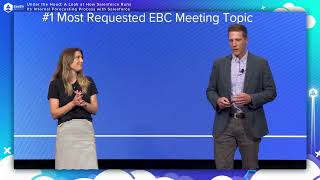
Salesforce VP Eric Cuff and RVP Theresa Stevens explain how the company forecasts sales using three pillars: people, process, and data. Every customer interaction must log to the CRM, which becomes the single source of truth. They run daily CRO reviews, weekly pipeline inspections, and monthly pipe councils to hold everyone accountable, from the CRO down to BDRs.
Chapters
All right. OK, we can get going. Hello, everyone. Welcome to our session, Under the Hood: How Salesforce Runs Their Forecasting Process. My name is Eric Cuff. I'm Vice President of Sales Strategy and Sales Programs for our mayor region. Today, I'm joined by Theresa Stevens, who's a regional vice president of our SMB sales team. And I'm really excited that she's here with us today, because she can provide a little more of the day-to-day perspective on not only how she manages the forecast, but how she coaches her reps on how to manage the forecast. Within our process. OK, so one of the reasons why we're here today— are you curious? Like, why are we— why do we have this session? Turns out that this is actually one of the most requested sessions that we have inside our Executive Briefing Center at Salesforce. Customers always want to understand, why do you— how do you run your sales forecasting process? Because running forecasts and having them accurate is critical to business success. And it's not easy to execute. [FOREIGN LANGUAGE] All right. So at Salesforce, there's 3 main culture— focus areas that we think about inside our Salesforce forecasting. 3 pillars. First one starts with the people. It's critical that we have a data-driven culture where every individual from the C-suite exec all the way down to the individual contributor are held accountable to their sales forecast. And second is a process. Now, we align the process across all of our departments so that they look at the most critical and crucial KPIs and definitions. It's critical we also have a very thoughtful and consistent cadence to how we look at forecasting. And third, it's ensuring that all the forecasts we look at are actually driving action. It's not just about reporting the news. It's able to look at our forecasts and actually understand what do we need to do next to move the needle. And third is data and tools. So for us, it's really, really critical that every organization have a single source of truth. For their forecasting data. It's critical because we can't have you swivel chairing between different reports, different systems, spreadsheets, etc. So it's really critical that you have one single source of truth. And as technology continues to develop, we ensure that we infuse that technology into our forecasting process, whether that's removing manual tasks or forecast prediction, etc. So we'll infuse those in, into our forecasting process that continues to evolve. Like the culture at Salesforce. So first, let me dive into the people. At Salesforce, we feel like sales is a team sport. Our account teams are led by an account executive. The account executive is responsible for managing the relationship with the customer, as well as act as the quarterback for the overall deal cycle. But the account executive knows that they won't be successful just purely on their own. They have to get the support from their both pre- and post-sales partners. So business development reps, they're in charge of really building the top of the funnel, creating the early-stage opportunities. While our specialist sellers and solution engineers will really serve as your product and subject matter expert. Sales leaders like Teresa will come in and really lean in wherever needed throughout the deal cycle. But their primary role is to coach the deal— or coach the rep, excuse me, through that deal cycle. Our business value team will spend a lot of time making sure the customer understands the justification and the business case, and what is the ROI for the investment that they're making in the product. And last but certainly not least, our customer success team engages in that post-sales handoff to ensure that we have a smooth implementation and ongoing adoption of the technology that they've purchased. Now, each of these different functions play a critical role in our forecasting process. From the start of identifying the opportunity all the way through to making sure the customer is happy with their purchase, And so they all have to abide by what we call at Salesforce the golden rule. The golden rule at Salesforce, if it's not in CRM, it doesn't exist. So essentially, anytime you have an opportunity or a conversation with a customer, customer interaction, if they're not logging that into our systems, it might as well never have happened. And this is critical. And I mentioned culture. Like, it's really embedded in every team member that they need to go in and add whatever interactions they've had into the system. Because every one of those basic inputs really help us with the forecast. Because without them, forecasting accurately is next to impossible. Now, I mentioned accountability a couple of times. The accountability is not just on our account executive. The accountability of the forecast is actually on the entirety of the sales team, from our CRO all the way down to our BDR. Everyone has to do their part. So the account executive, the BDR, they'll be identifying, creating, moving the opportunities through the actual deal cycle. Well, the sales leaders like Teresa will go in and add their own judgment. So they're really accountable and responsible for rolling up the final commit forecast of that territory. And then our executives, like our CRO Miguel Milano, he'll hold a weekly forecast call, 52 weeks a year, where he'll do the inspection and want to understand what's going on with all the different deals and really provide that tops-down guidance. So from here, actually, I'll hand it over to Teresa to walk us through process.
Thank you, Eric. Great. So I'll take you guys through our forecasting process. So the first step in establishing your forecasting process is really aligning and determining what success looks like for your business. What key performance indicators are critical for you, and agreeing upon those, and defining those across your organization. So at Salesforce, we run a recurring revenue SaaS business. So things like generating pipe, open opportunities, and then ACV are really critical for us. We monitor those very closely in order to determine, do we have enough pipeline to hit our targets and are we growing at the rate that we expect? We also look at things like annual order value and attrition to assess the general stability of our business. But it doesn't just stop, uh, at defining KPIs. You also have to define the stages within your sales cycle. So at Salesforce, we have 6 stages, all the way from identifying the opportunity through to closed won. Uh, for Salesforce, a deal doesn't become part of the pipeline until it reaches stage 2. And that's something that we've defined. Uh, also, when a stage, uh, deal gets to stage 4, we consider that a higher likelihood to close deal or a later stage deal. Again, these are all just based on our definitions at Salesforce. Um, so it's important that you guys define and align on these stages at your organization as well. The next step in the process, I would say, is establishing guardrails to ensure you have clean pipeline. Clean pipeline is critical for having an accurate forecast. At Salesforce, we have a couple of rules. For example, opportunity record must have the stage, the amount, the close date. Our leaders are expected to input their assessment on if the deal is— the likelihood of the deal closing, and also their own next steps for helping the deal get to closure. We also have a couple of guiding principles that create a little bit more consistency for us at Salesforce. Number one is just everything should be happening centrally in the CRM. It kind of goes back to our golden rule. But sales teams should be leveraging our CRM data when they're reviewing pipeline, doing pipe reviews, and also inputting their forecast. And we drive a weekly cadence at Salesforce around forecasting. So I think this slide helps to illustrate how every role that was defined earlier on forecasting plays a part in pipeline management, you'll see that at Salesforce, we have a forecasting meeting literally every single day of the week. On Mondays, our CRO and our CEO, they actually meet, they review the forecast. They look at things like week-over-week changes. They look at our big deals and a couple of other factors. At the same time, our AEs are expected to go in and update their opportunities on Mondays. So we have a true tops-down and bottoms-up approach to accountability across our forecast. And then you can see as the week progresses, different levels of sales leadership will review the forecast, they'll add inputs, and they'll provide feedback back to the account teams. But we don't just drive a weekly cadence. This all feeds into a greater annual cadence of review and things like monthly pipe councils and quarterly leadership meetings. We actually use that weekly cadence to get better representation or better grasp on the health of our business, so we can more accurately forecast that in things like our QBRs and our all-hands calls. I think the most important takeaway here is that what we've done at Salesforce is really develop a muscle around inspection in terms of our business process. And we can, at any point in time, identify gaps and have the ability to proactively address any concerns. So moving along to the last pillar, this is data and tools. So now with the, the, the different team member roles in place, cadences, we've got accountability, we've got definitions. This allows us to report on our forecast in real time. So we do this through our CRM reporting and also our CRM native analytics tool. Uh, it's important to note again that everything is driven centrally from our instance of Salesforce. So our sales teams are in there updating, managing, and inspecting their forecast, their pipeline, their opportunities, and they're updating those in real time as needed. And then we are able to view this data inside of our CRM analytics. This is a native tool that builds in predictive AI and also pulls in external data sources as needed. And we use these centralized dashboards really as the central place that we are looking when we are reviewing pipeline and we are going through forecasting calls. Again, I think this is the biggest thing that this does for us is since the data is being updated in real time, it allows us the opportunity to be really proactive in addressing hotspots as they come up. So let's walk through the couple of tools that we use in the forecasting process step by step. The first is opportunity. Everything starts with the opportunity record, as we've mentioned. Um, uh, AEs are expected to input the correct data, and they're expected to update it. If the data inside of this— the opportunity record isn't accurate, it's impossible for us to be able to accurately forecast. So we rely heavily on those best practices that we shared earlier. And we rely on our sales teams to keep that information up to date in real time. This is an actually an example of what an opportunity record looks like at Salesforce. So this is where our sellers are, are living and breathing every day as they're managing their opportunities. And the next step in the process is manager inspection. So Our leaders leverage Pipeline Inspection in order to view opportunity data in aggregate and identify trends across their team. So they look at things like how close dates and, and opportunity amounts are shifting throughout the week, throughout the month, and they're able to address them there. So these dashboards are critical in collaborating in pipeline reviews and being able to determine where we should focus our efforts and effort to improve our chances of hitting our targets. And this is where all the work that we've put into the process and the tech stack really comes together. All the information that our sales teams is inputting inside of Salesforce essentially rolls up to our CRO in this global forecast dashboard. So you can see here, there are about 12 different filters. We're really able to slice and dice our forecast in a number of different different ways by product, by industry, by region, and so much more. Also, it's color-coded so you can quickly see strengths and weaknesses. So for this example up here, you can see that pipe coverage is highlighted in red. That's an indicator that we need to generate more pipeline in order to hit our target. So our CRO, for example, could call a team together to dig into this more and try and understand what the root issue is and mitigate. And with that, I will hand it back to Eric to wrap us up.
Great. Thanks a lot, Theresa. Really fascinating stuff. So like she said, quickly, I'll just run through the final takeaways here. All right. So I know there's been a lot today. So if there's 3 things that you remember, we want to make sure you walk away with them. First, establish a data-driven culture. Ensure that every sales team member is held accountable to their forecast and can speak a common pipeline language. Second is to aim to create a consistent forecasting process. Make it a machine. And third is to create one single source of truth inside your CRM for forecasting so that every team member knows exactly what data to use to make the best, most informed decisions they can on their forecast. So with that, I want to thank you all. We know many of you are Salesforce customers and— or partners or community members. We acknowledge we wouldn't be where we are without any of you. So thank you. For those of you that don't know Salesforce, please come join us at our booth after the session. We'll be happy to chat with you about some of the challenges you may be facing and see where we can help. So thank you. Hope you enjoy the rest of your time here at SaaStr.
Thank you.
More from Jason

Why Your Next Hire Should Report to an AI, Tragedy Apps, and Too Many AI SDRs? | The Agents #004

Our Agents Drove Our Salesforce Bill Up 80%, Marketo Hates Agents, and We Stealth-Churned Off Notion




Managing 20+ AI Agents: Lazy Agents, Our $500K AI Bill, Stealth Churn & the Death of 60% Solutions




