What It’s Like Running a Profitable $400M Public SaaS Company with Vimeo CEO Adam Gross
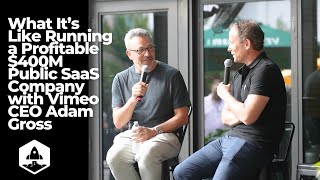
Adam Gross, interim CEO of Vimeo, discusses running the $400 million ARR video platform. Revenue per employee jumped from $80-100K in 2021 to $400K, and EBITDA turned positive. Vimeo serves three customer types: marketers seeking alternatives to Google and Meta, enterprises using Vimeo Central for collaboration, and individual creators.
Chapters
Thank you everybody. It's really great to have you here.
Woo!
So we've done a couple of these. The first two were meetups. We had one in 2022 that was like really formal, like SaaStr Annual with a lot of content. We thought we would mix it up a little bit here. We are lucky to have a SaaS veteran that I think we can all learn from, Adam Gross, here, which we'll talk through. He's now the interim CEO of Vimeo, which is public at $400 million in revenue. We'll talk about how easy that is. Just how easy it is to get profitable at $400 million in revenue. So that's pretty cool. But let's welcome Adam to Saastr. So it was great. Thank you. Thanks for coming.
Good to see you.
So for folks, Adam is definitely OG SaaS and cloud.
Are you saying I'm old?
No, I'm saying I think he started his first cloud startup at 12, right? What was the first company called?
Personify.
Personify. That was a client.
That was on-prem.
That was on-prem.
Okay. That was even though. That's when I learned that I, this was in the '90s. That's how I learned that I didn't want to do on-prem software from doing on-prem software.
You just couldn't patch the crappy software every night.
Was the night thing. Yeah.
Okay. And then maybe I skipped a step. You were like VP of developer relations or something at Salesforce in the good days, right?
That's right.
Good days. So working with all the up and comers.
All the parts of the Salesforce product you love. Those are the parts that I worked on and all the crappy parts.
I had nothing to do with it.
Okay. Yeah.
OG, then OG at Dropbox, like number 11. Number— I was gonna say almost single digits.
Yeah.
Number 11. The first business guy at Dropbox, right?
Yeah.
Even though you're somewhat technical in product, you were the first business guy at Dropbox.
I was also the first person who didn't go to MIT. Ah, so, uh, but I went to Carnegie Mellon, so they let me, they snuck me in.
It was probably still a culture clash.
Yeah.
Yeah. Got it. Now there was a story about you at Dropbox, which I don't think is true. But did you, were you the first person to build an actual desk at Dropbox or bring in a salesperson or something like that?
I will say that there might've been some office furniture controversy, but I think that's carried forward in the history of Dropbox.
Okay. So super early. And then CEO of Heroku. I don't know if any of you guys ever used Heroku. I'm sure you've used Dropbox and others. Yeah. So Heroku is as fundamental to how we think about platforms as it is, right? It's grown so much, right? But. Heroku was like jaw-dropping back in the day, wasn't it?
Amazing. I came in as CEO after the founders who I had known before. I was actually an angel investor in Heroku, incidentally. And they did some of the work that they did and the size of that team, they did the equivalent of Kubernetes and what Google was doing with buildings full of people with 10 people in a room. Still, I don't appreciate, I don't know that the technical brilliance of that original team is as fully recognized even to this day.
Yeah. Jaw-dropping. The fact that you actually didn't have to do all this work, which we take for granted today. Right. That was epic. I'm probably missing a piece from Heroku and then where before Vimeo, is there a gap I'm missing in the esteemed resume?
Not a gap. I just was more like you. I wasn't operational. I was doing investing and board work and stuff like that. I didn't have a real, didn't have a real job for a while.
So Vimeo, I don't know. And Adam will get up to speed. Vimeo has gone. It's one of the OGs of the internet. It was doing— the old Vimeo was doing HD video before YouTube.
As a—
I was watching Vimeo back in the day when I had to watch like VGA on YouTube. It's a very different business today. It's public. It's $400 million in ARR. It is going more enterprise, more sales-led, and Adam is now the interim CEO, was on the board for years, and now you're running the place, right?
That's right.
Got it. Okay. So big deal. So there's only so many. There's only so many public company SaaS CEOs we get. I don't know how often Howard, when he was running Next, he is here, was in Miami, but, uh, less often when you were running a public company.
Okay.
A little different. So there's only so many $400 million public company CEO. First of all, get us quickly, and I want to quickly have a speed, tell us about Vimeo today. What's the company you're running?
Yeah. The amazing thing about Vimeo is we are turning 20 this year. So we're starting our third decade, which there's not a lot of internet companies and a lot of brands, internet brands that have that kind of history. And that has some good and the bad with it. It means that a lot of people know who we are, but not as many people know what we're up to more recently. And we have a wonderful and rich history supporting the creative and filmmaker community and a very special relationship with that world. I recently saw a clip of a filmmaker who was just nominated, and in his previous Oscar acceptance speech, thanking Vimeo. That was pretty nice. It's pretty special. For your SaaS product as a thing. But where, where our business really is now is we're a SaaS company, right? We're not a social— people understand us historically as more of a social media company, but we never had advertising. And you wonder, how do we make money? We make money by essentially being a video platform in 3 buckets. We're the second largest video player after YouTube. We're doing about a quarter billion impressions of the video player a month. If you want a place to host your videos where you don't want to give your customer information to Google, TikTok, or Meta, we're a really good option for that. And we think that smart marketers should be doing more of that. And that free video hosting is not as good of a deal as it always seems to be. I'm all for putting stuff onto YouTube. I love YouTube. I use it all the time. But that broadly, our view of the video business is that it's going to swing from being more intermediary-led to always going to be a mix, but have more company control in that. That's a big part of the marketing pillar. We have a product we just launched last week called Vimeo Central, which is a complete suite for using video in collaboration and employee engagement. We think we're pretty unique in the space in kind of the breadth of capabilities that we offer there. And then finally is our media segment, which is a whole separate interesting business where we support creators who want to do subscription-based video monetization, where they top out what you can do in advertising rev share in YouTube. And it's remarkable. I'm not a media guy, I'm a SaaS guy, so I'm learning this along the way. but I meet with these folks all the time and they are building $100 million businesses selling subscriptions to whatever specialty content that they have. And they're largely coming up, some come out of traditional media like Criterion Collection, but a lot of them are coming out of this creator world.
And what a lot of, there's a lot of great, I wrote, I've written Vimeo up a couple of times on SaaS, or there's some pretty good investor slides, but the company is going through a phase transition, right? Mixing. If we abstract away a little bit, uh, you've got a long tail, you've got a product-led motion and a very sales-led motion. And I think today all of your growth seems to be on the sales-led side. That's what you call an enterprise. And I don't know where your line is for enterprise. It's not a million a year.
You're—
it might be $25K a year, but talk about that combination of the long tail and sales-led together.
Yeah. And I'll talk— it's how I ended up at Vimeo is I've always been interested in before we called it, and among my many views of PLG is it really emanates from the developer marketing world, right? The first PLG bottoms at products and really what we think about is content or PLG or a lot of marketing, modern marketing practice for my money emanated out of developer marketing and one of those. So I started off in that world that led to Dropbox-style companies. Again, similar thing. We didn't have names for it like then. Part of the joy for me at Baroku was really being able to tie those businesses together, take what was almost exclusively a credit card online business, builds an enterprise business on top of that, that by the time I left was about, went from 5% to being 50% of the revenue. And that's how I ended up on the Vimeo board. And that's my fundamental view of the opportunity here. I mentioned we have millions of people interacting with our product every month. Gee, that, what are all the things that you write about that we all struggle with? It's customer acquisition. It's a pain in the ass, isn't there? Can there be a better way? Now, a lot of people look at PLG and think that it's magic beans. It's not. It's in some ways, it's more work to get all the pieces synchronized. But if you can pull it off, it sure is damn rewarding to be able to connect a business that starts with that kind of consumer-style customer activity that you can then take through all the stages and ultimately monetize for $10K, $20K, $30K, or we even have customers that spend over $1 million a year with us.
And is the, and I should know this, but for the new product and enterprise stuff, there's probably several ICPs, but is marketers the real one that's buying this to put, to manage the content?
Yeah, we have a couple different ICPs, which is a good and a bad thing, right? We're, we are multi-product, but at the same time, it adds more complexity to complex business. Marketers are key ICP. The other one is IT, CIOs, and even as part of them, a little bit of HR. We sell a lot into internal video. Which is employee engagement and IT-led. And that's a little different than the marketing use case.
And how much of the long tail today can you mine for those customers? And how much comes in as essentially a paid conversion? Like how much synergy is there between the long tail and the PLG piece?
There's a lot and there's more to do. So certainly a majority of our enterprise business is being fed by our self-serve business. I don't know if we—
The majority is.
Yes, for sure. Now, how well are— I don't think we're done with connecting those dots and how well we can connect those dots and take that journey all the way from people who are free to people who spend $130 a year with us to people ultimately spending $100K plus.
The majority come from the long tail. So it's precious, right?
Majority, majority come from self-serve. Self-serve.
Yeah. And how do you think about the CAC of all of that? How do you think of the CAC of that self-serve going into those bigger deals? Are there a lot of them free-ish? Are the self-serve free-ish? Or is it from digital? Is it a nominal $0 CAC? Or how do you think about what it really costs to get these people?
Yeah, we talked about this in our last earnings call. Welcome being a public company. We recently made a change in our strategy to lean more into product-led. So we've spent a fair amount historically on advertising, primarily to fuel the more of the kind of prosumer individual online subscription business that you might be familiar with. And one of the strategy changes that we're making is to say, hey, if we turn up the innovation and we turn up the actual product quality, can we be ultimately, can we get around from having to spend all this money advertising and we've absolutely started that strategy and it's certainly something I believe is a big opportunity for us. We're spending a lot of money on advertising.
So yeah, almost at the edge of a B2C model, right?
Yes.
Advertising.
Yeah. There were parts of the business that resembled a little more of a consumer prosumer direct response marketing model where the, one of the things about PLG is to your point about CAC, what's the LTV? And if you can throw enterprise on the end of it, and you obviously can change the CAC dynamics in a material way as well. It's an evolving equation, but I'm a big believer. One of the great unique things about Vimeo, there are not a lot of companies that have that kind of brand recognition and have that kind of internet traffic. You and I and most of the people, if not all of these people in the room, have worked in the salt mines of starting a company where the only people who know what your company's called is you and your mom. You know what I mean? To actually have something that has some brand recognition, It's an unbelievable asset. I think there's a lot that we can do there.
Yeah. Does it help with outbound, with sales getting— do you outbound to get the sales to take the call?
Yeah. We— the door opens and we have our own very passionate community inside of these organizations, particularly the film people inside of a marketing organization. If you're large enough marketing or to have a film team, they have some deep emotional connection with Vimeo, which is really a sight to behold. And so the question for us is how do we translate? And if you read between the lines that what we've been doing, at least in my tenure, it's okay. How do we take that? How do we create products and value propositions and messages and go-to-market motions that are more strategic so we can have a bigger impact on those businesses? And this is part of the playbook. You've seen this. I saw this at Salesforce. We have a foothold. What does that journey look like to fundamentally grow your average deal size by becoming more strategic? And what kinds of problems are you solving for your customers? If the only— we solve a video hosting problem today. For sure. That is an entrée to solving any number of more strategic problems. And if we can climb up that ladder, all the goodness will come from that.
Let me ask a question to transition to a topic of efficiency, which will be a fun one to talk about.
Yeah.
But when you have a brand that people have high affinity for, like a Vimeo, especially coming in from where you have, how do you make sure you don't over-monetize that? How do you invest in the positive attributes, the community? Because there's so much— I think part of the tragedy of SaaS the last 18 months is over-monetizing as things got harder, as NR came down, as growth came down. There is— I want to hear from you, but there was a story we were up in SaaS, or there is a beloved product we all use all the time. And I, among others, we among others paid $300 a month for this product. And we got a threatening email at 11 o'clock at night saying we had to spend, pay $50,000 for 5 times as much license upfront. And if we didn't pay it by Friday, they would turn it off. Now, why did they do that? Now we won't say who, because we all love this company. One reason is they outsourced sales. Okay. Customer success, a whole topic. We'll run out of time. But the other thing is they came under growth pressure. And NRR was down and growth was down. And now Rambly's story of saying it's, you want to monetize these better, right? But you got to protect that special brand or it can decay fast. How do you load balance those two?
Yeah, I think, you know, the past couple of years have been a unique time for a whole bunch of reasons. And I think a lot of companies started missing plan. And when you start missing plan, pressure really comes down and those kinds of business decisions start taking precedent. One of the, certainly, north stars for us is being able to maintain a little bit of a long-term pers— longer-term perspective. And I do genuinely think it's, uh, to the, all of our stakeholders' benefit in the long term, but you do have to ask for a little patience. And we explicitly changed our strategy to one of the things about moving away from paid acquisition is trying to move to higher quality revenue, right? And trying to move to lower short, less short-term monetization. We made a very explicit strategy in the past couple months to reemphasize and reinvest in free, right? And that's another way of, right, that materializes. And again, not PLG is not for everybody, but if you're going to do it, free is a component. If you're trying to accelerate people or mine too aggressively for convert them too aggressively from free until paid, And you don't have that engagement, you're going to pay for it on the other side and quality and retention and those things. So I do think net, it does tend to work out, but yeah, it's hard to avoid those pressures.
This is something I wrote up years ago. Who's your VP of free then? Who owns free? What's their KPI?
Yeah, their KPI is MAU. And in our current model, and I—
MAU is a good one.
And in our current model, we have kind of a squad model. And this is one of the whole things about PLG. He'll forgive the, uh, diatribe. What makes it so hard is it's highly cross-organizational, right? And most companies we've all worked at are not good at cross-organizational in a single go-to-market mode. And here you have to be good at cross-organizational in three go-to-market modes, right? Free, self-serve, and enterprise. And the degree to which an organization can get its wires crossed when you're talking about all of those different motions. Is easy and profound. They're all in conflict. So keeping every, keeping those things in, and obviously the other thing with doing PLG versus doing enterprises, you know, as I often talk about, and we remember because we're older, in the old days, engineering would create a product and they put it on a CD and they throw it over a wall and that'll be the last anybody talked to them. Obviously that's not how these products work where engagement is such a key part of the customer journey. For us, we have a, what we call a squad model. I've got a VP of growth. Inside of marketing, and I've got a VP of product who owns experiencing great inside of product. And the two of them own a squad where they prioritize their projects together on a quarterly basis. Now it's not perfect, and, but it's working pretty well for us.
But just because this is interesting, the VP of growth has a MAU, a monthly active user KPI, not just monetizing that, not just converting it, but getting raw MAUs is one of their her or his core KPIs?
The two of them together, they own their metrics together, argue whether that's good or bad. And on free, it is 100% Mal. It's like people throw all of this, this is my other random, maybe helpful tactical piece of advice. The hard thing in running these businesses is having less metrics, not more, especially when companies are really trying to circle what they should be focusing on. There's a tendency to get lost in the data and think that the answer lies there. It doesn't, it lies with your customers, right? And our poor data team that got pummeled with all these different questions. And I showed up and we had pages and pages of metrics. I had went through the same exact thing at Heroku. First thing I did was like remove 80% of the metrics. This is the top line. If we're not, we can describe, all the businesses are non-orthogonal, all the metrics. If you, a couple simple things to focus on that everybody can keep in their head and align to, that's much more powerful than gee, I've got this physics model that describes if this impression happened here, then that other thing will relate to this ROI over here. Keep it simple. Keep it simple.
How many do you think a department can have? How many core metrics?
3 to 5 max. If you go home tonight, if you've got a spreadsheet, those rows and rows of metrics, there's a place for it. There's a place for the deeper financial and metric analysis. But the hard part about these businesses is aligning, right? Especially at scale. And Honestly, that's what my job is to help the organization align. And these just, you can get in circles with chasing the nth version of a metric when you're measuring all the same thing at the same time. At the end of the day, free businesses, man, like they're just measuring a different version of it if you pick something else. So keep it simple. Keep what people know.
Yeah. My simple version is 5 by 5. So the company shouldn't have more than 5 metrics and each department has 5, like they have their 5 and any more than that, it's a, Yeah, you're lost.
It's hard to have less. That's, that's the reality.
All right. Let's at least chat about efficiency and AI before we run out of time. So efficiency, this is something that I think the whole world of tech is struggling with. I think for startups, and Vimeo is a scale, so it's super interesting. And I'm not sure what your revenue per employee is, but we can probably figure it out in a minute. Right? I think for a lot of startups, we were around $80K to $100K in 2021. I don't know what it was at Brex in 2021, but times were good in terms of revenue per employee. In fact, I don't think people described it that way right now. We're moving to a $400K revenue per employee from $80K in 2021 to $400K. I don't think as an industry we've dealt with the ramifications for what that means in terms of if that's where we all got to get to, right? Everyone, every public company 2 years ago had -10%. I don't know what Vimeo's was, -12% operating margins. In 18 months, they went to 15 or 20. That's not a little, that's like more change than our whole lifetimes in SaaS, isn't it?
Yeah.
It's profound, isn't it?
It's profound. You can look at our results. It's public. We just announced for last year where it's something like $34 million EBITDA. Yeah.
And what was it 24 months ago?
Negative.
Yeah. It's not simple though. That's massive change, right?
Vimeo, it's hard for me to generalize because every company's journey is unique. And I do wonder about this because you and I lived in the era not that long ago when I remember at Salesforce, like the biggest thing you would get in trouble for is not spending enough because it was such a growth in a good way mentality. And the companies were growing like a berenkel. We were growing routinely at 70, 80%. So it was a different time. Obviously that's not where industry growth numbers are broadly. We accreted a lot of stuff really quickly. So there was a lot to digest. But yeah, it's a different era for sure.
Yeah. I think any big changes of all, I would say just a gross oversimplification. Everyone's gotten twice as efficient. So are any fundamentally things different at Vimeo in this world, this efficient world, or anything fundamentally different?
What I generally say, yes, is being really operationally expert, which is different than efficient. Efficient is like some CFOs ground you down, you know what I mean? And like you switched from Zoom to Google Meet, which we did. That's efficient. That's different than being—
Are we done with that, by the way?
All that operational—
all the app layoffs, going from Zoom to Google Meet to save a few nickels. Are we done with that?
I don't know. I'll tell you, this is an aside, but one of the more interesting experiences about my job is I'm now a major SaaS buyer.
Yeah.
And it is hilarious being on the other side of the equation. It is hilarious. And I think we spend too much on SaaS. So that's a, there's a lot of, it's a remarkable, we're a 1,000-person organization, $400 million revenue. It is remarkable how many effing tools we have.
Probably over 1,000 across all the orgs, right?
And I am not, I'm, one, I'm not convinced with the value. Two, as a CEO, it is not that hard to generate some value. I spend literally like 5 seconds. Approving or not approving a $50K random whatever SaaS request, just generate one iota of value for the CEO. So they give a little bit, like make that effort. It will make a difference. Anyway, that's my personal thought.
It's a good, it's a good topic.
But the thing that I, again, so not operational efficiency as much as like operational proficiency. How good are you at an organization? At planning, innovating, thinking about your business processes and implementing them into whatever your systems are. That is the missing piece. That is what makes the difference. And it's that skill that I, especially on the go-to-market side, right? That, and I'm a CRM tools nerd. So like, I, I think a lot about this stuff. If I were to say to any startup, like, what would you, what should you invest more in early? Or any company in any stage, it would probably be that.
We had that at Heroku.
We had the world's most amazing BizOps team and we were, we flew that thing like a fighter jet. Like it was unbelievable how we could innovate on our sales motions, on how the self-serve business related to the enterprise business. We were able to adapt, experiment, change, and that made all the difference. And that was more important than just grinding the numbers. Got it.
Okay. Last one. Let's talk about AI.
Yeah.
Let's talk about AI from a B2B perspective, from not about turning text into a cartoon, which is cool. Real world, fundamentally changing the workplace, changing products.
Yes.
What are you doing today? Where are we going to be at the end of the year?
You keyed it up as usual. We're on the same page. Obviously long-term, and I'm at a video company, long-term generative AI, generative video will change the world times 10. Absolutely. Where are we today? It's much more about content extraction and discovery and search. If in a way you can think about what we are as a video database company, our goal is for all your video in your organization, whether it's marketing video, internal meetings, town halls, you name it, to be in our database, which then we, and this is a product we released last week, Vimeo Central does all the content extraction, does all of the concept questions. You can now chat with videos, right? And you see this in other tools on the sales side. That to me, and we're still at the early days of what's possible there, in terms of how that's going to change how businesses operate and like some of the unlocks, I think we're at early days. That to me is really exciting and occasionally scary.
Do you see massive disruption in workforces, marketing departments and other departments, headcount shrinking because of AI, or do you think that's a bridge too far?
I'm not connecting those dots yet. I'm not seeing that. I'm not saying it doesn't happen. I'm just not seeing that from where we sit. Look, we're not in the customer support business, so maybe other companies see that in different ways. I do think that we are in the early days of— I think we're going to be surprised at how much collaboration tools and how much our day-to-day work experiences are yet to shift. And obviously video is the center of that. If you look at what happened over the past couple of years, none of us would have guessed that we would be using video so much in our day-to-day productivity experiences. And I can tell you from what I see, we're at inning 1 on that, not inning 9. We're gonna think about Zoom and hanging out in COVID times as the BlackBerry era, not the iPhone era, this stuff. So there's a lot left yet to come there. It's also interesting how much of video now is synchronous, Zoom, Meet, whatever. Versus as you introduce some of this AI technology, what it really does is heighten the async side of it and your ability to consume and collaborate, not all sitting around the same Zoom meeting. I don't know. That's where my nose is at for some of the impact. Cool. Cool.
All right, Adam, this was great. Um, this was incredible. Thanks everybody. Let's give Adam a big hand. Bring in the best CEOs to Miami.
More from Jason

Why Your Next Hire Should Report to an AI, Tragedy Apps, and Too Many AI SDRs? | The Agents #004

Our Agents Drove Our Salesforce Bill Up 80%, Marketo Hates Agents, and We Stealth-Churned Off Notion




Managing 20+ AI Agents: Lazy Agents, Our $500K AI Bill, Stealth Churn & the Death of 60% Solutions




