What's New at Box with Aaron Levie, CEO and Co-Founder of Box and Jason Lemkin, Founder at SaaStr
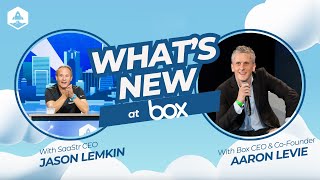
Aaron Levie, CEO of Box, discusses the company's 25-30% operating margins, new AI products like Box AI and Box Hubs, and why he hired a COO to focus on product and engineering. Box AI abstracts across any model starting with OpenAI, while Box Hubs aggregates content for question-answer retrieval.
Chapters
Hey everybody, it's Saster. Super pleased to have Aaron Levy, co-founder and CEO of Box, back with us on our series, What's New at Box. So we are going to talk, use about half of our 20 or 30 minutes on what's new at Box. Not only is Aaron one of the most inspirational founders and CEOs at Saster, but it's been fun to have him part of our journey. He was our kickoff speaker at the first Saster Annual, one week after Box's IPO. Watch this video, which for some reason is in 4:3 VGA format, but it's so funny on YouTube. I remember the first question was, do you think the public markets are understanding SaaS? And Aaron's question, so they're getting there. We may, we may have boomeranged back to that place in 2023. They may be confused about SaaS again, which we'll chat about, right?
Or maybe the Valley was confused actually.
So Valley was confused, right?
We'll see who got it right.
I don't know, but it is, it's so great to have you here. And I do want to talk about what's new, but maybe before we get there, I was putting together these just simple questions and I realized it's like almost 20 years as the CEO and founder. When did you guys start?
Can we round down instead of up in these?
We can round down if you like. 18?
Can we say, can we say, feeling like you've just hit maturity? Adulthood? It's a little over 15 years.
Is it really only 15?
No, well, I mean, it's 18, but I want to round down. We should round down to the nearest 5 in all situations.
Yeah. And how do you— and I'll tell you one thing I've watched the last 18 months is a lot of folks that we know are quietly retiring. And they may be 80, they may be— they're not 30 if we've known them for a long time. But a lot of folks we've worked with in SaaS over the years are paring back, right? And how do you, how do you keep it going as a founder? How do you keep the energy? Serious question.
Well, you know, I think it's probably a variety of factors. One is I've never been able to come up with something that I think would be more exciting to do than, than, than software. And I'm, and I'm in the very weird category of people that I think of enterprise software as actually the most exciting because it's funny, I've caught up with, you know, various friends on the consumer side and the enterprise side and, and, you know, the consumer is just like 10 times more stressful because you don't have recurring revenue. At any moment, like one single platform change, you know, can alter the entire dynamics of your business model. You're dealing with the whims and the mercy of the consumer, you know, kind of the fickle consumer market. And so I'm like, geez, like I lucked out. Like, this is the coolest. Like, we have 95% recurring revenue. Every single day I get to talk to a business in a totally different industry dealing with, you know, completely different, you know, use cases. So One day you're talking to a media company who's making movies with your software. The next day you're talking to a defense contractor that's saving the world with your software. So I can't imagine something more exciting to be doing. And then you kind of, this force multiplier of, you just have these technology transition moments like AI, cloud before it, mobile before, mobile after that, that just make it exciting because you can go and figure out new problems to solve with technology. So to me, I just, I can't think of something more exciting to be, to be doing.
Yeah, maybe it's interesting. Maybe that's an insight. Like, if you don't truly enjoy talking to customers, it may drive you nuts over time. Oh, you don't get a kick out of it. I think Marc Benioff still enjoys it from what I can see, right? I watched Goddard Abel doing this for the— his 11th, his 11th unicorn, and he just loves talking to customers, right?
Yeah.
I think if you don't get a kick out of that, the grind may wear you down, right?
Yeah, I think, I think you have to have a deep passion for continuously trying to solve new problems for people. And because that's the part that will change and make it interesting and dynamic. Otherwise, you'd be doing the same thing every day. But I've almost found that there's no single day that is exactly the same of new things that we're coming up with, new ideas that we're running into. And so that's what keeps me going.
Yeah. Do you have— I wrote this up on Saastr the other day. The Wall Street Journal had an article. I don't know if you saw it, that employees, especially in tech, have the lowest satisfaction on record, certainly the lowest since 2020. BambooHR helped them do the survey. Have you thought about— we talked about you, but have you— how do you, how do you energize the troops in this era? Have you changed anything? Are there things you can do to make— when, when people are— they've yo-yoed so many times over the last few years. Any insights on how to inspire the troops more these days?
Well, I, I didn't see that report, but I, I guess, uh, my, my guess would be that's a sort of a relative measurement off of like all-time highs relative to other industries. And so I definitely don't want to diminish the psychological impact of things like layoffs and whatnot. These are very real problems that do have a massive impact on people and families and just life decisions. So if you compartmentalize that component for a second, and so everything I'm saying is independent of that, I mean, I don't think you could have a better job on the planet than being in the software industry. [Speaker:JASON M. LEMKIN] Me either.
I don't know why everyone's so grouchy.
[Speaker:RYAN ROSLINSKY] Yeah, exactly. We get to literally go to our computers and work with other people and design new ideas and go and talk to customers everywhere, come up with new marketing ideas. This is not particularly hard work of 90% of the jobs that I see. Most jobs I've interact with as more on the consumer side, I'm like, wow, the energy level you still have after day 3,000 of doing what you're doing is incredibly inspiring relative to how I think on a relative basis, easy our jobs are and what we get to do every day. So I don't know. I think people just need to just grow up or something.
Maybe. I don't have the answer. Yeah, I was in— it's not a fun story, but I was in a pet ER not recently. Recently, and the, the amount of work they had to do. Imagine working in an ER, a 10-hour— and they're working 10, 12-hour shifts. They were working harder in 1 hour than honestly I think I worked the whole day.
For sure.
Exhausting. Exhausting.
Yeah, I stress. Yeah, the, the fact that, that the, the people delivering my FedEx and UPS boxes are, are, you know, extremely happy is, is just amazing, and I think a testament to Something.
So no magic answers here.
I would give up after probably 2 days of that kind of work.
So just one more on the people side. So you've got a new COO, it sounds like, right?
Yes.
Yeah. What did you— what and how are you changing how you divide things up? What did you learn through that hiring process?
Yeah. So we've had— this is our third COO in 14, 15 years.
Okay.
And we basically— I might have the numbers wrong by a year or two, but basically I've found that having a kind of So I have my co-founder Dylan, who basically handles all of the G&A functions of the business. So finance, legal, IT.
He's a bit of a COO over the years too, right?
Yeah. Yeah. Well, like, basically it's a coin toss. If you looked at it like historically, you know, he's almost a historical, you know, sort of definition of the, you know, kind of those back office operations.
Yeah.
And so that helps me a ton because he's just like keeping the business humming and, you know, he's obviously my thought partner on all business strategy stuff and building the company. And so it's great because I just know all of that is taken care of. The other part of the business that I need a lot of help with and equally getting taken care of is just all of the go-to-market operations. So customer success, marketing, all of the international geos, sales, consulting, all of that. And so, and then that lets me spend my time in the area that I get most excited about and why I wanted to do software in the first place is product and engineering and that space. So we've had now, this is our third COO, and basically the pattern is sort of somebody that can help take Box to the next stage of growth at each kind of commensurate point where that person's experience is very relevant in driving the next stage of growth. And so we had our original COO that took us to $500 million in revenue, did a fantastic job of that. Then we had a COO, Steph, who took us from $500 million to $1 billion. She's now retiring, and now we're lucky to have Olivia, who has equally seen multibillion-dollar software scale, most specifically at Google Cloud. And now she's now chartered with the project of take us from $1 to $2 billion and beyond, obviously. And that just helps me keep everything organized so I can go focus on what are we building, where are we taking the core product and the strategy overall.
That's— I get it. And so she's COO and also in a way, president go-to-market or field, like other people would have.
Yeah, I think, I think you could call it, you know, president field, field operations. We call it COO just because it is, you know, very equally operational. There's an element of kind of corporate, you know, company strategy in there. And that's just worked well for us from a titling standpoint.
Just curious, does she— I know it's new. Does she give you any sort of quota for how many customers a month she wants you to meet with or big deals to bring you in? How does she— how did she figure out how to manage your customer time?
Uh, we, at least as of this recording, we're, we're only 3 weeks in, so I don't think she hasn't put—
she hasn't locked you down to a quota yet.
Yeah, she hasn't given me MBOs yet, but that will, that will happen, I'm sure, eventually, as, as it has in prior relationships. So right now it's a little bit the reverse where we're, we're giving her MBOs.
Got it, got it. Okay, next thing I wanted to get— that, that's, that, that's super great learning. One, one for every 5 years, I'm going to take away from that. I wanted to get your thoughts on operating margins and efficiency, right? I mean, boy, it's like the— I mean, I know you've been thinking about this a long time, but this is the theme of this year, right? And I think I might have this wrong and our timing might be wrong when this gets out, but your operating margins are pretty impressive now, right? I might get it wrong. I think they're like 25% or something like that.
Yeah, basically.
And, and Benioff just said they're going to be 30% next year, right? So Maybe one high-level question. What have you learned through this journey? Right? I mean, we all want to invest more in growth if we could, right? If we could, if there were no, if there were no goals here, but we're, you know, we're at a billion plus in ARR. What have you learned at a meta level around all this?
Yeah, I think I've, and then, you know, to the introductory comment around is SaaS misunderstood or not, I think the part where SaaS itself misunderstood itself. Was slightly losing sight of the core fundamentals of literally how the market works and what the market pays for. And at the sort of final kind of the terminal point of your business, it's to produce a certain amount of cash that goes back to investors. Why would you give a dollar to something? It's because you want cash back at some point. Beyond, and the equity appreciation is only meant to effectively approximate what that cash back to the final investor is supposed to be. If you think about it, then at some point you have to show the market what is that cash return that your business can produce. I think that there's, on one hand, there's a very clear and good argument, which is, which is get the revenue to the largest number humanly possible. Because at some point, if you're doing a good software business, it should be 80% gross margin. It should be— you should have some efficiency in sales and marketing, all these things, and then you should be producing 20%, 30%, 40% operating margin. And then that profile is like, you can kind of like freeze that template and then everybody can kind of understand that's how much cash this business is going to produce. So then you want the largest revenue number possible. Because that's just more cash. That's when everything's going well. I think what we're finding, though, is that not all businesses either look the same or are created equal or have the same gross margin or have the same customer economics. Not all businesses have proven that that is their terminal state. Investors, I think, got a little bit weary of, well, when do I get to see the returns? When do I get to see what your actual cash flow is. It's not enough to just keep telling me that that's going to be in 5 or 10 years from now. I want to understand, can your company do that, and can you generate those returns? That was the transition we basically went through the past couple of years, which is if you're growing 100% a year, but you're losing 150% or 100% or even 50%, then you haven't really proven you have a fundamentally economically viable platform franchise. Then there's one other thing, which is at some point, your market has certain growth headwinds that just cause your growth to slow down, and then there's some efficacy loss where you're just spending too much to acquire customers, or you're just pushing a rock up a hill in a market environment. That's also a nod to then it's worth getting more efficient in those kinds of moments. I think we just happened to go through that transition a little bit earlier probably than other SaaS companies. Largely because I think at each point, we had to go through a transition earlier because we got started earlier. We started in 2005 instead of 2010. We IPO'd in 2015 instead of 2020. Everything, I think, for us has just been we've just been a few years ahead simply because of the arc of our history. I think maybe with a growth rate, I'd like to have a much higher growth rate to be clear, but plus or minus 5% on the growth rate, I think we look probably what most companies are going to have to look like at some point, which is you're probably growing teens, you're probably generating 30-plus percent operating margin. This is the historical norm for software companies, and you should get as many years of 50 to 100% growth as humanly possible, but at some point, that's going to end, and then you have to transition to a more sustainable long-term model. Oracle did it, and Adobe did it, and Autodesk did it, And these are just insanely successful, you know, organizations that we all would, you know, certainly strive to look like at some point.
Yeah, I wish when I was, I was too immature in my SaaS learnings when I was at Adobe. I wish I'd had the ability to understand what it looked like to work at a company where 50 cents of every dollar that comes in is kept as cash. Like I just couldn't appreciate it at the time. I didn't understand it, but now I see it's magical. But the way it just changes, A lot of the things that frankly frustrated me at Adobe, now I realize with a little maturity makes sense, right? When that 50 cents is, is staying in your pocket, right, before taxes.
Yeah. And, and I think, I mean, if you look at just like, as a great case study of, of just like stock, you know, appreciation, capital allocation, like look at Oracle in the past, you know, two decades. I mean, it's just an, and it's, it's an incredible story. And, and like Larry somehow has become worth like 5 times more because they just, he owns he owns even more of the company today than he did because they just keep buying back the company every year. And it's an incredible magical machine. Now, the key, the override to all of this is you shouldn't trade off very clear and obvious market opportunity or product strategy for this. And so where companies obviously go wrong is if you over-rotate, you're just taking your cash cows and you're exploiting those and you don't do the next growth businesses. And to your point about Adobe, I'd say ShotNew is world-class on taking advantage of the cash cow, but still make sure you're in growth markets and buying your way or building your way into those markets. And I mean, that's a case study that we should all, again, aspire to look like over time.
It's an incredible one, the last decade, right? It's an incredible one. Do you think on this, just at a higher level, sales and marketing efficiency today where we've all gotten to, including Box, right? And I know maybe this is an obvious question, but it might shock people that listen or watch. Is this the world we're going to be in forever? This world where everyone's just got to be more efficient than we've been in years? It puts pressure on sales comp, it puts pressure on marketing budgets, or you think things will reflate a little bit across, across SaaS and cloud?
I think it would be healthy if they didn't reflate too much. I think it would be healthy if they looked like when you and I were doing this and it was like you were trying to get a 6 to 8x multiple. That was fantastic. The only problem with the market is just the moment that the market sees something that's growing 50 or 100%, they get overly excited and they instantly jack it up to 15x multiple or 20x multiple. In some sense, it makes sense because if you can just extrapolate out 2 extra years, then maybe you're willing to pay that extra dollar for that company than the other investor is. But ultimately, when you do that indiscriminately across categories and across software companies, you get these bubble dynamics. I think where Wall Street got it wrong is they were treating literally all software the same, again, indiscriminate of what's the gross margin. What's the— what is the, you know, contract value size? What is the renewal rate of that company? Is— are they doing 5 or 10-year deals, or are they on monthly billing? And like, all these things end up sort of compounding over time one way or another, where ServiceNow should not be valued at the same multiple of a company that is much less gross margin, much, much smaller deal size. But that's what the market was doing. And so you can reward the extreme outliers, à la Superstores now, but you don't want that to cascade into everything in the way that was happening, I think, previously. You do want it to be just healthy to be at a 6x or 8x revenue multiple. I'm making up those numbers, but that tends to be a safe range if you assume the company's going to get 20%, 30%, 40% operating margin, grow at a 10% to 20% revenue rate. Actually, the DCF on that works out.
Yeah, what I think folks, a lot of folks are struggling with, maybe that are a little bit, a little bit lower on the org chart or even at the top in many ways is we, but we just got used to running companies a certain way. Yeah, our team sizes would be in a certain way. Our, our quotas would relate to bookings a certain way. And it wasn't 8, 6 months of craziness, right? Maybe it was 18 months of craziness preceded by 18 months of Goodness. Like 2018, 2019 were pretty good.
They were good.
Like before, before March 2020, it was pretty good. And then it was not so in many cases. Yeah. So we're like 4 years of good times for, for, for an AE at Box, right? Or a CSM, right? And I think people are, the 6th, what you're saying at a high level makes sense, but I think the human capital is struggling to, to readjust, right? Then we went through this, this, this, these tougher times and everyone gets into war mode and, and you know, the CEO comes in and says, hey guys, we've gotta, They've gotten tight in the belts and everyone in the short term is cool with that, but I think people want to go back to 2018 and 2019.
Yeah. Well, just for the pure posterity of the transcript, I would actually say we've been in a different category than most other companies because we went through an activist battle. Sure. Yeah. Early.
You were early to that too.
Yeah. So even the Nutso times, we didn't experience the Nutso craziness because we were already working on efficiency. We were already working on those things. As things have come down to earth in the past 18 months, for us, actually, the average person internally at Box has not experienced the deflation of the nutso period because we've been just running this efficiency. [Speaker:JASON M. LEMKIN] Consistent. [Speaker:RYAN CLARK] This is not the best proxy for it, but our stock has basically traded between $24 and $30 during this whole time. Got, you know, the hyper, the hyper-accelerant that a lot of companies had, but nor did it have the kind of roller coaster plummet. And so, so just, just for purely the, for the accuracy of that, but I think for everybody else, I think it would be a lot healthier if we don't go back to the past 2 years. I think it, I think it'd be better if we, if we sort of got to a new normal where, where things were kind of grounded in reality. We, you know, like, like you do have to build a profitable business. That means you have to make very intentional decisions on what you're investing in and think about efficiency. Sometimes during the transition period, it's hard to appreciate this. I personally think it's probably more fun this way because the puzzle is more intellectually interesting because—
[Speaker:JASON M. LEMKIN] It is a puzzle.
[Speaker:CHRIS SULLIVAN] It's a puzzle because if I give you unlimited money and I say grow, it's like, well, okay, I can just spray money in any direction and there's not that much intellectual work going on.
[Speaker:JASON M. LEMKIN] It's just hiring.
Yeah, exactly. Just hire as many people, see what happens. I think it's a more fun puzzle to say, if you had to build a really profitable business, but you also had to grow, how are you going to square that math? I think it makes it a much more interesting thing. Then by the way, it's literally what 97% of the rest of the economy has to do. I know. This is just how the real world works for everybody else on the planet.
I enjoy the puzzle. It is a puzzle, and I enjoy it too. I just worry that 98% of knowledge workers or tech workers have spent 5 years not in a puzzle-solving world. And I worry that it's too long, like, and that people don't want to live in a— even if they did a box, as a group, as a community, that people don't want to live in a puzzle-solving— some of us do. You and I enjoy it, and others enjoy it. But I don't think 95% of tech workers want to be in a puzzle-solving world. I think it's just an existential issue today.
No, totally. But I think Also, 90% of tech workers want to work at companies that are viable and sustainable and don't go out of business because your last funding round, you know.
No, I know what they want at all. We want it all.
Exactly.
All right. So let's talk about, before we run out of time, let's talk about what's new at Box. So what at a product level, either something coming down the pike that you've announced, right? That, so it's good enough to talk about, or that's come out this year. What, what gets you most excited when you're on the road, when you're talking with customers? What are you, what are you most passionate about?
Yeah, so I hate to, you know, be the cliché, but I would say that for our business specifically, the promise— and I say promise separate from, you know, today we're still very early— but the promise of what AI can do with your unstructured data to me is very exciting.
So I think it's real. It's already like changing legal overnight.
Totally, totally.
It's extremely real.
I think that the things that I need on the vendors for our software is I need cost to go down. I need, I need sort of quality and accuracy to go up. But it's those two. But, but you can see a trajectory where that's happening. And as that continues to happen, we get very excited because we have, you know, literally hundreds of petabytes of unstructured data. And what's inside of all that data is, is just mounds and mounds of text. And it's contracts, it's marketing assets, it's financial research, it's, it's, you know, HR documents, it's invoices. And so if you just sort of close your eyes and you say, okay, you have a super intelligent AI that can do anything with that data.
Yeah.
All of a sudden now I as a human have 100x more leverage in what I'm doing with my information. And so that to me is a goldmine of opportunity that we're really excited about. And we're in the various early stages. We've announced Box AI. Box AI basically connects you to any AI model starting with OpenAI. And we're just now literally in the month of November, our beta opened up for our customers on that.
Yeah, and the cost thing is interesting because, boy, I wonder how many just documents a midsize Box customer has. A lot, right? So Box has got to be more cost sensitive here than some vendors. I think you said something like for the AI product, there's a certain amount you can use up to a budget, and then there's variable costs beyond that. Is that temporary? Is that forever? What have you learned on the cost side?
I'll arrogantly say I think we came up with the most clever model I've seen in AI. So basically, your normal choice is you either you either tell the customer you have to pay us for the AI thing and then you buy the separate thing. And the problem with that is then you only have a certain percentage of customers adopting it. They have to figure out like, well, Sally is going to use it more than Bob is going to use it. So why would I pay the same fee for both of them?
It's like friction.
It's a lot of friction in the sales motion. And then there's a lot of testing, a lot of POCs. People only have budget for a few AI things right now. So we didn't like that model. The alternative model is you just say, hey, we're just going to embed AI into everything. And then you're like, well, shoot, now my costs just explode. And also equally, you have this disadvantage, which is the power user is being subsidized by the non-power user, which has— and I'm fine to do that in most areas, but in AI, that has a crazy power law dynamic where it could be very expensive in the power user use case. So we came up with a model which said, okay, let's solve this by saying, you get a certain amount of allocation for each user to use AI. So Sally and Bob get to use it the same amount. But if Sally decides like she's gonna power some crazy workflow with this thing, then the customer has to pay sort of for the volume of that after that sort of allotment. And we think that best balances a CIO who says, I wanna give AI to all my employees. I don't yet know where the most advanced things are gonna be emerging from. I wanna be able to experiment and not be, have any friction in that process. But if I go overboard with, with, with some group, you know, I understand that I'm gonna have to pay for that. And that, that has landed extremely well with customers. We've gotten great feedback and, and we're, we're gonna, you know, fully exploit that.
Where I get a little confused with the Gartner stuff and some of the public companies, is there any AI budget for CIOs? Are you able to tap into a different budget for Box that's a little bit of extra money for AI?
It's a great— this is the one part that I fear for SaaS is we haven't figured out yet where the new money is coming from.
Yeah, I'm confused.
So if you just like, there is no like, there's no AI budget per se. When I reference that, it's sort of like there's everybody has like some discretionary dollars for, you know, some R&D or innovation thing. And so that's probably right now the totality of the kind of quote unquote AI budget. And you should be like I'm making up a number, but like we should, we should as a software industry not expect that to be more than like 1 to 10% of an IT person's budget, right? It's like that's—
Mine was 5 as a VP at Adobe. I had a, I had a $400K discretionary slash budget, right?
Perfect. So that's, that's like, that's the kind of level that we should be thinking about that.
Other than that, that's where it's coming from. You think though, this, this, these vendors that are getting at the application level, you think it's coming out of that budget, the discretionary budget, right?
If with one, with one you know, kind of caveat, which is if you can find a way to reduce OpEx, then— but I just think we're quite early on that part of the story. I think our, our, the only major use cases that we're seeing are probably call centers and these kinds of—
Yeah, contact center is the explosion there. Automate, but it's got to be real automation, right? It's got to be real automation. Like getting rid of humans, getting rid of humans.
You have to prove out the, the, you have to prove it out and, or you have to make the human, you know, 30% more productive. So your next 10 hires are, are, you know, you're, you're doing 7 hires instead of, of 10. Yeah. So, so the— but I think we're just— I think we're quite early. I think the one risk that we as an industry have is we're probably overloading the customer with, with, you know, 1,000 pitches that— Yeah, 1,000 pitches. That all are the AI of X and the customer is sort of just, ah, like I'm really exhausted. And so actually this is sort of part of our— this is part of our theory on our pricing model is, is let's, let's create an instant win for the customer by just saying Box has AI in it. Like, you know, if we were to start Box over from scratch in 2023, AI would not be an add-on capability of Box. It would be the founding story of the company. So, so we wanted to kind of almost embody, you know, that, that kind of strategy in our pricing model.
Yeah, I mean, Box is— I mean, I'm only, you know, a small user, but watching the company for 18 years, now 20. But part of the challenge is obviously what are we going to do with this unstructured, slightly structured data? Tagged, but massive ingesting, massive amounts of data that has a little bit of light structure to it. It has titles and search, and now you, it's remaking the company probably in some ways, right? Where you can finally do more than text-based search across this data, right?
Yeah, that, that's right. So we, we, we just, uh, we, we lucked out. We have, we've been building a product for about 3 years. We just announced it called Box Hubs. And what, what Box Hubs does is, you know, traditionally you have your content organized in folders and you share those folders with people that you wanna work with. Hubs creates a presentation layer where I can say I want content from all these different folders to sort of be presented in this way to some audience. So your sales team will have a sales portal, your employees will have an HR portal, your, your marketing, you know, all your employees will have access to brand assets via marketing portal. So that's Hubs. We'd been building that for 3 years and all of a sudden, you know, a year ago, you know, the LLM explosion happened and we said, wait a second, this is sort of the perfect scenario now where the customer is telling us what is their most authoritative set of content by topic in a hub. And you bring an LLM to that and now all of a sudden you can actually start to do more kind of question and answer based, you know, like working through your data where you go to the sales portal and you say, what's the price of this product? And it's going to just give you an answer instead of saying, here's the file that might contain the answer. So we think that's a pretty big breakthrough in knowledge management and how you kind of work with information.
And so that's pretty interesting right there. On the, on the AI stuff, are you seeing any early other patterns of like killer use cases or killer micro apps or things that are breaking out?
Yeah, I mean, for us, most, most of the, well, you know, for Box specifically, most of the time it's, it's sort of, I have, you know, n, n set of documents, maybe a million invoices or contracts. Can you apply AI to this to process them all, extract data from them? Let me query that. Let me build dashboards on it. Give me insights. And so you can just imagine we're working on all of that, basically.
Yeah.
Cool.
So that, that, that right there, it's great. AI is the future. It's— there's no AI fatigue at Box. Anything else over the next 12 months, just to close it out, that's new, that's coming, that customers should be excited about, industry partners, anything? I mean, that's a lot right there you've already described, but anything new coming down the pike?
Yeah, I mean, on the, on the partner side, I think the message I would have is just we're— we, as always, you know, are focused on being as interoperable as humanly possible. So we believe in a world where customers are going to have, you know, hundreds of software vendors that do lots of different things. We humbly want to just be the place where they manage their content connected up to that software. So, you know, we believe deeply in the ecosystem. And so you're just going to see more and more features we build that support the ecosystem, more that we're doing on the interoperability front. AI creates another vector because, because we've built Box AI as an abstraction layer. If a customer comes and says, hey, I've got some AI model from Mosaic that is trained on my data, we want to just like point to that AI model. And, and so we think there's a huge new kind of era of partnering, uh, that we're gonna do within the AI, you know, space. Cool.
All right, my friend, thank you for all the time. Actually, I learned a lot and, uh, it's good. Uh, quick crystal ball, 2024 to 2023, better or worse, the same? How's the macro and everything for SaaS and cloud next year? Where, where do you give it the over-under versus this year?
I, I, I would say 2024, 2024 has to be way better. And, and, uh, I'm just like, for like a lot of reasons, but, and I don't necessarily see what is the crazy new tailwind in the economy, but it's very clear that the change in headwinds is a positive direction. If you just say this moment for the next year versus exactly a year ago and snapping the line on that moment, for 12 months, this is obviously a way better environment to be in just because it's not like every headline is now about an upcoming recession or more layoffs. We've sort of turned the corner on that. And so even if this was just the normalized economy at this moment, I think that would be a better thing for everybody than exactly a year ago.
And do you think— that's a good answer right there, but just more tactical. But do you think all this— and maybe you can speak about Abox or just in general, do you think a lot of these issues around seat contraction and relentlessly trying to cut the budget? Are we behind that? You can't do that forever. You can't cut seats and manage the budget forever.
[Speaker:JASON M. LEMKIN] Well, that's maybe the—
[Speaker:TREY LOCKERBIE] That's the point you're getting at, right?
[Speaker:JASON M. LEMKIN] That's the point is the contraction period, I mean, you never want to call the bottom, but it feels like we're lapping the contraction period. That's different from we're going to enter a growth period. I just think we have more information that we can now work with to say, okay, if this is the new normal for a while, Then how does everything play out? And I think that's a way better environment to be in than when it was just headwind after headwind after headwind that we were seeing. All right.
Good insights. Thanks again, Aaron.
This was so great. All right. See you, man.
More from Jason

Why Your Next Hire Should Report to an AI, Tragedy Apps, and Too Many AI SDRs? | The Agents #004

Our Agents Drove Our Salesforce Bill Up 80%, Marketo Hates Agents, and We Stealth-Churned Off Notion




Managing 20+ AI Agents: Lazy Agents, Our $500K AI Bill, Stealth Churn & the Death of 60% Solutions




