What's New at WordPress with Matt Mullenweg, CEO of Automattic and Co-Founder of WordPress
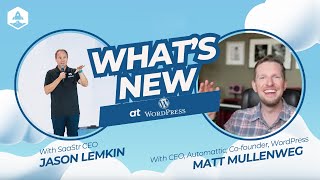
Matt Mullenweg, WordPress co-founder and CEO of Automattic, discusses how WordPress powers 42% of the web and explains his open-source-first business model across products like WordPress.com, Jetpack, and WooCommerce. He views AI as a discovery tool, not a threat to quality writing, and recently took his first sabbatical after 18 years while planning a 100-year hosting strategy.
Chapters
Hey everybody, it's Saster. I am super excited today to have an incredible guest, Matt Mullenweg, CEO and founder of Automatic WordPress. We're going to learn a little bit about the differences. It's a classic old school OG open source, commercial open source, everything leader, but I'm so excited. Obviously Saster would not exist without Matt and the 2,000 folks that work with him's hard work to build this. We. Started Saastr in 2011, 2012 with an idea to democratize the learning of how to build B2B companies and obviously needed a social platform. We grabbed WordPress and I don't know how many thousands and tens of thousands of articles and pages, and I could spend our entire time nerding out on questions I have about the software platform. I will in a bit, but it's just, it's one of the things I'm in all day, every day, including right now. But Matt, thank you so much for joining and coming back to Saastr for this conversation.
It's my pleasure and it's an honor to be here. I really like the work y'all do.
So, well, actually, before we get there, you just hit 40, you said. You've, you've been doing, but, but what's more interesting than that is you've been doing this 20 years, going back to the very beginning of the first code, right? 20, 20 years. Any insights in how to motivate yourself for half your life to do one mission?
Oh, wow. I think you just gotta pick a big mission. We started in 2003 to democratize publishing.
Yeah.
And so that was broad enough that we've been able to stay at that and expand it. And it's evolved over time, of course, like what it means to publish has evolved over time. But yeah, it's, it's pretty exciting to have that sort of North Star that you can go towards.
Can you see yourself running it at 60?
Gosh, if I'm lucky.
It's funny, we're seeing so many SaaS and cloud leaders reaching 20 years at a billion in revenue and so many milestones. And it's interesting to watch. Some folks have handed the baton on, right? But it is interesting how many folks— we've decided we can just go so long, right? With this stuff can go almost forever, it seems.
I think that there's a lot that you could build on and never underestimate the power of compounding.
Yeah. Yeah. That is the P, right? At all levels, product, revenue, and everything, right? We got 10 years ago, we didn't fully get it. We didn't fully get the power of compounding, right? It almost seemed like things were fatty. One platform would replace another overnight, but they don't, do they?
They can sometimes still. Technology is the funnest marketplace to work in the world. Like people can switch very quickly, but, but mostly there's compounding. Yeah.
Compounding. All right. So just to frame the conversation, I know you put this out every year, but how much of the web, the way you define it, runs on WordPress, the platform? How much of the web?
I think we're right now around like 42% of websites.
42%. 42%. And do you track that as notional market share? How do you think about that metric?
Yeah, when we started tracking it, we were at 0.8. Oh really? Yeah. So it's good to have a number, right? And it's been cool to see that go up, but it's really a result of our work. It's not our goal. Right. So if we are creating things that are, that serve our customers' needs that people want, then more and more. That number will go up. But the goal is not really just the market share. Cool.
I want to talk about the business and where you're going, but I wanted to take advantage that I have you for a personal question or two. Blogging, because I've been blogging for a while. You've been blogging for a while. You've been blogging. You've had a birthday post for 20 years. It's 43% of the web. But is blogging what it was? How do you think about what— because I'm still all in on blogging, right? I've got 3 blog, 3 pieces of content a day for 11 years. But is blogging on the decline? How do you think about that?
So Blogging did decline for a while.
Yeah.
And why did it decline? Why? Because distribution got really fragmented. Spam, websites got bad, right? There were all these pop-ups and they were slow to load and everything like that. We fixed all that. So now it's cool to see it coming back where people, what they want, what a blog, what people loved about a blog was that person's voice. Yes. Their story. They're like that, that authentic connection to someone like yourself that has something, some wisdom they want to share, a story I wanna tell, that is timeless. That will never go outta style. That will outlive both you and me. And so every single person has like a birthright to have a place where they could put their stuff.
Yeah.
That will be there forever. And that's what we try to create with WordPress and, and it should be fully open source and that's what we do. And that personal website, the most awkward part of this is the domain, but we try to make it easy on wordpress.com to like get it all set up and started.
I wish you'd bought Google Domains. It would've made my life better.
I wish I could too.
I know you tried.
But we really think about this long term. One thing that we launched last year was a 100-year plan.
Yeah.
So you could subscribe to a 100-year hosting plan. Wow. We are thinking long term about these things because we want you to have a place you can put your stuff. That you can enjoy it. It's out there. It's part of contributing to humanity.
Yeah. One, um, specific question. Let's talk a little bit about AI and content. Obviously it's something I'm sure you and your management team are, are talking about multiple times every hour and every day, right? I'm a little worried because of channels being flooded with content. And I'll give you, uh, I'm, I'm probably of the old OG Saastr folks. There's not many of us left on Quora, but I still read Quora. I love Quora because there's really some gems out there sharing content in in a niche way that we don't on other media. So I love it. But if, I don't know if you've been on it lately, I would say the majority of answers and the majority of questions are all AI driven. They're AI prompt driven. And then AIs are answering all these questions. And so I see this future where AI is corrupting the value of my content. And I'm a, I'm a little worried.
When you think of what an AI is. Yeah. It's something that's learned from a bunch of stuff it's trained on. When you think of what humans are.
Yes.
We've learned from a bunch of stuff we've trained on. And so each human walking around is not an artificial, is, is an intelligence. And so the product of that intelligence is so valuable and so sacred.
Yes.
And so I think that they're very complimentary and if the AI can help us find that, great. Let's, what are you trained on? So I, there is a version of AI that the web gets filled with spam and you know, everything. I think that will happen and it doesn't matter because ultimately what we're looking for is that discernment, that quality.
Yeah.
Because what ultimately we'll be looking for is that insight, that wisdom, that thing, and AI can help us find it.
Yeah, I know for sure. I don't personally think it's going to destroy high-quality, personally created content. I just think it can— when I take a Saastr question I put into ChatGPT, I get an answer that is scrubbed. It's impersonal, it's generic, but it sounds pretty good.
Yeah.
When I ask it how to hire a sales team or how to do these questions, I get this content that there's some hallucinations and other issues, but I do worry there'll be 100 versions of some of these mostly right answers out there. But I guess the best stuff will just shine through one way or the other.
These are just tools we we need to use to serve us better.
Yeah. Okay. So let's talk a little bit about the company a little bit. So a little bit of framework, Automattic, WordPress, what's the relationship a little bit? And then what's the real business model today? What are, how are the, how are you generating revenue for the 2,000 folks?
Yeah, I'll give like the TL;DR. I founded, co-founded WordPress when I was 19. About a year later, I created a company called Automattic to free commercial services around WordPress.
So that was the goal from almost day one was to commercialize it in some fashion. No, not at all.
I was like, I never thought we'd make any money from it. So it really started as an open source project. Right. Then I thought it'd be nice to get paid for working on this full time. So let me make some things that could help do that. Vee is its own thing. It's open source. It's an amazing, vibrant community of, at this point now, hundreds of thousands of people around the world. Yes. Create add-ons, plugins, develop sites, everything. It's like a really vibrant ecosystem. Ecosystem. Automattic is a member of that ecosystem. And we have some products within the WordPress ecosystem, like WordPress.com, where we kind of run WordPress for you, or Kismet that keeps spam off your site, Jetpack that makes your WordPress better, WooCommerce puts e-commerce on your WordPress. And we have some stuff outside of that. So we have some separate apps. One in the middle is Tumblr. Yep. Tumbler is not running on WordPress yet, but it will. So we're gonna switch Tumblr to be powered by WordPress. But then we have things like a podcast. So people might be listening to this on a podcasting app. Get Pocket— Pocket Cast. It's the very, very best podcasting app. What else? We have Day One, which is a journaling app, which is actually probably by the time this is published on Monday, they're launching a very exciting shared journals feature, which is— would allow people to have shared fully encrypted and synchronized journals. So like your family can have a journal that never goes to the cloud unencrypted, that like never, you're not publishing it, but like you can have for your family, like a beautiful place where you share things that are like special to you. So excited about that. And now text. So messaging is the, so Automattic's history, like we started, I said 2005. Publishing, democratize publishing. 2016, we went into commerce with WooCommerce. Let's democratize commerce. And we have now an open source Shopify, which is our, now our largest business. It's, uh, growing like a weed. And, and then in 2023, we moved into messaging where we said, hey, there's way too many messaging apps, right? We have this Tower of Babel problem and let's make an app that brings it all into one. Yeah. Really secure, encrypted that we never see your data. It's all local to your device way. And that's text. And that's a pretty exciting strategy. And now, unfortunately, because I've been doing this for so long, I got a lot of stuff to talk about. So it's complicated. So Automattic, it's one of those things. If like it's a behind the scenes brand, we're like Procter Gamble or something. We're not meant to be a consumer brand. It's more Automattic as a brand of which I want you to think of like open source and excellence, web excellence. And it's really just used for fundraising and recruiting the most talented people in the world. But these products that we create are part of a shared philosophy, which is around like user control, privacy, data encryption, open source that like really puts power back in the hands of the people and says like technology should enable you. It should not be about like me or my business model. It should be about you and what you want. And that's where I love technology.
There's a concept I didn't really think about until recently, which is under a platform, under-monetizing an opportunity. Because you can, what we've seen the last year and a half, especially with a lot of public companies, is they've over-monetized it. We've ran through pricing increases. We've pressured folks to go to 4-year contracts from month to month. But when you have something that's beloved, open source or free or low-end, you can almost under-monetize it in a way. Like you could say, listen, we could do A/B, given that we own 43, like I could come up with an argument, hey Matt, look, you own 43% of the web. You should be doing $43 billion in ARR.
It's one of those tricky things is that the WordPress ecosystem, I would estimate to be about $10 billion per year.
That makes sense. Okay. That ties to that number.
Yeah. $10 billion. But that is across hundreds of companies. Right. Um, Automattic's one of them. So we make a good amount. It's not $10 to $12 billion, but that means that when you like rank these companies, we don't show up in the Fortune 500 or anything like that. Right? Because we're an ecosystem, we're a platform, we're a movement. We're, we're not just like a one entity. So it, it's not great for leaderboards or anything like that, but I think it's good for humanity to have this type of approach. Yeah.
I just think it's sometimes it's, it's complicated where to draw the line, isn't it? Where to draw that line on monetizing when you've got this broad base. I don't know that the answers are always obvious.
I, I always go back to the customer and where are they getting value? Yes. We do a lot of really hard, complicated things, some which are invisible to users, some which are visible. Yeah. And I love business models, which are subscription models where the user's paying for something they get value out of. I don't love it where I'm like, I don't love advertising models or other things where I'm like trying to gather a lot of people and then sell them to someone else. We do that as well. We're a business. It's a good business model for some of our things. But what I prefer and what I cherish is that direct one-to-one subscription, that relationship with the customer, that sacred act of them taking out their credit card and saying, hey, I value what you make and I'm going to pay you for it. And what I want to build is a business of as many of those subscribers as possible.
So there's a $10 billion WordPress economy out there, right? There's $10 billion. Most of your product, probably all of your product also compete at some level, right? With some of those partners. It's natural, right? Building a platform at this scale. What, what have you learned from it? How do you handle that coopetition or that piece? Because you, you, we all naturally want it both ways. We want a vibrant ecosystem, right? And we want our own products to win at the same time. What have you learned over the years?
It's that people don't mind competition. Yeah. But they need transparency. So state your intentions. State your goals, make it clear, and then we can navigate around that. Actually, we're doing a big reorg in Automatic right now. I'm actually— this is news— for the first time in 18 years, I'm taking a sabbatical. So Automatic has the sabbatical benefit where every 5 years you get 3 months paid time off. And we architected it in a way where if you wait till 7 years to take it, you don't get your next one till 12, so like it encourages you to take it. Um, although I created this benefit and expound how awesome it is, after 18 years I've never done it. So I'm the biggest hypocrite. So finally, February, I'm going to take my first ever sabbatical, and it's been a great sort of forcing function for a lot of things. So this has been a, a great way to summarize and, and get everything lined up. One thing I identified in the company that was not clear is that we have parts of the company within the WordPress ecosystem. There are web hosts, people that host your website, and, and there's these plugins and add-ons and things. And so we developed a taxonomy where we said at the company, like those board games that you would play, like you get a card at the beginning, you're not allowed to change a rule. You get a card. Your card is either be the host, so you're trying to be the host. Yeah. Or your card is help the host or neutral. You can't change cards. So if you're in a division, if you want to change cards, you need to change divisions. So internally, we want to make it really clear to our partners and everyone in the ecosystem. Yes, WordPress.com competes for hosting companies. Customers with every other WordPress host in the world. Yes. So that part of the company, that's the be the host part. The rest is a help the host. So they cannot preference, part of the rules, they can't preference WordPress.com over any other host in the world. WordPress.com gets access to all the same code, APIs, everything that everyone else does. Got it.
No, they don't even get early access.
No, I guess there's something a little bit at the margin Slack or P2 or something, but there's, but yeah, basically like it's an even playing field. And so I want everyone to be able to wake up in the morning with a very clear intention and goal and not having to like switch between things through the course of the day.
And it wasn't set up that way before then, before the reorg, it wasn't set up that way.
Part of what'll allow me to arrived at this clarity was that personally, I have been running two of our businesses for the past year and a half, WordPress.com and Tumblr. Normally we have leaders for those, but I filled in and it was very hard for me to run WordPress.com while also running WordPress.org. I didn't like it because it's not that I don't like to have that difference of goals. Yeah. Part of the sabbatical is I've appointed a new leader for WordPress.com. They can just have one goal.
Got it. Now that is interesting. WordPress.com, they can support any ecosystem of other apps, of plugins, of e-commerce, anything that makes that group successful. And then Woo, which I want to talk about, all the plugins, all those folks, they can support the whole ecosystem of hosts. And that's their job. That's their job, their own P&L, their own goals.
Yes. And they might be hosted by Bluehost or SiteGround or GoDaddy or anyone. There's a lot of great people out there. Yes. So we want to. Partner with them and make sure they have the best experience possible because their customers are customers, right? One tricky thing in our model, because we're not fully SaaS, right? We're distributed software. So the most important thing in our, in my world on the.NET Work side is updates, auto-updates, right? Because software has bugs. So you want people to be on the latest version. If you break an auto-update, what people logically do is they pin to an old version, right? Because they don't break it. And then what happens, fast forward 2 years, I'm now comparing, it's 2026, and I'm comparing a several-year-old version of WordPress against a 2026 version of Squarespace, right? That's not a good comparison.
No, I get it. I'm always reluctant to touch, I like SaaS, I'm reluctant to touch anything that's not broken.
Right? So I want— I got a lot of updates waiting for me to improve the code and make, present our best self to people, the customers making a very logical decision. Like, what do I use to solve my problems? So yeah, that's where we're at.
So let's talk for a minute just on this. And then, and then let's talk a little bit about the future, but Woo and WooCommerce, the folks that don't know, haven't heard about it or don't know much, they might not realize what a force it is in e-commerce. It's a force and I've lucky enough to invest in a few leaders in B2B e-commerce, right? And they are all aligned on figuring out how they can do the most with WooCommerce, right? It has become the number 2 platform. I don't know about rank, maybe it's number 1 by, by users, right? But it's become a force, right? So how do you, how do you think about that and how does that fit into a content company and how much, or a platform company, how much of your time are you thinking about e-commerce and what's the future there? Because it's a big deal, right? As you alluded to, I think you said it's your biggest business now, right?
Yeah. And when we purchased WooCommerce in 2016, I said, this will become our biggest business.
Oh, you knew it back then?
Well, it's obvious, right? Like, I guess so. Because fundamentally, like transactions, that's the economy, right? So like publishing is a good business. There is some value there, but transactions are everything else for sure. And messaging is my third leg. That's between those three. I think you cover like almost all of human activity. So if I can create really awesome open source versions of those three things, I think we'll have a pretty good world.
Was it in 2016? I assume it was the number one plugin, right? Is that why you bought it? It was number one or what was it at the time?
So it was interesting because It was a plugin for Word— it was just a plugin for WordPress.
It was just a plugin. Yeah.
But there were companies like Magento, which were also open source that had been bought by someone for like billions of dollars. Adobe was one of the purchasers. Yeah. Yeah. And we were like, and we were just following the numbers. We're like, hey, WooCommerce looks like it has more sites than Magento has. And it's a plugin and it's complicated because honestly, we looked at it a few times. It was created by a theming company. So a company that made, uh, themes for WordPress, designs for WordPress. Their customers asked for commerce and so they made this. And so to be honest, the code was not good. And so like the first couple times we looked at it, we decided not to buy it cuz the code was so bad. But then at some point, like we were like, they've really figured out something with the users that's resonating. Yeah. So like we can fix the code. We're good engineers. So let's, they've done the hard thing, which is build something people want. And so let's buy that and then let's make the code amazing and awesome. Yeah.
All right. Very narrow. I know we're talking about the future and, and decades, but help us see our crystal ball. You were very lean for many years, barely raised any money, and then when times were good, put a few nickels in the bank, did, did some secondaries and tender offers like we all did. So you do have to think about public markets and windows and stuff. Are things looking any better than a year ago? What are you thinking in terms of public markets, IPOs, anything? Where's your head at?
What was the stat I saw? You probably know the numbers, like the number of IPOs in like '22 versus '23 or something like that.
It's been rough, right? It's in B2B after HashiCorp, there was only one IPO, which was Klaviyo. In e-commerce last year, it was two dry years, right? But on the other hand, there's a lot of folks that are doing well, right? They're at scale. More importantly, they're at scale, right? They're at $200 million or north of revenue, right?
I got to be honest, I didn't get here because of my knowledge of financial markets. This is not my area of expertise.
But no, you're not feeling any pressure or anything?
I will really focus in on building. Going back, how can we build as many subscribers as possible? How can we build like a really robust, sustainable business with millions of subscribers getting a lot of value from what they do and then compound that year over year for many decades to come. And also one big thing for me as a fiduciary is I tell all my shareholders, like, if you ever want to sell a share, I'm your man. I don't know what the price is, but I don't want to lock them up. So, got it. Automatic is a very closely held stock. It's basically our employees and a few dozen of the most sophisticated investors in the world. So it's a very small market, but it's a very coveted one. People really want it. Though we are not public, there is— I feel very comfortable that if anyone ever wants to exit the business for whatever reason, maybe they're no longer aligned with our timelines or mission or whatever, my duty to them as a shareholder is to find them a great buyer. And so I think by facilitating that, as actually just saying that's my duty, has really helped a lot. Because no one feels like they're locked up or trapped. I don't want anyone to feel trapped. And at the end of the day, I am also a large shareholder of Automattic, so I'm very aligned with all these folks.
Yeah. Yeah. It is interesting making that commitment as a founder, and you have to have Automattic scale or bigger for this to work, but making the commitment that you will find a liquidity path, it is relieving because you don't have to take it. At least it's there, right? I suspect 5% of the folks, a lot of folks might want it in stressful times, but if it's there, you don't need that. You don't need the liquidity as long as you know that it, there in theory.
In good product design, you don't come with a solution, you come with the problem, right? So don't— the solution, IPO, you need IPO, right? Come to me with your problem. Yeah. How old is this fund? Are you locked up? Uh, you're trying to raise a new one? Do you need social return? Do you want a dividend? Do you want to— like, there's so many— we can be so creative in finding ways to solve the problem. And I think that's where you find the ideal solution for everyone versus like just saying, hey, and you must IPO, you must do this or that. So there's, I would love for people in business to just be more creative because there is so much fun stuff you can do to solve these problems.
It's a good point. It is. What's the problem? Because people have all different horizons and goals here, right? One size fit all is suboptimal. Yeah. Okay. Last point before we run out of time, I want to make sure we have enough time because this series is what's new. What are the one or two things that you're most excited about that are coming out or coming down the pike the next— I'll call it 15 months because you're sabbatical the next 15 months. You know what?
I will highlight again, those three apps, Day One, Pocket Cast, and Text as really exciting solutions that maybe people haven't tried out before. And check it out. Pocket Casts is open source, by the way.
So, Matt, this was great. Maybe one, I, since I have you, one last question since we got the future products. You have also been living in a distributed team world since before almost any of us, right? Almost from day one, been distributed. I feel like we're in a new world where we all were forced to be distributed and now we're in a new world. Any, as you go off on sabbatical and all this, any new learnings on how to, instead of instead of specific companies like Automattic being distributed with all of us? Any learnings on how to reboot our teams, reboot motivations, reboot ways? Because I see honestly a lot of struggle out there for non-developers, non-folks working in this world. I don't think we figured it all out.
Totally. Yeah, we were the pioneers of distributed and fully remote from day one and everything. But what a lot of people, maybe because that was the story, that was the interesting part. They missed the part that we invested a ton in meeting up. Those meetups. Yeah, we lost that during COVID just like everyone else did. By the way, our culture suffered. Like, we were not as productive during COVID People thought, oh, this must be— I had other CEOs— this must be great. You just— you're— you must be running at full speed. I'm like, no, I hired 1,200 people the past year that have not— past 2 years have not met each other. They're not working together very well. It was a hot mess. So it was not good. We have been meeting up like maniacs since, since it's been safe to do so. And a lot of, if you look at the WordPress site, a lot of our community building is also around events. It's monthly meetups in cities all over the world. Yes. It's WordCamps. I'm gonna be at WordCamp Asia, March 7th to 9th, and then WordCamp Europe. I go to all these different WordCamps all over the world. That convening, there's just something there which is worth investing. It's pain in the butt to travel and get a dog sitter, cat sitter, whatever. It's worthwhile. If you have a culture which is the remote thing isn't working, one, identify that, talk about what's not working and see how you can bring people together. And then when you go back apart, you'll be way more effective. Yeah.
Is it quarterly? Is that the cadence you guys have? Have aligned on, or is there a specific cadence?
I think it varies so much for every team. So a fun thing I'll tell you is that we used to do grand meetups where we brought the whole company together, but our last one was in 2019. But now we've decided that every 5 years we will do a whole company meetup. And so we're going to do the first one in 2025 and the next one in 2030. So like, it's expensive. It's like a whole thing, but like It's that, that feels like the right cadence. So I think it's just look at the problem, look at what benefits you want out of it, and then decide what could be a good cadence that works well for y'all. If you were starting up like a small team, 10 people, gosh, get together as, as frequently as reasonable for your, your respective situations.
Yeah, it's a good reminder. I do think folks have cut corners there, whether it's because things are tougher or times and we're not investing enough in getting our distributed teams together. Right. I think we're all suffering for it.
But it's not daily. It's not weekly. Those are not the right answers. It's too much. And so it's probably closer to monthly, quarterly is a real sweet spot for this.
Matt, this was great. Thank you for investing so much time. I'm excited for your 3 months off. I'm excited to see you come back even fresher with new innovations for the community, including us. I hope you don't check your phone more than 3 times a day. And thanks for everything, man. This was great. Appreciate it.
More from Jason

Why Your Next Hire Should Report to an AI, Tragedy Apps, and Too Many AI SDRs? | The Agents #004

Our Agents Drove Our Salesforce Bill Up 80%, Marketo Hates Agents, and We Stealth-Churned Off Notion




Managing 20+ AI Agents: Lazy Agents, Our $500K AI Bill, Stealth Churn & the Death of 60% Solutions




