Why Enterprise AI Adoption Is Moving 5-10X Faster Than Cloud with Box 's Aaron Levie and IBM's VP AI
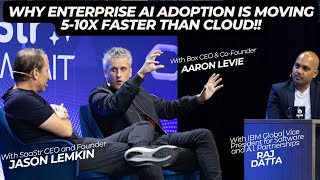
Box's Aaron Levie and IBM's VP of AI discuss why enterprise AI adoption is moving 5-10x faster than cloud did. AI agents that perform work are replacing chat assistants, data becomes a competitive moat, and companies need open marketplaces and APIs to avoid lock-in. The shift from software as a product to software as digital labor is reshaping how businesses operate.
Chapters
If you've already opted into being in this ecosystem, yeah, you're probably thinking like, okay, I'm building a company, I'm going to hire a sales team, I'm going to do the marketing thing. Like, like the lowering, the reduction of how easy it is to build these things doesn't make it any easier to build one of these things. The thinking through the long term of building a company and building a franchise business over the long run is just very different. And I mean, IBM has sort of proven just like what that takes over, over, you know, obviously decades. And so, so I do think that we will have to separate the sheer sort of like, holy crap, it seems like there's 100 copycats of every single space from the companies that are just like, I'm in this for the long run. And we are going to keep cranking day in and day out, iterating, building a better product, better serving our customers. The things that transcend AI will become probably then even more important.
Hey everybody, get excited. We just hosted 10,000 of you at the SaaStr Annual and AI Summit in the SF Bay Area. It was insane. It was off the charts compared to last year. It was a deep dive on everything new, everything AI, everything go-to-market. And we're getting ready because Saastr AI is coming to London in December. It's Christmas with Saastr on December 2nd and 3rd. We're bringing Saastr AI to the heart of Europe. This is your chance to connect with thousands of SaaS and AI executives, founders, and investors, all sharing the secrets to scaling in the age of AI. If you're a founder, a VC, a revenue leader, Saastr AI in London is where the future of B2B meets the power of AI. And we just announced tickets and sponsorship, so don't wait. sasterlondon.com to grab your tickets. SaaStr AI in London, where B2B meets AI and the next wave of innovation begins. See you there. Hey everybody, this episode is brought to you by Adio, the AI-native CRM. Just connect your email and Adio instantly builds a powerful CRM with every company contact and interaction you've ever had. Get 15% off your first year. That's 15% off your first year at attio.com/saster. That's attio.com/saster. All right.
All right.
So, all right. So thank you everyone for joining. Thank you, guys. So Jason decided to make a surprise visit and he's going to—
We just found out 45 seconds ago Jason was going to join us. So we're—
I found out last night.
All right. So, Aaron, we're going to start off.
Yeah.
AI agents is probably the hottest topic.
Yeah.
In the entire software industry. You guys have been early adopters of it. Could you just walk us through, I mean, what you've been looking at, what you've been doing, and share some stories about that?
Maybe like raise your hand if you're building an AI agent. Okay, good. We're at the right conference. So a lot of— oh, so a lot of agents. And I think for us, for everybody else probably in software, there was this moment like 2 years ago where the conversation was, okay, are we all going to have like a chat interface on our software? It was the ChatGPT moment of AI and everybody was in this mad rush of like, should we put a little chatbot? Should it like pop up while you're in the software? Should you change the kind of, you know, core user experience? That was the primary conversation and it was a user experience conversation. It was, it was more of like an HCI type conversation, but underneath the hood was like the really big idea was forget, forget focusing on just it's a change to the user experience of software. Think about AI as actually a change to the labor model of using the software. So what, what can you do in a world where you can effectively create digital workers that can go automate anything, you know, within the confines of, of your software? So that, that's kind of been, I think, what we've all been up to for the past year plus is how do you turn these models, especially now with reasoning capabilities, especially with tool use and, you know, better context windows for managing objectives? What if we could turn these things into agents that you can go deploy 100 times, 1,000 times, 1,000,000 times inside of your software instance? So for us, that's been allowing for AI agents that can do things like read your documents, summarize information, extract data from documents, automate workflows. We have a great partnership with IBM, with Watson X, where We are bringing model choice to our customers, powering things like the latest Llama models, integrating with things like Orchestrate. So the whole idea is what if you can have agents across your enterprise software talk to other agents in other enterprise software? And us, I think for all of us as an ecosystem, this is going to completely change what interoperability looks like, what the future of, of building software looks like, and obviously a lot to unpack.
Yeah.
So you brought up one interesting area. I love your thoughts on this. Just for more of the audience's understanding, agents versus assistants.
Yes.
Because we saw the era of assistants and everything was assistants at that point. What makes agents different?
Yeah, I think— I mean, this is— everybody has their own probably different nomenclature or vocabulary for this. We kind of think about it as models. You know, we've always had— we've had AI models or some version of ML models and then kind of some of the initial transformer-based models for the past, let's say, 5+ years. Then we had these assistants, things like ChatGPT, etc., are really kind of these assistants you go back and forth with. And now we're obviously seeing this era of agents which really fundamentally go do work for you. And that work could take a minute or it could take an hour or it could take 100 hours for the agent. And then in human time, that could mean, you know, days of work or months of work being compressed. And you'll deploy these agents across your, your software stack to go execute work within your software environment. And so Deep Research from OpenAI, perfect example of an agent. I want you to go do a bunch of research across the web, come back, you know, provide an aggregated answer for me. And the powerful thing, unlike a traditional just query with a model, is it's not just going to think for 1 second, come back with an answer. It's actually going to go do basically what a human would. I'm going to read all the documents, I'm going to check my assumptions, I'm going to change my course of actions based on new data that I learn in the review process. I'm going to correlate information and then go and actually collate it in some sort of, you know, ultimate asset at the end of that. And that's, that's now what is becoming possible with agents. We've seen things like Operator from OpenAI where an agent can actually control a browser that becomes incredibly powerful. Imagine if you could deploy 1,000 agents in browsers and all of a sudden in the cloud you have 1,000 browsers running with AI agents doing work for you. I want to go scrape, you know, data from different interfaces. I want to go do QA testing on software. I want to be, you know, have an agent that acts as a security researcher finding different vulnerabilities. So, so we can now effectively think about our software as having labor attached to it. Which for all of us building enterprise software is like a completely mind-bending, you know, concept where we're no longer just limited by the number of people that we sell to in an organization. So if I'm building legal software, I can only sell to the 10 lawyers inside of a company. Now all of a sudden my software comes with infinite legal capacity and it opens up all new kind of addressable market for our businesses. I'm sure we're seeing that throughout the conference.
Can I ask just a really tactical question, maybe to both? When you talk to customers— because Aaron, you talk to so many customers, right? Half your week is customers, probably 30%. Raj at IBM, do real-world customers, do they want agents? Do they, are they, or do they just want AI to solve their problem? What I worry, I know this sounds specific and maybe the train's left the station on agents, right? But do customers really want 1,000 agents or do they just want, are they still learning what AI is? And I want to talk to my documents, I want to solve my problem. Do they really want Businesses want 1,000 agents. We're building them, don't get me wrong, but can they process this?
The beauty of agents and what we're seeing is there'll be thousands of agents working in the background. Yeah, but typically one in the background and there'll be one interface for the client.
Yeah.
And so that's where the beauty lies is because you're able to have disparate systems start talking to each other, but you only have one interface. I'll give you a perfect example. You know, IBM went down this agent journey back in 2023 and we've actually been using it internally. And last week we announced, you know, we saved over $3.5 billion internally from cost savings because HR functions are there, procurement functions are there. So every different area that you go down, and it's only the same, it's exactly the same interface. So I don't even know in the background if I'm talking to SuccessFactors or what other products I'm talking to. I'm actually just talking to my Watson X bot, essentially. For sure.
Yeah, I think, I think, you know, you're bringing up a very provocative question and we should probably remove you from the stage for, for the—
Fair enough.
This is an AI agent conversation.
Okay. I apologize.
But, uh, no, it's a very good question. Like, this is, uh, this is kind of classic Clayton Christensen, jobs to be done. What is your product being hired for? It's a good way to always think about, you know, sort of solution, product market fit, solution fit. And the underlying kind of theory of Clayton Christensen was like, we don't go buy products, we buy— effectively we hire solutions to solve our problems. And so what is the problem that an enterprise is running into? Well, if they're reviewing legal documents, they want to be able to just get, you know, lower risk in their customer contract negotiation. They want to have better renewal rates. They want, you know, more accelerated deal cycles. They don't want an agent for that. They want that as the outcome. And so obviously, you know, collectively for all of us, the closer we get to conveying those ultimate outcomes, the closer we get to pricing towards those outcomes. I think that will be the natural direction this space goes in. Agents, at least for lack of a better term that we've landed on, at least describes what's happening behind the scenes that's causing that deal cycle to be faster.
Behind the scenes. You hit it on the head.
Yeah.
Typically, you don't know what— you know, and I know, but most people don't know what cloud you're running on, for example. It's all happening in the back end magically. Yeah, but, you know, same way we should look at agents because all of this is going to be happening in the back end. You know, what's really interesting is— and Box was actually one of our, our first partners to join us on this— but we opened up an agent catalog last week where companies that are creating agents can submit to the IBM catalog. And then IBM sales teams can sell it. So even if you're a 5-person shop, yeah, you submit your AI agent that you built specific for a use case within this catalog. You're able to take that and then the IBM sellers are able to sell it for you. So I think that's important, especially for the groups that we have here, because if you're an earlier stage company, you're looking for that traction. Yeah, we're enabling that. And obviously Box doesn't need the help, but they were one of the— Aaron's been a great partner on this AI journey. And, you know, the moment we talked about it, he's like, I'm in. Let's go.
You've got this IBM Salesforce, which is legions in size, right? And they are now recently— I should know this, but I don't— they're off selling agents. And how many?
We kicked it off last week.
Okay. And I'm just— I'm very— how many do they sell and how do they get smart enough about each agent to sell it?
So it becomes a use case specific. So if you look at the way that IBM's mentality is, is not to go industry specific. We go horizontal.
Yeah.
We want folks that have the industry expertise to leverage that. So you know, as the seller is looking at various AI use cases and clients are starting to ask for it, that's a great opportunity to say, well, within our agent catalog, we have this. We'll even make it self-service at one point. So even the sellers don't need to touch it. You know, if a customer wants to go on there and just download it from the catalog, essentially they could start leveraging it.
But what an interesting time, though, to be in software, right? Just because think about, right, what you just kind of said. So IBM, is going to be going to a bank or an energy company or a life sciences company. I'm making this up, so, so correct it. And basically being— they're going to be bringing digital labor to that organization. It's no longer a software sale. It is not, you know, let me go find your process and I'm going to sell software for that process. It is, I might actually bring the process to your organization in the form of this digital labor. So it's going to actually kind of shift the deck chairs on what's actually happening, who's what. Like, I think we're all going to increasingly look almost like professional services companies, probably to some extent, because you're bringing now solutions to the customer as opposed to just, hey, use our software. Hopefully you have the people to implement it. Hopefully you have the people to even use it at your own risk. I think this is a fundamental change literally in what software is going to be procured for.
You know, another interesting thing I'm seeing, which I didn't expect, is if your AI is very good, broadly speaking AI. So let's imagine this, these agents are gonna be great.
Okay.
What is really interesting is it can make folks, IBM has an incredible depth of customer relationships that people don't even get ever. I mean, incredibly deep and broad.
Box is my favorite customer, by the way.
Mine as well. You can be— older companies like can be much better with AI. Yeah, absolutely. Because maybe there's some— a few parts of IBM, not Watson, but a few parts that maybe are a little, a little older. But if the AI is great, if the agents— if I can walk in with the box, you can tell me what it's like. All of a sudden that team can be much more, more agile. I'll give you a specific example if you're curious, but like one, one that Zendesk is much better than a year ago.
Yeah, I did.
But I've invested a lot in contact centers. I came in on board of this company called Gorgeous, which is like Zendesk for e-commerce. Just like you have HubSpot, we have HubSpot. Shopify is Klaviyo, which is a billion, right? If you go over to that world, the Shopify world, it's not Zendesk, it's Gorgeous. Right. Okay. Over there, Zendesk used to be old. The plugin was a little creepy for Shopify. It couldn't really interact with FedEx or your returns. So like they won 20,000 customers, right? Zendesk is probably still creaky under the hood, but the AI is bitching. The AI is bitching. So Zendesk in one year—
That's a technical term.
Yeah, it's a technical term. It's an MGS. It comes from the CSAT Bible of bitching.
We need like a bitching benchmark, AI benchmark.
No, you know what we need is a bitching agent.
Okay. Yeah.
So there's still a better in this vertical, right? But the gap has narrowed. So if I'm on the IBM sales team in one month, I might actually have much better solutions to sell with these agents.
Yeah.
Like overnight it could change. It's kind of crazy.
We always have to kind of recheck in with our assumptions and biases on what the state of the art is on the technology, because things that literally 3 or 6 months ago were not possible all of a sudden become possible. And so we like the rate of change in this space means that first of all, it's like the most stressed out I've ever been.
Because of good sign.
Yeah. I mean, if that correlates—
The opposite is worse.
Yeah, that, that is— I mean, I kind of enjoyed when I wasn't stressed, but But my stress is absolutely a corollary to how interesting the technology industry is. So it's a good sign for all of us because it means it's a very dynamic time and lots of stuff is happening. But to this exact point, you know, like what you— if you go back a year ago, the amount of work you would have to do to pack into, let's say, a non-reasoning model for giving it exactly the right sort of context instructions kind of hacking and tool use versus today just having O3 go do that.
Yeah.
Or having the new Llama 4 go and do that with reasoning capabilities. You instantly have now caught up probably, probably an entire year of development from other companies with just a single model upgrade now is happening. And so it does mean that you have— it's like a nonstop level of change that we're seeing in the space.
I was going to say, like last year, I think the big buzzword was RAG.
Yeah.
And now we've seen the shift for agents, but that happened so fast.
So fast, right?
Yeah.
The interesting part about this is as we look at all these, you know, tens of thousands of agents, we're also providing the capability of if companies— I saw like 50% raised their hand that they were building agents. We actually released agent builders last week as well. Right. And then on top of that, we already have prebuilt agents. So what we used internally, our Ask HR, Ask Procurement, etc., we've actually released that and productized it. So now folks can— you can actually just purchase it versus spending time to build it. So we're opening up the aperture because as Aaron said, it's moving so fast that if we don't keep up with the market, you know, that's why he's losing sleep. I'm sleeping great, by the way.
I have similar tech, like 1 amp, so.
Yeah, it should be stressful, right? The rate of change is so high, isn't it?
Yeah, I mean, even just take something as simple as, let's say, GitHub Copilot, right?
Yeah.
Basically invented the current paradigm of AI coding, was obviously the de facto standard. And let me just do a dangerous survey. How many people are using Cursor or Windsurf or Replit right now? Okay.
So like last year was close to zero.
Last year that would have been zero. And now all of a sudden we're already seeing a kind of a tide change in the direction of a new set of startups that are attacking the space. And so I think right now we're in an environment where nobody can take any of their position for granted. It's a fast-moving space. I do think, and would love to even hear what you're seeing from Startupland, what you're thinking about from the customers you work with. I do think you're starting to see a pattern of how to have moats begin to emerge. This sort of relationship between the agent, the data that it works off of, the level of sort of domain specificity of that agent, obviously the capability of the model. You start to get this dynamic where you could have a reinforcing or sort of virtuous cycle of, of how do you build a moat around what the agent is doing. And, and so because I think one existential question for everybody, whether you're big or small, is how do you have a sustaining advantage if so much of the value is packed in the model? And to your point about this Zendesk or Gorgeous, you know, dynamic, like how do you make sure that you can have a, have a position of of strength that you build on top of. And so we're starting to, you know, have these big questions of like, okay, what does it mean? What is the new network effect in a world of AI? And it's some degree of, of that user working with an agent to create something. By creating something, that data feeds back into the agent's future capabilities and you get this sort of flywheel that ends up being pretty positive. But I don't know what you're seeing in the larger company side.
From the enterprise standpoint, one thing that's very interesting is a lot of these enterprise companies are actually sitting on a ton of data.
Yeah.
And they've been sitting on this data for many, many years, slowly trying to cleanse it, trying to figure it out. With the adoption of AI, even companies using their internal data in order to get solid outcomes, we're seeing that over and over again. Right. So, I mean, the beauty of this is now you have all of this data that you've been using. And also, you know, a lot of the models are built off of public data. But how many of these models are actually built off of enterprise internal data?
Right.
Very limited. Right. Once we unlock that, I think the pace of change that we're going to see is going to go even faster than we're seeing today.
Yeah, there's a kind of a fun question that you can start to ask your customers, which is sort of like, what data are you sitting on that is proprietary to you? And so thus, if you had AI that worked on your data, what would you have as a differentiated outcome relative to your competition? And very quickly you realize more companies are actually in the data business or information business than they maybe initially had thought about, where they start to realize like, okay, actually I do have some proprietary information or insight about the real estate market or about, about my, my, my talent clients. If I'm a talent agent agency or obviously if you're in financial services, you know, you're sitting on a wealth of data. So the question is, if I can bring AI to that data, yep. What can I do with that in a unique way relative to my competition? And, and you can kind of like go really far with this, which is right now as an example, if you look at like a company's income statement or balance sheet, there's nothing that approximates the value of their data. Yeah, that's where people get confused about that goodwill line, but I'm happy to throw some, some, you know, data in the goodwill line. I don't know if a lot of companies do that. The question would be, the question would be, in 10 years from now, will we see this sort of emerge as a thing, which is like, what, how good is your data as an enterprise? How much data do you have?
Yeah.
Are you actually able to turn it into business value?
Yeah.
And AI will be the thing that, that basically unlocks that because what they, what AI wants more than anything is more data to work on.
Yep.
And that's what it thrives on. So, so we will enter this completely new shift in, in actually like What are the assets in an enterprise in a world where you can deploy AI agents to, to, you know, have completely disproportionate outcomes in your organization? And I think data is going to be one of these.
But, and it's— but where you ask the question, I'm just— I'm learning from you on this one. I'm not seeing modification. I am— I haven't seen any. I can't think of a single— I mean, you talked to more than I can think of a single company I work with or know, know that feels like there's a stronger moat today.
Yeah.
If that was the question you were asking, you tell me some examples. To me, I actually think about Box as a case study. Actually, we do this new podcast I do with Rory from Scale. I did the other day and I said, if there's anyone that should be benefiting this from it, I said Box. And let me tell you why, because I've been in this document space for a while, as you remember, right?
You are a document OG.
Yeah.
And I'm like, I've been— and I've been a Box user at least since '06. I'm like, so I got— I've got like forever content. Yeah. Okay. I could never talk to it before AI. Yeah. So everyone that's been in documents has wanted to talk to their documents. Now I can. And, and not only can I talk to my documents, 'cause it's a, what's Aaron can tell us now or in 6 months, that also means I can do stuff I never thought I could do with my doc. Like the initial case study is, okay, tell me everything in Box where I have the wrong indemnity provision.
Yep.
You start there and then all of a sudden you can talk, tell me what contracts I shouldn't have signed. Tell me what contracts had lacked authority. Tell me where like the designs were off on the measurement on, and then so Or just tell me where I could have an upsell opportunity. An upsell opportunity.
Based on those contracts. Yeah. So who's got pricing that maybe, you know, you'd be— you have a better position for that uplift.
Yeah.
The value—
Build your moat bigger.
We think so. But I'm, you know, I'm just asking you to learn. Well, I don't want to turn this into a Wall Street conference, but yes.
That happens faster sometimes.
Inadvertently.
We're very— we're big fans of our moat. But the— but I think the big question is what is the value inside of your data for any enterprise? And then if you're building software, find ways to get the customer to tap into that. That's what's going to build this flywheel. Like, I'm actually very bullish right now. You know, there's like a little bit of a meme of like these AI coding tools. You can just swap them out. Yeah, I think that's like a temporary thing that you'll see on Twitter or X or whatever. I think the mode is actually fantastic because if you're the place where you have agents that understand your codebase, they understand your development methodologies, they understand your documentation, they understand your specs, that is something that becomes this ongoing flywheel that just gets bigger and bigger and bigger. That will be true of every single segment in healthcare. Imagine if you wonder if you're the AI system that understands a particular set of patients and the particular sort of practice areas of that healthcare provider. You're not going to want to swap out that AI system. Yeah. So for as fast as everything is moving and as disruptive as everything is right now, I think there's— this is a window in the next couple of years where I think we'll have the defining platforms get built and effectively cemented, assuming that they stay current, right? If you, if you're asleep at the wheel in this space, it's over, right? You only have— you can lose your entire position probably in a 2-year period at this point. But it's also a point where you could cement your leadership position, I think, in a, in a, in a very unique and different way where that wasn't possible. Let's say, let's, you know, let's go back 20 years to cloud, there was a 5-year period where people could just kind of futz around like, maybe I'll do a hyperscaler, maybe I won't do a hyperscaler. And somehow 10 years later, 15 years later, basically you've got 3, 4, or 5 major platforms all at massive scale. People had time to kind of figure it out. AI is probably not going to look like that. Like it's going to, it's going to get locked in and compound.
But what happens when— Yeah, sorry to interrupt, Bryce, but I get I want to believe that. I'm with you, right? I've got your back. But let's—
and I'm not totally—
again, you were him to figure out this mode. I understand.
I'm going to be quiet. I'm not going to ask you—
he just shows up on our panel.
That was my last question. But I'm not an MCP expert, but let's take it out a couple of months.
Sure.
Right. So you've got this data lock.
Yes.
But if my MCP is great.
Yeah.
Maybe I just grab those Box files and that data and I abstract away Box. And sure, Box has the data and the healthcare company. But if I can talk to it through a myriad of different levels and MCPs and everything, is it really a moat?
I would actually argue that MCP is a thing that only enhances the underlying moat because data wants to be free. That doesn't mean that there's no moat around managing the data and making it useful. It wants to be incorporated in some other workflow. So for us, the more places where customers can use their data is only a net positive. We want to connect to every MCP environment that's possible as a tool. And that just makes the continued feedback loop of having more data, at least in our environment, more valuable because, because you know that it's going to be accessible from all these other systems. So I think of that as kind of a— the analogy would be like, did APIs reduce people's moats? No, it actually in many cases made companies more sticky over time because they could be embedded into even more software, which made that even a greater level of sort of concentration. So, so I mean, I see no reason why MCPs wouldn't be just analogous to all of the the APIs that we built over the past couple of decades.
Yeah, I was also going to just say that one other aspect with the moat, if you're able to establish the moat, let's say there is a moat that's established within AI, there's a significant monetization opportunity for all of these companies because then you have the ability once you're showcasing and you have that moat, once you're showcasing the AI capabilities, we're seeing significant upsell in the marketplace where companies are able to raise their prices because of these AI capabilities, but they're continuously adopting. And so I don't think there's going to be only, you know, and you said 2 years, I think it's less than 2 years that we see this evolution and it's, it's going like 1000x faster than the cloud adoption.
Yeah.
Because everyone's using it because 1000x kids start using it, you know, and probably in high school doing homework.
Yeah.
You know, and, and so on. So like everyone's using it, it's in the mindset already and that's where the adoption is happening so fast.
I mean, I don't think it's that crazy to say that. I mean, this is easily the fastest adopted technology in history. If you look at ChatGPT's, you know, any of their published metrics, somewhere, what, 500 million active users, something on that order of magnitude in 2, 2 and a half years, 2 and a quarter years. Yeah, there's never in history, there's never been something like that because first of all, in every other technology transformation in history, you didn't have enough people wired up on the internet to put up those kind of numbers. So it's just like de facto, it's obviously correct. And so, so think about, to Raj's point, how many people right now are being wired completely differently. I don't know if anybody has gone to a college, knows somebody in college, maybe just graduated college. I was speaking at a college class recently and it's like these, these kids are like, I want to be a little bit like Old Man Yells at Cloud kind of thing, but you get off my lawn. But it's like you're also kind of like amazed By how it works, but like, they do not work like us.
They're much more efficient.
They're much more efficient. Maybe they don't know anything as a result. I don't know. We'll figure that out as they enter the workforce.
Yep.
But they work so differently.
Yep.
And it's like, they're gonna come into our enterprises and be like, wait a second, like, you take 2 weeks to come up with a project plan for some marketing strategy? Like, literally that thing was just spit out by Claude. In 5 seconds. Why would you meet about that? Like, they're gonna wonder, why do we work the way we work? And obviously we're gonna tell them, like, this technology didn't exist. Like, give us a break. But like, think about an entire onslaught of a new generation that is just like, why would you spend time reinventing the wheel of a marketing plan? Like, literally, it's in the model. Like, the model has the marketing plan you want, just do the thing. And so, so this is why you're going to see such a rapid change is you have a new workforce entering, you know, every organization. You have boards and CEOs and governments saying like, holy crap, we got it. We have to move faster. Raj, I'm sure you see this, but, but every customer that we talk to, if I compare it to, if you're quite literal on the timeline, let's say it's like '08 or '09 in cloud terms. Think about '08 and '09 pitching the cloud to a bank.
I wasn't born then.
Okay.
Okay. So like, that was a nonstarter. Like, that was like not a conversation you would have.
They had to keep all the data on-premise.
You have to keep data.
We don't even— we can't even contemplate this. Get out of my office.
Yep.
Probably that, that still persisted to the mid-2010s. I would have meetings with banks that, that were finally like, okay, we're going to deploy our first couple of use cases. So that's the timeline we're on. There is not an enterprise that you could meet with today where they have not already basically said, here's our AI-first strategy, or here's the AI-first strategy we're working on, or here are AI principles. That is not happening in these big companies. So we're in a totally different market. And so probably to your point, like it will move way faster than cloud and that timeline is going to shrink in a pretty incredible way.
Yeah, I think it's going to— I think It's great, but I think it's— I don't mean to go too deep, but I think it reduces all the moats. Literally, we had Yamini from— was here yesterday from HubSpot, and they're— I mean, they're crushing it, right? Every way. And she was great. She's like, she's like, I'm behind. She's— and they're pretty far ahead.
Look at where—
if you look at all the peer groups, who's further ahead in deploying AI?
Yamini's stressed than— yeah, we all got—
yeah.
And she's like, listen, our core is stressed about— and it was interesting what she said. Our core is strong. Okay. Our core is— and it is— it gets stronger and stronger, right? But the 1,000 small competitors are better than ever.
Yeah.
So yes, this is— it's another example. Like the, the core mode is there, right? The core mode is there. But if you get nibbled away at the end, if you get nibbled away because the big guys get better because of AI, this— you don't have 2 small competitors now. You have 1,000. And the 1,000 aren't like one feature like in the old days. Now the 1,000 are cool because you can talk to them and they can talk to your data and they can MCP into Box. And so now you have 1,000 really good competitors, not 2 crappy ones. Yeah, right. I hope our moats are getting stronger, but I think they're all getting weaker.
I agree. I guess the thing that— the only counter. Yeah, I think anybody at this conference is— will probably actually endorse my point. If you're here, yeah, then that means that you're probably building something that you want to be sustainable. That you want to— you're not, you know, sort of vibe coding a Salesforce competitor like one night and be like, okay, maybe 3 of you are.
So sorry, but more than you think, actually. Fine, fine.
But if you've already opted into being in this ecosystem, yeah, you're probably thinking like, okay, I'm building a company, I'm going to hire a sales team, I'm going to do the marketing thing. Like, we like the lowering the reduction of how easy it is to build these things.
Yeah.
Doesn't make it any easier to build one of these things. The thinking through the long term of building a company and building a franchise business over the long run is just very different. And I mean, IBM has sort of proven just like what that takes over, over, you know, obviously decades. And so, so I do think that we will have to separate the sheer sort of like, holy crap, it seems like there's 100 copycats of every single space from the companies that are just like, I'm in this for the long run. And we are going to keep cranking day in and day out, iterating, building a better product, better serving our customers, the things that transcend AI will become probably then even more important because they will be the things that separate the sort of flash in the pan, you know, overnight success that then fizzles because the founding team wasn't really in it for the right reasons or they weren't really thinking through how do they actually get to scale.
So, and there's no real first mover advantage right now because it's everything's, you're going to have to leapfrog. But once you're able to have an established base, Box, for example, now you put— you guys move pretty fast on the AI piece. Now you put AI into it, you're— that's becoming your moat because you do have all of these documents, you have access to so much data, and you're able to—
Well, I think to Jason's point of like, okay, so what do we do though when, when, when from a net new kind of company that's just starting, they don't have the data. But I am, I am optimistic that these things end up compounding.
Exactly.
Because the better company ends up getting the more customers, ends up building then the next feature is better. And that keep that— I don't think AI has fundamentally changed the calculus of that as long as the team is sort of in it and building for the long run.
And Laser, I'll tell you, if you want a slightly funny story from this event, ties to both college and kids and generation. So we had, we had a, we had like a kickoff party that IBM sponsored on Monday night before we started. And my daughter is a freshman at Stanford and my son's here. He's, he's finished up at Penn State as a sophomore. And this, this guy comes up and he found her. He's like, are you Anna Lemkin's dad? He's like, yeah, I'm in her class. He's like, I just dropped out. I built an AI sales agent to do research a couple of months ago. We're at $2 million ARR.
Wow.
I want to get to $5 by the summer and I want to go more mid-market. I'm out on the road going more mid-market. We're doing a lot of it with AI. Wow. And 20% of my class has already dropped out to do AI. Oh, there's a lot in that story, isn't there? There is. Is he worried about moat?
There's a whole—
Is he worried? Is he worried that he needs to build a giant sales team? He had to take 8 years to get to $2 million in ARR.
I think he'll be worried in 2 years, but then he can call us old timers and we'll give him some advice.
It was just the craziest story on pre-opening night. But there's so many little things in disruption, right? How much you could do with it, how quickly you could grow, and the lack of fear of incumbents.
That's cool.
No incumbent fear, right? No incumbent fear. That's really cool.
I mean, but that's every startup. You can't have fear if you go into that space. And I mean, that's a good story, but then I know we're over here, but that begs the question, because my older son's going to becoming a freshman next year. But what do you end up studying now with AI, right? Like, you know, before is, you know, you knew computer science was going to happen, right?
So, but, you know, I think I think it's like you want to be like, you probably want to be like 15 years old right now.
Right.
So that way there's enough time.
My age. Yeah.
Well, yeah. Yeah. We want, you need enough people to go in the front lines and sort of figure it out. Like, I think maybe your son, right, is on the cutoff of, of he'll have enough time, but, um, he's going to economics. Okay. Okay. He's okay. But I mean, what an incredible time, right? And I do think, I do think that these, this generation has a leg up because of this ability to just be like, I, I've seen the future. Yeah, this is what it looks like. And you can go and enter companies and just be like, ta-da, this is how I do things. I remember my first internship, I got like some of the most like random, probably strategic projects because I just like was like better at the internet than the other people. And so, so like just imagine if you're that for AI in your company and you're just like, I'm just like better at AI than every one of my colleagues, you'll just get more stuff. So I think there's a, you know, there's an, it's an interesting time to be coming into the workforce. In this next generation.
Absolutely.
All right.
So I know we're over, but I learned a fun fact while we were back there. Was that you were at the first SaaStr? Yeah. And now you're closing out this SaaStr?
Yes.
Yeah.
But hopefully not ominous.
Was that—
was that— that's right.
Okay.
Okay. It was one week after the Box IPO. You might not remember. I remember it viscerally.
Those were wild times.
You were the kindest gentleman in the— I mean, you're always kind, Aaron. But coming one week.
Anything for a document OG. So yeah, there you go.
Awesome.
Thank you. Do we just end? Do we self-end?
Is that like self-out? We haven't been tossed out of the studio yet. There's security back there.
More from Jason

Why Your Next Hire Should Report to an AI, Tragedy Apps, and Too Many AI SDRs? | The Agents #004

Our Agents Drove Our Salesforce Bill Up 80%, Marketo Hates Agents, and We Stealth-Churned Off Notion




Managing 20+ AI Agents: Lazy Agents, Our $500K AI Bill, Stealth Churn & the Death of 60% Solutions




