Why You're Unfundable Today: The Cold, Hard Truths About SaaS Part 2 with SaaStr CEO Jason Lemkin
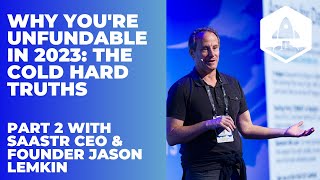
Jason Lemkin tells founders why VCs default to no and what actually makes you fundable. Get your software revenue to 70-80% before Series B, evaluate your VP of Sales with numbers, and stop pretending you're between rounds when you're just unfunded.
Chapters
I had a question. So we're between Series A, Series B, about $3 million annualized revenue. We have a—
There's no in-between.
As in, we raised a Series A about a year ago.
You're on— you're— assume you're unfundable until you hear otherwise.
Thank you.
And that applies to everyone in the room.
No, that's—
I laugh. I laugh. And I want to hear a question, but if I can provide some advice, even in June of 2023, every founder I meet is too optimistic about funding today. There are so many VCs here to shake a stick at. VCs have not gone away. VCs have raised bigger funds than ever. But every VC I talked about that I've known for years in the green room, whether they're seed or Series A or Series B, all said the same thing, like, we're just not seeing a lot of deals. We're just not getting a lot of deals done. And they're getting like— did you, did you see the ICONIQ growth session in this room? It's okay if you didn't. Well, they're one of the great growth investors. Well, they did zero deals last year. Zero, one of the best growth funds, they did 5 this year, so it's back. But everyone's default no. So I know it's not, I'll answer a question you didn't ask. You're not between rounds. You are unfundable until someone tells you otherwise. Everyone was between rounds in '20 and '21. We're pre-Series B, we're pre-A, we're doing our third pre-A round. And what happened, 2021, for the privileged, for the privileged, and I said this in my opener, but it's worth saying again, 2021 just taught everyone the wrong lessons, because funding got easier. People really thought they were between A and B, right? And it's so hard out there, and it should be hard out there. We could talk about why, but anyhow, I know it's not the question you're asking, but to everyone else, there is no between A and B, or C and A, or B and C. You are unfundable.
I'll restate my question. We're an unfundable company.
No, no, no, no, no, no, no, no. It's good context. I didn't mean to pick on you.
I appreciate it. I knew I was going to get roasted. I just wasn't sure it was going to be that far.
Well, let's step back. You've got about $4 million in revenue. You're doing well. You've raised a Series A round.
Yep, that's right. And we generate both recurring software revenue and also non-recurring professional services. We have a pretty complex—
What's the ratio?
It's about 50/50.
Okay, that— we'll come back to that. But okay, I get it.
So what are your—
what are your blended margins? What are your blended margins?
Blended margins, about 70%. Okay. That's still pretty high. So yeah, we see a future where we can pull out more of the professional services, either automating into the platform or with partner programs. And I'm— I want to think about the timing of that. How long do we intentionally stay close to customers and embrace the—
it's a great question—
professional services versus start to build those kind of programs?
Yeah, the question, let me, it's a great question, and I was just talking with a couple founders about it, and I've lived it through several investments I've made, including the one that sold for $300 million that we were talking about. The question is if you have one of these businesses where services really enable the product to work, right? These aren't just to help folks start, or to deal with the fact you didn't build a few features you should have built, out of that your onboarding is bad. Like sometimes professional services solves bad onboarding. You're talking about, there are, especially there's a lot of verticals where that domain knowledge really helps people use the software, right? You need both together, right? Is that something like we have?
Medical research.
Yeah, medical, environmental, all these things. It's very common that, you know, big customers want a solution, and software alone is often not the solution. They want experts along with the solution, right? So, here's the conundrum, and the impact of that conundrum changes based on macro, We got to be a software company. We got to be a software company. So at some point that means at least 70% of our revenue has to come from software, not services. Ideally 80%. I've written this up a few times on SaaS. Viva went public, which is at $30 billion, 70-30%. Qualtrics was like 80-20%. Palantir is most interesting. I wrote up Palantir. When they go to SaaS and search Palantir, Palantir was like 18% software until the year before their IPO and they flipped to like 70 in one year. Okay. Now some of that I bet is financial shenanigans because it's too fast. But Palantir was basically a services company and then became— as everyone wondered, because it's so mysterious before it— is Palantir really a services company with custom software or is it software company? Well, it was a services company that magically before its IPO became a software company. Okay. So, you know, where you have to skate to eventually to go big, you have to skate to 70% or more. Look at Veeva, look at Qualtrics, look at Palantir too. And to raise that B, no one on planet Earth wants to fund a professional services company. You know that, right? I'm not saying, I mean, you are unfundable, but it doesn't mean you'll be unfundable forever. You might be fundable this afternoon, right? If you had a great meeting here. But no one, I don't know any Series B investors that want to fund 50/50, right? So you probably have to answer this before your Series B round in part. But this is my experience with companies. But geez, these service— be careful because you can throw out the solution with the software. I've seen this happen too many times as founders get all this advice that you have to be all software. They dump the services business when it's a solution business. It's not a game, it's a solution business. And the customer, it gets much harder to close the customers. Right?
Yeah.
And so when you compare a Veeva or a Qualtrics that always had a high level to, to make their products work to a Palantir that waited until the last minute, I don't know the answer, but if it were me, I would actually— and this is different advice than you get from some— I would keep that mix as long as your funding allows it, knowing almost nothing about your business but pattern matching, because when you make the solution worse, you lose some of your magic. Right? So I would be careful with the advice. I would be careful with the advice to change too quickly. I would be careful advice to dehumanize the support until the software really can replace these very specialized folks with medical knowledge and others. I'd be careful and always, and it's a mistake we can make as CEOs especially, and it's an understandable mistake, is you can do too much for your VCs and money. Right? And I used to joke about, uh, someone told me this many years ago that every software product has a feature that's only used by one of their investors. Okay? And if you went to Adobe Sign, which Adeko Sign was started in 2005, if you went until about a year ago, there was a notes tab so that when you signed a contract, okay, you could write some notes about it. Hey, this was Michael and Jason's contract. And that note was searchable through our search index and it was very cool. And one of our investors said, you got to have— like, I know all about contracts. You got to make notes on your contracts. And so we built it. It didn't take that long. All the way through our acquisition, like 3 people used it and it took a whole tab. It took a whole tab in our app. And so— but that didn't— like, that wasn't like dumping our services business, but it was clearly doing something to make a VC happy that was unnecessary. We all do that, but take it to an extreme. It's bad advice, right? So what do you think the answer is?
Yeah, I— so I would like to stay as close to our customers as we can. Some of the other advice I've gotten is don't really think too much about it until you're at $10 million-plus ARR and you really understand—
I like that too. I like that too. Yeah. Stay as close as you are. Just figure out where you are between Palantir and Veeva and look at them. But I think that's the right advice. Right.
All right. Thank you. Hi.
First SaaSers, Walt.
Thanks for coming.
Absolutely. I have the maybe The misfortune of having argued with you once on Twitter about DocSend, and I apologize for that.
Well, I mean, I was right.
Yes.
You wanna know the trick to being right?
Having done it before and made the mistake?
Just don't speak up unless you are. That's the problem with Twitter. Everyone's talking and talking about things that they might be right about. I just try to hold back. And then I'm sort of kidding, but I probably— what did I say?
I think it was about don't send doc sends to VCs.
If you're selling, if you're selling, if they're selling, put it behind 11 firewalls and 28 passwords. You've got to figure out who's doing the selling, right? That's, that's the— that's the problem with the advice.
I understand. I didn't come here to argue about doc sends.
No, no, you may. We're not arguing. I'm— that's, that's just the subtlety people miss.
It did get me interested enough to come to the conference.
Thank you for coming.
My question is this. Traditional sales-led model, not a product-like model. Grew 3x last year, raised a Series B, so we were fundable.
Congratulations.
Growth stalled out. Growth stalled out.
Well, as you saw on the charts today, you're not the only one, right?
Right. Had built up a sales org, including VP of Sales. Read a lot of your stuff on that. Now I've got to go back in and rebuild. How have you approached this in the past? And is it usually the founders just got to basically go back in and run sales? Do you hire a new head of sales?
Well, let's step back for a minute. How big is or was the sales team?
It's about 12 if you include the technical support.
Okay. And you said the VP of sales left, or she is still there and wants to stay through this tougher period? Committed?
Yes.
And how many of the 12 are sort of kind of hitting quota now?
Mm. 3.
3. And what is— what, 3 or 4?
I'd say 3.
3. And then 3 are sort of covering their costs or something like that.
Yeah.
Okay.
Or not. Depends on the quarter.
What does your VP of Sales want to do?
Iterate and iterate and try to make things better.
Yeah. Okay. Well, that's not illogical, right? Okay, so, but here's the, like, I'm gonna ask you to ask the question again because you still have your VP of sales. You have confidence in her or him?
I think the challenge is that the things we did that worked, you know, 18 months ago don't work anymore.
That's true of half the room, right? Yeah. But the question is, do you have a person that is agile enough to evolve the playbook or not?
I think the problem we've got is that we've now had a number of quarters to evolve it and it hasn't, and I've been off doing other things. Now I've come back to it and I've realized You've got to iterate it faster. So I guess the question is like, have you seen— it doesn't necessarily mean that I need to fire everyone or fire individual people, but the question is like, have you then seen those VPs of sales get layered? Let's say they want to continue to work, but they're not going to be running it. Or have you seen founders usually come in and say, I'm going to run this whole thing, or basically need to go out and find a new VP of sales? I mean, I know it's an unusual moment because we haven't seen—
It's not unusual. Not everyone's been through what you've been through, but almost everyone's been through some version of that.
right?
Where there's a phase change, things get harder, right? It does not always— it could be in a good year. It even happened to people in 2021. Things got harder and you have to understand what to do with a somewhat expensive team that is now underperforming, right? And so let me step back. I wrote this in a math on a Saastr post. People, you can search it and I've updated it a couple times. What to do with a good but not great VP of sales. And I'm not saying that's your person, but the math holds. And I did some math of what happens in a typical model if you have a bad VP. And it doesn't mean they're not great somewhere else. I'm not I'm not criticizing them as humans, but bad at your company. You usually see performance decline from founder-led sales. It's all the time. A founder will have a certain level of quirky efficiency with 2 AEs. They'll bring in the wrong, not bad, the wrong VP of sales, and efficiency goes down. That's sort of unfixable, right? Revenue even goes down. That's bad, right? A great VP of sales is in one quarter you're selling more. Okay, whether you're selling 10% more or 100% more, that's a sign of a great, that in one quarter or less or one sales cycle, it's materially better. Then there's this middle area where things are still growing, or in it, and if it's struggling, you're still hitting what you think as CEO is reasonable growth given the macro changes, reasonable growth. And what you usually find is if you get rid of the good but not great VP of Sales and don't have a plan, don't have someone to replace her or him, don't have a strategy, I see companies go into a spiral they often struggle to recover from. And this is a tough part of the CEO job. Who do I have? Do I have bad, again in air quotes, doesn't mean they won't go somewhere else and crush it, or do I have an okay, and I think the article's called Okay But Not Great, and I put all the math in a spreadsheet, and you gotta be really careful and understand, it's hard, right? And you can look at it quantitatively, you gotta do it quantitatively, but you have to add like a toughness factor to it, right? And I see too many emotional, passionate CEOs go off and fire that head of sales, and then for a year there's no one. They don't have a plan. There's no one. Okay. Now sometimes if they're bad, what often happens is there's someone that steps up on the team, like that number one rep becomes the team lead. And another sign of a bad VP of sales is it gets immediately better when they leave. Because the rest of the team steps up. It happens all the time for a bad VP of sales, but you have to decide if bad or okay, and I'd be very cautious about making the replacement if they're okay in this environment. And there's no, I put the math in the article, but you've got to make your own version. That's the challenge, but the job as being the leader. So, okay, the second point is about leveling or topping someone. I guess my learning over the years on this, and look, it's really stressful and we all go through it. You know, I'm hitting $10 million, $20 million, $30 million. I'm not sure Bob can still do it or Jane can still do it. I'm worried they'll quit if they do it, right? The answer is always be 90% transparent and do what the business needs to be done and be open about it. And sometimes they will quit, but it's okay. Like, it sucks, but it's okay. Don't hide the ball, don't try to do a stealth search unless you magically find someone. Like, if you bump into someone here and they're your new VP of sales and they're clearly better, you did a stealth search, congratulations. Walk her into work on Monday and things will be good. But you can't do a half-assed search, you can't do something, and I've recently gone through two of these toppings or levelings with a company at about $30 million in revenue. Went through it with one and the person wanted to be a CMO and immediately quit. Immediately quit. Did a lot of, and things are worse without him now. They're not bad, but they're clearly worse, and it's stinks that they left, and it took a few months to hire the person, but this person was unwilling to— unable to get to the next level, so he had to take the medicine. And then they did it with the head of sales and brought in a real CRO that this person looked up to and respected, and sales was faster. It was— he resisted at first, but the deal was, we're only going to bring in someone that you agree is better than you and that you agree will enable you to do better. There was some resistance, there was some crankiness to the interviews, but they aligned on that candidate, and the person's a lot less stressed and doing a lot less better today. As a VP of sales with a CRO above them, right? So I guess my learning is you can't— these topping thing or leveling thing, like you can think about it for weeks and days and try to play games or whatever, but at the end of the day, just do it. Just be, you know, 100% transparency is too much, I think, but 90% is pretty good, right? Hopefully it's helpful.
It was.
Thanks. Hi, first time at SaaStr as well. Love it.
Thanks for coming.
Uh, so, so far I understand that the topic of this event is efficiency, so I'll ask—
sure seems to be the theme of the year, doesn't it?
Yeah. I'll ask a rapid-fire question. How do you respond to cold emails and what it takes to write a cold— a great cold email in 2023?
How do I respond to cold emails in general for investing, or for what reason?
In general?
Well, look, you can go to Saastr.com and we have a big search box in the middle, and I will show you, and I have an article titled "Two Cold Emails I Funded for Millions." And I have another article if you search "cold email VCs," and I have David Sacks, Keith Rabois, Eileen Lee, Satya Patel from Homebrew who did Chime and Plaid, and me all sharing examples of how they respond to cold emails. Those are pretty good folks if you've heard of them, right? I mean, some of them have some Weird political views, but they're pretty darn good investors. Okay. So, and I put real examples of the actual emails from TalkDesk, which is worth $10 billion, and another company, the original emails, they're all in this thing. And so look, the answer is, uh, you could ask one follow-up question cuz out cold emails is a, is a great theme. Amazing, great emails that are perfect, that solve your problem as a buyer for real right now. or as an investor that are jaw-dropping investments get opened. That the, there's, you know, here's the thing and you know, are you, are you CEO?
No, I'm the head of sales.
Okay, well, head of sales too. The weird thing about CEOs, even of huge companies, is almost all of them open all their emails. They sit in front of their, their phones and their computers and look, they don't open the dumb emails and they don't go to the promotions tab. Okay. But if you're a CEO and someone sends you an email with a headline that's going to solve your problem, imagine your problem is I need a VP of sales. I mean, it's not your problem, right? Or maybe you need a director of outbound. Okay. And you get an email and it's from me and I'm like, I've got the best director of outbound candidate for you. You're going to open that in 4 seconds, right? And CEOs of the biggest companies open the perfect outbound email in an hour that day unless they're out of it. They all do and they ignore all the other ones, but they see the headlines. They see the headlines. And it's true up and down the stack. And that's why amazing outbound works for sales. It works for marketing. It works for raising funds. The mistake everyone makes, the mistake mediocre salespeople make, is they think a cadence is going to work, or they think a form email where they replace, you know, vendor with Secure Frame is going to work. The same content. Or an SDR asks if they can pick my brain or buy me coffee. You can't buy a CEO coffee. Right? The stupid emails don't work, and even the mediocre ones. But the one you spend 2 hours on researching and you solve their problem, it always works. It always gets opened. It always gets opened. Right? And I listen, when I first started as a SaaS CEO, I didn't really— I tried to do it myself. I was terrible at it, right? I wrote dumb emails and it didn't really work. I had done it before. I closed a $6 million customer from a raw email before. I can tell you that story. But then when I got into SaaS, I didn't get it. But then I was at, again, an early Dreamforce event, and two of our customers— I was on a panel with Jeff Yoshimura, who is now CMO at Sneak, Snyke, Sneak, right? In London, Sneak? He's the CMO. But back then he was at Salesforce, and he put together this panel, and it had SuccessFactors, which got bought for $3 billion by SAP, and the head of sales operations was there. And they were talking about products they use, and he said, I use EchoSign, now Adobe Sign. And I didn't even— We didn't even know we're on the panel together, right? Exactly. Maybe he knew, I didn't know it. It's like, wow. He's like, why'd you use, why'd you pick us? He's like, well, it was, you know, this is the early days of eSignatures. It was the 30th of the month. I couldn't get my damn team to get any of these contracts signed. And I got a cold email by someone at your company and you said, we can get you up and running today and sign your contracts on the internet. And he's like, this was my frigging problem that week. And I get 1,000 pitches for sales tools and all, but that was the one, one he needed. And a $3 billion company. Became— and I didn't even send the email, right? But it wasn't a random spam of, you know, meet for coffee. It was, here's exactly what we do for your peer companies, for your competitors. Can I do it for you? Sent to the right person, the right buyer at the right time. Right. It's that simple. Right. And if you don't invest the time on outbound, I really don't think it works in 2023. Too many SDRs don't invest the time. Too many. There's still too much spray and pray, too many cadences. Too many dump everyone in a list and do no work. It, it can work to, to impact the funnel and to move things on the funnel, but it's, it doesn't work for raw outbound. Yeah. Is that helpful?
Yeah.
Is that helpful? Um, do I have my follow-up question though?
Sure. Yeah. Yeah.
All right, let's go. Uh, there's a lot of buzz right now around salespeople building personal brands. It's not really a selling activity. It's like, it's not really moving the needle forward, like right now, but on LinkedIn it's everywhere. What's your take on that?
Like, my take is that I think sales folks should spend at least half their time building their own brand rather than selling their product. I think they should spend 60, 70% of just on LinkedIn promoting themselves, not selling. But I think it's great if you've had at least 2 weeks of experience of an SDR is if you share your learnings with the world for hours a day. Hour. I see so many of us. I've been in SDR for 4 weeks now. Let me tell you how to do outbound and, and after that, buy my course. I think, I think, listen, LinkedIn feed is very interesting. I don't think any of us expected that LinkedIn feed would get as big and as visceral as it is, right? Right now the engagement for SaaS Europa is higher on LinkedIn than Twitter. That certainly wasn't true 4 or 5 years ago. It's crazy. The best stuff, the best summaries of this event, the best photos, the best long-form content. I mean, I do love LinkedIn. I use LinkedIn a lot. Myself. And what do I think of it for revenue professionals and leaders, right? I do think a modest amount of it is good for your next job, okay, as an individual contributor. So I think we're looking to get to know people, right? And we look at social media and we look at the— you should look at the dumb things they put on TikTok or Facebook, and you should not hire people that say inappropriate or sexist or problematic things on social media. Don't hire those people that say that say inappropriate things. On the flip side, you can research someone on LinkedIn and see if they say very intelligent things about not just themselves, but maybe their product. Someone that— what's your company called? Woodpecker. Woodpecker. Okay. Woodpecker.
Yeah.
Imagine I'm Reese. I want to hire someone and this person on LinkedIn, this young sales exec tells me 12 amazing reasons to buy Woodpecker. Like, I'd want to hire that person. And vice versa. So if you do it well, it is a great way to showcase your skills in a way that's hard to do for an IC. For a leadership, I think a thoughtful, careful way of doing it really helps with recruiting. It really helps with recruiting. But people get it wrong because they don't know what to do. You know, the best VPs of sales spend 25, 30% of their time recruiting. And you need to do that one-on-one. You need to do it manually, and you need to create excitement around your startup, often that no one's really heard of, right, or has other issues. And I think a handful of folks do this very effectively on LinkedIn, but 80% of folks take it too far. They spend too much time, they give cut-and-paste advice, and I see— and, and, and, and they judge themselves on the number of followers or views they have on LinkedIn, but I don't think that helps them hit quota, right? So like most things, quality over quantity, and And moderation I think is the key, right? Seeing, seeing a couple great posts from someone on how to do sales in your industry, really interesting. Seeing 8 a day, maybe I wouldn't make that hire. All right.
Thanks.
Yeah.
Hi. Um, my question, oh, was I rude?
Hold on. Sorry.
I'm sorry. Please.
Hi. Um, I'm sorry.
What the— it's my fault. Yeah, I get confused. It's okay.
Yeah.
Um, it's a disaster. Thank you. Um, I'm a new AE. I would be super curious to hear a story of yours about a time you had to make a really difficult business decision, perhaps related to integrity. What happened? What did you do? At what point in your career was this? And would you have handled it the same way today?
Around integrity? I can try. Is there any angle of, it's actually, there's a lot of elements to integrity. Is there anything rattling around in your brain, or is it just a general question?
It's more a general question. Just how to deal well with difficult situations, especially when integrity is a priority to you.
Look, I think I'm, it's a, boy, I think about this stuff a lot. People may disagree with me. There's two sides to every— many stories, not every story. I generally think, being objective, I think I'm one of the highest integrity people out there. And the more time that goes by, the more benefits I get from it, and the more hurt I get by it. Because the more people will throw you under the bus, the more people will wrong you. Literally, without getting into details, right before I got here, someone took millions of dollars away from me that I earned for them. Millions and millions of dollars I earned for them. They just took it away. I won't tell you why. This is people I helped for years, and they did it because they could, and there was no reason to do it. They did it out of just sheer greed or whatever. This just happened to me again, and so the longer you're in the game, the more this is gonna happen. I had a very good friend who started his own startup, and, um, Very incredibly creative and talented, but probably too emotional to be a CEO, right? Probably at the edge of unstable, maybe past the edge of unstable. But so, one of the most greatest product geniuses I ever had, and he just melted down being a CEO. He hired a great engineering team 'cause he's a great leader, and the customers liked him, but it was just too much for him, and he would break into a sweat. And I calmed him down, I became his advisor, I got him in front of a bunch of VCs, I helped him raise his round, I did, I turned a guy that wanted to quit, he begged me to be CEO, he didn't want to do it. And I did it out of loyalty and friendship. And he sold the company for $150 million later. Good outcome for him. And I never asked for a nickel, but he gave me $100,000 of stock options, which is not a lot of money compared to what it is, but it's not nothing, right? It honestly wasn't going to impact me either way, and $100,000 out of $150 million for what I did is Not the most generous advisor grant in the history of mankind. OK. But I didn't even read the advisor grant. I just signed it. And it had vesting in it. And he started the vesting really late. And technically, under— in the acquisition, he could decide whether to fully give me the $100 grand or give me $18,000 that had vested. I made this guy about $5 million before, and I got him his $150 million exit. What do you think he did with the money? Gave me the 18. I told him, you know, just keep it.
Wow.
Just keep it. Just keep it. But it still rattles around in my head, right? I had another boss. I had an early boss earlier in my career who came in. I was hired to do a specific role. I was, I was in business development. I was on a, I had a $30K bonus on a $150K base for a VP of business development. I went into a company and I had a specific business development goal to hit. It turned out to be technically impossible, okay? The company lost all of its revenue. It was gonna go out of business. CEO was gonna give up. I went out, I pitched 200 VCs, 200 VCs, and raised him $40 million. All he had to do was show up to the meetings. No, everyone else in the company had given up, raised him $40 million. He sat me down after in the conference room and said, you saved the company. Here's your bonus. Because he gave me 10 out of the 30. I said, Tim, thank you. I get that I did not hit my initial KPI, but I really, I got you the $40 million. You were about to go bankrupt. It's like, yeah, but you didn't hit your goal. I thanked him. I said, keep your check. I said, I'm not, I'm fine. I'm here. I'm on your team. Just keep your check. I don't need it. I didn't quit or create any drama. I just gave him the $10K back.
Wow.
So, about 2 weeks later, he sheepishly gave me the $30 grand. Wow. So, I don't know if these are the questions that you're asking. And maybe if you asked him and he was here, he'd say, well, Jason was great, but I'm glad he gave me the $40 million, but he didn't hit his other goal. He didn't earn it. Like, he forced me, he forced my hand. I could keep going if I could think of some other stories. And there's a lot of them, but then, but then there's some magic that happens. There's some magic that happens. And I have made— I've been a good investor, I've been an okay founder, I've done other things, but I will tell you, without getting into too many details, founders that I have helped, I have made literally millions of dollars that out of them doing the right, helping me, being grateful, and I didn't ask them for a dollar. Now maybe if I had, I would have gotten millions and one dollars, but not hundreds. I've made millions of dollars from founders being appreciative when I went the extra yard to help them. And so, you know, someone a couple weeks ago took away millions of dollars, not tens of millions, but it's a lot of money. Others folk, I mean, I have more life experience than you, so I know these numbers sound big, but I'm giving you hopefully, like, I don't think there's any karma out there. I've decided after all these years that the people that mistreated me, many of them did pretty well. I actually think the folks that really harmed, my founder that gave me the $15K did fine. Like, he was a CEO, he then became the CEO of a company that went public, he made about $40 more million and retired. He seems to be doing fine, right? The guys that stole my millions of dollars, they just made tons more money and they're fine. They're gonna live in their chaotic neutral or whatever world and I see no karma out there at all. And, but, but, but people do startups because they think it's a positive sum game. People do, real people do startups because they think that the pie grows. The pie has to only, can only be 100%. But if we all grow the pie, we can do something where we don't have to steal from each other. You don't have to. You can be successful as an AE without taking away revenue from your colleague, without stealing their leads. Not Glen Gary Glen Ross, hopefully, in software, because the company grows. The leads aren't fixed. They grow each year. We, we go into this. You especially can't be a leader if you don't think it's a positive-sum game. If you're a zero-sum or negative-sum person, go work at a hedge fund or something else, right? So if you make You're gonna make a few bad bets in your career, and you're gonna feel thrown under the bus and treated— but if you get— if you don't get jaded, and this will be the last point I'll make, you can ask a follow-up. If you don't get jaded and you're good and you stay in the game, um, you— there is no karma. It will not be fixed. The person that wronged you will go on to success, but you will probably get other shots and other chances to benefit from this positive-sum game. That is startups and why I think the best of us do it, right? I don't know if that's what you're asking, but maybe there's some helpful stories.
Those were super helpful. Thank you so much.
Yes.
My follow-up, I'll take it in a little bit of a different direction since you're talking about VCs a lot. For me as an account executive, what would you recommend as far as my relationship to VCs? So, We tend to work in an account-based way, and most of my accounts aren't connected to VCs of ours, but is there something that I could be doing that would be wise as far as even just understanding VCs better? Like, can I be better for my clients through understanding VCs?
Do you sell to VCs?
No, we sell to game development studios.
I think that, Look, my first, you know, I've worked one way or another adjacent to VC since my first tech job, so I'm a little jaded on it because I think this stuff is boring. It's the same crap over and over again, that it's pretty— but I recognize that 99% of the world thinks it's opaque, right? And sometimes I write some SaaS articles on VC and I think, oh my God, it's like the 12,000th article. Same thing. And people love it, right? People, people love VC Day today. And a lot of the great folks— and I know a lot of the folks that spoke, I thought this was— some of it was very specific and great with data, but some of it I think, I don't need to hear this story again. But it's, it's so— I forget that most folks don't have that much experience, right? And it's weird, episodic, opaque experience. So in some ways I'm not the perfect person to ask. But I wouldn't— what I find is you do want to learn about VC. And we had a whole VC Day today. We publish a lot of SaaS content. We do Workshop Wednesdays, which are live with VCs that you can attend. You want to learn just enough to know how the world works. You want to learn how fundraising really works, why companies get funded, what the bar is to raise. You know, I joked about with our friend here about not being fundable between A and B, but that was a joke. But what does that— like, you might not know as an AE what that means, but he knew what that meant, right? That to understand what I said, you want to get that smart, but any smarter is not a good use of your time until you're raising money. Okay. Yeah.
Thank you so much.
Sure.
Hi, my question is about the simple role of luck in success.
Role of luck?
Look, of luck. So you see founders who—
Luck is staying in the game. Well, ask the question.
Oh, sorry, no worries. So you see people, you see founders who hustle, they hire the right people, right? They come to Saastr and absorb all the advice they can, but things don't work out. What proportion of— do you think what portion of people and founders have that that fate and what lessons can you draw from that?
Have— what proportion of founders have—
sorry, what proportions of people do everything right as far as anyone might say and still fail? And still fail. And what lessons can be drawn from that?
Um, well, look, my— I think that all the metrics on startups that fail, that 90% fail, I think these are Sony baloney metrics. I think truly great founders, truly great, that have a great CTO and CTO, or a CTO that can be both, that can build amazing software, that do not quit, that commit for years, not months, but years, and that understand a market. I've seen 0% fail. I've never failed in my entire career from startups. I've never— I'm not— I'm no whatever Aaron Levy or David Sacks or any of these folks. I'm not as good as Edith, who I know well. I'm not as good as Parker. I'm not even close. I'm not even close. But I've never failed. But I've almost failed every time. Almost failed every time. My first startup, we had, it was tough times. We did need to be venture-backed for the way we did our technology. All the VCs pulled their term sheets. We ran out of, I literally, we could not make payroll. I finally, I had 2 weeks left, okay? There was no way to make payroll. I went out, I closed $6 million of contracts and shipped our product. In 2 weeks. $6 million of revenue and shipped our products in 2 weeks. I finally got a term sheet, but only if I would personally pledge $750,000 to back the company. I had $8,000 in the bank, but we did have a house, so I had to pledge the house to the VCs. But I friggin' did it. That's me. I'm no Parker Conrad. I did it, but it almost failed, right? Uh, you know, to skip ahead, I can give you other stories where we almost failed, right? At Adobe Sign, EchoSign, We screwed up. I had to go 14— I mean, I had some money from my first job. I had to go 14 months without any salary to stretch it after having a salary, but I didn't quit. My other co-founder walked out the friggin' door and never came back. Said he was taking parental leave, came back 8 months later for 1 day, and then turned around and left. He quit. Smarter than me. He is smarter than me. He quit. If I did what him, I would have failed. But I took no money and did no nothing and never quit and got on planes and finally found Dell and finally found GE and finally found BT and Comcast and closed them. And it took 2 years longer than it should have. And I had no salary, but I didn't quit. And I recruited pretty good people. Not perfect, but I kept recruiting good people. So that's me. This is just me. I give you other stories from my— I'll give you more. Even with our little team at Saster, we have 7 people. March 2020 came on. We were the first major event to be canceled by COVID by Santa Clara County. We lost $10 million in one night. We lost $10 million in one night with 7 people. A bunch of the team quit. Amelia, who may or may not be here, right there. That night she didn't go home and started dealing with everything and fixed everything in 30 days. We couldn't get the $10 million back, we fixed all these issues. She didn't quit, half our team quit. They're good people, but they quit. There's a theme there, right? Uh, and I look back on different cohorts, um, And I just think of the peers I've had at different phases of my life, the ones that had great co-founders, great CTOs, and were pointed in the right direction, didn't quit. They've never failed. Okay. And I'll give you a couple. When I started investing, I kept a very tight, a very tight box on who I invest in. And I had a couple of rules. They had to be pointed in the right direction and they had to be better CEOs than me. Because I knew if they were pointed in a, if they had a somewhat better unit economics, a somewhat better price point than I did, and they were better than me, if I didn't fail, what are the odds they're gonna fail? Zero, right? So, and I just kept doing that again, and my first investment was Pipedrive. That sold for $1.5 billion in cash when I invested early. Second one was Algolia. They're at $200 million in revenue and are worth $2 billion. The third one is Talkdesk. The CEO was the only person in the country with 5 guys in Portugal. They're worth $10 billion today. Okay. The 4th one is actually Greenhouse, who sponsors out here. They were worth $800 million and are worth $200 million today. They never quit. They never quit when it got hard, right? The 5th one was Salesloft, which you may know they sold for $2.5 billion in— at the end of 2021, they had to— Kyle had to abandon his first product. The CEO, I did something. His first product before Salesloft was the product that it is today, a different product called Prospector that had $7 million in revenue. LinkedIn threatened to sue them and they had to abandon $7 million revenue and start from scratch. He didn't quit, did he? So he took a product that went from $7 to $0 and built it into a $2.5 billion exit, okay? So you bet on those folks and they don't lose, do they? So look, that's the long-winded answer. It wasn't easy. When Tiago, who's the CEO of $10 billion Talkdesk, came to SaaStr Europa 2018, I invested when it was him and 4 engineers, right? But they were at $1 million in revenue, and I knew it had taken him 2 tough years with like no money. Like, he just got a little money from 500 Startups. He had no— nothing to get to a million. He did it from dirt, and that's hard enough, right, to do that with no money. Then I found out before that, it was so bad before those 2 years, he had to babysit to make the company happen. Not just— it was so rough, he had to— I mean, that's pretty tough, but he never quit, did he? So it's a lot of stories. I don't know if it's helpful. You can ask one to follow up, but I've, I, I, my answer to all this is cry me a river. It's supposed to be hard. It's supposed, and the best ones almost fail. And Daniel Dines again from UiPath this morning or yesterday, 10 years to a million in revenue for UiPath. That's at a billion today. He didn't quit. 10 years. How many people would wait 10 years to get to a million in revenue? I mean, pretty, pretty crazy, right? I mean, maybe you would. So, but he, he could have, I'm sure he could have quit anyway on the way to 10 years to a million in revenue. And so startups are supposed to be for crazy people in the early days, right? But any of the last point I'll make and then I'll shut up. But you can ask a quick follow-up. Where— but so these are my stories and I'm hopeful they're illustrative, right? Where do people in my experience still fail like this? Okay. And the number one way they really fail, and this is something as founders, as business founders, you should reflect on. The number one reason I see these failures happen is when the CEO is like pretty good, they're committed, they'll do it for 10 years. They'll run up the hill, they'll hustle, they'll get the sales, but the CTO isn't that good. It's too competitive today. You can't sell a mediocre product. Everyone has competition. If you don't think you have competition, you have competition for budget. No one is gonna go bankrupt if they don't buy your product, absent a few crazy security products. And where I see failing is when a CEO, especially a CEO that hasn't built software before, doesn't know what, how to build great software, or is not a great recruiter, starts off with an okay technical co-founder that they found on Craigslist or something, or— I'm joking, but I see this too often. And you wanna bet on the CEO and you wanna invest in them and you wanna support 'em, and then, you know, I'll often— I do a lot of seed investing, and most founders tell me I'm the only investor that asks to talk to their CTO. No one else does, but I always do. And I'm looking for a CTO that's better than the CEO. I'm looking for a CTO that's so amazing. I ask, what do you— what features do you want to build? Like, what do you— what kind of software do you like to build? What do you like to do on the weekends? What do you think? I want to hear someone that's a hacker that wants to triple the output of their software, that has 7 features they're going to launch next week. I don't want to hear someone that's talking about how they wear Prada shoes and like it's really hard to get the release out. Like, you got to run from those people, or they don't know, or they're intimidated, or they're scared. You got to— too many business founders fail without a great— that's what I see the root cause in SaaS. Right. But I know it's crazy, but if you know a space like who the heck needs another, who needs a Salesloft competitor or Greenhouse competitor or a HubSpot competitor or Pipedrive? But these are old products. And if you have an amazing CEO and a CTO that makes your jaw drop in a space, you can win in the most competitive space in the world because there's always white space. There's always something that whoever Vanta or Secureframe or Vendor or HubSpot or Outreach that are here or anyone, There's always something they're not doing. I don't know what outreach is at. I think they're at like $250 million in revenue. They're probably not handling the smallest part of the business that well, are they? It's not worth it, right? So you can all— the best teams, they may not have a $10 billion outcome, but they always can build something great if they're committed and they know the market and are tenacious, right? And where you lose as an employee, where you lose as an investor, is when you cut that corner. When there isn't a great CTO or they're pretty good or they're not fully committed. But, you know, not to ramble, but the beauty to software is like, I mean, some of it's pretty hard, but a good team can build anything with APIs and frameworks that you can build anything. A really great CTO can build anything. Go build me a whatever. Go build me a sales automation tool. Go build me a sales intelligence tool. Here's ZoomInfo. Go build me a better one. Here's the idea. Here's what we like. Go build me a part of HubSpot that's better. HubSpot is amazing, right? It's one of my favorite companies, but This company started 15 years ago. You can build a piece of HubSpot that— build HubSpot for restaurants, build HubSpot for taxi cab owners, right? A great team can do it, can't they? So, sorry if it's too much. You can ask a follow-up question, but I just think the rambling answer of this is helpful. The best founders bend the odds. They bend the odds. They turn that 90% failure rate into 0.9, but they almost fail all the time. Everyone has an almost failure story. They all, not all of them, there's a few that I know. I remember I asked Doug Song, who founded Duo Security, which Cisco bought for a couple billion. I'm like, what was your rough year? Well, actually we didn't have one. He's the only one. But everyone else, every other founder I've ever asked on stage, you know, Stewart Butterfield, Slack. Slack almost failed as Tiny Speck. It started off as Tiny Speck. They lost all the money, right? But they didn't quit. They built Slack as a side project. Stewart offered to give all the money back to Andreessen. You can just Google this. He said, we failed at TinySpec. You want your money back? And Jason said, this Slack thing looks pretty good. You're a good founder. Just go do it. Don't quit. Didn't quit. Had a $27 billion exit, right? So they bent the odds. Stewart bent the— Stewart and Cal and the team bent those odds because they failed, right, at TinySpec. It failed. And they burnt out away half the money, but they didn't quit. So thanks.
Thank you.
So a bit of context. I'm the head of revenue at a B2B business called Trustkeef. $1 million of ARR, and we do data protection as a service. So we help other tech startups comply with things like GDPR. We're about to embark on this journey from $1 to $3 million, and it's just— yeah, if you have any thoughts or advice to share as you go on to that journey, because it's quite different from $0 to $1 million.
Well, how, how much time do we have? Just a time check. Are we over? A few more minutes. 5, 10 more minutes. How quickly do you want it? From 1 to 3?
How quickly? Maybe in the next 2 years.
2 years is a lot different than 1 year if you think about the human beings that you need, right?
Yeah.
We're bootstrapped. So I would say within the next 2 years, that's probably the time frame that we'd be looking at. If we could do it in 1, that's great.
But yeah. Okay. So ask the question is what should you do in this phase?
Yeah. What advice do you have on the journey?
Who else is on the sales team besides you?
It's me and SDR, and the founder probably spends about 60% of his time in the revenue function as well. So we've got a pretty lean team.
Well, look, I think there's a lot— I mean, there's a lot of what, what most folks do wrong. Almost all CEOs. I remember I actually did it with Sam and Parker in the early days of Zenefits, and then they got it. They got it right, is they just don't calculate just the amount of human capital it will take to hit these numbers. Okay. And they usually get it wrong. And the faster you're growing, the more you get it wrong because You need the, you need the scaled human beings to hit the plan 3 to 6 months from now, not to hit the plan now. Right? So the faster you're growing, the harder the math it is. The slower you're growing, the more you have time to get the people and go. But let's step back from it. You want to go from 1 to 3. We'll come back in 2 years. So you want to add plus 2 million over 2 years. Let's simplify, even though the math's wrong, to 1 million over the course of a year, a little less than 1 million.
Yeah.
Probably you and your CEO can do $1 million with the SDR, but it would help a lot to have one good AE. So the really simple math is in the next 6 months, you should hire one great person to your team.
Yeah.
And then by, and then you, if you wanna go from 1 to 3, you, that's not fast enough, right? In one year. But if you wanna do one year, you should obsess, obsess about not hiring a salesperson, but one great AE will move the needle for you. Right? And then hire another. Like, you have the luck— if that's the growth rate you want to do, you can hire these AEs sequentially. So you'll need one more to hit the plan next year, and you'll need one or two more the following year. And depending on the physics of your model, like, you have one SDR, you know, as great as she or he is, that there's a chance they want to be promoted or leave. So you need two. Like, you always sort of need two of everything to make it work for redundancy. So you need two AEs and two SDRs is kind of the nuts and bolts. It might not be the question you're asking, but it's what you need.
No, that's, that's really helpful. Also, where do you— follow-up question then. A guy came up here earlier and said he's got a team of 12 AEs and like 3 of them are hitting target.
Yes.
Where do you stand on the balance between marketing and sales? Because I feel like every business I speak to is way over-indexed on sales and isn't touching marketing. So where do you stand on that? Like, if we get one AE and an SDR, what do you have for us on the marketing side as well?
I think it's a really good question that could go a lot of ways. First of all, I think your observation is a good one and astute one, which is almost all founders, uh, over— put more energy into sales and marketing for a variety of reasons. They don't know demand gen. Sometimes they don't trust it if they haven't done it. They think it's too soft. So that is an issue. Also, there's another reality that in most startups, sales consumes so much of the oxygen. It's so human-centric, it takes so much time that marketing gets ignored in a sales-driven organization almost by default, right? Even our little Saastr team, 7 people, when we do our daily scrums, 80% of it's sales for us. And like everything we do, all the content in this event costs money, but everything else is free. The weekly webinars are free, the YouTubes are free, Saastr University is free. We generate so much content all the time, but 80% of our conversation is about those little sponsor booths that are out there, right? So, um, but, um, how do you address it? Well, I think the simple answer is you can't fully, but the key is to help. Do you have like a real head of demand gen marketing today?
We've just, we've finally found a freelance marketing director who we're getting along with really well. They've got like a good strategic know-how, but they're also happy to get stuck in, and it's taken about a year and a and a half to find that person. Yeah.
I'm worried they're a freelancer and I'm worried you said strategy, but putting those big points aside.
Oh, just to add, they, they can do the strategy, but 80, 90% of what they're doing is actually getting shit done.
Okay. So usually the reality is when you have a CEO that has not lived demand gen or ABM or all these other things, you at least help her or him find a great person if you can, which you have, and then promote it and educate it and build like Sterling talked about this morning. Promote that partnership, come up with joint goals and promote joint wins and try to elevate the level of marketing in the same way attention that sales gets and it will then get more attention than it deserves.
Nice.
Nice, thank you.
And then just at a base, I know this is obvious, but especially if they're a contractor or consultant, make sure they're part of at least the pseudo-management team and have, do you have weekly staff meetings?
We do, yeah, weekly leadership meetings.
Is she or he coming to them, this marketer? Well, I would change that. That's the one thing I would— if you change that next week, even if you have to twist the CEO's arm, um, either you will find out that person is not a leader because they don't come, or you will change the whole— if the person doesn't have a seat at the table, this is true in so many things. It's true in equality. It's true if someone doesn't have a seat at the table, they can't really influence the decisions, can they? So that's one quick hack you can do and watch what happens. They may quit. Your freelancer may quit when they have to show up to the meeting, but you'll find out.
In an ideal world, we end up hiring them.
So yeah, but it may be great. That's what I would do. Bring them to the staff meeting.
Thanks. That's really helpful.
Thank you.
More from Jason

Why Your Next Hire Should Report to an AI, Tragedy Apps, and Too Many AI SDRs? | The Agents #004

Our Agents Drove Our Salesforce Bill Up 80%, Marketo Hates Agents, and We Stealth-Churned Off Notion




Managing 20+ AI Agents: Lazy Agents, Our $500K AI Bill, Stealth Churn & the Death of 60% Solutions




