Zoom's founder explains why he started alone: speed and decisiveness without co-founder coordination. An engineering background gives you product insight and market sense, but becoming CEO means learning sales and marketing, usually by hiring people stronger than you in those areas.
Chapters
So let's start with being a solo founder. Yeah, because it's incredibly hard to start a company. And tell us about why you decided to go it solo.
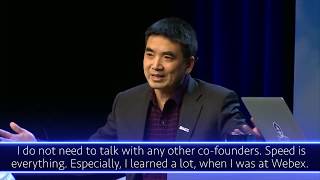
Yeah, so I started a company 2011. I was already 41 years old, but I still feel I was very young. So, and that's okay. So again, so because when you start a company, every company is different, right? Because, you know, I learned a lot when I was at WebEx. For sure, if I was 24, 25 years old when I started a company, ideally have 2 co-founders or 3 co-founders. And when I started a company already 41 years old, I really think I can handle the pressure. And my left brain can help the right one. And for sure, there's pros and cons, right? You have multiple co-founders, for sure, whenever you have something very important, you can discuss with your co-founders to collectively make a decision. But also, as a sole founder, quite often you also can make this decision in a very timely manner. I do not need to talk with any other co-founders, because speed is everything. Especially I learned a lot when I was at Webex, not only for the product side, but also for sales and marketing side. Yeah, it really depends. If you think you have— you learn a lot of you were before at other companies, you really can start as a sole founder. I do not think that's a problem.
Yeah. So, well, you clearly have done something right. So you were an engineer by training, and then you became an engineering leader with the CTO of WebEx, and then you became a CEO. And I would say you've made that transition pretty well. In fact, Glassdoor last year named you number one CEO on top of folks like Marc Benioff and Jeff Weiner and Satya Nadella. Just saying, you know, I think you figured it out a bit. So tell Tell me how that transition was between being an engineer to saying, okay, now I'm a founder, but now I'm also, I'm a CEO.
So, you know, to start a company, you know, product is everything, right? If you have an engineer background, I would say it's probably, it's much better, you know, because you really understand the product, right? And otherwise, you need to have a co-founder to help you to drive the, the product side. And to be a Engineer really can help you because you really understand what's going on in the market. However, transition from engineer to engineering manager, probably straightforward. But if you transition from engineering manager to a CEO, it's not that easy, not that straightforward. You got to learn a lot about sales, about marketing. And otherwise, you need to hire a lot of other people around you to help. And another thing is to be a CEO is not only the product side. You also manage the overall of the business. I think as long as you think you can do it and learn as fast as you can, also keep working hard, I think you will get it there. Don't think about, hey, my background is engineer, I do not think I can be a CEO. I do not think that's the case. I see lots of great, you know, companies like Facebook. Mark Zuckerberg is an engineer background, right? Yahoo and Facebook. So Yahoo, Google, same thing. I think to have an engineer background, and we will help you to transition to be a much better CEO because you really understand the product.
So a lot of the folks out in the audience, a lot of the founders are first-time CEOs. And so is there any advice that you would give them in terms of how do you get up to speed and how do you become an effective CEO?
I would say be patient. So everybody knows that. To build a successful company is a long journey, right? You don't think about overnight success. Keep working as hard as you can, be patient, and every day think about what you can do differently to improve, and then I think you will get there down the road.