Your Safest Investment in Difficult Times: Your Product with Pendo
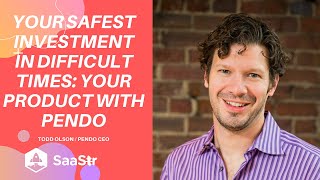
In this keynote at the SaaStr Summit, Todd Olson, CEO and co‑founder of Pendo, argues that a company’s product is the safest investment during economic downturns. Drawing on his experience navigating the 2008‑09 recession, he explains why continued R&D spending is crucial for rapid post‑crisis acceleration. Olson urges product leaders to reassess roadmaps—prioritizing core customers, enabling sales to close deals quickly, and shifting focus to sectors that are thriving (telehealth, edtech, collaboration tools, digital banking). He outlines three strategic pillars: (1) protect the base by retaining customers and supporting sales; (2) improve internal efficiencies through automation, process optimization, and tech‑debt reduction; and (3) invest in long‑term bets such as re‑architecting platforms, hiring disruptive talent, and building new digital products. He highlights the importance of delivering a smoother, more human‑like digital experience for remote users. The talk concludes with a call to balance defensive and offensive moves, leveraging the current crisis to build for the future.
Chapters
Awesome.
Thanks, everyone. Greetings. Welcome. My name is Todd Olson, CEO and co-founder of Pendo. Thank you for spending your afternoon and evening with me. The subject of my talk today is your safest investment, in my mind, in a difficult time. Which is your product. So as folks kind of roll in here, I'm going to start off with this chart. So this chart is from, of course, 2008 to— in this case, starting in 2011. They're calling it— you know, they call it the Great Recession. I'm not sure about many of you. Some of you may have had the opportunity to work through this prior crisis. I had the opportunity to be on a leadership team the SaaS business through this crisis. It was a good company and we did well and we, we got through it. The company ultimately went public. But one of the things I learned in that process is that we didn't invest enough in our product. What happened was, as we started to come out of the downturn, as the economy started to recover and we started to get normal demand for our products, our engineering team wasn't able to catch up. We weren't able to innovate the way we wanted to. And frankly, we lost a little bit of ground in that period. And that left a huge impression on me. It's one of the things that, that I've taken away from that professional experience. And when we entered into this, um, this new reality here in the past few months, the first thing I told my leadership team and my board and my investors was that the one thing we have to do is maintain investments in R&D through this. The last thing we can do is let ourselves get behind because we need to prepare ourselves for as things recover We need to be able to accelerate out of it. And that's what I've seen. And that's what plenty of studies show is that companies that continue to invest in product and innovation tend to accelerate faster out of downturns than those who don't. So that's the one thing I want you to come away with is thinking about how you can invest, make, you know, trying to convince you that you should continue to invest and potentially continue to grow your investment in product through this challenging time. I also want you to think as you're in this, do you have the right roadmap? Or said differently, is you have the same roadmap pre-COVID that you have now? Have you left it the same? Presumably, there's a lot of parts of your company that are thinking about how they change. If you as a product leader or you as even as CEO, If you're coming in and telling your board that you have the exact same roadmap post this event, probably not the right answer, right? The world has changed. Your customers, many cases have been affected. This is an opportunity to look at what is the most important thing for us? What do we need to do in our product to help our company weather this as well as come out of this in the correct way? And one of the nice things about spending money on product and investing in product, or I think it's a nice thing about investing in product, is that The world's incredibly uncertain. There's conversations of V curves, U curves, L curves. We have no idea what the curves are. There's uncertainty around health. There's uncertainty around when we're going to open. There's uncertainty around phases. There's uncertainty on second waves. We legitimately have no idea. But so what that translates into is like dollars spent on sales and marketing It's gonna have a questionable yield right now. You can't assume that your funnel metrics, whatever they were a few months ago, are the exact same funnel metrics you are now. You probably shouldn't be thinking that. Sure, some of your business may be that way, but most of your businesses probably aren't. But I can say this: dollars spent on engineering are typically yield features. Those features have a certain value, and that value is probably about the same as it was in a pre-COVID world. So what I, what I love about investing in a product is that it's a relatively certain investment. And yes, I know we are all in a work from home and you may not have done work from home, but there are known processes, known methods for product engineering teams to work from home productive. I don't know about you, but some of my engineers actually prefer working from home and asking for a while. They're actually happier in this environment. So again, this is an area that is a relatively safe bet at a time when there are very, very few safe bets. So now I wanna talk about how I think about where to invest, how to adjust that roadmap, where to apply those dollars in this time. So the first thing, first order of business, and you hear all these kind of mantras and conversations around wartime versus peacetime. Look, first order of business is protecting the base. Protect your base. What is your base? Your customers, your business, right? So first order of business is retaining customers. I know we went through our roadmap and just put it through a quick lenses. If we surveyed our top 10 customers of what they want to see in our product, does our roadmap reflect those top 10 things? Are we prioritizing things based on what our core customers, what our ideal customer wants? And if we didn't or we felt like we didn't, we adjusted. This is more of a time of protecting that base than it is going and trying to acquire a new base. There may be some circumstances where that's the case, but no, now is the time to help your customer success team, help your company retain those customers. It's hard to predict new business acquisition. It's hard to predict CFOs signing off on new deals, starting new projects, starting new things right now. But you can protect what you've got if you're delivering value, if you're delivering an ROI back to that customer. Good opportunity to retain that. You should be thinking about what are we prioritizing, how do we put those things at the top of our list, especially your big customers. Those are— those would hurt right now. Think of the, the how challenging those would be in your business. The second thing is help your sales team win closed deals. If you have closed deals and those deals require a little bit of engineering work, a little bit of change, maybe a commit Now's the time to start doing those things. You need wins. We all need wins right now. We don't feel really, really good in this world. This is the time that I would exercise some of that muscle and do that. We had a situation recently where a customer needed something, a customer needed something ASAP, needed ASAP to close the deal this quarter. For us, that's the end of next week. So it was going to take, I don't know, a quarter-ish of time for engineering team to deliver on our ideal solution. What are— what would our product team designers spec out as what the right What would the right solution look like? I challenge team, what would it take to get something done in a short time? A month, which would be a third of the time. How do we deliver value? Maybe not the ideal, but an incremental way that unlocks our ability to win this deal. We need to be winning closed deals. Do things a little bit more aggressive than you normally would do in order to capture that revenue. The other thing is Given the macroeconomic changes, what is now important on your roadmap? Some of you may be serving different industries, different markets. If it's not obvious, different markets are handling this better. If you were prioritizing features for, I don't know, hospitality and travel, but have the opportunity to invest in other areas like edtech and telehealth, maybe you want to shift the way you're thinking. That doesn't say abandon those things. Prioritize those things based on what's important now. If it's not obvious, the world's gone more digital than it ever has before. If you have things to help customers go digital, do it now. The metaphor I like to say is, we imagine we're driving down a road and there's completely clear skies. We can move really fast, we can take risks, we can turn faster. Imagine if a storm comes in, are you gonna drive the same way? Of course you aren't. A storm has come. What is important? What is important to your customers? Go ask them. Go look at the segments that are doing better. Go to the segments that are strong. Go look at the segments that you need to take care of and ask them what's more important. And maybe your roadmap looks completely different than it did prior to this. That is what you fundamentally should be doing right now. So that's the first plank, protect the base. The second thing is about efficiencies, cash. A lot of you are looking for ways to drive cash or create cash. And of course, the There's the classic playbooks. Folks are looking at layoffs, furloughs, reduction in salaries, et cetera, et cetera. Of course, many of you may have to do that, and that's like a whole separate conversation. But what are the things you can do just by improving internal efficiencies? A lot of us, because money has been flowing, have been able to afford to throw humans at problems that typically we throw computers at. You know, there's the old mantra, fail fast, break things. Of course, I'm paraphrasing. That's one of the Zuckerberg things from Facebook. But this is a time where we can actually step back and maybe look at ways we can be a little more efficient. If you're throwing humans at an onboarding problem, maybe automate it. Find things that absolutely a computer can do and get your engineers to clean up those things. This could be— this could reduce support costs. For some of you, if support tickets are continuing to rise, you still need to hire support engineers. Find ways to reduce your need on support engineers so you don't have to keep up with that growth. You still deliver great service, you still retain customers, but you're creating a more efficient way to do it. This is an opportunity, folks, to get tighter, more efficient, do more with less. In this case, you may be able to preserve the headcount you have and generate cash in different ways. This is a great opportunity. For some folks, it's an opportunity to acquire customers in a more cash-efficient way. Some of you have been using, again, salespeople, SDRs, humans to go out there and acquire all of your business, heavy marketing spends, digital spends, et cetera. What if you can acquire customers through trial and growth? One of the greatest stories of the last great recession was Mailchimp, and all of you should be familiar with Mailchimp. You know, the article, maybe about a year ago in Forbes, valued them at over $4 billion. They launched freemium in the Great Recession and their business fundamentally transformed. Is there ways that you can do things that are transformative in your business now that can help create a more efficient business in the long term? Freemium is a potential option here. Another thing is optimizing internal processes. This is one where, you know, a lot of us were focused on growth, growth, growth, growth, growth. A lot of us aren't thinking about internal processes. We're hiring consultants, we're throwing humans at the problem. Like, you know, even at Pendo here, we've been grow, grow, grow. You know, the number of times I do a one-on-one with people and say, oh, our Salesforce instance is is awful, it's hard to have good data here, or our systems are disconnected, or this is a super manual process to understand this. This is an opportunity to actually put some engineers on our problem and actually fix those problems. We actually launched a project in the last few weeks to connect our Salesforce instance to our product to help drive lots more automation, things that like More automated provisioning. These are all things we'd throw humans at in the past, and it'd be fine to do so if we're operating in a normal world, but in a not-so-normal world, and not knowing when we're going to come out of this normal world, these are great things to invest in because at the end of the day, we're going to do stuff anyway. This is stuff we should have done in the first place, arguably, but we're growing really fast. We're focusing on features, we're capturing growth, we're capturing market share. So our focus is growth, grow, grow, grow, grow. But now is how can we do more with less? How can we be more efficient? How can we do to create more automation? These are awesome things. Actually, I'm super excited about this initiative. Shockingly, but it's fun stuff because it's going to be transformative. This is going to help us accelerate out of the turn. So the last thing I want to talk about is investing in the future. And if you get through those first two and still have some capacity, this is a great time to think long term, long term bets. This is how you think about accelerating out of the turn. Investing in props is a long term bet because guess what? We will get out of this at some point. Trust me, we will, and you want to be set up for that. So there's going to be new strategic areas, new products, and, you know, as people realize the world is going to go more digital, and that is one of the changes we're going to see. Companies that could have afforded, I don't know, a year to go digital are being forced to go digital right now. That sets up new opportunities, new business opportunities, new product areas, new automation, new challenges that that is an opportunity for all of us to capitalize. There could be a great opportunity here to build. You may not wanna launch it now, may not wanna try to capture a lot of revenue out of now, now's not a great measure of grabbing revenue per se, but it's a great opportunity to build, go heads down. If you're not dealing with as many customer requests 'cause your business is just completely slowed, build something strategic, go internal. You've got these great engineers, take them and put them in something strategic. Again, every business is different. This could be an area that if you have no other alternative for those first two, like business is just slow, invest in the future. Second thing is fixing tech debt and rearchitecture. As I shared in my opening example, the last thing you want to do when business starts flying is have to then go back and fix tech debt and brittle architecture. You're going to be so upset at yourself if like sales starts coming to you, business is taking off, doing all these customer calls, All this, your competitors are flying and all of a sudden they go, oh, we got to rewrite the system from, you know, this technology, this technology, because we just can't build it. It's, you know, it's end of life or it's out of date. We can't have our engine. Like, think of the reasons for it, folks. This is not the situation you want to be in. Now's the time to fix these things while things are a little bit slower in the markets. And the last thing is find disruptive talent. You know, right or wrong, there are, there are now people coming available. There's plenty of layoff sites, go look at them. Humans can be an amazing force multiplier for your product team. Special AI talent, machine learning talent, things— talent that you wouldn't be able to hire in a normal economy, you can hire now. They could then go build things that are, again, long-term focused items. Huge, huge opportunity. Think long-term. This is a, a great way to think about it, and I would think about reserving some of these headcount spots you have if you are growing R&D talent. I know we're thinking this way for special, special talent. So as you know, in summary, look, if I haven't made the case, I hope I have. Now is a time that investing in products will help set you up to accelerate faster out of the downturn, specifically versus those who don't. And I'm going to challenge you is, what have you changed? What have you adjusted? If I was your board and you're presenting to me and I asked you what has changed in your roadmap, you should have a really quick answer. It should be like based on some sort of facts and things are what's going on. Don't just let your chief revenue officer or your chief financial officer go through all the changes they've made. I'm sure they've all forecast different things. They've been looking at your cash position. You should be looking at your product roadmap and making decisions based on what's changed. There's a great HBR study which we'll, which we'll share here in the chat in the chat. It's a longer article, but I love the way they frame this, which is this delicate balance between cutting costs, surviving today, or playing defense, as they put it, to investing in the future. And the companies that actually do the best are ones that don't lean on any one side. They're playing a little bit of defense, a little bit of offense. And you can tell from my talk that the first couple areas are more defensive moves and the later more offensive moves. Strike the balance. This is an opportunity to help you break away from the pack. When things recover. And the last thing is, I'll just reiterate this. I hope you guys saw this fantastic article published, I think it was last week or over the weekend, from Marc Andreessen, kind of his latest call to action. You know, actually the most recent one after the software's eating the world. But he said it's a time to build. And you know what I loved about this is that, look, there's a lot of things we can talk about doing or point fingers or complain about. But at the end of the day, our roots are in building. It's a great time to get back to building. It's a great time to invest in the future. And I'd encourage you to think about how you can do this for your business. So with that, thank you. I have 2 minutes left. I suppose there could be a fast question. Um, Amelia, is there any interesting questions I should answer?
You do have one that you got asked a couple times, which is what was the product that you used at the very beginning of your slides? For the product roadmap app? People want to know. I'm assuming it's Pendo.
It is a Pendo, uh, Pendo Feedback, which is our roadmapping product. Exactly.
I'm like, I think it's Pendo. Um, last, last question: what industries do you anticipate, or are you seeing currently, leaning into the Pendo product suite with everything going on?
Yeah, so I already touched on a little bit earlier, but, you know, we have this fortunate, I guess, position, and we collect data from all these different applications. And of course, the companies that are really exploding right now— telehealth, as you can imagine, is up, you know, in the hundreds of percents since the beginning of this due to some of their lax legislation. EdTech, e-learning, education in general— all those segments are booming. Obviously healthcare is still very, very strong. Collaboration tools are really, really, really strong. Banking is actually doing— if you think about it, none of us are walking into branches anymore, so they're all using digital banking. So A lot of really interesting segments that are, that are exploding right now.
Um, yeah, last question because it's from Jason, it's faster. How do you see products most changing now with work from home, shelter in place?
How I see products changing right now?
Yeah.
Um, look, I, I think, um, you're seeing a lot of products focus on a more enhanced, more human-like digital experience. I think what we're going to see is when you can't rely on humans at all, the digital experience needs to be so tight, so comforting almost, to kind of really explain things along. You don't want to rely on people, so I think you have to provide just a much smoother, more handheld digital experience. That's kind of what we're seeing the most.
All right. Well, we are sadly out of time, but thank you, Todd. This has been super amazing. Especially at the nearing the end of the day here at SaaStr Summit. So thanks for your energy and sharing the insights with the SaaStr fam.
My pleasure. Thanks, thanks guys.
Have a great one.
More from Jason

Why Your Next Hire Should Report to an AI, Tragedy Apps, and Too Many AI SDRs? | The Agents #004

Our Agents Drove Our Salesforce Bill Up 80%, Marketo Hates Agents, and We Stealth-Churned Off Notion




Managing 20+ AI Agents: Lazy Agents, Our $500K AI Bill, Stealth Churn & the Death of 60% Solutions




