4 Helpful Tips To Deliver A Winning Pitch Every Time
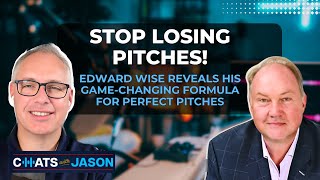
Edward Wise breaks down his system for pitches that win: start early, rehearse relentlessly, and build around one clear idea your audience can actually catch. Map what your prospect cares about and what blocks them, then tailor everything to that.
Questions this video answers
The Total Pitch
Amazon
Over six years
From one major client to over 100 clients in 10 years
About 4,500 individuals (with 15 CEOs reporting to him)
Chapters
Foreign.
Whatever your pursuit passion or business venture, there will come a time when you need to share your ideas, your product or your business proposal with others. And sooner or later you will find yourself in that most vulnerable, competitive and exposed position of all. That's it. As the presenter of the A pitch, are you hooked? I bet you are. Because that is the opening to the most amazing book I've read all year so far and we have the author of that book with us today. But before we get into that, welcome to the show. This is Chats with Jason. I'm your host, Jason S. Bradshaw. The show that helps transform your experience to transform your business. Now today's guest is an absolute pitch master, Edward Wise. He was the founder and CEO of Omnicom Health Group, the largest healthcare communications group in the world for over six years. Before that, he led the CDM Group, a healthcare advertising agency startup where he grew a client roster from one major client to over 100 in 10 years as President and CEO. In large part by perfecting the pitch process from beginning to end. Today, Edward Wise is an author, investor, executive advisor and is a certified executive coach by the International Coaching Federation. He also serves on the board of several private equity owned companies. Who better to talk to us about mastering the art of pitch and that is of course Edward Wise. Edward, welcome to the show.
Thank you very much Jason. Really happy to be here today.
A page turner out of the gate from that paragraph that I read to the listener today. The total pitch and end to end guide to winning the pitch every step of the way. Like I said, it is a page turner and absolutely filled with practical advice to help people master the pitch. I could go on for hours about it, but I didn't write it. You did. What led you to write the book, Edward?
As you mentioned, my career in professional services firm, in particular advertising agencies. I joined as a seventh employee of this startup and then 10 years later I was named president and CEO. And we have one major client. So I was asked to turn this business grow at 10% a year. And I came from the creative side. I didn't have client relationships, I wasn't a salesperson. So what we had to do is diversify and start pitching business. This was existential to our agency's life. If we didn't pitch, we were going to fade away and die. So we had to learn how to pitch. It was an ugly experience at the beginning. We start late because we had client work to do. We would work till 2, 3 o' clock in the morning. The night before we would be questioning our original idea. And then we'd cobble it together. And the next day we'd show up at the pitch, slightly broken, and do our best at doing this pitch. This happened time and time again. I came home to my wife and I said, every time we end up, it's a mess, and I just can't deal with this. She said, if it's the same thing every time, why don't you fix it? And I was like, how could you be chilled for the time like this? And so I listened to her. I actually applied a team to this. We started taking apart our pitches. What worked, what didn't work. We needed a system. And so I developed a system and dedicated myself to really focusing on developing a system, a process, ways to do things that still allowed a lot of creativity because we were in a creative business. Each pitch was going to be different, but there are going to be fundamental things that were the same that were going to carry us through. And we're always learning at the end. We're always like, what worked? What didn't work? Let's make it better. And out of need for survival and out of need of no desire to suffer anymore, I did this. And it became a huge competitive advantage for us moving forward. So we created a whole system. And that was the inspiration for this book. Trying to save other people the pain and agony that I happen to go through.
Yeah. And one of the key things that I just took out of that was the pain that you were experiencing wasn't because the content of the pitch had to change from client to client rather, but that you didn't have a system of going around pitching. So it was like you were starting the building all over again every time and throwing spaghetti at the wall and hoping some of it would stick. Great insight for us out of the gate there to build a system to overcome that pain. Point. Why it's so important just so that you can get systematic around pitching.
You do need a system because time. And I have a chapter that talks about turning time on its head because time appears to be the enemy when you're doing a pitch. It's working against you. There's not enough of it. You're being dragged in a lot of different directions. So if you can turn that on its head and manage time better. Our competitors are forming teams to figure out what we were doing differently that was winning the pitch. And I said, imagine if they knew all they had to do was listen to their mother in fifth grade who said, stop procrastinating. But realization Gets you so far. But being able to know when to start, know that the gun goes off the second you have an idea about a pitch. And then you design a system so that every step along the way, that's a part of it. At the heart really of what I talk about in the book though is about content. I come from advertising and communications. Getting to a single minded idea is critical. And so that's at the heart of the book. A single minded idea that connects to your customers across every step of the pitch journey. So there's, there's a couple elements in there. It has to be single minded, it has to connect with your customer and it has to be applied every pitch across the pitch journey.
Yeah, it gives me flashbacks to when I was sitting in the boardroom having agencies pitch to me around what their next campaign idea was and how, how it would come to fruition. And I would quite often ask the question at the end. So was there any other ideas? But this is the idea, this is the, the winning idea. And I'm sure I frustrated them and I, I wasn't doing it to frustrate them, just to be clear, but to understand how we landed or how they landed, I should say, on what they were pitching. So a lot that you cover in the book and it is a great read, but still a load of content. And no matter how easy the read is, it just shows such a great communicator that you are. When I think of all the elements that you cover that make up the total pitch, what is the main idea that underlines your book?
Would you say you have to commit to a single minded idea that connects to your customers across every aspect of the pitch journey. So that is the main idea, but to really focus on the two central parts of it, one is committing to a single idea and connecting to your customer. Starting with connecting to your customer. I think the issue with a pitch is that it sends us the completely wrong signals. We're standing in front of an audience, we have the microphone, we have the stage. The audience is surrounding us with adoration, looking at us for wisdom and we get the idea I'm the star of the show. When in fact you have to turn that to be successful at pitching, you have to turn that upside down and you have to make the audience the center of your universe. And everything you do in the purpose of your presentation has to search to connect with that audience. And so the first part of the content section of this book really focuses on a very simple method to connect with customers and really understand customers. And that's to take them apart into two key areas. One is motivators and the other is barriers to really dive into customer and understand what are the mental models that they might have that would make them more predisposed to accepting my idea. And what are some of the obstacles that would stand in their way of understanding my idea. And sort of like a pros and cons list, that's a simple way to dissect that customer so that when you get in that room and you're presenting and you're designing your pitch, you're connecting to that customer. The more you can understand that, the more you can do a hardwire connection direct to them. So that's one part of it.
Before we get into the second part, what I really want the audience to hear, and that's why I asked you the question again is, and you've mentioned it twice, and I'm going to make sure I mentioned it a third time, commit to a single minded idea, whether it's a pitch or whether it's your business strategy, if you don't have a single clear vision, a single minded idea that you're chasing, then you are just spread too thin. You can't commit to delivering on anything if you're trying to do everything. And so I really want you, the audience, to understand the power of committing to this single idea. And the second thing that you mentioned then, Edward, was understanding your customer. Now having spent my entire life advocating for the customer and the customer experience, I cannot agree more with you that the key to pitching, the key to business is understanding your customer. Because the more you understand your customer, the better you can serve them and the better that they will connect with you. So love those two clear concepts coming out, the single minded idea, understanding your customer. Now I cut you off. You were about to jump in telling us about part two, so I'll let you go forward, Edward.
Okay. Yeah. And this is really getting at the single minded idea part of it. To get to that single minded idea, I have someone who I used to work with who has this great example. He takes three juggling balls and he asks someone to come up from the audience, says, okay, I'm going to throw these balls at you right now. Ready to catch them. He throws three balls at them. How many do they catch? Any guesses? 0 per. Pretty much every time they catch 0, you take one ball, you throw it at someone, they catch the ball. It's the same thing with ideas, is if we have that single minded idea and we can edit that idea down to One single idea, it becomes something that they can catch. The problem with. This is entrepreneurs. I've dealt with scientists who develop life saving drugs. They're in love with every aspect of their product, every aspect of their baby. And if you think about someone showing a picture of the actual babies, what do you love about that baby? I love everything about it. And this is the problem. This is the problem. We love everything about our idea. We love the history, we love everything it took to develop it and everything about the market of it. It becomes important. And I have a system in this book about how to reduce the clutter in your house. There's a way to get to declutter your idea that I go through in a book.
Yeah, decluttering the idea I see as a key way to be able to communicate it because you're not trying to tell everyone about everything. You're telling them the key elements. You're ripping it back to what really matters. And all the other stuff might be important when it comes to execution, but in that pitch, being crystal clear and easy to understand is important. I've talked about pitching some of the framework, understanding the customer, getting that single idea that you articulate. But is this just all business focused? Can it help me outside of business?
Yeah, absolutely. It has a bunch of different business focuses, but it certainly has application to help anybody organize their thinking around something. So one place where it's very helpful, I a lot of mentoring for young people who are entering the workforce. And yes, this is a business purpose in a way, but it's really people pitching themselves and helping them to understand how to connect with a customer, how to see the world through their customer's perspective, and really even how to write their resume in a way that connects with their customer in a very direct way. And also to have a point of view in your resume that you really have an idea about yourself and that resume that comes through. Clearly that's one place there's obviously entrepreneurs who are pitching for funding and things like that. There's pitching a new vacation idea to your partner or spouse. Anything you want to do to try to package your thinking better. Another place where I've used it in business, which is not pitching, is in leadership. At my last role, I oversaw 4,500 individuals. I had 15 CEOs reporting to me a very complicated organization. And so when I saw the need to shift some of the thinking within our organization, I had to reduce my thinking to a very simple set of messages that I could deliver to people. And this was very helpful to me. In companies trying to establish their vision and their purpose, these reductive platforms, these systems to get more reductive, are very valuable in those pursuits as well.
Yeah, that decluttering definitely would come out a lot, I think, when you're talking about a vision of a company, because quite often it just becomes this mess of words that you have to try and get people to buy into. I have to say, there was one chapter in your book that when I first picked it up and I was scanning the contents as I. Not that I was going to jump around, of course, and not read it in chronological order, but one chapter, that title that really jumped out to me was Win by Choosing Better Prospects. Now my ears pricked and I was like, of course you get better prospects. It's easy to pitch to them. But that's not really what you're saying, is it?
What it's saying is that you do need to be somewhat selective in who you choose to pitch to. Not every pitch is going to be good for you and your organization. We were at points where we were up against the wall. We needed to get some growth into the agency, and we were somewhat desperate. Okay, you're like, we gotta win or we're in trouble. And the result of that, though, was that we were pitching to every opportunity that came along. And the result of that was we were spreading ourselves too thin and we were not choosing good prospects by not choosing good prospects. They weren't the right people for us. They weren't really a good match for us. They weren't willing to pay the rates that we required. What I suggest is that people qualify their prospects, their criteria like size, culture, willingness to pay. If someone has a bad reputation or they're a great company to work with, you'll want to try to work with those people. So it sounds a little arrogant that I get to choose who has the privilege of working with me. So it's not meant to exclude the better part of people, the better the bigger group. What it does is it just refines it a little bit. So you're not saying yes to every opportunity and you're refining your ability to pitch and connect.
I think it makes a load of sense because it reinforced to me that your business, your team, if you're with inside a company, doesn't have to be all things to all people. And by trying to be all things to all people, not only do you run the risk of potentially being nothing to anyone, but you also run the risk of diluting the value that you can deliver to your core audience. Because you're being distracted by you're not taking the time or devoting that extra time to delivering better value, to getting deeper with that customer that is your ideal customer. And we so often forget that those decisions to try and serve everyone actually also hurt those that we are best placed to serve. And that doesn't mean that your organization and I think back to different advertising and marketing agencies that I've used over the years. There were times where the scrappy startup agency was the absolute right agency and then there was times where the global agency was the right agency to use because they're bringing different skills and different understanding of the challenge. And that's why at times I would say, well, I don't want you to pitch because it's not the right use of your time for us. Great, so we've got a single minded idea, we've got understanding your customer, we've got being completely specific about who we're going to serve, who we're going to pitch to make sure that we're using energy in the right time. Lots of great work here. But you know, now that you've got this formula and you know how you're going to go into every pitch, does that mean you just put together your pitch deck and rock up on Monday morning to deliver the pitch or do you have to do any pre work or is there something I'm missing?
One thing that I learned in once we had a process and we grew as an agency is that what we're creating, we had to decide what this was going to do and what it wasn't going to do. What it was going to do was to provide a framework and a structure to make success repeatable. What it wasn't going to do was to create ideas, create good thinking. You have to bring the good thinking and apply it because it's garbage in and garbage out. If you put in great thinking, you'll get stuck something out. In great measure. This allows you to repeat it, to take out the stress, to have a system and logistics in place in order to deliver it and a way to get to the idea more clearly and some discipline around that. But you need to bring your creativity to it. And one thing that people often push to the side is rehearsal. Yeah, of course we want to try to have rehearsal, but rehearsal is one of the unsung heroes of pitching because often again, it isn't factored in the time scheme and people are up at 2 o' clock in the morning still putting together the pitch always ended. The mechanics of putting together a Pitch at least two days before we pitch, and then we spent two days perfecting our performance. And you might say, that's crazy. How is that possible? It is very possible. If you put in the discipline and the system, you can do it. And then there's a bunch of ideas in there about the rehearsal and how to make a rehearsal effective. There's tips like, if you're presenting with a group, you want to come across as a team, and so you need to really refer to each other in different sections of the presentation. You really come across as a cohesive team versus just showing up and trying to present. I always say not prioritizing rehearsal is like the person producing a play. We're going to spend up the opening day writing the play, and then we're just going to go out there and do it. That's an absurd concept. It is a performance. The more skillful you are, the more poised you are, the more perfected you are, the more you refer to one another, the more likely you are to be successful.
Yeah, I think that's a great reminder. I know myself that I still find myself in hotel rooms the night before delivering a presentation. I will, of course, know the content. I will of course, have delivered the content in various ways, maybe dozens, if not hundreds of times, but I still want to make sure I land it. The next day, I'll be awkwardly in my hotel room, often wondering whether the person next door can hear me and if they think that I've lost my marbles for the night or something. Because I'll be going over and making sure that not only that the content's fresh in my mind, but that I'm ready to present, and that I think that's a great way not only to deliver a great presentation or great pitch, but also a great way to manage your nerves. Because even if you've done it a hundred times, you still have some nervous energy because you care, you want to do a great job. So really appreciate you reinforcing the need for people to practice the pitch. And in that process, you're obviously refining in your mind just those points that you're going to hit and how you can be clear about your message through the way that you deliver it. And I hope the audience knows it's not just about reading out aloud the pitch deck. It's about communicating the key points and pausing with emphasis, raising your voice, tonality, all those different things that we use when we're talking to really get our point across. And that is a key that only you can unlock through practice. And repetition. Great tip for us there. Now the book the Total Pitch, an end to end guide to winning the pitch every step of the way. If I was to document on Amazon, I'm sure it would tell me that it gives me the tools to ensure your message and your Total pitch is clear, compelling and impossible to ignore. Where can the audience get a copy of your book, Edward?
Amazon is the best place to get a copy. So just go on Amazon, it's got a few different formats and just search for the Total Pitch or Edward Wise.
And you'll find it fantastic. And of course, in the show notes, we'll be putting links to the easiest way you can get the book, which is the world's largest bookstore, Amazon. But of course, how you can connect with Edward and follow his work. Now, Edward, before I let you go today, I have one last question for you. What's one thing someone listening on a podcast today or perhaps watching a log on YouTube should start or stop doing as soon as they finish listening to improve how they pitch?
I think we need to start letting go of all the things that we think we need to communicate to people and become better editors and really narrow it down to a single minded idea. And as I say in the book, simple isn't simple as hard. It requires fortitude. It requires tremendous effort and energy to get to simple and it's work you have to do. But once you've made it simple, then you'll be able to repeat that at every step along a pitch journey and be able to really make your point Fantastic.
Declutter your message, make it nice and simple and clear so people can connect with it and take action from your message. Edward, it's been great having you on the show. Absolute dropping bombs of wisdom throughout. Really appreciate your time today.
Thank you, Jason. Really appreciate it.
And to you, the audience, really appreciate you taking the time to listen to this episode. Be sure to share it with a friend or a colleague. But most importantly, take action today to improve the way that you pitch. I'm Jason S. Bradshaw and until next time, I wish you great success in everything that you're doing.
More from Jason

Bringing Wonder Back to Work | Leadership, Culture & Service with Peter Merritt







How to Lead With Empathy: Claude Silver on Emotional Bravery & People-First Culture


Inside Harley’s Cult-Like Loyalty | Ken Schmidt on Turning Customers Into Believers
