Amazon Expert And Author Isaac Kuhlman on Building Million-Dollar
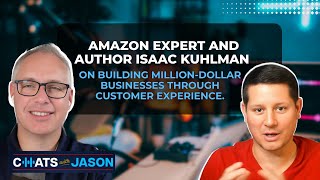
Isaac Kuhlman built his first Amazon FBA business to $500,000 in December sales within nine months of starting in 2013, using just 15 products. He's since created three training programs that each hit seven figures, and emphasizes using traffic and conversion metrics to guide decisions and treating selling as solving customer problems.
Questions this video answers
April 2013.
Over $500,000 in December 2013 (on about 15 SKUs).
Three separate Amazon training programs reached seven-figure sales.
You're a Great Marketer, You Just Don't Know It.
isaackuhlman.com.
Chapters
Hi and welcome to Chats with Jason. I'm of course your host, Jason Espratro, and this is the show where we help you transform the experience to transform your business. Today's guest is a man of many talents. I'm sure we're in for an absolutely smashing conversation and one that's going to help you transform your business. Our guest today is Isaac Kuhlman. He's an author, entrepreneur and creator and that's just scratching the surface of all his talents. Isaac, it's great to have you with us today.
Thanks for having me, Jason. It's great to be here.
Yeah, we were having a bit of a chat before we hit the record button and we were talking about some of your various talents and hobbies and whatnot. And amongst many of your attributes, you're a part time musician, shall we say?
Yeah, I wouldn't say I make any money from it, but it's definitely something I like to do for sure.
We all need something that clears our mind from time to time. And one of your Amazon businesses are actually in the music field. I'm sure that it is all related somehow. Now, Isaac, when we first connected, it was because of your new book. You're a great marketer, you just don't know it. So that's a fairly big claim. I've downloaded the audio copy. Thank you for making an audio copy available. It makes it a little faster for me to listen to it than read it. A it's a great book. What led you to write it?
Well, I've been coaching people in their businesses, consulting and coaching for about 12 years now, 11 years now, since 2013. Basically, as soon as I learn how to do something, somebody's going to ask me how I did it. And as soon as that happened, I started turning from just doing it myself to also helping other people do it. And over time, obviously you get that kind of built up of wealth of knowledge that you're just like, you got to put it in something. And I've got some training programs and stuff like that and obviously YouTube videos, all the other stuff that's out there, podcasts and stuff like that. But I really just wanted to get a distilled kind of focus version, put it into a book. Because I do like to write. I've always been a writer. It's one of my other side talents. And I've written books of poetry and stuff like that. But this one was, it was more of a challenge in a sense of I'm building an actual book.
Right.
This is a business Book. It's supposed to be something that people can take, take action out of, they can make something happen in their business and it's not gonna take em 10 years, it's gonna take em two hours or something like that. So that was the challenge of figuring out exactly how to format it. But the strategy is sound. It's obviously been worked through thousands of different businesses in my businesses and many of my other clients and stuff like that. It's a marketing book, but it's a little different in the sense that of all the marketing books I've ever read, it's not based on generic advice, it's based on here's an actual thing you can do right now and you can go out do it. And it's an ideal client exercise that I'll speak a little bit more about as we go through this.
Yeah, absolutely. Love that it's based on your experience and has so many actionable insights in it. Talking about your experience back in 2013, that sounds forever ago, but it's only, it's only a little bit over 10 years ago you joined a friend and started to run an Amazon FBA business and had a number of things happen since then. Can you share with us a little bit of your background?
Yeah. So I started working with him on his Amazon business, learn the ropes. But he was very hands off. He was actually an Australian from outside of Melbourne and he wanted just let me run it. And he basically didn't give me much guidance. But I knew business so I knew how to run businesses from obviously being in retail and other stuff like that and working as a manager, operations manager, general manager of physical retail locations. And he didn't want to do the day to day stuff. So he was one of those guys that said, here's this business, see how well you can run it. And literally the day that I got hired actually was the day before I was supposed to set the start. All those Amazon accounts got shut down and then we had to start from scratch. So it was almost like this huge thing of this was a business that was doing about a million dollars a year. Now it was down to zero the day before I was supposed to start. So I thought, oh, I'm just gonna have to go get my old job back. Didn't we worked through it. So that was in April of 2013. By that December we had grown the business better than it ever was. It actually did over a half a million dollars in just December alone that year. And that was only on maybe 15 SKUs, which is a pretty good amount of business per skew. And then we grew it and grew it and at some point started seeing that I didn't need to run his day to day operations, I could go do my own thing. I was already doing a lot of the coaching because we'd also built a coaching program and a training course together and done some other stuff and he wanted to go off one way and I didn't want to go that way. So I decided we'll just part ways and we'll do things the way that we want to do individually. Work with another partner. Her name was Kirsty Verity. Worked with her for about five years on another training and coaching program for Amazon, FBA Sellers and we did that. We got it over seven figures. That was the second seven figure training business. We did another co launch with a program called Amazing Selling Machine. They're now amazing dot com. We did the Amazing Accelerators training program which also became a seven figure training program. So to my knowledge I'm the only person who's been involved with three separate Amazon training programs that have had seven figure sales. Having three bestseller books at the same time in the same niche. But yeah, obviously say I haven't just been coaching, I've also been selling that entire time, learning every year that there's something that just is. It's a new wrinkle that gets thrown at you by Amazon. With that comes all the other stuff that real businesses, accounting, marketing, advertising, that all gets piled on top of it. It's a long history of building off of the corporate and retail side that I worked with and then transforming it into more of an online venture and helping people learn that stuff along the way.
Yeah, that's great. And you mentioned three online training courses that delivered over a million dollars in revenue each probably better than most people's book royalties. Certainly in the business space there's some exceptions of course. But talk to me, like you mentioned Amazon Accelerators. I think there was Sprint to Profit as well. When you think back to those courses, what was maybe the one or two things that for you was a logical thing to teach people on, but most people when they heard it was like, oh yeah, that's the missing part. That's what's been holding me back.
Yeah, I think for me the most logical thing that I always figured was like if you're going to do business, you have to know key metrics. Like you have to know your conversion rates, you have to know how much sessions or traffic or people walking in your building or whatever your business is set up to do you have to know how much traffic you have? And you have to know how well you're converting them into sales? Like, this started back when I was working in a go kart facility here in Las Vegas. I was tasked to be the operations manager there. And the thing was, they worked in a weird spot. Like, they weren't on the Strip. They were off in the suburbs. And they said, this has never been a profitable facility. We have a sister one. That one's profitable. It keeps both of them afloat. And I said, why would you even open this? Like, you have to make it profitable. So I found out how many people were walking in the door. I went through the metrics, what they were converting on. Everything was like a single race sale, right? So it was like, why would you come in for just one race? I even asked the owners, do you like go karts? And he's like, of course I do. I love it. I love racing. I was like, do you think one race is enough to be good or have fun? And he's no. I was like, okay, so we need to get people to stop just buying one races at a time. We need them to buy three, because that's the full experience that we offer. Actually, it was so simple. All I started doing was stop listening to myself. Great customers. And I started listening to what the other rest of the team started greeting their customers. And they'd say, hello, welcome to the, you know, go Kart facilities name. How can I help you today? That was what they said. But every time I greeted somebody and said, can I interest you in a three race package today? And it became this completely different scenario where I was basically, without even me knowing it cognizantly or whatever, I was asking them to experience the best thing that we offered, whereas everybody else was just trying to answer questions. And obviously, when you come into a new place, they're gonna have all sorts of questions. Just like when they come to an Amazon listing or your website, it's all questions. If you don't immediately just show them what you want them to see, answer those questions up front, or give them the thing that you think is going to best capitulate them into a sale, or just give them the best experience, whether or not it turns into a sale, make them understand that you're there for them, then that's when it turns the table. And when. When I did that and when I had our staff do that, it started to grow into this. And I tell a story about this in the book, it started to snowball into this effect of where we're selling only three race packages and we're making more money every single month. I think it went from 23 race packages for one month to 300 four months later. And so we're talking the difference between a couple thousand dollars in loss a month to $30,000 in profit in a five month span. So it's just these little things that you don't even think about and all came from just analyzing the metrics, knowing that everybody's buying one race. Something's got to be wrong. They're not coming in here to just put $15, $20 down and walk back out. They're here for an experience. Jason, that's why I love your program, Customer Experience Master. Right. You got to think first and foremost, what is it that they're actually looking for? When they come to you, you get, that's, that's the basis of this. You are a great marketer. All you have to think about is it from the customer's experience, what are they looking at to get from you? And then you just basically tell them exactly how they can benefit from that.
Yeah, absolutely. And a lot of time the criticism I get is if you ask a customer what they want, they'll say a faster horse, not a car. Right. But it's not about whether the customer can articulate in a short sentence, I want a car, it's what are the things they are looking for? What are those signals that they're giving you in the data to help you work out like you did? Actually, they're here for not a transaction, they're here for an experience. Which means the best experience we can give them is a three package. So let's lead with that versus leading with the product. That's most likely going to leave them dissatisfied. Right. They'll like, yep, I've ticked the box, I've done go karting. I never want to do it again versus oh my gosh, I can't wait to tell people about my experience and possibly do it again or bring them along. Fantastic example there. Now, even the smallest data can lead to some breakthroughs because a lot of people wouldn't take the time to listen. And kudos to you for listening and observing there. Now in your book, fairly early on, you start to talk about selling and what selling really is. You've got this bold statement, stop thinking that you are selling anything. Instead, what you're really doing is offering to solve someone's problems with a product or a service. Entrepreneurs particularly fall into a couple of different camps. The ones that always Seems to be struggling are the ones that seem to never get over this mental leap of sales. So how do you define sales beyond that statement? Is the first question or the first part of the question. And the second part of the question is, how do you get people into that mindset of service versus selling?
Yeah, that's. It starts from serving, servicing, whatever you want to say. Solving someone's problem. I always found that maybe my superpower on earth might be like solving problems. That's one of the things I can do pretty well. I can like vividly remember like the steps to it because I've done it so many times. Somebody will ask me how to do something, I'll be like, this is the step. I'll have an SOP for it. Obviously standard operation procedure. But I could do it from memory most of the time because I've done it so many times for a lot of the problems I've had to solve over the years. And in that experience of what sales is to what, offering a solution of a product, a problem with a product or services, there is really no difference of what selling is. They always say, you don't want to be a used car salesman. Go up and hey, can I help you today? And just be like on top of somebody, right? The best way to help somebody achieve what they want from you is to guide them. But don't force them, don't push their hand, don't give them those pushy sales messaging, nothing like that. It's really like they're already here looking for what you offer, right? So if you have a lead, if you have somebody walk into your property, if you have somebody walk into your store, they're already interested. They're highly interested, in fact, right? So they found you. All you need to do is not push them away. That's the whole point, right? So sales is basically you coming to a mutual personality agreement with this person that all you're trying to do is make their experience absolutely phenomenal. So that way you don't push them away to a competitor, and the fact that they're in the door gives you a massive advantage. Right? So in reality, if it's face to face or online sales, you've got to give everybody that comes to you, your listing, your website, your retail store, whatever, that kind of personal attention. Listen to what they're saying and don't just try to push what you want them to buy. If there's like an incentive or a motivation for you to sell the highest thing, don't make it seem obvious. Obviously, don't go out there and say, oh, you know what I would explain or what I would suggest is this top of the line thing. If they're clearly saying to you, I don't want that before you get to that message, be flexible, be versatile, explain that. But in reality you're just trying to make it as easy for them to meet the goal of them buying whatever thing, product or service from you as possible. So you know, it does always comes back to the customer experience. It always comes back to solving the problems. It's those two statements. When you marry them together, you will have a high conversion rate in sales almost every single time.
Yeah, I think key part of what I just heard from you was make it easy for them to achieve what they wanted to achieve.
Yeah.
If they came in to buy the suv, don't try to sell them the two door sports car because one of you are going to is going to end up unhappy and it's probably the person trying to sell the product that they didn't want. Great way of looking at it. Now the book title itself is very provocative. You're a great marketer, you just don't know it. How do you make that claim? Like, I know some people that think they're great marketers and I'm not sure I'd agree.
Yeah. After working with several hundreds and over a thousand clients in the years, most people will say, I can't do what you do, I'm not good at this, I'm not a great marketer, I can't write copy. And I say, absolutely you can. And they go, no, I can't. I promise you, I can't. I'll say, okay, listen, I'm going to ask you a series of questions and this is what I call my ideal client exercise. Now I'll, I'll explain how I became this and explain the exercise here in a second. But basically I boil it down to eight questions, something like that, eight or nine questions. And then all I ask them is to tell me the answers to those questions. And if they struggle to come up with something, I'll go, what do you mean by that? Or how is that possible? Like you just asked me, how can I make this claim that they're a great marketer. You're asking me to explain to you exactly how this product works. Right. So I just go through these steps. How do people use this product? Who's most likely to use it? How do they use it? How do they feel when they use it? All these questions that I ask as they're verbally Saying everything, it becomes copy. All they do is they take those words that they spoke verbally to me and then turn around and write it down somehow, some way. That distance between the brain and the mouth is so short, and this is obviously clearly not scientifically proven. This is just a joking metaphor. Essentially, that shorter distance from the brain to the mouth makes it easier for people to communicate than from the brain to the hands. Like, they just can't type it, they can't write it. There's that extra distance. It just doesn't make sense. But if you ask somebody, why would somebody want to use your product? They'll have an answer. They might not write it down very clearly, but if you just keep asking them, what do you mean by that? How does that work? And they go through this exercise, they can do it themselves. That's the best part, because they'll just say, oh, you know what? Once they get actually even good at asking, answering these questions, they can ask themselves over and over these questions again, and they'll get better and better answers. And it turns out anybody can actually do this.
Yeah, it's like the young child always asking why, no matter what answer you give back, they ask why they want to go, you know, six or seven levels deeper. And when people have that conversation that you're talking about, it's about getting it out there so then you can craft the message. I absolutely love that. Your ideal customer framework. When I hear that, some things pop into my mind, as I'm sure with you, the listener. Isaac, how do you define the ideal customer? How do you make sure that how you define is actually who your customer is?
It's a great question, because every person I paid for, a lot of marketing experts to explain this to me, they basically came back with this template of a customer avatar. I'm sure you're familiar with that idea that you have to know what magazines they read, what TV shows, how much money they make, their house, their car, their how many kids, all this stuff. That's a customer avatar. It's a demographic. Right. And that's great for advertising, but advertising is only half of marketing, or even maybe a third of marketing, really, because customer messaging, understanding customer experience, that's all part of the other part of marketing. Now, what I found was there was a huge gap in customer avatars versus who my customer really was, because I could make up a customer avatar. Peter Pan could be my avatar. Right. But that doesn't help me sell anything to Peter Pan or doesn't help me even offer anything to Peter Pan. So What I did was I reeled back and I said, who's most likely to purchase the product? The first thing that came to mind is who's most likely to use the product. If they're going to use the product, they're most likely going to be the ones purchasing it. Even if on their customer credit card it's a woman and it's the guy using it. Maybe it's the Amazon Seller Central account or the Amazon Buyer account is under a woman's name, but a man's buying it. I'm not trying to focus my attention on who's buying it, what that credit card statement says, right? Or the email says, or the name says. I'm focusing on who's most likely to use it. It doesn't have to be man or woman. It could be. I talked about the example of a garden shovel. Who's most likely to use a garden shovel? It's probably a landscaper, a gardener, somebody working in home repairs, something like that. Something with having to deal with digging holes. I have a jokingly said maybe a mafia mob member, right? So they go out and dig a hole for a dead body or whatever. But basically the idea is you have to know who uses the product. You think back to when you were a kid when you watched Saturday morning cartoons, you saw the sugary cereal ads on tv. Were those talking about who's gonna buy it or who's gonna eat the cereal? Right. It was always focused on the kids so that then they'd ask their parents to buy them. Lucky Charms, tricks, whatever. I don't know all the cereals in Australia anymore, but I know you guys have sugary cereals as well. But they were talking to the kids. Cause they're the ones that are gonna use it. They're the ones that are gonna ask for it, right? So even if the person who sees the cereal on the shelf and, and buys it as the parent, that's not the person using it. So you always want to try to focus on who's using the product, how they feel when they're using it. What would they feel if they didn't get this product and use your product? Right. What's their current experience? Like, how does yours make it better? So that's the person that you're really talking to. That's almost all that matters is who's most likely to use it. Once you figure that out, your messaging becomes so much easier because you're not trying to sell to every single person. In fact, I made this meme of Batman slapping Robin that Kind of got posted out what, 10, 15 years ago. And I'd say don't try to sell to everyone. And it's Batman, Slap and Robin. And I use that as a meme because basically if you try to sell to everyone, you run the risk of selling to nobody. Nobody's going to want it. If you try to appeal to 80 year old men and 20 year old females, active people and decrepit people or whatever, there's going to be some sort of disconnect. Like TikTok for example, if they said this is a platform for everyone versus, hey, this is a platform where all the cool people hang out. Same with Apple, right? Apple's for all cool kids. Microsoft was for the geeky nerd people who wanted to use their workspace, computer or whatever. It's clever marketing because you're not distancing by age or race, demographic of gender, nothing like that. It's do you want to be like this or do you want to be like that? And so if you can control that narrative and just say users who use our product want to be this, even if they're not currently that. So even if you're not currently a gardener, but you want to get into gardening, this is that shovel for you. We're going to talk to you like you already are in that space, even if you're just, I want to be for that space. Right. Again, it comes back to who is most likely to use it. The people that are currently using it for digging holes and people who also want to dig holes but maybe aren't currently doing it. So you craft your message around that, you craft your experience around that, you craft your buy, post, purchase, email sequence around that or whatever. Everything's going to be, hey, I understand that you're probably digging a hole with the shell, right? So talk to them like you understand how to dig a hole with a shovel and then they're going to trust you a lot more and you should be the one that they come to because you should also be the ideal client in that scenario. Generally people are like, I sell products that I don't use. You're probably not going to be very good at the marketing then because you won't understand anything about the products, the problems people have. And I always say if you want to be the best version of the marketer within you, you have to understand your ideal client. And usually you have to be your ideal client. So that kind of helps as well.
Yeah, absolutely. When you were talking then, I was thinking it's about how do you create A tribe or a community that people want to identify with. And people, take your example, people buying shovels may not be gardeners, but they might be aspiring to be gardeners. They want to be seen as gardeners. Right. So you get that full spectrum of enthusiasts through to expert, but they still want to be part of that tribe or that community. So I think that's a great way of looking at it. And I also love the point that you made around if you don't know your product, how can you possibly know how to talk to it, how to sell it, how to provide insights and be trustworthy to your audience? And I think there's many example of people trying to sell stuff that they don't understand and it not going well. Some great golden nuggets there for everyone. Thinking about your book, we could talk for days. I think on every chapter, there's so much gold in there. You have a chapter titled your ideal client exercise, and I think we've touched on that a little bit. But what's one thing people should avoid when they're going through that ideal client exercise?
I think one thing they should probably avoid is starting with the mindset of people don't want my product, people don't want my service. If you start with that, you probably shouldn't have started the business or started selling anything in the first place. Running a business or being a marketer or any of this stuff isn't for everybody. You can do something else with your wife. There's nothing, there's no shame in not having your own business. But I think when people go in there and say, I can't do this because I'm not a business person, you are. You started a business, you are now a business person. Get good at this. Keep an open mind. So if they come in with that negative mindset of it's not going to work, then it's not going to work. Right? You put it. So many people you know, Tim Ferriss, a lot of other people, a lot of famous entrepreneurs and coaching leaders, yourself included. We'll talk about the power of words. And they really are powerful because a lot of people don't think, just because I say something doesn't mean that's how I feel, or if I say something a thousand times, that it's not really reflective of the truth. It becomes the truth when you say things repeatedly, even if you didn't believe it at the start. It now becomes the truth whether or not it was true when they first started saying it. Now they believe it because they've said it so many times, and now it becomes this narrative instead of focusing on what that little tiny detail was, that maybe you could have overcome that origin story, if you will. Now you've got a backpedal on all these negative things or all this other stuff that you've started in your own mind and in your own experience of you can't do it because 20 years ago you started this mindset burden. Right. So I would just say keep that open mind. If you're going in with a negative mindset, nothing's ever going to work. You're always going to prove your own confirmation bias by saying, it's not going to work because I can't do it. You can do it. I've seen the absolute, what I would say, least likely candidates for making this work, make it work. So if they can do it, I'm very confident almost everybody can do it. And I say almost everybody because there will be people like that negative mindset, and you can't control the effort and the input. And I think it was Perna. She was on your show recently. Perna Virgin. She said, focus on the outcomes over the outputs. So get those outcomes. Right? So get one big thing instead of just trying to put out as much as you can. So get that one big experience. Overcome that problem within yourself so that you can have one big outcome instead of a bunch of little outputs. So I think that it's that experience that really just getting out of your own way, and we even said, you said that earlier, before we even came on air, is get out of your own way. The reason why you're in the position you're in is because you have these beliefs and these thoughts and you sabotage a lot of your own self. And I've done it in the past. I know exactly how. As soon as I watched that movie yes Ma' Am with Jim Carrey. I don't know if you remember that one.
Yep.
I just. I thought it was like, bull crap. Right? I was like, whatever. Like, I tried it. I was like, let's just see. So then it was like, it started out very innocently, like somebody asking, hey, do you want to go out? And I was absolutely like, no, I don't want to go out. But I did anyway. I was pushing myself to just do stuff. And then it started becoming like, job opportunities and career opportunities, and I just didn't say no. My new motto is say yes at first until you can't say yes anymore. And what that means is basically, if it's really just not something you can do and say yes to the idea, but maybe you have to say no to the logistics of it. Oh, man, I just, I can't make that work this time. Like, I've had former clients of mine be like, hey, do you want to come visit us in Oklahoma or Texas? And I just said, yeah, sure. No. What day works? And I was like, I'll look. And I have visited clients of mine just because of that. And I'm not going to say no. And I've worked, worked with them, I know them, they're good people. So it's like, why not we can be friends? And most of them aren't clients anymore just because business ebbs and flows and they go do their own thing and maybe they didn't work out on that thing. And a lot of them are businesses only last a couple of years anyway, but we're still friends because of it. And so those are things that just had I stayed in that negative mindset that I started before watching that movie, I would have just said no. There's no way. Like, oh, that's thanks for the offer, but I don't think that's appropriate or something like that. And I would have found a way to say no. But I just say, look, say yes to a lot of things until you can't say yes anymore. Or maybe the logistics don't work out.
And to add to that, I think it's a good reminder that done is better than perfect. So often we say, I can't do that because I can't do it as good as somebody else. A lot of people have had that mentality but have said, you know what, I'm just going to give it a go in a way. Sure, it might not look as shiny or as pretty. It might need two clicks instead of one click compared to your competitors. But if it's done, at least then you can start serving your customers versus dreaming of having those customers come. Right, as we come to the end of the show, I've got two last questions for you. The first one is actually piece of advice. What piece of advice would you give people to grow their business? You've developed three online courses delivering over a million dollars each in revenue. You've grown a number of online FBAs significantly. Physical bricks and mortar experiences. You've grown those thinking of all those quite diverse experiences. Go Karting is completely different, I'm sure, to selling on Amazon as it is doing a course. And certainly there are a lot of people out there that try to do courses and never even get single digits. So that are known a million. So what's the one common thread through that or one common piece of advice that would work across all of those industries that you would give to someone listening today to help them grow their business?
It all comes back to the customer experience and that's one of the absolute best reasons why I'm here. So across all those things, the reason why I've been pretty successful at all of them is because I think of the end person who's going to experience this thing, this product, this service, and I start backwards. So I think about what's best for them as they come into me, what's the best thing for me to help them with, how do I guide them through that journey? So start with your customer experience, not. You don't even have to think about who the customer is. Just pretend you're walking in the door, right? Even if you're not the ideal customer, pretend you're walking in the door or you're coming to your site or you're looking at your listing is what's there in front of them, what should be there for you to understand exactly what you need to see right away, right? So. And it all comes back to metrics and data and all that stuff because customer experience is reflective of conversion rates, traffic, all that other stuff, right? How much they purchase, customer lifetime value. So all that stuff is related. But don't look at the data first, just look at it. Take a step back and soak it all in. Understand. Exactly. And pretend you have nothing to do with creating it in the first place. Look at it and then just think, is this clean slate? If I'm person looking for this thing, does this make sense to me? Could it be clear? Could it be more enjoyable? Could it be funny? Could it be whatever that person's looking for on this thing? And then generally speaking, that's what's going to drive you to the more successful version of whatever you're doing currently.
Yeah, fantastic advice. Now, in Isaac Kuhlman's book, you are a great marketer, you just don't know it. Isaac wraps up the book with what do you do now? So in respect for your book, we're going to wrap up this episode of Chats with Jason by me asking you, Isaac, the question, what do our listeners do right now?
Yeah, you can head to my website, it's isaaccoolman.com you can actually download a free like intro to the book. I think it's like the first chapter and a half or preface and first chapter, something like that. So you can get an idea of it. It you can purchase the book, that's totally up to you. But more than anything, I think even if you just go to Amazon, you can read it on Kindle for a discount price or I think it's on. If you got Kindle Unlimited, you can read the whole thing right now. If you have any other questions about any of this stuff, you can always reach out. I've got my, you know, email to reach out there. You can reach me and I will answer every email personally.
Fantastic. And of course, we'll put links to all of the ways that people can connect with you and get your book in the show notes. I will just reinforce that one of the things I absolutely love about your book is, is the fact that you made it so accessible. It's like you said, it's on Kindle. You can get a physical printed copy, you can get an audio copy. There really are no excuses for not grabbing this book. In my case, it's an easy listen because that's how I prefer to consume content. But fantastic book. Congratulations on the success that you're having with it and thank you for serving our audience today.
Thank you very much.
More from Jason

Bringing Wonder Back to Work | Leadership, Culture & Service with Peter Merritt







How to Lead With Empathy: Claude Silver on Emotional Bravery & People-First Culture


Inside Harley’s Cult-Like Loyalty | Ken Schmidt on Turning Customers Into Believers
