Breaking the Silence: Tackling Customer Abuse and Transforming Experiences
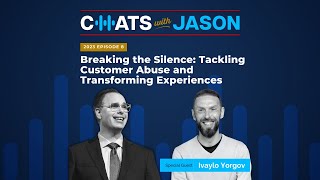
Ivo Yorgov, a CX analytics expert, argues that poor customer experience drives abusive behavior. He recommends frontline staff stay calm and assertive while solving problems, and organizations invest in end-to-end CX improvements, closed-loop feedback, and training to prevent abuse before it starts.
Chapters
Hi, I'm Jason S. Bradshaw, the host.
Of Chats with Jason.
And welcome to another episode, Breaking the Silence, Tackling Customer Abuse and Transforming Experiences. This is what we're tackling on this episode and I don't want to keep you from it, but I do want to do justice to Introducing today's Guests Today's guest is Ivo Yorgov and he's a customer experience analytics and expert with 20 years of consulting experience. He blends expertise in consumer psychology and behavior with the best change management practices to help companies understand their customers, devise improvement initiatives and see them come to fruition. Now, together with his team, Aivo has won a number of industry awards. Customer Centricity World Series Overall winner and in 2021 and in 2023, market research societies Award for Innovation in Data analytics for Predicting Net Promoter Score and European Customer Centricity Award for digital transformation in 2020. He somehow has also found time to write two absolute stellar books, the New Customer Experience Management how, why and how the Companies of the Future Address Their Customers Needs Proactively. And his latest book, the Abuse of Customer Breaking the Silence Around Customers Aggressive Behavior. This is a great episode. Let's dive into it.
I'm so excited for today's episode. As you know, if you've been following my work for some time, I've built a career out of a focus and intentionally helping businesses transform the experiences they deliver. And it's always great when I get to connect with individuals as passionate about customer experience as I am. Ivo, I'm really excited that you're with us. Thank you and welcome to the show.
Thank you so much, Jason, for the invitation. It's a real pleasure to be here with you and I look forward to an interesting and very productive conversation. Hopefully productive. Well, for the listeners, obviously, I'm sure.
They'Re in for a real treat. Now, before we do get into it, our listeners might be experiencing a little bit of shock because most of our guests are from the UK or from the US where are you joining us from today?
I'm joining from Sofia from Bulgaria, which is Europe, obviously, I think.
And just goes to show, doesn't matter what part of the world you're in, customer experience absolutely matters. Now, you've recently released a new book, the Abusive Customer Breaking the Silence Around Customers Aggressive Behavior. I know that it's been doing absolutely fantastic in the bookstores. Congratulations on the book. What led you to write it?
Thank you so much. You know, my first book, I work within the customer experience domain, so I'm very used to Talking about customer experience and explaining and kind of working with people to improving it, showing the value of improving customer experience, offering great experiences and so on and obviously the ways of doing that. And my first book, which is called the New Customer Experience Management, dealt basically with what can we do to improve customer experience? Because that's kind of my domain is similarly to you obviously. I think at some point as I was researching some academic papers and so on, I came across the topic of customer abuse. And that got me very interesting because it goes counter a little bit to what I'm very used to talking about. We're very used to saying the customer is king and the customer is always right and we should do everything to keep the customer happy. And then there was these guys saying that's not necessarily true. In fact, customers very often actually destroy value. We talk about customer value and how do we create value with customers and how our products and services fit with people's lives. How do we support them in this process, which is pretty much the topic of my first book. But then oftentimes it's not only within companies hands because oftentimes actually customers are acting destructively. They destroy, literally destroy value in some cases. Because my book is about customer abuse, which is more about when customers act aggressively towards employees. So more within conversational contexts if you will. But oftentimes actually customers destroy, destroy property of the company and so on. So it was very interesting. I was actually doing further research into how do we create value with the customer and for the customer when I came across the topic of well, customers actually oftentimes destroy the value of it. And that got me very interesting. And to be honest with you, I wasn't expecting to find what I found out because the more you research into the topic, the more you realize that it's a very significant problem really. And it's a very significant problem for a lot of people. More than 50% of the population in the world works within service contexts. And in developed economies that's north of 75%. So it's basically three out of four of your friends work within service environments. And within service environments customers can go extremely aggressive with you. And I'm sure that you will be very hard pressed to find someone working within a service context who hasn't actually experienced very aggressive. You can also go a little bit softer and say very unreasonable customers, you know, customers who demand more and more and who at some point start acting, being very pushy with you, close to being aggressive and abusive with you. That was a very long answer. I think to your question, but yes. So I was researching customer value creation really, when it struck me that there is a flip side to it.
And I think that it's become really prevalent since the pandemic, unfortunately, certainly here in Australia and in the us I've noticed through my travels a lot more businesses actually now displaying signs saying, if you don't respect our team members, you don't respect our staff, then you're not welcome here. Or words to that effect. And every time I see that, I.
Get conflicted because I'm like, you shouldn't.
Have to tell people. And then conversely, I'm like, well, what about the poor employee that's got to deal with that situation? Go home and write a letter of dissatisfaction or a complaint. Don't get aggressive. But in your book, which you've heavily researched, and there's what I would say an absolute true account of how customer behavior can impact the business, there's two areas in particular that I find quite insightful. How to prevent customer abuse and how to handle abusive customers. So let's dive into those two areas and we'll start with how to handle an abusive customer. What's your top tip for. For someone listening today to handle an abusive customer?
Just referring back to what you said. I think the situation has definitely become worse since the pandemic. And I've read a number of research which shows that people are acting more impolitely, if you will, not only in business context, not only in customer to company context, but even between us, on the street, on the plane and so on. So it's definitely, definitely becoming worse. I think the top tip really, it's. And it's not an easy thing to implement, but I think it's a very valuable life skill, if you will. I call it assertiveness, really, which is the name basically, that is given in the psychological literature. You know, we, we have the tendency, well, there you have two options, really. One, one would be to. To. To react with aggression, to the aggression. And it's a very natural response because when someone attacks you, you strike back. You know, that's your fight response. Basically, it's a stressful situation. So your almost natural impulse is to. Is to fight. The other response, the flight response, which I think we all know very well, so that's kind of more on the passive side, you know, starting, Start being apologetic, you know, and trying to avoid conflict and so on. And I think that it's about the balance between the two, which is the assertiveness bit here. So it's not about Being aggressive and pushing back on the customer. But it's also not about accepting the behavior because it's not a behavior that should be accepted. So I think the first thing is staying really calm, which is, I know it's this type of fortune cookie type of advice. You calm down a little bit, but you need to really try and do it and then start being assertive. Really, I think it's a good idea to tell the customer that no, this behavior is not appreciated in a very polite tone. So that not to aggravate the situation further, but you also have the right to say how you demand to be treated. And you're not demanding much. You're basically demanding not to be treated abusively. And I think that's an absolutely fair thing to say. So that's already two things. Being calm and being assertive is absolutely critical. And I think the third very, very, very important element is focused on the problem instead of on the. On the emotion. We oftentimes talk, talk about emotion regulation, but that's an approach that rarely works. Even I was, I was very surprised. You know, I always thought that venting an emotion kind of helps. In fact, it can make things worse. So you need to really do your best to. To leave the emotion of the situation aside, focus on the problem. Because the customer very often. And that leads me basically to, also to the prevention bit. The customer has a problem and a customer has a problem which they perceive as a threat. And very often that's why they become aggressive. Of course, I'm leaving aside the side. There are just some people with kind of individual tendencies to do that. But the majority of people who become aggressive in such situations are actually people like you and me. And I'll be very open and honest with you. I tend to become aggressive in some situations. Well, obviously before writing the book, now I try to control it, but the customer has a problem. Think of it this way. This emotion that they're showing, it basically shows that they have a problem which they perceive as a threat. They think that they're going to lose something. I paid for a surveys which I'm not getting. And that creates a stress for me. Basically I feel that I'm threatened by the situation. So what they really want, the emotion is really a distress signal. It's like, help me out here. You know, I'm feeling very vulnerable. I'm being hurt right now. So why don't you, can you please help me? And when this, when the customer sends this signal a couple of times and receives no support, then they become aggressive. I don't think people become aggressive just because, you know, in most cases. So the reality of it is focus on the problem. If you can solve the problem, if you can show the customer that you, you know, and I own the problem for you, I'm going to help you with this. I think everything is going to be fine. And part of it is, you know, I would appreciate if you don't, don't behave like this and don't use search words and all these things and then show the customer that you own it. Showing ownership, you know, it's like, I appreciate that you have this problem, I'm going to solve it for you. I'm going to need to do, obviously giving them updates is super critical. I'm going to need to do these five different steps, you know, so that I'm able to solve your problem and then keeping the customer updated. Some would say that that's pretty, pretty kind of basic, if you will, productive business communication. And it is, it's not like rocket science in this case, but it's, but it's really critical to solve the problem. And I think companies a little bit probably anticipating your next question or a question for further down the conversation, but that's the bit where companies can do a lot because companies supply employees with the resources to handle these situations. And very often, it's very often companies are also the one who unintentionally trigger this, you know, by simply by talking about the prevention. Now the best way to prevent customer, customer abuse, by what I just said, it just makes sure that nothing goes wrong in the process. That's it. It's as simple as that. Actually poor customer experience is the number one reason for customer abuse. That's it. And then the second major reason is when kind of solving customers problems also goes wrong. And that's kind of the second. So if I have both a product and it's not working well and I file a complaint and I see no action after that, that's when things really start getting bad. So in a lot of ways I started calling it Customer abuse is kind of the hidden cost of poor customer experience. Because we know what the benefits of customer experience are. People pay more, they return and so on. But there are very, very serious costs associated with it. And last week was CX day. So I was like, customer experience is more than just a good way of doing business. It's actually a lot about, well, being a lot about mental and mental health for these employees. If you don't want to invest in customer experience to improve your Business, just do it for your employees. That's your responsibility. That's your responsibility to your customers, that's your responsibility to your employees. And I'm saying it's customer experience. Because customer experience is not only about the frontline interaction, it's also about the product. It's also about the journey people take. It's also about the pricing and all the processes, policies companies have around this interaction. And when companies don't invest in this, employees pay the price. And obviously customers pay the price, but then employees also pay the price. It's this whole chain of reaction which gives us the hints to how to handle it and also how to prevent it. Just offer a good customer experience and nothing is ever going to go wrong. And if it goes wrong within the customer experience, make sure that you have the the right capabilities to solve customers problems when they appear. One thing, and I'm seeing a lot of improvement in this, giving people the channel because it's exactly as you said, just write a complaint letter. Well, oftentimes it could be very difficult to find. How should I complain to companies?
Yeah, not only sometimes how to complain, but sometimes how to even contact a company outside of making a purchase. As you were talking, there was a number of things that came to mind. First of all, as the individual receiving the aggression or the complaint, I think it's important for us to remember that in the majority, if not 99% of cases, the person's not angry at you, they're angry at the company or the situation. And so you mentioned and encouraged people to stay calm. And what I would encourage people to do is the first step in staying calm is to remember that it's not about you, it's about something that your company has done. The second thing that triggered in my mind as you were talking was quite often companies invest lots of time, perhaps not always enough time, but time in what to sell, what a product does, how to use a cash register, how to process an order. But they don't necessarily spend any time training their team members on how to manage a difficult situation. And so if you're a leader listening today, I'd encourage you to take some time to educate your team members on how to manage those difficult situations because in the end they'll come out of that situation much better emotionally themselves, but also they'll be able to diffuse the situation with customers a lot. So as I mentioned earlier, your new book is the Abusive Customer. I have to say I never thought I was going to read a book called the Abusive Customer, but the Abusive Breaking the silence around customers, aggressive behavior. It's a fantastic read. And in the show notes, we'll leave a link to how people can get themselves a copy of it. But you've spent every waking moment, or almost every waking moment helping individuals and businesses improve the experience they deliver for customers. So let's change things up a bit. And let me ask you a different question. How can I, as a business owner or a leader within a business, lead a transformation for customer experience and make it stick? Now, a lot of companies spend a lot of money on a big program and then three years down the track, it's not working. So how can I lead a transformation and really make it stick?
The million dollar question, right?
Absolutely.
And there is no simple answer. Rather it's going to have to be a combination of rather simple steps, if I'm honest. So it's not a very complicated thing, it's not rocket science, but it requires a number of elements, I think. And I think that the one element which I have found is very often missing is how do you spark that? So how do you stimulate it? Because we oftentimes expect that people. I work in a customer experience analytics company, right? We provide analytics, we provide information, we help people listen to their customers. And that's all very good. Obviously, I think it's important working in the business, but that's in no way enough for people to start taking action. I can tell you a lot of things, you know, or you can tell me a lot of things. You can tell me, hey, you cannot, you don't sync very well. And that's fine. I can agree with that. So that's an important input for me. But do I care about that? No, it's definitely not within the scope of things that I want to do. And I cannot see how. I can see how singing can improve my life in some ways, but I'm not able to relate it to who I want to become or if I'm a company, who do I want to be as a company? So input is. It's unfortunately critical, but it's not sufficient. It's a necessary but not a sufficient piece. You need also this spark. You need to relate customer experience to something that the company wants to achieve, to other goals. How does it help me sell more? How does it help me prevent customers from churning and so on. That's why people talk about the importance of leadership. Buy in. That's why they talk about the importance of having a CX vision. That's why they talk about, you know, having a business case for customer Experience. But it could also be about much simpler things. So you don't, it's good if you have these, if you have these things. But also at the same time, it doesn't need to be something too corporate. You know, it's, it's, it oftentimes boils down to am I going to improve the life of this person if I, if I change this process? You know, going back to again, it could be as simple as improving their well being. So definitely this, having this spark there is important. Having quick wins in the process is absolutely critical because people need to, as you said, they need to sustain the momentum. So when I have started doing something, I need to see if it's working. Obviously I think we're all very reasonable and we know that we're not going to see results overnight, but it's a very good thing to see improvement. So if I start training for a marathon, I know that I'm not going to be ready after my first run. But you kind of naturally feel that, hey, I'm becoming better and better and better and better at this. You need to create these kind of momentums. You need to celebrate success. It could be that you have today have improved the experience of two customers, but that's good enough. People get motivated by this. They see how their actions are closing this gap really between where they want to be and where they are right now. And I think the second very critical element that is very often missing is strengthening this. And you spoke about it when it spoke about training stuff to handle abusive customers. And I think this applies to everything. Improvements in customer experience are changes in how people do business as well. We oftentimes think changes as fixing problems. Improvements are also changes. People need to get used to these changes. We need to help them. When I say people, your employees or you within your, your own business, you need to strengthen that. You need to give people the kind of the training. You need to give them the knowledge success stories from other companies. That's why they're absolutely critical here. You know, showing people this is how you can actually solve that. So so far you have created kind of a gap. You know, this is where we need to be, this is where we are. This is the solution that we have. But people can also get scared from solutions. If you start training for a marathon and I tell you you've never ran before and I tell you go run 15 kilometers, you're gonna be scared. So you need to give them this strengthening first. You know, maybe do small steps, maybe go to the gym first, maybe do Some swinging on that kind of stuff. Give them the knowledge. You know, the knowledge would in this case would be this is a good diet that you can start, start doing immediately. And I think that's kind of the, that's basically the four I think so far components. And then you need to keep going within this loop. I think there is a very. I don't know why we. I do it as well. I'm certainly guilty of that. You know, when I. You say something and you magically expect that people keep following that day after day after day after day. And that's that we all know that that's not exactly how, how things work. I think it's. It's a lot about repetition here. Kind of having the. Having the persistent, having the self discipline if you will, that every day reminding people that this is the goal, this is the target, this is where we want to be. And every day giving them these small successes that they have done something today or yesterday to improve customers lives. And that's why I said it's not. These things are not things that we don't know. I think we kind of all of us sense them in a lot of ways. That's why I also said it's not complex things. Really problem with this is that you need to have all of the elements in place for action to happen. I need to have the goal, I need to have the input or the feedback. This is where I am right now. I need to have a solution, otherwise you know, it's useless. And I need to have kind of the strength and the willingness or not the willingness, but really the strength and the capability to do it. And it could be, when I say strengthening, it could be about processes, it could be about systems, it could be about governance structures, could be about operating procedures, it could be about trainings, all of these things really anything that helps people. So kind of lower the barrier of entry if you will make it easier, to put it very simply, make it easier for people.
Yeah, some excellent advice there. What I was thinking about, especially given your background and the work that GEMSEQ does, how do you tie analytics or customer feedback? Now lots of companies go out and they create a customer feedback mechanism or program and voice, a customer program. They'll get hundred thousand pieces of data and undoubtedly they'll get a score on something. But quite often not a lot happens with that data. How do you encourage someone that's ticking the boxes doing the survey, getting a score? How do you encourage them to go beyond the score or data collection and actually using it to help keep people motivated for the customer experience transformation.
My sincere hope is that companies are, when they start listening their, their goal is really to, to, to start acting because otherwise it's like a newspaper is, is good enough. You know, it's. I, I don't see the sense of it information. You know, a famous psychologist once said my thinking is for action. We all, we think because we need to, we need to act. Everything should, should result at the end of the day in some sort of an action. Otherwise it's, the information is just useless. I and I, I think showing people examples of actions that they can do works really well. Really the success stories from other companies and making baby steps. Really a lot of things like having a closed loop program is you don't need to start with all customers, you don't need to start closing the loop with all journeys and stuff like that, which is eventually probably a state that companies are going to reach. But you can have one person or half a person doing close the loop with some of the customers and scale it up from there. The beauty of close the loop really is that it utilizes very quickly the insights that you have gathered and it's very close to the action. So you can see immediately, you know, these customers had this feedback, I called them. Now they're not a detractor, for example, anymore. Now they're a promoter. And you know, what's the value of a promoter at the end of the day for your business and this whole cycle you can run it in weeks probably so you can very quickly see the results of it.
That makes so much sense and I love the insight there. Just keep it actionable and close to what's happening so that over time you make the improvements that you're looking for but you aren't trying to solve everything overnight. Which to use your analogy would be going for that marathon run tomorrow without doing the training. It's unlikely for most of us. That.
And I think going back to your question, just a further thought on that we sometimes it's the goal is to take action. The goal is not to have an insights problem. The goal really is to have an action program, the voice of the customer program and all the research and data it serves to support taking action. But the goal that the real thing that we're trying to do is to take actions, not to have a voice of the customer program. We have a voice of the customer problem to take action, not just to have it.
That is absolute gold. You don't have a voice of customer program just to collect data or to think, but rather to take action. I love it. Before we finish up for today, reminder to those watching or listening to the show. In the show notes will be links to all of the resources that we've mentioned today, both books that you've written and also the company that you lead gemseq. But before I let you go, I'm wondering what's one thing someone listening or watching along today can do almost immediately to start improving the experiences of their customers? Or I'll give you an either or or managing abusive customers better.
And I'm going to go with the, with the first one. Really. And maybe also referring to my first book. I think it's more of a mindset change if you will, be proactive. So my number one advice is be proactive. Don't wait for the customer to tell you something. I'm sure that 95% of the companies right now, they know what their customers want, they know what they need to improve. Be proactive, go there and solve it. All these things, you know, having complaint management, complaint management systems, that's critical. You need to listen to customers, you need to allow them to complain because that's a way to create value with them really having closed the loop program. It's critical because it, it kind of expands on that because not everyone is going to complain. So reach out to people, talk to them, listen to what they have to say. But I think ultimately try to reach a stage in which you are proactive, really. So instead of waiting for people to complain or waiting to tell you how they feel, you know, it. You know, with so much available data right now, these things are noble by most of the companies, really. You can just by listening to customers, listening to signals that they send, not so much to their feedback, listening to signals, how much they use your product, you know, and these kind of things. It's absolutely achievable to be proactive and reach out to them before they actually complain or before they have a problem with your product or before they stop realizing the value that they're hoping to get from your product. I think being proactive in this, getting control, if you will, if you prefer the word control, that will be control, the journey control or support the value creation process for the customers. Don't wait for them to come and say, hey, I have a microwave from you, which I've never used, because they're not gonna say that. But with all the smart products and all the digital products that we use and so on, you know that. So be proactive, reach out to them and help them create value. The value ultimately is not created by the company. The company delivers a cup, you know, but that's not the value. The value is what I do with the cup. The value is the coffee that I, that I make myself with the cup. The value is created by the customer and help them in the process and help them proactively.
Yeah, I love that. Be more proactive. Don't sit back and wait for things to go wrong or for some major research project, you know, right now that you can take a step to improve your customers experience. Ivo, it's been absolutely wonderful having you on the show. Thank you for your time today.
Thank you so much and I hope that your audience is going to find this insightful. Thanks a lot for the invite.
Thanks so much. And to everyone watching the show to help support the show, be sure to give it a 5 stars, share it with your friends and most importantly, remember that you can improve the lives of your customers and employees just by taking one action today.
More from Jason

Bringing Wonder Back to Work | Leadership, Culture & Service with Peter Merritt







How to Lead With Empathy: Claude Silver on Emotional Bravery & People-First Culture


Inside Harley’s Cult-Like Loyalty | Ken Schmidt on Turning Customers Into Believers
