From One Viewer to One Million: TheSalonGuy’s Secret to a Powerful Brand
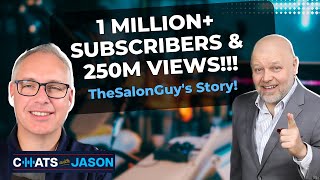
Stephen Marinaro built TheSalonGuy from one viewer to over one million YouTube subscribers in 15 years. He shares his "Why, What, How" framework, explains how attending events and attaching to bigger platforms accelerated growth, and reveals why authenticity became his most powerful growth lever.
Chapters
Hi and welcome to this edition of Chats with Jason. I am of course your host, Jason Esperture and this is the show that helps transform the experience to transform your business and the world around you. Today's guest is a multi passionate entrepreneur, content creator and educator with over 30 years in the hair industry. His trusted YouTube channel boasts over 1 million million subscribers and hundreds of millions of views, offering practical haircut tutorials, innovative product demos and powerful branding insights for hairstylists and creatives worldwide. He's the creative force behind the best selling hair products like Tidal Wave, Sea Salt Spray, innovative digital courses for hairstylists and HairAdvisor AI, an exciting new AI powered platform for on demand hair advice. Beyond hair, Steven excels in brand building, marketing strategy and content production from his full service media studio. His mission is clear empowering entrepreneurs and creatives to elevate their business through education, consistency and authenticity. Let's dive in and learn from Stephen the salon guy. Stephen, it's great to have you on the show today.
What an intro, man. What an intro. Thank you so much. I'm glad to be with you and, and I'm excited to share my journey and you mentioned some really amazing points and thank you for that nice intro.
Now, I don't know about you at home listening or watching today, but just listening to that intro, I'm exhausted. You must never stop. How do you do it all?
You know, the thing is, it's a great question and sometimes people may overlook that question. What keeps you going? And a lot of it is really your dedication. What fuels you? The power of having some sort of driving force. Like for me, failure is not an option, you know, So I have those things ingrained in my mind that I can't fail, I can't give up. We all as entrepreneurs go through highs and lows. Even recently I've had highs and maybe five minutes later I'll have a low. And it's like we're constantly being challenged. What's interesting is that sometimes when those lows really hit me hard, it actually motivates me. And a lot of people, they never get out of it. For me, it actually, it's, oh my gosh, I'm in an awful position right now. This is amazing. And it drives me to keep pushing forward and keep going. My new book, why, what, how, that, that's probably another driving force too. If you can answer those three questions, that's really what drives me. So it's just really believing in myself and also putting all the blame on myself. I can't blame anyone else for me not growing. Now, if you have a staff of 15, 20 people, they're not doing their job, blah, blah. But as a solopreneur, and sometimes people don't understand that you really can only blame yourself when you know what your true potential is.
Yeah. And congratulations, by the way, on the new book. We'll get to it a little bit later in the show. But why? What? How? The step by step playbook for creating a memorable brand. I said, congratulations. It's doing phenomenal. I believe even in the last 24 hours, you outsold Alex Amozi and Russell Brunson.
I don't know how that's possible, but I was like. When I saw the photograph of it there, and I was like, wait, I have both of those books. Like, how is that even possible? So, yeah, it was. It's definitely pretty cool.
Yeah. And before either of their legal teams contact me, outsold on Amazon, in the window of time that Amazon was reporting the book rankings, I should say. But number one on Amazon is no small feat. It is definitely a busy marketplace now. Stephen, every memorable story starts with a spark. Can you share with us that defining moment where you realize your journey could inspire and connect with so many people?
That's a great question. Honestly, when I first started, there's a lot of different phases and parts of that question, or how I can answer it. But in reality, when people think about social media, they're really hung up on vanity metrics. How many followers, how many views, how many this. And the bigger the better. When I first started, Jason, do you know what my goal was? I had a goal of one. I had a goal of one person. I said, if I can inspire one person and they can provide me with some sort of feedback that I'm changing their life with what I'm doing, then I'm onto something. And then my. The goal went from one and all of a sudden, wow, five people watched my stuff. I can't believe this. And this was when, have to understand, I started this 15 years ago when YouTube and all that was new and Facebook was just starting. Instagram didn't even exist at that point. TikTok didn't exist. It was like MySpace was just coming out. This was so, like, way in the past that I had friends of mine, one particular friend who was tracking my growth. I started a Facebook page, the Saloni Facebook page. Stephen, you're up to 15 likes on your Facebook page. I'm like, what? You're up to 50 likes? That was equivalent to 5 million people. Having 50 likes back then. So it all started and really sunk in when I went from one to ten, ten to twenty, twenty to thirty, a hundred people, and they would just share with me how inspiring I was. And when I first started putting out content, I wasn't even putting out haircutting tutorials. I was literally putting out videos on how to give better customer service in a salon, how to do better consultations. I wasn't even doing hair until people started asking me, steven, do you do hair? Like, we want to see you do hair, but who wants to watch a bald guy do hair on the Internet? Sure enough, millions of people. That's what's gotten me where I'm at now, doing hair tutorials and all that. So it's been a long journey, but I remember having a goal of one, and really, every single time it would go, little spurts that meant so much to me.
And 15 years on, that overnight success has definitely worked. I know that there was a point in your journey where you started interviewing celebrities from all walks of life. What was the catalyst for you to start doing that? And how did you have the will, the strength of power to find a way into those audiences or to those celebrities?
Right. You're asking all the right questions. I'll tell you. It was so interesting. When I first started getting out there, I wanted to be a media personality in the salon industry. I. I started going to hair shows and events with a camera guy and a microphone, walking around as a salon guy, interviewing friends of mine that were stylists and salon owners and putting out YouTube videos. Until a friend of mine who was actually on television on a reality show said to me, he's like, stephen, you're not really going to get too far by interviewing Bob the salon owner. I'm like, what am I supposed to do? He's like, interview celebrities and attach yourself to things much bigger than you. I said, yeah, but how the heck do I do that? And he gave me the secret sauce, he gave me the secret ingredients, and he told me what to do. It's a bit of a trade secret that I hold near and dear to my heart, but he told me, go to fashion events, get press credentials, get a DSLR camera with a microfil. He told me what to do, and so I did that. I got press credentials at Mercedes Benz Fashion Week in New York City, when it was still Mercedes Benz Fashion Week. And I got my press credential, had no idea what to do, what was going to happen. Okay, I'm a press guy all of a Sudden, and he goes, make sure you look at the front row. The front row at fashion shows and events. Those are where all the celebrities like a buffet. I said, okay. All of a sudden, I'm like, oh, my gosh, that's. That's. And I started just approaching them. You got to approach them, and then you have to get to their PR person. And you literally have five to seven seconds to sell yourself to land an interview with any one of these high profile individuals. And I learned the art of persuasion through just being myself. And. And then it became second nature. So it went from interviewing local salon owners and hairstylists to interviewing celebrities, and then interviewing one of the top reality TV shows at the time was being filmed 20 minutes away from my house. So I went down there, introduced myself. Next, you know, I was interviewing him, one of the people on that show. And all of a sudden, Stephen, my brand, the salon guy, was elevated. It went from local salon owner to individual on the number one reality TV show. So that started scaling me and elevating me. And it really comes down to if you have the opportunities, attach yourself to things and people that are much bigger than you because it instantly elevates you.
And I think also it's about taking that uncomfortable action at times. Like, I'm sure, as you explained that first time at Mercedes Benz Fashion Week, you weren't exactly, like, jumping up with joy of this feels like home. It was a little bit uncomfortable for you, but you took the action anyway. Now, over 15 years, you've built an incredible brand. And like we mentioned, recently released why? What? How? The step by step playbook for creating a memorable brand. I'm wondering, Stephen, what made you realize that now was the time to share your framework for building a brand?
Because I see what's happening right now. What's happening is there's a lot of individuals who want to grow a brand. There's a lot of individuals who may be frustrated, who may be challenged. They don't know what to do. They might feel lost. They can't answer those three questions.
And.
And what I didn't want to do was write a story book of four chapters in about me playing soccer when I was 10. So this book, I get right into it. This is basically a handbook, a tactical handbook with no fluff, barely any storytelling, just little drips and drabs. There's some cool elements in the book where you can scan a QR code and watch me do a video of me actually talking, which is pretty cool. And it was just something I said. I think A lot of people need this right now. They want answers quickly, they want to take action quickly, they want results quickly. So I said, let me see if I can try to capture an audience and capture their attention. Now, this isn't an easy read, it's a hardcore read. However, I think that's the thing that's going to capture your attention because it's not page after page. It's almost, oh my gosh, think that Stephen Hawking wrote this. It's such an intense book. And that was my goal, is just to really jumpstart people. And all the feedback I've been getting from friends, family, they're just like, wow, I have one, one guy who I know. I keep this book by me when I travel. When I need some motivation, I just refer to it as almost like an encyclopedia. I go right to the book. So I just felt that now was a good time because there's a lot of this stuff going on in the business world.
One of the things I absolutely love about the book is that in each of the sections you have an accelerator. If you like a 60 minute action plan, you talk about not having fluff. In the book, you've definitely made sure that it's action orientated and gives the reader a really clear roadmap for how to get started. So many books as all theory and no action. This has definitely got the action banked into it. Now, in the book, you emphasize the why behind a brand. So why do you believe that starting with why is key to unlocking a truly impactful brand story?
If you can answer those three questions, why, what, how, it's going to lay everything out for you. Why is the main reason. It's your backbone, it's your fuel. Why do you want to do what you want to do? A lot of people can't even answer that question or they'll say, oh, I don't know, like they think, I'm gonna make a lot of money, I Wanna be a YouTuber, I wanna make a lot of money, or I wanna post videos and I wanna do this. They're not really understanding the why behind it. I'm like, that's no real true core meaning. And a lot of those whys come from suffering from pain, from tragedies. How many times have you heard a list? Celebrities, rappers, musicians being oh, I was homeless, I was broke. You know, all these people talking about the lowest of their lows, the most successful people talk about, and their why is that I was homeless. At one point I said, I never want to be homeless again. So that's why I'm doing this. So the why is your core foundation, and then the next parts fall into place. Okay, now you know why. What the heck do you want to do? What do you want to do? Do you want to film videos all day? Do you want to be a blogger? Do you want to do this? Do you want to do that? And then how are you going to do it? The how is almost just as important as the why, because a lot of people don't understand what goes into making things. The how, right. How are you going to film this podcast? How are you going to prepare things? It's all about the end result, right? How are you going to make the damn thing happen? Successful. So all of these three elements are so important. I've been saying this for years, Jason. This isn't something I just came up with two months ago. I've been saying why, what, how for 10 years. So it's something that is near and dear to my heart. And if you really can break those things down, especially if you feel lost or you're just starting out, it's really going to help you.
So I think it would be easy for someone to pick up the book and go, I don't need to worry about the why and the what. I'll just jump straight to the how, because I want to get started. I want to get going. The why and what doesn't matter if to someone picking up a copy of your book, what would you say to them if they're thinking about skipping the why and the what and just jumping to the how?
That's an interesting point. The way I lay this book out is you can jump around because it's so tactical. You can jump right in and say, okay, because I explain each part of it. So the how really starts off with what is the how. So it's very defined and it's laid out, and the structure of it is easy to follow. So you can bounce around from the beginning of the book. It lays out, if you are feeling like you need this, then you can start from the why, because that's the core essential. But you may, like you said, you may have someone's like, I know why I'm doing this. I know what I want to do. You can jump right into it. And that's what's cool about it.
Yeah. Each of those sections are contained, in a sense. Really great tactic there. So I'm wondering, like, over the 15 years that you've been doing this work, you will have seen a lot change, a change in the way the platforms promote your work, change in what audiences connect with and whether it's a 15 second bit or a long form bit, like all these changes over the time, how have you stayed relevant throughout all of that disruption?
Well, you know what's interesting, Jason, and you probably do the same thing. And people in our realm of entrepreneurship and practitioners is every single day I am on YouTube looking and learning every single day, even to this point. Today I did it yesterday, I did it in the morning, at night. Every single day I am trying to stay one step ahead of how I can be relevant. So 15 years is when I started my brand, the salon guy. But 30 years I've been in the industry as a professional. I was 21, working for the largest beauty company in the world at the time, l'. Oreal. I was a kid representing the biggest computer company. And then I worked for other major companies too. And I've learned a lot from a very young age. And all of that experience I had those 15 or so years prior got me to the point and really helped me get to where I'm at to be able to understand what it was I was doing and fuel it. And even back then technology was so different, it was so crazy and I just stayed with it. I learned about coding, I learned about videography, photography, video editing, you know, how to be an on camera personality. I've done a lot of ongoing education, but I also just feel like if you stop learning, you're going to fall behind. And lastly on that, there's a lot of competition, especially in my space, the hair product space. Jason. I'm competing with 20 year olds who are living at home making products in their bathroom. And just because they have nice hair, a pretty face and nice abs, they're outselling me because people, that generation is worshiping them. That's my competition. I'm a dinosaur compared to these people. But I'm also referred to as the og, the goat. So there's a lot of old school people who understand. Stephen was One of the OGs, man, he was one of the guys who first started this. So I've earned my street cred and that's what's really important. But you have to be learning every single day and it's also very inspiring and motivating.
So over the years you've spent a lot of time investing in yourself, in your own development. You've also spent a lot of time interviewing celebrities and notable individuals. What's one time where you interviewed someone and you were surprised by what you learned from them?
It's interesting. I've had people, friends and people in my circle who have been there in person watching me do it from afar watching me do it. And they always said to me, like, steven, no matter who you're with, how big that person is, you just seem so natural, right? You just seem like you're yourself. You bring them into your world, and it's just you're so great on camera that it's almost like you're so entertaining to watch. And that's me not even trying to do anything. That's just me being me. And I think a lot of the times I've learned that when you treat someone like they're a person with respect, they'll be just as respectful right back to you. When you joke with them, when you laugh with them, when you just make them feel like they're normal people or you make them feel warm and welcome, they're going to respect you. Also, you have to show that you're intelligent. You have to show you're well spoken. Because it's just like any conversation. These are people who are getting approached every 30 seconds by someone wanting to ask them a question. And trust me, Jason, I've been on some major red carpet events where I'm like, really? What a dud this guy is, asking these questions. Or this. What a idiot. And I'm like, they're major networks, and here I am, my own individual brand, asking like, hey, let's talk about your hair. What's most important to you? Hair or clothing? They're like, oh, man, if my hair's messed up, I'm not going to feel too good. So I was just asking them unique things that they're not used to hearing. I think a lot of my success with working and interviewing celebs and actors or whoever it is, it was just me being myself and not trying to fake anything. Me being stupid and goofy. The actor Jon Voight. One of our interviews, we talked about beards for the first three minutes, and. And he was on that show, Ray Donovan, and he was talking about, like, how one of the seasons he looked like he had to be going on a binge and his beard. I said, you know, I'm a big beard guy, but what's with your beard? Oh, it's for the part from Ray Donovan, and I have to have this look. And then we just went into beards, and then we just talked about. And it went from that into a whole all these different topics. Next thing you know, it's like, the guy's like, all right, Look, I've been with you for 45 minutes. I gotta go. So you bring them into your world and I think I've realized the biggest takeaway is like a lot of these people are just their people and you treat them like they're normal and you get to see a different side of them.
Yeah, makes a lot of sense. Would you say that's your secret to keeping audiences engaged with you and growing over the long haul is that you've just been authentically yourself or has there been something else? Some other secret sauce?
Being that my last name is Marinaro, that's the sauce. All right, Marinara sauce right there. That's a good one, Jason. I like that. Honestly, when people see me, they go, boy, you have such nice hair and good look. Oh, I know, thank you. But anyway, I think honestly what it comes down to, and that's a really, I take that as a compliment because that's something that I just overlook. And I think that has really made me who I am as far as my brand, because the tone that I set, even in my videos, I'm just being me. I'm just being well spoken. I'm sharing my passion, I'm sharing my knowledge. And what's interesting is I can even see that in my comments. People who leave comments, like, for example, if I make a video that's a bit more off topic or a little more wholehearted or something a little bit like a rant type of video, the floodgates open with, Steven, you're passionate, your work. They're so nice because they recognize who I really am. And again, when it comes down to competition, there's a lot of people in the space that I'm in, whether it's men's grooming or hair related stuff that literally all they do is flaunt Ferraris and new mansions. And they lure these people into brainwash them by being super flashy. And it's almost so gimmicky and scammy. I don't know how more people buy into that. But I've never been like that and I never will be. So yes, it is me being authentic. That really is the word. Authenticity. There's a lot of people out there, they're not authentic. There's no credibility to what they're doing. It's like talking about being or making it seem like you're a heart surgeon and being an expert in heart surgeries, but you've never done a heart surgery. You're not even a doctor. That's what we're up against, Jason. You know what I mean? A guy who could say, oh, I'm the king of podcasts. And okay, let me watch your podcast. Oh, I don't have one. I'm like, oh, that's. We're up against.
Yeah, yeah, I hear you there. I hear you there. So, Stephen, I'm sure we've piqued the interest of everyone listening and watching to this episode. What's the easiest way for people to take a look at your work, to follow your work, and to learn from you?
Sure. You know what's also interesting is there's a couple of things that I think are important for viewers to build more brand recognition and some credibility. I'm sure some of your viewers have heard of Gary Vaynerchuk. He put me in his book Crushing it, and that was a huge accomplishment. He actually asked me live on one of his live streams, I know Crush it, which was his first book. And he goes, I know Crush it is what did it for you. And that's why I'm going to put you in Crushing It. And he put me in it. So a lot of people found out about me through that. He wrote me a quote for my book. My. Not this book. I had another book called Brand you, which was my first book. He wrote a quote for that. So I think that's also some street cred. That is pretty cool. My brand, the salon guy. It's all one word, literally. If you type in the salon guy on Google, you'll find everything. You'll find images of me. You can go to the salon guy dot com. You can buy my hair products. You can find me on Amazon. I'm all over the place.
And we'll be sure to put in the comments below links to all of the ways that you can connect with Stephen, the salon guy. But it's interesting you bring up a Crush it because it was something that.
Really.
I guess it's a unique dynamic when it comes to the power of building a brand. Right. So Gary Vaynerchuk is arguably one of the biggest authorities at the moment on how to get attention. And he's very big on personal brand and leaning into it. And for you to be invited to be part of his book talks to the quality of work that you're doing. I'm wondering, how do you get the attention of the man that's all about getting attention?
You know, what's. Jason, man, I have to admit, you're good at this. You're good at asking questions. I'm really impressed, Jason. I'm really impressed. I Actually used a Gary Vaynerchuk tactic to meet him. The story goes back to if you're a hardcore Gary Vee fan, he has a wine store in New Jersey. I'm in New Jersey in the United States. And it was called Wine Library. It's still there. And that store was probably about 20 minutes from my house. I knew that he was on Twitter and I was like, you know what, I want to go visit that store. So I sent him an email. Just random email. Now, this is still after. I've been following him for maybe, I don't know, six months to a year. He had no idea who I was, at least I know of. And I sent him an email. Gary, I want to go buy some wine at Wine Library. I live in this town, which is not that far away. Can you connect me with someone who can help me now? Of course. To a sales guy. What's going to get him to respond? Me wanting to spend money at his store. So he responded within five minutes. I'm like, oh, boy. So he goes, yeah, talk to my brother in law, Justin, and you know, he'll help you out, blah, blah. I said, oh, my God, that's so cool. There's a connection. He responded to me. I went down there, I met just, hey, Justin. Gary told me to come down, talk to you. Yeah, yeah, he told me you're coming down. I'm like, he did. Totally random. So I bought some wine. He showed me around the store. Really? It was great. Justin spent a lot of time with me. So I bought the wine, I spent maybe 200 bucks in wine and that was it. I'm going to my car. And then I stopped dead in my tracks and I go, I am such an idiot. And now you're probably wondering, jason, what are you talking about? Yes, I said I was such an idiot. You know why? Because I didn't create any social proof of what happened. So I went back into the store and I got Justin and I said, justin, can I take a picture with you? So I took a picture with Justin, arm around him. I tagged Wine Library, I tagged Gary, and there it is. He responded to the tweet. Love this. And that's how I got his attention. I used his tactic. I was literally ready to drive off. And I said to myself, I am such an idiot. I went back in and made it happen. And then that built the connection. I know you went to the store. I know you cool, Justin. You're like, all right, we've made that connection. That's cool. Tell me what you do. And that's how it started. I even, I have saved on my phone a 30 to 45 minute phone call with him that I recorded of him just talking with me. And this was like 11 years ago maybe. So that's how I got the connection with him. And then I actually called him out and I said, gary, I've been following you for how long? And you got to follow me back on Instagram. And then he followed me. So I was like, wow, okay. So I used one of his tactics to get his attention.
Yeah, taking the uncomfortable action. That theme keeps coming back. How easy would it have been for you to just to jump in the car and go, oh, I missed the moment, I'll do it again another time. The time would may never have come again or it definitely wouldn't have been the same. So you took that uncomfortable action. You went back in with a bit of humble pie and said, hey, this is what I wanted to do. And look where it led. Fantastic reminder for us all. Before I let you go, I have one last question. After someone finishes your book, and just in case you don't remember, that's why. What? How the step by step playbook for creating a memorable brand. After someone's finished reading the book, Steven, what's one action you hope that they're going to start taking to make their brand a pass? Powerful.
That's a great one. This book is like I mentioned, a really hardcore book. And the responses that I've been getting so far from people who just finished a book who have been kind enough to reach out to me, like personally, they're all telling me that this was an eye openening, awakening moment for them. And my biggest accomplishment or affiliate is someone actually taking action. Biggest thing you can do after finishing this book is take action on whatever it is. After you do all the exercise, the accelerators, it's take the action on what you need to do. And I've even had people send me and I'm seeing it publicly. They're changing their website, they're changing their language, they're launching a website. Finally they're starting an llc. I've been getting all sorts of different feedback and people are sending me photos because of your book. I've been able to like increase my business. I've been able to get that motivation I've been looking for. I've wanted to give up. So I think the biggest takeaway is just knowing that someone's going to take action because that's why I made this book. It almost forced you to take action. It's a tactical handbook. It makes you realize and it makes you think, I have to do something, because if I don't do something, nothing's ever going to happen. You know what I mean? Nothing's ever going to happen. I have a question for you, Jason, because you've been asking me such great questions. Out of all the stuff we've talked about, I think you can relate to a lot of it. What are some of the things that you're seeing in our spectrum of business? What do you think people are shifting towards? What do you think they're doing? What should they be doing? What are you seeing?
I'm seeing more and more focus on two things. Either trying to be the next shiny object, which is great in the moment, but it's not sustainable, or they're just doubling down. Especially with the economic conditions that we're in at the moment and the uncertainty because of actions of various leaders that they're just doubling down on filling their funnel with sales with new customers, but they're failing to take action, to care for and to nurture their existing customers. I'm a big believer that you can grow your business without growing your salesforce. And it's about generating goodwill, close relationships, nurturing your existing customers so it generates repeat and referral business. But unfortunately, right now, too many businesses are trying to either be the next shiny object that everyone's going to pay attention to for a period of time, or it's like just jam as many new people into the sales funnel as possible and hope that we can ride this wave of disruption that's happening more broadly in the economy. Both of those, I think, are foolish if you want long term sustainable success.
Yeah, that's interesting. And every day we're seeing the people popping up with the courses and the this and the that on YouTube. And I'm like, wait, how are you making $100 million? These people boast about how much money they're making. And I'm just like, how are you doing this? You've been on the Internet for three years and you're making a million dollars a month in courses. Like, I don't get it. I just don't get it, man.
And of course, there are definitely creators out there that are delivering immense value and they should be reaping the rewards that come with that. I always say that do your due diligence before you purchase. If it's a $7 purchase, you probably don't have to think too much about it. But if it's a $7,000 course, you should definitely know that what you're getting yourself into. Well, Stephen, it's been fantastic catching up with you.
Yes, thank you. You've really asked some great questions and you should be doing some red carpet events.
Yes, I certainly wouldn't say no. We've had an incredible conversation today. Stephen. Stephen the Salon Guy. Packed with insights on branding, creativity and entrepreneurship. If you've enjoyed this conversation, be sure to follow, subscribe and share this episode with someone who could use a little inspiration today. And if you're feeling extra generous, leave us a review. It helps much more than you would imagine. That helps people discover conversations just like this one. Remember, when you transform the experience, you transform your business and the world around you. Take the uncomfortable action and make it happen.
More from Jason

Bringing Wonder Back to Work | Leadership, Culture & Service with Peter Merritt







How to Lead With Empathy: Claude Silver on Emotional Bravery & People-First Culture


Inside Harley’s Cult-Like Loyalty | Ken Schmidt on Turning Customers Into Believers
