From Shark Tank Rejection to SpaceX and Global Success
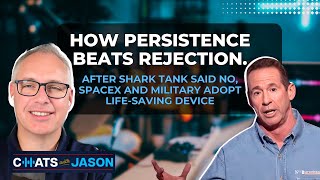
Dr. Rob Yonover, a geochemist who worked with NASA and MIT, invented the streamer, a life-saving device now used by SpaceX and the military. He pitched it on Shark Tank, got rejected, then proved the investors wrong by building a global business anyway.
Chapters
Hi and welcome to this episode of Chats with Jason. I'm of course, your host, Jason S. Bradshaw, and this is the show that helps you transform the experience to transform your business today. I am absolutely excited about our guest. Dr. Robert Yonova is a phenomenal individual who I know is going to inspire you to take action potentially on those projects that you didn't think were worthwhile. Or perhaps he didn't think he had the grit to get it done and that it would make a difference. Dr. Rob has achieved so much in his life. He has a PhD in geochemistry and volcanology. He has a huge history of innovation, and he has so much to share with us, including lessons from his appearance on the US hit show Shark Tank. Dr. Rob, it's great to have you on the show.
Thanks, Jason. Great to be here. Appreciate that.
Now, I know that your bio is two or three pages long on a short day, but do you want to give our audience a little bit of a rundown of your history?
Sure. I'm a scientist that became an inventor. I got a PhD working on lava flows off the Galapagos Islands. I went down in a submersible two miles down to get my data. Worked with lasers at NASA and MIT studying them. And I'm a big wave surfer. I live in Hawaii, so it seems like I'm always on the edge of dying between volcanoes, deep water diving, surfing. So I happened to be on a flight where I invented something called the streamer when you're lost at sea, because people, when they're lost at sea, you're just a little speck. And the standard equipment is smoke, flare, sea dye, it all goes away. So I invented this on the side while I was doing my PhD and I have a lot of inventions, but this one never left. It kept coming back and I knew it was a good one. And that's to your audience. I know everyone has a lot of ideas. The question is, which do you pick? And I was crowdsourcing before it was fashionable. And I would bounce it off people and it just, it was always right. I always came back to it. I always knew it was right. And I got patents, military approvals. It's now used by militaries worldwide and it's even on SpaceX under the ass of every astronaut. It's on new F16 ejection seats. And it saved some lives, which was the best part. So my invention, for me, the money's great, yes, we all need it. But if you can work on something that has value bigger and have someone thank you for saving their lives. That really struck a chord with me. So I've been in the survival invention business ever since I took a diversion from academia, and that's where I am these days.
What a diversion it was. And I have to say, when your details came across my desk to be a guest on this show, I watched the Shark Tank interview. And lo and behold, I remembered watching that interview when it first aired. And now, you know, I think it would be easy for the people watching and or listening today to think, oh, gosh, Dr. Robb's just said that military approval, it's on SpaceX. Like, this guy not only has made it, and he was on Shark Tank, you know, that someone, Mark Cubane or someone must have just double down and invested heavily. But that's not the story, is it?
No, it's not. It was surprising and shocking to me. But you know what? They all liked it. They all thought it was great. They all thought it would save lives. But they all didn't think they could do any more than I could with my history with the military. And they were right, technically, but it was still hard to hear. And especially when I'm sitting up there and all five of them, it's five against one. And they're all, it's a TV show there, so they're all trying to sound smart. And as soon as I realized they were all going out, I'm like, okay, that's fine. And I just do what I always do, which is, hey, that's your loss, basically. Thank you. Thank you. And it's great exposure. And they won't put you on that show if you just want the exposure. And I did want to team up with them, especially Mark Cuban. But it was a little shocking to me because, like I just said, the value of saving someone lives for guys that are millionaire and billionaires, you'd think that would resonate with them. They're all into money and they're into making money fast. The streamer. I've been like the tortoise in the hare, that great story. I'm like the tortoise. I've been doing this for 30 years and I'm not giving up. People thought I would go away. And even the Shark Tank guys, you think I'm going away, I'm not going away. And that's where their time frame is much different. Those guys are like the hares. They want to run to the money right away. And I'm like, I want to keep saving lives, keep building the technology, build other technologies, inspire other people, Just keep Grinding on it, and that's where I am. But it was quite an experience. And I have to say, you gotta be ready, though. The show is straight away real. They didn't know me, I didn't know them, and we just went right into it, and they were just bombarding me with questions. And because I practice a lot, I don't like to structure anything, except I practice before I do something. Even then, it's free form. And one of the things they wanted me to do was have a set pitch, and they wanted to see what I was going to say. I said, I don't do. I can't do that well. And sure enough, in the practice rounds, it wasn't that well. Finally said, you don't have to memorize. I said, great, you free me up because I like to read the audience in real time, just like you. I'm talking to you now. If you start rolling your eyes, getting bored, I'm like, okay, I got to change a little. You got to have. Your mind has to go quick. It's a trade show mentality. Whoever's coming by my booth, I gotta look them in their eye, say, what are they interested in? I gotta say something. How are they receiving it? Is it working? Do I need to speed up? Do I need to slow down? Do I need to change the subject? That's. I'm always trying to do that. But I do practice a lot, so I have all these different variations of tangents, if you will, or approaches that I can take. And I found that to be very useful, if nothing else. I'll give your audience the greatest trade show line of all time, which I've invented and I've written a couple books. One of them is called Hardcore Inventing. And the line is, come people come by your trade show booth. Everyone's been in trade shows. You could say, hello, can I help you? But no, it's these four words. Have you seen this? Have you seen this? If they say yes, you haven't seen the new lighted streamer. If they haven't, you got them either way, because you've engaged them into asking you a question. And it's not an infringement of their private space, like, how are you doing today? Or hello, or can I help you? Anyway, that's just a little take home for people.
No, it's great. In fact, one of the questions that I thought of asking you was, how do you prepare for a pitch like Shark Tank? Because as leaders, as entrepreneurs, you have to pitch constantly, right? I was a C suite executive in a large global company. But I had to pitch to the board all the time or the investment board. Right. And if you're an entrepreneur, you have to pitch to potential investors. And here you are, an inventor pitching to not only billionaires, but also on not only national, but global tv. And I was thinking, how does one prepare for it? And what I took away from what you were saying was, first of all, you have to read your audience, regardless of whether you've got a well rehearsed pitch or not. You need to read your audience and be ready to pivot based on their level of engagement.
Exactly.
Second is be true to yourself. Because what I heard from you was you were being encouraged, shall we say, to have a rehearsed, scripted pitch. When you broke three of that model, you were able to do a better job, get your message across.
What I learned at academia was I go with slides. Okay, So a slideshow, they only let me have one slot, two slides. The TV screen had a before and after picture. But in my mind, whenever I have to give a talk without slides, I visualize the slides in my mind. And each slide, I know what I'm going to talk about. Not exactly what I'm going to say, but what I'm going to cover. And I practice it to all sorts of people, including alone and record it sometimes and see how it sounds. And then if you get stuck, you're like, what slide am I in? Oh, I didn't show the after slide yet I know where I am. I do that in all of my life because I'd rather have my brain free to think and pivot and read their. Their minds and their body language than have memorizing. You get stuck on words. I don't want to get stuck on words because every audience has different level of words they're comfortable with. And I like it to flow. You're trying to make friends, really. Sales 101. So if I know you're a surfer, I might throw in more of a surfer thing. If you're a money guy or if you're a status guy, I might drop SpaceX or F16. If you're a military guy, I might throw in some more military acronyms. If you're more down to earth or let's say people like the streamer for their loved ones, I might try to hit on the heartstrings. This could be your son or daughter that could get lost at sea or in the mountains. This thing would be great for you. So it all depends on the audience, and that's why it's so great to even these thousand miles away that we are from each other. I can see you. And audio is good, too. Same thing. That's why I like live video in person first, then video, then phone, text, email. That stuff's way below because it's not interactive and live. And the amount of pressure for that, I knew 9 million people are going to watch it. There are 50 cameras there, there's five sharks, and there's 100 people just lurking around looking. It was a massive, massive pressure. Thing is, in academia, I had done it. I defended my PhD dissertation, and I grew up in a family. We were always arguing. Not in a bad way. We're just debating things. Even my buddies on the street corner, we're always arguing. So we're always fashioning our lingo. On whatever level, PhD or street level. You gotta be able to have discourse and also be able to listen. That's a good skill. And I'm pretty good at it. I talk a lot, but I'm pretty good at social cues. And I know when I'm talking too much.
Yeah, so much great insight for us already. I have two last questions around Shark Tank. First of all, have any of the sharks reached out to you post the show to provide any encouragement or connections or any support?
The funny thing about it is social media blew up that day because the show I was on had a wine glass, a sippy wine glass, a backpack you can't cut into. And I forgot the third thing, but it was something. Oh, booty pants that made your butt look bigger. And they all got funded and I didn't. And there was a little bit of a public outcry on social media saying, I can't believe you didn't fund this guy to save lives, but you're funding Booty Pants. So each shark, I don't know if it was them or their people, like, almost apologized to me online saying, yeah, this was great, and we know he's going to save lives. We just couldn't help. I just couldn't help him. So it was their way of reaching out. The other thing that happened is I was just contacted. We have a group of people that have been on the show. We have a little private Facebook account, and we all get together like reunions and. And I learned so much from them. And even though I'm a weird outlier being in the military survival space, the challenges are the same. Selling a product, promoting a product. So that's been incredible. But the personal sharks, Mark Cuban was really. I'm a heterosexual man, which is cool whether you Are or not. But he made me a little uncomfortable because he was really like flirting with me. I felt on the way out, I gave him a little wink because he's like, I'd love to pick their mind more about volcanoes. And I'm like, hey, give me a call. And I've never weeped in my life. But I'm still waiting for him to call me. Yeah, again, I knew it was a TV show and by then it was over. But the whole thing was, again, you have to befriend them. And I wish they would call me more, but I don't talk to them specifically, but I talk to their disciples. The people they have funded are part of this group. So I get indirectly input. Yeah, yeah.
Well, Mark sold the Maverick, so maybe his diary is going to clear.
Absolutely.
And so the last question I have around the shark experience is, here you are, you've invented this life saving device, you've got patents. One of the questions that they always ask, is this something that people can copy easily? Of course not. You've patented, you've trademarked. Nonetheless, I'm wondering, here you are, all five sharks have said, no, it's not something I can help you with.
Right.
In their own ways. When you walked away, were you still able to find any pieces of advice that they gave during the show that ended up helping you regardless?
Definitely. I think they talked about how like Mark Cuban talked about it being bimodal, all or nothing. Because when I got panicked a little, I went with the what are you gonna do with the money? And I went for the mandate, the home run. We have to have these on all life jackets, flight jackets, life rafts, which they should be. But that statement by him, he was right. So the point is you go for that and I keep doing that. I keep going for the home run, but I keep trying to hit singles all along. So I don't try to get the military or the Coast Guard to make this required equipment. I try that, but in a parallel, in another channel, I'm trying to sell it to Joe Boder or Joanne Kayaker or whoever. So it's a dual use, dual program. And that they help crystallize that because I could see that it's true. It is too risky to go all the way for the approvals. And just along the patent thing, the other thing that I have protection with is I have all these military approvals. All branches of the military have approved it. And that represents years and millions of dollars of research and testing. So even if you could get around the patents you still have to get the credibility level of the testing. But, yeah, I learned a lot from them, and they were good. I'm not being arrogant, but Mark Cuban was tracking the best the others. Remember, this isn't a technical crowd. And Mark Cuban, I think, is a technical guy, wannabe. I mean, yes, he's got that software. He's in the computer world, but I'm, like, from pure science. So I'm a PhD scientist talking to a bunch of people that are used to selling, like, cookies and little knickknacks, and that's fine, and they make way more money than me. But I had to keep switching gears on what am I talking about? And make sure they understood it. And if you watch it again, you'll see exactly that happened. He. He fed me the perfect line. He goes, I don't see the guy. Damon said that. I go, yeah, that's the whole point. He fed me the perfect line of why the streamer works. It was really cool. And I also got to give a little nudge to Mr. Wonderful because he's always abusing everyone. I knew he was short and bald, and they asked me, who do you want me to demo? I go, let me use Kevin to demo it. So I knew he'd take the streamer for me to unfurl it down the hallway, and I knew I could look down on him for all the people he hassle. And they made jokes about it, too, so it was a cool experience. But, yeah, I was upset at the time. After, I was pretty frustrated. I couldn't believe that they didn't want to invest. But as time went by, I'm like, oh, maybe this is a good thing.
Yeah, that's the thing that we'll never know is if they did invest, perhaps it would have gone in a completely different direction.
Right.
Still having an impact, but maybe not the impact that you've achieved today. So we unfortunately or fortunately, don't have a crystal ball that can see two different outcomes. Right?
That's right. That's right.
Dr. Rob, when I think about everything that you've shared and your bio, the word tenacious just keeps coming top of mind. Like, you're a tenacious guy. You want to deliver results, you want to make a difference, and you get up regardless of some of the backs. So here you are, you've built the streamer, and I should highlight to the audience. It's not the only thing you've invented. It's just perhaps your hero product. If I don't mean that in the sense of you saving Lives. It's the one that you champion the most. So you've built this product. It's a niche product, like, yes, every camper, every kayaker, but it's still Joe Blow, walking down the street, going on her first camping trip isn't necessarily thinking about survival in the way that you are.
No, it's true.
So you go through this process of you inventing that's taken you a period of time, and then you decide, hang on, I've got to go down this path of getting approval to sell to the US and other militaries around the world. What keeps you going, and how do you stay tenacious regardless of the set?
And I grew up in a real tight neighborhood. We were very competitive. Being a surfer, it's the same kind of thing. You're always getting drilled. The wave come and crushes you. You can't get discouraged, or you'll drown in the moment. You survive it, and it makes you stronger. I know that sounds corny and just the way we are competitive as kids, sports wise, dating wise, whatever. Just tenacious is a good word. I appreciate that. You get knocked down, and that's really. The test is, how do you come back from that? So I kind of almost welcome failure sometimes. And I used to root for my kids. I just used to root for small failures, small bad things. And it's almost like the more the bad things happen to you, and the more you can deal with those, the stronger and more powerful you are and the better the story. I love the underdog story. These guys. Okay, assholes, you don't want this. You guys think this is not worth. I'll show you. That's a phrase that goes in my mind a lot. I'll show you. Which is. It's maybe not the best personality trait if you let it go into too many aspects of your life. But I try to just channel it into surfing where. Okay, wave. You're crushing me on the north shore. There's 20ft of white water on me. I'll show you. I'll live through this and surf another day, another wave. Same thing in business, okay? You're crushing me. You said I'm worthless. We're talking very advanced. The early streamer, I got laughed out. I mean, it was a joke. And even some of the comments. Someone lifted my Shark Tank pitch and put it on TikTok, got 15 million hits. And I was reading the comments, and it was so funny. One guy goes, man, this guy made a million dollars with a Fruit Roll up, which is a candy, which was brilliant. I laugh at that. That's awesome. So you just have to roll with the punches. And I'm sensitive, though. I am. So if someone says something bad about me again, I use it as fuel. I turn it around and internally say, okay, you don't think it's worth it? It's not that I think that I'm worthless, but you don't think my idea is worth anything. I do. I put a lot of time into this. I've tested it, I've launched it. I bounced it off a lot of people, not just my family or my friends. This is professional. People have said, yes, this is good. It's worked with people. So I come from a place where I know it's a good idea. And I just had a meeting with the Air Force yesterday and some of these guys still. It's hard to get the word out, especially in this day and age with social media. There's. Getting eyeballs in any place is hard. I don't get frustrated and I don't get like, just bogged down to starting over. And in fact, I love talking to people like you who don't know anything about it, except for maybe Shark Tank. And then it's a challenge to me to go from 0 to 100 miles an hour with anyone, get you up to speed, get to where you're comfortable understanding it, and then you become a disciple. If you can get other people to vouch for you as a third party, that's more powerful. Anyway, my brother taught me. He was in advertising. He goes, listen, editors are sitting on their ass all day wondering what to write about. You got to convince them to write about this. And not only it free publicity, it's third party publicity, which is much more valuable. I could buy an ad in the New York Times. So what? I have money. But if the New York Times editorial writes about this great technology that's going to save lives, that is worth way more. And that's what I continue to do. And I continue to look for those kinds of opportunities. And yours is another opportunity. And I also want to inspire people to do this themselves, because we're all inventors. Humans are inventors. And the other thing about inventing is it doesn't have to go all the way. Mine's gone real far. But just to get that idea out of your head, get it on paper, try it, try to build it, try to promote it, even if it goes nowhere. So what? That's a great experience and it'll help you in other aspects of your life and even in a business. You want your people, if you own a business, you want your people to think that way. It's problem solving. Humans are great problem solvers, so reward them, encourage them to solve problems. So that's where I come from.
Yeah. Wow. So much. There's. I cannot stress enough a couple of points that you've just shared with us. First of all, take the energy from some of those setbacks and funnel it into momentum towards the outcome. Love the comment that you made around the guy that said something about he made millions out of a freak roll up. It's funny, somewhat comedic, but also somewhat of a reinforcement point that you're the one that did it.
Exactly. Also another comment along right next to Fruit Roll Ups was a guy goes, this is the most confident guy I've ever seen on Shark Tank. That was another comment. So I like to take those two and juxtapose them. I don't know what it is. I get fuel out of people telling me I can't do something. And I don't know if that's me personally or all humans get that, but I want to prove myself. Oh, maybe I have a chip on my shoulder. And also, you get older. I'm an old guy now. I like getting fired up. I like something that energizes me. I don't want to just go off into the old people's farm.
Yeah, who does? Right. The other thing that you shared with us was that insight about just get the news out there, get people talking about it, build credibility. It's easy to buy an ad, but getting someone to write about you, talk about you, that is the key. Getting exposure. And then of course, you encouraged us all to be problem solvers, to be inventive. Earlier in the show, you said, I'm going to paraphrase it, but you said something like. Like you knew that the streamer was the thing. It absolutely was the thing that you had to be constantly pushing because it was going to make a difference. How did you know again?
Crowdsourcing, in part before it was fashionable 30 years ago. I would ask people that I trusted and then I would take their data, how they responded, and I kept looking at it. I set my Google alert to Lost at Sea and Lost Hikers. They're like five to seven a day. So this is a huge problem. Then I talked to people that had lived through it. A couple guys, if you live through being lost at sea, you know what the first thing you say is? You flew over me four times. Why didn't you see me? Another validation of having an orange streamer, a 25 or 40 foot long orange tail. I know that would solve the problem and I know it has to be done simply. And I know from being a boater, fisherman, surfer that things break out at sea or in the saltwater environment or in the military environment. So to make it as simple as possible, another thing, I made some major mistakes. And one of them as a business is I made this thing indestructible and last forever, which is stupid. I don't have any return sales. The sharks may not have gotten that. We have a fighter pilot auto deploy, one that has electronic lights. There's a picture of some of the lights behind me. But the basic unit is going to last 50 or 100 years. And I like that. I solved the problem. Forget the money, I solved the problem. You buy this and put this on your boat or in your backpack, it's going to be there forever and great. I don't make a lot of money because you have to buy one every three years. But so what? I solved the problem in the simplest way possible. And that to me is the most elegant way too. You also have to have passion about what you do. And the other thing about getting nervous in front of talks is no one knows your subject more than you. And I learned that when I was getting my PhD so I could talk. And these guys, these other professors are coming at me, but no one knows what I've been studying as well as me. No one knows my invention. And that's my version of look at the audience, they're all naked. You know that saying we're supposed to relax you? I don't think that way. I tell people you know about it more than anyone. So if they press you, you just talk about what you know and know what you know. Don't bullshit them. Know your stuff inside and out and be prepared. And the other reason I like to give presentations and bounce it off people is I've heard every question there is about this over the last 30 years. So people will say, why don't you do this? Or why didn't you do this? And I already know. I've thought that through from experience and from hearing it. But you just keep getting more and more armed to go to battle, which is this back and forth, which I, I really enjoy because it's fruitful. All great decisions are made when you have to defend your position and someone comes after you. And I, I know it's not for everyone. And people aren't all good with excited banter because it sounds like I'm arguing, but I'm not arguing. I'm arguing with myself. I'm arguing about the subject. I also like to do flash inventing. I like to try to say I have two minutes to solve this problem with three pieces of string and a piece of tape. How would I do it? Because I read a lot about survival stories and they're out lost at Sea for 70 days. They have a piece of string and a fork. How are they going to catch a fish? Or how are they going to live? I always like to do that, even when I fish for years. And I think about contingencies. Okay, now if the motor breaks and if I get cut and I'm losing blood, what do I do? What would I do here? Keep using your brain. Keep problem solving and whatever your field is, keep doing that and try to think about the worst thing to happen. Don't always think about how great it's going to be when everything's great. No, the worst things are always going to happen. It takes twice as long to launch something with twice as much money. That's probably an understatement. It's probably 10x, really. And that's why my number one rule is don't quit your day job. So you can quit your day job. Get a job so you have income. Invent on the side. There are 40 hours a week to work, 40 hours a week to sleep. You got another 40 to invent. Put your phone down and work on it. And then when the invention makes enough to quit your job, then you quit your job. You don't quit your job and say, this is going to work and I'm going to be a millionaire. That's another thing people get wrong.
Yeah, that makes. It makes a lot of sense. So what's one thing that you would say is the key to inventing a successful product?
I'd have to say creativity. And I'd also not be too proud to let something go, a variation of the product or the product at all. I probably have a hundred inventions and I write them all down, but only 10 or 20 are good. But I don't blame myself. I'm always writing this. I look at it another day, and one of the other things I do is I keep switching gears. I go from one project to the next, and that brings me back with fresh eyes. Maybe it's your day job. Go do your day job. Invent at night, come back the next night, keep coming back to things and see how they look from different perspectives and use other people's perspectives. Take all the input you can and use it, even if it's negative. And I've got a lot of negative over the years.
Yeah, great. So as we wrap up, what's one thing that our audience should start doing as soon as they finish listening today?
I would say get a notebook with blank pages and write your ideas, put a date on them, and then just keep doing that, whether they're business ideas or inventions. Take notes. In this day and age, we all have these devices and no one writes. I mean, there's something about writing from your hand to a piece of paper to your brain. That's what I think humans are supposed to do. We're not supposed to press buttons and look at screenshots. So my number one is to put the phone down, get a piece of paper, write, draw, create, anything, even if it's just poetry, whatever. And I go across the board. I'm a big fan of the arts. I love music, art, writing, poetry, all that. And I wish I could do more of that. But whatever you're good at, do it. But write, disconnect from the rest of the world, because the rest of the world will keep judging you or you'll judge yourself by looking at other people. This whole social media is a very unnatural thing. I think by writing, you can leave something for a long time and come back to it and say, oh, I was thinking about this, but now that I look at it a year later, a month later, a week later, I have a new idea for that. But if you wrote that on a computer, it's just not the same. You got to touch things.
Yeah, great. A piece of advice there for us, Dr. Rob. Now, Dr. Rob, how do people get to learn more about the work that you do and importantly, your invention? The streamer.
You can go to Crescue streamer or just Google my last name. Yonover. Y O N O V E R. I got a bunch of books, and the invention is on Amazon. You just go online, crescuestreamer.com and I wrote a bunch of books. One's on inventing, one's on caregiving. I had to take care of my wife. She was paralyzed, which is a whole other story. And then I wrote a children's book called Brainstorm Islands, and I wrote a health book called Hardcore Health. So I have a whole bunch of stuff. I'm not the best in social media. I put stuff out there. I'm against it, but I'm for it. So I have to temper that. My phone doesn't look like everyone else's phone. That's my phone. Okay. My phone has buttons. I can only get to social media through my iPad. You can just Google me and see that and drop me a line if you want to interact. I'm always looking for new people, new perspectives and new ideas.
Fantastic. Of course, we'll put links to your books and to the Sea Rescue streamer in the show notes. Dr. Rob, it's been an absolute pleasure having you on the show. Thank you so much for giving generously of your time.
Thank you, Jason. I appreciate that. Take care.
More from Jason

Bringing Wonder Back to Work | Leadership, Culture & Service with Peter Merritt







How to Lead With Empathy: Claude Silver on Emotional Bravery & People-First Culture


Inside Harley’s Cult-Like Loyalty | Ken Schmidt on Turning Customers Into Believers
