Hacking Bureaucracy Insights and Strategies for Getting Things Done
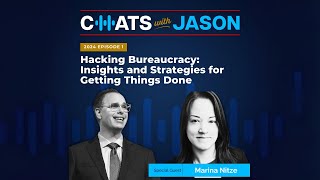
A recorded interview (host Jason S Bradshaw) with Marina Nitzer, co-author of Hack Your Bureaucracy, discussing practical tactics for navigating and improving bureaucratic processes across governments and organizations. Key points: the book compiles 56 tactics; Marina's background includes serving as Chief Technology Officer of the U.S. Department of Veterans Affairs and now working as a "crisis engineer." Core tactics highlighted in this chunk include "look between the silos" (follow end-to-end processes and target handoffs), "be your own customer" (observe real user journeys), "use the bureaucracy against itself" (codify changes into policy/job descriptions/metrics rather than skirting rules), and "don't waste a crisis" (use crises to drive durable change). Example: eliminated a carbon-copy/mailing step and saved 32 days in a foster-parent licensing process. Closing resources: appendix/cheat-sheet of tactics available via the book website.
Questions this video answers
56
Chief Technology Officer of the U.S. Department of Veterans Affairs
Crisis engineer
hackyourbreopcy.com (as spoken in the transcript)
Chapters
Hey everyone, welcome to the show today. And I'm so excited about the topic that we're going to be covering because if you know one thing about me, it's that I absolutely hate bureaucracy. Why did we ever think we needed to create all this red tape to get anything done in the world? Well, today's guest is the co author of a book called Hack your bureaucracy, get things done no matter what your role on any, any team. Now if that hasn't got you ready to dive into this show, nothing will. But it's a wonderful book. It's a best selling book and we're so lucky to have one of the co authors with us today, none other than Marina Nitzer. Marina, welcome to the show.
Thanks so much for having me. Excited to be here.
Now, thank you for writing this book. I think bureaucracy needs to go in the garbage, but we can never get rid of it. And so giving us the tools to, to hack it to be able to get stuff done is remarkable. What led you to write the book?
So I used to work in the federal government here in the United States and as did my co author Nick, who was actually my first boss in the government. And I came into that, which is right, one of the largest, worst bureaucracies in the world, imagining that it was impossible to make change, that everything would take a million years. And I was really surprised to look around and discover that I was wrong. And I was surrounded by people who were making pretty monumental changes at a relatively fast clip. And I wanted to understand more about how that worked. And they were very open about their strategies, but they were very specific tactics that I had not really been familiar with. And so then I tried using them myself when I went on to become the chief technology officer of our Department of Veterans affairs, which is our largest federal agency after the Defense Department. And they kept working. And then I kept learning from other people that were getting stuff done and it kept working. And so Nick and I had a list that we would literally share with our new hires of tactics that could work. And that's what ultimately came to this book. And then in the course of writing the book, we tried it in a variety of additional environments. So it's worked in, you know, the highest echelons of the American government. It's also worked at condo associations, it's also worked at school schools. It's also worked in hospitals and small workplaces. So it's really these tactics, they don't all work all the time, but one of them should work in any given situation.
And that's what I love about the book is that it's practical application in any industry. I too have had a stint in government, and I think the external view is that governments are slow, they're bureaucratic, and change is a word you talk about, not something that you do. But it is absolutely possible as you, as you attest, to make changes at pace within government. You just have to know how to hack the bureaucracy to use your terms. So I'm wondering, what's your favorite bureaucracy hacking tactic?
Yeah, so it was hard to choose because there's 56 in the book. But I would say my favorite, which I continue to use all day, every day in my current life, is looking between the silos. So I think we're all probably familiar with a bureaucracy of any size starts getting siloed teams, siloed decision makers, siloed departments, and those siloed teams. It almost feels like they have sentries posted on the outside that are there to defend against anybody coming in and looking around and trying to make change. And often I've seen people fail pretty explosively because they go right at the heart of the problem, right at the team that's. That's in charge. And again, that team is well defended and they know how to stop your changes. But the handoffs between the teams are where there is often rich opportunity space that is completely undefended and not understood at all. And so what I really encourage is whatever space you're in, commercial, public sector, nonprofit, take a process that you're frustrated with and follow it in incredible detail from start to finish. If it's an application form, if it's a sale, if it's a complaint process. Right. And don't do this abstractly. You want to really follow a real person or claim or an application through. And in the course of doing that, you're going to see the different handoffs between the silos. And that's where you might have a bunch of aha moments. Again, I feel like I do just about every day. And I people consider this to be almost my, like, secret professional weapon in my day now where I'm a crisis engineer. But I'm telling you freely, this is the same thing that I do everywhere, which is follow the process and then look at the handoffs. Because you may find incredible opportunities to make changes or transformations or delete steps or add steps with almost no resistance. And I'll tell one quick story here. So I was helping one of the states in the United States streamline the way they were licensing foster parents and to do this. It took hundreds of days to finish this process. And during those hundreds of days, there were kids, babies that were sleeping on the floor of the office, waiting for their grandparent or their aunt or their uncle to get through this paperwork process. So very, very high stakes. And, you know, people were very reticent to make change because change could mean, you know, safety issues or lawsuits. It's very, very scary. So I followed this, a real application all the way through, start to finish. It went to the mail room, I went to the mailroom, it went to a fax machine. I went to the other side of the fax machine, and at one point it took me to this woman's desk. And her job was to request that grandparents driving record from the state. And she complained about this step to me the whole time. Oh, my God, Marina. This. The driving department. They live in, like the 20th, the 19th century. It's like they have a horse and buggy. They're making me fill out carbon copy forms. Like the paper that you press really hard on and the multiple layers. I have to mail it in the mail. I have to use a stamp like, what is. This is awful. I. I hate this. And I did what that woman was not empowered to do, but which I encourage everybody listening to do, which is I went to the driving records department and I said, show me how you're fulfilling this request. And the woman there was like, oh, no problem. I pull up my electronic system, I click here and here, and I send it back within about an hour. And I was like, well, wait a minute, where does the carbon copy paper fit in? And she was like, oh, my God, were you at child welfare? Those people live in the 19th century. They keep sending me this carbon copy form when they could be emailing it me like the rest of everybody else. So I immediately introduced these two women, and within one hour, we had shaved 32 days off the process of becoming a foster parent because we eliminated this carbon copy step in the mail, et cetera. And you may be shocked to find how many things like that are happening all the time. Because nobody's job is to own the end to end process. Everybody's job is to own the parts inside their silo. So really encourage you to my favorite one all the time. Just because it's such a rich source of change and opportunity is looking between the silos.
It's. It's phenomenal to think that you can shave 32 days off a process simply by walking the steps out and, and asking the obvious question around. Why are you doing what you're doing in the step or where in this. In the example you shared, you know, that frustration where they were both calling each other as if they were from the 1920s, which is hilarious, but really amplifies the power of just taking the time. I think that's the other thing, right. You mentioned not everyone owns the end to end process. In your example, the individual wasn't empowered to go and ask the other side, what are they doing with it? Yet taking that step back and seeing what happens at each step makes makes all the difference. I love that there are so many examples in the book that are along those lines where, especially coming from the customer space, especially be your own customer, how does that help you unlock bureaucracy to get things done, do you think?
Yeah. So trying and being your own customer, or like the show Undercover Boss, where someone is going out and trying to consume your product and consume your service. And obviously depending on your industry, this can be harder or easier. You know, if you're a doctor, you can't really show up in your own emergency room pretending to have appendicitis or something. But there's lots of different ways that you can try. It can really open your eyes to what your customer's experience is in ways that you can improve it. You can reduce time, you can remove friction. And I think a combination of being your own customer and then of talking to your customers. And I am not as much a fan of like super structured focus groups and surveys as I am of simply going out and talking to people and getting their feedback, watching them actually go through a process, fill out a form, complete a sale, you know, submit a comment, whatever they're trying to do and observing, and then finding ways that it may be sped up. And when you combine that with looking between the silos and understanding all the process that goes on later, you may be able to eliminate a bunch of steps entirely or change what they look like and make that customer experience that much better, that much more loyal, that much cheaper. Whatever the incentives are that you have with this understanding that just way too many people don't have it can be free. You can go. You know, when I was chief technology officer of the va, I would literally sit on a bench at hospitals and talk to people. You know, it takes time, of course, but it doesn't require a lot of skills or a lot of planning or a lot of expense to find really a treasure trove of insights.
Well, other than your time, it's potentially free, especially if the customers are at your website. And the skill of a conversation isn't a difficult one. And you can just ask a question and be that curious 2 year old, ask why and then go from there. So I absolutely love that. Now, one of the things that hit me about your book when I first picked it up was when I say picked it up, the digital copy, but was the, I'm going to say the contents. It goes over two or three pages, maybe even on to four pages because you've logically grouped everything and there is just so many different ways to hack the bureaucracy. So I really don't care which industry you're in, I can guarantee that this book can help you. It's a phenomenal work. But I'm just wondering out of all of the, the different ideas that you share, what's the most difficult to implement?
Yeah, so the most difficult one for me and what I've observed in other people is you can't try to make the bureaucracy care. And I see a lot of people fail on this because ultimately bureaucracies are entirely made of humans. But bureaucracies are not human and they can't respond to emotional arguments or pleasure. And by this I really mean, you know, let's say that you're trying to get approval for something for a change or for an order to go through or a budget or whatever it may be. There is a formal process in your bureaucracy and it might be painful and it might be long and it may be nonsensical at times, but there is a process to fill it out. And that process probably does not include emotions or even. And this is sort of a stark way to look at bureaucracy. But it's really been my experience it often doesn't take into account the end impact at all. So, you know, I used to work at our veterans department and then I've done a lot of work in foster care as well. And you see people make a lot of emotional pleas that hey, if I can't get this tool or I can't get this funding, this many children will be homeless, this many veterans will not have access to health care. These are very important critical arguments, but they don't fill out the boxes on the approval form. And so when you are facing something, when you're arguing with it or legal or budget, that you're trying to make your case. I discourage folks from making the emotional, heartfelt kind of high school debate argument as much as ask the questions about what they need to make the approval or the decision. Get the form, get the approval, get the policy language and then spend your energy and your emotions filling that out. Exactly. If you need to answer like ridiculous, truly ridiculous questions about it security. In order to get, you know, a spreadsheet so that a bunch of kids in foster care are not homeless, fill out the spreadsheet with a bunch of questions like don't try to talk your way past it or around it because there is no way through a bureaucracy with emotional arguments. The way through the bureaucracy is the bureaucracy.
Yeah. And I think in the moment it's easy for us to get caught up with the emotional side of things, especially when you're working in high stake environments where individuals lives are being impacted. But if we can go a bit further, what I'm hearing is do the bureaucracy, work the bureaucracy and then after you've got whatever it might be, the system, the approval for whatever, then look at how you can have conversations to improve the efficiency of the bureaucracy as opposed to trying to make it care.
Yeah, absolutely that. And that's where the talking to users, trying to be your own customer that might unveil the tools or the policy changes that you need to solve the problem. But then again the emotional, the way to get the approval is the approval form. And we call this tactic, it's sort of a meta tactic in the book which is using the bureaucracy against itself. Bureaucracies are fundamentally made up of policies and rules and procedures and guides. And way too often we see people with the best of intentions trying to skirt all of it. I'm going to go around it, I'm going to go under it, I'm going to, you know, ignore this rule this one time that works sometimes, exactly once. And then the bureaucracy will spring up 10 new rules and forms and guidelines to keep it from ever happening again. And so what really works better is write a new policy that codifies what you want to do. Update people's job descriptions so that their job is to do the thing that you want them to do. Change the metrics for promotion, bonus and like, and bonuses and step upgrades so that the people are literally incentivized to do the new behavior that you want them to do. And when you do that, it feels slower. It can be frustrating, but then it takes the next person, you know, 30 years and 10 times as much work to undo your change. Whereas if you just go around the bureaucracy and you try to use some duct tape spaghetti again, it might work once, but nobody will be able to follow in your path.
If you can't beat them, join them. In other words, improve the bureaucracy for your outcome. So one thing that I didn't mention at the top of the show was, shall we say, your day job. And you mentioned it very briefly earlier in the episode, but today you're a crisis engineer. Now, what is a crisis engineer?
Yeah, so crisis engineering is when we come into an organization that is experiencing a crisis. It could be all the computer systems are down. It could be your chief financial officer just quit and took all the passwords with them. It could be you're on the front page of the newspaper for a new crisis. We want to get you out of the crisis and get you stronger emerging from it. So whatever the cause was, like, let's fix the problem, but let's not band aid it or duct tape it. Let's create some use. One of the tactics in the book is don't waste a crisis. And this was really just kind of perma. Crisis engineering is, aha. There's a crisis, there is a moment, there's a window where we will have access to funds or resources or changing a policy in a way that we will not, and potentially even as soon as tomorrow. How do we maximize that window so that we make changes that will prevent the next crisis from ever happening?
I love that. Use the crisis to drive a wedge in that bureaucracy, to change the bureaucracy so that hopefully you avoid the crisis ever happening again, but also that you build back a better, stronger organization and that the crisis isn't wasted. I love that. I've done a lot of. I've had the privilege of working a lot of companies during crisis, which sounds counterintuitive, but you definitely learn a lot about a whole pile of things, including yourself, during a crisis. I think that would be such an interesting role that you have as a crisis engineer, working with companies that perhaps some of their most difficult times and makes perfect sense that you tie that back into the bureaucracy and how the bureaucracy led to the crisis happening and how it can help the company change the bureaucracy. So I'm wondering whether, in your experience, though, bureaucracy is limited to big business and large government organizations, or does bureaucracy creep into some of the. Some of the smaller businesses out there as well?
Yeah, we've actually gotten this question a lot as we've done book tour. And in the course of writing the book, Nick and I tried to find organizations that were not bureaucracies. And this even led us to interviewing like a grocery store and a pizza parlor in different places, and we couldn't find anything that wasn't a bureaucracy. And actually right now, with my godson and reading a series of dragon young adult fiction called Wings of Fire and the Dragons in young adult fiction have bureaucracy too. So I've been sending screenshots of how their, their paperwork process is in this dragon dragon land. And so but you can be a well functioning bureaucracy and that's really our perspective. Bureaucracy is kind of like oxygen and gravity. It's there and you can dislike oxygen all you want, but we still need it to breathe. But you can be a really well functioning bureaucracy if you recognize that you are a bureaucracy bureaucracy. So you have to recognize that you have decision making processes, that people have risk and incentive frameworks and that fundamentally your organization is incentivizing certain behaviors and disincentivizing others. And if you have for example, looking between the silos at a well functioning bureaucracy is something that happens all the time and it shouldn't surface enormous treasure chests of insights because they're doing it so often that what it would rather be finding are like small minor things that you can catch and tweak up front. A well functioning bureaucracy has people that own end to end processes and understand them and even measure them. And it's one that's very self aware about how it makes decisions. Even you know, very small firms, startups with two or three people, you have bureaucracies, you have decision making processes. They just might be the three of us get together over a beer on Friday and talk it out. That's a process and there is nothing necessarily wrong with that process. But that can't be the process when you're 20 or 25 people because it won't scale. And so kind of just assuming things will work themselves out, which I see a lot of people do as they grow their companies, I think does not work nearly as much as kind of acknowledging the elephant in the room and then designing the bureaucracy that you want for your company and your culture.
So if you're designing a bureaucracy, and I doubt most of us think of that term when we're designing at our processes and systems and scaling our business. But one of the, one of the hints that you gave us just a moment ago was have people own the process end to end, measure the process for its effectiveness and hold them accountable to that effectiveness. Which I guess in one way means that at least you're not going to have the situation where someone's filling out a form in triplicate and sending it via the post. Although the mail service would love the business. What's something else that I can do though? I'm scaling my business, I'm scaling my team, I'm setting up a new team with inside an Organization. I've got this opportunity to do things differently. I acknowledge that there's got to be a way of working a bureaucracy, if you will. I can have people accountable and own processes end to end. But what's a couple of other things that I should be on the lookout when I'm building this fresh new entity or scaling it?
Yep. I think you need to make sure that there are real avenues to receive feedback and that people see feedback being received and acknowledged. If not, you can't always act on it. Right. But I'm not talking about a suggestion box or an online form where people submit things and they kind of go to die. And I'm not. Some companies too, they have like an innovation box where you said, you know, sign up for a prize and you try to add an efficiency. I think that that makes it seem tertiary as opposed to a core part of your business that you are, you want to be a well functioning organization. Another this may seem slightly counterintuitive, but I think you need to actively model being a safe place to fail. One of the taxes we talk about is defining your success metrics up front. So something that I see happen constantly in ineffective bureaucracies is somebody has a pilot, they have an idea for something that they want to do to make a change. They believe fervently in this change, it will make things better. They do the pilot and then the naysayers hung out in the shadows and they come out after the pilot and they say, oh, your pilot actually failed because it didn't take into account this, this thing. Or like you only had 10,000, an N of 10,000. And really to be statistically significant, you need an N of 100,000. And so we suggest defining success metrics up front, which is to say I'm going to do a pilot and if I get 10,000 people to recommend this service at the end of the pilot, it's going to move forward. And that. So everybody gets a chance to weigh in on that upfront. And also here, here's our baseline metrics. If we don't even get 100 users, we're going to close up shop in November. And seeing people model that with behavior and then act on it means that you can create a culture where people try changes, they measure them and then they don't live forever, which is not something that you necessarily want to every pilot to do.
Yeah, that makes, that makes so much sense. And looking at it through this lens makes it so much easier. I think that's the other challenge that people could fall into is they build something and then they try to reverse engineer to achieve a functioning organization as opposed to coming from it from the beginning. Marina, it's been absolutely excellent chatting to you today and getting to understand this Hacking the Bureaucracy, the fantastic book. Now in the show notes we're going to leave details on how people can follow your work and of course get a copy of the book. But I think also on your website you have a free resource for our listeners.
Yeah, there's a. If you go to hackyourbreopcy.com we have a bunch of extra strategies and tactics from the book, including a download of the appendix, which is the list of all the tactics if you need kind of a cheat sheet for hacking your next bureaucratic challenge.
Fantastic. Well, of course we'll make sure that we link to that in the show notes as well. But before I let you go today, what's one piece of advice, the one thing our audience members can do as soon as they finish watching or listening today to really help them navigate their bureaucracy more effectively and to get things done faster?
Yeah, this was actually advice I was given early on when I joined the government and I didn't take and I should have, which is you've got to go and have lunch or coffee or some other sort of social engagement with a bunch of people in your organization that have nothing to do with your current team or department or mission. We call this cultivating the carass in the book because if you've read Cat's Cradle by Kurt Vonnegut, he coined the term caress, which is to mean people hidden around the planet who are designed to accomplish a goal together. And so we love to think about like in your organization rather than thinking that there are people hidden around to slow roll you, to block you from getting resources to tattle on you. What if there are people hidden around to help you that you just don't realize? And in my case, some of the most valuable crass members I've ever had are in extremely unexpected places. Like the security guards at VA are how I ultimately got multimillions of dollars of IT budget or getting help from the executive secretary pool who you may not realize often are the people that have the most power in any organization. And we just, you know, it could be people in legal, in compliance, in engineering, whatever, something that's that's well or outside your comfort zone and that can just help you understand more about other areas of your organization, help you think about problems that you're having in different ways and then they might be able to help you troubleshoot. They may have resources or tools or experience that apply in ways you may not realize. And so going out grabbing a cup of coffee with a few colleagues that you don't know that are well outside your kind of zone is the great way to start hacking your bureaucracy.
Fantastic way to end the show and a great reminder to create connection with people just outside of your immediate sphere of of influence and day to day work. Marina, it's been absolute pleasure to have you on the show. Thanks so much for giving up your time and sharing your thoughts with us today.
Thanks so much for having me.
And to you, the audience, thank you so much. If you've enjoyed this show, please give us five stars. Importantly, share it with a colleague or a friend. And most importantly, do one thing from today's episode to help you get things done faster and beat bureaucracy.
More from Jason

Bringing Wonder Back to Work | Leadership, Culture & Service with Peter Merritt







How to Lead With Empathy: Claude Silver on Emotional Bravery & People-First Culture


Inside Harley’s Cult-Like Loyalty | Ken Schmidt on Turning Customers Into Believers
